
Market Overview
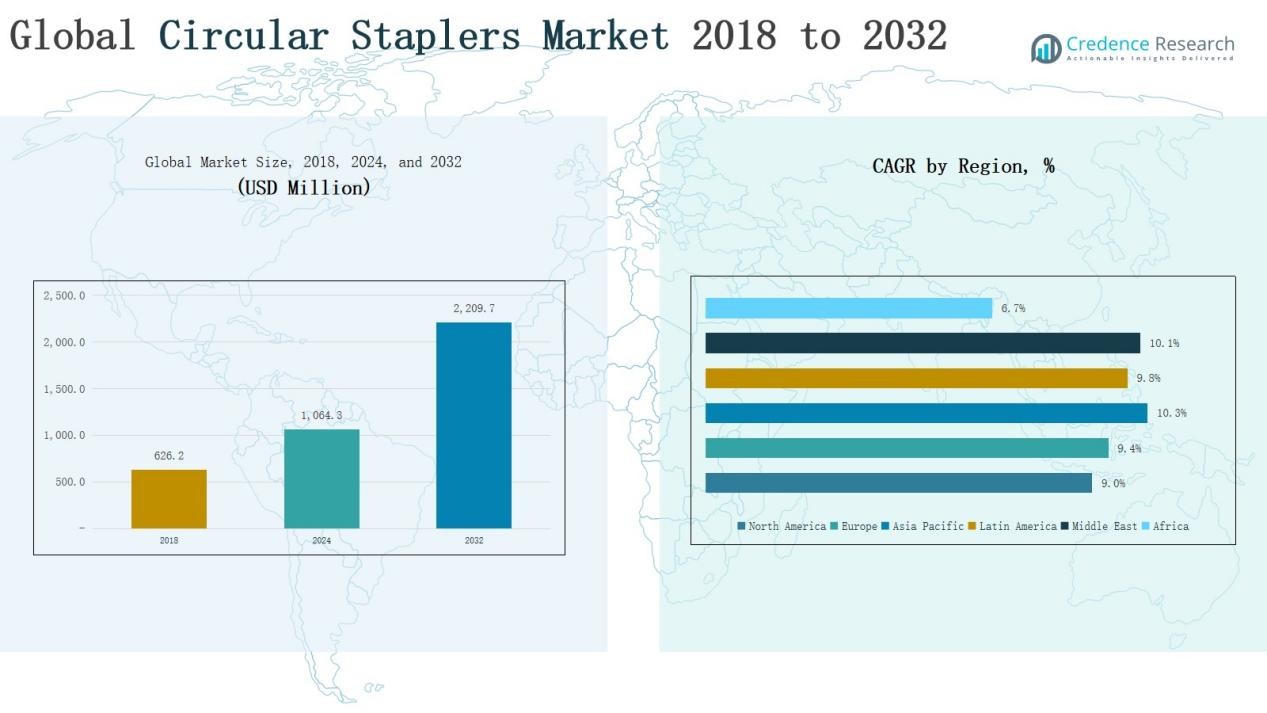
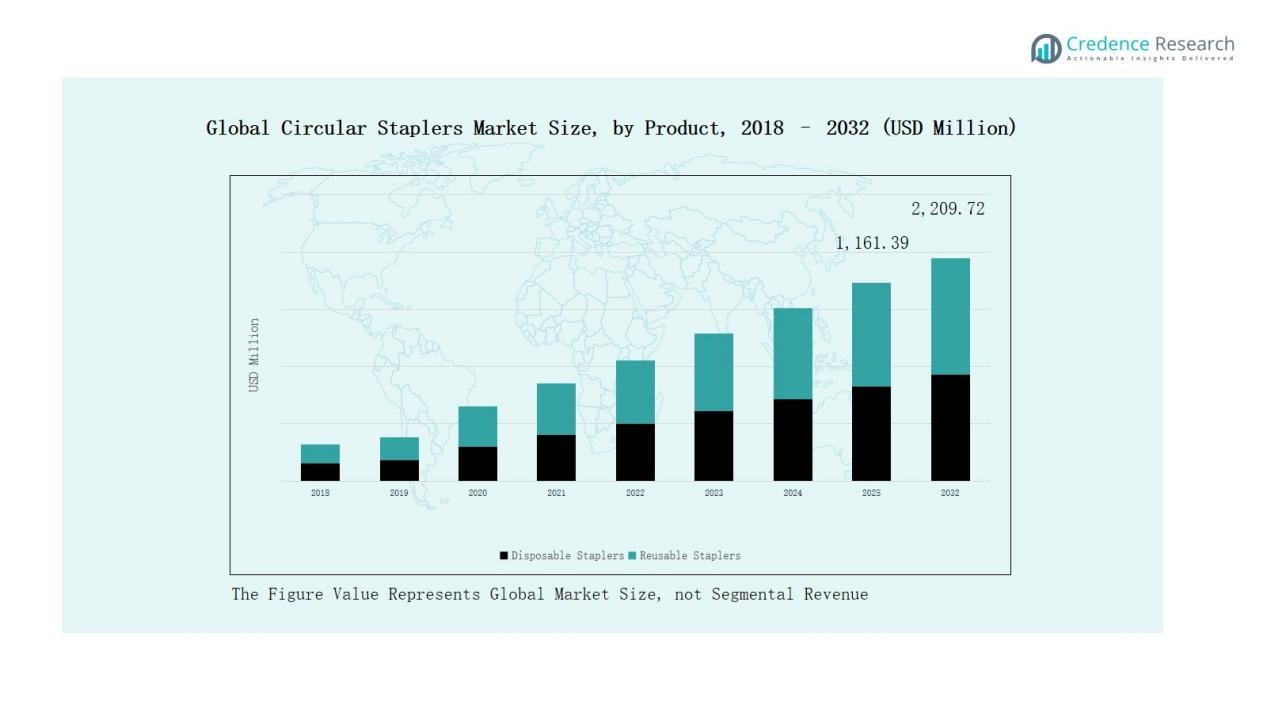
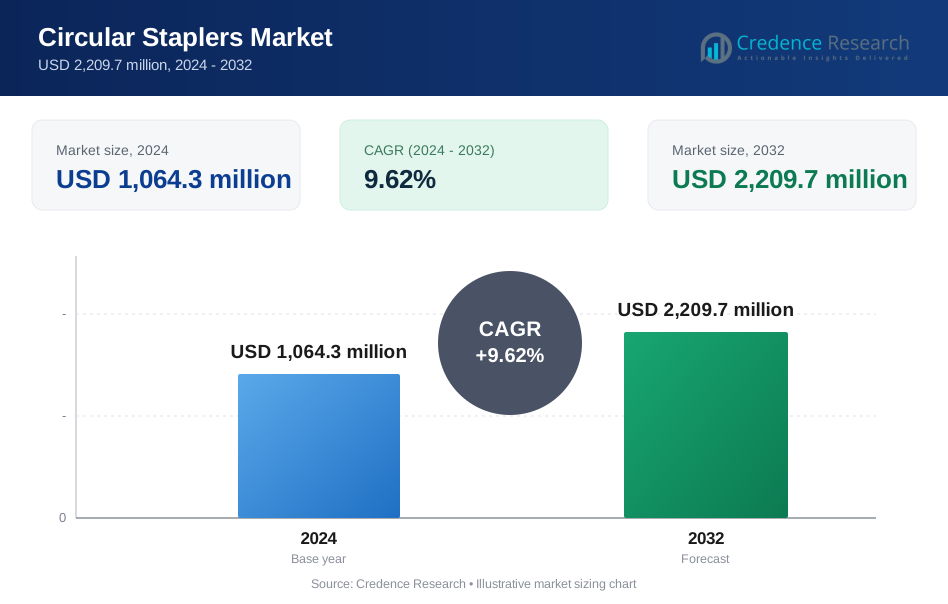
Global Circular Staplers Market size was valued at USD 626.2 million in 2018 to USD 1,064.3 million in 2024 and is anticipated to reach USD 2,209.7million by 2032, at a CAGR of 9.62% during the forecast period.
| REPORT ATTRIBUTE | DETAILS |
|---|---|
| Historical Period | 2020-2023 |
| Base Year | 2024 |
| Forecast Period | 2025-2032 |
| Circular Staplers Market Size 2024 | USD 1,064.3 Million |
| Circular Staplers Market, CAGR | 9.62% |
| Circular Staplers Market Size 2032 | USD 2,209.7 Million |
The Global Circular Staplers Market is shaped by the presence of leading companies such as Medtronic Inc., Meril Life Sciences, Frankenman International, Purple Surgical, Changzhou Ankang Medical Instruments, Reach Surgical, Vector Medical Instruments, Narang Medical Instruments, and Surkon Medical. These players maintain strong positions through extensive product portfolios, technological advancements, and robust distribution networks, focusing on reusable and precision-enhanced staplers to meet rising surgical demands. Regionally, Asia Pacific emerged as the largest market in 2024 with a 38.9% share, driven by rapid healthcare infrastructure development, increasing surgical volumes, and strong adoption of advanced stapling technologies across China, Japan, and India.
Market Insights
- The Global Circular Staplers Market grew from USD 626.2 million in 2018 to USD 1,064.3 million in 2024 and is projected to reach USD 2,209.7 million by 2032.
- Reusable staplers dominated with a 58% share in 2024, while metal staplers led materials with 65%, reflecting demand for cost efficiency, durability, and precision.
- Hospitals remained the leading end user with 71% share in 2024, supported by high surgical volumes, advanced infrastructure, and strong purchasing power compared to other healthcare providers.
- Asia Pacific led the market with 38.9% share in 2024, driven by expanding healthcare networks, rising colorectal surgeries, and strong adoption in China, Japan, and India.
- Key players such as Medtronic Inc., Meril Life Sciences, Frankenman International, Purple Surgical, Changzhou Ankang Medical Instruments, Reach Surgical, and Surkon Medical shape competition with innovation and distribution strength.
Market Segment Insights
By Product
Reusable staplers dominate the Global Circular Staplers Market with a revenue share of 58% in 2024. Their leadership stems from cost efficiency in repeated use, rising adoption in high-volume surgical procedures, and growing preference in developed healthcare systems for sustainable solutions. Disposable staplers, holding the remaining share, gain traction in infection control-sensitive environments but lag due to higher per-procedure costs.
- For instance, Ethicon's ECHELON Circular Powered Stapler showed a 74% reduction in anastomotic leak rates compared to manual staplers, demonstrating its clinical safety and efficacy while being single-use.
By Material
Metal circular staplers lead the market with a 65% revenue share in 2024, supported by durability, precision, and reliability during complex surgeries. Their robust structure reduces mechanical failures and enhances patient outcomes, driving demand across hospitals globally. Plastic staplers account for the rest, with rising use in cost-sensitive markets where affordability and lightweight designs are prioritized.
- For instance, EziSurg Medical disclosed ongoing R&D developments on ultrasonic surgical staplers, aiming to improve surgical outcomes by combining stapling with ultrasonic tissue sealing technology, targeting reductions in operative time and complications.
By End User
Hospitals represent the largest end-user segment, contributing 71% of the market share in 2024. Their dominance is driven by the high volume of surgical procedures, strong purchasing power, and advanced infrastructure enabling wide adoption of both reusable and metal-based staplers. Ambulatory surgical centers hold a smaller but growing share, driven by the trend toward minimally invasive procedures and outpatient care. The “Others” category, including specialty clinics, accounts for a limited portion with niche applications.
Key Growth Drivers
Rising Surgical Volumes and Prevalence of Chronic Diseases
The increasing incidence of colorectal cancer, obesity, and gastrointestinal disorders is driving surgical demand worldwide. Circular staplers are extensively used in procedures such as colorectal resections, gastric bypass, and esophageal surgeries. Hospitals and surgical centers prefer staplers for their efficiency in reducing procedure time and enhancing precision. With an aging global population and rising lifestyle-related conditions, the demand for minimally invasive and advanced surgical instruments is set to expand, making circular staplers a critical tool in modern surgical care.
- For instance, Johnson & Johnson MedTech (Ethicon) launched a circular stapler tailored for variable tissue thickness, expanding its advanced-energy portfolio and improving outcomes in gastrointestinal surgeries.
Shift Toward Minimally Invasive Procedures
Global healthcare systems are increasingly prioritizing minimally invasive surgical approaches due to faster recovery, reduced hospital stays, and lower overall costs. Circular staplers play a crucial role in enabling such procedures, particularly in laparoscopic and robotic-assisted surgeries. Their precision in creating secure anastomoses enhances patient safety and clinical outcomes. Growing patient preference for minimally invasive options, combined with rising adoption of advanced surgical technologies, is fueling consistent demand for circular staplers across hospitals and ambulatory surgical centers.
Technological Advancements in Stapling Devices
Continuous innovation in stapler design and functionality is driving market growth. Manufacturers are introducing staplers with enhanced ergonomics, better staple line security, and reduced risk of leakage. The integration of lightweight materials and single-use innovations also expands adoption in infection-sensitive environments. Furthermore, advancements in powered stapling devices support efficiency and ease of use during complex surgeries. These improvements not only enhance surgeon confidence but also ensure greater patient safety, reinforcing the preference for modern circular staplers in operating rooms globally.
- For instance, Ethicon (Johnson & Johnson MedTech) introduced the ECH60L+ Powered Circular Stapler, designed with 3D staple technology to minimize leaks and ensure uniform compression during colorectal surgeries.
Key Trends & Opportunities
Growing Adoption in Emerging Markets
Emerging economies in Asia-Pacific, Latin America, and Africa present significant growth opportunities. Rapid improvements in healthcare infrastructure, rising disposable incomes, and increasing awareness of advanced surgical techniques are boosting demand for circular staplers. Governments in these regions are also investing in expanding hospital networks and adopting cost-effective surgical devices. With multinational companies expanding distribution networks and local manufacturers entering the market, emerging regions are expected to register faster adoption rates, creating long-term opportunities for circular stapler suppliers.
- For instance, India’s Apollo Hospitals Group partnered with Intuitive and global device makers to scale robotic and stapler-assisted surgeries, highlighting rising institutional adoption across emerging markets.
Sustainability and Reusable Device Preference
Sustainability is becoming a central trend across the surgical device industry. Healthcare providers in developed markets are increasingly shifting toward reusable staplers to reduce medical waste and overall costs. Hospitals recognize the environmental benefits of minimizing disposable instruments while maintaining efficiency in high-volume surgeries. This trend also aligns with global regulatory push for greener practices in healthcare. Manufacturers offering durable, sterilizable, and cost-effective reusable staplers are positioned to gain competitive advantage in this evolving market landscape.
- For instance, Covidien introduced the fully powered, reusable, battery-operated endoscopic surgical iDrive Ultra stapling system, which was compatible with their market-leading portfolio of disposable stapling reloads.
Key Challenges
High Cost of Advanced Surgical Staplers
Circular staplers, particularly powered and technologically advanced variants, involve significant upfront costs. Many healthcare systems in low- and middle-income countries struggle with affordability, limiting access. Even in developed markets, budget constraints in smaller hospitals and surgical centers can slow adoption. The high per-unit price and additional costs for accessories and maintenance create a financial barrier for widespread penetration, particularly when alternatives such as sutures are more cost-effective. This continues to challenge manufacturers in expanding market reach globally.
Risk of Post-Surgical Complications
Despite technological progress, circular staplers remain associated with risks such as anastomotic leakage, bleeding, and stricture formation. These complications can result in extended hospital stays, additional surgeries, and increased healthcare costs, creating concerns among surgeons and patients. Negative outcomes undermine surgeon confidence and may lead to cautious adoption, particularly in sensitive procedures like colorectal surgeries. Addressing these risks through improved design, safety features, and clinical training remains a critical challenge for manufacturers competing in this market.
Regulatory and Compliance Barriers
The medical device industry faces stringent regulatory approvals, clinical testing requirements, and compliance standards. Circular staplers must adhere to rigorous safety, efficacy, and sterilization protocols before entering markets. Delays in approvals, coupled with varying regional regulatory frameworks, create hurdles for product launches and global distribution. Manufacturers also face challenges in meeting evolving compliance demands related to patient safety and sustainable manufacturing. Navigating this complex regulatory environment requires high investment and slows time-to-market, limiting competitive flexibility.
Regional Analysis
North America
North America held a 26.2% share of the Global Circular Staplers Market in 2024, generating USD 244.97 million. The region is projected to reach USD 486.14 million by 2032 at a CAGR of 9.0%. Growth is fueled by advanced healthcare infrastructure, high surgical procedure volumes, and early adoption of technologically advanced staplers. Strong presence of leading medical device companies and rising demand for minimally invasive surgeries further strengthen the market. U.S. accounts for the largest share, supported by robust reimbursement policies and increasing prevalence of gastrointestinal disorders requiring surgical intervention.
Europe
Europe accounted for 32.4% of the global market in 2024, with revenue of USD 302.28 million, expected to rise to USD 616.51 million by 2032, growing at a CAGR of 9.4%. The region’s dominance is supported by established surgical practices, favorable government healthcare spending, and widespread adoption of reusable staplers. Countries such as Germany, France, and the UK lead in procedure volumes, particularly in colorectal and bariatric surgeries. Strong clinical focus on patient safety and the presence of key European manufacturers also reinforce the region’s competitive strength in circular staplers adoption.
Asia Pacific
Asia Pacific held the largest share at 38.9% in 2024, valued at USD 363.77 million, and is projected to reach USD 793.29 million by 2032, recording the fastest CAGR of 10.3%. Rapid healthcare infrastructure development, expanding hospital networks, and rising patient awareness drive growth. High prevalence of colorectal cancer and obesity-related surgeries in China, Japan, and India boosts adoption of staplers. Additionally, growing investments from multinational players and increasing demand for minimally invasive surgeries in emerging economies position Asia Pacific as the key growth engine for the circular staplers market globally.
Latin America
Latin America represented 7.9% of the global market in 2024, generating USD 74.26 million, and is forecasted to reach USD 156.45 million by 2032, advancing at a CAGR of 9.8%. Growth is supported by increasing healthcare expenditure, rising number of specialty hospitals, and gradual adoption of minimally invasive techniques in Brazil and Argentina. Market expansion is further encouraged by government initiatives to modernize surgical facilities and improve patient outcomes. However, limited affordability and uneven access to advanced surgical devices across the region present constraints to wider circular staplers adoption.
Middle East
The Middle East accounted for 5.6% of the global market in 2024, with revenue of USD 52.33 million, projected to reach USD 112.70 million by 2032 at a CAGR of 10.1%. Demand is driven by rapid improvements in healthcare infrastructure, growing prevalence of lifestyle-related disorders, and increasing adoption of advanced surgical technologies. GCC countries dominate due to higher investments in healthcare modernization, while Turkey and Israel contribute significantly with rising procedural volumes. Expanding partnerships with global medical device manufacturers further boost accessibility to circular staplers in the region.
Africa
Africa held the smallest share at 2.8% in 2024, with revenue of USD 26.67 million, expected to grow to USD 44.64 million by 2032 at a CAGR of 6.7%. Growth is mainly driven by gradual improvements in healthcare facilities, rising government investment, and expanding private healthcare networks. South Africa and Egypt lead the market, supported by higher surgical procedure volumes compared to the rest of the region. However, limited awareness, affordability issues, and lower access to advanced surgical devices continue to restrict large-scale adoption of circular staplers across most African countries.
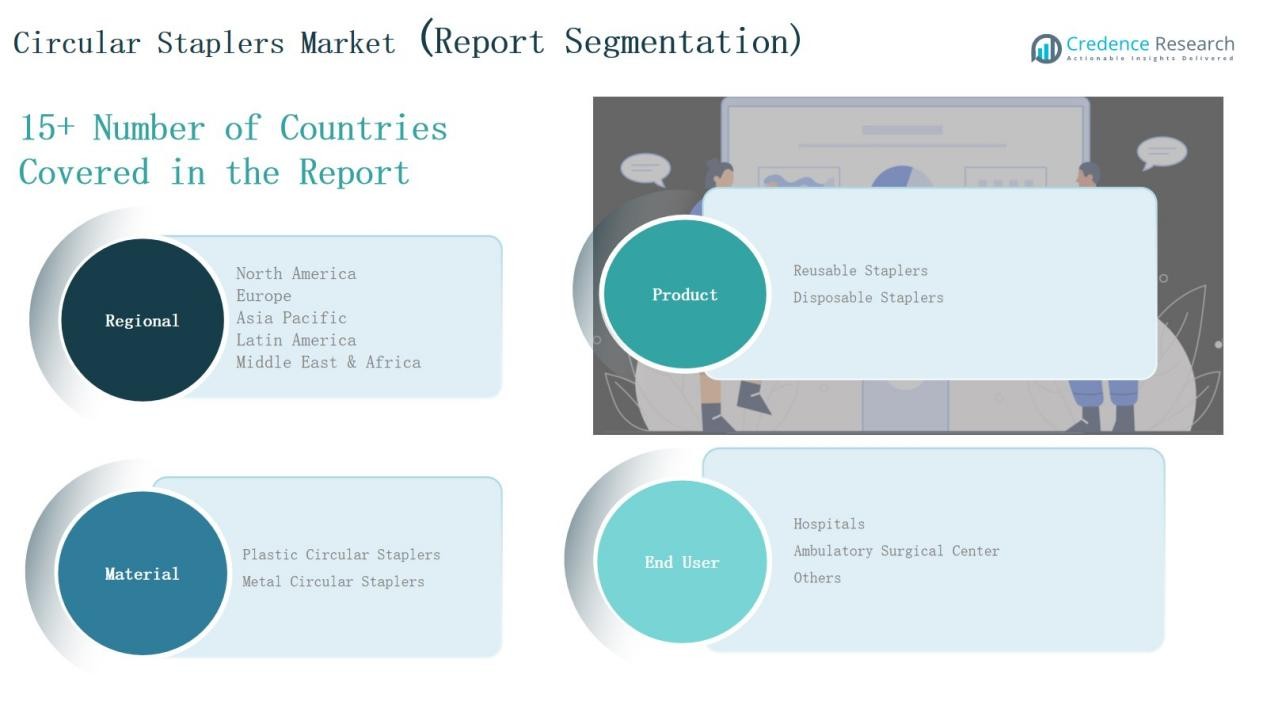
Market Segmentations:
By Product
- Reusable Staplers
- Disposable Staplers
By Material
- Plastic Circular Staplers
- Metal Circular Staplers
By End User
- Hospitals
- Ambulatory Surgical Centers
- Others
By Region
North America
- U.S.
- Canada
- Mexico
Europe
- UK
- France
- Germany
- Italy
- Spain
- Russia
- Rest of Europe
Asia Pacific
- China
- Japan
- South Korea
- India
- Australia
- Southeast Asia
- Rest of Asia Pacific
Latin America
- Brazil
- Argentina
- Rest of Latin America
Middle East
- GCC Countries
- Israel
- Turkey
- Rest of Middle East
Africa
- South Africa
- Egypt
- Rest of Africa
Competitive Landscape
The Global Circular Staplers Market is moderately consolidated, with a mix of multinational corporations and regional manufacturers competing for share. Leading players such as Medtronic Inc., Meril Life Sciences, Frankenman International, Purple Surgical, and Changzhou Ankang Medical Instruments dominate through extensive product portfolios, strong distribution networks, and continuous investments in innovation. These companies focus on developing staplers with enhanced ergonomics, improved staple-line security, and reusable designs to meet hospital demands for cost efficiency and sustainability. Regional manufacturers, including Surkon Medical, Reach Surgical, and Narang Medical Instruments, strengthen competition by offering cost-effective alternatives and expanding presence in emerging markets. Strategic initiatives such as partnerships with healthcare providers, mergers, acquisitions, and geographic expansion remain central to competitive positioning. Rising demand for reusable devices and minimally invasive procedures is pushing companies to differentiate through advanced technology and tailored offerings, intensifying competition across both developed and emerging economies.
Key Players
- Changzhou Ankang Medical Instruments
- Medtronic Inc.
- Meril Life Sciences
- Frankenman International
- Purple Surgical
- Reach Surgical
- Vector Medical Instruments
- Narang Medical Instruments
- Surkon Medical
- Other Key Players
Recent Developments
l In June 2025, Johnson & Johnson launched the Ethicon 4000 Stapler featuring advanced stapling technology designed for the OTTAVA Robotic Surgical System.
l In May 2024, Lexington Medical launched the AEON-Powered Stapling System, a linear surgical stapler, marking a significant product introduction in surgical staplers.
l In 2024, Medtronic rolled out a new disposable circular stapler equipped with advanced safety features, aimed at supporting rising surgical procedure volumes worldwide.
l In May 2024, Johnson & Johnson MedTech introduced the ECHELON LINEAR™ Cutter, the first surgical stapler with combined 3D-Stapling and Gripping Surface Technology, reducing staple-line leaks by 47%.
Report Coverage
The research report offers an in-depth analysis based on Product, Material, End User and Region. It details leading market players, providing an overview of their business, product offerings, investments, revenue streams, and key applications. Additionally, the report includes insights into the competitive environment, SWOT analysis, current market trends, as well as the primary drivers and constraints. Furthermore, it discusses various factors that have driven market expansion in recent years. The report also explores market dynamics, regulatory scenarios, and technological advancements that are shaping the industry. It assesses the impact of external factors and global economic changes on market growth. Lastly, it provides strategic recommendations for new entrants and established companies to navigate the complexities of the market.
Future Outlook
- Hospitals will continue to drive the majority of demand due to high surgical volumes.
- Adoption of reusable staplers will increase as healthcare systems prioritize cost efficiency.
- Technological advancements will enhance precision, safety, and ease of use in surgeries.
- Asia Pacific will emerge as the fastest-growing region with expanding healthcare infrastructure.
- Rising prevalence of gastrointestinal and obesity-related conditions will boost procedure volumes.
- Ambulatory surgical centers will gain market share as outpatient procedures expand.
- Regulatory focus on patient safety will push manufacturers to innovate safer devices.
- Sustainability initiatives will accelerate the shift toward environmentally friendly reusable staplers.
- Local manufacturers in emerging markets will strengthen competition with affordable solutions.
- Strategic collaborations and product launches will shape competitive differentiation globally.
Request a Free Sample
Fill in your details and we'll send you a free sample report.
- Sample data tables & charts
- Research methodology
Need a Custom Version of This Report?
Tailor the scope, geography, or segments to your exact requirements.
- Custom geography or segment scope
- Direct access to our analyst team
Frequently Asked Questions
What is the current market size for Global Circular Staplers Market, and what is its projected size in 2032?
At what Compound Annual Growth Rate is the Global Circular Staplers Market projected to grow between 2025 and 2032?
Which Global Circular Staplers Market segment held the largest share in 2024?
What are the primary factors fueling the growth of the Global Circular Staplers Market?
Who are the leading companies in the Global Circular Staplers Market?
Which region commanded the largest share of the Global Circular Staplers Market in 2024?
Table of Content
Chapter 1. Report Introduction
- 1.1 Report Description & Purpose
- 1.1.1 Report Title & Market Definition
- 1.1.2 Unique Selling Propositions (USP) & Key Differentiators
- 1.1.3 Value Proposition for Stakeholders
- 1.2 Research Objectives
- 1.2.1 Market Sizing Objectives (Volume & Revenue)
- 1.2.2 Segmentation Objectives
- 1.2.3 Competitive Intelligence Objectives
- 1.2.4 Forecast & Scenario Objectives
- 1.3 Report Scope
- 1.3.1 Circular Staplers Scope – Types & Subtypes Covered
- 1.3.2 Geographic Scope – Regions & Countries Covered
- 1.3.3 Historical Period, Base Year & Forecast Period (2024; forecast to 2032)
- 1.3.4 Inclusions & Exclusions
- 1.4 HS Code & Classification Framework
- 1.5 Currency, Units & Pricing Basis
- 1.6 Target Stakeholders
- 1.7 Limitations & Assumptions
Chapter 2. Executive Summary
- 2.1 Global Circular Staplers Market Snapshot
- 2.1.1 Market Size – Historical (2024) & Forecast (2024-2032) (2024: USD 1,064.3 million → 2032: USD 2,209.7 million)
- 2.1.2 Volume & Revenue – Global Totals
- 2.1.3 Key Market Highlights – Top Five Facts
- 2.2 Circular Staplers Market Segmentation Snapshot
- 2.2.1 Market Split by Region – 2024 vs. 2032
- 2.3 Competitive Snapshot
- 2.3.1 Top 10 Players by Revenue Share – 2024
- 2.3.2 Top 10 Players by Volume Share – 2024
- 2.3.3 Recent Strategic Developments (18-Month Summary)
- 2.4 Key Investment Highlights & Strategic Conclusions
Chapter 3. Circular Staplers Market Dynamics & Industry Analysis
- 3.1 Market Overview & Context
- 3.1.1 Circular Staplers Market Position in the Broader Automotive Value Chain
- 3.1.2 OEM vs. Replacement Market Dynamics
- 3.1.3 Market Maturity & Development Stage by Region
- 3.2 Circular Staplers Market Drivers
- 3.3 Circular Staplers Market Restraints & Challenges
- 3.4 Circular Staplers Market Opportunities
- 3.5 Porter's Five Forces Analysis
- 3.5.1 Threat of New Entrants
- 3.5.2 Bargaining Power of Suppliers
- 3.5.3 Bargaining Power of Buyers
- 3.5.4 Threat of Substitutes
- 3.5.5 Competitive Rivalry – Intensity Assessment
- 3.6 Circular Staplers Value Chain Analysis
- 3.6.1 Upstream – Raw Material/Input Suppliers
- 3.6.1.1 Raw Material/Input 1
- 3.6.1.2 Raw Material/Input 2
- 3.6.1.3 Raw Material/Input 3
- 3.6.2 Midstream – Production/Manufacturing/Service Delivery
- 3.6.2.1 Production/Process Overview
- 3.6.2.2 Key Facility Locations & Capacity by Manufacturer
- 3.6.3 Downstream – Distribution & End Consumer
- 3.6.3.1 Primary Channel – B2B/OEM
- 3.6.3.2 Secondary Channels – Dealer, Retail, Online, Direct
- 3.6.4 Value Chain Profitability Analysis
- 3.6.1 Upstream – Raw Material/Input Suppliers
- 3.7 PESTEL Analysis
- 3.7.1 Political Factors
- 3.7.2 Economic Factors
- 3.7.3 Social Factors
- 3.7.4 Technological Factors
- 3.7.5 Environmental Factors
- 3.7.6 Legal Factors
- 3.8 Circular Staplers Supply Chain Analysis
- 3.8.1 Raw Material/Input Supply Risk Assessment
- 3.8.2 Manufacturing Concentration Risk (Geographic Exposure)
- 3.8.3 Trade Disruption Impact Analysis
- 3.9 Regulatory & Policy Landscape
Note: The regulatory and policy landscape section covers regulations based on their applicability to the market, Circular Staplers category, geography, and scope of the study. Only regulatory frameworks with a material impact on operations, compliance, trade, sustainability, or market access are analyzed in detail.
Chapter 4. Key Investment Pockets & Opportunity Analysis
- 4.1 Circular Staplers Market Attractiveness Analysis
- 4.1.1 By Region – Investment Attractiveness Matrix (Volume × CAGR)
- 4.2 Absolute Revenue Growth Opportunity
- 4.2.1 By Region – Absolute USD Growth Through 2032
- 4.3 Incremental Volume Opportunity
- 4.3.1 By Region – Incremental Volume Through 2032
- 4.3.2 Segment – Incremental Volume
- 4.4 Emerging Submarket Opportunity Deep Dive (Subject to Applicability)
- 4.5 Emerging Market Opportunity Scorecards
- 4.5.1 United States
- 4.5.2 Europe
- 4.5.3 Asia
- 4.5.4 Middle East & Africa
Note: Emerging Market Opportunity Scorecards will be included based on relevance and strategic importance. Regions listed are indicative and may vary depending on data availability and market dynamics.
Chapter 5. Circular Staplers Import-Export Analysis & Trade Flows
- 5.1 Global Trade Overview
- 5.1.1 Global Export Value by Country (2024)
- 5.1.2 Global Export Volume by Country (2024)
- 5.1.3 Global Import Value by Country (2024)
- 5.1.4 Global Import Volume by Country (2024)
- 5.1.5 Net Trade Balance by Country (2024)
- 5.2 Export Analysis – Segment
- 5.2.1 Type 1 (HS Code)
- 5.2.2 Type 2 (HS Code)
- 5.2.3 Type 3 (HS Code)
- 5.2.4 Type 4 (HS Code)
- 5.2.5 Type 5 (HS Code)
- 5.3 Import Analysis – Segment
- 5.3.1 Type 1 (HS Code)
- 5.3.2 Type 2 (HS Code)
- 5.3.3 Type 3 (HS Code)
- 5.3.4 Type 4 (HS Code)
- 5.3.5 Type 5 (HS Code)
- 5.4 Average Unit Trade Prices
- 5.4.1 Average Export Price – Segment & Country
- 5.4.2 Average Import Price – Segment & Source Country
- 5.4.3 Price Trends (2024)
- 5.5 Key Trade Route Analysis
- 5.5.1 Trade Route 1
- 5.5.2 Trade Route 2
- 5.5.3 Trade Route 3
- 5.5.4 Trade Route 4
- 5.5.5 Trade Route 5
- 5.6 Trade Policy Impact Assessment
- 5.6.1 US Anti-Dumping & Section 301 Tariffs
- 5.6.2 EU Customs Union Impact
- 5.6.3 Major Free Trade Agreements
- 5.6.4 USMCA Rules of Origin
Note: Trade policy analysis will be included only where relevant to the Circular Staplers market.
Chapter 6. Competitive Landscape & Company Benchmarking
- 6.1 Circular Staplers Market Concentration & Structure
- 6.1.1 Herfindahl-Hirschman Index (HHI) – vs. 2024
- 6.1.2 Tier 1, Tier 2 & Tier 3 Market Structure
- 6.1.3 Global, Regional & Local Player Dynamics
- 6.2 Circular Staplers Market Share Analysis – 2024
- 6.2.1 Global Revenue Share by Company
- 6.2.2 Global Volume Share by Company
- 6.2.3 Regional Revenue Share
- 6.2.4 Market Share Evolution ( vs. 2024)
- 6.2.5 OEM Segment Share by Company
- 6.2.6 Replacement Segment Share by Company
- 6.3 Production/Delivery Capacity & Facility Analysis
- 6.3.1 Global Installed Capacity
- 6.3.2 Capacity Utilization Rates
- 6.3.3 Production/Output Volume
- 6.3.4 Facility Locations & Capacity Map
- 6.3.5 Planned Capacity Additions
- 6.4 Circular Staplers Competitive Benchmarking Matrix
- 6.4.1 Revenue, Volume, CAGR & Profitability Comparison
- 6.4.2 Channel Revenue Mix
- 6.4.3 Geographic Revenue Exposure
- 6.4.4 R&D Intensity
- 6.4.5 Sustainability Maturity
- 6.5 Strategic Developments in Circular Staplers (Last 24 Months)
- 6.5.1 Mergers, Acquisitions & Divestments
- 6.5.2 New Circular Staplers Launches
- 6.5.3 Facility Expansions
- 6.5.4 Strategic Alliances, Joint Ventures & Partnerships
- 6.5.5 Distribution Expansion & Market Entry
- 6.5.6 Sustainability & ESG Initiatives
- 6.6 Competitive Strategy Mapping
- 6.6.1 Leader, Challenger, Follower & Niche Classification
- 6.6.2 Pricing Strategy Comparison
- 6.6.3 Channel Strategy Matrix
Note: Strategic developments are included based on their materiality and the availability of reliable information.
Chapter 7. Global Circular Staplers Market – By Distribution Channel
- 7.1 Segment Overview
- 7.1.1 Volume & Revenue Split by Channel (2024 & 2032)
- 7.1.2 Channel Mix Evolution (2024-2032)
Chapter 8. Regional Market Analysis – Global Overview
- 8.1 Global Regional Overview
- 8.1.1 Regional Volume Share
- 8.1.2 Regional Revenue Share
- 8.1.3 Regional Volume by Region
- 8.1.4 Regional Revenue by Region
- 8.1.5 Regional Forecast Through 2032
- 8.2 Cross-Regional Segment Analysis
- 8.2.1 By Distribution Channel
- 8.2.2 By Brand/Price Tier
Chapter 9. North America Circular Staplers Market
- 9.1 United States
- 9.2 Canada
- 9.3 Mexico
Chapter 10. Europe Circular Staplers Market
- 10.1 Germany
- 10.2 France
- 10.3 Italy
- 10.4 United Kingdom
- 10.5 Spain
- 10.6 Poland
- 10.7 Russia
- 10.8 Netherlands
- 10.9 Belgium
- 10.10 Sweden
- 10.11 Denmark
- 10.12 Norway
- 10.13 Rest of Europe
Chapter 11. Asia Pacific Circular Staplers Market
- 11.1 China
- 11.2 India
- 11.3 Japan
- 11.4 South Korea
- 11.5 Thailand
- 11.6 Indonesia
- 11.7 Vietnam
- 11.8 Malaysia
- 11.9 Australia
- 11.10 Rest of Asia Pacific
Chapter 12. Latin America Circular Staplers Market
- 12.1 Brazil
- 12.2 Argentina
- 12.3 Colombia
- 12.4 Chile
- 12.5 Rest of Latin America
Chapter 13. Middle East Circular Staplers Market
- 13.1 Saudi Arabia
- 13.2 United Arab Emirates
- 13.3 Turkey
- 13.4 Israel
- 13.5 Iran
- 13.6 Rest of the Middle East
Chapter 14. Africa Circular Staplers Market
- 14.1 South Africa
- 14.2 Egypt
- 14.3 Nigeria
- 14.4 Morocco
- 14.5 Rest of Africa
Chapter 15. Circular Staplers Company Profiles
- 15.1 [Company 01]
- 15.1.1 Company Overview
- 15.1.2 Key Management Personnel
- 15.1.3 Products & Services Portfolio
- 15.1.4 Financial Performance
- 15.1.5 Key Market Focus & Geographic Presence
- 15.1.6 Recent Developments & Strategic Initiatives
Note: The company profile list is preliminary and may change based on research findings, market developments, data availability, and client requirements.
Chapter 16. Appendices
- Appendix A – List of Abbreviations & Acronyms
- Appendix B – Industry Classification Code Reference – Full Series
- Appendix C – Production & Capacity Data Tables
- Appendix D – End-Use & Demand Base Tables
- Appendix E – Consumption & Replacement Rate Assumptions
- Appendix F – ASP Reference Tables
- Appendix G – Manufacturing & Facility Database
- Appendix H – Import-Export Data Tables
- Appendix I – Regulatory Summary Tables
- Appendix J – Primary Research Participant List (Anonymized)
- Appendix K – Primary Research Questionnaire Framework
- Appendix L – Data Sources & Bibliography
- Appendix M – Market Size Divergence & Source Comparison
Chapter 17. Research Methodology
- 17.1 Research Framework & Philosophy
- 17.2 Secondary Research – Sources, Hierarchy & Data Extraction
- 17.3 Data Modeling – Bottom-Up & Top-Down Market Sizing
- 17.4 Primary Research – Stakeholder Framework, LOI & Sample Sizes
- 17.5 Forecast Methodology – Regression, Scenario & Sensitivity Analysis
- 17.6 Quality Control – Four-Layer Validation Framework
- 17.7 Limitations & Standard Assumptions
- 17.8 Disclaimer
