
Market Overview
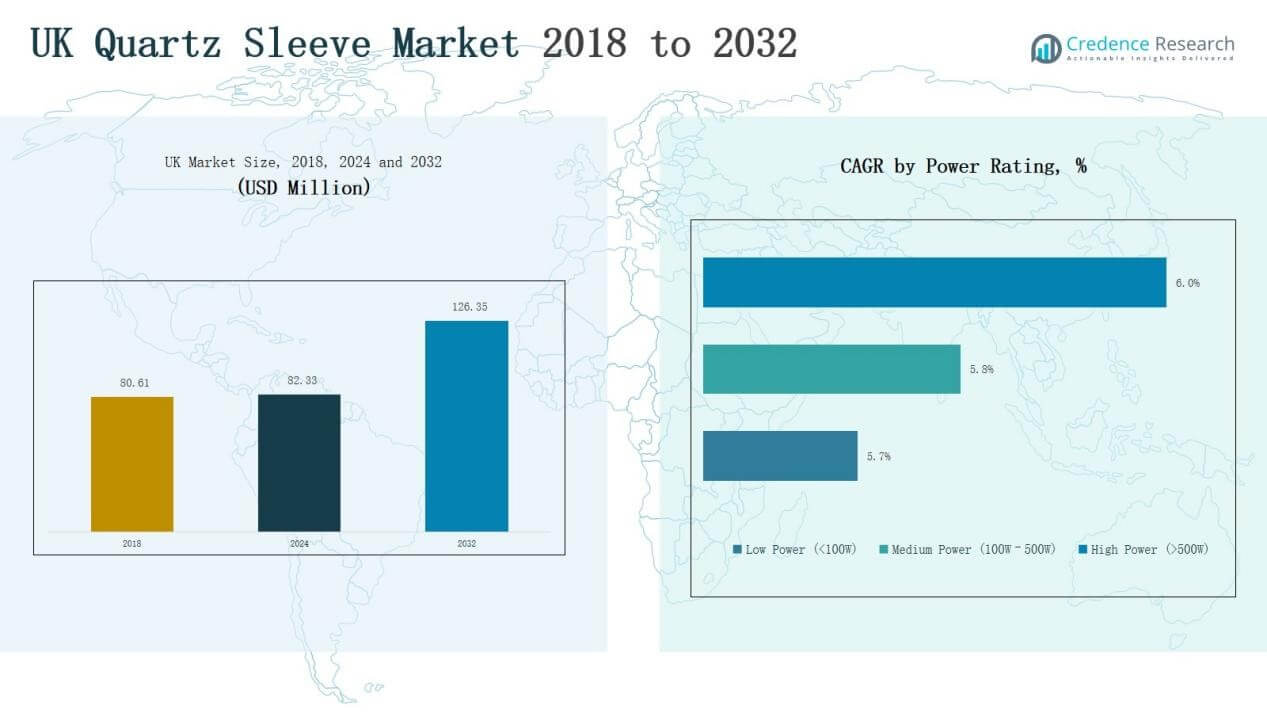
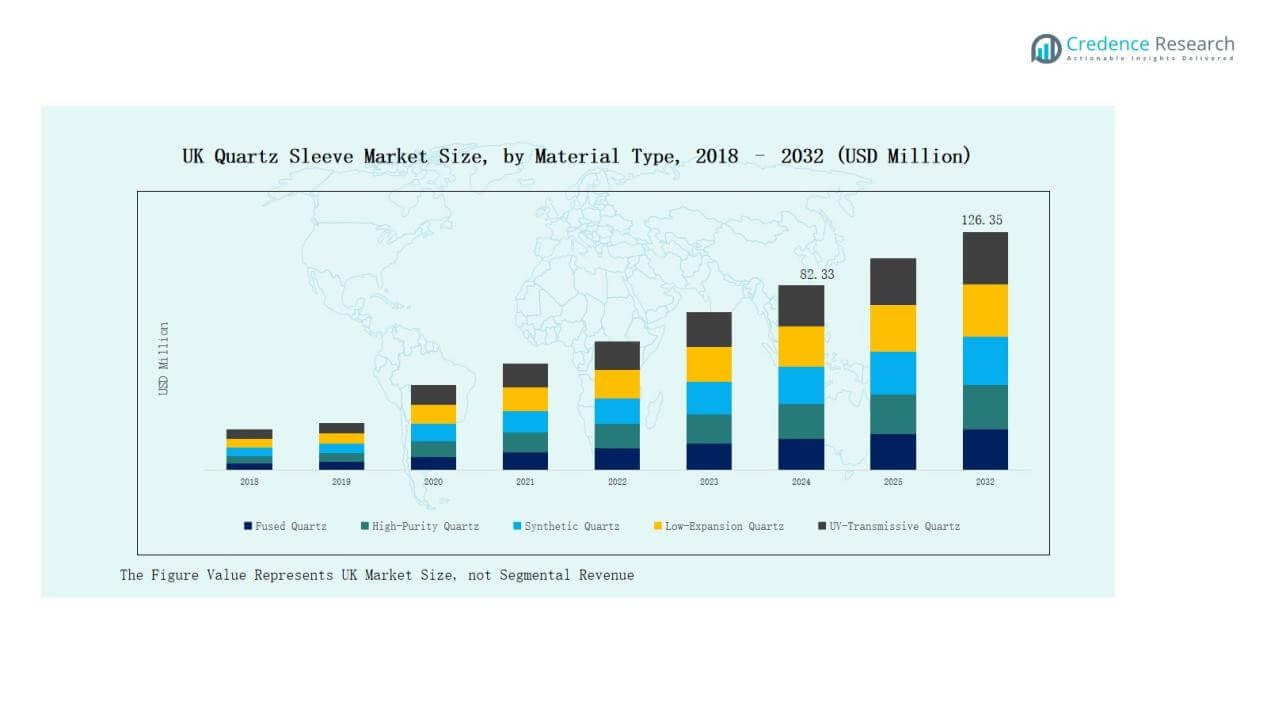
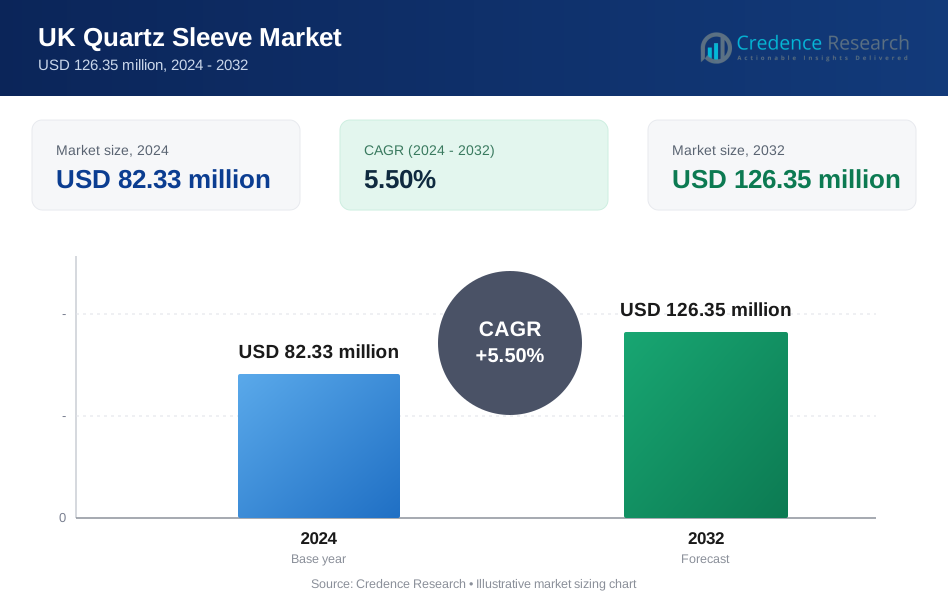
UK Quartz Sleeve Market size was valued at USD 80.61 million in 2018, reached USD 82.33 million in 2024, and is anticipated to reach USD 126.35 million by 2032, at a CAGR of 5.50% during the forecast period.
| REPORT ATTRIBUTE | DETAILS |
|---|---|
| Historical Period | 2020-2023 |
| Base Year | 2024 |
| Forecast Period | 2025-2032 |
| UK Quartz Sleeve Market Size 2024 | USD 82.33 Million |
| UK Quartz Sleeve Market, CAGR | 5.50% |
| UK Quartz Sleeve Market Size 2032 | USD 126.35 Million |
The UK Quartz Sleeve Market is shaped by global leaders and regional specialists competing on innovation, quality, and customization. Key players include Heraeus, Saint-Gobain, Tosoh Corporation, SGL Carbon, Mondi Group, Quartztec Europe, Enterprise Q Ltd, John Moncrieff Ltd, and QSI Quartz, each leveraging advanced manufacturing and distribution strengths to secure market presence. These companies focus on high-purity, fused, and UV-transmissive quartz solutions serving water treatment, semiconductor, and pharmaceutical sectors. Regionally, England led the market with a 46% share in 2024, supported by municipal water projects, healthcare infrastructure, and semiconductor expansion.
Market Insights
- The UK Quartz Sleeve Market grew from USD 80.61 million in 2018 to USD 82.33 million in 2024 and is projected to reach USD 126.35 million by 2032, at a CAGR of 5.50%.
- Fused quartz led the market by material type with a 37% share in 2024, supported by its superior durability, UV transparency, and strong demand in disinfection applications.
- By application, UV water disinfection dominated with a 41% share in 2024, driven by municipal infrastructure projects, clean water initiatives, and strict health regulations.
- Water treatment was the leading end-user, holding a 39% share in 2024, with growing adoption supported by stricter environmental norms and municipal project expansion.
- England led the regional market with a 46% share in 2024, supported by strong municipal water treatment projects, advanced healthcare infrastructure, and expanding semiconductor activities.
Market Segment Insights
By Material Type
Fused quartz dominated the UK Quartz Sleeve Market in 2024 with a 37% share. Its strong thermal stability, durability, and high UV transparency make it the preferred choice for demanding industrial and disinfection applications. High-purity quartz followed, supported by increasing demand from semiconductor and pharmaceutical industries. Synthetic and UV-transmissive quartz are gaining traction for advanced water treatment and optical applications. Low-expansion quartz holds a niche share, driven by specialized laboratory and precision instrumentation use.
For instance, Heraeus Conamic operates a fused silica production facility in Bitterfeld, Germany, supplying fused quartz for applications including the UV and semiconductor markets.
By Application
UV water disinfection led the UK market with a 41% share in 2024. Growing focus on clean water supply, municipal infrastructure projects, and strict health regulations drive its dominance. UV air disinfection gained momentum post-pandemic, supported by demand in healthcare and commercial buildings. Surface disinfection is expanding across food and beverage facilities. Chemical processing maintains steady adoption due to durability needs in corrosive environments. Other applications include specialized industrial processes where quartz sleeves ensure performance consistency and reliability.
For instance, Xylem's Wedeco brand has installed more than 250,000 systems globally across private, public utility, and industrial locations, including municipal water treatment plants in Europe. These systems, like other UV disinfection technology, utilize quartz sleeves that require maintenance to preserve UV output for effective pathogen reduction
By End-User
Water treatment emerged as the largest end-user segment, accounting for 39% share of the UK Quartz Sleeve Market in 2024. Expanding municipal water treatment projects and stricter environmental norms drive this leadership. The food and beverage sector increasingly adopts quartz sleeves for UV disinfection, ensuring hygiene and safety. Pharmaceutical and semiconductor industries demand high-purity quartz for sterile and precision operations. Oil and gas usage remains limited but steady, while other segments adopt quartz sleeves for niche industrial processes.
Key Growth Drivers
Rising Demand for Water and Air Disinfection
The UK Quartz Sleeve Market benefits from rising adoption of UV disinfection systems in water and air treatment. Growing concerns about public health and stringent regulatory frameworks drive large-scale municipal water projects. Demand from healthcare, food safety, and residential sectors continues to rise, creating strong momentum for fused and UV-transmissive quartz sleeves. This increasing focus on sustainable and chemical-free disinfection methods strengthens quartz sleeve adoption across industries, positioning it as a critical component in the UK’s environmental and health safety infrastructure.
For instance, Trojan Technologies has installed more than 11,000 municipal UV water treatment systems globally, which is the largest base in the world. These systems use quartz sleeves that are kept clean, often with automatic cleaning systems, to maintain high UV transmittance for effective pathogen inactivation.
Expanding Semiconductor and Electronics Industry
Growth in the UK’s semiconductor and electronics industry supports demand for high-purity quartz sleeves. Quartz provides superior purity, thermal stability, and UV transparency, making it indispensable in chip fabrication and optical components. Rising investments in advanced manufacturing technologies and electronic innovation strengthen the role of quartz sleeves in precision operations. The industry’s continuous need for reliable and contamination-free materials drives steady adoption, particularly in high-value manufacturing clusters. This end-user demand highlights the growing importance of quartz sleeves in ensuring quality and performance in electronics production.
For instance, Shin-Etsu Chemical, through its subsidiary Shin-Etsu Quartz Products Co., Ltd., offers quartz glass crucibles for silicon single crystal pulling applications, which are used in semiconductor fabrication.
Increased Focus on Sustainability and UV Technology Adoption
The UK is increasingly prioritizing sustainable technologies, boosting the adoption of UV-based disinfection over chemical-based alternatives. Quartz sleeves enable the durability and performance required in these systems, supporting growth across water, air, and surface applications. Government initiatives promoting greener solutions in municipal utilities and industries further accelerate this shift. Adoption is also fueled by rising public and industrial awareness of reducing chemical exposure. This trend ensures quartz sleeves remain integral to sustainable development efforts and long-term infrastructure projects, reinforcing their market demand.
 Key Trends & Opportunities
Shift Toward Advanced UV-C Solutions
The market is witnessing a strong trend toward the adoption of advanced UV-C disinfection systems, particularly in healthcare, food processing, and residential spaces. These solutions demand quartz sleeves with superior UV transmission and durability. Manufacturers are focusing on innovation in synthetic and high-purity quartz to support this need. Growing adoption of compact, portable UV units further expands opportunities for quartz sleeves in consumer markets. This trend reflects the industry’s alignment with global hygiene priorities and growing demand for advanced, energy-efficient disinfection technologies.
For instance, Signify (Philips UV-C) has deployed UV-C disinfection units in locations such as UK hospitals and schools. These units typically utilize UV-C lamps encased in quartz sleeves, a standard material chosen for its high UV-C transmittance.
Growth in Online and OEM Distribution Channels
UK quartz sleeve suppliers are leveraging e-commerce platforms and direct OEM partnerships to expand reach and improve accessibility. The shift toward online sales provides small and medium enterprises with cost-effective access to products, while OEM collaborations ensure integration of quartz sleeves into advanced UV equipment. This dual-channel expansion creates opportunities for both established players and emerging suppliers. Strong demand for customized and application-specific solutions highlights the potential for further channel innovation, enhancing market penetration across residential, commercial, and industrial sectors.
For instance, Xylem provides Wedeco UV disinfection systems for water treatment projects, collaborating with suppliers for components like quartz sleeves and distributing them through various channels to serve municipal and industrial clients across regions like the UK and Europe.
Key Challenges
High Manufacturing and Processing Costs
Quartz sleeve production involves specialized equipment, precision processing, and high-quality raw materials, resulting in elevated costs. UK manufacturers face pressure from global competitors offering lower-priced alternatives. These high costs limit adoption among price-sensitive end-users, particularly in smaller commercial and residential applications. The challenge is intensified by fluctuating raw material prices and energy costs, which affect margins. Addressing this requires investments in process optimization and partnerships to balance quality and affordability, ensuring competitiveness against global suppliers in the quartz sleeve market.
Dependence on Imports for Advanced Grades
The UK relies heavily on imports for advanced grades of high-purity and synthetic quartz used in semiconductor and pharmaceutical applications. Limited domestic production capacity restricts supply security and increases vulnerability to global trade disruptions. This dependence exposes the market to price volatility and extended lead times. Companies operating in sensitive sectors often face procurement risks that can disrupt operations. Strengthening local manufacturing capabilities or forming long-term supply agreements is essential to mitigate this dependency and support market stability in critical applications.
Market Fragmentation and Competitive Pressure
The UK Quartz Sleeve Market is fragmented, with global leaders, regional specialists, and small suppliers competing on pricing, innovation, and customization. Intense competition leads to margin pressures and limits the ability of smaller players to scale. Differentiation remains challenging due to the commoditized nature of standard quartz sleeves. Companies focusing on application-specific innovations, strong distribution networks, and partnerships are better positioned to compete. However, achieving consistent market share growth requires sustained investment in technology, branding, and service capabilities to counter competitive pressures.
Regional Analysis
England
England accounted for the largest share of the UK Quartz Sleeve Market in 2024, holding 46% of total revenue. Strong municipal water treatment projects and advanced healthcare infrastructure drive high adoption. The region’s growing semiconductor activity also supports demand for high-purity quartz. England’s large population and urban concentration strengthen the need for UV disinfection systems in residential and commercial sectors. It remains the hub for key suppliers and distributors, ensuring reliable supply. Strong regulatory frameworks further enhance market penetration across multiple applications.
Scotland
Scotland contributed 22% share in the UK Quartz Sleeve Market in 2024. Investments in renewable energy and strict water quality standards encourage adoption of quartz-based UV disinfection. The food and beverage sector also plays a vital role, with quartz sleeves ensuring hygiene standards in processing. Scotland’s expanding pharmaceutical presence strengthens demand for high-purity quartz. Regional growth is further supported by government initiatives promoting sustainable solutions. It continues to gain traction in specialized applications requiring durability and high UV transmission.
Wales
Wales represented 17% of the UK Quartz Sleeve Market in 2024. Its demand is driven by rising municipal water treatment needs and industrial projects. The food and beverage industry adopts quartz sleeves for ensuring product safety and compliance. Wales benefits from smaller but expanding healthcare infrastructure requiring reliable disinfection technologies. Market adoption is supported by the availability of distributors catering to regional industries. It is also strengthening presence in niche industrial applications where quartz sleeves provide cost-effective performance.
Northern Ireland
Northern Ireland held 15% share in the UK Quartz Sleeve Market in 2024. Regional growth is supported by increasing demand from water treatment and healthcare projects. Smaller but growing industrial activity requires quartz sleeves for disinfection and chemical processing. Northern Ireland’s focus on improving public health infrastructure drives steady adoption. The semiconductor and electronics sector contributes modestly but remains a potential growth area. It shows consistent uptake across municipal and commercial applications, reflecting the region’s alignment with national sustainability goals.
 Market Segmentations:
By Material Type
- Fused Quartz
- High-Purity Quartz
- Synthetic Quartz
- Low-Expansion Quartz
- UV-Transmissive Quartz
By Application
- UV Water Disinfection
- UV Air Disinfection
- UV Surface Disinfection
- Chemical Processing
- Others
By End-User
- Water Treatment
- Food & Beverage
- Pharmaceutical
- Semiconductor & Electronics
- Oil & Gas
- Others
By Power Rating
- Low Power (<100W)
- Medium Power (100W–500W)
- High Power (>500W)
By Distribution Channel
- OEMs (Original Equipment Manufacturers)
- Aftermarket / Distributors
- Direct Sales
- Online / E-Commerce
- Others
By Region
- England
- Scotland
- Wales
- Northern Ireland
Competitive Landscape
The UK Quartz Sleeve Market is characterized by a mix of global leaders and regional specialists competing on innovation, quality, and customization. Major players such as Heraeus, Saint-Gobain, Tosoh Corporation, SGL Carbon, Mondi Group, and QSI Quartz maintain strong positions through advanced manufacturing, extensive product portfolios, and strategic distribution networks. Domestic companies including Quartztec Europe, Enterprise Q Ltd, and John Moncrieff Ltd strengthen market competition by offering tailored solutions and servicing niche applications. Competition remains intense, with companies focusing on UV-transmissive and high-purity quartz products to meet rising demand from water treatment, semiconductor, and pharmaceutical industries. The aftermarket and distributor network play a critical role in extending reach across regional industries. Innovation in product durability, sustainability, and application-specific performance continues to define competitive strategies. Strategic collaborations and localized service offerings further help companies secure long-term contracts, particularly within municipal and healthcare sectors, where compliance and reliability are crucial.
Key Players
- Heraeus
- Quartztec Europe
- Saint-Gobain
- Enterprise Q Ltd
- Tosoh Corporation
- John Moncrieff Ltd
- Mondi Group
- SGL Carbon
- QSI Quartz
Recent Developments
- In April 2023, Saint-Gobain Quartz officially evolved into Saint-Gobain Advanced Ceramic Composites, consolidating its quartz, ceramic filament, and composite businesses to target aerospace, connectivity, and industrial markets.
- In 2023, Quartztec Europe’s majority shareholding was acquired by Rosefinch Technology HK, integrating its UK operations into a broader group with expanded manufacturing footprint.
- In 2024, Saint-Gobain’s ACC unit began increasing production of oxide-quartz and continuous ceramic fibers to meet growth in composite demand.
Report Coverage
The research report offers an in-depth analysis based on Market Type, Application, End User, Power Rating, Distribution Channel and Region. It details leading market players, providing an overview of their business, product offerings, investments, revenue streams, and key applications. Additionally, the report includes insights into the competitive environment, SWOT analysis, current market trends, as well as the primary drivers and constraints. Furthermore, it discusses various factors that have driven market expansion in recent years. The report also explores market dynamics, regulatory scenarios, and technological advancements that are shaping the industry. It assesses the impact of external factors and global economic changes on market growth. Lastly, it provides strategic recommendations for new entrants and established companies to navigate the complexities of the market.
Future Outlook
- Demand for quartz sleeves will rise with stricter water and air quality regulations.
- Healthcare facilities will expand UV disinfection adoption, boosting quartz sleeve usage.
- The semiconductor sector will drive growth for high-purity quartz applications.
- Food and beverage industries will increase reliance on UV systems for hygiene
- Online and OEM distribution will gain importance in expanding market reach.
- Sustainability goals will encourage preference for quartz sleeves over chemical alternatives.
- Technological innovation will improve durability and UV transmission performance.
- Regional suppliers will strengthen presence through tailored and cost-effective solutions.
- Strategic partnerships will shape competitive positioning among global and local players.
- Investment in municipal infrastructure will remain a core driver of long-term demand.
Request a Free Sample
Fill in your details and we'll send you a free sample report.
- Sample data tables & charts
- Research methodology
Need a Custom Version of This Report?
Tailor the scope, geography, or segments to your exact requirements.
- Custom geography or segment scope
- Direct access to our analyst team
Frequently Asked Questions
What is the current market size for UK Quartz Sleeve Market, and what is its projected size in 2032?
At what Compound Annual Growth Rate is the UK Quartz Sleeve Market projected to grow between 2025 and 2032?
Which UK Quartz Sleeve Market segment held the largest share in 2024?
What are the primary factors fueling the growth of the UK Quartz Sleeve Market?
Who are the leading companies in the UK Quartz Sleeve Market?
Which region commanded the largest share of the UK Quartz Sleeve Market in 2024?
Table of Content
Chapter 1. Report Introduction
- 1.1 Report Description & Purpose
- 1.1.1 Report Title & Market Definition
- 1.1.2 Unique Selling Propositions (USP) & Key Differentiators
- 1.1.3 Value Proposition for Stakeholders
- 1.2 Research Objectives
- 1.2.1 Market Sizing Objectives (Volume & Revenue)
- 1.2.2 Segmentation Objectives
- 1.2.3 Competitive Intelligence Objectives
- 1.2.4 Forecast & Scenario Objectives
- 1.3 Report Scope
- 1.3.1 UK Quartz Sleeve Scope – Types & Subtypes Covered
- 1.3.2 Geographic Scope – Regions & Countries Covered
- 1.3.3 Historical Period, Base Year & Forecast Period (2024; forecast to 2032)
- 1.3.4 Inclusions & Exclusions
- 1.4 HS Code & Classification Framework
- 1.5 Currency, Units & Pricing Basis
- 1.6 Target Stakeholders
- 1.7 Limitations & Assumptions
Chapter 2. Executive Summary
- 2.1 Global UK Quartz Sleeve Market Snapshot
- 2.1.1 Market Size – Historical (2024) & Forecast (2024-2032) (2024: USD 82.33 million → 2032: USD 126.35 million)
- 2.1.2 Volume & Revenue – Global Totals
- 2.1.3 Key Market Highlights – Top Five Facts
- 2.2 UK Quartz Sleeve Market Segmentation Snapshot
- 2.2.1 Market Split by Region – 2024 vs. 2032
- 2.3 Competitive Snapshot
- 2.3.1 Top 10 Players by Revenue Share – 2024
- 2.3.2 Top 10 Players by Volume Share – 2024
- 2.3.3 Recent Strategic Developments (18-Month Summary)
- 2.4 Key Investment Highlights & Strategic Conclusions
Chapter 3. UK Quartz Sleeve Market Dynamics & Industry Analysis
- 3.1 Market Overview & Context
- 3.1.1 UK Quartz Sleeve Market Position in the Broader Automotive Value Chain
- 3.1.2 OEM vs. Replacement Market Dynamics
- 3.1.3 Market Maturity & Development Stage by Region
- 3.2 UK Quartz Sleeve Market Drivers
- 3.3 UK Quartz Sleeve Market Restraints & Challenges
- 3.4 UK Quartz Sleeve Market Opportunities
- 3.5 Porter's Five Forces Analysis
- 3.5.1 Threat of New Entrants
- 3.5.2 Bargaining Power of Suppliers
- 3.5.3 Bargaining Power of Buyers
- 3.5.4 Threat of Substitutes
- 3.5.5 Competitive Rivalry – Intensity Assessment
- 3.6 UK Quartz Sleeve Value Chain Analysis
- 3.6.1 Upstream – Raw Material/Input Suppliers
- 3.6.1.1 Raw Material/Input 1
- 3.6.1.2 Raw Material/Input 2
- 3.6.1.3 Raw Material/Input 3
- 3.6.2 Midstream – Production/Manufacturing/Service Delivery
- 3.6.2.1 Production/Process Overview
- 3.6.2.2 Key Facility Locations & Capacity by Manufacturer
- 3.6.3 Downstream – Distribution & End Consumer
- 3.6.3.1 Primary Channel – B2B/OEM
- 3.6.3.2 Secondary Channels – Dealer, Retail, Online, Direct
- 3.6.4 Value Chain Profitability Analysis
- 3.6.1 Upstream – Raw Material/Input Suppliers
- 3.7 PESTEL Analysis
- 3.7.1 Political Factors
- 3.7.2 Economic Factors
- 3.7.3 Social Factors
- 3.7.4 Technological Factors
- 3.7.5 Environmental Factors
- 3.7.6 Legal Factors
- 3.8 UK Quartz Sleeve Supply Chain Analysis
- 3.8.1 Raw Material/Input Supply Risk Assessment
- 3.8.2 Manufacturing Concentration Risk (Geographic Exposure)
- 3.8.3 Trade Disruption Impact Analysis
- 3.9 Regulatory & Policy Landscape
Note: The regulatory and policy landscape section covers regulations based on their applicability to the market, UK Quartz Sleeve category, geography, and scope of the study. Only regulatory frameworks with a material impact on operations, compliance, trade, sustainability, or market access are analyzed in detail.
Chapter 4. Key Investment Pockets & Opportunity Analysis
- 4.1 UK Quartz Sleeve Market Attractiveness Analysis
- 4.1.1 By Region – Investment Attractiveness Matrix (Volume × CAGR)
- 4.2 Absolute Revenue Growth Opportunity
- 4.2.1 By Region – Absolute USD Growth Through 2032
- 4.3 Incremental Volume Opportunity
- 4.3.1 By Region – Incremental Volume Through 2032
- 4.3.2 Segment – Incremental Volume
- 4.4 Emerging Submarket Opportunity Deep Dive (Subject to Applicability)
- 4.5 Emerging Market Opportunity Scorecards
- 4.5.1 United States
- 4.5.2 Europe
- 4.5.3 Asia
- 4.5.4 Middle East & Africa
Note: Emerging Market Opportunity Scorecards will be included based on relevance and strategic importance. Regions listed are indicative and may vary depending on data availability and market dynamics.
Chapter 5. UK Quartz Sleeve Import-Export Analysis & Trade Flows
- 5.1 Global Trade Overview
- 5.1.1 Global Export Value by Country (2024)
- 5.1.2 Global Export Volume by Country (2024)
- 5.1.3 Global Import Value by Country (2024)
- 5.1.4 Global Import Volume by Country (2024)
- 5.1.5 Net Trade Balance by Country (2024)
- 5.2 Export Analysis – Segment
- 5.2.1 Type 1 (HS Code)
- 5.2.2 Type 2 (HS Code)
- 5.2.3 Type 3 (HS Code)
- 5.2.4 Type 4 (HS Code)
- 5.2.5 Type 5 (HS Code)
- 5.3 Import Analysis – Segment
- 5.3.1 Type 1 (HS Code)
- 5.3.2 Type 2 (HS Code)
- 5.3.3 Type 3 (HS Code)
- 5.3.4 Type 4 (HS Code)
- 5.3.5 Type 5 (HS Code)
- 5.4 Average Unit Trade Prices
- 5.4.1 Average Export Price – Segment & Country
- 5.4.2 Average Import Price – Segment & Source Country
- 5.4.3 Price Trends (2024)
- 5.5 Key Trade Route Analysis
- 5.5.1 Trade Route 1
- 5.5.2 Trade Route 2
- 5.5.3 Trade Route 3
- 5.5.4 Trade Route 4
- 5.5.5 Trade Route 5
- 5.6 Trade Policy Impact Assessment
- 5.6.1 US Anti-Dumping & Section 301 Tariffs
- 5.6.2 EU Customs Union Impact
- 5.6.3 Major Free Trade Agreements
- 5.6.4 USMCA Rules of Origin
Note: Trade policy analysis will be included only where relevant to the UK Quartz Sleeve market.
Chapter 6. Competitive Landscape & Company Benchmarking
- 6.1 UK Quartz Sleeve Market Concentration & Structure
- 6.1.1 Herfindahl-Hirschman Index (HHI) – vs. 2024
- 6.1.2 Tier 1, Tier 2 & Tier 3 Market Structure
- 6.1.3 Global, Regional & Local Player Dynamics
- 6.2 UK Quartz Sleeve Market Share Analysis – 2024
- 6.2.1 Global Revenue Share by Company
- 6.2.2 Global Volume Share by Company
- 6.2.3 Regional Revenue Share
- 6.2.4 Market Share Evolution ( vs. 2024)
- 6.2.5 OEM Segment Share by Company
- 6.2.6 Replacement Segment Share by Company
- 6.3 Production/Delivery Capacity & Facility Analysis
- 6.3.1 Global Installed Capacity
- 6.3.2 Capacity Utilization Rates
- 6.3.3 Production/Output Volume
- 6.3.4 Facility Locations & Capacity Map
- 6.3.5 Planned Capacity Additions
- 6.4 UK Quartz Sleeve Competitive Benchmarking Matrix
- 6.4.1 Revenue, Volume, CAGR & Profitability Comparison
- 6.4.2 Channel Revenue Mix
- 6.4.3 Geographic Revenue Exposure
- 6.4.4 R&D Intensity
- 6.4.5 Sustainability Maturity
- 6.5 Strategic Developments in UK Quartz Sleeve (Last 24 Months)
- 6.5.1 Mergers, Acquisitions & Divestments
- 6.5.2 New UK Quartz Sleeve Launches
- 6.5.3 Facility Expansions
- 6.5.4 Strategic Alliances, Joint Ventures & Partnerships
- 6.5.5 Distribution Expansion & Market Entry
- 6.5.6 Sustainability & ESG Initiatives
- 6.6 Competitive Strategy Mapping
- 6.6.1 Leader, Challenger, Follower & Niche Classification
- 6.6.2 Pricing Strategy Comparison
- 6.6.3 Channel Strategy Matrix
Note: Strategic developments are included based on their materiality and the availability of reliable information.
Chapter 7. Global UK Quartz Sleeve Market – By Distribution Channel
- 7.1 Segment Overview
- 7.1.1 Volume & Revenue Split by Channel (2024 & 2032)
- 7.1.2 Channel Mix Evolution (2024-2032)
Chapter 8. Regional Market Analysis – Global Overview
- 8.1 Global Regional Overview
- 8.1.1 Regional Volume Share
- 8.1.2 Regional Revenue Share
- 8.1.3 Regional Volume by Region
- 8.1.4 Regional Revenue by Region
- 8.1.5 Regional Forecast Through 2032
- 8.2 Cross-Regional Segment Analysis
- 8.2.1 By Distribution Channel
- 8.2.2 By Brand/Price Tier
Chapter 9. North America UK Quartz Sleeve Market
- 9.1 United States
- 9.2 Canada
- 9.3 Mexico
Chapter 10. Europe UK Quartz Sleeve Market
- 10.1 Germany
- 10.2 France
- 10.3 Italy
- 10.4 United Kingdom
- 10.5 Spain
- 10.6 Poland
- 10.7 Russia
- 10.8 Netherlands
- 10.9 Belgium
- 10.10 Sweden
- 10.11 Denmark
- 10.12 Norway
- 10.13 Rest of Europe
Chapter 11. Asia Pacific UK Quartz Sleeve Market
- 11.1 China
- 11.2 India
- 11.3 Japan
- 11.4 South Korea
- 11.5 Thailand
- 11.6 Indonesia
- 11.7 Vietnam
- 11.8 Malaysia
- 11.9 Australia
- 11.10 Rest of Asia Pacific
Chapter 12. Latin America UK Quartz Sleeve Market
- 12.1 Brazil
- 12.2 Argentina
- 12.3 Colombia
- 12.4 Chile
- 12.5 Rest of Latin America
Chapter 13. Middle East UK Quartz Sleeve Market
- 13.1 Saudi Arabia
- 13.2 United Arab Emirates
- 13.3 Turkey
- 13.4 Israel
- 13.5 Iran
- 13.6 Rest of the Middle East
Chapter 14. Africa UK Quartz Sleeve Market
- 14.1 South Africa
- 14.2 Egypt
- 14.3 Nigeria
- 14.4 Morocco
- 14.5 Rest of Africa
Chapter 15. UK Quartz Sleeve Company Profiles
- 15.1 [Company 01]
- 15.1.1 Company Overview
- 15.1.2 Key Management Personnel
- 15.1.3 Products & Services Portfolio
- 15.1.4 Financial Performance
- 15.1.5 Key Market Focus & Geographic Presence
- 15.1.6 Recent Developments & Strategic Initiatives
Note: The company profile list is preliminary and may change based on research findings, market developments, data availability, and client requirements.
Chapter 16. Appendices
- Appendix A – List of Abbreviations & Acronyms
- Appendix B – Industry Classification Code Reference – Full Series
- Appendix C – Production & Capacity Data Tables
- Appendix D – End-Use & Demand Base Tables
- Appendix E – Consumption & Replacement Rate Assumptions
- Appendix F – ASP Reference Tables
- Appendix G – Manufacturing & Facility Database
- Appendix H – Import-Export Data Tables
- Appendix I – Regulatory Summary Tables
- Appendix J – Primary Research Participant List (Anonymized)
- Appendix K – Primary Research Questionnaire Framework
- Appendix L – Data Sources & Bibliography
- Appendix M – Market Size Divergence & Source Comparison
Chapter 17. Research Methodology
- 17.1 Research Framework & Philosophy
- 17.2 Secondary Research – Sources, Hierarchy & Data Extraction
- 17.3 Data Modeling – Bottom-Up & Top-Down Market Sizing
- 17.4 Primary Research – Stakeholder Framework, LOI & Sample Sizes
- 17.5 Forecast Methodology – Regression, Scenario & Sensitivity Analysis
- 17.6 Quality Control – Four-Layer Validation Framework
- 17.7 Limitations & Standard Assumptions
- 17.8 Disclaimer
