
| REPORT ATTRIBUTE | DETAILS |
|---|---|
| Historical Period | 2020-2023 |
| Base Year | 2024 |
| Forecast Period | 2025-2032 |
| Wellness And Nutritional Supplements Market Size 2024 | USD 540.65 Million |
| Wellness And Nutritional Supplements Market, CAGR | 6.23% |
| Wellness And Nutritional Supplements Market Size 2032 | USD 8,54,082.48 Million |
Market Overview:
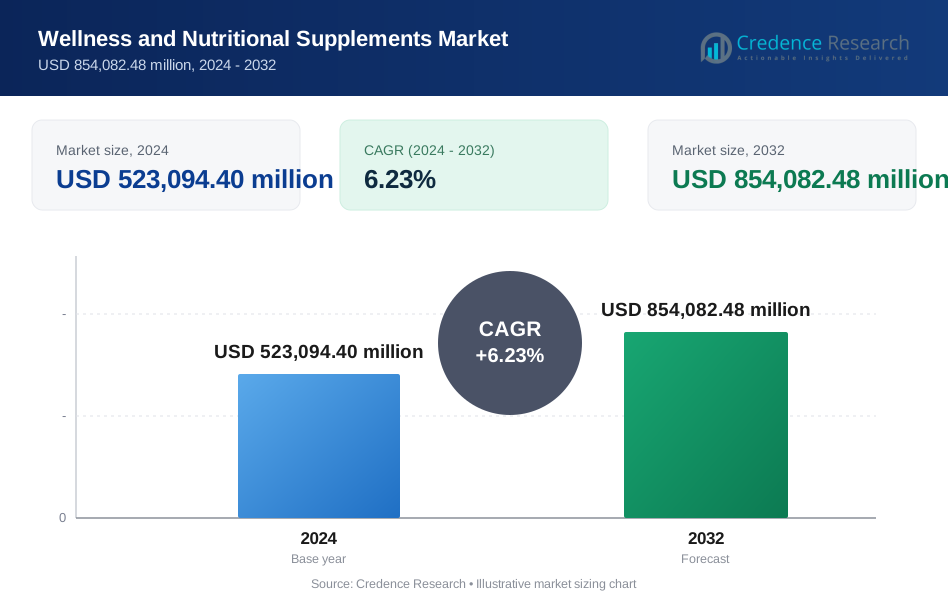
The Wellness And Nutritional Supplements Market is projected to grow from USD 5,23,094.40 million in 2024 to an estimated USD 8,54,082.48 million by 2032, with a compound annual growth rate (CAGR) of 6.23% from 2024 to 2032.
The wellness and nutritional supplements market is experiencing significant growth due to several key drivers. Increasing health consciousness among consumers is one of the main factors, as people are becoming more aware of the importance of maintaining a healthy lifestyle and preventing health issues before they arise. This has led to a surge in demand for various supplements, including vitamins, minerals, and herbal products. The growing focus on preventive healthcare, with an emphasis on boosting immunity and improving overall wellness, further contributes to this trend. Additionally, the aging population worldwide requires supplements to address age-related health concerns, such as joint health, cognitive function, and bone density. Moreover, the rise of fitness culture has stimulated demand for sports nutrition products aimed at improving athletic performance and aiding recovery. The growth of e-commerce platforms has also made it easier for consumers to access a wide range of wellness supplements, driving the market further.
The global wellness and nutritional supplements market is characterized by distinct regional growth patterns. North America leads the market, driven by high disposable incomes, a strong health-conscious consumer base, and the presence of major supplement manufacturers. In the Asia-Pacific region, the market is expanding rapidly due to rising urbanization, increasing disposable incomes, and a growing shift towards healthier lifestyles, particularly in countries like China and India. Europe also shows consistent growth, with consumers seeking supplements to support weight management and chronic disease prevention, especially in countries such as Germany, France, and the UK. In the Middle East and Africa, the market is experiencing growth, particularly in the UAE and South Africa, as rising disposable incomes and heightened health awareness continue to influence demand for wellness supplements. Overall, the market shows strong regional variation, with each region benefiting from different demographic and economic factors.
Market Insights:
- The wellness and nutritional supplements market is projected to grow significantly, reaching USD 8.54 trillion by 2032, with a steady CAGR of 6.23% from 2024 to 2032.
- Increasing health consciousness is a key driver, as consumers seek proactive measures to improve well-being through supplements, including vitamins, minerals, and herbal products.
- The rising demand for preventive healthcare is fueling market growth, as individuals prioritize immune support and chronic disease prevention.
- The aging population is a major factor, with older adults seeking supplements to support joint health, cognitive function, and bone density, driving demand for specialized products.
- Fitness culture continues to gain momentum, leading to a surge in demand for protein, amino acids, and energy-boosting supplements, particularly in regions with active lifestyles.
- Regulatory challenges and the evolving global landscape pose barriers, complicating market entry and raising compliance costs for companies.
- Intense competition and market saturation are increasing, requiring companies to innovate continually and differentiate their products to maintain consumer loyalty.
 Market Drivers:
Increasing Health Consciousness
A significant driver of growth in the wellness and nutritional supplements market is the rising awareness among consumers about the importance of health and wellness. As individuals become more health-conscious, they seek products that support their overall well-being. This shift towards preventative care has led many consumers to prioritize supplements as a way to maintain or improve their health. For instance, advancements in microbiome testing, blood biomarker analysis, and genetic testing have enabled companies to offer personalized supplements tailored to individual needs. Consumers are leveraging wearable health technology and digital health trackers to integrate real-time data into their supplement plans, supporting informed decisions for optimal health outcomes. As consumers increasingly recognize the benefits of nutritional supplements, they are incorporating them into their daily routines to address specific health concerns or enhance their general vitality.
Demand for Preventive Healthcare
There has been a marked increase in the demand for preventive healthcare solutions globally, contributing to the growth of the wellness and nutritional supplements market. Rather than waiting for health problems to arise, many consumers now prefer to take proactive measures to maintain their well-being. For example, science-backed nutraceuticals such as bioactive peptides for blood sugar regulation and anti-inflammatory plant compounds for heart health are emerging as effective preventive interventions. Supplements play a key role in this paradigm shift by providing essential nutrients that can support immune function, improve mental clarity, and reduce the risk of chronic diseases. With growing awareness of conditions such as cardiovascular disease, diabetes, and osteoporosis, individuals are increasingly turning to supplements to manage and prevent these health issues before they become more severe.
Aging Population and Health Needs
The aging population worldwide is another critical factor driving the wellness and nutritional supplements market. As people live longer, the demand for supplements designed to address age-related health concerns has surged. Supplements targeting joint health, cognitive function, and bone density have become particularly popular among older adults who are looking for ways to maintain their quality of life as they age. Additionally, seniors are increasingly concerned with preserving their independence and preventing conditions that could impact their daily functioning. This demographic trend is expected to continue to fuel the demand for wellness supplements tailored to meet the specific health needs of the aging population.
Growth of the Fitness and Active Lifestyle Trend
The growing popularity of fitness and active lifestyles is another key driver of the wellness and nutritional supplements market. As more individuals engage in regular physical activities, they seek supplements that can enhance their performance, aid in muscle recovery, and support their overall fitness goals. Products such as protein powders, amino acids, and energy-boosting supplements have gained traction among fitness enthusiasts. This trend is particularly prominent in regions where exercise culture is deeply ingrained, such as North America and Europe. The rise of gym memberships, sports activities, and fitness-focused social media platforms has further fueled interest in supplements that can optimize physical performance, creating a strong demand within the market.
Market Trends:
Market Expansion and Growth
The wellness and nutritional supplements market has witnessed substantial growth in recent years, driven by a combination of factors such as increasing health awareness, a shift towards preventive healthcare, and a rising demand for personalized nutrition. As consumers become more mindful of their health and wellness, they are turning to supplements to enhance their overall well-being and address specific health concerns. This trend is expected to continue as the market evolves, with innovations and a greater emphasis on product quality contributing to its growth.
Technological Innovations in Supplement Delivery
Advancements in technology have led to the development of new and convenient supplement delivery formats, which have enhanced consumer experience and compliance. For instance, capsule-in-capsule technology can enhance nutrient bioavailability by facilitating the staged release of active ingredients. This innovative drug delivery system allows for the encapsulation of one capsule within another, enabling the separation of incompatible substances and ensuring their sequential release in the digestive tract. The introduction of gummy vitamins and wellness patches has made it easier for consumers to incorporate essential nutrients into their daily routines. These innovations cater to a broader audience, including those who may struggle with traditional pill-based supplements. Additionally, the integration of transdermal delivery systems, such as wellness patches, has expanded the range of options available to consumers seeking more efficient and personalized ways to take their supplements.
Rise of Plant-Based and Natural Supplements
Consumer preferences are shifting towards plant-based and natural supplements, with many individuals prioritizing health, sustainability, and ethical considerations. This shift has led to a surge in demand for vegan and plant-derived supplements, as consumers become more aware of the environmental impact of their choices. As part of this broader trend, there has been a notable increase in the consumption of whole food-derived nutraceuticals. This demand is driven by a desire for cleaner, more transparent ingredients and a growing focus on natural health solutions that align with a holistic approach to well-being.
Integration of Supplements with Digital Health Platforms
The wellness and nutritional supplements market is increasingly integrating with digital health technologies, offering personalized health solutions and greater consumer engagement. Advancements in wearable technology and data analytics allow companies to provide tailored supplement recommendations based on individual health metrics, preferences, and goals. For instance, Thorne offers personalized supplement plans based on at-home blood tests, providing insights into individual biomarkers and health needs, including recommendations for immune support and cardiovascular health. As consumers seek more customized approaches to health and wellness, brands that successfully incorporate digital platforms into their offerings are likely to see continued growth. This trend reflects a broader movement towards personalized nutrition, with consumers increasingly relying on digital tools to optimize their health outcomes.
Market Challenges Analysis:
Regulatory Challenges
One of the primary restraints for the wellness and nutritional supplements market is the complex and evolving regulatory landscape. Different countries and regions have varying regulations governing the production, marketing, and distribution of dietary supplements, which can create barriers for companies seeking to enter new markets. Stringent guidelines regarding ingredient safety, health claims, and product labeling can delay product launches and increase compliance costs. Moreover, the lack of uniformity in global regulations adds complexity to international trade, as manufacturers must adapt their products and marketing strategies to meet diverse requirements, hindering growth potential.
Market Saturation and Intense Competition
The wellness and nutritional supplements market is becoming increasingly saturated, with numerous players offering a wide range of products. This saturation, combined with low entry barriers for new brands, has led to intense competition among established companies and new entrants alike. As the market becomes crowded, companies face challenges in differentiating their products and maintaining consumer loyalty. Price wars, coupled with the need for continuous innovation and product development, put pressure on margins. Companies that fail to innovate or offer unique value propositions may struggle to stay relevant in such a competitive environment.
Consumer Skepticism and Misinformation
Despite the growing demand for wellness and nutritional supplements, consumer skepticism remains a significant challenge. With the proliferation of online health information, some consumers are wary of the efficacy and safety of certain supplements, especially when it comes to unverified health claims. Additionally, misinformation and misleading marketing tactics can undermine trust in the industry, making it harder for companies to build credibility and consumer confidence. For example, marketing often exaggerates benefits using terms like "natural," invoking the appeal-to-nature fallacy. To mitigate these challenges, supplement brands must invest in transparency, scientific research, and clear communication to educate consumers about the benefits and safety of their products.
Supply Chain Disruptions
Supply chain disruptions pose another challenge for the wellness and nutritional supplements market, particularly in the wake of global crises such as the COVID-19 pandemic. Raw material shortages, transportation delays, and rising production costs can result in inventory shortages, price increases, and delays in product availability. These disruptions not only affect companies’ ability to meet consumer demand but also compromise the consistency and quality of products. Manufacturers must invest in resilient supply chain strategies to ensure continuity and minimize the impact of such disruptions.
Market Opportunities:
The wellness and nutritional supplements market presents significant growth opportunities driven by shifting consumer preferences towards health and wellness. As more individuals prioritize preventive healthcare and holistic well-being, there is increasing demand for products that support immunity, mental clarity, energy levels, and overall vitality. This trend offers companies a chance to expand their product portfolios to include supplements targeting specific health concerns, such as heart health, cognitive function, and digestive health. Additionally, as consumers become more health-conscious, they are actively seeking natural, organic, and plant-based supplements, which presents an opportunity for brands to cater to this demand with clean-label products that emphasize transparency and sustainable sourcing.
The growing popularity of personalized nutrition also offers an exciting market opportunity. With advancements in technology, companies can now offer tailored supplement solutions based on individual health data, lifestyle, and dietary needs. By integrating digital health platforms and wearable devices, brands can provide customized recommendations, enhancing the consumer experience and building long-term loyalty. This personalized approach not only addresses the unique needs of each consumer but also offers the potential for higher engagement and satisfaction. Moreover, emerging markets in Asia-Pacific, Latin America, and the Middle East provide significant opportunities for expansion, as rising disposable incomes and increasing health awareness contribute to the growing demand for wellness supplements in these regions.
Market Segmentation Analysis:
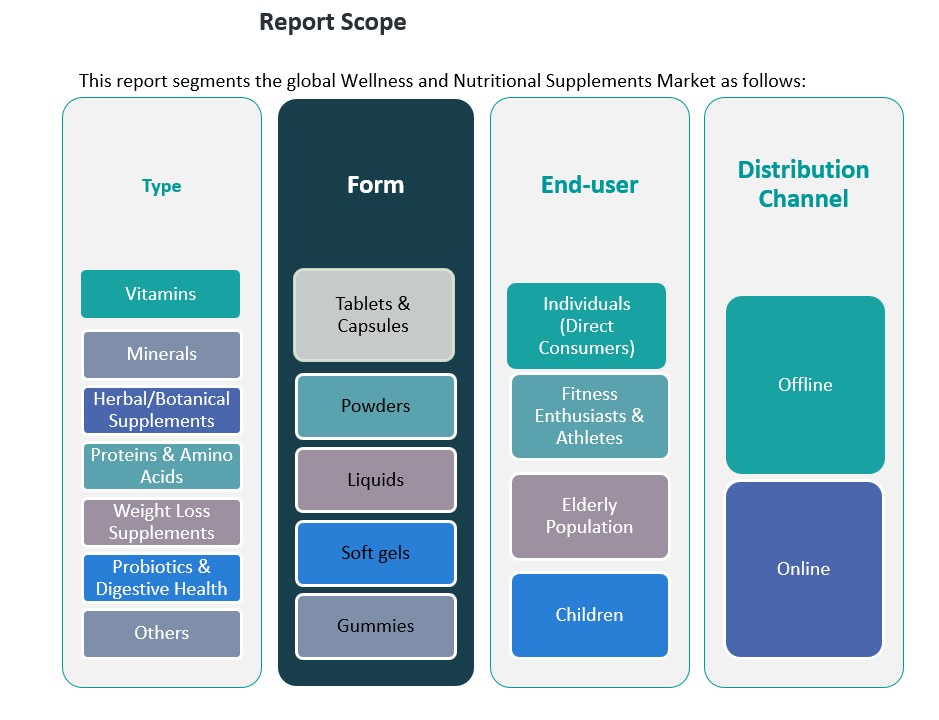
The wellness and nutritional supplements market is segmented across multiple categories, each offering distinct opportunities for growth.
By Type Segment, the market is diverse, with significant demand for vitamins, minerals, and herbal/botanical supplements. Vitamins and minerals remain dominant, driven by their essential role in supporting overall health. Herbal and botanical supplements are gaining traction as consumers increasingly seek natural alternatives. Proteins and amino acids are particularly popular in sports nutrition, while weight loss supplements and probiotics cater to growing health-conscious populations looking to manage weight and improve gut health. The “Others” category includes various niche supplements, such as antioxidants and omega-3 fatty acids.
By Form Segment, tablets and capsules hold the largest market share due to their convenience and widespread use. Powders, often favored by fitness enthusiasts, and liquids, preferred for ease of consumption, follow closely. Soft gels and gummies are also gaining popularity, particularly among consumers seeking more palatable or innovative supplement forms.
By End-User Segment, the market is driven by a wide range of consumers. Direct-to-consumer sales are growing rapidly, fueled by e-commerce platforms. Fitness enthusiasts and athletes continue to seek performance-enhancing supplements, while the elderly population demands supplements for age-related health concerns, such as joint health and cognitive function. The children’s segment also sees growth, with products tailored to the nutritional needs of young consumers.
By Distribution Channel Segment, both offline and online channels play significant roles. Offline sales, through retail and pharmacies, remain strong, while the online channel continues to expand rapidly, providing convenience and direct access to a broad consumer base.
Segmentation:
By Type Segment:
- Vitamins
- Minerals
- Herbal/Botanical Supplements
- Proteins & Amino Acids
- Weight Loss Supplements
- Probiotics & Digestive Health
- Others
By Form Segment:
- Tablets & Capsules
- Powders
- Liquids
- Soft gels
- Gummies
By End-User Segment:
- Direct to Consumers
- Fitness Enthusiasts & Athletes
- Elderly Population
- Children
By Distribution Channel Segment:
- Offline
- Online
Regional Analysis:
Regional Analysis of the Wellness and Nutritional Supplements Market
The wellness and nutritional supplements market is experiencing dynamic growth across various regions, each driven by unique factors such as health trends, demographics, and economic conditions. North America, Europe, Asia-Pacific, Latin America, and the Middle East & Africa are the key regions influencing market expansion. Below is an in-depth regional analysis highlighting the market share and growth prospects for each.
North America
North America dominates the wellness and nutritional supplements market, accounting for the largest share globally. The region's market leadership is attributed to high consumer awareness, advanced healthcare systems, and substantial disposable incomes. The United States, in particular, has a well-established market with a strong presence of key manufacturers and a high rate of supplement consumption. The growing trend of preventive healthcare, increasing interest in fitness and active lifestyles, and the aging population are all contributing to sustained demand. Additionally, the rise in e-commerce platforms has made wellness supplements more accessible, further fueling the market's growth. North America's market share is estimated to be the highest, reflecting its dominant position.
Europe
Europe holds a significant share of the global market, driven by growing health-consciousness and an increasing demand for natural and plant-based supplements. Consumers in countries such as Germany, France, the UK, and Italy are increasingly turning to nutritional supplements for weight management, immune support, and chronic disease prevention. Regulatory support for the supplement industry and the growing trend of personalized nutrition are expected to drive market growth in this region. However, the European market faces challenges such as stringent regulations and high competition among established players. Despite these challenges, Europe is anticipated to maintain a strong market position, with steady growth expected in the coming years.
Asia-Pacific
The Asia-Pacific region is experiencing rapid growth in the wellness and nutritional supplements market, driven by rising disposable incomes, urbanization, and an increasing focus on healthy living. Countries such as China, India, Japan, and South Korea are witnessing a surge in demand for nutritional supplements as consumers become more health-conscious. The region's large population and growing middle class present vast opportunities for manufacturers to expand their reach. Additionally, the demand for plant-based and natural supplements is gaining traction, particularly in countries like Japan and India. The market share of Asia-Pacific is growing steadily and is expected to continue expanding at a strong pace, particularly due to the rapid development of the nutraceutical industry in this region.
Latin America
In Latin America, the wellness and nutritional supplements market is growing at a moderate pace, with countries like Brazil and Mexico showing increasing consumer demand for wellness products. As disposable incomes rise and awareness about the benefits of supplements grows, more individuals are turning to products for preventive health and wellness. The market is driven by a growing middle class and an increasing emphasis on fitness. However, Latin America faces challenges such as limited regulatory frameworks and logistical hurdles, which could impact growth. Despite these obstacles, the market is expected to see steady growth, particularly as health trends continue to permeate the region.
Middle East & Africa
The Middle East and Africa region is seeing gradual growth in the wellness and nutritional supplements market, driven by rising disposable incomes, increased health awareness, and a shift towards preventive healthcare. In countries such as the UAE, Saudi Arabia, and South Africa, the demand for wellness supplements is increasing, particularly among the urban population. The region’s focus on improving healthcare infrastructure and promoting healthy lifestyles contributes to market growth. However, the market faces challenges related to high product costs and regulatory issues, which may hinder faster expansion. Despite these challenges, the Middle East & Africa market is expected to continue its upward trajectory in the coming years.
Key Player Analysis:
- Amway Corporation
- Nature’s Bounty, Inc.
- GNC Holdings, Inc.
- Nestlé Health Science
- Abbott Laboratories
- The Nature’s Way Brands, LLC
Competitive Analysis:
The wellness and nutritional supplements market is highly competitive, with numerous global and regional players vying for market share. Key companies in this sector include industry giants such as Herbalife, Amway, Abbott Laboratories, Glanbia, and Nature’s Bounty, which dominate the market with extensive product portfolios and strong brand recognition. These players benefit from well-established distribution channels, robust research and development capabilities, and large-scale manufacturing operations. In addition to these established brands, the market is also witnessing the rise of smaller, niche players that focus on specific consumer segments, such as plant-based or organic supplements. These companies are capitalizing on the growing consumer demand for natural, clean-label products. E-commerce platforms and direct-to-consumer models are becoming increasingly important, providing companies with greater reach and access to health-conscious consumers. Competitive strategies in the market include innovation, product differentiation, and partnerships with health and wellness influencers to build brand loyalty and expand consumer bases.
Recent Developments:
- On October 16, 2023, Amway India introduced "Nutrilite Daily Plus," a multivitamin and multimineral health supplement featuring a Dual Layer Dual Release Formulation. This innovative product is designed to support both physical and mental well-being, incorporating Gotukola for stress reduction and doubling plant concentrate content.
- On December 9, 2024, Nature’s Bounty launched a Plant-Based Omega-3 supplement derived from algae. This vegetarian alternative to fish oil provides EPA and DHA omega-3s to support heart, joint, and skin health. The product caters to consumers seeking plant-based nutritional solutions.
- On March 13, 2025, GNC India launched "Pro Performance 100% Whey + Nitro Surge," India's first whey protein with cardio-protective properties. This formulation combines performance-enhancing ingredients with cardiovascular health benefits to meet the growing demand for fitness and wellness products in India.
- In January 2025, Wellful Inc., a Kainos Capital portfolio company, announced the acquisition of Ancient Nutritionfrom VMG Partners, Hillhouse Investment, and other unit holders. This strategic move aims to strengthen Wellful's omnichannel presence across vitamin, mineral, and supplement categories while expanding its distribution footprint in the natural retail channel.
Market Concentration & Characteristics:
The wellness and nutritional supplements market exhibits a moderately concentrated structure, with several large multinational companies holding significant market share. Industry leaders such as Herbalife, Amway, Abbott Laboratories, and Glanbia dominate the market, leveraging their extensive distribution networks, strong brand recognition, and substantial financial resources. These companies benefit from economies of scale, enabling them to offer a wide range of products across multiple segments, including vitamins, minerals, protein supplements, and herbal products. However, the market also features a growing number of smaller, specialized players focusing on niche markets such as plant-based, organic, and clean-label products. These companies target health-conscious consumers seeking tailored wellness solutions, which has led to a more fragmented landscape in recent years. The market is characterized by high product differentiation, with companies investing in innovation to meet diverse consumer demands. Moreover, the rise of e-commerce has intensified competition, providing new opportunities for both established and emerging players.
Report Coverage:
The research report offers an in-depth analysis based on Type Segment, Form Segment, End-User Segment and Distribution Channel Segment. It details leading market players, providing an overview of their business, product offerings, investments, revenue streams, and key applications. Additionally, the report includes insights into the competitive environment, SWOT analysis, current market trends, as well as the primary drivers and constraints. Furthermore, it discusses various factors that have driven market expansion in recent years. The report also explores market dynamics, regulatory scenarios, and technological advancements that are shaping the industry. It assesses the impact of external factors and global economic changes on market growth. Lastly, it provides strategic recommendations for new entrants and established companies to navigate the complexities of the market.
Future Outlook:
- The wellness and nutritional supplements market is expected to continue growing steadily as consumers prioritize preventive health and wellness solutions.
- Personalized nutrition will drive market innovation, with companies leveraging data and technology to offer tailored supplement recommendations.
- The demand for plant-based and natural supplements will increase, reflecting growing consumer interest in clean-label and sustainable products.
- E-commerce platforms will play an increasingly important role in distribution, offering direct-to-consumer models and broadening market access.
- Regulatory frameworks will evolve, pushing companies to ensure higher standards of transparency and product safety.
- Emerging markets in Asia-Pacific, Latin America, and the Middle East will become significant growth areas due to rising disposable incomes and health awareness.
- The aging population will drive demand for supplements targeting age-related health concerns like joint health and cognitive function.
- Innovations in supplement delivery formats, such as gummies and wellness patches, will continue to attract new consumer segments.
- Competition will intensify, prompting established brands to invest in R&D and marketing to maintain consumer loyalty.
- The market will increasingly focus on the integration of supplements with digital health solutions, offering more personalized and data-driven wellness options.
Request a Free Sample
Fill in your details and we'll send you a free sample report.
- Sample data tables & charts
- Research methodology
Need a Custom Version of This Report?
Tailor the scope, geography, or segments to your exact requirements.
- Custom geography or segment scope
- Direct access to our analyst team
Frequently Asked Questions
What is the current size of the Wellness and Nutritional Supplements Market?
What factors are driving the growth of the Wellness and Nutritional Supplements Market?
What are the key segments within the Wellness and Nutritional Supplements Market?
What are some challenges faced by the Wellness and Nutritional Supplements Market?
Who are the major players in the Wellness and Nutritional Supplements Market?
Table of Content
Chapter 1. Report Introduction
- 1.1 Report Description & Purpose
- 1.1.1 Report Title & Market Definition
- 1.1.2 Unique Selling Propositions (USP) & Key Differentiators
- 1.1.3 Value Proposition for Stakeholders
- 1.2 Research Objectives
- 1.2.1 Market Sizing Objectives (Volume & Revenue)
- 1.2.2 Segmentation Objectives
- 1.2.3 Competitive Intelligence Objectives
- 1.2.4 Forecast & Scenario Objectives
- 1.3 Report Scope
- 1.3.1 Wellness and Nutritional Supplements Scope – Types & Subtypes Covered
- 1.3.2 Geographic Scope – Regions & Countries Covered
- 1.3.3 Historical Period, Base Year & Forecast Period (2024; forecast to 2032)
- 1.3.4 Inclusions & Exclusions
- 1.4 HS Code & Classification Framework
- 1.5 Currency, Units & Pricing Basis
- 1.6 Target Stakeholders
- 1.7 Limitations & Assumptions
Chapter 2. Executive Summary
- 2.1 Global Wellness and Nutritional Supplements Market Snapshot
- 2.1.1 Market Size – Historical (2024) & Forecast (2024-2032) (2024: USD 523,094.40 million → 2032: USD 854,082.48 million)
- 2.1.2 Volume & Revenue – Global Totals
- 2.1.3 Key Market Highlights – Top Five Facts
- 2.2 Wellness and Nutritional Supplements Market Segmentation Snapshot
- 2.2.1 Market Split by Region – 2024 vs. 2032
- 2.3 Competitive Snapshot
- 2.3.1 Top 10 Players by Revenue Share – 2024
- 2.3.2 Top 10 Players by Volume Share – 2024
- 2.3.3 Recent Strategic Developments (18-Month Summary)
- 2.4 Key Investment Highlights & Strategic Conclusions
Chapter 3. Wellness and Nutritional Supplements Market Dynamics & Industry Analysis
- 3.1 Market Overview & Context
- 3.1.1 Wellness and Nutritional Supplements Market Position in the Broader Automotive Value Chain
- 3.1.2 OEM vs. Replacement Market Dynamics
- 3.1.3 Market Maturity & Development Stage by Region
- 3.2 Wellness and Nutritional Supplements Market Drivers
- 3.3 Wellness and Nutritional Supplements Market Restraints & Challenges
- 3.4 Wellness and Nutritional Supplements Market Opportunities
- 3.5 Porter's Five Forces Analysis
- 3.5.1 Threat of New Entrants
- 3.5.2 Bargaining Power of Suppliers
- 3.5.3 Bargaining Power of Buyers
- 3.5.4 Threat of Substitutes
- 3.5.5 Competitive Rivalry – Intensity Assessment
- 3.6 Wellness and Nutritional Supplements Value Chain Analysis
- 3.6.1 Upstream – Raw Material/Input Suppliers
- 3.6.1.1 Raw Material/Input 1
- 3.6.1.2 Raw Material/Input 2
- 3.6.1.3 Raw Material/Input 3
- 3.6.2 Midstream – Production/Manufacturing/Service Delivery
- 3.6.2.1 Production/Process Overview
- 3.6.2.2 Key Facility Locations & Capacity by Manufacturer
- 3.6.3 Downstream – Distribution & End Consumer
- 3.6.3.1 Primary Channel – B2B/OEM
- 3.6.3.2 Secondary Channels – Dealer, Retail, Online, Direct
- 3.6.4 Value Chain Profitability Analysis
- 3.6.1 Upstream – Raw Material/Input Suppliers
- 3.7 PESTEL Analysis
- 3.7.1 Political Factors
- 3.7.2 Economic Factors
- 3.7.3 Social Factors
- 3.7.4 Technological Factors
- 3.7.5 Environmental Factors
- 3.7.6 Legal Factors
- 3.8 Wellness and Nutritional Supplements Supply Chain Analysis
- 3.8.1 Raw Material/Input Supply Risk Assessment
- 3.8.2 Manufacturing Concentration Risk (Geographic Exposure)
- 3.8.3 Trade Disruption Impact Analysis
- 3.9 Regulatory & Policy Landscape
Note: The regulatory and policy landscape section covers regulations based on their applicability to the market, Wellness and Nutritional Supplements category, geography, and scope of the study. Only regulatory frameworks with a material impact on operations, compliance, trade, sustainability, or market access are analyzed in detail.
Chapter 4. Key Investment Pockets & Opportunity Analysis
- 4.1 Wellness and Nutritional Supplements Market Attractiveness Analysis
- 4.1.1 By Region – Investment Attractiveness Matrix (Volume × CAGR)
- 4.2 Absolute Revenue Growth Opportunity
- 4.2.1 By Region – Absolute USD Growth Through 2032
- 4.3 Incremental Volume Opportunity
- 4.3.1 By Region – Incremental Volume Through 2032
- 4.3.2 Segment – Incremental Volume
- 4.4 Emerging Submarket Opportunity Deep Dive (Subject to Applicability)
- 4.5 Emerging Market Opportunity Scorecards
- 4.5.1 United States
- 4.5.2 Europe
- 4.5.3 Asia
- 4.5.4 Middle East & Africa
Note: Emerging Market Opportunity Scorecards will be included based on relevance and strategic importance. Regions listed are indicative and may vary depending on data availability and market dynamics.
Chapter 5. Wellness and Nutritional Supplements Import-Export Analysis & Trade Flows
- 5.1 Global Trade Overview
- 5.1.1 Global Export Value by Country (2024)
- 5.1.2 Global Export Volume by Country (2024)
- 5.1.3 Global Import Value by Country (2024)
- 5.1.4 Global Import Volume by Country (2024)
- 5.1.5 Net Trade Balance by Country (2024)
- 5.2 Export Analysis – Segment
- 5.2.1 Type 1 (HS Code)
- 5.2.2 Type 2 (HS Code)
- 5.2.3 Type 3 (HS Code)
- 5.2.4 Type 4 (HS Code)
- 5.2.5 Type 5 (HS Code)
- 5.3 Import Analysis – Segment
- 5.3.1 Type 1 (HS Code)
- 5.3.2 Type 2 (HS Code)
- 5.3.3 Type 3 (HS Code)
- 5.3.4 Type 4 (HS Code)
- 5.3.5 Type 5 (HS Code)
- 5.4 Average Unit Trade Prices
- 5.4.1 Average Export Price – Segment & Country
- 5.4.2 Average Import Price – Segment & Source Country
- 5.4.3 Price Trends (2024)
- 5.5 Key Trade Route Analysis
- 5.5.1 Trade Route 1
- 5.5.2 Trade Route 2
- 5.5.3 Trade Route 3
- 5.5.4 Trade Route 4
- 5.5.5 Trade Route 5
- 5.6 Trade Policy Impact Assessment
- 5.6.1 US Anti-Dumping & Section 301 Tariffs
- 5.6.2 EU Customs Union Impact
- 5.6.3 Major Free Trade Agreements
- 5.6.4 USMCA Rules of Origin
Note: Trade policy analysis will be included only where relevant to the Wellness and Nutritional Supplements market.
Chapter 6. Competitive Landscape & Company Benchmarking
- 6.1 Wellness and Nutritional Supplements Market Concentration & Structure
- 6.1.1 Herfindahl-Hirschman Index (HHI) – vs. 2024
- 6.1.2 Tier 1, Tier 2 & Tier 3 Market Structure
- 6.1.3 Global, Regional & Local Player Dynamics
- 6.2 Wellness and Nutritional Supplements Market Share Analysis – 2024
- 6.2.1 Global Revenue Share by Company
- 6.2.2 Global Volume Share by Company
- 6.2.3 Regional Revenue Share
- 6.2.4 Market Share Evolution ( vs. 2024)
- 6.2.5 OEM Segment Share by Company
- 6.2.6 Replacement Segment Share by Company
- 6.3 Production/Delivery Capacity & Facility Analysis
- 6.3.1 Global Installed Capacity
- 6.3.2 Capacity Utilization Rates
- 6.3.3 Production/Output Volume
- 6.3.4 Facility Locations & Capacity Map
- 6.3.5 Planned Capacity Additions
- 6.4 Wellness and Nutritional Supplements Competitive Benchmarking Matrix
- 6.4.1 Revenue, Volume, CAGR & Profitability Comparison
- 6.4.2 Channel Revenue Mix
- 6.4.3 Geographic Revenue Exposure
- 6.4.4 R&D Intensity
- 6.4.5 Sustainability Maturity
- 6.5 Strategic Developments in Wellness and Nutritional Supplements (Last 24 Months)
- 6.5.1 Mergers, Acquisitions & Divestments
- 6.5.2 New Wellness and Nutritional Supplements Launches
- 6.5.3 Facility Expansions
- 6.5.4 Strategic Alliances, Joint Ventures & Partnerships
- 6.5.5 Distribution Expansion & Market Entry
- 6.5.6 Sustainability & ESG Initiatives
- 6.6 Competitive Strategy Mapping
- 6.6.1 Leader, Challenger, Follower & Niche Classification
- 6.6.2 Pricing Strategy Comparison
- 6.6.3 Channel Strategy Matrix
Note: Strategic developments are included based on their materiality and the availability of reliable information.
Chapter 7. Global Wellness and Nutritional Supplements Market – By Distribution Channel
- 7.1 Segment Overview
- 7.1.1 Volume & Revenue Split by Channel (2024 & 2032)
- 7.1.2 Channel Mix Evolution (2024-2032)
Chapter 8. Regional Market Analysis – Global Overview
- 8.1 Global Regional Overview
- 8.1.1 Regional Volume Share
- 8.1.2 Regional Revenue Share
- 8.1.3 Regional Volume by Region
- 8.1.4 Regional Revenue by Region
- 8.1.5 Regional Forecast Through 2032
- 8.2 Cross-Regional Segment Analysis
- 8.2.1 By Distribution Channel
- 8.2.2 By Brand/Price Tier
Chapter 9. North America Wellness and Nutritional Supplements Market
- 9.1 United States
- 9.2 Canada
- 9.3 Mexico
Chapter 10. Europe Wellness and Nutritional Supplements Market
- 10.1 Germany
- 10.2 France
- 10.3 Italy
- 10.4 United Kingdom
- 10.5 Spain
- 10.6 Poland
- 10.7 Russia
- 10.8 Netherlands
- 10.9 Belgium
- 10.10 Sweden
- 10.11 Denmark
- 10.12 Norway
- 10.13 Rest of Europe
Chapter 11. Asia Pacific Wellness and Nutritional Supplements Market
- 11.1 China
- 11.2 India
- 11.3 Japan
- 11.4 South Korea
- 11.5 Thailand
- 11.6 Indonesia
- 11.7 Vietnam
- 11.8 Malaysia
- 11.9 Australia
- 11.10 Rest of Asia Pacific
Chapter 12. Latin America Wellness and Nutritional Supplements Market
- 12.1 Brazil
- 12.2 Argentina
- 12.3 Colombia
- 12.4 Chile
- 12.5 Rest of Latin America
Chapter 13. Middle East Wellness and Nutritional Supplements Market
- 13.1 Saudi Arabia
- 13.2 United Arab Emirates
- 13.3 Turkey
- 13.4 Israel
- 13.5 Iran
- 13.6 Rest of the Middle East
Chapter 14. Africa Wellness and Nutritional Supplements Market
- 14.1 South Africa
- 14.2 Egypt
- 14.3 Nigeria
- 14.4 Morocco
- 14.5 Rest of Africa
Chapter 15. Wellness and Nutritional Supplements Company Profiles
- 15.1 [Company 01]
- 15.1.1 Company Overview
- 15.1.2 Key Management Personnel
- 15.1.3 Products & Services Portfolio
- 15.1.4 Financial Performance
- 15.1.5 Key Market Focus & Geographic Presence
- 15.1.6 Recent Developments & Strategic Initiatives
Note: The company profile list is preliminary and may change based on research findings, market developments, data availability, and client requirements.
Chapter 16. Appendices
- Appendix A – List of Abbreviations & Acronyms
- Appendix B – Industry Classification Code Reference – Full Series
- Appendix C – Production & Capacity Data Tables
- Appendix D – End-Use & Demand Base Tables
- Appendix E – Consumption & Replacement Rate Assumptions
- Appendix F – ASP Reference Tables
- Appendix G – Manufacturing & Facility Database
- Appendix H – Import-Export Data Tables
- Appendix I – Regulatory Summary Tables
- Appendix J – Primary Research Participant List (Anonymized)
- Appendix K – Primary Research Questionnaire Framework
- Appendix L – Data Sources & Bibliography
- Appendix M – Market Size Divergence & Source Comparison
Chapter 17. Research Methodology
- 17.1 Research Framework & Philosophy
- 17.2 Secondary Research – Sources, Hierarchy & Data Extraction
- 17.3 Data Modeling – Bottom-Up & Top-Down Market Sizing
- 17.4 Primary Research – Stakeholder Framework, LOI & Sample Sizes
- 17.5 Forecast Methodology – Regression, Scenario & Sensitivity Analysis
- 17.6 Quality Control – Four-Layer Validation Framework
- 17.7 Limitations & Standard Assumptions
- 17.8 Disclaimer
