
Weight Loss and Weight Management Diet Market Overview:
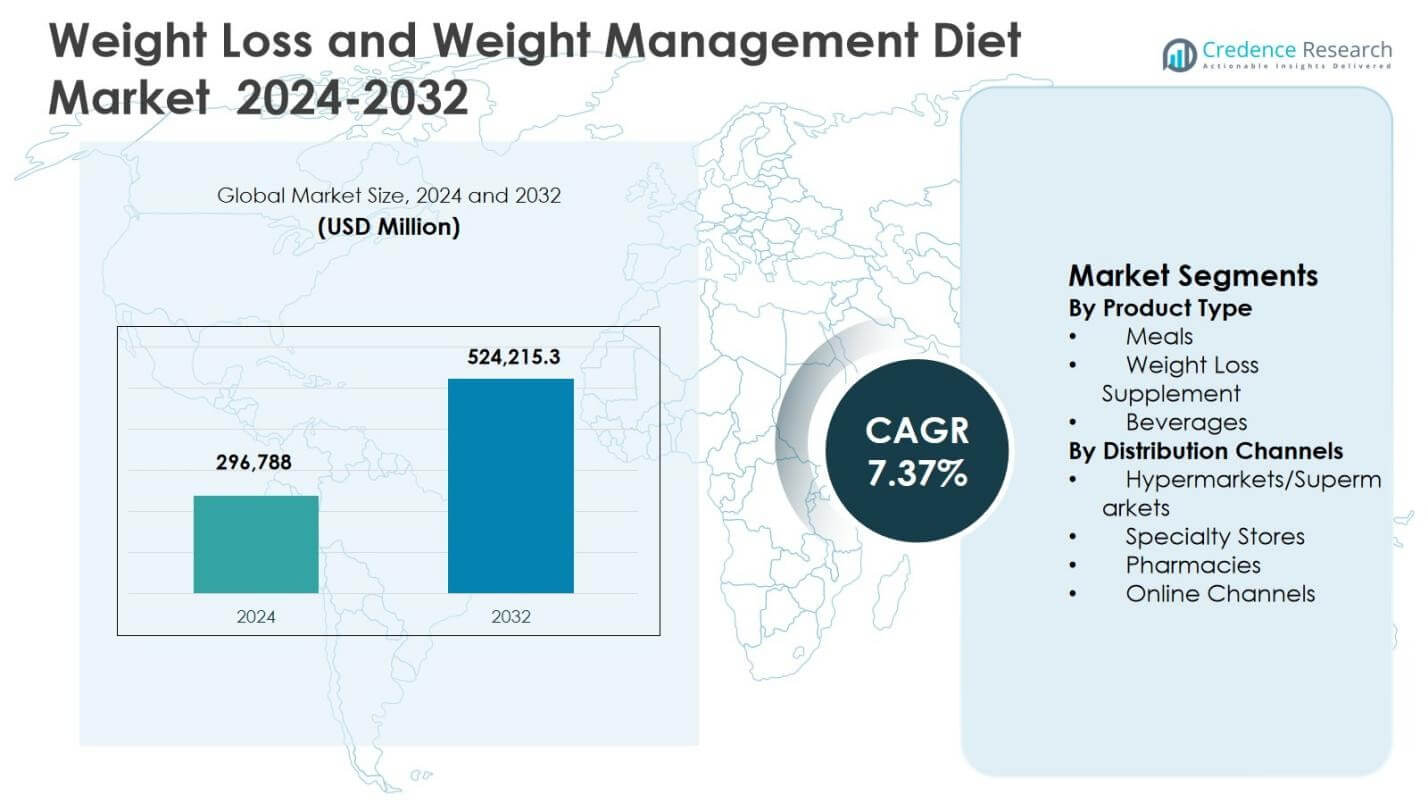
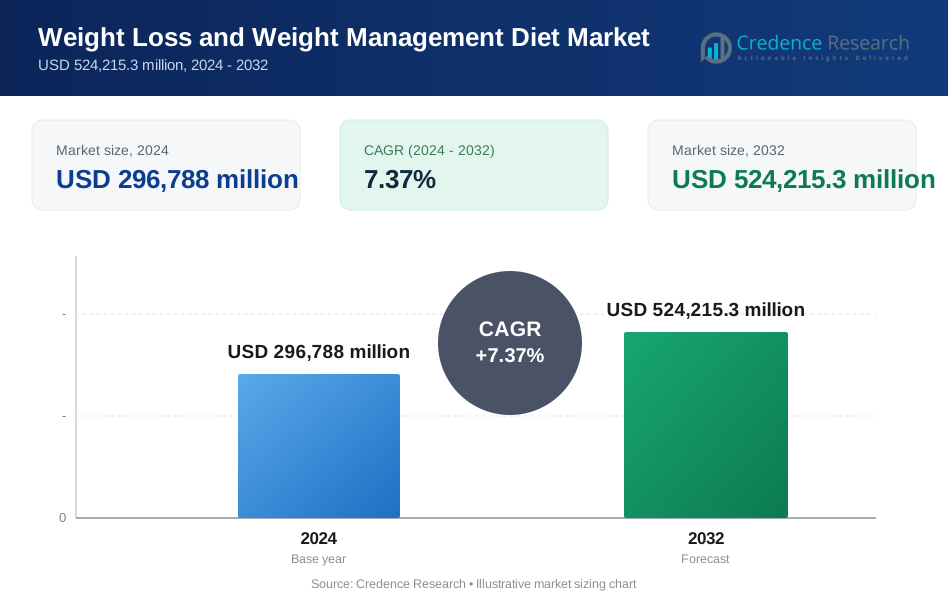
The Weight Loss and Weight Management Diet Market size was valued at USD 296,788 million in 2024 and is anticipated to reach USD 524,215.3 million by 2032, growing at a CAGR of 7.37% during the forecast period.
| REPORT ATTRIBUTE | DETAILS |
|---|---|
| Historical Period | 2020-2023 |
| Base Year | 2024 |
| Forecast Period | 2025-2032 |
| Weight Loss and Weight Management Diet Market Size 2024 | USD 296,788 million |
| Weight Loss and Weight Management Diet Market, CAGR | 7.37% |
| Weight Loss and Weight Management Diet Market Size 2032 | USD 524,215.3 million |
Weight Loss and Weight Management Diet Market Insights
- Market growth is driven by rising obesity rates, lifestyle-related disorders, and increasing preference for preventive nutrition, with structured diet programs and medically supported weight management solutions gaining strong consumer traction globally.
- Market trends indicate rising demand for personalized nutrition, digital diet platforms, clean-label formulations, and subscription-based meal programs, while meals dominated the product segment with a 42.6% share in 2024 due to higher compliance and convenience.
- Market performance is shaped by strong brand portfolios, expansion of direct-to-consumer channels, and focus on portion-controlled, high-protein, and functional diet offerings across meals, supplements, and beverages, with online channels holding a 38.9% share in 2024.
- Regional analysis shows North America leading with a 39.4% share in 2024, followed by Europe at 27.1% and Asia Pacific at 22.6%, while Latin America and Middle East & Africa collectively support incremental growth through urbanization and rising health awareness.
Weight Loss and Weight Management Diet Market Segmentation Analysis:
By Product Type:
The Weight Loss and Weight Management Diet Market by product type is led by Meals, which accounted for 42.6% market share in 2024, driven by rising demand for structured, portion-controlled, and nutritionally balanced diet solutions. Ready-to-eat and meal-replacement products appeal to time-constrained consumers seeking convenience without compromising calorie management. Strong adoption among working professionals and urban populations further supports growth. Weight loss supplements and beverages continue to expand, supported by protein-based formulations and functional ingredients, but meals remain dominant due to higher compliance rates, predictable outcomes, and strong brand penetration across developed and emerging markets.
- For instance, Nutrisystem's structured program delivered an average 11.6 pounds lost in four weeks in a clinical trial. Weight Watchers participants lost an average of 9.7 pounds (5% body weight) at six months in a clinical study.
By Distribution Channels:
The distribution channel segment is dominated by Online Channels, holding 38.9% market share in 2024, supported by increasing digital health awareness and direct-to-consumer diet programs. Subscription-based models, personalized diet plans, and easy access to product information drive higher consumer engagement online. Pharmacies and specialty stores maintain stable demand due to trust in clinically backed products, while hypermarkets and supermarkets benefit from impulse purchases and broad product availability. However, online platforms lead due to competitive pricing, doorstep delivery, and integration with mobile health and weight-tracking applications.
- For instance, Zoe provides personalized nutrition via a direct-to-consumer subscription app, where users purchase a $294 at-home test kit for gut microbiome and blood analysis, followed by a $59.99 monthly fee for tailored dietary advice, attracting over 100,000 paid subscribers.
Key Growth Drivers
Rising Global Obesity and Lifestyle-Related Disorders
The Weight Loss and Weight Management Diet Market is strongly driven by the increasing prevalence of obesity, overweight conditions, and lifestyle-related disorders, including diabetes and cardiovascular diseases. Sedentary lifestyles, urbanization, and high consumption of calorie-dense foods continue to elevate health risks across all age groups. As awareness of long-term medical complications grows, consumers are actively adopting structured diet programs and weight management solutions. Healthcare professionals increasingly recommend diet-based interventions as an essential preventive approach, supporting sustained demand for calorie-controlled meals, functional nutrition products, and evidence-based weight management plans.
- For instance, WW participants in randomized controlled trials achieved average weight losses of 3.1% to 5.5% at 12 months, outperforming control groups through its Points Tracking system combining low-calorie foods, activity monitoring, and group support.
Growing Health Awareness and Preventive Nutrition Adoption
Rising health awareness is a major driver shaping the Weight Loss and Weight Management Diet Market. Consumers are increasingly focused on preventive nutrition, long-term wellness, and body weight control rather than short-term weight loss. Digital health platforms, fitness applications, and wellness campaigns have expanded access to nutritional education, encouraging disciplined dietary habits. Increased focus on balanced macronutrient intake, clean-label formulations, and portion control further drives adoption. This shift toward proactive health management supports consistent demand for meal replacements, diet beverages, and clinically supported weight management programs.
- For instance, Herbalife Nutrition launched Fat Release in July 2022, featuring patented Litramine cactus fiber in stick packs to bind dietary fats when taken post-meal, aiding portion control in real-world dining.
Expansion of Structured Diet Programs and Medical Nutrition
The growing availability of structured diet programs and medically supervised nutrition plans is accelerating the Weight Loss and Weight Management Diet Market. Commercial diet plans, personalized meal subscriptions, and condition-specific dietary solutions provide predictable outcomes and higher compliance rates. Integration of nutrition science with behavioral coaching enhances consumer confidence and long-term adherence. Additionally, rising recommendations from healthcare providers for clinically validated weight management diets strengthen market growth. This structured approach appeals particularly to individuals seeking measurable results, supporting steady expansion across both retail and online distribution channels.
Key Trends & Opportunities
Personalization and Digital Integration in Diet Solutions
Personalized nutrition is emerging as a significant trend and opportunity within the Weight Loss and Weight Management Diet Market. Consumers increasingly demand customized diet plans based on age, metabolism, lifestyle, and health conditions. Advancements in digital platforms, mobile applications, and data analytics enable tailored meal planning, calorie tracking, and progress monitoring. Integration with wearable devices enhances engagement and accountability. This personalization trend creates opportunities for brands to offer premium subscription models, improve retention, and differentiate products through targeted nutritional solutions and technology-driven consumer experiences.
- For instance, Noom's mobile app delivers personalized coaching and behavioral support, with users logging diet and activity data for customized feedback.
Rising Demand for Clean-Label and Plant-Based Diet Products
Growing preference for clean-label, plant-based, and minimally processed foods presents strong opportunities in the Weight Loss and Weight Management Diet Market. Consumers are increasingly scrutinizing ingredient transparency, artificial additives, and sugar content while seeking natural and sustainable alternatives. Plant-based meals, protein supplements, and functional beverages aligned with weight management goals are gaining rapid traction. This trend supports innovation in ingredient sourcing, formulation, and product positioning, allowing manufacturers to align weight management benefits with ethical consumption, environmental sustainability, and long-term wellness priorities.
- For instance, Nestlé Health Science introduced weight management supplements using sustainably farmed ingredients and recyclable packaging. These clean-label products emphasize plant-derived nutrition for health and wellness needs.
Key Challenges
High Cost and Long-Term Adherence Barriers
High product costs and challenges related to long-term adherence remain key obstacles in the Weight Loss and Weight Management Diet Market. Structured diet programs, meal replacements, and personalized nutrition plans often carry premium pricing, limiting accessibility for cost-sensitive consumers. Additionally, sustaining dietary discipline over extended periods remains difficult, leading to high dropout rates. Inconsistent results and lifestyle fatigue further affect consumer confidence. These factors challenge brands to balance affordability, effectiveness, and sustained engagement to maintain long-term customer loyalty.
Regulatory Scrutiny and Consumer Trust Issues
Stringent regulatory requirements and rising scrutiny around product claims pose significant challenges for the Weight Loss and Weight Management Diet Market. Authorities closely monitor health claims, ingredient safety, and labeling accuracy, increasing compliance costs for manufacturers. Simultaneously, consumer skepticism toward exaggerated weight loss promises affects brand credibility. Negative perceptions stemming from unverified supplements and misleading marketing further complicate trust-building. To overcome these challenges, companies must prioritize transparency, clinical validation, and responsible communication to strengthen consumer confidence and ensure sustainable market growth.
Regional Analysis
North America
North America leads the Weight Loss and Weight Management Diet Market with a 39.4% market share in 2024, driven by high obesity prevalence, strong health awareness, and widespread adoption of structured diet programs. The region benefits from advanced healthcare infrastructure, high disposable income, and strong penetration of meal replacements, supplements, and digital weight management platforms. The United States dominates regional demand due to the presence of established brands, subscription-based diet plans, and growing use of personalized nutrition solutions. Increasing integration of diet programs with fitness apps and clinical guidance continues to support sustained regional growth.
Europe
Europe accounted for a 27.1% market share in 2024 in the Weight Loss and Weight Management Diet Market, supported by rising focus on preventive healthcare and balanced nutrition. Countries such as Germany, the United Kingdom, and France drive demand through structured meal programs, pharmacy-led diet solutions, and growing adoption of clean-label products. Strong regulatory oversight enhances consumer trust in diet-based weight management offerings. Increasing awareness of lifestyle-related diseases and emphasis on long-term wellness rather than rapid weight loss further support stable market expansion across both Western and Eastern European economies.
Asia Pacific
Asia Pacific captured a 22.6% market share in 2024 in the Weight Loss and Weight Management Diet Market, reflecting rapid urbanization, changing dietary habits, and increasing obesity rates in countries such as China, India, and Japan. Rising middle-class income and growing exposure to global wellness trends are accelerating adoption of weight management diets. The region shows strong growth in online channels and functional beverages tailored to local preferences. Increasing government health initiatives and expanding digital health ecosystems further strengthen regional demand for affordable and scalable diet-based weight management solutions.
Latin America
Latin America held a 6.8% market share in 2024 in the Weight Loss and Weight Management Diet Market, driven by increasing awareness of obesity-related health risks and growing urban populations. Brazil and Mexico represent key markets due to rising lifestyle diseases and expanding retail access to diet meals and supplements. Demand is supported by improving healthcare access and increasing influence of fitness culture. While affordability remains a constraint, growing online sales channels and localized diet programs are enhancing product accessibility and supporting gradual regional market expansion.
Middle East & Africa
The Middle East & Africa region accounted for a 4.1% market share in 2024 in the Weight Loss and Weight Management Diet Market. Growth is driven by rising obesity prevalence, particularly in Gulf countries, supported by higher disposable income and increasing wellness awareness. Demand is concentrated in urban centers, with growing interest in structured diet plans and meal replacements. In Africa, market growth remains moderate due to price sensitivity, but improving healthcare infrastructure and digital penetration are gradually expanding access to weight management diet solutions across the region.
Weight Loss and Weight Management Diet Market Segmentations:
By Product Type
- Meals
- Weight Loss Supplement
- Beverages
By Distribution Channels
- Hypermarkets/Supermarkets
- Specialty Stores
- Pharmacies
- Online Channels
By Geography
- North America
- U.S.
- Canada
- Mexico
- Europe
- Germany
- France
- U.K.
- Italy
- Spain
- Rest of Europe
- Asia Pacific
- China
- Japan
- India
- South Korea
- South-east Asia
- Rest of Asia Pacific
- Latin America
- Brazil
- Argentina
- Rest of Latin America
- Middle East & Africa
- GCC Countries
- South Africa
- Rest of the Middle East and Africa
Competitive Landscape
Competitive landscape analysis of the Weight Loss and Weight Management Diet Market highlights the presence of established food, nutrition, and wellness companies with diversified product portfolios and strong brand equity. PepsiCo, The Kraft Heinz Company, General Mills Inc., Kellogg Company, Abbott Laboratories Inc., Cargill, Ingredion, Medifast Inc., Nutrisystem Inc., and W.W. International Inc. form the core group of key participants shaping market dynamics. These companies compete through portfolio expansion, product reformulation, and targeted weight management solutions across meals, supplements, and beverages. Strategic focus remains on clean-label ingredients, high-protein formulations, and portion-controlled offerings to improve consumer adherence. Digital engagement, subscription-based programs, and direct-to-consumer models are increasingly used to enhance customer retention. Companies also invest in clinical validation, personalized nutrition platforms, and regional expansion to strengthen market positioning. Innovation, brand trust, and distribution reach remain critical factors influencing competitive intensity and long-term growth.
Key Player Analysis
- Ingredion
- W.W. International Inc.
- General Mills Inc.
- Medifast Inc.
- PepsiCo
- Kellogg Compan
- Nutrisystem Inc.
- The Kraft Heinz Company
- Cargill
- Abbott Laboratories Inc.
Recent Developments
- In December 2025, Carbyne Equity Partners acquired SuanNutra, a nutraceutical ingredients supplier featuring Metabolaid for weight management, to expand in the sector.
- In July 2025, Herbalife launched MultiBurn™, a science-backed weight loss supplement designed to support metabolic health and healthy fat reduction.
- In December 2025, Weight Watchers introduced a fully integrated GLP-1 era platform combining medical programs, behavior support, coaching, and digital tools to enhance weight-loss outcomes.
Report Coverage
The research report offers an in-depth analysis based on Product Type, Distribution Channel and Geography. It details leading market players, providing an overview of their business, product offerings, investments, revenue streams, and key applications. Additionally, the report includes insights into the competitive environment, SWOT analysis, current market trends, as well as the primary drivers and constraints. Furthermore, it discusses various factors that have driven market expansion in recent years. The report also explores market dynamics, regulatory scenarios, and technological advancements that are shaping the industry. It assesses the impact of external factors and global economic changes on market growth. Lastly, it provides strategic recommendations for new entrants and established companies to navigate the complexities of the market.
Future Outlook
- The Weight Loss and Weight Management Diet Market will continue expanding due to sustained global focus on obesity reduction and preventive healthcare.
- Demand for structured, portion-controlled meal solutions will increase as consumers seek predictable and sustainable weight outcomes.
- Personalized nutrition based on lifestyle, age, and metabolic needs will gain stronger adoption across both online and clinical channels.
- Digital platforms and mobile applications will play a critical role in diet tracking, engagement, and long-term adherence.
- Clean-label, plant-based, and low-sugar formulations will see rising preference among health-conscious consumers.
- Subscription-based and direct-to-consumer models will strengthen brand loyalty and recurring revenue streams.
- Integration of diet programs with fitness, mental wellness, and behavioral coaching will improve consumer success rates.
- Emerging economies will present strong growth opportunities driven by urbanization and increasing health awareness.
- Regulatory compliance and clinical validation will become essential for maintaining consumer trust and market credibility.
- Continuous product innovation and ingredient optimization will remain central to long-term market differentiation.
Request a Free Sample
Fill in your details and we'll send you a free sample report.
- Sample data tables & charts
- Research methodology
Need a Custom Version of This Report?
Tailor the scope, geography, or segments to your exact requirements.
- Custom geography or segment scope
- Direct access to our analyst team
Frequently Asked Questions
What is the current market size for the Weight Loss and Weight Management Diet Market, and what is its projected size in 2032?
At what Compound Annual Growth Rate is the Weight Loss and Weight Management Diet Market projected to grow between 2024 and 2032?
Which Weight Loss and Weight Management Diet Market segment held the largest share in 2024?
What are the primary factors fueling the growth of the Weight Loss and Weight Management Diet Market?
Who are the leading companies in the Weight Loss and Weight Management Diet Market?
Which region commanded the largest share of the Weight Loss and Weight Management Diet Market in 2024?
Table of Content
Chapter 1. Report Introduction
- 1.1 Report Description & Purpose
- 1.1.1 Report Title & Market Definition
- 1.1.2 Unique Selling Propositions (USP) & Key Differentiators
- 1.1.3 Value Proposition for Stakeholders
- 1.2 Research Objectives
- 1.2.1 Market Sizing Objectives (Volume & Revenue)
- 1.2.2 Segmentation Objectives
- 1.2.3 Competitive Intelligence Objectives
- 1.2.4 Forecast & Scenario Objectives
- 1.3 Report Scope
- 1.3.1 Weight Loss and Weight Management Diet Scope – Types & Subtypes Covered
- 1.3.2 Geographic Scope – Regions & Countries Covered
- 1.3.3 Historical Period, Base Year & Forecast Period (2024; forecast to 2032)
- 1.3.4 Inclusions & Exclusions
- 1.4 HS Code & Classification Framework
- 1.5 Currency, Units & Pricing Basis
- 1.6 Target Stakeholders
- 1.7 Limitations & Assumptions
Chapter 2. Executive Summary
- 2.1 Global Weight Loss and Weight Management Diet Market Snapshot
- 2.1.1 Market Size – Historical (2024) & Forecast (2024-2032) (2024: USD 296,788 million → 2032: USD 524,215.3 million)
- 2.1.2 Volume & Revenue – Global Totals
- 2.1.3 Key Market Highlights – Top Five Facts
- 2.2 Weight Loss and Weight Management Diet Market Segmentation Snapshot
- 2.2.1 Market Split by Region – 2024 vs. 2032
- 2.3 Competitive Snapshot
- 2.3.1 Top 10 Players by Revenue Share – 2024
- 2.3.2 Top 10 Players by Volume Share – 2024
- 2.3.3 Recent Strategic Developments (18-Month Summary)
- 2.4 Key Investment Highlights & Strategic Conclusions
Chapter 3. Weight Loss and Weight Management Diet Market Dynamics & Industry Analysis
- 3.1 Market Overview & Context
- 3.1.1 Weight Loss and Weight Management Diet Market Position in the Broader Automotive Value Chain
- 3.1.2 OEM vs. Replacement Market Dynamics
- 3.1.3 Market Maturity & Development Stage by Region
- 3.2 Weight Loss and Weight Management Diet Market Drivers
- 3.3 Weight Loss and Weight Management Diet Market Restraints & Challenges
- 3.4 Weight Loss and Weight Management Diet Market Opportunities
- 3.5 Porter's Five Forces Analysis
- 3.5.1 Threat of New Entrants
- 3.5.2 Bargaining Power of Suppliers
- 3.5.3 Bargaining Power of Buyers
- 3.5.4 Threat of Substitutes
- 3.5.5 Competitive Rivalry – Intensity Assessment
- 3.6 Weight Loss and Weight Management Diet Value Chain Analysis
- 3.6.1 Upstream – Raw Material/Input Suppliers
- 3.6.1.1 Raw Material/Input 1
- 3.6.1.2 Raw Material/Input 2
- 3.6.1.3 Raw Material/Input 3
- 3.6.2 Midstream – Production/Manufacturing/Service Delivery
- 3.6.2.1 Production/Process Overview
- 3.6.2.2 Key Facility Locations & Capacity by Manufacturer
- 3.6.3 Downstream – Distribution & End Consumer
- 3.6.3.1 Primary Channel – B2B/OEM
- 3.6.3.2 Secondary Channels – Dealer, Retail, Online, Direct
- 3.6.4 Value Chain Profitability Analysis
- 3.6.1 Upstream – Raw Material/Input Suppliers
- 3.7 PESTEL Analysis
- 3.7.1 Political Factors
- 3.7.2 Economic Factors
- 3.7.3 Social Factors
- 3.7.4 Technological Factors
- 3.7.5 Environmental Factors
- 3.7.6 Legal Factors
- 3.8 Weight Loss and Weight Management Diet Supply Chain Analysis
- 3.8.1 Raw Material/Input Supply Risk Assessment
- 3.8.2 Manufacturing Concentration Risk (Geographic Exposure)
- 3.8.3 Trade Disruption Impact Analysis
- 3.9 Regulatory & Policy Landscape
Note: The regulatory and policy landscape section covers regulations based on their applicability to the market, Weight Loss and Weight Management Diet category, geography, and scope of the study. Only regulatory frameworks with a material impact on operations, compliance, trade, sustainability, or market access are analyzed in detail.
Chapter 4. Key Investment Pockets & Opportunity Analysis
- 4.1 Weight Loss and Weight Management Diet Market Attractiveness Analysis
- 4.1.1 By Region – Investment Attractiveness Matrix (Volume × CAGR)
- 4.2 Absolute Revenue Growth Opportunity
- 4.2.1 By Region – Absolute USD Growth Through 2032
- 4.3 Incremental Volume Opportunity
- 4.3.1 By Region – Incremental Volume Through 2032
- 4.3.2 Segment – Incremental Volume
- 4.4 Emerging Submarket Opportunity Deep Dive (Subject to Applicability)
- 4.5 Emerging Market Opportunity Scorecards
- 4.5.1 United States
- 4.5.2 Europe
- 4.5.3 Asia
- 4.5.4 Middle East & Africa
Note: Emerging Market Opportunity Scorecards will be included based on relevance and strategic importance. Regions listed are indicative and may vary depending on data availability and market dynamics.
Chapter 5. Weight Loss and Weight Management Diet Import-Export Analysis & Trade Flows
- 5.1 Global Trade Overview
- 5.1.1 Global Export Value by Country (2024)
- 5.1.2 Global Export Volume by Country (2024)
- 5.1.3 Global Import Value by Country (2024)
- 5.1.4 Global Import Volume by Country (2024)
- 5.1.5 Net Trade Balance by Country (2024)
- 5.2 Export Analysis – Segment
- 5.2.1 Type 1 (HS Code)
- 5.2.2 Type 2 (HS Code)
- 5.2.3 Type 3 (HS Code)
- 5.2.4 Type 4 (HS Code)
- 5.2.5 Type 5 (HS Code)
- 5.3 Import Analysis – Segment
- 5.3.1 Type 1 (HS Code)
- 5.3.2 Type 2 (HS Code)
- 5.3.3 Type 3 (HS Code)
- 5.3.4 Type 4 (HS Code)
- 5.3.5 Type 5 (HS Code)
- 5.4 Average Unit Trade Prices
- 5.4.1 Average Export Price – Segment & Country
- 5.4.2 Average Import Price – Segment & Source Country
- 5.4.3 Price Trends (2024)
- 5.5 Key Trade Route Analysis
- 5.5.1 Trade Route 1
- 5.5.2 Trade Route 2
- 5.5.3 Trade Route 3
- 5.5.4 Trade Route 4
- 5.5.5 Trade Route 5
- 5.6 Trade Policy Impact Assessment
- 5.6.1 US Anti-Dumping & Section 301 Tariffs
- 5.6.2 EU Customs Union Impact
- 5.6.3 Major Free Trade Agreements
- 5.6.4 USMCA Rules of Origin
Note: Trade policy analysis will be included only where relevant to the Weight Loss and Weight Management Diet market.
Chapter 6. Competitive Landscape & Company Benchmarking
- 6.1 Weight Loss and Weight Management Diet Market Concentration & Structure
- 6.1.1 Herfindahl-Hirschman Index (HHI) – vs. 2024
- 6.1.2 Tier 1, Tier 2 & Tier 3 Market Structure
- 6.1.3 Global, Regional & Local Player Dynamics
- 6.2 Weight Loss and Weight Management Diet Market Share Analysis – 2024
- 6.2.1 Global Revenue Share by Company
- 6.2.2 Global Volume Share by Company
- 6.2.3 Regional Revenue Share
- 6.2.4 Market Share Evolution ( vs. 2024)
- 6.2.5 OEM Segment Share by Company
- 6.2.6 Replacement Segment Share by Company
- 6.3 Production/Delivery Capacity & Facility Analysis
- 6.3.1 Global Installed Capacity
- 6.3.2 Capacity Utilization Rates
- 6.3.3 Production/Output Volume
- 6.3.4 Facility Locations & Capacity Map
- 6.3.5 Planned Capacity Additions
- 6.4 Weight Loss and Weight Management Diet Competitive Benchmarking Matrix
- 6.4.1 Revenue, Volume, CAGR & Profitability Comparison
- 6.4.2 Channel Revenue Mix
- 6.4.3 Geographic Revenue Exposure
- 6.4.4 R&D Intensity
- 6.4.5 Sustainability Maturity
- 6.5 Strategic Developments in Weight Loss and Weight Management Diet (Last 24 Months)
- 6.5.1 Mergers, Acquisitions & Divestments
- 6.5.2 New Weight Loss and Weight Management Diet Launches
- 6.5.3 Facility Expansions
- 6.5.4 Strategic Alliances, Joint Ventures & Partnerships
- 6.5.5 Distribution Expansion & Market Entry
- 6.5.6 Sustainability & ESG Initiatives
- 6.6 Competitive Strategy Mapping
- 6.6.1 Leader, Challenger, Follower & Niche Classification
- 6.6.2 Pricing Strategy Comparison
- 6.6.3 Channel Strategy Matrix
Note: Strategic developments are included based on their materiality and the availability of reliable information.
Chapter 7. Global Weight Loss and Weight Management Diet Market – By Distribution Channel
- 7.1 Segment Overview
- 7.1.1 Volume & Revenue Split by Channel (2024 & 2032)
- 7.1.2 Channel Mix Evolution (2024-2032)
Chapter 8. Regional Market Analysis – Global Overview
- 8.1 Global Regional Overview
- 8.1.1 Regional Volume Share
- 8.1.2 Regional Revenue Share
- 8.1.3 Regional Volume by Region
- 8.1.4 Regional Revenue by Region
- 8.1.5 Regional Forecast Through 2032
- 8.2 Cross-Regional Segment Analysis
- 8.2.1 By Distribution Channel
- 8.2.2 By Brand/Price Tier
Chapter 9. North America Weight Loss and Weight Management Diet Market
- 9.1 United States
- 9.2 Canada
- 9.3 Mexico
Chapter 10. Europe Weight Loss and Weight Management Diet Market
- 10.1 Germany
- 10.2 France
- 10.3 Italy
- 10.4 United Kingdom
- 10.5 Spain
- 10.6 Poland
- 10.7 Russia
- 10.8 Netherlands
- 10.9 Belgium
- 10.10 Sweden
- 10.11 Denmark
- 10.12 Norway
- 10.13 Rest of Europe
Chapter 11. Asia Pacific Weight Loss and Weight Management Diet Market
- 11.1 China
- 11.2 India
- 11.3 Japan
- 11.4 South Korea
- 11.5 Thailand
- 11.6 Indonesia
- 11.7 Vietnam
- 11.8 Malaysia
- 11.9 Australia
- 11.10 Rest of Asia Pacific
Chapter 12. Latin America Weight Loss and Weight Management Diet Market
- 12.1 Brazil
- 12.2 Argentina
- 12.3 Colombia
- 12.4 Chile
- 12.5 Rest of Latin America
Chapter 13. Middle East Weight Loss and Weight Management Diet Market
- 13.1 Saudi Arabia
- 13.2 United Arab Emirates
- 13.3 Turkey
- 13.4 Israel
- 13.5 Iran
- 13.6 Rest of the Middle East
Chapter 14. Africa Weight Loss and Weight Management Diet Market
- 14.1 South Africa
- 14.2 Egypt
- 14.3 Nigeria
- 14.4 Morocco
- 14.5 Rest of Africa
Chapter 15. Weight Loss and Weight Management Diet Company Profiles
- 15.1 [Company 01]
- 15.1.1 Company Overview
- 15.1.2 Key Management Personnel
- 15.1.3 Products & Services Portfolio
- 15.1.4 Financial Performance
- 15.1.5 Key Market Focus & Geographic Presence
- 15.1.6 Recent Developments & Strategic Initiatives
Note: The company profile list is preliminary and may change based on research findings, market developments, data availability, and client requirements.
Chapter 16. Appendices
- Appendix A – List of Abbreviations & Acronyms
- Appendix B – Industry Classification Code Reference – Full Series
- Appendix C – Production & Capacity Data Tables
- Appendix D – End-Use & Demand Base Tables
- Appendix E – Consumption & Replacement Rate Assumptions
- Appendix F – ASP Reference Tables
- Appendix G – Manufacturing & Facility Database
- Appendix H – Import-Export Data Tables
- Appendix I – Regulatory Summary Tables
- Appendix J – Primary Research Participant List (Anonymized)
- Appendix K – Primary Research Questionnaire Framework
- Appendix L – Data Sources & Bibliography
- Appendix M – Market Size Divergence & Source Comparison
Chapter 17. Research Methodology
- 17.1 Research Framework & Philosophy
- 17.2 Secondary Research – Sources, Hierarchy & Data Extraction
- 17.3 Data Modeling – Bottom-Up & Top-Down Market Sizing
- 17.4 Primary Research – Stakeholder Framework, LOI & Sample Sizes
- 17.5 Forecast Methodology – Regression, Scenario & Sensitivity Analysis
- 17.6 Quality Control – Four-Layer Validation Framework
- 17.7 Limitations & Standard Assumptions
- 17.8 Disclaimer
