
| REPORT ATTRIBUTE | DETAILS |
|---|---|
| Historical Period | 2020-2023 |
| Base Year | 2024 |
| Forecast Period | 2025-2032 |
| Breast Pump Market Size 2024 | USD 3100.09 Million |
| Breast Pump Market, CAGR | 7.93% |
| Breast Pump Market Size 2032 | USD 5708.36 Million |
Market Overview:
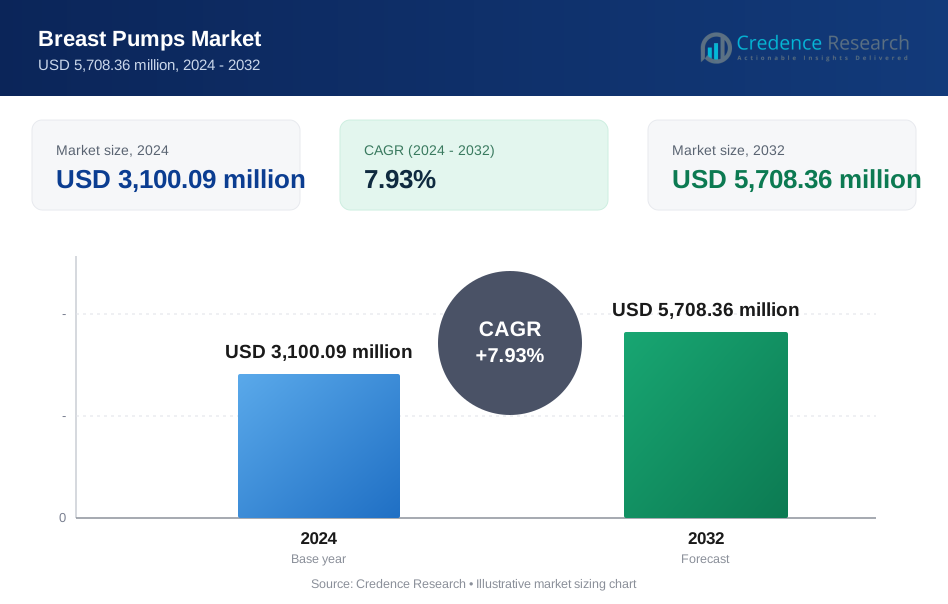
Breast Pump Market size was valued at USD 3100.09 million in 2024 and is anticipated to reach USD 5708.36 million by 2032, at a CAGR of 7.93% during the forecast period (2024-2032).
Key market drivers include a rising focus on maternal and infant health, which has been bolstered by healthcare initiatives promoting breastfeeding. Governments and healthcare organizations are increasingly supporting breastfeeding through various campaigns, encouraging the use of breast pumps. Additionally, the increasing number of women entering the workforce, coupled with the need for more flexible breastfeeding solutions, has heightened the demand for electric and manual breast pumps. Innovations such as hands-free and wearable breast pumps are further enhancing the market’s appeal, providing greater convenience and comfort for mothers. Moreover, the growing availability of breast pumps through online and retail channels is making these devices more accessible to a wider demographic. Increasing disposable income and the expansion of maternity care services are also contributing to market growth, allowing more consumers to afford and prioritize these devices.
Geographically, North America holds the largest share of the breast pump market, driven by high healthcare spending and widespread adoption of advanced breastfeeding solutions. With a well-established healthcare infrastructure, North America continues to lead in technological innovations and product developments. Europe follows closely, with a strong emphasis on maternal health initiatives and increasing awareness about the benefits of breastfeeding. Additionally, government-backed maternity programs in the region are further supporting market growth. The Asia Pacific region is expected to witness the highest growth rate due to rising healthcare expenditures, expanding urban populations, and increasing working mothers in countries such as China and India. Growing urbanization and improving healthcare policies are also playing a significant role in this expansion. Latin America and the Middle East & Africa are also witnessing a gradual increase in demand, driven by improved healthcare access, rising disposable incomes, and growing awareness about maternal and child health.
Market Insights:
- The breast pump market size was valued at USD 3,100.09 million in 2024 and is projected to reach USD 5,708.36 million by 2032, growing at a CAGR of 7.93%.
- Key market drivers include the rising focus on maternal and infant health, government-backed breastfeeding initiatives, and the increasing number of working mothers requiring flexible breastfeeding solutions.
- Technological advancements such as hands-free and wearable breast pumps are gaining traction, providing more convenience and comfort for mothers.
- North America holds the largest market share of 40%, driven by high healthcare spending and widespread adoption of advanced breastfeeding solutions.
- The Asia Pacific region is expected to witness the highest growth rate, fueled by rising disposable incomes, urbanization, and a growing number of working mothers.
- High initial costs and ongoing maintenance for electric and smart pumps pose challenges to adoption, particularly in emerging markets.
- Product complexity and inadequate consumer education about usage and maintenance can deter potential users, necessitating clearer instructions and customer support.
Market Drivers:
Growing Focus on Maternal and Infant Health:
A primary driver of the breast pump market is the increasing focus on maternal and infant health. Health organizations worldwide, such as the World Health Organization (WHO) and UNICEF, strongly advocate breastfeeding for its proven benefits for both mothers and infants. As awareness of these benefits grows, healthcare systems are promoting breastfeeding practices, thereby boosting demand for breast pumps. Healthcare initiatives, campaigns, and educational programs emphasize the importance of breastfeeding, particularly in the early stages of a child's life, contributing to greater adoption of breastfeeding devices. This focus on maternal health has led to greater product development and innovation within the breast pump industry, with manufacturers continuously enhancing the functionality and user-friendliness of breast pumps to meet the needs of mothers.
Increasing Number of Working Mothers:
The growing number of women in the workforce has led to an increased demand for breastfeeding solutions that accommodate busy lifestyles. For instance, UNICEF's "Mothers@Work" initiative in Bangladesh has implemented breastfeeding-friendly policies in factories such as Dulal Brothers Limited and Vision Apparel. As more women return to work shortly after childbirth, they seek convenient ways to continue breastfeeding while managing their careers. This demand has significantly driven the adoption of electric and manual breast pumps, which allow mothers to express milk efficiently and feed their infants while they are at work. The shift towards flexible and portable breastfeeding solutions has given rise to hands-free, wearable breast pumps that cater to the needs of working mothers, enabling them to pump discreetly and comfortably during their daily activities. The growing number of working mothers has become one of the most prominent drivers of breast pump market growth.
Technological Advancements in Breast Pumps:
Technological innovation plays a significant role in the market’s growth, as manufacturers are continuously developing advanced breast pumps to enhance comfort, efficiency, and convenience for users. For instance, Willow Innovations introduced the Willow 360 wearable breast pump system with enhanced leak-proof technology and a user-friendly app that tracks pumping sessions and milk production. Smart breast pumps, which are equipped with Bluetooth capabilities, mobile apps, and customizable settings, are becoming increasingly popular. These pumps offer real-time monitoring and data collection, providing mothers with more control over their breastfeeding routine. Additionally, the development of quieter, faster, and more energy-efficient breast pumps has improved the overall user experience. These innovations are helping to address the challenges faced by breastfeeding mothers and are driving the adoption of more sophisticated and effective breast pump solutions in the market.
Rise in Disposable Income and Healthcare Access:
The increasing disposable income of consumers, especially in developing regions, is another crucial factor contributing to the growth of the breast pump market. As disposable income rises, more families are able to afford quality healthcare products, including breast pumps. This trend is particularly notable in emerging economies, where improving living standards and better access to healthcare services are allowing more mothers to invest in breast pumps. Furthermore, the expansion of healthcare infrastructure in developing regions has improved access to maternal care and breastfeeding products. As awareness grows and access improves, the market for breast pumps is expected to expand significantly, particularly in regions like Asia Pacific, Latin America, and the Middle East & Africa.
Market Trends:
Shift Toward Smart and Connected Devices:
A key trend in the breast pump market is the increasing adoption of smart, connected devices. Many modern breast pumps are now equipped with Bluetooth technology and mobile apps that enable mothers to track their milk production, customize settings, and monitor pumping sessions in real time. These innovations offer greater convenience and flexibility for mothers, allowing them to integrate pumping into their busy lifestyles. Smart pumps also provide detailed insights into the pumping process, which can help optimize milk production. The growing demand for such advanced, data-driven devices is reshaping the market, appealing to tech-savvy consumers seeking enhanced functionality and user experience.
Hands-Free and Wearable Breast Pumps:
Another emerging trend is the rising popularity of hands-free and wearable breast pumps. These devices allow mothers to pump while remaining mobile and engaged in other activities. Hands-free pumps are designed for comfort and convenience, offering mothers the ability to express milk discreetly while at work or on the go. For instance, the Willow Generation 3 and Elvie wearable electric breast pump have gained significant attention for their discreet design and advanced features, such as mobile app connectivity to track milk volume and pumping sessions. This trend is particularly significant for working mothers and those who lead busy lifestyles, as it supports continued breastfeeding while offering greater flexibility. As more manufacturers introduce portable and discreet pumping solutions, this segment of the market continues to expand.
Eco-Friendly and Sustainable Products:
Sustainability has become a notable trend within the breast pump market. With increasing awareness of environmental issues, many consumers are opting for eco-friendly products. Manufacturers are responding to this demand by producing breast pumps with recyclable materials and offering products that are energy-efficient. For example, Medela has developed breast pumps with reusable parts that align with the broader movement toward reducing waste. Additionally, there is a growing interest in reusable breast pump parts and accessories, which aligns with the broader movement toward reducing waste. This trend is gaining traction as both consumers and manufacturers aim to reduce their environmental footprint.
Expansion of Distribution Channels:
The accessibility of breast pumps is another current trend, with a growing emphasis on expanding distribution channels. Online platforms, retail stores, and pharmacies are increasingly offering a wide range of breast pump models to cater to diverse consumer needs. E-commerce platforms have made it easier for customers to access a variety of products and compare features, thus driving sales. As the market continues to expand, the accessibility and convenience of purchasing breast pumps are becoming essential for meeting consumer demands.
Market Challenges Analysis:
High Initial Cost and Maintenance:
One of the key challenges facing the breast pump market is the high initial cost of advanced devices, particularly electric and smart pumps. For instance, in the United Kingdom, the National Health Service (NHS) has been noted for providing free breast pumps worth around £40 to support breastfeeding mothers, which highlights efforts to address cost barriers. Many of these pumps can be expensive, making them inaccessible for certain demographics, particularly in lower-income regions. Additionally, the ongoing costs associated with replacing parts such as valves, membranes, and bottles can add up, further increasing the overall financial burden on consumers. While breast pumps offer long-term benefits for breastfeeding mothers, the initial investment and maintenance costs can deter some potential buyers from investing in high-quality, long-lasting products. This challenge is compounded by the lack of adequate insurance coverage for breast pumps in some regions, limiting access for those who could benefit from these devices the most. Moreover, the high cost can be a significant barrier in emerging markets, where disposable income is lower, limiting the adoption of these devices.
Product Complexity and Consumer Education:
Another challenge is the complexity of some breast pump models, which may discourage new users. While technological advancements have enhanced functionality, not all consumers are well-versed in operating high-tech devices like smart or wearable breast pumps. This lack of familiarity can create a barrier to adoption, especially for first-time mothers who may feel overwhelmed by the variety of options available. Additionally, inadequate consumer education about the proper use, cleaning, and maintenance of breast pumps can lead to product inefficiencies, reduced lifespan, and hygiene concerns. To overcome this challenge, manufacturers need to provide clearer instructions, educational resources, and customer support to ensure users are comfortable with their products and can fully benefit from their features. As the market expands, ensuring a seamless and supportive user experience will be crucial for long-term success.
Market Opportunities:
The breast pump market presents significant opportunities due to the increasing demand for flexible and convenient breastfeeding solutions. As more women enter the workforce, there is a rising need for products that enable them to continue breastfeeding while balancing their careers. The growing awareness of the benefits of breastfeeding, coupled with the shift towards more accessible and portable devices, opens up opportunities for manufacturers to innovate. The development of hands-free, wearable, and compact breast pumps that allow mothers to pump discreetly while on the go is a key area of opportunity. Additionally, advancements in smart breast pump technology, which enable users to track their milk production and customize pumping sessions, are driving demand for more sophisticated solutions. The market is also benefiting from the increasing availability of these products through online platforms, making it easier for consumers to access a variety of options.
Emerging markets offer substantial growth opportunities as rising disposable incomes and improved healthcare access drive demand for breast pumps. In regions such as Asia Pacific, Latin America, and the Middle East, increasing awareness about maternal health, coupled with the expansion of healthcare services, is creating a fertile environment for market growth. Manufacturers can capitalize on this opportunity by tailoring their products to meet the specific needs of these regions, such as offering cost-effective models and enhancing distribution channels. As healthcare infrastructure improves and the focus on maternal well-being intensifies, the breast pump market is expected to see continued expansion globally.
Market Segmentation Analysis:
By Product
The breast pump market is primarily segmented into electric, manual, and battery-operated breast pumps. Electric breast pumps dominate the market due to their convenience, efficiency, and ability to express milk faster. These devices are particularly popular among working mothers and those seeking more advanced features, such as customizable settings and smart technology. Manual pumps, while less expensive, remain a viable option for mothers seeking portability and simplicity. Battery-operated pumps bridge the gap between electric and manual options, offering increased mobility and convenience for on-the-go use.
By Application
The breast pump market is segmented into hospital-grade and personal-use applications. Hospital-grade pumps are designed for mothers with specific medical needs or those who require frequent use of the device. These pumps are highly efficient and are often rented from healthcare facilities. Personal-use pumps, on the other hand, are designed for everyday use by mothers who need to express milk at home or work. This segment is growing rapidly, driven by the increasing number of working mothers and the demand for convenient, portable pumping solutions.
By Technology
The technology segment of the breast pump market includes manual, electric, and smart breast pumps. Electric breast pumps are further divided into single and double pumps, with double pumps being more efficient for faster milk expression. Smart breast pumps, which feature Bluetooth connectivity and mobile app integration, are gaining popularity due to their enhanced functionality and real-time monitoring capabilities. These advanced features offer mothers greater control over their breastfeeding routines and contribute to the segment’s growth.
Segmentations:
By Product- Electric Breast Pumps
- Manual Breast Pumps
- Battery-operated Breast Pumps
- Hospital-grade Breast Pumps
- Personal-use Breast Pumps
- Manual Breast Pumps
- Electric Breast Pumps
- Smart Breast Pumps (Bluetooth-enabled, mobile app integration)
- North America
- U.S.
- Canada
- Mexico
- Europe
- UK
- France
- Germany
- Italy
- Spain
- Russia
- Belgium
- Netherlands
- Austria
- Sweden
- Poland
- Denmark
- Switzerland
- Rest of Europe
- Asia Pacific
- China
- Japan
- South Korea
- India
- Australia
- Thailand
- Indonesia
- Vietnam
- Malaysia
- Philippines
- Taiwan
- Rest of Asia Pacific
- Latin America
- Brazil
- Argentina
- Peru
- Chile
- Colombia
- Rest of Latin America
- Middle East
- UAE
- KSA
- Israel
- Turkey
- Iran
- Rest of Middle East
- Africa
- Egypt
- Nigeria
- Algeria
- Morocco
- Rest of Africa
Regional Analysis:
North America
North America holds the largest share of the global breast pump market, accounting for 40% of the total market share. The region's dominance is driven by high healthcare spending, advanced healthcare infrastructure, and a well-established maternal health awareness culture. Additionally, a large number of working mothers and the increasing adoption of smart, wearable, and electric breast pumps have contributed to the market's growth. With widespread availability of breast pumps in retail stores and online platforms, North America has emerged as a key market for premium, technologically advanced products. The region also benefits from robust support for breastfeeding initiatives by healthcare organizations, further bolstering demand. As innovation continues in smart breast pumps, North America is expected to maintain its position as the largest market in the coming years. Moreover, the growing focus on postnatal care and the increasing number of breastfeeding-friendly policies in workplaces are expected to further accelerate market growth.
Europe
Europe holds the second-largest share, contributing 30% to the global breast pump market. The region’s strong emphasis on maternal health and breastfeeding has led to widespread adoption of breast pumps, particularly in countries such as Germany, France, and the UK. Increasing government support for breastfeeding, coupled with growing awareness of its benefits, has boosted the market. Moreover, the availability of a wide range of affordable and advanced breast pumps through online and retail channels is driving sales. The rise in disposable income and the increasing number of working mothers in Europe further support the market's growth. The region is also witnessing a shift towards more eco-friendly and sustainable breast pump options, in line with broader environmental trends. As Europe continues to invest in maternal health, the breast pump market is expected to expand steadily. Additionally, regional regulations promoting breastfeeding support in healthcare systems are creating a conducive environment for further market penetration.
Asia Pacific
The Asia Pacific region is projected to experience the highest growth rate, with a market share of 20%. The increase in disposable income, urbanization, and healthcare expenditures in countries like China, India, and Japan are major factors driving market expansion. The rising number of working mothers in these countries, coupled with greater access to healthcare products, is propelling the demand for breast pumps. Additionally, as more women in the region become aware of the health benefits of breastfeeding, the adoption of breast pumps is expected to rise. Manufacturers are focusing on tailoring products to the preferences and needs of consumers in the Asia Pacific market, including more affordable and portable solutions. As maternal care services continue to improve across the region, the breast pump market is poised for significant growth in the coming years. Increased government initiatives aimed at promoting breastfeeding and improving healthcare access further support the anticipated growth trajectory.
Key Player Analysis:
- Ardo medical AG
- KISSBOBO
- Ameda (International Biomedical, Ltd.)
- Hygeia Health
- Medela AG
- Willow Innovations, Inc.
- Uzin Medicare (Spectra Baby)
- Koninklijke Philips N.V.
- Lansinoh Laboratories, Inc. (Pigeon Corporation)
- Motif Medical
- Chiaro Technology Limited (Elvie)
- Haakaa
- Momcozy (Shenzhen Lute Jiacheng Network Technology Co., Ltd.)
- Mamapump
- Tommee Tippee (Shanghai Jahwa United Co., Ltd)
Competitive Analysis:
The breast pump market is highly competitive, with numerous key players striving to innovate and meet the growing demand for efficient and convenient breastfeeding solutions. Leading companies such as Medela, Philips Avent, Lansinoh, and Spectra are at the forefront, offering a range of electric, manual, and wearable breast pumps designed to cater to diverse consumer needs. These companies invest significantly in product innovation, with a focus on enhancing comfort, portability, and ease of use, incorporating features such as Bluetooth connectivity, customizable settings, and quieter pumping mechanisms.
Additionally, new entrants and smaller players are increasingly targeting niche segments, including eco-friendly products and affordable solutions for emerging markets. As consumer demand shifts towards smart, hands-free, and sustainable options, established brands are intensifying their efforts in research and development to maintain market leadership. Strategic partnerships, mergers, and acquisitions are also common as companies seek to expand their product portfolios and geographical reach.
Recent Developments:
- In July 2024, KISSBOBO introduced the M1, marking a new era in breast pumping. The M1 Breast Pump features 19 adjustable suction levels, allowing mothers to tailor their pumping experience to find the most comfortable and effective strength.
- In February 2023, Medela AG partnered with Sarah Wells to release the Allie sling bag for breastfeeding parents. This product complements Medela’s Freestyle™ Hands-free Breast Pump, providing added convenience for mothers on the go.
- In January 2023, Willow Innovations, Inc. unveiled the Willow 3.0, the first breast pump companion app for Apple Watch. This app allows breastfeeding parents to easily track, control, and view their pumping sessions directly from their smartwatch.
- In August 2023, Lansinoh launched the Lansinoh Wearable Pump, furthering their commitment to "Stand with the Mothers." This new product aims to support new moms by providing products and resources designed to simplify their breastfeeding journey.
Market Concentration & Characteristics:
The breast pump market is characterized by a moderate level of concentration, with a few dominant players holding significant market shares. Key companies such as Medela, Philips Avent, Spectra, and Lansinoh lead the market, benefiting from strong brand recognition, extensive distribution networks, and continuous product innovation. While these established players maintain a competitive edge, the market also sees the presence of smaller and emerging brands focusing on niche segments, such as eco-friendly or budget-friendly options. The market is driven by technological advancements, including smart, wearable, and hands-free pumps, and is highly influenced by consumer preferences for convenience, portability, and sustainability. As the demand for advanced breastfeeding solutions grows, the competitive landscape continues to evolve, with companies investing in research and development to introduce new features and improve product quality. The market’s characteristics reflect a blend of mature leaders and growing innovation from new entrants.
Report Coverage:
The research report offers an in-depth analysis based on Product Application, Technology and Region. It details leading market players, providing an overview of their business, product offerings, investments, revenue streams, and key applications. Additionally, the report includes insights into the competitive environment, SWOT analysis, current market trends, as well as the primary drivers and constraints. Furthermore, it discusses various factors that have driven market expansion in recent years. The report also explores market dynamics, regulatory scenarios, and technological advancements that are shaping the industry. It assesses the impact of external factors and global economic changes on market growth. Lastly, it provides strategic recommendations for new entrants and established companies to navigate the complexities of the market.
Future Outlook:
- The global breast pump market is experiencing significant growth, driven by technological advancements and a rising number of working mothers seeking efficient breastfeeding solutions.
- Electric breast pumps are gaining popularity due to their efficiency and user-friendly features, leading to increased adoption among working mothers.
- Wearable and hands-free breast pumps are emerging as preferred choices, offering mothers greater mobility and convenience during milk expression.
- Closed system breast pumps are becoming more prevalent, providing enhanced hygiene by preventing milk contamination.
- Smart breast pumps equipped with connectivity features are gaining traction, allowing mothers to monitor and control pumping sessions via mobile applications.
- North America currently leads the market, attributed to high healthcare spending and a strong culture of maternal health awareness.
- The Asia Pacific region is projected to witness the highest growth rate, driven by increasing disposable incomes and urbanization in countries like China and India.
- Government initiatives and workplace policies supporting breastfeeding are positively influencing market growth by encouraging the use of breast pumps.
- Ongoing research and development efforts are focused on reducing the noise levels of breast pumps, aiming to enhance user comfort during operation.
- The market is witnessing a trend towards eco-friendly products, with manufacturers developing pumps using sustainable materials to appeal to environmentally conscious consumers.
Request a Free Sample
Fill in your details and we'll send you a free sample report.
- Sample data tables & charts
- Research methodology
Market Dynamics
Growing Focus on Maternal and Infant Health
Global health organizations and governments are promoting breastfeeding for its health benefits, leading to increased awareness and adoption of breast pumps as part of maternal care. Educational campaigns and healthcare initiatives are encouraging mothers to use breast pumps to support breastfeeding, especially in the early stages of a child's life.
Increasing Number of Working Mothers
As more women enter the workforce, there is a heightened need for flexible breastfeeding solutions that allow mothers to continue breastfeeding while managing their careers. This trend is driving demand for electric, wearable, and hands-free breast pumps that offer convenience and portability.
Technological Advancements in Breast Pumps
Innovations such as smart pumps with Bluetooth connectivity, mobile app integration, and hands-free designs are making breast pumps more user-friendly and efficient. These advancements are attracting tech-savvy consumers and improving the overall breastfeeding experience, thus expanding the market.
Rise in Disposable Income and Healthcare Access
Increasing disposable incomes, especially in emerging markets, are enabling more families to afford quality healthcare products like breast pumps. Improved healthcare infrastructure and access to maternity care services are further supporting market growth in regions such as Asia Pacific and Latin America.
Expansion of Distribution Channels
The growing availability of breast pumps through online platforms, retail stores, and pharmacies is making these devices more accessible to a wider demographic. E-commerce and diversified retail presence are facilitating easier product comparison and purchase, boosting overall market penetration.
Need a Custom Version of This Report?
Tailor the scope, geography, or segments to your exact requirements.
- Custom geography or segment scope
- Direct access to our analyst team
Frequently Asked Questions
What is the current market size of the breast pump market?
What is the projected market size for the breast pump market by 2032?
What are the key drivers for the growth of the breast pump market?
Which region holds the largest share in the breast pump market?
Which region is expected to experience the highest growth in the breast pump market?
Table of Content
Chapter 1 Market Segmentation
- 1.1 Segmentation Framework
- 1.1.1 Product and Service Classification
- 1.1.2 Application and End-Use Classification
- 1.1.3 Technology and Solution Classification
- 1.1.4 Customer and Distribution Channel Classification
- 1.1.5 Geographic Segmentation
- 1.1.6 Market Segment Definitions and Boundaries
- 1.2 By Product
- 1.2.1 Electric Breast Pumps
- 1.2.2 Manual Breast Pumps
- 1.2.3 Battery-operated Breast Pumps
- 1.3 By Technology
- 1.3.1 Manual Breast Pumps
- 1.3.2 Electric Breast Pumps
- 1.3.3 Smart Breast Pumps
- 1.4 By Application
- 1.4.1 Hospital-grade Breast Pumps
- 1.4.2 Personal-use Breast Pumps
Chapter 2 Introduction
- 2.1 Report Objectives and Scope
- 2.2 Product Definition and Industry Terminology
- 2.3 Market Inclusions and Exclusions
- 2.4 Research Process
- 2.4.1 Primary Research and Expert Interviews
- 2.4.2 Secondary Research and Source Review
- 2.4.3 Top-Down and Bottom-Up Estimation
- 2.4.4 Data Triangulation and Verification
- 2.5 Market Size Measurement Basis
- 2.5.1 2024: USD 3,100.09 million → 2032: USD 5,708.36 million
- 2.6 Historical and Forecast Reference Periods
- 2.6.1 Base Year: 2024
- 2.6.2 Forecast Period: 2024-2032
- 2.7 Research Assumptions and Limitations
Chapter 3 Executive Summary
- 3.1 Market Snapshot and Key Findings
- 3.2 Base-Year Market Size, 2024
- 3.3 Forecast Market Size, 2032
- 3.4 Revenue and Volume Growth Outlook
- 3.5 Key Demand and Supply Indicators
- 3.6 Leading Market Segments
- 3.7 Fastest-Growing Market Opportunities
- 3.8 Regional Performance Highlights
- 3.9 Technology and Industry Transformation
- 3.10 Competitive Landscape Summary
- 3.11 Analyst View and Strategic Implications
Chapter 4 Global Breast Pumps Market Trends and Developments
- 4.1 Historical Industry Development
- 4.2 Recent Market Trends and Developments
- 4.3 Demand and Customer Behavior Trends
- 4.4 Technology and Product Innovation
- 4.5 Artificial Intelligence, Automation and Digitalization
- 4.6 Local Manufacturing and Supply Chain Realignment
- 4.7 Industry Partnerships, Mergers and Acquisitions
- 4.8 Sustainability and Circular Economy Developments
- 4.9 Government and Private Sector Investment Trends
- 4.10 Emerging Business Models and Commercialization
- 4.11 Industry Developments and Announcements
Chapter 5 Global Breast Pumps Market Production, Supply and Demand Analysis
- 5.1 Demand Trend and Consumption Analysis
- 5.2 Demand Forecast, 2024-2032
- 5.3 Production and Output Trend
- 5.4 Production and Output Forecast, 2024-2032
- 5.5 Installed Capacity and Capacity Utilization
- 5.6 Company-Wise Production Plants and Statistics
- 5.6.1 Installed Production Capacity
- 5.6.2 Actual Production
- 5.6.3 Planned Capacity and Expansion Targets
- 5.7 Supply Chain Structure and Procurement Trends
- 5.8 Supply-Demand Gap and Bottlenecks
- 5.9 Import Dependence and Sourcing Structure
- 5.10 Contract Manufacturing and Outsourcing
- 5.11 Regional Supply and Demand Concentration
Chapter 6 Global Breast Pumps Market Pricing Analysis
- 6.1 Pricing Structure and Measurement
- 6.2 Historical Pricing Trends
- 6.3 Pricing Outlook, 2024-2032
- 6.4 Average Selling Price and Unit Economics
- 6.5 Pricing by Product and Market Segment
- 6.6 Geographic Pricing Differences
- 6.7 Key Input, Energy, Labor and Logistics Costs
- 6.8 Contract Pricing and Purchasing Models
- 6.9 Pricing Sensitivity and Competitive Positioning
- 6.10 Price, Margin and Profitability Implications
Chapter 7 Global Breast Pumps Market Dynamics
- 7.1 Market Growth Drivers
- 7.1.1 Demand-Side Drivers
- 7.1.2 Technology and Innovation Drivers
- 7.1.3 Infrastructure and Investment Drivers
- 7.1.4 Regulatory and Policy Drivers
- 7.2 Market Restraints
- 7.2.1 Cost and Affordability Constraints
- 7.2.2 Technology and Adoption Barriers
- 7.2.3 Supply Chain and Operational Constraints
- 7.3 Market Challenges
- 7.3.1 Competitive Pressure and Margin Erosion
- 7.3.2 Skills, Infrastructure and Implementation Gaps
- 7.4 Emerging Market Opportunities
- 7.5 Market Dynamics Impact and Time-Horizon Assessment
Chapter 8 Global Breast Pumps Value Chain Analysis
- 8.1 Industry Value Chain Overview
- 8.2 Upstream Suppliers and Critical Inputs
- 8.3 Technology and Component Providers
- 8.4 Manufacturing or Service Delivery
- 8.5 Distribution, Channel Partners and Integrators
- 8.6 Downstream Applications and End Users
- 8.7 Value Addition and Profit Pools
- 8.8 Vertical Integration and Outsourcing
- 8.9 Supplier Concentration and Risk
- 8.10 Supply Chain Localization and Resilience
Chapter 9 Global Breast Pumps Market Regulations and Policies
- 9.1 Relevant Laws, Standards and Compliance Frameworks
- 9.2 Product, Service, Safety and Quality Requirements
- 9.3 Government Policies, Incentives and Subsidies
- 9.4 Imports, Exports and Trade Barriers
- 9.5 Public Procurement and Local Content Requirements
- 9.6 Environmental and Sustainability Compliance
- 9.7 Upcoming Policy Changes and Market Implications
Chapter 10 Global Breast Pumps Market Hotspots and Opportunities
- 10.1 Market Opportunity Mapping and Growth Hotspots
- 10.2 High-Growth Applications and Customer Groups
- 10.3 Underserved Markets and White-Space Opportunities
- 10.4 Emerging Technology and Product Opportunities
- 10.5 New Capacity and Investment Hotspots
- 10.6 Market Entry and Expansion Opportunities
- 10.7 Distribution and Partnership Opportunities
- 10.8 Near-Term and Long-Term Commercial Potential
- 10.9 Opportunity Attractiveness and Execution Risks
Chapter 11 Global Breast Pumps Market Outlook, 2024-2032
- 11.1 Market Size and Analysis
- 11.1.1 Revenue (Market Measurement: 2024: USD 3,100.09 million → 2032: USD 5,708.36 million)
- 11.1.2 Market Volume and Quantity Sold
- 11.1.3 Historical Market Size
- 11.1.4 Base-Year Market Size, 2024
- 11.2 Market Forecast, 2024-2032
- 11.2.1 Revenue Forecast to 2032
- 11.2.2 Volume Forecast to 2032
- 11.2.3 CAGR and Year-on-Year Growth
- 11.2.4 Incremental Revenue Opportunity
- 11.3 Forecast Assumptions and Scenario Analysis
- 11.3.1 Base-Case Forecast
- 11.3.2 Optimistic and Conservative Scenarios
- 11.3.3 Technology, Pricing and Policy Sensitivities
- 11.4 Market Attractiveness and Growth Outlook
Chapter 12 Global Breast Pumps Market Segmentation and Outlook
- 12.1 Segmentation Summary and Market Shares, 2024
- 12.2 Largest and Fastest-Growing Segments
- 12.3 By Product - Market Size and Forecast, 2024-2032
- 12.3.1 Segment Definition and Scope
- 12.3.2 Historical Market Size
- 12.3.3 Revenue Forecast, 2024-2032
- 12.3.4 Volume Forecast, 2024-2032
- 12.3.5 Base-Year Market Share, 2024
- 12.3.6 Segment CAGR and Growth Drivers
- 12.3.7 Subsegment Market Size and Forecast
- 12.3.7.1 Electric Breast Pumps
- 12.3.7.2 Manual Breast Pumps
- 12.3.7.3 Battery-operated Breast Pumps
- 12.3.8 Subsegment Pricing and Adoption Trends
- 12.3.9 Leading Suppliers and Competition
- 12.3.10 Regional Demand and Opportunities
- 12.4 By Technology - Market Size and Forecast, 2024-2032
- 12.4.1 Segment Definition and Scope
- 12.4.2 Historical Market Size
- 12.4.3 Revenue Forecast, 2024-2032
- 12.4.4 Volume Forecast, 2024-2032
- 12.4.5 Base-Year Market Share, 2024
- 12.4.6 Segment CAGR and Growth Drivers
- 12.4.7 Subsegment Market Size and Forecast
- 12.4.7.1 Manual Breast Pumps
- 12.4.7.2 Electric Breast Pumps
- 12.4.7.3 Smart Breast Pumps
- 12.4.8 Subsegment Pricing and Adoption Trends
- 12.4.9 Leading Suppliers and Competition
- 12.4.10 Regional Demand and Opportunities
- 12.5 By Application - Market Size and Forecast, 2024-2032
- 12.5.1 Segment Definition and Scope
- 12.5.2 Historical Market Size
- 12.5.3 Revenue Forecast, 2024-2032
- 12.5.4 Volume Forecast, 2024-2032
- 12.5.5 Base-Year Market Share, 2024
- 12.5.6 Segment CAGR and Growth Drivers
- 12.5.7 Subsegment Market Size and Forecast
- 12.5.7.1 Hospital-grade Breast Pumps
- 12.5.7.2 Personal-use Breast Pumps
- 12.5.8 Subsegment Pricing and Adoption Trends
- 12.5.9 Leading Suppliers and Competition
- 12.5.10 Regional Demand and Opportunities
- 12.6 Segment Growth Comparison
- 12.7 Segment Attractiveness and Priority Matrix
Chapter 13 Global Breast Pumps End-Use and Application Market Outlook
- 13.1 End-Use Industry and Customer Demand Structure
- 13.2 Leading Applications and Customer Groups
- 13.3 End-Use Market Size, Share and Forecast
- 13.4 Major End-Use Industry Deep Dives
- 13.4.1 Customer Requirements and Use Cases
- 13.4.2 Demand and Replacement Cycles
- 13.4.3 Technical and Regulatory Considerations
- 13.4.4 Purchasing and Procurement Models
- 13.4.5 Leading Vendors and Distribution Channels
- 13.4.6 Forecast and Commercial Opportunities
- 13.5 Emerging Applications and Cross-Segment Demand
- 13.6 End-Use Industry Investment Priorities
Chapter 14 Global Breast Pumps Geographic Market Outlook, 2024-2032
- 14.1 Regional Market Size and Share, 2024
- 14.2 Regional Market Forecast, 2024-2032
- 14.3 Regional Pricing, Production and Demand Differences
- 14.4 North America
- 14.4.1 United States
- 14.4.2 Canada
- 14.4.3 Mexico
- 14.5 Europe
- 14.5.1 Germany
- 14.5.2 France
- 14.5.3 Italy
- 14.5.4 United Kingdom
- 14.5.5 Spain
- 14.5.6 Poland
- 14.5.7 Russia
- 14.5.8 Netherlands
- 14.5.9 Belgium
- 14.5.10 Sweden
- 14.5.11 Denmark
- 14.5.12 Norway
- 14.5.13 Rest of Europe
- 14.6 Asia Pacific
- 14.6.1 China
- 14.6.2 India
- 14.6.3 Japan
- 14.6.4 South Korea
- 14.6.5 Thailand
- 14.6.6 Indonesia
- 14.6.7 Vietnam
- 14.6.8 Malaysia
- 14.6.9 Australia
- 14.6.10 Rest of Asia Pacific
- 14.7 Latin America
- 14.7.1 Brazil
- 14.7.2 Argentina
- 14.7.3 Colombia
- 14.7.4 Chile
- 14.7.5 Rest of Latin America
- 14.8 Middle East
- 14.8.1 Saudi Arabia
- 14.8.2 United Arab Emirates
- 14.8.3 Turkey
- 14.8.4 Israel
- 14.8.5 Iran
- 14.8.6 Rest of the Middle East
- 14.9 Africa
- 14.9.1 South Africa
- 14.9.2 Egypt
- 14.9.3 Nigeria
- 14.9.4 Morocco
- 14.9.5 Rest of Africa
- 14.10 Regional Investment, Policy and Supply Chain Differences
- 14.11 Regional Competitive Landscape
- 14.12 Geographic Growth Hotspots
Chapter 15 Global Breast Pumps Technology, Innovation and Sustainability Outlook
- 15.1 Technology Landscape and Maturity
- 15.2 Product, Process and Service Innovation
- 15.3 AI, Automation and Digital Tools in the Industry
- 15.4 Technology Adoption and Performance Benchmarking
- 15.5 Innovation Pipeline and R&D Investment
- 15.6 Patent and Intellectual Property Trends
- 15.7 Energy Efficiency and Resource Management
- 15.8 Sustainability, Recycling and Circularity
- 15.9 Technology Roadmap, 2024-2032
- 15.10 Risks of Obsolescence and Technology Substitution
Chapter 16 Global Breast Pumps Market Key Strategic Imperatives
- 16.1 Growth and Market Entry Priorities
- 16.2 High-Return Products and Segments
- 16.3 Pricing, Profitability and Cost Optimization
- 16.4 Technology Investment and Product Differentiation
- 16.5 Supply Chain Localization and Resilience
- 16.6 Distribution and Customer Acquisition
- 16.7 Partnership, Acquisition and Capacity Strategy
- 16.8 Regional Expansion Priorities
- 16.9 Short-, Medium- and Long-Term Actions
Chapter 17 Competition Outlook
- 17.1 Industry Competition Characteristics
- 17.2 Market Structure and Concentration
- 17.3 Market Share and Competitive Positioning, 2024
- 17.4 Company-Wise Revenue and Product Benchmarking
- 17.5 Production and Service Capacity Benchmarking
- 17.6 Technology, Pricing and Differentiation
- 17.7 Regional Footprint and Distribution Strength
- 17.8 Mergers, Acquisitions and Strategic Alliances
- 17.9 New Entrants and Competitive Threats
- 17.10 Porter's Five Forces and Industry Attractiveness
- 17.11 Competitive Outlook, 2024-2032
Chapter 18 Company Profiles
- 18.1 Company Coverage and Selection Criteria
- 18.2 Medela AG
- 18.2.1 Business Description
- 18.2.2 Company Ownership and Geographic Presence
- 18.2.3 Product and Service Portfolio
- 18.2.4 Manufacturing and Operating Footprint
- 18.2.5 Production Capacity and Expansion Plans
- 18.2.6 Financial Performance and Investment
- 18.2.7 Market Share and Competitive Position
- 18.2.8 Technology and Innovation Capabilities
- 18.2.9 Strategic Alliances or Partnerships
- 18.2.10 Recent Developments
- 18.2.11 Growth Strategy and Outlook
- 18.3 Koninklijke Philips N.V.
- 18.4 Lansinoh Laboratories, Inc.
- 18.5 Willow Innovations, Inc.
- 18.6 Spectra (Uzin Medicare)
- 18.7 Ameda (International Biomedical, Ltd.)
- 18.8 Chiaro Technology Limited (Elvie)
- 18.9 Haakaa
- 18.10 Momcozy
- 18.11 KISSBOBO
- 18.12 Other Relevant Market Participants
Note: Every listed company is profiled on the structure shown under the first company. The company list is preliminary and may change based on research findings, market developments, data availability and client requirements.
Chapter 19 Disclaimer
- 19.1 Research and Forecast Disclaimer
- 19.2 Data Source and Estimation Limitations
Note: The depth of individual sections depends on data availability for this market. Volume, capacity, trade and other unit-based metrics are included where applicable.

