Home » Medical Devices » Cochlear Implants Market

Cochlear Implants Market By Implant Type (Unilateral, Bilateral); By Patient Type (Adult, Pediatric); By End User (Clinics, Hospitals, Others) – Growth, Share, Opportunities & Competitive Analysis, 2024 – 2032

Report ID: 3672 | Report Format : Excel, PDF

Market Overview

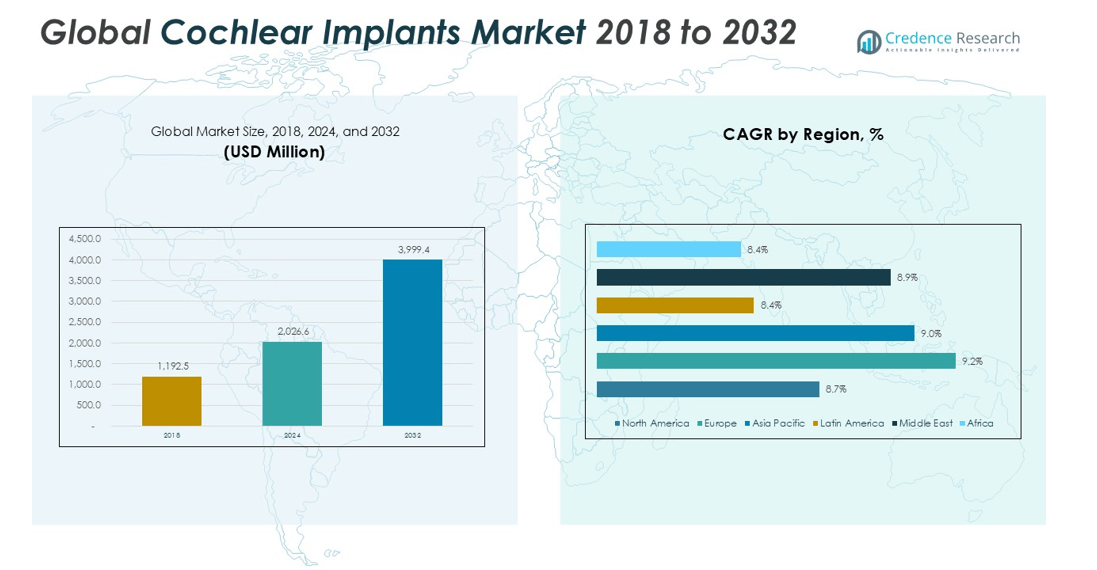
Global Cochlear Implants market size was valued at USD 1,415.4 million in 2018 to USD 1,936.8 million in 2024 and is anticipated to reach USD 3,138.2 million by 2032, at a CAGR of 6.29% during the forecast period.

REPORT ATTRIBUTE DETAILS
Historical Period 2020-2023
Base Year 2024
Forecast Period 2025-2032
Cochlear Implants Market Size 2024 USD 1,936.8 million
Cochlear Implants Market, CAGR 6.29%
Cochlear Implants Market Size 2032 USD 3,138.2 million


The Global Cochlear Implants market is led by established manufacturers with strong clinical and geographic reach. Cochlear Ltd., Sonova, MED-EL Medical Electronics, Demant A/S, and Advanced Bionics dominate global competition through technology leadership and broad product portfolios. These companies maintain strong ties with hospitals and hearing care networks. North America leads the market with an exact share of 34% in 2018. Europe follows with a 27% market share, supported by public healthcare coverage. Asia Pacific accounts for 23% of global revenue, driven by rising access and diagnosis rates. Latin America holds 10%, while the Middle East represents 4%. Africa contributes the remaining 1%, reflecting limited access and infrastructure.

Cochlear Implants Market size

Market Insights

  • The Global Cochlear Implants market grew from USD 1,415.4 million in 2018 to USD 1,936.8 million in 2024 and is projected to reach USD 3,138.2 million by 2032, registering a CAGR of 6.29% during the forecast period.
  • Rising prevalence of hearing loss among adults and children drives demand, supported by early screening programs, aging populations, and wider clinical acceptance of implant-based hearing solutions.
  • Technology trends focus on improved sound processors, wireless connectivity, smaller implant designs, and MRI compatibility, while pediatric implantation and emerging market access create strong growth opportunities.
  • The competitive landscape remains moderately consolidated, led by Cochlear Ltd., Sonova, MED-EL, Demant A/S, and Advanced Bionics, with unilateral implants and adult patients holding the largest segment shares.
  • North America leads with about 34% market share, followed by Europe at 27% and Asia Pacific at 23%, while Latin America, the Middle East, and Africa show gradual expansion driven by healthcare access growth.

Access crucial information at unmatched prices!

Request your sample report today & start making informed decisions powered by Credence Research Inc.!

Download Sample

Market Segmentation Analysis:

By Implant Type

The implant type segment shows clear dominance by unilateral cochlear implants. Unilateral systems hold the largest market share worldwide. Lower device cost supports faster adoption across public and private healthcare settings. Shorter surgery time improves clinician preference for unilateral procedures. Many reimbursement programs favor single-side implantation. Adults with partial hearing loss often select unilateral solutions. Device makers also prioritize unilateral product portfolios. Bilateral implants grow steadily due to better sound localization benefits. However, higher procedure costs limit bilateral uptake in price-sensitive regions.

  • For instance, Cochlear Limited has provided more than 850,000 implantable devices globally since 1981, with the majority of procedures historically performed as single-ear (unilateral) surgeries using their Nucleus systems

By Patient Type

Adult patients account for the dominant share of the patient type segment. High prevalence of age-related hearing loss drives adult demand. Faster diagnosis rates improve adult treatment adoption. Working professionals seek hearing restoration to maintain productivity. Awareness campaigns target adult hearing impairment more actively. Pediatric implants grow through early screening programs. Government newborn screening supports pediatric intervention. Yet, surgical complexity and follow-up care remain higher for children. Adult patients therefore sustain higher procedure volumes globally.

  • For instance, MED-EL reports that adult recipients represent the majority of its global implant base, with its Synchrony cochlear implant supporting electrode arrays up to 31.5 mm to address long-standing adult cochlear anatomy needs.

By End User

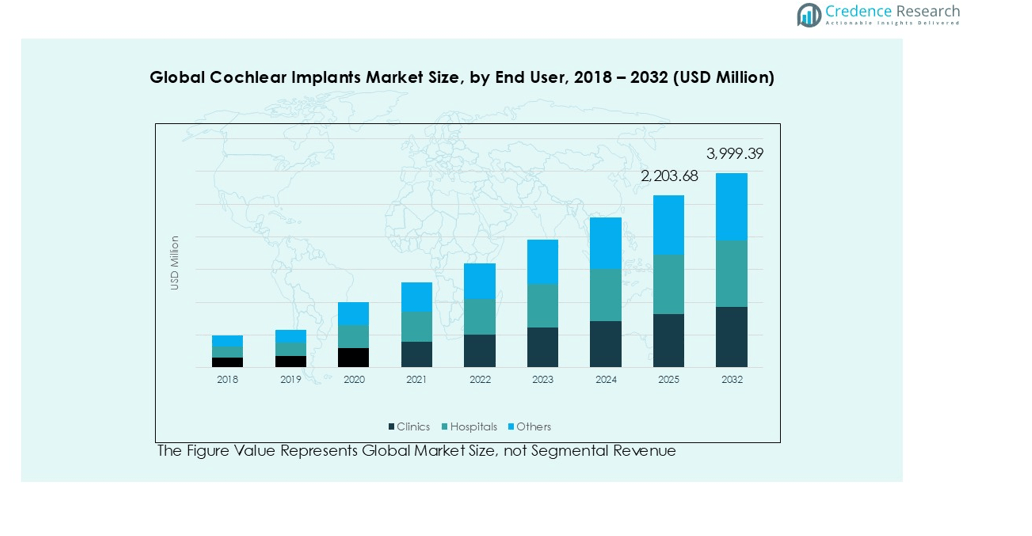
Hospitals represent the leading end user sub-segment by market share. Advanced surgical infrastructure supports complex cochlear implant procedures. Skilled otolaryngologists concentrate in hospital settings. Hospitals manage both diagnosis and long-term rehabilitation services. Insurance coverage often favors hospital-based implantation. Clinics show steady growth through outpatient consultation expansion. Clinics focus mainly on follow-up and device tuning services. Other end users include research centers and specialty institutes. Hospitals remain central due to integrated care capabilities

Key Growth Drivers

Rising Prevalence of Hearing Loss Across Age Groups

Hearing loss cases continue to rise across adult and pediatric populations worldwide. Aging populations drive higher incidence of sensorineural hearing impairment. Noise exposure increases hearing damage among working-age adults. Early diagnosis improves eligibility for cochlear implantation. Screening programs expand detection rates in newborns and infants. Physicians recommend implants for severe to profound hearing loss. Improved clinical guidelines support earlier intervention decisions. Patients seek long-term hearing restoration solutions. Cochlear implants provide measurable speech recognition improvement. This benefit strengthens clinician confidence in device outcomes. Governments prioritize hearing health within public health agendas. These factors collectively sustain strong demand growth for cochlear implant procedures.

  • For instance, the World Health Organization estimates over 430 million people globally require rehabilitation for disabling hearing loss, including more than 34 million children, supporting sustained cochlear implant procedure demand.

Technological Advancements in Implant Systems and Sound Processing

Continuous innovation improves cochlear implant performance and patient outcomes. Manufacturers develop smaller and lighter implant components. Advanced sound processors enhance speech clarity in noisy environments. Wireless connectivity improves device usability and patient comfort. Software upgrades allow personalized sound mapping. Battery efficiency improvements extend daily usage time. MRI compatibility reduces post-implantation diagnostic limitations. Surgeons benefit from refined electrode designs. These designs reduce cochlear trauma during implantation. Faster rehabilitation supports patient satisfaction. Technology progress strengthens adoption among clinicians and patients. Innovation remains a central growth driver for the global cochlear implants market.

  • For instance, Cochlear Limited’s Nucleus Profile Plus implant supports full-body MRI scans up to 3.0 tesla without magnet removal and uses electrode arrays with up to 22 contacts to deliver precise sound stimulation.

Expanding Access Through Healthcare Infrastructure and Reimbursement Support

Healthcare systems increasingly support cochlear implant accessibility. Public hospitals expand otology and audiology departments. Insurance coverage improves affordability of implant procedures. Government-funded programs support pediatric implantation initiatives. Subsidy schemes reduce patient out-of-pocket expenses. Hospitals invest in advanced surgical equipment. Specialist training programs increase surgeon availability. Rehabilitation services expand alongside implantation centers. These improvements reduce treatment waiting times. Improved access supports higher procedure volumes. Emerging markets strengthen referral networks for hearing care. Infrastructure growth directly drives sustained market expansion.

Cochlear Implants Market share

Key Trends & Opportunities

Early Intervention Through Newborn Hearing Screening Programs

Early implantation supports better language development outcomes. Pediatric specialists advocate implantation before critical learning periods. Governments fund early intervention initiatives. Hospitals integrate screening with referral pathways. Device makers design child-friendly processors and accessories. Parental awareness improves acceptance of surgical solutions. Long-term educational benefits encourage policy support. Pediatric programs create stable long-term demand. This trend strengthens future implant volumes across regions.

  • For instance, the World Health Organization reports that around 34 million children worldwide live with disabling hearing loss, many identified through newborn screening programs linked to early cochlear implantation.

Expansion of Emerging Markets and Untapped Patient Pools

Emerging economies present strong growth opportunities for cochlear implants. Large untreated hearing-impaired populations exist in developing regions. Urban hospitals expand advanced ENT services. Private healthcare investment supports implant center growth. Awareness campaigns improve diagnosis rates. Rising income levels increase affordability of advanced devices. Medical tourism supports cross-border implantation demand. Local distributor networks strengthen device availability. Manufacturers localize training and support services. These trends open new revenue streams globally.

Key Challenges

High Cost of Devices and Surgical Procedures

High procedure costs remain a major market challenge. Cochlear implants involve expensive hardware components. Surgical and rehabilitation costs increase total treatment expenses. Limited insurance coverage restricts patient access in some regions. Price sensitivity affects adoption in low-income populations. Public funding remains insufficient in many markets. Device replacement and upgrades add long-term costs. These factors limit procedure volumes outside major urban centers. Cost barriers slow market penetration despite clinical benefits. Addressing affordability remains critical for broader adoption.

Limited Awareness and Specialist Availability in Certain Regions

Awareness gaps hinder cochlear implant adoption in underserved areas. Many patients remain undiagnosed or untreated. Primary care providers may lack referral knowledge. Specialist shortages delay implantation timelines. Rural regions face limited access to audiology services. Post-surgical rehabilitation availability remains uneven. Cultural stigma around hearing devices persists in some societies. Education efforts require sustained investment. Limited awareness reduces early intervention success. Overcoming these barriers is essential for balanced global market growth.

Regional Analysis

North America

North America held the largest regional share of the Global Cochlear Implants market in 2018. The region generated USD 482.95 million in 2018, accounting for about 34% of global revenue. Strong reimbursement coverage supports high procedure volumes. Advanced healthcare infrastructure enables early diagnosis and implantation. High awareness levels drive faster patient referrals. Leading manufacturers maintain strong regional presence. Market value reached USD 649.72 million in 2024. It is projected to reach USD 1,028.70 million by 2032. The region is expected to grow at a CAGR of 6.0%, supported by technology adoption.

Europe

Europe represented the second-largest market share in 2018. The region recorded USD 378.35 million in 2018, contributing nearly 27% of global revenue. Universal healthcare systems improve patient access. Government-funded hearing programs support pediatric implantation. Strong clinical research improves treatment protocols. Western Europe leads adoption across hospitals. Market size increased to USD 512.48 million by 2024. Revenue is forecast to reach USD 819.07 million by 2032. Europe is projected to expand at a CAGR of 6.1%. Stable reimbursement policies continue to drive consistent regional demand.

Asia Pacific

Asia Pacific held a significant and fast-growing market share in 2018. The region generated USD 328.67 million, accounting for around 23% of global revenue. Large untreated patient populations support long-term demand. Healthcare infrastructure continues to expand across urban centers. Government screening programs improve diagnosis rates. Rising income levels increase affordability. Market value reached USD 464.50 million in 2024. Revenue is expected to reach USD 784.55 million by 2032. Asia Pacific is projected to grow at a CAGR of 6.8%, the highest among major regions.

Latin America

Latin America accounted for a moderate share of the global market in 2018. The region generated USD 144.38 million, representing nearly 10% of global revenue. Public hospitals drive most implantation procedures. Private healthcare investment supports specialized ENT services. Awareness levels continue to improve gradually. Market size reached USD 198.72 million in 2024. Revenue is projected to reach USD 324.49 million by 2032. The region is expected to grow at a CAGR of 6.4%. Improving reimbursement access supports steady regional expansion.

Middle East

The Middle East held a smaller but growing market share in 2018. The region recorded USD 61.43 million, contributing about 4% of global revenue. High-income countries drive most demand. Government healthcare spending supports advanced implant procedures. Medical tourism supports regional growth. Market value increased to USD 86.80 million by 2024. Revenue is projected to reach USD 146.55 million by 2032. The Middle East is expected to grow at a CAGR of 6.8%. Investment in specialized hospitals supports long-term growth.

Africa

Africa represented the smallest regional share in 2018. The market generated USD 19.67 million, accounting for around 1% of global revenue. Limited access to advanced hearing care restricts adoption. Awareness levels remain low in many countries. Public healthcare funding remains constrained. Market size reached USD 24.60 million in 2024. Revenue is expected to reach USD 34.83 million by 2032. Africa is projected to grow at a CAGR of 4.5%. Gradual infrastructure development supports slow but steady progress

Cochlear Implants Market segmentation

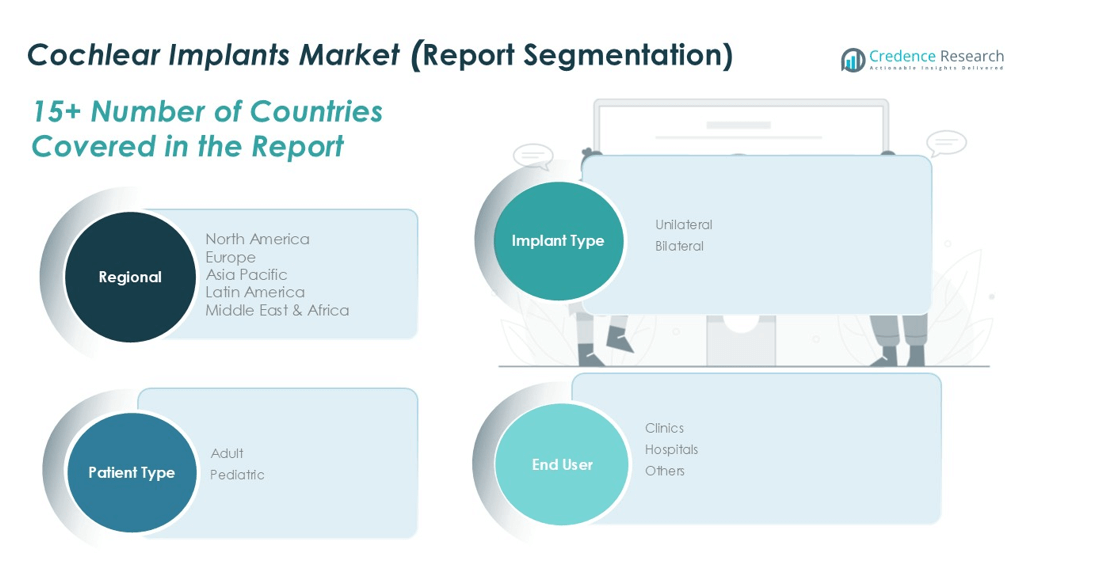
Market Segmentations:

By Implant Type

  • Unilateral
  • Bilateral

By Patient Type

  • Adult
  • Pediatric

By End User

  • Clinics
  • Hospitals
  • Others

By Geography

  • North America
    • U.S.
    • Canada
    • Mexico
  • Europe
    • Germany
    • France
    • U.K.
    • Italy
    • Spain
    • Rest of Europe
  • Asia Pacific
    • China
    • Japan
    • India
    • South Korea
    • South-east Asia
    • Rest of Asia Pacific
  • Latin America
    • Brazil
    • Argentina
    • Rest of Latin America
  • Middle East & Africa
    • GCC Countries
    • South Africa
    • Rest of the Middle East and Africa

Competitive Landscape

The competitive landscape of the Global Cochlear Implants market remains moderately consolidated. A few multinational manufacturers hold strong global positions. These companies compete through technology leadership and clinical performance. Continuous product innovation drives competitive differentiation. Firms invest heavily in sound processing algorithms and implant miniaturization. Strong distribution networks support global reach. Strategic partnerships with hospitals strengthen procedure volumes. Companies focus on surgeon training and rehabilitation support services. Regulatory approvals play a key competitive role. Patent portfolios protect core implant technologies. Emerging players target cost-sensitive markets with localized offerings. Pricing strategies vary by reimbursement environment. After-sales service quality influences brand loyalty. Clinical evidence supports long-term adoption decisions. Competition intensifies as emerging markets expand access. Established players maintain leadership through scale, experience, and sustained research investment.

Shape Your Report to Specific Countries or Regions & Enjoy 30% Off!

Key Player Analysis

  • Cochlear Ltd.
  • Sonova
  • MED-EL Medical Electronics
  • Demant A/S
  • Zhejiang Nurotron Biotechnology Co., Ltd.
  • Amplifon S.p.A.
  • Neubio AG
  • Advanced Bionics

Recent Developments

  • In July 2025, Cochlear Limited announced that the U.S. Food and Drug Administration (FDA) had approved the Cochlear Nucleus Nexa System, a smart cochlear implant system. The device featured upgradeable firmware, providing users with continuous access to new innovations and enhanced hearing performance. This approval is expected to strengthen Cochlear’s market position by highlighting its commitment to technological advancement and improving patient outcomes, thereby driving adoption in the market.
  • In 2024, MED-EL Medical Electronics, Austria, launched the audio processor SONNET 3. This is an advanced BTE audio processor that boasts exceptional hearing performance and seamless connectivity for cochlear implant users. With state-of-the-art technology, the SONNET 3 will set another milestone in further improving the hearing experience and seamlessly integrating into daily life.
  • In May 2024, Cochlear Ltd. acquired Demant’s Oticon Medical Cochlear Implant business. The acquisition strengthened Cochlear’s market position by expanding its customer base and technology portfolio

Report Coverage

The research report offers an in-depth analysis based on Implant Type, Patient Type, End User and Geography. It details leading market players, providing an overview of their business, product offerings, investments, revenue streams, and key applications. Additionally, the report includes insights into the competitive environment, SWOT analysis, current market trends, as well as the primary drivers and constraints. Furthermore, it discusses various factors that have driven market expansion in recent years. The report also explores market dynamics, regulatory scenarios, and technological advancements that are shaping the industry. It assesses the impact of external factors and global economic changes on market growth. Lastly, it provides strategic recommendations for new entrants and established companies to navigate the complexities of the market.

Future Outlook

  1. Adoption will increase as hearing loss diagnosis rates continue to improve worldwide.
  2. Technology upgrades will enhance speech clarity and patient comfort.
  3. Wireless connectivity will become standard across implant systems.
  4. Pediatric implantation will expand through early screening programs.
  5. Adult demand will remain strong due to aging populations.
  6. Hospitals will continue to dominate implantation procedures.
  7. Emerging markets will record faster procedure growth rates.
  8. Cost optimization efforts will improve access in price-sensitive regions.
  9. Surgeon training programs will support consistent clinical outcomes.
  10. Long-term rehabilitation services will gain greater strategic importance.

CHAPTER NO. 1 :      GENESIS OF THE MARKET           

1.1 Market Prelude – Introduction & Scope

1.2 The Big Picture – Objectives & Vision

1.3 Strategic Edge – Unique Value Proposition

1.4 Stakeholder Compass – Key Beneficiaries

CHAPTER NO. 2 :      EXECUTIVE LENS

2.1 Pulse of the Industry – Market Snapshot

2.2 Growth Arc – Revenue Projections (USD Million)

2.3. Premium Insights – Based on Primary Interviews

CHAPTER NO. 3 :      COCHLEAR IMPLANTS MARKET FORCES & INDUSTRY PULSE

3.1 Foundations of Change – Market Overview
3.2 Catalysts of Expansion – Key Market Drivers
3.2.1 Momentum Boosters – Growth Triggers
3.2.2 Innovation Fuel – Disruptive Technologies
3.3 Headwinds & Crosswinds – Market Restraints
3.3.1 Regulatory Tides – Compliance Challenges
3.3.2 Economic Frictions – Inflationary Pressures
3.4 Untapped Horizons – Growth Potential & Opportunities
3.5 Strategic Navigation – Industry Frameworks
3.5.1 Market Equilibrium – Porter’s Five Forces
3.5.2 Ecosystem Dynamics – Value Chain Analysis
3.5.3 Macro Forces – PESTEL Breakdown

CHAPTER NO. 4 : KEY INVESTMENT EPICENTER        

4.1 Regional Goldmines – High-Growth Geographies

4.2 Product Frontiers – Lucrative Implant Type Categories

4.3 End User Sweet Spots – Emerging Demand Segments

CHAPTER NO. 5: REVENUE TRAJECTORY & WEALTH MAPPING

5.1 Momentum Metrics – Forecast & Growth Curves

5.2 Regional Revenue Footprint – Market Share Insights

5.3 Segmental Wealth Flow – Implant Type, Patient Type, and End User Revenue

CHAPTER NO. 6 : TRADE & COMMERCE ANALYSIS    

6.1.      Import Analysis By Region

6.1.1.    Global Cochlear Implants Market Import Revenue By Region

6.2.      Export Analysis By Region

6.2.1.    Global Cochlear Implants Market Export Revenue By Region

CHAPTER NO. 7 :      COMPETITION ANALYSIS 

7.1.      Company Market Share Analysis

7.1.1.    Global Cochlear Implants Market: Company Market Share

7.2.      Global Cochlear Implants Market Company Revenue Market Share

7.3.      Strategic Developments

7.3.1.    Acquisitions & Mergers

7.3.2.    New Product Launch

7.3.3.    Regional Expansion

7.4.      Competitive Dashboard

7.5.      Company Assessment Metrics, 2024

CHAPTER NO. 8 : COCHLEAR IMPLANTS MARKET – BY IMPLANT TYPE SEGMENT ANALYSIS

8.1.      Cochlear Implants Market Overview By Implant Type Segment

8.1.1.    Cochlear Implants Market Revenue Share By Implant Type

8.2.       Unilateral

8.3.       Bilateral

CHAPTER NO. 9 : COCHLEAR IMPLANTS MARKET – BY PATIENT TYPE SEGMENT ANALYSIS

9.1.      Cochlear Implants Market Overview By Patient Type Segment

9.1.1.    Cochlear Implants Market Revenue Share By Patient Type

9.2.      Adult

9.3.      Pediatric

CHAPTER NO. 10 : COCHLEAR IMPLANTS MARKET – BY END USER SEGMENT ANALYSIS

10.1.     Cochlear Implants Market Overview By End User Segment

10.1.1.  Cochlear Implants Market Revenue Share By End User

10.2.    Clinics

10.3.    Hospitals

10.4.    Others

CHAPTER NO. 11 : COCHLEAR IMPLANTS MARKET – REGIONAL ANALYSIS

11.1.     Cochlear Implants Market Overview By Region Segment

11.1.1.  Global Cochlear Implants Market Revenue Share By Region

10.1.2.  Regions

11.1.3.  Global Cochlear Implants Market Revenue By Region

11.1.4.  Implant Type

11.1.5.  Global Cochlear Implants Market Revenue By Implant Type

11.1.6.  Patient Type

11.1.7. Global Cochlear Implants Market Revenue By Patient Type

11.1.8.  End User

11.1.9. Global Cochlear Implants Market Revenue By End User

CHAPTER NO. 12 : NORTH AMERICA COCHLEAR IMPLANTS MARKET – COUNTRY ANALYSIS

12.1.     North America Cochlear Implants Market Overview By Country Segment

12.1.1.  North America Cochlear Implants Market Revenue Share By Region

12.2.     North America

12.2.1.  North America Cochlear Implants Market Revenue By Country

12.2.2.  Implant Type

12.2.3.  North America Cochlear Implants Market Revenue By Implant Type

12.2.4.  Patient Type

12.2.5.  North America Cochlear Implants Market Revenue By Patient Type

12.2.6.  End User

12.2.7.  North America Cochlear Implants Market Revenue By End User

12.3.     U.S.

12.4.     Canada

12.5.     Mexico

CHAPTER NO. 13 : EUROPE COCHLEAR IMPLANTS MARKET – COUNTRY ANALYSIS

13.1.     Europe Cochlear Implants Market Overview By Country Segment

13.1.1.  Europe Cochlear Implants Market Revenue Share By Region

13.2.     Europe

13.2.1.  Europe Cochlear Implants Market Revenue By Country

13.2.2.  Implant Type

13.2.3.  Europe Cochlear Implants Market Revenue By Implant Type

13.2.4.  Patient Type

13.2.5.  Europe Cochlear Implants Market Revenue By Patient Type

13.2.6.  End User

13.2.7.  Europe Cochlear Implants Market Revenue By End User

13.3.     UK

13.4.     France

13.5.     Germany

13.6.     Italy

13.7.     Spain

13.8.     Russia

13.9.    Rest of Europe

CHAPTER NO. 14 : ASIA PACIFIC COCHLEAR IMPLANTS MARKET – COUNTRY ANALYSIS

14.1.     Asia Pacific Cochlear Implants Market Overview By Country Segment

14.1.1.  Asia Pacific Cochlear Implants Market Revenue Share By Region

14.2.     Asia Pacific

14.2.1.  Asia Pacific Cochlear Implants Market Revenue By Country

14.2.2.  Implant Type

14.2.3.  Asia Pacific Cochlear Implants Market Revenue By Implant Type

14.2.4.  Patient Type

14.2.5.  Asia Pacific Cochlear Implants Market Revenue By Patient Type

14.2.6.  End User

14.2.7.  Asia Pacific Cochlear Implants Market Revenue By End User

14.3.     China

14.4.     Japan

14.5.     South Korea

14.6.     India

14.7.     Australia

14.8.     Southeast Asia

14.9.     Rest of Asia Pacific

CHAPTER NO. 15 : LATIN AMERICA COCHLEAR IMPLANTS MARKET – COUNTRY ANALYSIS

15.1.     Latin America Cochlear Implants Market Overview By Country Segment

15.1.1.  Latin America Cochlear Implants Market Revenue Share By Region

15.2.     Latin America

15.2.1.  Latin America Cochlear Implants Market Revenue By Country

15.2.2.  Implant Type

15.2.3.  Latin America Cochlear Implants Market Revenue By Implant Type

15.2.4.  Patient Type

15.2.5.  Latin America Cochlear Implants Market Revenue By Patient Type

15.2.6.  End User

15.2.7.  Latin America Cochlear Implants Market Revenue By End User

15.3.     Brazil

15.4.     Argentina

15.5.     Rest of Latin America

CHAPTER NO. 16 : MIDDLE EAST COCHLEAR IMPLANTS MARKET – COUNTRY ANALYSIS

16.1.     Middle East Cochlear Implants Market Overview By Country Segment

16.1.1.  Middle East Cochlear Implants Market Revenue Share By Region

16.2.     Middle East

16.2.1.  Middle East Cochlear Implants Market Revenue By Country

16.2.2.  Implant Type

16.2.3.  Middle East Cochlear Implants Market Revenue By Implant Type

16.2.4.  Patient Type

16.2.5.  Middle East Cochlear Implants Market Revenue By Patient Type

16.2.6.  End User

16.2.7.  Middle East Cochlear Implants Market Revenue By End User

16.3.     GCC Countries

16.4.     Israel

16.5.     Turkey

16.6.     Rest of Middle East

CHAPTER NO. 17 : AFRICA COCHLEAR IMPLANTS MARKET – COUNTRY ANALYSIS

17.1.     Africa Cochlear Implants Market Overview By Country Segment

17.1.1.  Africa Cochlear Implants Market Revenue Share By Region

17.2.     Africa

17.2.1.  Africa Cochlear Implants Market Revenue By Country

17.2.2.  Implant Type

17.2.3.  Africa Cochlear Implants Market Revenue By Implant Type

17.2.4.  Patient Type

17.2.5.  Africa Cochlear Implants Market Revenue By Patient Type

17.2.6.  End User

17.2.7.  Africa Cochlear Implants Market Revenue By End User

17.3.     South Africa

17.4.     Egypt

17.5.     Rest of Africa

CHAPTER NO. 18 : COMPANY PROFILES

18.1.      Cochlear Ltd.

18.1.1.  Company Overview

18.1.2.  Product Portfolio

18.1.3.  Financial Overview

18.1.4.  Recent Developments

18.1.5.  Growth Strategy

18.1.6.  SWOT Analysis

18.2.    Sonova

18.3.    MED-EL Medical Electronics

18.4.    Demant A/S

18.5.    Zhejiang Nurotron Biotechnology Co., Ltd.

18.6.    Amplifon S.p.A.

18.7.   Neubio AG

18.8.   Advanced Bionics

18.9.  Other Key Players

Request Free Sample

We prioritize the confidentiality and security of your data. Our promise: your information remains private.

Ready to Transform Data into Decisions?

Request Your Sample Report and Start Your Journey of Informed Choices


Providing the strategic compass for industry titans.

cr-clients-logos

Frequently Asked Questions

What is the current market size for the Global Cochlear Implants market, and what is its projected size in 2032?

The market was valued at USD 1,936.8 million in 2024. It is projected to reach USD 3,138.2 million by 2032.

At what Compound Annual Growth Rate is the Global Cochlear Implants market projected to grow between 2024 and 2032?

The market is expected to grow at a CAGR of 6.29% during the forecast period.

Which Global Cochlear Implants market segment held the largest share in 2024?

Unilateral cochlear implants held the largest share due to lower cost and wider reimbursement support.

What are the primary factors fueling the growth of the Global Cochlear Implants market?

Rising hearing loss prevalence, technology improvements, early screening programs, and better reimbursement drive growth.

Who are the leading companies in the Cochlear Implant Market?

Major players include Cochlear Ltd., MED-EL Medical Electronics, Sonova Holding AG, Oticon Medical, and Nurotron Biotechnology Co., Ltd.

Which region commanded the largest share of the Cochlear Implant Market in 2024?

North America led the global market with a 38% share in 2024, driven by strong healthcare infrastructure and favorable reimbursement frameworks.

About Author

Shweta Bisht

Shweta Bisht

Healthcare & Biotech Analyst

Shweta is a healthcare and biotech researcher with strong analytical skills in chemical and agri domains.

View Profile


Related Reports

Disinfection Robots Market

The Disinfection Robots Market size was valued at USD 2,100.00 million in 2018 to USD 3,877.37 million in 2024 and is anticipated to reach USD 14,844.47 million by 2032, at a CAGR of 18.38% during the forecast period.

Holter Monitoring System Market

The Holter Monitoring System Market is projected to grow from USD 1,355 million in 2024 to USD 1,868.52 million by 2032. The market is expected to expand at a CAGR of 4.1% during the forecast period.

Hearing Aids Market

The Hearing Aids Market is projected to grow from USD 13,960 million in 2024 to USD 29,276.75 million by 2032. The market is expected to expand at a CAGR of 9.7% during the forecast period.

Gait Trainer Market

The Global Gait Trainer Market size was valued at USD 290.00 million in 2018 to USD 326.90 million in 2024 and is anticipated to reach USD 467.54 million by 2032, at a CAGR of 4.65% during the forecast period.

Sepsis Therapeutics  Market

Sepsis Therapeutics Market size was valued at USD 3,946.7 Million in 2024 and is anticipated to reach USD 6,290.44 Million by 2032, at a CAGR of 6% during the forecast period.

Tourette Syndrome Treatment Market

The Tourette Syndrome Treatment Market size was valued at USD 2,368.05 million in 2024 and is anticipated to reach USD 3,831.65 million by 2032, growing at a CAGR of 6.2% during the forecast period.

Tuberculosis Therapeutics Market

The Tuberculosis Therapeutics Market size was valued at USD 2,096.64 million in 2024 and is anticipated to reach USD 3,140.43 million by 2032, growing at a CAGR of 5.18% during the forecast period.

Topical Drugs CDMO Market

The Topical Drugs CDMO Market size was valued at USD 46,705.52 million in 2024 and is anticipated to reach USD 102,322.78 million by 2032, expanding at a CAGR of 10.3% during the forecast period.

ENT Devices Market

ENT Devices Market size was valued at USD 22,188 Million in 2024 and is anticipated to reach USD 33,794.27 Million by 2032, at a CAGR of 5.4% during the forecast period.

Companion Diagnostics Market

The Companion Diagnostics Market size was valued at USD 8,860 million in 2024 and is anticipated to reach USD 21,935.8 million by 2032, growing at a CAGR of 12% during the forecast period.

Clinical Nutrition Market

The Clinical Nutrition Market size was valued at USD 58,590 million in 2024 and is anticipated to reach USD 130,232.1 million by 2032, expanding at a CAGR of 10.5% during the forecast period

Smart Healthcare Products Market

The Smart Healthcare Products Market size was valued at USD 177,158 Million in 2024 and is anticipated to reach USD 410,035.7 Million by 2032, growing at a CAGR of 11.06% during the forecast period.

Licence Option

The report comes as a view-only PDF document, optimized for individual clients. This version is recommended for personal digital use and does not allow printing. Use restricted to one purchaser only.
$4999

To meet the needs of modern corporate teams, our report comes in two formats: a printable PDF and a data-rich Excel sheet. This package is optimized for internal analysis. Unlimited users allowed within one corporate location (e.g., regional office).
$6999

The report will be delivered in printable PDF format along with the report’s data Excel sheet. This license offers 100 Free Analyst hours where the client can utilize Credence Research Inc. research team. Permitted for unlimited global use by all users within the purchasing corporation, such as all employees of a single company.
$12999

Report delivery within 24 to 48 hours

Europe

North America

Email

Smallform of Sample request
User Review

Thank you for the data! The numbers are exactly what we asked for and what we need to build our business case.

Materials Scientist
(privacy requested)

User Review

The report was an excellent overview of the Industrial Burners market. This report does a great job of breaking everything down into manageable chunks.

Imre Hof
Management Assistant, Bekaert

cr-clients-logos

Request Sample