
| REPORT ATTRIBUTE | DETAILS |
|---|---|
| Historical Period | 2019-2022 |
| Base Year | 2023 |
| Forecast Period | 2024-2032 |
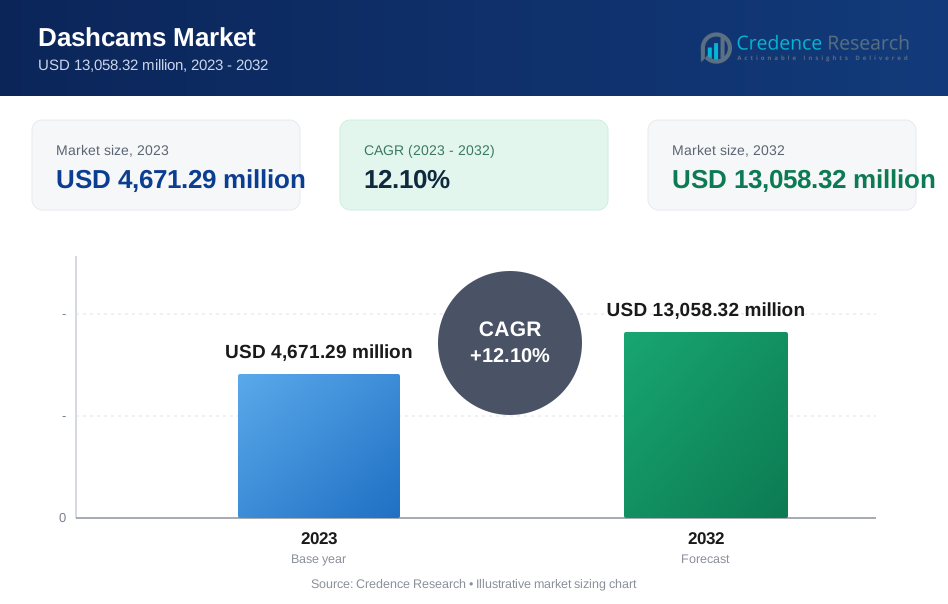
| Dashcams Market Size 2023 | USD 4,671.29 Million |
| Dashcams Market, CAGR | 12.10% |
| Dashcams Market Size 2032 | USD 13,058.32 Million |
Market Overview
The Global Dashcams Market is projected to grow from USD 4,671.29 million in 2023 to USD 13,058.32 million by 2032, at a compound annual growth rate (CAGR) of 12.10%. The Global Dashcams Market is driven by increasing concerns over road safety and the need for evidence in case of accidents. Growing awareness of the benefits of dashcams, such as recording traffic incidents and providing protection against insurance fraud, is propelling demand. Additionally, advancements in dashcam technology, including high-definition video recording, GPS integration, and cloud storage capabilities, are enhancing product appeal. The market is also benefiting from the rising adoption of ride-sharing and commercial fleet services, where dashcams are increasingly becoming standard equipment for monitoring and safety purposes. The Global Dashcams Market is witnessing significant growth across various regions, particularly in North America, Europe, and Asia-Pacific. North America leads due to high adoption rates driven by safety awareness and regulatory support. Europe follows closely with increasing installations in commercial and personal vehicles for security and legal evidence purposes. Asia-Pacific is rapidly expanding, fueled by rising disposable incomes and increasing road accident rates. Key players in the market include Panasonic Corporation, DOD Tech, and Thinkware, which dominate through innovation, extensive product portfolios, and robust distribution networks to meet the growing demand for advanced dashcam solutions globally.Market Drivers
Rising Accidents and Thefts The increasing number of accidents and thefts on the roads is a major driver of the dashcam market. For instance, in the United States, there were an estimated 6.7 million police-reported motor vehicle traffic crashes in 2019. The dashcam market is driven by such statistics, as drivers seek reliable ways to protect themselves and their vehicles. Dashcams provide critical video evidence that can be used to settle insurance claims, identify hit-and-run drivers, and deter theft. This capability not only helps in resolving disputes but also offers peace of mind to vehicle owners, knowing they have a reliable witness on board. Growing Focus on Driver Safety Globally, road traffic injuries are estimated to be the eighth leading cause of death for all age groups. Governments and organizations are implementing policies to reduce road accidents and enhance overall traffic safety. Dashcams contribute significantly to these efforts by providing an objective record of events on the road. In the event of an accident, dashcams can help determine the sequence of events, potentially saving lives by highlighting dangerous behaviors and encouraging safer driving habits. Advancements in Technology Dashcam technology is continuously evolving, with new features making these devices more appealing to consumers. For example, modern dashcams offer night vision capabilities, high-definition recording up to 4K resolution, and cloud storage solutions, which enhance their functionality and reliability. These advancements ensure that footage is clear and accessible, even in low-light conditions or after a device is damaged. The integration of advanced technologies like GPS and real-time tracking further increases the utility of dashcams, making them indispensable for both individual and commercial users. Rising Disposable Income and Insurance Premiums In developing countries, the average disposable income has been increasing by approximately 5% annually. As more consumers can afford these devices, the market is experiencing significant growth. Additionally, the rising cost of car insurance, with premiums increasing by an average of 3% to 4% per year, is prompting drivers to seek ways to lower their premiums. Many insurance companies offer discounts of up to 10% to 15% for drivers who use dashcams, recognizing the added security and reduced risk they provide. This financial incentive is further boosting the adoption of dashcams, making them a valuable investment for cost-conscious consumers. Market Trends Shift Towards Advanced and Smart Features While basic dashcams offering forward-facing recording currently dominate the market, with a 70% market share, there’s a growing demand for devices with advanced features. This includes night vision, high-definition recording with 1080p or 4K resolution, wider fields of view up to 180 degrees, and additional data capture through radar or GPS. Smart dashcams with WiFi connectivity and cloud storage are gaining traction, with a 40% increase in sales year-over-year, allowing users to remotely access footage and integrate these devices with other driver assistance systems. These advanced functionalities not only enhance the user experience but also provide more comprehensive safety measures, making dashcams an essential part of modern vehicles, which are expected to be installed in 60% of new cars by 2025. Growth of Multi-Channel Dashcams There is an increasing preference for dual-channel dashcams that record both the front of the vehicle and the cabin, with a 30% rise in adoption among new dashcam users. This trend is particularly beneficial for ride-sharing drivers, taxis, and commercial vehicles, as it provides a more comprehensive record of events. By capturing activities inside the vehicle as well as on the road, these multi-channel dashcams offer enhanced security and accountability. This feature is becoming crucial for fleet management and professional drivers who require detailed documentation of their journeys for safety and legal purposes, with 85% of fleet vehicles expected to use multi-channel dashcams by 2027.Market Challenges Analysis
Climate Sensitivity and Supply Uncertainty Sunflower oil production is highly susceptible to climate variations. As sunflower cultivation depends significantly on stable weather conditions, anomalies such as droughts, excessive rainfall, or extreme temperatures can dramatically affect crop yields. This sensitivity leads to fluctuations in sunflower seed availability, causing volatility in sunflower oil prices and market stability. The challenge is compounded by the increasing frequency of extreme weather events linked to climate change, necessitating advanced agricultural practices and improved weather resistance through crop breeding to ensure consistent supply levels. Competitive Pressures from Alternative Vegetable Oils Sunflower oil competes directly with other popular vegetable oils, such as soybean, palm, and canola oils. These alternatives often enjoy price advantages or more extensive production bases, influencing consumer and industrial preferences globally. The competition is particularly fierce in markets sensitive to price fluctuations, where even minor cost differences can shift buyer loyalty. Addressing this challenge requires strategic marketing and emphasizing the unique health benefits of sunflower oil to differentiate it from competitors and justify potential price premiums.Market Segmentation Analysis:
By Type: The Global Dashcams Market is segmented into 1-channel and 2-channel dashcams. 1-channel dashcams, which record the view from the front of the vehicle, dominate the market due to their simplicity and cost-effectiveness. These dashcams are popular among personal vehicle owners who seek basic recording features for evidence in case of accidents or disputes. On the other hand, 2-channel dashcams, which record both the front and rear views or the interior of the vehicle, are gaining traction, particularly among commercial and law enforcement applications. The dual recording capability provides comprehensive coverage, making them ideal for fleet management, ride-sharing services, and enhanced security measures. By Application: The application of dashcams spans across commercial vehicles, personal vehicles, government and law enforcement vehicles, and others. Commercial vehicles represent a significant segment, driven by the need for fleet management and monitoring driver behavior to enhance safety and efficiency. Personal vehicles also account for a substantial share as individuals increasingly recognize the benefits of dashcams for insurance claims and security. Government and law enforcement vehicles utilize dashcams for evidence collection, monitoring, and enhancing transparency. Additionally, other applications include emergency service vehicles and public transportation, where dashcams play a crucial role in ensuring passenger safety and accountability. Each application segment underscores the versatile utility of dashcams across different sectors.Segments:
Based on Type- 1-Channel
- 2-Channel
- Commercial Vehicle
- Personal Vehicle
- Government and Law Enforcement Vehicles
- Others
- Standard Definition
- High Definition
- Full HD
- Ultra High Definition (4K)
- Others
- Basic
- Advanced
- Smart
- $0-$50
- $50-$100
- Above $100
- North America
- The U.S.
- Canada
- Mexico
- Europe
- Germany
- France
- UK.
- Italy
- Spain
- Rest of Europe
- Asia Pacific
- China
- Japan
- India
- South Korea
- South-east Asia
- Rest of Asia Pacific
- Latin America
- Brazil
- Argentina
- Rest of Latin America
- Middle East & Africa
- GCC Countries
- South Africa
- The Rest of the Middle East and Africa
Regional Analysis
Asia-Pacific Asia-Pacific holds a dominant market share of approximately 40% in the Global Dashcams Market. Countries like China, Japan, and South Korea have been at the forefront of dashcam adoption, driven by factors such as high traffic densities, increasing urbanization, and growing concerns over road safety. The region's tech-savvy population and the availability of affordable dashcam options have further fueled market growth. Europe Europe commands a significant market share of around 25%, with Russia being a major contributor. The region's stringent traffic laws and the increasing awareness of the benefits of dashcams, such as providing evidence in case of accidents or disputes, have driven their adoption. Additionally, the growing popularity of connected cars and the integration of dashcams with advanced driver-assistance systems (ADAS) have further propelled market growth.Key Player Analysis
- Panasonic Corporation
- ABEO Technology
- DOD Tech
- Pittasoft Co. Ltd.
- HP Development Company LP
- Cobra Electronics Co.
- Hewlett-Packard
- Harman International Industries Inc.
- Falcon Zero LLC
- 360 (QIHU)
- Thinkware
- DOME Technology
- Philips
- First Scene
- Comtec
- SAST
- JADO
- REXing
- Kenwood
- Yupiteru
- Fine Digital
- PAPAGO
- Nextbase UK
- HUNYDON
- Qrontech
- DAZA
- YI Technology
- Aiptek Inc.
- LG Corp
- Qrontech Co. Ltd.
- Satechi Baravon
Competitive Analysis
The Global Dashcams Market is highly competitive, with leading players such as Panasonic Corporation, DOD Tech, and Thinkware driving innovation and market growth. Panasonic Corporation leverages its strong brand reputation and technological expertise to offer advanced dashcam solutions with high-definition recording, night vision, and cloud connectivity features. DOD Tech is renowned for its high-quality dashcams with superior image clarity and reliability, catering to both personal and commercial vehicle segments. Thinkware focuses on integrating smart features like GPS tracking, WiFi connectivity, and driver assistance systems, making its products highly attractive to tech-savvy consumers. These companies maintain their competitive edge through continuous research and development, strategic partnerships, and comprehensive product portfolios that cater to diverse customer needs. Additionally, they invest in robust marketing strategies and extensive distribution networks to expand their global reach and capitalize on the increasing demand for dashcams in emerging markets.Recent Developments
- In October 2023, Qubo, a smart device brand owned by Hero Electronix, introduced new dashcam products called Dashcam Pro X and Dashcam Pro 3K, with advanced features such as GPS tracking, loop recording, time-lapse, and front and rear cameras to track vehicles in real-time.
- In September 2023, Firsttech LLC, launched DroneMobile XC Dash Cam. It seamlessly integrates with compatible remote start and security systems so users can see what is happening in and around their cars in real-time.
- In January 2023, Garmin Ltd. launched Garmin Dash Cam Live, which is connected to the LTE network and allows drivers to access a live exterior view of their vehicle.
Market Concentration & Characteristics
The Global Dashcams Market exhibits a moderate to high level of market concentration, with a few key players dominating a significant share of the market. Leading companies such as Panasonic Corporation, Thinkware, and DOD Tech hold substantial market positions due to their technological advancements, strong brand recognition, and extensive product offerings. These players drive innovation by integrating advanced features like high-definition recording, night vision, GPS, and cloud connectivity into their dashcams, setting high industry standards. Despite the dominance of these major players, the market remains competitive with numerous smaller and regional manufacturers also contributing to the market dynamics. These companies often focus on niche markets or offer cost-competitive alternatives to gain market share. The market is characterized by rapid technological advancements, evolving consumer preferences, and a growing emphasis on driver safety and vehicle security, which collectively drive continuous innovation and product differentiation.Report Coverage
The research report offers an in-depth analysis based on Type, Application, Video Quality, Technology, Price Range and Geography. It details leading market players, providing an overview of their business, product offerings, investments, revenue streams, and key applications. Additionally, the report includes insights into the competitive environment, SWOT analysis, current market trends, as well as the primary drivers and constraints. Furthermore, it discusses various factors that have driven market expansion in recent years. The report also explores market dynamics, regulatory scenarios, and technological advancements that are shaping the industry. It assesses the impact of external factors and global economic changes on market growth. Lastly, it provides strategic recommendations for new entrants and established companies to navigate the complexities of the market.Future Outlook
- The Global Dashcams Market will continue to grow due to increasing awareness of road safety and security.
- Advancements in dashcam technology, such as 4K recording and AI integration, will enhance product offerings.
- The rise in vehicle thefts and accidents will drive demand for dashcams as a preventive measure.
- Growing government regulations mandating dashcam installation in commercial vehicles will boost market growth.
- The expansion of e-commerce platforms will make dashcams more accessible to consumers worldwide.
- Increased adoption of dual-channel dashcams will provide comprehensive in-car and road footage.
- Collaboration between dashcam manufacturers and automotive OEMs will create new market opportunities.
- Integration with smart home and IoT ecosystems will enhance the functionality of dashcams.
- Growing interest in fleet management solutions will drive dashcam adoption in commercial vehicle sectors.
- Rising consumer demand for high-quality video evidence in insurance claims will further propel market growth.
Request a Free Sample
Fill in your details and we'll send you a free sample report.
- Sample data tables & charts
- Research methodology
Need a Custom Version of This Report?
Tailor the scope, geography, or segments to your exact requirements.
- Custom geography or segment scope
- Direct access to our analyst team
Frequently Asked Questions
What is the current size of the Global Dashcams Market?
What factors are driving the growth of the Global Dashcams Market?
What are the key segments within the Global Dashcams Market?
What are some challenges faced by the Global Dashcams Market?
Who are the major players in the Global Dashcams Market?
Which segment is leading the market share?
Table of Content
Chapter 1. Report Introduction
- 1.1 Report Description & Purpose
- 1.1.1 Report Title & Market Definition
- 1.1.2 Unique Selling Propositions (USP) & Key Differentiators
- 1.1.3 Value Proposition for Stakeholders
- 1.2 Research Objectives
- 1.2.1 Market Sizing Objectives (Volume & Revenue)
- 1.2.2 Segmentation Objectives
- 1.2.3 Competitive Intelligence Objectives
- 1.2.4 Forecast & Scenario Objectives
- 1.3 Report Scope
- 1.3.1 Dashcams Scope – Types & Subtypes Covered
- 1.3.2 Geographic Scope – Regions & Countries Covered
- 1.3.3 Historical Period, Base Year & Forecast Period (2023; forecast to 2032)
- 1.3.4 Inclusions & Exclusions
- 1.4 HS Code & Classification Framework
- 1.5 Currency, Units & Pricing Basis
- 1.6 Target Stakeholders
- 1.7 Limitations & Assumptions
Chapter 2. Executive Summary
- 2.1 Global Dashcams Market Snapshot
- 2.1.1 Market Size – Historical (2023) & Forecast (2023-2032) (2023: USD 4,671.29 million → 2032: USD 13,058.32 million)
- 2.1.2 Volume & Revenue – Global Totals
- 2.1.3 Key Market Highlights – Top Five Facts
- 2.2 Dashcams Market Segmentation Snapshot
- 2.2.1 Market Split by Region – 2023 vs. 2032
- 2.3 Competitive Snapshot
- 2.3.1 Top 10 Players by Revenue Share – 2023
- 2.3.2 Top 10 Players by Volume Share – 2023
- 2.3.3 Recent Strategic Developments (18-Month Summary)
- 2.4 Key Investment Highlights & Strategic Conclusions
Chapter 3. Dashcams Market Dynamics & Industry Analysis
- 3.1 Market Overview & Context
- 3.1.1 Dashcams Market Position in the Broader Automotive Value Chain
- 3.1.2 OEM vs. Replacement Market Dynamics
- 3.1.3 Market Maturity & Development Stage by Region
- 3.2 Dashcams Market Drivers
- 3.3 Dashcams Market Restraints & Challenges
- 3.4 Dashcams Market Opportunities
- 3.5 Porter's Five Forces Analysis
- 3.5.1 Threat of New Entrants
- 3.5.2 Bargaining Power of Suppliers
- 3.5.3 Bargaining Power of Buyers
- 3.5.4 Threat of Substitutes
- 3.5.5 Competitive Rivalry – Intensity Assessment
- 3.6 Dashcams Value Chain Analysis
- 3.6.1 Upstream – Raw Material/Input Suppliers
- 3.6.1.1 Raw Material/Input 1
- 3.6.1.2 Raw Material/Input 2
- 3.6.1.3 Raw Material/Input 3
- 3.6.2 Midstream – Production/Manufacturing/Service Delivery
- 3.6.2.1 Production/Process Overview
- 3.6.2.2 Key Facility Locations & Capacity by Manufacturer
- 3.6.3 Downstream – Distribution & End Consumer
- 3.6.3.1 Primary Channel – B2B/OEM
- 3.6.3.2 Secondary Channels – Dealer, Retail, Online, Direct
- 3.6.4 Value Chain Profitability Analysis
- 3.6.1 Upstream – Raw Material/Input Suppliers
- 3.7 PESTEL Analysis
- 3.7.1 Political Factors
- 3.7.2 Economic Factors
- 3.7.3 Social Factors
- 3.7.4 Technological Factors
- 3.7.5 Environmental Factors
- 3.7.6 Legal Factors
- 3.8 Dashcams Supply Chain Analysis
- 3.8.1 Raw Material/Input Supply Risk Assessment
- 3.8.2 Manufacturing Concentration Risk (Geographic Exposure)
- 3.8.3 Trade Disruption Impact Analysis
- 3.9 Regulatory & Policy Landscape
Note: The regulatory and policy landscape section covers regulations based on their applicability to the market, Dashcams category, geography, and scope of the study. Only regulatory frameworks with a material impact on operations, compliance, trade, sustainability, or market access are analyzed in detail.
Chapter 4. Key Investment Pockets & Opportunity Analysis
- 4.1 Dashcams Market Attractiveness Analysis
- 4.1.1 By Region – Investment Attractiveness Matrix (Volume × CAGR)
- 4.2 Absolute Revenue Growth Opportunity
- 4.2.1 By Region – Absolute USD Growth Through 2032
- 4.3 Incremental Volume Opportunity
- 4.3.1 By Region – Incremental Volume Through 2032
- 4.3.2 Segment – Incremental Volume
- 4.4 Emerging Submarket Opportunity Deep Dive (Subject to Applicability)
- 4.5 Emerging Market Opportunity Scorecards
- 4.5.1 United States
- 4.5.2 Europe
- 4.5.3 Asia
- 4.5.4 Middle East & Africa
Note: Emerging Market Opportunity Scorecards will be included based on relevance and strategic importance. Regions listed are indicative and may vary depending on data availability and market dynamics.
Chapter 5. Dashcams Import-Export Analysis & Trade Flows
- 5.1 Global Trade Overview
- 5.1.1 Global Export Value by Country (2023)
- 5.1.2 Global Export Volume by Country (2023)
- 5.1.3 Global Import Value by Country (2023)
- 5.1.4 Global Import Volume by Country (2023)
- 5.1.5 Net Trade Balance by Country (2023)
- 5.2 Export Analysis – Segment
- 5.2.1 Type 1 (HS Code)
- 5.2.2 Type 2 (HS Code)
- 5.2.3 Type 3 (HS Code)
- 5.2.4 Type 4 (HS Code)
- 5.2.5 Type 5 (HS Code)
- 5.3 Import Analysis – Segment
- 5.3.1 Type 1 (HS Code)
- 5.3.2 Type 2 (HS Code)
- 5.3.3 Type 3 (HS Code)
- 5.3.4 Type 4 (HS Code)
- 5.3.5 Type 5 (HS Code)
- 5.4 Average Unit Trade Prices
- 5.4.1 Average Export Price – Segment & Country
- 5.4.2 Average Import Price – Segment & Source Country
- 5.4.3 Price Trends (2023)
- 5.5 Key Trade Route Analysis
- 5.5.1 Trade Route 1
- 5.5.2 Trade Route 2
- 5.5.3 Trade Route 3
- 5.5.4 Trade Route 4
- 5.5.5 Trade Route 5
- 5.6 Trade Policy Impact Assessment
- 5.6.1 US Anti-Dumping & Section 301 Tariffs
- 5.6.2 EU Customs Union Impact
- 5.6.3 Major Free Trade Agreements
- 5.6.4 USMCA Rules of Origin
Note: Trade policy analysis will be included only where relevant to the Dashcams market.
Chapter 6. Competitive Landscape & Company Benchmarking
- 6.1 Dashcams Market Concentration & Structure
- 6.1.1 Herfindahl-Hirschman Index (HHI) – vs. 2023
- 6.1.2 Tier 1, Tier 2 & Tier 3 Market Structure
- 6.1.3 Global, Regional & Local Player Dynamics
- 6.2 Dashcams Market Share Analysis – 2023
- 6.2.1 Global Revenue Share by Company
- 6.2.2 Global Volume Share by Company
- 6.2.3 Regional Revenue Share
- 6.2.4 Market Share Evolution ( vs. 2023)
- 6.2.5 OEM Segment Share by Company
- 6.2.6 Replacement Segment Share by Company
- 6.3 Production/Delivery Capacity & Facility Analysis
- 6.3.1 Global Installed Capacity
- 6.3.2 Capacity Utilization Rates
- 6.3.3 Production/Output Volume
- 6.3.4 Facility Locations & Capacity Map
- 6.3.5 Planned Capacity Additions
- 6.4 Dashcams Competitive Benchmarking Matrix
- 6.4.1 Revenue, Volume, CAGR & Profitability Comparison
- 6.4.2 Channel Revenue Mix
- 6.4.3 Geographic Revenue Exposure
- 6.4.4 R&D Intensity
- 6.4.5 Sustainability Maturity
- 6.5 Strategic Developments in Dashcams (Last 24 Months)
- 6.5.1 Mergers, Acquisitions & Divestments
- 6.5.2 New Dashcams Launches
- 6.5.3 Facility Expansions
- 6.5.4 Strategic Alliances, Joint Ventures & Partnerships
- 6.5.5 Distribution Expansion & Market Entry
- 6.5.6 Sustainability & ESG Initiatives
- 6.6 Competitive Strategy Mapping
- 6.6.1 Leader, Challenger, Follower & Niche Classification
- 6.6.2 Pricing Strategy Comparison
- 6.6.3 Channel Strategy Matrix
Note: Strategic developments are included based on their materiality and the availability of reliable information.
Chapter 7. Global Dashcams Market – By Distribution Channel
- 7.1 Segment Overview
- 7.1.1 Volume & Revenue Split by Channel (2023 & 2032)
- 7.1.2 Channel Mix Evolution (2023-2032)
Chapter 8. Regional Market Analysis – Global Overview
- 8.1 Global Regional Overview
- 8.1.1 Regional Volume Share
- 8.1.2 Regional Revenue Share
- 8.1.3 Regional Volume by Region
- 8.1.4 Regional Revenue by Region
- 8.1.5 Regional Forecast Through 2032
- 8.2 Cross-Regional Segment Analysis
- 8.2.1 By Distribution Channel
- 8.2.2 By Brand/Price Tier
Chapter 9. North America Dashcams Market
- 9.1 United States
- 9.2 Canada
- 9.3 Mexico
Chapter 10. Europe Dashcams Market
- 10.1 Germany
- 10.2 France
- 10.3 Italy
- 10.4 United Kingdom
- 10.5 Spain
- 10.6 Poland
- 10.7 Russia
- 10.8 Netherlands
- 10.9 Belgium
- 10.10 Sweden
- 10.11 Denmark
- 10.12 Norway
- 10.13 Rest of Europe
Chapter 11. Asia Pacific Dashcams Market
- 11.1 China
- 11.2 India
- 11.3 Japan
- 11.4 South Korea
- 11.5 Thailand
- 11.6 Indonesia
- 11.7 Vietnam
- 11.8 Malaysia
- 11.9 Australia
- 11.10 Rest of Asia Pacific
Chapter 12. Latin America Dashcams Market
- 12.1 Brazil
- 12.2 Argentina
- 12.3 Colombia
- 12.4 Chile
- 12.5 Rest of Latin America
Chapter 13. Middle East Dashcams Market
- 13.1 Saudi Arabia
- 13.2 United Arab Emirates
- 13.3 Turkey
- 13.4 Israel
- 13.5 Iran
- 13.6 Rest of the Middle East
Chapter 14. Africa Dashcams Market
- 14.1 South Africa
- 14.2 Egypt
- 14.3 Nigeria
- 14.4 Morocco
- 14.5 Rest of Africa
Chapter 15. Dashcams Company Profiles
- 15.1 [Company 01]
- 15.1.1 Company Overview
- 15.1.2 Key Management Personnel
- 15.1.3 Products & Services Portfolio
- 15.1.4 Financial Performance
- 15.1.5 Key Market Focus & Geographic Presence
- 15.1.6 Recent Developments & Strategic Initiatives
Note: The company profile list is preliminary and may change based on research findings, market developments, data availability, and client requirements.
Chapter 16. Appendices
- Appendix A – List of Abbreviations & Acronyms
- Appendix B – Industry Classification Code Reference – Full Series
- Appendix C – Production & Capacity Data Tables
- Appendix D – End-Use & Demand Base Tables
- Appendix E – Consumption & Replacement Rate Assumptions
- Appendix F – ASP Reference Tables
- Appendix G – Manufacturing & Facility Database
- Appendix H – Import-Export Data Tables
- Appendix I – Regulatory Summary Tables
- Appendix J – Primary Research Participant List (Anonymized)
- Appendix K – Primary Research Questionnaire Framework
- Appendix L – Data Sources & Bibliography
- Appendix M – Market Size Divergence & Source Comparison
Chapter 17. Research Methodology
- 17.1 Research Framework & Philosophy
- 17.2 Secondary Research – Sources, Hierarchy & Data Extraction
- 17.3 Data Modeling – Bottom-Up & Top-Down Market Sizing
- 17.4 Primary Research – Stakeholder Framework, LOI & Sample Sizes
- 17.5 Forecast Methodology – Regression, Scenario & Sensitivity Analysis
- 17.6 Quality Control – Four-Layer Validation Framework
- 17.7 Limitations & Standard Assumptions
- 17.8 Disclaimer
