
| REPORT ATTRIBUTE | DETAILS |
|---|---|
| Historical Period | 2019-2022 |
| Base Year | 2023 |
| Forecast Period | 2024-2032 |
| Faux Finish Coatings Market Size 2023 | USD 8158.20 million |
| Faux Finish Coatings Market, CAGR | 5.50% |
| Faux Finish Coatings Market Size 2032 | USD 13208.89 million |
Market Insights
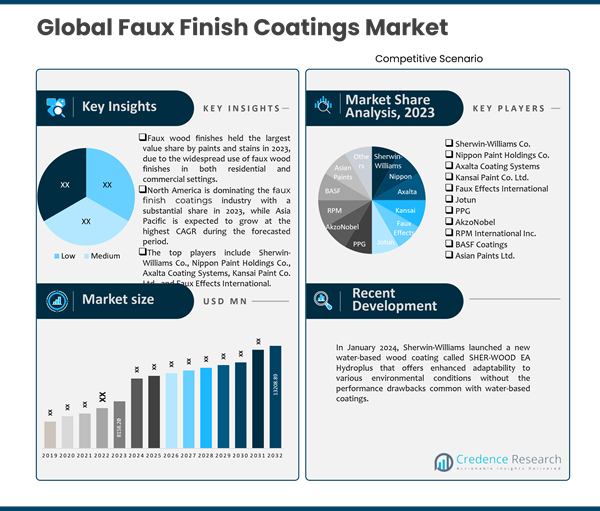
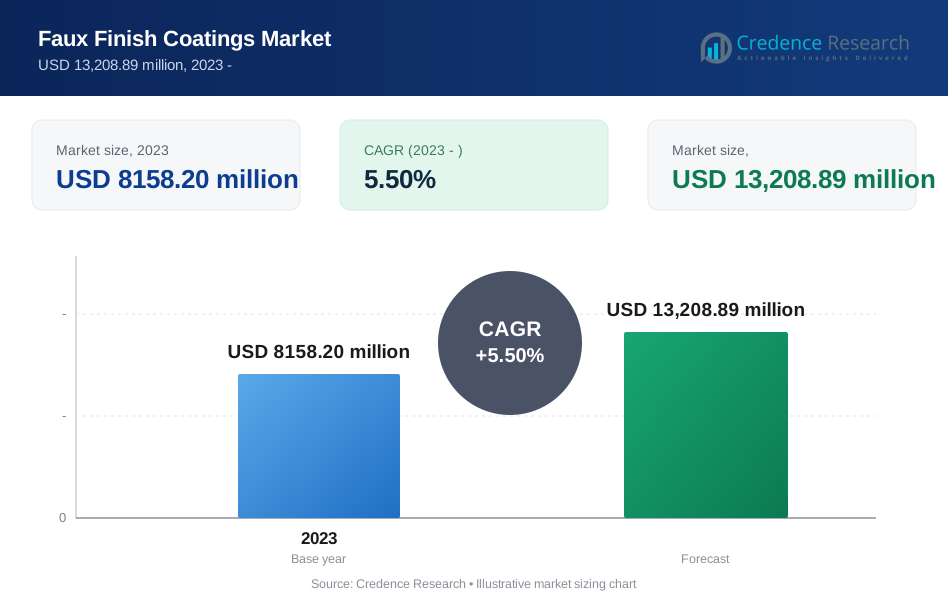
- The global demand for faux finish coatings was valued at USD 8158.20 million in 2023 and is expected to reach USD 13208.89 million in 2032, growing at a CAGR of 5.50% between 2024 and 2032.
- The Faux Wood Finishes segment was the market leader by Paints and Stains, accounting for the highest share in value in 2023, and the Faux Metal Finishes segment is expected to grow rapidly throughout the forecast period.
- The Venetian Plaster segment was the market leader by Plasters and Textures, accounting for the highest share in value in 2023, and the Trowel Applied Finishes segment is expected to grow rapidly throughout the forecast period.
- The Cemented segment was the market leader by Specialty Coatings, accounting for the highest share in value in 2023, and the Cementless segment is expected to grow rapidly throughout the forecast period.
- Spraying segment is predicted to grow fastest over the projection period, while Brushing and Rolling had the largest share by application in 2023.
- Over the projection period, the Commercial segment is expected to expand at the fastest rate, and the Residential segment dominated the market share by End-Use Applications in 2023.
- North America is dominating the Faux Finish Coatings industry, with over one-third of the market in 2023.
- The market's primary possibilities include advancements in technology for more realistic coatings, increased demand for eco-friendly formulations, expanding application scopes, rising DIY trends, and the integration of digital technologies for enhanced consumer engagement and visualization.
Executive Summary
Market Definition
Faux finish coatings are specialized decorative painting techniques that replicate the appearance of materials such as marble, wood, stone, and various textures using paint or plaster. These coatings are applied to surfaces to create a rich and intricate aesthetic without the expense or installation challenges associated with natural materials. Faux finishes can be used on walls, furniture, ceilings, and other architectural elements, providing a versatile option for enhancing the visual appeal of interior and exterior spaces. Techniques often involve layering, glazing, sponging, rag rolling, and stippling to achieve the desired effect.
Market Overview
The global faux finish coatings market has witnessed steady growth in recent years and is expected to grow at a CAGR of 5.50% between 2024 and 2032. The market was valued at USD 8158.20 million in 2023 and is expected to reach USD 13208.89 million in 2032.
The growth of the Faux Finish Coatings Market is significantly driven by the increasing consumer demand for aesthetically pleasing interiors and exteriors. As homeowners and businesses seek to create unique, customized spaces, faux finishes offer a cost-effective and versatile solution. The ability of these coatings to mimic high-end materials such as marble, wood, and stone without the associated costs and installation complexities appeals to a wide range of customers, from residential to commercial sectors.
Advancements in technology and materials have also contributed to the market's expansion. Improved formulations and application techniques have made faux finish coatings more durable, easier to apply, and capable of achieving more realistic and intricate designs. This technological progress has broadened the appeal of faux finishes, making them accessible to both professional contractors and DIY enthusiasts. Additionally, the development of eco-friendly and low-VOC (volatile organic compounds) options aligns with the growing consumer preference for sustainable products, further boosting market growth.
Moreover, rising construction activities worldwide are another significant factor propelling the faux finish coatings market. As global urbanization accelerates, there is an increased demand for new residential and commercial buildings. The construction boom in emerging markets, coupled with renovation projects in developed regions, has led to a heightened need for innovative and decorative painting solutions. Faux finish coatings, with their ability to enhance the aesthetic appeal of structures, are increasingly being specified in both new builds and refurbishments, contributing to market growth.
Furthermore, economic factors, such as rising disposable incomes and increasing urbanization, particularly in emerging markets, have led to greater investment in home and commercial space renovations. The hospitality and retail industries, in particular, have embraced faux finishes to create visually striking environments that attract and retain customers, contributing to the overall market expansion.
Segmentation by Paints and Stains
- Faux Wood Finishes is the leading segment by Paints and Stains and held the dominant share in value in 2023. These finishes are extensively used to mimic the appearance of natural wood on various surfaces, including walls, furniture, trim, and architectural elements. Faux wood finishes offer cost-effective alternatives to real wood while providing durability and versatility in design options, making them highly sought after in both residential and commercial applications.
- The Faux Metal Finishes segment is expected to exhibit the highest CAGR during the forecast period. These finishes replicate the look of metallic surfaces such as copper, bronze, and silver on a wide range of substrates. With the growing demand for industrial and contemporary design aesthetics, faux metal finishes are gaining popularity in interior and exterior applications across various industries.
- Other segments, such as Faux Stone Finishes and Faux Fabric Finishes, are anticipated to grow moderately during the forecasted period.
Segmentation by Plasters and Textures
- Venetian Plaster is the leading segment by Plasters and Textures and holds a substantial share in 2023. Venetian plaster is highly sought after for its luxurious appearance, smooth texture, and ability to mimic the look of natural stone. It is widely used in both residential and commercial settings for creating elegant and sophisticated interior finishes.
- Trowel Applied Finishes are the fastest-growing subsegment during the forecast period. These finishes offer versatility in texture and design, allowing for a wide range of creative effects and customization options. Trowel-applied finishes are gaining popularity among designers and homeowners for their ability to add depth, dimension, and visual interest to interior surfaces.
- Stucco and Marmorino also contribute substantially to the market share.
Segmentation by Specialty Coatings
- Metallic paints and powders is the leading segment by Specialty Coatings and holds a substantial share in 2023. Metallic finishes offer a contemporary and sophisticated look, making them popular choices for interior and exterior applications in both residential and commercial settings. Their ability to create a luxurious and visually striking appearance contributes to their dominance in the market.
- Special effects coatings are the fastest growing subsegment during the forecast period. These coatings offer unique visual effects such as iridescence, pearlescence, and holographic finishes, allowing for creative and customized designs. With growing demand for distinctive and eye-catching surface treatments, special effects coatings are gaining traction among designers, artists, and homeowners. The versatility and creativity afforded by these coatings drive their rapid market growth.
- Glazes & Washes and Crackle & Distressing Mediums also contribute substantially to the market share.
Segmentation by Application Method
The Brushing and Rolling held the largest market share by application in terms of value in 2023. These traditional application methods are widely used for applying faux finish coatings in both residential and commercial settings. They offer ease of use, versatility, and control, making them popular among DIY enthusiasts and professional painters.
- Spraying is expected to be the fastest-growing segment during the forecasted period. This method involves the use of spray guns or aerosol cans to apply faux finish coatings, offering efficiency and uniform coverage. Spraying allows for faster application and seamless blending of colors and textures, making it increasingly favored by professional painters and contractors. Additionally, advancements in spray technology and equipment further drive the growth of this subsegment.
- Other segments, such as Sponging & Ragging and Marbling & Graining, is projected to grow at a moderate CAGR and hold a lower share than the Brushing and Rolling segment.
Segmentation by End-Use Application
- The Residential segment held the largest market share in terms of value in 2023. Faux finish coatings are extensively used in residential properties for interior and exterior applications. Homeowners often seek these coatings to enhance the aesthetic appeal of their homes, create unique decorative effects, and replicate the look of natural materials such as stone, wood, or metal.
- The Commercial segment is anticipated to be the fastest-growing segment in terms of End-Use Applications. Faux finish coatings are increasingly adopted in commercial properties such as offices, retail stores, hospitality venues, and healthcare facilities. The demand for visually appealing and customizable surface treatments is driving the growth of faux finish coatings in commercial spaces. These coatings offer designers and architects a versatile tool to create distinctive interior and exterior environments that reflect the brand identity and enhance the customer experience.
- The Industrial segment is anticipated to contribute significantly to the market growth during the forecasted period.
Segmentation by Region
- North America dominated the Faux Finish Coatings industry in 2023, fueled by the region's growing consumer preference for high-end aesthetics in residential and commercial spaces.
- Asia Pacific is anticipated to showcase the highest growth rate during the forecasted period, propelled by rapid surge in urban population, while creates a massive demand for new housing, commercial buildings, and infrastructure projects.
- The rest of the world, including Latin America, the Middle East, and Africa, supplies the remaining demand for retail inventory management software.
North America holds the dominant share of the Faux Finish Coatings Market and is expected to maintain its dominance during the forecast period. This dominance is attributed to the growing popularity of high-end residential and commercial projects. These projects prioritize aesthetics and a unique design element, making faux finishes a desirable choice . Additionally, the rising consumer spending on luxury home decor, home furnishings and renovations, supported by higher disposable incomes, is further driving the growth of the market in this region. According to a report by Joint Center for Housing Studies of Harvard University, in 2023, spending on home improvements and maintenance was USD 580 billion in the US.
On the other hand, Asia Pacific is anticipated to be the fastest-growing market for faux finish coatings during the forecast period. This growth is attributed to the rapid urbanization and thriving construction sector in countries such as China and India, coupled with the increasing consumer preference for aesthetically pleasing interiors. According to the Asian Development Bank, urbanization in Asia is expected to increase to 64% by 2050, driving the demand for decorative and faux finish coatings in residential and commercial spaces.
Key Highlights of the Report
The global Faux Finish Coatings Market is segmented by paints and stains, plasters and textures, specialty coatings, application method, end-use application, and region. The Faux Wood Finishes segment dominated the market in 2023, holding the largest value share. However, faux metal finishes is expected to see the fastest growth, and residential remain the primary end-use application, with North America leading the market growth.
The global faux finish coatings market is growing rapidly due to rising consumer demand for aesthetically pleasing interiors and exteriors. As homeowners and businesses seek to create unique, customized spaces, faux finishes offer a cost-effective and versatile solution. Additionally, increasing construction activities worldwide, propelled by urbanization and extensive renovation projects, are significantly contributing to market growth. Moreover, improved formulations and application techniques have made faux finish coatings more durable, easier to apply, and capable of achieving more realistic and intricate designs, thereby driving market growth.
Nonetheless, North America dominated the Faux Finish Coatings industry in 2023, fueled by the region's surging popularity of high-end residential and commercial projects, while Asia Pacific is anticipated to showcase the highest growth rate during the forecasted period, propelled by its rapid urbanization and increasing disposable income.
What Are The Main Drivers Of The Global faux finish coatings market?
The global faux finish coatings market is growing rapidly due to rising consumer demand for aesthetically pleasing interiors and exteriors. As homeowners and businesses seek to create unique, customized spaces, faux finishes offer a cost-effective and versatile solution. Additionally, increasing construction activities worldwide, propelled by urbanization and extensive renovation projects, are significantly contributing to market growth. Moreover, improved formulations and application techniques have made faux finish coatings more durable, easier to apply, and capable of achieving more realistic and intricate designs, thereby driving market growth.
What are The Major Challenges Faced By The Global faux finish coatings market?
The high cost of premium faux finish coatings is a vital challenge for budget-conscious consumers and smaller businesses. These specialized products and techniques often require skilled labor, which can increase overall project costs. This financial barrier may limit the market's reach, particularly in price-sensitive regions.
What Are The Growth Opportunities In The Global Faux Finish Coatings Market?
Advancements in technology and materials are driving innovation in the faux finish coatings market, creating significant opportunities for future growth. Research and development efforts focus on formulating more durable and eco-friendly coatings, such as mineral-based paints, plant-based waxes, bio-based resins, and water-based glazes. The integration of bio-based resins derived from renewable resources reduces dependence on petroleum-based ingredients, enhancing sustainability. Additionally, nanotechnology shows opportunities in enhancing faux finishes with improved stain and water resistance, paving the way for innovative applications in developing regions.
Market Drivers
Growing Urbanization and Rising Construction Activities Globally
The growing rate of urbanization is significantly driving the faux finish coatings market by increasing the demand for new residential and commercial buildings. According to the World Bank's April 2023 report, over 56% of the world's population, approximately 4.4 billion people, currently live in urban areas. By 2045, the urban population is expected to increase by 1.5 times to 6 billion, and by 2050, nearly 70% of the global population will reside in cities. This rapid urbanization trend necessitates innovative and decorative painting solutions, such as faux finish coatings, to meet the aesthetic and functional demands of these expanding urban landscapes.
Moreover, Additionally, the construction boom in emerging markets, combined with extensive renovation projects in developed regions, further heightens the need for such solutions. According to Oxford Economics, global construction output is projected to grow by over USD 4.2 trillion in the next 15 years, rising from USD 9.7 trillion in 2022 to USD 13.9 trillion by 2037. China, the US, and India are expected to account for half of the global construction and engineering market by 2037, driving significant economic development in these countries, which together comprise over a third of the world’s population and economic output. Moreover, the top ten global construction markets will account for 70% of all construction work by 2037, representing a market worth over USD 9.7 trillion, approximately the same size as all current global construction output.
This substantial growth in construction activities underscores the increased demand for decorative and innovative painting solutions. Faux finish coatings, which offer the ability to replicate high-end materials, including marble, wood, and stone, at a fraction of the cost, are becoming increasingly popular, thereby fueling market expansion.
Market Restraints
High Cost Associated with Complex Application Method
The considerable costs associated with the high cost of premium faux finish coatings are significantly restraining the growth of the Faux Finish Coatings Market. Premium faux finish coatings typically carry a higher price tag due to the specialized materials and skilled labor necessary for their application. The intricate nature of these coatings, which aim to replicate high-end materials, including marble or wood, requires meticulous attention to detail and expertise, contributing to the elevated expense.
In regions where pricing considerations heavily influence purchasing decisions, such as areas with lower disposable incomes or higher cost of living, the affordability of faux finish coatings becomes a critical factor. Consequently, the market's growth potential may be limited in these regions as potential customers opt for more budget-friendly alternatives or forego decorative coatings altogether.
Opportunities
Advancements in Technology and Eco-Friendly Materials
Ongoing advancements in technology and materials are poised to create significant opportunities for the future growth of the faux finish coatings market. Continual research and development efforts are anticipated to drive innovation within the industry, leading to the formulation of more durable, eco-friendly faux finish coatings. Notably, developments such as Mineral-Based Paints, Plant-Based Waxes and Stains, and Water-Based Glazes exemplify this trend toward sustainability and environmental consciousness.
Manufacturers are actively exploring the use of bio-based resins derived from renewable resources, including plant starches, reducing dependence on petroleum-based ingredients and enhancing the eco-friendliness of faux finish coatings. Additionally, the integration of nanotechnology holds immense promise for creating even more durable and realistic faux finishes with improved stain and water resistance. This technological frontier could potentially revolutionize the market by enabling innovative applications in developing areas and challenging environments.
These advancements broaden their versatility, making them increasingly appealing to a wider range of consumers and industries. With eco-friendly formulations and advanced features, faux finish coatings are poised to meet the evolving needs and preferences of environmentally conscious consumers and businesses. By leveraging these technological innovations, manufacturers can seize new opportunities for market growth and cement their position as leaders in the faux finish coatings industry.
Competitive Landscape
Key Players
The global faux finish coatings market is highly competitive, with several key players. Some of the major players in the market:
- Sherwin-Williams Co.
- Nippon Paint Holdings Co.
- Axalta Coating Systems
- Kansai Paint Co. Ltd.
- Faux Effects International
- Jotun
- PPG
- AkzoNobel
- RPM International Inc.
- BASF Coatings
- Asian Paints Ltd.
These organizations prioritize product innovation, partnerships, and collaborations to stay competitive.
The global faux finish coatings market's key players continually seek to stay ahead by partnership and launching new products.
In January 2024, Sherwin-Williams launched a new water-based wood coating called SHER-WOOD EA Hydroplus that offers enhanced adaptability to various environmental conditions without the performance drawbacks common with water-based coatings. Features of EA Hydroplus include low VOC content, no shelf life, simplified cleanup, safer storage, superior flow and leveling, scratch resistance, and the ability to meet or exceed KCMA testing requirements when properly applied.
In December 2023, AkzoNobel partnered with coatingAI to develop an AI-based software called Flightpath. This technology optimizes equipment settings to reduce defects and overspray, improving powder consumption and overall efficiency.
In March 2023, Axalta launched its latest ICONICA collection of Alesta SD powder coatings in the United States. The ICONICA collection is based on a super-durable polyester resin system. It combines higher-grade pigments and stabilizers to provide exterior durability and extend the life cycle of architectural projects.
How are Companies Performing in the Faux Finish Coatings Market?
The global faux finish coatings market is highly competitive, with several key players.
Startups are playing a vital role in driving innovation and growth within the faux finish coatings industry. These entrepreneurial ventures bring fresh perspectives, agile methodologies which are contrary to traditional practices, thereby contributing to the evolution of the market. By leveraging cutting-edge technologies, such as advanced materials and digital tools, startups pioneer novel products and processes, expanding the possibilities for faux finish coatings.
Additionally, startups often play a pivotal role in addressing emerging market needs and trends, identifying gaps in the industry, and introducing tailored solutions to meet these demands. Whether it's developing eco-friendly formulations, streamlining application processes, or exploring new texture and design possibilities, startups are at the forefront of innovation, driving the industry forward.
Furthermore, startups serve as hubs for collaboration and knowledge-sharing, fostering a dynamic ecosystem where professionals can exchange ideas, share best practices, and stay abreast of the latest developments. Platforms curated by startups provide networking opportunities and access to resources, empowering industry players to adapt to evolving trends and technologies. Their creativity, agility, and entrepreneurial spirit fuel innovation, drive growth and pave the way for a more dynamic and vibrant market landscape.
Summary of Key Findings
- The global faux finish coatings market is growing rapidly due to rising consumer demand for aesthetically pleasing interiors and exteriors. As homeowners and businesses seek to create unique, customized spaces, faux finishes offer a cost-effective and versatile solution. Additionally, increasing construction activities worldwide, propelled by urbanization and extensive renovation projects, are significantly contributing to market growth. Moreover, improved formulations and application techniques have made faux finish coatings more durable, easier to apply, and capable of achieving more realistic and intricate designs, thereby driving market growth.
- Market segmented by paints and stains, plasters and textures, specialty coatings, application method, end-use application, and region.
- Faux wood finishes are the most popular paint and stains, with residential remaining the primary end-use application segment.
- North America is leading market growth; the market is highly competitive, with key players including Sherwin-Williams, Nippon Paint, Axalta, Kansai Paint, Faux Effects International, Jotun, PPG, AkzoNobel, RPM International, BASF Coatings, and Asian Paints.
Future Outlook
- Positive outlook for the global faux finish coatings market with significant growth potential in the North American region.
- The key drivers accelerating the growth of the Faux Finish Coatings Market include rising consumer demand for aesthetically pleasing interiors and exteriors and increasing construction activities propelled by urbanization and extensive renovation projects.
- During the forecast period, the high cost associated with premium faux finish coatings is expected to restrain the market growth.
- Key firms must focus on product innovation, growing market reach, and maintaining competitive pricing to keep ahead of the competition.
How CXOs Can Benefit from the Credence Research Faux Finish Coatings Market Report
The Credence Research Faux Finish Coatings Market Report provides CXOs with a comprehensive overview of the market, including:
- Market size and growth forecast:The report provides detailed estimates of the global faux finish coatings market size, segmented by paints and stains, plasters and textures, specialty coatings, application method, end-use application, and region. It also includes forecasts for the market through 2032 based on key trends and drivers.
- Market segmentation:The report segments the Faux Finish Coatings Market by paints and stains, plasters and textures, specialty coatings, application method, end-use application, and region. This segmentation provides CXOs with a granular understanding of the market and the opportunities in each segment.
- Competitive Landscape:The report profiles the key players in the Faux Finish Coatings Market and provides insights into their strategies, product offerings, and financial performance. This information can help CXOs to identify and assess their competition.
- Key trends and drivers:The report identifies and analyzes the key trends and drivers shaping the Faux Finish Coatings Market. This information can help CXOs make informed decisions about their investments and strategies.
CXOs can use the insights from the Credence Research Faux Finish Coatings Market Report to:
- Identify growth opportunities:The report can help CXOs identify new growth opportunities in the Faux Finish Coatings Market. For example, it identifies increasing construction activities worldwide, propelled by urbanization and extensive renovation projects.
- Make informed investment decisions:The report can help CXOs make informed investment decisions about Faux Finish Coatings. For example, it provides insights into the key factors to consider when evaluating Faux Finish Coatings providers.
- Develop competitive strategies:The report can help CXOs develop competitive strategies for their Faux Finish Coatings businesses. For example, it identifies the key strategies that Faux Finish Coatings providers are using to differentiate themselves from their competitors.
- Track market developments:The report can help CXOs monitor market developments and stay ahead of the curve. For example, it provides insights into the latest trends and innovations in the Faux Finish Coatings Market.
The Credence Research Faux Finish Coatings Market Report is helpful for CXOs who want to learn more about the market and identify potential opportunities.
Segmentation
-
By Paints and Stains
- Faux Wood Finishes
- Faux Stone Finishes
- Faux Metal Finishes
- Faux Fabric Finishes
-
By Plasters and Textures
- Venetian Plaster
- Trowel Applied Finishes
- Stucco and Marmorino
-
By Specialty Coatings
- Glazes and Washes
- Metallic Paints and Powders
- Crackle and Distressing Mediums
- Special Effects Coatings
-
By Application Method
- Brushing and Rolling
- Spraying
- Sponging and Ragging
- Marbling and Graining
-
By End-Use Application
- Residential
- Commercial
- Industrial
-
By Region
- North America
- US
- Canada
- Mexico
- Europe
- Germany
- France
- UK
- Italy
- Spain
- Rest of Europe
- Asia Pacific
- China
- Japan
- India
- South Korea
- South-east Asia
- Rest of Asia Pacific
- Latin America
- Brazil
- Argentina
- Rest of Latin America
- Middle East & Africa
- GCC Countries
- South Africa
- Rest of the Middle East and Africa
- North America
Adjacent Markets
In the Faux Finish Coatings Market, several adjacent markets have high revenue growth opportunities. The key adjacent markets for Faux Finish Coatings are-
Adjacent Markets |
||
| Decorative Paints Market | Wallcoverings Market | Architectural Coatings Market |
| Specialty Coatings Market | Construction Materials Market | Interior Design Services Market |
| Furniture Finishing Market | Flooring Market | DIY (Do-It-Yourself) Supplies Market |
Request a Free Sample
Fill in your details and we'll send you a free sample report.
- Sample data tables & charts
- Research methodology
Need a Custom Version of This Report?
Tailor the scope, geography, or segments to your exact requirements.
- Custom geography or segment scope
- Direct access to our analyst team
Frequently Asked Questions
What is the current size of the global faux finish coatings market?
What is the expected growth rate of the Faux Finish Coatings Market between 2024 and 2032?
Which segment is leading the market share in terms of Paints and Stains?
Which Application Method governs the demand for Faux Finish Coatings globally?
Which end-user application is expected to post the highest CAGR during the forecast period?
Which region is fueling the growth of the Faux Finish Coatings industry?
Who are the major players in the global faux finish coatings market?
What are the major market drivers of the Faux Finish Coatings industry?
What are the major market restraints of the Faux Finish Coatings industry?
What are the major market opportunities of the Faux Finish Coatings industry?
Table of Content
Chapter 1. Report Introduction
- 1.1 Report Description & Purpose
- 1.1.1 Report Title & Market Definition
- 1.1.2 Unique Selling Propositions (USP) & Key Differentiators
- 1.1.3 Value Proposition for Stakeholders
- 1.2 Research Objectives
- 1.2.1 Market Sizing Objectives (Volume & Revenue) (Volume Where Applicable)
- 1.2.2 Segmentation Objectives
- 1.2.3 Competitive Intelligence Objectives
- 1.2.4 Forecast & Scenario Objectives
- 1.3 Report Scope
- 1.3.1 Faux Finish Coatings Scope – Segments & Subsegments Covered
- 1.3.2 Geographic Scope – Regions & Countries Covered
- 1.3.3 Historical Period, Base Year & Forecast Period (2023; forecast to the forecast period)
- 1.3.4 Inclusions & Exclusions
- 1.4 Industry Classification & Applicable Codes
- 1.5 Currency, Measurement Units & Valuation Basis
- 1.6 Target Stakeholders
- 1.7 Limitations & Assumptions
Chapter 2. Executive Summary
- 2.1 Global Faux Finish Coatings Market Snapshot
- 2.1.1 Market Size – Historical (2023) & Forecast (the forecast period) (2023: USD 8158.20 million → forecast year: USD 13,208.89 million)
- 2.1.2 Volume & Revenue – Global Totals (Volume Where Applicable)
- 2.1.3 Key Market Highlights – Top Five Facts
- 2.2 Faux Finish Coatings Market Segmentation Snapshot
- 2.2.1 Market Split by Region – 2023 vs.
- 2.3 Competitive Snapshot
- 2.3.1 Top 10 Players by Revenue Share – 2023
- 2.3.2 Top 10 Players by Volume Share – 2023 (Volume Where Applicable)
- 2.3.3 Recent Strategic Developments (18-Month Summary)
- 2.4 Key Investment Highlights & Strategic Conclusions
Chapter 3. Faux Finish Coatings Market Dynamics & Industry Analysis
- 3.1 Market Overview & Context
- 3.1.1 Faux Finish Coatings Market Position in the Broader Industry Value Chain
- 3.1.2 Demand Structure & Purchasing Dynamics
- 3.1.3 Market Maturity & Development Stage by Region
- 3.2 Faux Finish Coatings Market Drivers
- 3.3 Faux Finish Coatings Market Restraints & Challenges
- 3.4 Faux Finish Coatings Market Opportunities
- 3.5 Porter's Five Forces Analysis
- 3.5.1 Threat of New Entrants
- 3.5.2 Bargaining Power of Suppliers
- 3.5.3 Bargaining Power of Buyers
- 3.5.4 Threat of Substitutes
- 3.5.5 Competitive Rivalry – Intensity Assessment
- 3.6 Faux Finish Coatings Value Chain Analysis
- 3.6.1 Upstream – Key Inputs, Resources & Suppliers
- 3.6.1.1 Key Input/Resource 1
- 3.6.1.2 Key Input/Resource 2
- 3.6.1.3 Key Input/Resource 3
- 3.6.2 Midstream – Core Operations & Value Creation
- 3.6.2.1 Operating Model & Process Overview
- 3.6.2.2 Key Operating Locations & Capabilities by Company
- 3.6.3 Downstream – Market Channels & End Users
- 3.6.3.1 Direct Sales & Customer Engagement Channels
- 3.6.3.2 Indirect Sales, Intermediaries & Partner Channels
- 3.6.4 Value Chain Profitability Analysis
- 3.6.1 Upstream – Key Inputs, Resources & Suppliers
- 3.7 PESTEL Analysis
- 3.7.1 Political Factors
- 3.7.2 Economic Factors
- 3.7.3 Social Factors
- 3.7.4 Technological Factors
- 3.7.5 Environmental Factors
- 3.7.6 Legal Factors
- 3.8 Faux Finish Coatings Supply Chain Analysis
- 3.8.1 Critical Input & Resource Availability Risk Assessment
- 3.8.2 Supplier & Operational Concentration Risk (Geographic Exposure)
- 3.8.3 Supply & Service Disruption Impact Analysis
- 3.9 Regulatory & Policy Landscape
Note: The regulatory and policy landscape section covers regulations based on their applicability to the market, Faux Finish Coatings category, geography, and scope of the study. Only regulatory frameworks with a material impact on operations, compliance, trade, sustainability, or market access are analyzed in detail.
Chapter 4. Key Investment Pockets & Opportunity Analysis
- 4.1 Faux Finish Coatings Market Attractiveness Analysis
- 4.1.1 By Region – Investment Attractiveness Matrix (Market Size × CAGR)
- 4.2 Absolute Revenue Growth Opportunity
- 4.2.1 By Region – Absolute Revenue Growth Through the forecast period
- 4.3 Incremental Demand Opportunity
- 4.3.1 By Region – Incremental Demand Through the forecast period
- 4.3.2 Segment – Incremental Demand
- 4.4 Emerging Submarket Opportunity Deep Dive (Subject to Applicability)
- 4.5 Priority Market Opportunity Scorecards
- 4.5.1 United States
- 4.5.2 Europe
- 4.5.3 Asia
- 4.5.4 Middle East & Africa
Note: Priority market opportunity scorecards reflect the geographic scope and strategic relevance of the study. Listed markets are indicative and may be adapted to the industry.
Chapter 5. Faux Finish Coatings Cross-Border Trade & Market Access Analysis
- 5.1 International Trade & Cross-Border Activity Overview
- 5.1.1 Global Export Value by Country (2023)
- 5.1.2 Global Export Volume by Country (2023) (Volume Where Applicable)
- 5.1.3 Global Import Value by Country (2023)
- 5.1.4 Global Import Volume by Country (2023) (Volume Where Applicable)
- 5.1.5 Net Trade Balance by Country (2023)
- 5.2 Export Analysis – Segment
- 5.2.1 Category 1 (Applicable Classification Code)
- 5.2.2 Category 2 (Applicable Classification Code)
- 5.2.3 Category 3 (Applicable Classification Code)
- 5.2.4 Category 4 (Applicable Classification Code)
- 5.2.5 Category 5 (Applicable Classification Code)
- 5.3 Import Analysis – Segment
- 5.3.1 Category 1 (Applicable Classification Code)
- 5.3.2 Category 2 (Applicable Classification Code)
- 5.3.3 Category 3 (Applicable Classification Code)
- 5.3.4 Category 4 (Applicable Classification Code)
- 5.3.5 Category 5 (Applicable Classification Code)
- 5.4 Cross-Border Pricing & Transaction Benchmarks
- 5.4.1 Export Pricing – Segment & Country
- 5.4.2 Import Pricing – Segment & Source Country
- 5.4.3 Price Trends (2023)
- 5.5 Key Cross-Border Trade & Delivery Routes
- 5.5.1 Cross-Border Trade/Delivery Route 1
- 5.5.2 Cross-Border Trade/Delivery Route 2
- 5.5.3 Cross-Border Trade/Delivery Route 3
- 5.5.4 Cross-Border Trade/Delivery Route 4
- 5.5.5 Cross-Border Trade/Delivery Route 5
- 5.6 Trade Policy & Market Access Impact Assessment
- 5.6.1 Tariff & Non-Tariff Barriers
- 5.6.2 Regional Trade & Economic Integration Frameworks
- 5.6.3 Bilateral & Multilateral Trade Agreements
- 5.6.4 Cross-Border Operating, Licensing & Localization Requirements
Note: This chapter applies where cross-border trade or delivery is relevant to Faux Finish Coatings. Goods, services, and digital offerings are assessed using applicable classifications and transaction measures. Import-export volumes, trade balances, and route analyses are included only where meaningful to the market.
Chapter 6. Competitive Landscape & Company Benchmarking
- 6.1 Faux Finish Coatings Market Concentration & Structure
- 6.1.1 Herfindahl-Hirschman Index (HHI) – vs. 2023
- 6.1.2 Leading, Mid-Sized & Emerging Player Structure
- 6.1.3 Global, Regional & Local Player Dynamics
- 6.2 Faux Finish Coatings Market Share Analysis – 2023
- 6.2.1 Global Revenue Share by Company
- 6.2.2 Global Volume Share by Company (Volume Where Applicable)
- 6.2.3 Regional Revenue Share
- 6.2.4 Market Share Evolution ( vs. 2023)
- 6.2.5 Company Market Share by Key Segment
- 6.2.6 Company Market Share by Customer Group
- 6.3 Operating Scale, Capacity & Infrastructure Analysis
- 6.3.1 Global Operating Scale & Supply Capacity
- 6.3.2 Resource Utilization & Operating Efficiency
- 6.3.3 Output, Service Delivery & Activity Metrics
- 6.3.4 Operating Footprint & Infrastructure Map
- 6.3.5 Planned Operational & Capacity Expansion
- 6.4 Faux Finish Coatings Competitive Benchmarking Matrix
- 6.4.1 Revenue, Growth, Profitability & Operating Metric Comparison
- 6.4.2 Channel Revenue Mix
- 6.4.3 Geographic Revenue Exposure
- 6.4.4 R&D Intensity
- 6.4.5 Sustainability Maturity
- 6.5 Strategic Developments in Faux Finish Coatings (Last 24 Months)
- 6.5.1 Mergers, Acquisitions & Divestments
- 6.5.2 New Products, Services & Solutions in Faux Finish Coatings
- 6.5.3 Operational & Infrastructure Expansions
- 6.5.4 Strategic Alliances, Joint Ventures & Partnerships
- 6.5.5 Distribution Expansion & Market Entry
- 6.5.6 Sustainability & ESG Initiatives
- 6.6 Competitive Strategy Mapping
- 6.6.1 Leader, Challenger, Follower & Niche Classification
- 6.6.2 Pricing Strategy Comparison
- 6.6.3 Channel Strategy Matrix
Note: Strategic developments are included based on their materiality and the availability of reliable information.
Chapter 7. Global Faux Finish Coatings Market – By Sales & Delivery Channel
- 7.1 Segment Overview
- 7.1.1 Volume & Revenue Split by Channel (2023 & ) (Volume Where Applicable)
- 7.1.2 Channel Mix Evolution (the forecast period)
Chapter 8. Regional Market Analysis – Global Overview
- 8.1 Global Regional Overview
- 8.1.1 Regional Volume Share (Volume Where Applicable)
- 8.1.2 Regional Revenue Share
- 8.1.3 Regional Volume by Region (Volume Where Applicable)
- 8.1.4 Regional Revenue by Region
- 8.1.5 Regional Forecast Through the forecast period
- 8.2 Cross-Regional Segment Analysis
- 8.2.1 By Sales & Delivery Channel
- 8.2.2 By Competitive Positioning & Price Tier
Chapter 9. North America Faux Finish Coatings Market
- 9.1 United States
- 9.2 Canada
- 9.3 Mexico
Chapter 10. Europe Faux Finish Coatings Market
- 10.1 Germany
- 10.2 France
- 10.3 Italy
- 10.4 United Kingdom
- 10.5 Spain
- 10.6 Poland
- 10.7 Russia
- 10.8 Netherlands
- 10.9 Belgium
- 10.10 Sweden
- 10.11 Denmark
- 10.12 Norway
- 10.13 Rest of Europe
Chapter 11. Asia Pacific Faux Finish Coatings Market
- 11.1 China
- 11.2 India
- 11.3 Japan
- 11.4 South Korea
- 11.5 Thailand
- 11.6 Indonesia
- 11.7 Vietnam
- 11.8 Malaysia
- 11.9 Australia
- 11.10 Rest of Asia Pacific
Chapter 12. Latin America Faux Finish Coatings Market
- 12.1 Brazil
- 12.2 Argentina
- 12.3 Colombia
- 12.4 Chile
- 12.5 Rest of Latin America
Chapter 13. Middle East Faux Finish Coatings Market
- 13.1 Saudi Arabia
- 13.2 United Arab Emirates
- 13.3 Turkey
- 13.4 Israel
- 13.5 Iran
- 13.6 Rest of the Middle East
Chapter 14. Africa Faux Finish Coatings Market
- 14.1 South Africa
- 14.2 Egypt
- 14.3 Nigeria
- 14.4 Morocco
- 14.5 Rest of Africa
Chapter 15. Faux Finish Coatings Company Profiles
- 15.1 [Company 01]
- 15.1.1 Company Overview
- 15.1.2 Key Management Personnel
- 15.1.3 Products & Services Portfolio
- 15.1.4 Financial Performance
- 15.1.5 Key Market Focus & Geographic Presence
- 15.1.6 Recent Developments & Strategic Initiatives
Note: The company profile list is preliminary and may change based on research findings, market developments, data availability, and client requirements.
Chapter 16. Appendices
- Appendix A – List of Abbreviations & Acronyms
- Appendix B – Industry Classification Code Reference – Full Series
- Appendix C – Supply, Output & Operating Capacity Data Tables
- Appendix D – End-Use & Demand Base Tables
- Appendix E – Demand, Adoption & Usage Assumptions
- Appendix F – Pricing & Revenue Metric Reference Tables
- Appendix G – Company Operations & Infrastructure Database
- Appendix H – Cross-Border Trade & Activity Data Tables (Where Applicable)
- Appendix I – Regulatory Summary Tables
- Appendix J – Primary Research Participant List (Anonymized)
- Appendix K – Primary Research Questionnaire Framework
- Appendix L – Data Sources & Bibliography
- Appendix M – Market Size Divergence & Source Comparison
Chapter 17. Research Methodology
- 17.1 Research Framework & Philosophy
- 17.2 Secondary Research – Sources, Hierarchy & Data Extraction
- 17.3 Data Modeling – Bottom-Up & Top-Down Market Sizing
- 17.4 Primary Research – Stakeholder Framework, LOI & Sample Sizes
- 17.5 Forecast Methodology – Regression, Scenario & Sensitivity Analysis
- 17.6 Quality Control – Four-Layer Validation Framework
- 17.7 Limitations & Standard Assumptions
- 17.8 Disclaimer
