
Market Overview:
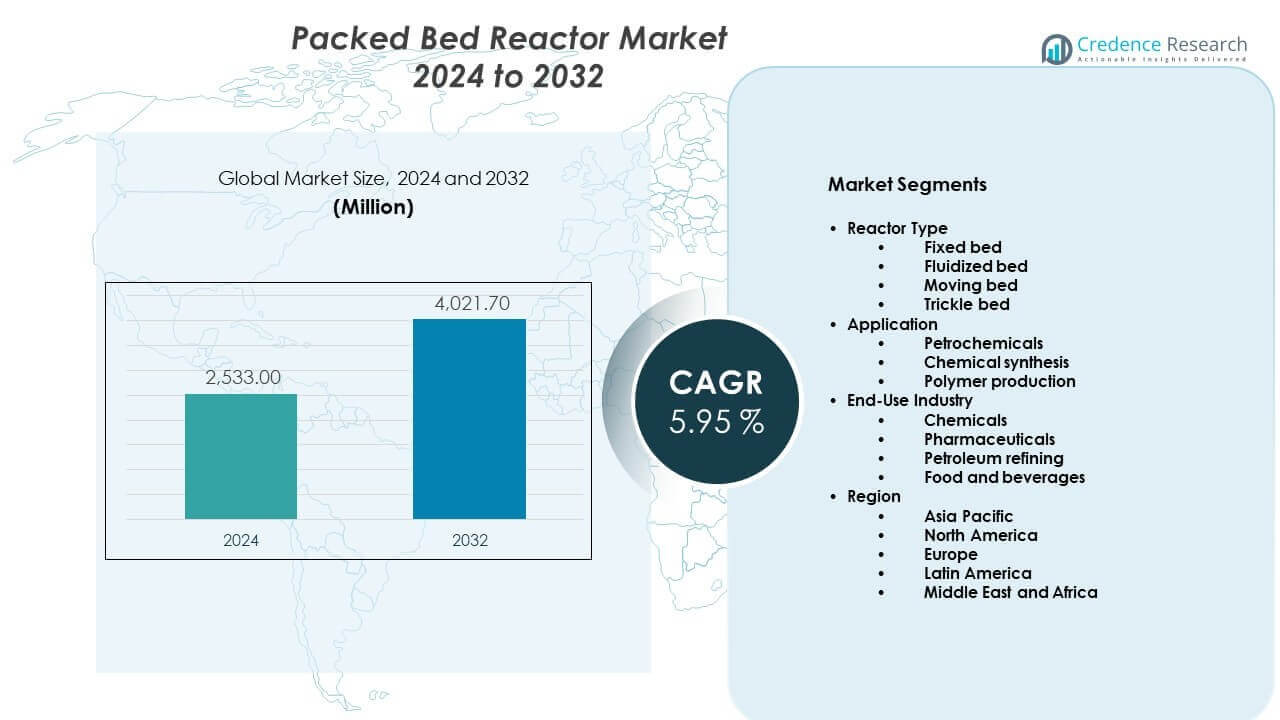
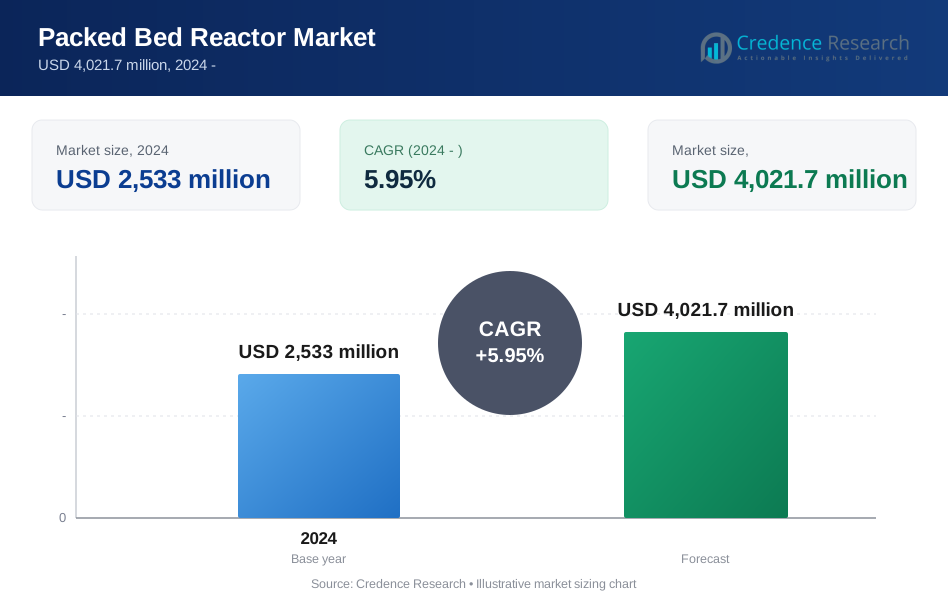
The Packed bed reactor market is projected to grow from USD 2,533 million in 2024 to USD 4,021.7 million by 2032, at a CAGR of 5.95% during the forecast period.
| REPORT ATTRIBUTE | DETAILS |
|---|---|
| Historical Period | 2020-2023 |
| Base Year | 2024 |
| Forecast Period | 2025-2032 |
| Packed Bed Reactor Market Size 2024 | USD 2,533 million |
| Packed Bed Reactor Market, CAGR | 5.95% |
| Packed Bed Reactor Market Size 2032 | USD 4,021.7 million |
Growth in chemical and petrochemical output drives demand for packed bed reactors. Manufacturers rely on these reactors for consistent reaction control and product quality. The design supports catalytic reactions with low operational risk. Refineries use the system to improve yield efficiency and reduce downtime. Rising investment in specialty chemicals supports equipment upgrades. Environmental compliance also plays a role, since efficient reactors reduce waste formation. Process industries favor proven reactor designs to ensure long operating cycles and predictable maintenance planning.
North America and Europe lead the market due to strong chemical and refining capacity. These regions focus on process efficiency and technology upgrades. Asia Pacific emerges as the fastest-growing region, driven by industrial expansion in China and India. New chemical plants increase demand for reliable reactor systems. Southeast Asia shows steady adoption due to rising specialty chemical production. The Middle East gains traction from refinery and petrochemical investments. Latin America and Africa remain emerging markets with gradual industrial development.
Market Insights:
- The Packed bed reactor market was valued at USD 2,533 million in 2024 and is projected to reach USD 4,021.7 million by 2032, growing at a CAGR of 5.95% during the forecast period.
- Asia Pacific leads with about 42% share, driven by large chemical capacity in China and India, followed by North America at 28% due to strong refining and pharmaceutical bases, and Europe at 22% supported by specialty chemicals and strict process standards.
- Asia Pacific is also the fastest-growing region, holding around 42% share, supported by new chemical plants, refinery expansions, and cost-efficient manufacturing ecosystems.
- By reactor type, fixed bed reactors dominate with nearly 55% share due to operational stability, long service life, and wide industrial acceptance.
- By end-use industry, chemicals account for about 48% share, supported by broad use in synthesis, intermediates, and specialty chemical production.
Market Drivers:
Rising Demand From Chemical And Petrochemical Processing Industries
The Packed bed reactor market benefits from steady growth in chemical production capacity worldwide. Chemical plants require stable reactors for continuous and batch operations across core processes. Packed bed designs support efficient catalytic reactions under controlled flow conditions. Petrochemical units rely on these systems for hydrogenation and oxidation applications. The reactor structure ensures uniform flow and predictable reaction outcomes over long cycles. Operators prefer proven reactor formats to reduce operational risk at scale. Long equipment life supports capital investment planning. This demand pattern sustains consistent procurement across large facilities.
- For instance, BASF operates fixed packed bed reactors in ammonia and methanol plants with catalyst lifetimes exceeding 8 years under continuous operation.
Preference For High Conversion Efficiency And Process Reliability
The Packed bed reactor market gains traction from rising focus on high conversion efficiency. Industries prioritize reactors that maintain reaction stability across extended production cycles. Packed beds support effective contact between fluids and catalyst surfaces. This structure improves yield consistency across multiple product batches. Refineries value reactors that operate reliably under high pressure environments. The design limits unexpected shutdown events during peak output periods. Maintenance planning remains simpler with fixed catalyst beds. Such reliability strengthens adoption across core process industries.
- For instance, Johnson Matthey reports hydrogenation catalysts in packed bed reactors achieving above 99% selectivity in refinery applications.
Growth In Refining And Specialty Chemical Manufacturing Capacity
The Packed bed reactor market expands alongside new refinery and specialty chemical investments. Producers increase output of polymers, intermediates, and performance chemicals. These processes require reactors with precise temperature control capabilities. Packed bed systems deliver controlled heat distribution during exothermic reactions. The format supports scalable production without major design changes. Plant owners favor standardized reactor designs for faster project execution. Regulatory compliance encourages use of stable reaction systems. This factor drives steady demand for industrial reactors.
Focus On Operational Safety And Proven Industrial Designs
The Packed bed reactor market benefits from strong emphasis on operational safety standards. Industrial operators prioritize equipment with established performance histories. Packed bed reactors offer predictable flow behavior under varying load conditions. This predictability reduces risks linked to runaway reactions. The fixed bed structure limits catalyst movement and channeling issues. Operators gain confidence in process control during extended operations. Insurance assessments favor proven reactor technologies. Safety-driven procurement supports long-term market demand.
Market Trends:
Integration Of Advanced Catalyst Formulations Within Fixed Reactor Systems
The Packed bed reactor market reflects wider use of advanced catalyst formulations. Producers deploy high-activity catalysts to improve selectivity and output control. Packed bed configurations support uniform catalyst placement across the reactor volume. This arrangement improves contact efficiency during chemical reactions. Manufacturers adjust bed depth to match catalyst performance needs. The approach enhances consistency across production cycles. Process engineers value compatibility with new catalyst chemistries. This trend supports gradual system upgrades without major redesign.
- For instance, Clariant’s EnviCat catalysts achieved a conversion efficiency of up to 99% and beyond for harmful emissions in fixed-bed chemical reactors, while reducing energy consumption by up to 40% compared to thermal alternatives.
Adoption Of Modular Reactor Designs For Flexible Plant Layouts
The Packed bed reactor market shows a shift toward modular reactor construction. Equipment suppliers offer standardized reactor modules for faster installation. Plants use modular layouts to reduce construction timelines. This structure supports phased capacity expansion plans. Modular systems simplify transportation and site assembly activities. Engineering teams gain flexibility during plant retrofits. Standard designs reduce customization effort and cost. This trend improves project execution efficiency.
Digital Monitoring And Process Control Integration
The Packed bed reactor market aligns with rising use of digital monitoring tools. Operators deploy sensors to track temperature and pressure levels. Real-time data improves operational visibility across reaction stages. Control systems support early fault detection and response. Automation ensures stable reaction conditions over long cycles. Reduced manual intervention improves operational safety. Data-driven control enhances output consistency. Digital integration strengthens overall plant performance.
Shift Toward Energy Efficient Reaction System Designs
The Packed bed reactor market follows energy efficiency focused equipment selection. Plants seek reactors that reduce thermal losses. Packed bed systems enable efficient heat utilization within reaction zones. Controlled thermal profiles support stable process performance. Energy optimization lowers operating expenses over time. Sustainability targets influence equipment investment decisions. Efficient reactors support emission reduction goals. This trend shapes future reactor specifications.
Market Challenges Analysis:
High Capital Investment And Complex Installation Requirements
The Packed bed reactor market faces challenges from high initial investment needs. Reactor fabrication requires specialized materials and engineering expertise. Installation demands skilled technical teams and precise planning. Site preparation increases project timelines and costs. Smaller producers face budget constraints during procurement. Custom designs extend manufacturing lead times. Capital approval cycles slow investment decisions. Cost sensitivity limits adoption in some markets.
Operational Constraints Related To Catalyst Replacement And Scale Changes
The Packed bed reactor market encounters limits during catalyst replacement cycles. Planned shutdowns affect production schedules and output targets. Fixed bed designs restrict rapid capacity adjustments. Scaling production often requires reactor modification. Maintenance planning becomes critical to ensure uptime. Operators balance output goals with service intervals. Process interruptions impact supply commitments. These factors influence reactor selection strategies.
Market Opportunities:
Expansion Of Chemical Manufacturing Capacity In Emerging Economies
The Packed bed reactor market gains opportunity from industrial growth in emerging regions. New chemical plants require reliable reactor systems for core processes. Developing economies invest in downstream chemical production. Packed bed designs suit early-stage industrial facilities. Local manufacturing reduces import reliance. Policy support encourages domestic chemical output. Equipment demand rises with new plant construction. This expansion opens long-term growth avenues.
Rising Adoption Within Sustainable And Green Chemistry Applications
The Packed bed reactor market benefits from growth in sustainable chemical practices. Green chemistry relies on efficient and controlled catalytic reactions. Packed bed systems support stable reaction pathways with low waste. Reduced byproduct formation supports sustainability goals. Producers adopt cleaner process technologies across portfolios. Regulatory pressure favors efficient reactor designs. Catalyst innovation enhances system relevance. Sustainability trends create durable growth potential.
Market Segmentation Analysis:
Reactor Type
The Packed bed reactor market shows strong preference for fixed bed reactors due to stable operation and proven performance. Fixed bed systems support continuous processing with consistent catalyst contact. Fluidized bed reactors serve applications that require better heat transfer and solid mixing. Moving bed reactors allow gradual catalyst replacement, which supports longer operating cycles. Trickle bed reactors meet demand in processes that involve gas and liquid phases together. Each reactor type addresses specific process requirements across industries.
- For instance, Shell uses trickle bed reactors extensively in hydroprocessing units across global refineries.
Application
Petrochemicals represent a major application segment due to high demand for catalytic conversion processes. Packed bed reactors support hydrogenation, oxidation, and reforming operations. Chemical synthesis uses these reactors for controlled reaction pathways and yield stability. Polymer production relies on packed beds for uniform temperature control and product consistency. Process reliability drives adoption across these applications. The reactor design supports scalable production across multiple product lines.
- For instance, SABIC utilizes gas-phase reactors (such as UNIPOL™ technology) and tubular reactors across its polyethylene and polypropylene facilities in Saudi Arabia
End-Use Industry
Chemicals dominate end-use demand due to broad reactor utilization across manufacturing stages. Pharmaceuticals use packed bed reactors for precise reaction control and quality assurance. Petroleum refining depends on these systems for high pressure and high temperature operations. Food and beverage processing applies packed bed reactors in enzymatic and catalytic processes. Industry preference focuses on safety, efficiency, and long equipment life.
By Segmentation:
By Reactor Type- Fixed bed
- Fluidized bed
- Moving bed
- Trickle bed
- Petrochemicals
- Chemical synthesis
- Polymer production
- Chemicals
- Pharmaceuticals
- Petroleum refining
- Food and beverages
- North America
- U.S.
- Canada
- Mexico
- Europe
- Germany
- France
- U.K.
- Italy
- Spain
- Rest of Europe
- Asia Pacific
- China
- Japan
- India
- South Korea
- South-east Asia
- Rest of Asia Pacific
- Latin America
- Brazil
- Argentina
- Rest of Latin America
- Middle East & Africa
- GCC Countries
- South Africa
- Rest of the Middle East and Africa
Regional Analysis:
Asia Pacific
The Packed bed reactor market in Asia Pacific holds the largest share at around 42%. Strong chemical and petrochemical capacity in China supports high equipment demand. India contributes through refinery expansion and specialty chemical production. Japan and South Korea focus on process efficiency and reactor upgrades. Manufacturers prefer fixed and trickle bed systems for stable operations. Cost-effective manufacturing supports regional adoption. Industrial growth sustains long-term demand across multiple end-use sectors.
North America
North America accounts for nearly 28% of the global market share. The United States leads due to advanced refining and petrochemical infrastructure. Operators invest in reactors that support high pressure applications. Process optimization and safety standards influence equipment selection. Pharmaceutical manufacturing supports steady demand for precision reactors. Technology upgrades drive replacement cycles. Strong engineering expertise supports consistent market activity.
Europe
Europe represents about 22% of the market share. Germany, France, and the United Kingdom drive demand through chemical and specialty production. Environmental compliance encourages efficient reactor deployment. Refining operations rely on proven packed bed designs. Pharmaceutical production supports demand for controlled reaction systems. Equipment standardization improves operational reliability. Industrial modernization sustains regional market stability.
Key Player Analysis:
- Parker Autoclave Engineers
- Vapourtec
- HiTec Zang GmbH
- AP-Miniplant GmbH
- WINKELS GmbH
- BASF SE
- Honeywell International Inc.
- Haldor Topsoe A/S
Competitive Analysis:
The Packed bed reactor market features a mix of global engineering firms and specialized reactor manufacturers. Competition centers on reactor design reliability, catalyst compatibility, and process safety. Leading players focus on customized systems for chemical, refining, and pharmaceutical clients. Product portfolios emphasize fixed and trickle bed reactors for continuous operations. Companies strengthen positions through long-term supply contracts with process industries. Technical service capability supports customer retention. Innovation targets modular designs and digital monitoring features. Strategic partnerships with catalyst suppliers improve system performance. Market rivalry remains moderate, with differentiation driven by engineering expertise and application knowledge.
Recent Developments:
- Parker Hannifin Corporation, the parent company of Parker Autoclave Engineers, has actively expanded its portfolio through significant acquisitions in 2025. In June 2025, Parker announced the acquisition of Curtis Instruments, Inc. for approximately $1 billion in cash. This transaction adds complementary control solutions and electric vehicle motor speed controllers to Parker's existing industrial electrification platform, positioning the company to better serve customers adopting electric and hybrid solutions across in-plant material handling and off-highway applications. More significantly, on November 11, 2025, Parker announced a landmark acquisition of Filtration Group Corporation for $9.25 billion on a cash-free, debt-free basis. This strategic transaction creates one of the largest global industrial filtration businesses, combining complementary filtration technologies and significantly expanding aftermarket business presence in Life Sciences, HVAC/R, and industrial verticals. The Filtration Group acquisition is expected to deliver $220 million in cost synergies and strengthen Parker's portfolio with high-quality, performance-critical applications. Additionally, Parker completed its acquisition of aerospace and defense components manufacturer Meggitt PLC for approximately £6.3 billion, adding advanced aerospace and defense technologies to its portfolio.
- In March 2025, Vapourtec Ltd announced a significant product development milestone by launching its high-temperature packed bed reactor as an enhancement to its existing E-Series and R-Series flow chemistry systems. This modular reactor represents a major technological advancement, extending operational capabilities up to 250°C and 50 bar pressure, significantly beyond previous system limitations. The reactor features stainless steel or Hastelloy column construction, allowing users to pack it with their desired catalysts or reagents, providing exceptional versatility for specialized applications. The high-temperature packed bed reactor opens new opportunities for advanced chemical syntheses including high-temperature click chemistry, continuous flow hydrogenations, direct alkylation of N-heterocycles and amines, and post-cracking work-up of high-value petroleum products. This development demonstrates Vapourtec's commitment to expanding flow chemistry applications across pharmaceutical, fine chemicals, and petrochemical sectors.
- BASF SE made a transformative strategic investment in its research and development infrastructure on December 12, 2024, by inaugurating its new Catalyst Development and Solids Processing Center in Ludwigshafen, Germany. This state-of-the-art facility represents a high double-digit million-euro investment designed to accelerate pilot-scale production of chemical catalysts and drive innovation in solids processing technologies. The center functions as a global hub for catalyst innovation, enabling BASF to rapidly transition laboratory-developed catalysts to production scale and deliver high-quality pilot samples to customers more swiftly a critical factor in successful product launches. The facility incorporates advanced process equipment and state-of-the-art safety features, positioning BASF to meet rapidly evolving global market demands with unprecedented speed.
- Additionally, BASF announced in December 2024 its investment in additional production capacity for its revolutionary X3D® catalyst technology, an additive manufacturing technology based on 3D printing. The new production plant is expected to become operational in 2026, scaling this breakthrough technology to industrial levels. X3D catalysts feature mechanically robust structures with open architecture that significantly reduces pressure drop across reactors while increasing surface area, resulting in improved catalyst performance, increased reactor output, higher product quality, and reduced energy consumption directly supporting customers' green transformation objectives. This dual investment strategy underscores BASF's commitment to maintaining its leadership position in chemical catalyst innovation and supporting the industry's transition toward sustainable production methods.
Report Coverage:
The research report offers an in-depth analysis based on reactor type, application, end-use industry, and region. It details leading market players, providing an overview of their business, product offerings, investments, revenue streams, and key applications. Additionally, the report includes insights into the competitive environment, SWOT analysis, current market trends, as well as the primary drivers and constraints. Furthermore, it discusses various factors that have driven market expansion in recent years. The report also explores market dynamics, regulatory scenarios, and technological advancements that are shaping the industry. It assesses the impact of external factors and global economic changes on market growth. Lastly, it provides strategic recommendations for new entrants and established companies to navigate the complexities of the market.
Future Outlook:
- The market will benefit from steady expansion in chemical and petrochemical manufacturing capacity.
- Fixed bed reactors will remain the preferred choice due to proven operational stability.
- Modular reactor designs will gain wider adoption to support flexible plant expansion.
- Digital monitoring systems will improve process control and operational reliability.
- Catalyst innovation will enhance conversion efficiency and reactor performance.
- Refinery modernization projects will support replacement demand for reactor systems.
- Emerging economies will increase investments in industrial reactor infrastructure.
- Sustainability goals will influence reactor selection and process optimization.
- Engineering standardization will reduce installation time and project complexity.
- Service and maintenance offerings will strengthen long-term customer relationships.
Request a Free Sample
Fill in your details and we'll send you a free sample report.
- Sample data tables & charts
- Research methodology
Need a Custom Version of This Report?
Tailor the scope, geography, or segments to your exact requirements.
- Custom geography or segment scope
- Direct access to our analyst team
Frequently Asked Questions
What is the current market size for Packed bed reactor market, and what is its projected size in 2032?
At what Compound Annual Growth Rate is the Packed bed reactor market projected to grow between 2025 and 2032?
Which Packed bed reactor market segment held the largest share in 2024?
What are the primary factors fueling the growth of the Packed bed reactor market?
Who are the leading companies in the Packed bed reactor market?
Which region commanded the largest share of the Packed bed reactor market in 2024?
Table of Content
Chapter 1. Report Introduction
- 1.1 Report Description & Purpose
- 1.1.1 Report Title & Market Definition
- 1.1.2 Unique Selling Propositions (USP) & Key Differentiators
- 1.1.3 Value Proposition for Stakeholders
- 1.2 Research Objectives
- 1.2.1 Market Sizing Objectives (Volume & Revenue)
- 1.2.2 Segmentation Objectives
- 1.2.3 Competitive Intelligence Objectives
- 1.2.4 Forecast & Scenario Objectives
- 1.3 Report Scope
- 1.3.1 Packed Bed Reactor Scope – Types & Subtypes Covered
- 1.3.2 Geographic Scope – Regions & Countries Covered
- 1.3.3 Historical Period, Base Year & Forecast Period (2024; forecast to the forecast period)
- 1.3.4 Inclusions & Exclusions
- 1.4 HS Code & Classification Framework
- 1.5 Currency, Units & Pricing Basis
- 1.6 Target Stakeholders
- 1.7 Limitations & Assumptions
Chapter 2. Executive Summary
- 2.1 Global Packed Bed Reactor Market Snapshot
- 2.1.1 Market Size – Historical (2024) & Forecast (the forecast period) (2024: USD 2,533 million → forecast year: USD 4,021.7 million)
- 2.1.2 Volume & Revenue – Global Totals
- 2.1.3 Key Market Highlights – Top Five Facts
- 2.2 Packed Bed Reactor Market Segmentation Snapshot
- 2.2.1 Market Split by Region – 2024 vs.
- 2.3 Competitive Snapshot
- 2.3.1 Top 10 Players by Revenue Share – 2024
- 2.3.2 Top 10 Players by Volume Share – 2024
- 2.3.3 Recent Strategic Developments (18-Month Summary)
- 2.4 Key Investment Highlights & Strategic Conclusions
Chapter 3. Packed Bed Reactor Market Dynamics & Industry Analysis
- 3.1 Market Overview & Context
- 3.1.1 Packed Bed Reactor Market Position in the Broader Automotive Value Chain
- 3.1.2 OEM vs. Replacement Market Dynamics
- 3.1.3 Market Maturity & Development Stage by Region
- 3.2 Packed Bed Reactor Market Drivers
- 3.3 Packed Bed Reactor Market Restraints & Challenges
- 3.4 Packed Bed Reactor Market Opportunities
- 3.5 Porter's Five Forces Analysis
- 3.5.1 Threat of New Entrants
- 3.5.2 Bargaining Power of Suppliers
- 3.5.3 Bargaining Power of Buyers
- 3.5.4 Threat of Substitutes
- 3.5.5 Competitive Rivalry – Intensity Assessment
- 3.6 Packed Bed Reactor Value Chain Analysis
- 3.6.1 Upstream – Raw Material/Input Suppliers
- 3.6.1.1 Raw Material/Input 1
- 3.6.1.2 Raw Material/Input 2
- 3.6.1.3 Raw Material/Input 3
- 3.6.2 Midstream – Production/Manufacturing/Service Delivery
- 3.6.2.1 Production/Process Overview
- 3.6.2.2 Key Facility Locations & Capacity by Manufacturer
- 3.6.3 Downstream – Distribution & End Consumer
- 3.6.3.1 Primary Channel – B2B/OEM
- 3.6.3.2 Secondary Channels – Dealer, Retail, Online, Direct
- 3.6.4 Value Chain Profitability Analysis
- 3.6.1 Upstream – Raw Material/Input Suppliers
- 3.7 PESTEL Analysis
- 3.7.1 Political Factors
- 3.7.2 Economic Factors
- 3.7.3 Social Factors
- 3.7.4 Technological Factors
- 3.7.5 Environmental Factors
- 3.7.6 Legal Factors
- 3.8 Packed Bed Reactor Supply Chain Analysis
- 3.8.1 Raw Material/Input Supply Risk Assessment
- 3.8.2 Manufacturing Concentration Risk (Geographic Exposure)
- 3.8.3 Trade Disruption Impact Analysis
- 3.9 Regulatory & Policy Landscape
Note: The regulatory and policy landscape section covers regulations based on their applicability to the market, Packed Bed Reactor category, geography, and scope of the study. Only regulatory frameworks with a material impact on operations, compliance, trade, sustainability, or market access are analyzed in detail.
Chapter 4. Key Investment Pockets & Opportunity Analysis
- 4.1 Packed Bed Reactor Market Attractiveness Analysis
- 4.1.1 By Region – Investment Attractiveness Matrix (Volume × CAGR)
- 4.2 Absolute Revenue Growth Opportunity
- 4.2.1 By Region – Absolute USD Growth Through the forecast period
- 4.3 Incremental Volume Opportunity
- 4.3.1 By Region – Incremental Volume Through the forecast period
- 4.3.2 Segment – Incremental Volume
- 4.4 Emerging Submarket Opportunity Deep Dive (Subject to Applicability)
- 4.5 Emerging Market Opportunity Scorecards
- 4.5.1 United States
- 4.5.2 Europe
- 4.5.3 Asia
- 4.5.4 Middle East & Africa
Note: Emerging Market Opportunity Scorecards will be included based on relevance and strategic importance. Regions listed are indicative and may vary depending on data availability and market dynamics.
Chapter 5. Packed Bed Reactor Import-Export Analysis & Trade Flows
- 5.1 Global Trade Overview
- 5.1.1 Global Export Value by Country (2024)
- 5.1.2 Global Export Volume by Country (2024)
- 5.1.3 Global Import Value by Country (2024)
- 5.1.4 Global Import Volume by Country (2024)
- 5.1.5 Net Trade Balance by Country (2024)
- 5.2 Export Analysis – Segment
- 5.2.1 Type 1 (HS Code)
- 5.2.2 Type 2 (HS Code)
- 5.2.3 Type 3 (HS Code)
- 5.2.4 Type 4 (HS Code)
- 5.2.5 Type 5 (HS Code)
- 5.3 Import Analysis – Segment
- 5.3.1 Type 1 (HS Code)
- 5.3.2 Type 2 (HS Code)
- 5.3.3 Type 3 (HS Code)
- 5.3.4 Type 4 (HS Code)
- 5.3.5 Type 5 (HS Code)
- 5.4 Average Unit Trade Prices
- 5.4.1 Average Export Price – Segment & Country
- 5.4.2 Average Import Price – Segment & Source Country
- 5.4.3 Price Trends (2024)
- 5.5 Key Trade Route Analysis
- 5.5.1 Trade Route 1
- 5.5.2 Trade Route 2
- 5.5.3 Trade Route 3
- 5.5.4 Trade Route 4
- 5.5.5 Trade Route 5
- 5.6 Trade Policy Impact Assessment
- 5.6.1 US Anti-Dumping & Section 301 Tariffs
- 5.6.2 EU Customs Union Impact
- 5.6.3 Major Free Trade Agreements
- 5.6.4 USMCA Rules of Origin
Note: Trade policy analysis will be included only where relevant to the Packed Bed Reactor market.
Chapter 6. Competitive Landscape & Company Benchmarking
- 6.1 Packed Bed Reactor Market Concentration & Structure
- 6.1.1 Herfindahl-Hirschman Index (HHI) – vs. 2024
- 6.1.2 Tier 1, Tier 2 & Tier 3 Market Structure
- 6.1.3 Global, Regional & Local Player Dynamics
- 6.2 Packed Bed Reactor Market Share Analysis – 2024
- 6.2.1 Global Revenue Share by Company
- 6.2.2 Global Volume Share by Company
- 6.2.3 Regional Revenue Share
- 6.2.4 Market Share Evolution ( vs. 2024)
- 6.2.5 OEM Segment Share by Company
- 6.2.6 Replacement Segment Share by Company
- 6.3 Production/Delivery Capacity & Facility Analysis
- 6.3.1 Global Installed Capacity
- 6.3.2 Capacity Utilization Rates
- 6.3.3 Production/Output Volume
- 6.3.4 Facility Locations & Capacity Map
- 6.3.5 Planned Capacity Additions
- 6.4 Packed Bed Reactor Competitive Benchmarking Matrix
- 6.4.1 Revenue, Volume, CAGR & Profitability Comparison
- 6.4.2 Channel Revenue Mix
- 6.4.3 Geographic Revenue Exposure
- 6.4.4 R&D Intensity
- 6.4.5 Sustainability Maturity
- 6.5 Strategic Developments in Packed Bed Reactor (Last 24 Months)
- 6.5.1 Mergers, Acquisitions & Divestments
- 6.5.2 New Packed Bed Reactor Launches
- 6.5.3 Facility Expansions
- 6.5.4 Strategic Alliances, Joint Ventures & Partnerships
- 6.5.5 Distribution Expansion & Market Entry
- 6.5.6 Sustainability & ESG Initiatives
- 6.6 Competitive Strategy Mapping
- 6.6.1 Leader, Challenger, Follower & Niche Classification
- 6.6.2 Pricing Strategy Comparison
- 6.6.3 Channel Strategy Matrix
Note: Strategic developments are included based on their materiality and the availability of reliable information.
Chapter 7. Global Packed Bed Reactor Market – By Distribution Channel
- 7.1 Segment Overview
- 7.1.1 Volume & Revenue Split by Channel (2024 & )
- 7.1.2 Channel Mix Evolution (the forecast period)
Chapter 8. Regional Market Analysis – Global Overview
- 8.1 Global Regional Overview
- 8.1.1 Regional Volume Share
- 8.1.2 Regional Revenue Share
- 8.1.3 Regional Volume by Region
- 8.1.4 Regional Revenue by Region
- 8.1.5 Regional Forecast Through the forecast period
- 8.2 Cross-Regional Segment Analysis
- 8.2.1 By Distribution Channel
- 8.2.2 By Brand/Price Tier
Chapter 9. North America Packed Bed Reactor Market
- 9.1 United States
- 9.2 Canada
- 9.3 Mexico
Chapter 10. Europe Packed Bed Reactor Market
- 10.1 Germany
- 10.2 France
- 10.3 Italy
- 10.4 United Kingdom
- 10.5 Spain
- 10.6 Poland
- 10.7 Russia
- 10.8 Netherlands
- 10.9 Belgium
- 10.10 Sweden
- 10.11 Denmark
- 10.12 Norway
- 10.13 Rest of Europe
Chapter 11. Asia Pacific Packed Bed Reactor Market
- 11.1 China
- 11.2 India
- 11.3 Japan
- 11.4 South Korea
- 11.5 Thailand
- 11.6 Indonesia
- 11.7 Vietnam
- 11.8 Malaysia
- 11.9 Australia
- 11.10 Rest of Asia Pacific
Chapter 12. Latin America Packed Bed Reactor Market
- 12.1 Brazil
- 12.2 Argentina
- 12.3 Colombia
- 12.4 Chile
- 12.5 Rest of Latin America
Chapter 13. Middle East Packed Bed Reactor Market
- 13.1 Saudi Arabia
- 13.2 United Arab Emirates
- 13.3 Turkey
- 13.4 Israel
- 13.5 Iran
- 13.6 Rest of the Middle East
Chapter 14. Africa Packed Bed Reactor Market
- 14.1 South Africa
- 14.2 Egypt
- 14.3 Nigeria
- 14.4 Morocco
- 14.5 Rest of Africa
Chapter 15. Packed Bed Reactor Company Profiles
- 15.1 [Company 01]
- 15.1.1 Company Overview
- 15.1.2 Key Management Personnel
- 15.1.3 Products & Services Portfolio
- 15.1.4 Financial Performance
- 15.1.5 Key Market Focus & Geographic Presence
- 15.1.6 Recent Developments & Strategic Initiatives
Note: The company profile list is preliminary and may change based on research findings, market developments, data availability, and client requirements.
Chapter 16. Appendices
- Appendix A – List of Abbreviations & Acronyms
- Appendix B – Industry Classification Code Reference – Full Series
- Appendix C – Production & Capacity Data Tables
- Appendix D – End-Use & Demand Base Tables
- Appendix E – Consumption & Replacement Rate Assumptions
- Appendix F – ASP Reference Tables
- Appendix G – Manufacturing & Facility Database
- Appendix H – Import-Export Data Tables
- Appendix I – Regulatory Summary Tables
- Appendix J – Primary Research Participant List (Anonymized)
- Appendix K – Primary Research Questionnaire Framework
- Appendix L – Data Sources & Bibliography
- Appendix M – Market Size Divergence & Source Comparison
Chapter 17. Research Methodology
- 17.1 Research Framework & Philosophy
- 17.2 Secondary Research – Sources, Hierarchy & Data Extraction
- 17.3 Data Modeling – Bottom-Up & Top-Down Market Sizing
- 17.4 Primary Research – Stakeholder Framework, LOI & Sample Sizes
- 17.5 Forecast Methodology – Regression, Scenario & Sensitivity Analysis
- 17.6 Quality Control – Four-Layer Validation Framework
- 17.7 Limitations & Standard Assumptions
- 17.8 Disclaimer
