| REPORT ATTRIBUTE |
DETAILS |
| Historical Period |
2019-2022 |
| Base Year |
2023 |
| Forecast Period |
2024-2032 |
| Home Infusion Therapy Market Size 2024 |
USD 23514.2 Million |
| Home Infusion Therapy Market, CAGR |
6.80% |
| Home Infusion Therapy Market Size 2032 |
USD 42508.07 Million |
Market Insights
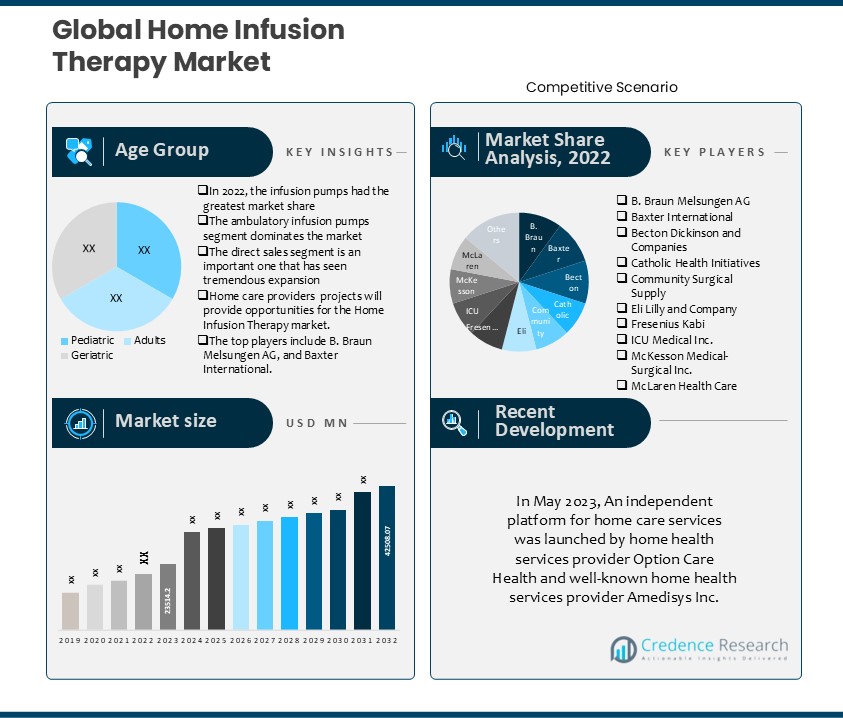
- A compound annual growth rate (CAGR) of 6.80% is predicted for the global market for home infusion therapy between 2024 and 2032, taking it from an estimated USD 23514.2 million in 2023 to USD 42508.07 million in 2032.
- The largest product type section is infusion pumps. On the other hand, intravenous sets are expected to grow at a strong CAGR.
- The leading application segment is anti-infective.
- The CAGR for ambulatory infusion pumps is expected to be the highest during the projection period.
- The infectious diseases will have the highest CAGR throughout the prediction period.
- Home care providers are estimated to have the greatest CAGR during the forecast period.
- The direct sales segment will likely have the highest CAGR during the prediction period.
- During forecasting, pediatrics will probably have the highest CAGR.
- During the forecast period, the anti-infective therapy sector will probably have the greatest CAGR.
- The market for home infusion therapy was dominated by North America.
- Regarding the market share of home infusion therapy, Europe is expected to come second.
- In the home infusion therapy market, Asia Pacific is anticipated to grow fastest.
- The primary drivers of market development are the aging population, the integration of telehealth, the rising prevalence of chronic illnesses, and collaboration between healthcare providers.
- The home infusion therapy market has potential in the areas of pediatric home infusion, pharmaceutical company partnerships, remote patient monitoring solutions, and healthcare IoT integration.
Executive Summary
Market Definition
The market for home infusion therapy includes a range of goods and services, such as IV catheters, infusion sets, pumps, and solutions. Furthermore, to provide these services to patients, specialty pharmacies, home healthcare agencies, and healthcare providers are essential. Technologies and platforms that enable remote patient monitoring for home infusion therapy may also be part of the market.
Market Overview
According to estimates, the home infusion therapy market will continue upward and grow at a 6.80% compound annual growth rate (CAGR) from 2024 to 2032. The market is expected to continue growing, reaching a projected value of USD 42508.07 million in 2032 from its estimated USD 23514.2 million in 2023.
The market for home infusion therapy, or HIT, is expanding as a result of the increasing prevalence of chronic illnesses. As opposed to a hospital or clinic, home infusion therapy involves giving patients intravenous (IV) routes for the administration of drugs or fluids. The growing prevalence of chronic illnesses is fueling the popularity of this approach to healthcare delivery. Globally, the prevalence of chronic illnesses like diabetes, heart disease, autoimmune disorders, and some forms of cancer is rising. Chronic conditions are becoming more common as a result of the aging population and altered lifestyle factors like poor diets and sedentary behaviors. Long-term care and treatment are frequently necessary for chronic illnesses to reduce symptoms, avoid complications, and enhance patients’ quality of life. Without the need for frequent hospital visits, home infusion therapy provides a practical and efficient way to administer medication for chronic conditions.
Additionally, technological developments have resulted in the creation of portable, easy-to-use infusion devices, which facilitate patients’ self-administration of medication at home. These gadgets have safety features that guarantee correct dosage and reduce the possibility of problems. Compared to inpatient care, home-based care is frequently less expensive. Home infusion therapy can lower medical expenses related to hospital stays, travel, and other related costs. More decentralized and patient-centric care models are becoming the norm due to the growing strain on healthcare systems to handle the growing number of chronic disease cases.
Segmentation by Product type
- Infusion pumps are the market leader by product type. Home infusion therapy is a medical procedure in which patients receive medications or fluids directly into their bloodstream via a needle or catheter. Infusion pumps are an essential part of this process. With home infusion therapy, patients can receive essential medical care without having to go to a hospital or clinic; instead, they can receive it in the convenience of their own homes.
- The intravenous sets category will exhibit a sizable CAGR during the projected period. Intravenous sets, commonly referred to as IV sets or infusion sets, are medical devices that are used to give patients direct access to fluids, medications, and other treatments. These sets usually contain tubing, a venous access needle or catheter, and additional parts required for the secure and regulated delivery of infusions.
- The need for home infusion therapy is additionally supported by other product types, including IV cannulas, needleless connectors, and others.
Segmentation by Application
- The main application is anti-infective. Anti-infective drugs are made to fight or stop infections brought on by bacteria, viruses, fungi, or parasites. Instead of giving these drugs in a hospital or clinic, home infusion therapy involves giving them to patients in their homes. Patients who need ongoing or frequent treatments are frequently the target audience for this strategy.
- The hydration therapy category will likely register a significant CAGR during forecasting. Regarding home infusion therapy, hydration therapy is the process of giving nutrients, electrolytes, and fluids intravenously (IV) while the patient is comfortable in their own home. When people need more nutrition or hydration but are not in the hospital, this strategy is frequently employed.
- Other applications, such as chemotherapy, enteral nutrition, parenteral nutrition, specialty pharmaceuticals, and others, also contribute to the demand for home infusion therapy.
Segmentation by Infusion Pump Type
- It is projected that over the projection period, the category of ambulatory infusion pumps will grow at the fastest rate. The ability for patients to receive intravenous (IV) medications or fluids outside of a traditional healthcare setting often in the comfort of their own homes makes ambulatory infusion pumps indispensable to the field of home infusion therapy (HIT).
- The need for home infusion therapy is also influenced by various infusion pump types, including volumetric and syringe infusion pumps.
Segmentation by Disease Type
- The infectious diseases category will likely have the highest CAGR during the projection period. Intravenous (IV) medicine may be necessary to treat individuals with infectious diseases, such as bacterial or viral infections. This population is served by home infusion therapy, which enables them to obtain essential medications without visiting the hospital frequently.
- Other disease types, such as oncology, gastrointestinal diseases, diabetes, pain management, hemophilia, immunodeficiency disorders, and others, also contribute to the demand for home infusion therapy.
Segmentation by Service Provider
- Home care providers will be expected to have the foremost CAGR during the prediction period. Through the provision of specialized medical treatments to patients in the comfort of their own homes, home care providers are essential to the Home Infusion Therapy (HIT) industry. A common treatment for infections, immunological deficiencies, chronic diseases, and pain management is home infusion therapy, which entails giving drugs, fluids, or nutrients subcutaneously or through an IV.
- Other service providers, such as hospitals and specialty clinics, also contribute to the demand for home infusion therapy.
Segmentation by Distribution Channel
- Throughout the forecast duration, the category for direct sales is anticipated to have the greatest CAGR. Infusion therapy products and services are sold directly from the manufacturer or provider to end users, such as patients or healthcare facilities, in the home infusion therapy market.
- Other distribution channels, such as retail and online pharmacies, also influence the need for home infusion therapy.
Segmentation by Age Group
- Throughout the forecast period, pediatrics is anticipated to have the highest CAGR. Giving prescription drugs or other medical treatments to young patients in the convenience of their own homes is known as pediatric home infusion therapy. Children who need continuous intravenous (IV) medication, nutritional support, or other specialized treatments may benefit most from this therapy. Receiving these treatments in a clinic or hospital setting can be substituted with home infusion therapy.
- Other age groups, such as adults and the geriatric, increase the need for home infusion therapy.
Segmentation by Therapy Type
- Throughout the forecast duration, the category for anti-infective therapy is anticipated to have the greatest CAGR. Antibiotics, antivirals, antifungals, and antiparasitic drugs are among the various pharmaceuticals classified as anti-infective drugs. These medications are administered to treat infections caused by bacteria, viruses, fungi, or parasites.
- The need for home infusion therapy is also influenced by different therapy types, such as nutritional therapy, hydration therapy, chemotherapy, etc.
Segmentation by Region
- North America leads the home infusion therapy industry. This can be attributed to various variables, including rising rates of long-term diseases, rising healthcare expenses, new product introductions, and rising treatment prices, all of which are predicted to propel the region’s development. According to the 2021 updates from the American Cancer Society, approximately 1.8 million new instances of cancer were recorded in the United States alone in 2020.
- Europe is estimated to rank second in market size for home infusion therapy.
- Asia Pacific will witness the most rapid home infusion therapy market growth.
- The additional need for home infusion therapy is met by regions such as Africa, the Middle East, and Latin America.
The main forces behind the growth of the home infusion therapy market are the growing adoption of remote consultations for medical guidance, the implementation of remote monitoring equipment to track patient health, and the rising public knowledge of healthcare alternatives and possibilities.
Regarding forecasting, North America will likely dominate the home infusion therapy market. The incidence of chronic illnesses like diabetes, autoimmune diseases, and cancer is comparatively high in North America. The treatment of these ailments frequently involves home infusion therapy, which supports the expansion of the sector. Modern healthcare innovations and technologies are frequently adopted and funded in the region. Technology that improves the effectiveness and security of home infusion therapy may include sophisticated infusion pumps, remote monitoring systems, and other tools. A major factor in North America, particularly the United States, has a strong healthcare reimbursement system. Healthcare providers and patients are encouraged to choose home infusion services by reimbursement policies that cover them.
Throughout the forecast, the home infusion therapy market in Asia-Pacific is anticipated to expand at the fastest rate. Like numerous other regions across the globe, the Asia Pacific area has witnessed an increase in elderly individuals. Infusion therapy at home is a convenient option for the elderly, who frequently need long-term care and treatment. The need for home infusion therapy has been fueled by the rise in the prevalence of chronic illnesses like diabetes and heart problems. Patients’ quality of life can be enhanced by receiving ongoing treatment and medication at home, which is often necessary for those with chronic conditions. Comparing home infusion therapy to hospital-based treatments, cost is frequently thought to be lower. Furthermore, it eases the burden on healthcare facilities by enabling patients to receive medical care in the comfort of their own homes.
The delivery of complex treatments at home has been made easier by adopting cutting-edge medical technologies. This covers infusion pumps and other tools facilitating patients’ at-home intravenous drug administration. A contributing factor to the expansion of home infusion therapy has been favorable regulatory policies and guidelines. Support from regulations can guarantee safety standards, expedite procedures, and incentivize healthcare providers to provide these services. For various reasons, such as the security of being in familiar surroundings, a lower chance of hospital-acquired infections, and more control over their health management, many patients choose home infusion therapy over hospital stays.
Key Highlights of the Report
The global home infusion therapy market is segmented by product type, application, infusion pump type, disease type, service provider, distribution channel, age group, therapy type, and region. As far as the product type is concerned, infusion pumps are the market spearhead. Anti-infective is the top application segment. The ambulatory infusion pumps category is anticipated to increase at the highest CAGR throughout the projection period. Direct sales will experience the highest CAGR during the forecast period. Home infusion therapy is expanding mostly in North America.
The home infusion therapy market is significantly influenced by remote patient monitoring (RPM) solutions, which improve the effectiveness, security, and ease of administering medical treatments at home. Home infusion therapy administers drugs, liquids, or other medicinal agents subcutaneously or intravenously (IV) to a patient. This approach eliminates the need for frequent hospital visits by enabling patients to receive necessary treatments in the comfort of their own homes. An additional degree of protection is offered by remote monitoring to patients receiving home infusion therapy. Healthcare professionals can quickly identify and handle possible problems, such as complications or unfavorable reactions. To promote a safer experience with home infusion, patients receive prompt guidance or alerts if there are any concerns.
North America is expected to account for the largest portion of the home infusion therapy market globally. The expansion of home infusion therapy services has been made possible by partnerships between home healthcare companies, hospitals, and healthcare providers in North America. These collaborations contribute to the smooth discharge of patients from the hospital. Many patients would rather receive their care at home than in a medical facility. Better patient satisfaction and treatment plan adherence are facilitated by the more familiar and comfortable setting that home infusion therapy offers. The Asia Pacific region is also assumed to have the market’s sharpest growth. Several Asia-Pacific nations have made investments to upgrade their healthcare systems, including home healthcare services. This has made home infusion therapy more widely accepted as a practical and practical form of treatment. A part has also been played by government programs to support at-home healthcare and lessen the strain on hospitals. The market for home infusion therapy has expanded in the area due to policies that support home-based care.
Which Key Factors Are Driving The Global Home Infusion Therapy Market?
The market for home infusion therapy is expected to continue growing due to advancements in drug therapies, rising healthcare costs, technological advancements, and the growing use of remote monitoring devices to track patient health.
What Are The Main Challenges Confronting The Home Infusion Therapy Market Globally?
Numerous problems, including reimbursement difficulties, the complexity of therapies, a shortage of home nurses, resistance from healthcare providers, and a technological literacy gap, are impeding the growth of the home infusion therapy industry.
What Market Opportunities Exist For Home Infusion Therapy Globally?
The growing popularity of home infusion therapy can be attributed to several factors, including biological drugs and biopharmaceuticals, improvements in infusion pump technology, using technology to improve patient engagement, and providing cancer treatment and supportive care through home infusion.
Access crucial information at unmatched prices!
Request your sample report today & start making informed decisions powered by Credence Research Inc.!
Download Sample
Market Drivers
Multiple factors propel the home infusion therapy industry across the globe. The primary factors propelling the global home infusion therapy market are as follows:
Growing Chronic Illness Prevalence
In contrast to hospital or clinic settings, home infusion therapy involves giving medication to patients intravenously or subcutaneously. For those with chronic conditions that necessitate ongoing treatment, this approach is especially advantageous. The prevalence of long-term conditions like diabetes, cancer, autoimmune diseases, and some infectious diseases has increased worldwide. For these conditions, home infusion therapy is a convenient and patient-friendly option because the treatments are often ongoing and can be complex. Compared to inpatient care, home infusion therapy may be less expensive. Less frequent hospital visits are also required because it provides patients with the convenience of receiving treatment in a familiar setting. Patient adherence to recommended treatment plans may improve as a result. Home infusion therapy administration and monitoring have become simpler due to technological advancements like telehealth and portable infusion pumps. The viability and safety of administering infusion treatments outside of conventional healthcare settings are improved by these developments. The market is growing due to policies and programs that assist home-based care, including infusion therapy. To enhance patient outcomes and lessen the strain on healthcare facilities, governments, and healthcare organizations may support such practices.
Market Restraints
There are several obstacles that the global home infusion therapy market must overcome to continue growing. Among them are the following:
Increase in the Frequency of Illnesses Acquired in Hospitals
The rise in hospital-acquired disease prevalence for several reasons may restrain the market for home infusion therapy. Instead of administering medication or fluids in a hospital setting, home infusion therapy uses intravenous (IV) or injection routes to deliver the patient’s supplies. The prevalence of hospital-acquired diseases can obstruct the uptake and expansion of home infusion therapy even though this strategy has many advantages, including improved patient comfort and lower healthcare costs. The high rate of hospital-acquired infections may indicate that more people need to know about infection control procedures and safety precautions related to home infusion therapy. To gain confidence in the safety of home infusion therapy and to comprehend the measures taken to reduce the risk of infection, patients, healthcare providers, and caregivers might need additional information.
Opportunities
There are plenty of potential prospects in the global home infusion therapy industry. Among these are the following:
Advancements in Technologies for Remote Patient Monitoring
In the framework of home infusion therapy, remote patient monitoring (RPM) technologies are essential because they present chances to improve patient care and treatment results. Instead of giving medicine in a conventional hospital setting, home infusion therapy involves giving it to patients intravenously, subcutaneously, or intramuscularly. Healthcare professionals can monitor and modify infusion parameters remotely by connecting these devices to a central monitoring system. To guarantee precise dosing and lower the possibility of mistakes, smart pumps can offer real-time data on medication administration. Healthcare providers can consult virtually with patients thanks to telehealth platforms. Without requiring face-to-face interaction, this can be especially helpful for tracking and evaluating the patient’s condition, discussing treatment options, and addressing any concerns. Through reminders and educational materials, mobile apps can support patients in following their prescription regimens. To improve communication with healthcare providers, these apps might also have features for reporting side effects or symptom changes. Cloud-based systems can compile and evaluate data from multiple sources, providing insights into patient patterns and the effectiveness of treatments. By using data to inform decisions and optimize treatment plans, healthcare providers can benefit from this data-driven approach.
Competitive Landscape
Key Players
There are several major competitors in the fiercely competitive global home infusion therapy market. The followings are a few of the leading market participants and their market shares:
- B. Braun Melsungen AG
- Baxter International
- Becton Dickinson and Companies
- Catholic Health Initiatives
- Community Surgical Supply
- Eli Lilly and Company
- Fresenius Kabi
- ICU Medical Inc.
- McKesson Medical-Surgical Inc.
- McLaren Health Care
- Nipro Corporation
- Option Care Health Inc.
- Smiths Medical
- Sutter Health
- Terumo Corporation
- Others
To remain competitive, these companies prioritize product innovation, distribution channel expansion, mergers, and acquisitions.
By releasing new ideas and goods, the biggest vendors in the global home infusion therapy sector constantly strive to stay one step ahead of the competition.
In June 2023, The Progressa+ Next Gen ICU bed, designed to meet patients’ basic needs at home, will be available from the American healthcare company Baxter International. Nurses can more easily provide patient care and help with at-home rehabilitation with the help of this technology.
In May 2023, The Ivenix Infusion System’s price and term benefits were negotiated by the international healthcare company Fresenius Kabi and the American healthcare company Premier, Inc. The goal of this technology is to increase the dependability and user-friendliness of infusion pumps.
Summary of Key Findings
- The home infusion therapy market is continuing to grow due to greater awareness of healthcare.
- The market is segmented by product type, application, infusion pump type, disease type, service provider, distribution channel, age group, therapy type, and region.
- The most popular product type in the market is infusion pumps.
- Anti-infective is the foremost application category.
- Regarding CAGR, infectious diseases are expected to grow fastest during the forecast period.
- The category for pediatric will likely see the highest CAGR during the anticipated time frame.
- North America is leading market development; the market is highly competitive with key players including B. Braun Melsungen AG, Baxter International, Becton Dickinson and Companies, Catholic Health Initiatives, Community Surgical Supply, Eli Lilly and Company, Fresenius Kabi, ICU Medical Inc., McKesson Medical-Surgical Inc., McLaren Health Care, Nipro Corporation, Option Care Health Inc., Smiths Medical, Sutter Health, Terumo Corporation, and Others.
Shape Your Report to Specific Countries or Regions & Enjoy 30% Off!
Future Outlook
- The home infusion therapy industry is expected to increase significantly in North America and has a positive outlook worldwide.
- Home infusion therapy is growing in popularity because of the remote monitoring of patients.
- During the projected period, one of the main factors anticipated to restrain the home infusion therapy market’s growth is the high initial setup costs.
- To stay ahead of the competition, key enterprises must develop new products, expand their market reach, and keep their prices competitive.
How CXOs Can Benefit from the Credence Research Home Infusion Therapy Market Report
CXOs may get a detailed picture of the market in the Credence Research Home Infusion Therapy Market Report, which includes:
- Market size and growth forecast: The report provides detailed estimates of the global home infusion therapy market size, segmented by product type, application, infusion pump type, disease type, service provider, distribution channel, age group, therapy type, and region. It also includes forecasts for the market through 2032 based on key trends and drivers.
- Market segmentation: The research report breaks down the market for home infusion therapy into segments based on the product type, application, infusion pump type, disease type, service provider, distribution channel, age group, therapy type, and region. CXOs are given a detailed grasp of the market and the opportunities within each segment due to this segmentation.
- Competitive landscape: The research report offers a detailed analysis of the major companies in the home infusion therapy industry, including information on their business plans, line of products, and earnings. CXOs can use this information to evaluate and identify their competitors.
- Key trends and drivers: The research report identifies and evaluates the main trends and factors influencing the market for home infusion therapy. CXOs can use this information to make well-informed choices regarding their plans and investments.
CXOs can use the insights from the Credence Research Home Infusion Therapy Market Report to:
- Identify growth opportunities: With the help of this analysis, CXOs may identify new growth opportunities in the home infusion therapy sector. For example, the report identifies the growing demand for home infusion therapy from remote patient monitoring solutions as a key opportunity.
- Make informed investment decisions: With the help of the report, CXOs can choose home infusion therapy wisely. For example, the research study provides information on the critical factors to consider while selecting home infusion therapy solutions and evaluating home infusion therapy suppliers.
- Develop competitive strategies: The research report can be used by CXOs to develop competitive strategies for their home infusion therapy businesses. For example, the research paper outlines the main strategies suppliers of home infusion therapy utilize to differentiate themselves from competitors.
- Track market developments: CXOs may stay ahead of the curve by tracking market developments with the aid of this research report. For instance, the research report offers insights into the most recent developments and trends in the market for home infusion therapy.
In general, CXOs seeking to expand their industry knowledge and spot growth prospects will find the Credence Research Home Infusion Therapy Market Report a useful tool.
Segmentation
By Product Type
- Infusion Pumps
- Intravenous Sets
- IV Cannulas
- Needleless Connectors
- Others
By Application
- Anti-Infective
- Hydration Therapy
- Chemotherapy
- Enteral Nutrition
- Parenteral Nutrition
- Specialty Pharmaceuticals
- Others
By Infusion Pump Type
- Ambulatory Infusion Pumps
- Volumetric Infusion Pumps
- Syringe Infusion Pumps
By Disease Type
- Infectious Diseases
- Oncology
- Gastrointestinal Diseases
- Diabetes
- Pain Management
- Hemophilia
- Immunodeficiency Disorders
- Others
By Service Provider
- Home Care Providers
- Hospitals
- Specialty Clinics
- Others
By Distribution Channel
- Direct Sales
- Retail Pharmacies
- Online Pharmacies
By Age Group
- Pediatric
- Adults
- Geriatric
By Therapy Type
- Anti-Infective Therapy
- Nutritional Therapy
- Hydration Therapy
- Chemotherapy
- Others
By Region
- North America
- Europe
- Germany
- France
- U.K.
- Italy
- Spain
- Rest of Europe
- Asia Pacific
- China
- Japan
- India
- South Korea
- South-east Asia
- Rest of Asia Pacific
- Latin America
- Brazil
- Argentina
- Rest of Latin America
- Middle East & Africa
- GCC Countries
- South Africa
- Rest of Middle East and Africa
Adjacent Markets
Several adjacent markets in the home infusion therapy market have high revenue growth opportunities. The key adjacent markets for the home infusion therapy market –
Adjacent Markets
|
| Telehealth and Telemedicine |
Pharmaceuticals |
Healthcare IT Solutions |
| Remote Patient Monitoring |
Chronic Disease Management |
Health and Wellness Apps |
| Regenerative Medicine |
Clinical Trials Services |
Healthcare Analytics |



