
N-Methyl-2-Pyrrolidone Market Overview:
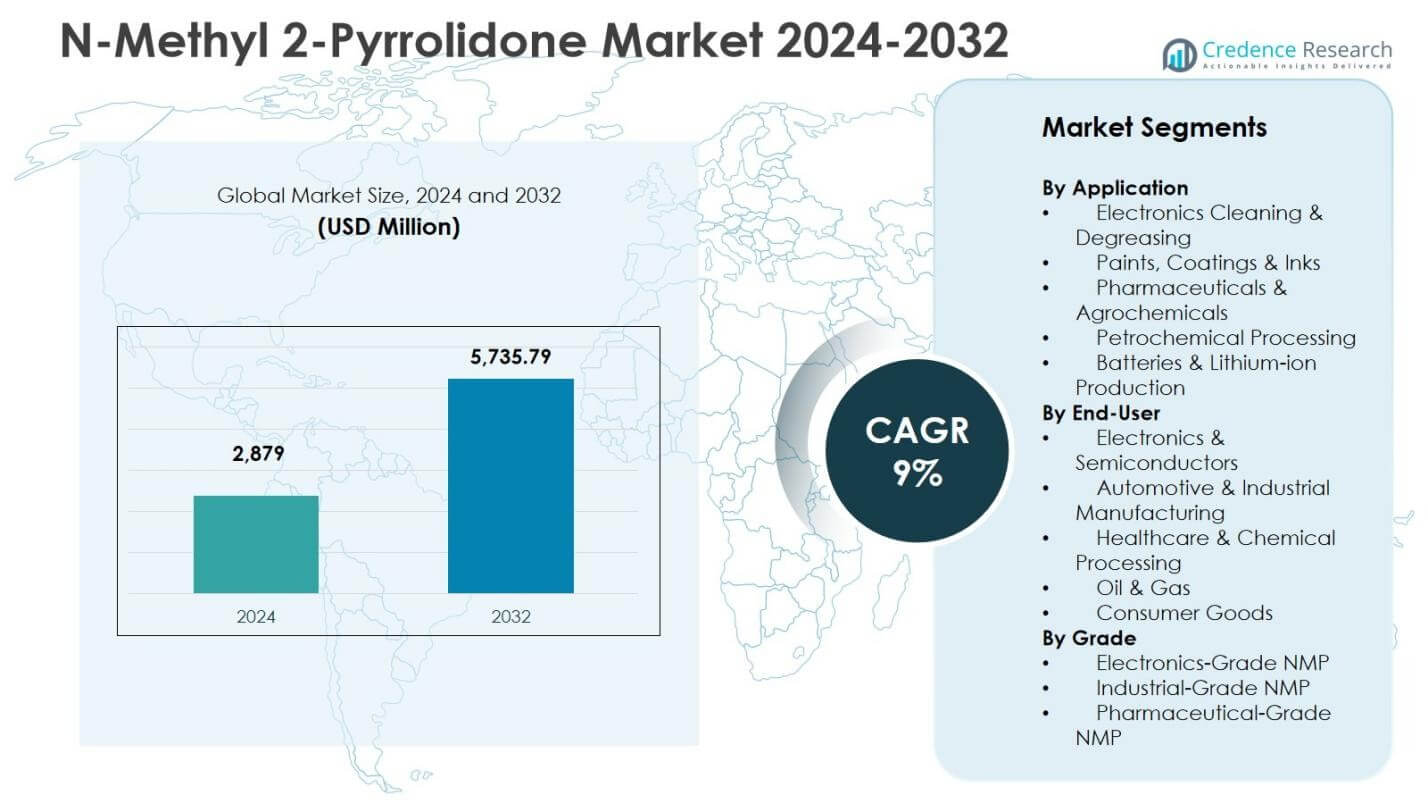
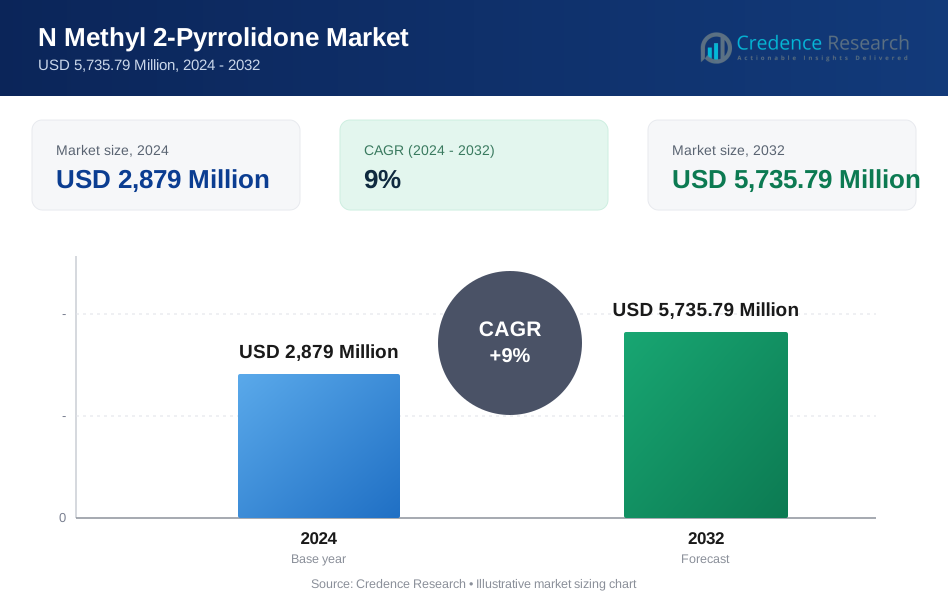
N-Methyl-2-Pyrrolidone Market size was valued at USD 2,879 Million in 2024 and is anticipated to reach USD 5,735.79 Million by 2032, at a CAGR of 9% during the forecast period.| REPORT ATTRIBUTE | DETAILS |
|---|---|
| Historical Period | 2020-2023 |
| Base Year | 2024 |
| Forecast Period | 2025-2032 |
| N-Methyl-2-Pyrrolidone Market Size 2024 | USD 2,879 million |
| N-Methyl-2-Pyrrolidone Market, CAGR | 9% |
| N-Methyl-2-Pyrrolidone Market Size 2032 | USD 5,735.79 million |
N-Methyl-2-Pyrrolidone Market Insights
- Markets driver is strengthened by rapid electrification trends, expansion of gigafactories, and increase in high-performance polymer and specialty chemical applications across industrial manufacturing value chains.
- Competititive analysis indicates strong presence of major chemical producers focusing on high-purity NMP grades, product innovation, and capacity expansion to support applications in electronics, automotive, and chemical processing industries.
- Regional analysis shows Asia-Pacific holding a 47.8% share in 2024 driven by industrial manufacturing and battery production, followed by Europe with a 22.6% share and North America with an 18.9% share, while Latin America and Middle East & Africa continue to exhibit steady emerging-market growth.
N-Methyl-2-Pyrrolidone Market Segmentation Analysis:
By Application
The N-Methyl-2-Pyrrolidone Market is segmented by application into Electronics Cleaning & Degreasing, Paints, Coatings & Inks, Pharmaceuticals & Agrochemicals, Petrochemical Processing, and Batteries & Lithium-ion Production. Batteries & Lithium-ion Production dominated the segment with a 34.6% share in 2024, driven by expanding electric vehicle manufacturing, rapid growth in energy-storage deployment, and increasing demand for high-purity solvents in cathode processing and electrolyte formulation. Strong investments in gigafactories, government-led clean-energy initiatives, and the rising penetration of consumer electronics further accelerated consumption of NMP in battery electrode production across Asia-Pacific, Europe, and North America.
- For instance, in Batteries & Lithium-ion Production, ZESHENG supplies high-purity NMP as a solvent for cathode coating and drying processes, enhancing energy density in lithium-ion batteries produced across multiple facilities.
By End-User
The market is categorized by end-user into Electronics & Semiconductors, Automotive & Industrial Manufacturing, Healthcare & Chemical Processing, Oil & Gas, and Consumer Goods. Electronics & Semiconductors emerged as the leading end-use industry with a 38.2% share in 2024, supported by strong growth in chip fabrication, precision cleaning processes, photoresist stripping, and advanced materials manufacturing. Rising semiconductor capacity expansions, automation of electronics assembly lines, and the surge in demand for high-performance consumer devices and communication hardware strengthened NMP usage due to its excellent solvency, stability, and compatibility with ultra-fine electronic components.
- For instance, LyondellBasell produces NMP-EL grade specifically for electronics, used in photoresist stripping and cleaning of circuit boards and precision instruments. The solvent enables effective removal in high-temperature applications while maintaining dielectric properties.
By Grade
The N-Methyl-2-Pyrrolidone Market is segmented by grade into Electronics-Grade NMP, Industrial-Grade NMP, and Pharmaceutical-Grade NMP. Industrial-Grade NMP accounted for the largest share at 46.5% in 2024, driven by its widespread adoption in petrochemical extraction, surface coatings, wire enamels, and engineered polymer processing. Its high solvency strength, versatility across large-scale manufacturing operations, and cost-effectiveness compared to higher-purity variants supported broad usage across automotive, industrial, and chemical value chains, while regulatory-compliant handling practices and process modernization initiatives continued to reinforce demand for industrial-grade formulations.
Key Growth Drivers
Rising Adoption of NMP in Lithium-Ion Battery Production
Growing global investment in electric vehicles, energy-storage systems, and consumer electronics is driving strong demand for N-Methyl-2-Pyrrolidone in lithium-ion battery manufacturing. NMP is widely used as a solvent for cathode-active material processing due to its strong solvency, thermal stability, and compatibility with electrode coatings. The expansion of battery gigafactories, localization of cell manufacturing in Asia-Pacific and Europe, and policy-driven electrification initiatives are strengthening consumption across automotive and stationary storage applications. Continuous advancements in high-energy-density battery chemistries and increasing adoption of rechargeable devices further reinforce the role of NMP as a critical processing solvent in large-scale electrode production.
- For instance, Verkor’s gigafactory in France integrates a solvent recovery system (SRS) to condense highly concentrated NMP vapors from cathode drying.
Increasing Use of NMP in Petrochemical and Polymer Processing
The N-Methyl-2-Pyrrolidone Market benefits significantly from its extensive use in petrochemical extraction, gas treating, engineering plastics, and high-performance polymer production. Its superior solvency and selectivity make it highly effective in butadiene extraction, aromatics recovery, and wire-enamel and coating formulations. Demand growth in specialty chemicals, advanced materials, and industrial processing has strengthened consumption across automotive, construction, and electronics supply chains. Ongoing capacity expansions in polymer manufacturing, modernization of refining facilities, and strong demand for engineered resins such as PPS and PU support sustained utilization of NMP as a preferred processing solvent in heavy and specialty industrial applications.
- For instance, BASF employs NMP in its state-of-the-art butadiene extraction technology, leveraging the solvent's selectivity for unsaturated hydrocarbons and aromatics in petrochemical processing.
Expansion of Electronics and Semiconductor Manufacturing
Rapid development in semiconductor fabrication, precision cleaning, and advanced electronics manufacturing is accelerating the adoption of N-Methyl-2-Pyrrolidone across chip-processing and circuit-assembly workflows. NMP is used in photoresist stripping, metal cleaning, and surface treatment due to its strong solvency, residue-free performance, and compatibility with miniaturized components. Growing demand for high-performance computing, 5G devices, industrial automation systems, and consumer electronics continues to increase the need for specialized solvent solutions. Capacity expansion in semiconductor foundries, rising investments in electronics manufacturing in Asia-Pacific, and the shift toward advanced lithography technologies further strengthen NMP consumption in precision electronics production.
Key Trends & Opportunities
Transition Toward High-Purity and Battery-Grade NMP
A major trend shaping the N-Methyl-2-Pyrrolidone Market is the growing shift toward high-purity and battery-grade solvent formulations designed for next-generation lithium-ion batteries and semiconductor applications. Manufacturers are focusing on ultra-low impurity levels, improved recyclability, and process-optimized formulations that enhance electrode coating efficiency and device reliability. The expansion of gigafactory clusters and vertical integration of battery supply chains is creating strong opportunities for suppliers specializing in premium-grade NMP with tighter quality specifications. Furthermore, strategic partnerships between chemical producers, battery manufacturers, and technology firms are accelerating innovation in purification technologies and closed-loop solvent recovery systems.
- For instance, Eapearl supplies battery-grade NMP with purity above 99.9%, certified for high-sensitivity processes in battery manufacturing. The product ensures minimal contamination during cathode material preparation, aiding consistent electrode quality.
Opportunities in Sustainable Processing and Solvent Recovery Technologies
Sustainability-driven manufacturing and regulatory pressure on solvent emissions are encouraging industries to adopt advanced recovery, recycling, and low-emission processing technologies using N-Methyl-2-Pyrrolidone. This trend is creating growth opportunities for solution providers offering energy-efficient distillation systems, closed-loop extraction processes, and environmentally aligned production frameworks. Increasing investments in green chemistry, material-efficiency initiatives, and circular-economy models are promoting wider implementation of solvent-recovery integration across battery, petrochemical, and polymer plants. Market participants focusing on safer handling systems, lifecycle optimization, and recovery-enhanced NMP formulations are positioned to benefit from tightening sustainability and industrial-performance requirements.
- For instance, Organo Corporation developed a membrane separation-based NMP refining and recycling system tailored for polymer production, enabling efficient solvent purification.
Key Challenges
Regulatory Restrictions and Occupational Health Concerns
The N-Methyl-2-Pyrrolidone Market faces challenges from evolving regulatory frameworks related to worker exposure limits, chemical-safety classification, and environmental compliance in regions such as Europe and North America. Concerns regarding reproductive toxicity and exposure risk have resulted in stricter labeling requirements, usage controls, and workplace-safety mandates across several industrial applications. These regulations increase compliance costs for manufacturers and end-users, while encouraging downstream industries to evaluate alternative solvents in specific processes. Companies operating in the market must invest in safer handling systems, exposure-control technologies, and reformulation strategies to maintain operational continuity and market acceptance.
Availability of Substitute Solvents and Shift Toward Alternatives
Increasing research into bio-based solvents, water-borne formulations, and low-toxicity chemical alternatives presents a competitive challenge to the long-term adoption of N-Methyl-2-Pyrrolidone in certain applications. End-use industries such as coatings, cleaning chemicals, and electronics manufacturing are gradually testing substitute materials to reduce regulatory risk and compliance costs. Although performance characteristics of NMP remain difficult to replace in many high-precision processes, ongoing innovation in solvent chemistry may influence procurement decisions over time. Market participants must focus on performance differentiation, product-safety optimization, and value-added application support to maintain competitiveness against emerging solvent technologies.
Regional Analysis
Asia-Pacific
Asia-Pacific held the largest share of the N-Methyl-2-Pyrrolidone Market with 47.8% in 2024, driven by strong growth in lithium-ion battery manufacturing, electronics production, and petrochemical processing across China, South Korea, Japan, and India. Expanding gigafactories, semiconductor foundries, and chemical processing plants continue to accelerate solvent demand in cathode processing, cleaning applications, and polymer extraction. Rapid industrialization, government-supported EV adoption initiatives, and increasing export-oriented manufacturing output further strengthen regional consumption. The presence of large-scale chemical producers and integrated supply chains positions Asia-Pacific as the core hub for production, processing, and downstream utilization of NMP across industrial sectors.
Europe
Europe accounted for 22.6% share of the N-Methyl-2-Pyrrolidone Market in 2024, supported by strong penetration in advanced materials, specialty chemicals, and automotive manufacturing ecosystems. Demand is driven by growing lithium-ion battery investments, particularly in Germany and Scandinavia, alongside semiconductor and engineered polymer processing applications. However, the region operates under stringent regulatory frameworks related to chemical exposure, emissions, and workplace safety, encouraging innovation in recovery systems and safer handling technologies. Ongoing capacity expansion in battery gigafactories, coupled with initiatives promoting clean technology manufacturing, continues to maintain stable industrial demand for high-purity and industrial-grade NMP across key European economies.
North America
North America captured 18.9% share of the N-Methyl-2-Pyrrolidone Market in 2024, driven by expanding electric vehicle supply chains, semiconductor manufacturing capacity, and petrochemical refining activities in the United States and Canada. Increasing investments in energy-storage systems and battery component production have strengthened NMP consumption in electrode coating and processing operations. The region also benefits from high demand in specialty coatings, polymer production, and precision cleaning applications. Regulatory emphasis on workplace safety and solvent exposure limits encourages adoption of improved recovery systems and safe-handling solutions, supporting a balanced combination of industrial productivity and compliance-oriented process modernization.
Latin America
Latin America represented 6.4% share of the N-Methyl-2-Pyrrolidone Market in 2024, primarily supported by petrochemical refining, polymer processing, and industrial coatings industries across Brazil, Mexico, and Argentina. Growing manufacturing modernization, expansion of chemical production facilities, and strengthening automotive and industrial clusters are gradually increasing NMP adoption in extraction, processing, and surface-treatment applications. The region benefits from strengthening trade integration with North American and Asia-Pacific supply chains, which supports technology transfer and process upgrades. Although market scale remains moderate, rising investments in industrial infrastructure and specialty materials manufacturing are expected to support steady demand growth over the forecast period.
Middle East & Africa
Middle East & Africa accounted for 4.3% share of the N-Methyl-2-Pyrrolidone Market in 2024, driven mainly by petrochemical processing, gas treatment, and polymer value-chain applications in GCC economies. Large-scale refining operations, expansion of chemical processing parks, and diversification into specialty materials manufacturing support solvent demand across industrial operations. Growth is further influenced by infrastructure development initiatives, rising industrial investment, and strengthening integration with global petrochemical supply chains. Although the market remains developing relative to other regions, ongoing industrial diversification strategies and modernization of processing facilities continue to create emerging opportunities for NMP adoption in selected industrial segments.
N-Methyl-2-Pyrrolidone Market Segmentations:
By Application
- Electronics Cleaning & Degreasing
- Paints, Coatings & Inks
- Pharmaceuticals & Agrochemicals
- Petrochemical Processing
- Batteries & Lithium-ion Production
By End-User
- Electronics & Semiconductors
- Automotive & Industrial Manufacturing
- Healthcare & Chemical Processing
- Oil & Gas
- Consumer Goods
By Grade
- Electronics-Grade NMP
- Industrial-Grade NMP
- Pharmaceutical-Grade NMP
By Geography
- North America
- U.S.
- Canada
- Mexico
- Europe
- Germany
- France
- U.K.
- Italy
- Spain
- Rest of Europe
- Asia Pacific
- China
- Japan
- India
- South Korea
- South-east Asia
- Rest of Asia Pacific
- Latin America
- Brazil
- Argentina
- Rest of Latin America
- Middle East & Africa
- GCC Countries
- South Africa
- Rest of the Middle East and Africa
Competitive Landscape
Competitive landscape in the N-Methyl-2-Pyrrolidone (NMP) Market includes key players such as LyondellBasell Industries N.V., BASF SE, Ashland, Eastman Chemical Company, Mitsubishi Chemical Holdings Corporation, Shandong Qingyun Changxin Chemical Science-Tech Co., Ltd., Kairav Chemofarbe Industries Ltd, Puyang Guangming Chemicals Co., Ltd., Hefei TNJ Chemical Industry Co., Ltd., and Zhejiang Realsun Chemical Industry Co., Ltd. The market analysis highlights a strongly consolidated structure, where leading multinational chemical manufacturers compete on product quality, purification standards, supply reliability, and adherence to evolving regulatory norms across major consuming regions. Companies increasingly focus on expanding production capacity for high-purity and battery-grade NMP, supported by demand from lithium-ion battery, semiconductor, polymer processing, and petrochemical industries. Strategic initiatives such as vertical integration, technology upgrades, solvent-recovery partnerships, and regional manufacturing expansion are strengthening competitive positioning. At the same time, participants invest in sustainability-aligned product innovation and safer handling solutions to retain market presence amid regulatory scrutiny and emerging substitute solvent developments.
Key Player Analysis
- Zhejiang Realsun Chemical Industry Co., Ltd.
- Ashland
- BASF SE
- Kairav Chemofarbe Industries Ltd
- Puyang Guangming Chemicals Co., Ltd.
- Eastman Chemical Company
- Shandong Qingyun Changxin Chemical Science-Tech Co., Ltd.
- Mitsubishi Chemical Holdings Corporation
- Hefei TNJ Chemical Industry Co., Ltd.
- LyondellBasell Industries N.V.
Recent Developments
- In June 2025, Wanhua Chemical Battery Technology Co., Ltd. signed a strategic agreement with ElevenEs to develop a localized supply chain for battery cathode materials, including NMP solvents and PVDF binders, to support sustainable growth in the new energy sector.
- In March 2025, NEI Corporation collaborated with HydroGraph Clean Power to launch advanced graphene dispersions for battery applications using N-Methyl-2-Pyrrolidone-based formulations.
Report Coverage
The research report offers an in-depth analysis based on Application, End User, Grade and Geography. It details leading market players, providing an overview of their business, product offerings, investments, revenue streams, and key applications. Additionally, the report includes insights into the competitive environment, SWOT analysis, current market trends, as well as the primary drivers and constraints. Furthermore, it discusses various factors that have driven market expansion in recent years. The report also explores market dynamics, regulatory scenarios, and technological advancements that are shaping the industry. It assesses the impact of external factors and global economic changes on market growth. Lastly, it provides strategic recommendations for new entrants and established companies to navigate the complexities of the market.
Future Outlook
- The N-Methyl-2-Pyrrolidone Market will witness sustained demand growth from lithium-ion battery manufacturing and EV value chains.
- Market participants will focus on expanding production capacity for high-purity and battery-grade NMP to support advanced energy-storage technologies.
- Increasing semiconductor fabrication and precision electronics manufacturing will strengthen solvent adoption across cleaning and stripping applications.
- Companies will invest in recovery, recycling, and closed-loop solvent systems to align with sustainability and regulatory expectations.
- Regulatory developments will encourage safer handling practices, exposure-control solutions, and process-optimization initiatives across industries.
- Market consolidation will continue as leading chemical manufacturers pursue partnerships, capacity additions, and regional expansion strategies.
- Demand from petrochemical extraction, polymer processing, and specialty chemical applications will remain an important growth pillar.
- Innovation in purification technologies and quality-controlled formulations will enhance performance in high-precision industrial processes.
- Emerging economies in Asia-Pacific, Middle East, and Latin America will increase NMP consumption through industrialization and manufacturing investments.
- Competitive differentiation will increasingly depend on product safety, environmental compliance, supply reliability, and application-specific technical support.
Request a Free Sample
Fill in your details and we'll send you a free sample report.
- Sample data tables & charts
- Research methodology
Need a Custom Version of This Report?
Tailor the scope, geography, or segments to your exact requirements.
- Custom geography or segment scope
- Direct access to our analyst team
Frequently Asked Questions
What is the current market size for the N-Methyl-2-Pyrrolidone Market, and what is its projected size in 2032?
At what Compound Annual Growth Rate is the N-Methyl-2-Pyrrolidone Market projected to grow between 2024 and 2032?
Which N-Methyl-2-Pyrrolidone Market segment held the largest share in 2024?
What are the primary factors fueling the growth of the N-Methyl-2-Pyrrolidone Market?
Who are the leading companies in the N-Methyl-2-Pyrrolidone Market?
Which region commanded the largest share of the N-Methyl-2-Pyrrolidone Market in 2024?
Table of Content
Chapter 1. Report Introduction
- 1.1 Report Description & Purpose
- 1.1.1 Report Title & Market Definition
- 1.1.2 Unique Selling Propositions (USP) & Key Differentiators
- 1.1.3 Value Proposition for Stakeholders
- 1.2 Research Objectives
- 1.2.1 Market Sizing Objectives (Volume & Revenue)
- 1.2.2 Segmentation Objectives
- 1.2.3 Competitive Intelligence Objectives
- 1.2.4 Forecast & Scenario Objectives
- 1.3 Report Scope
- 1.3.1 N Methyl 2-Pyrrolidone Scope – Types & Subtypes Covered
- 1.3.2 Geographic Scope – Regions & Countries Covered
- 1.3.3 Historical Period, Base Year & Forecast Period (2024; forecast to 2032)
- 1.3.4 Inclusions & Exclusions
- 1.4 HS Code & Classification Framework
- 1.5 Currency, Units & Pricing Basis
- 1.6 Target Stakeholders
- 1.7 Limitations & Assumptions
Chapter 2. Executive Summary
- 2.1 Global N Methyl 2-Pyrrolidone Market Snapshot
- 2.1.1 Market Size – Historical (2024) & Forecast (2024-2032) (2024: USD 2,879 Million → 2032: USD 5,735.79 Million)
- 2.1.2 Volume & Revenue – Global Totals
- 2.1.3 Key Market Highlights – Top Five Facts
- 2.2 N Methyl 2-Pyrrolidone Market Segmentation Snapshot
- 2.2.1 Market Split by Region – 2024 vs. 2032
- 2.3 Competitive Snapshot
- 2.3.1 Top 10 Players by Revenue Share – 2024
- 2.3.2 Top 10 Players by Volume Share – 2024
- 2.3.3 Recent Strategic Developments (18-Month Summary)
- 2.4 Key Investment Highlights & Strategic Conclusions
Chapter 3. N Methyl 2-Pyrrolidone Market Dynamics & Industry Analysis
- 3.1 Market Overview & Context
- 3.1.1 N Methyl 2-Pyrrolidone Market Position in the Broader Automotive Value Chain
- 3.1.2 OEM vs. Replacement Market Dynamics
- 3.1.3 Market Maturity & Development Stage by Region
- 3.2 N Methyl 2-Pyrrolidone Market Drivers
- 3.3 N Methyl 2-Pyrrolidone Market Restraints & Challenges
- 3.4 N Methyl 2-Pyrrolidone Market Opportunities
- 3.5 Porter's Five Forces Analysis
- 3.5.1 Threat of New Entrants
- 3.5.2 Bargaining Power of Suppliers
- 3.5.3 Bargaining Power of Buyers
- 3.5.4 Threat of Substitutes
- 3.5.5 Competitive Rivalry – Intensity Assessment
- 3.6 N Methyl 2-Pyrrolidone Value Chain Analysis
- 3.6.1 Upstream – Raw Material/Input Suppliers
- 3.6.1.1 Raw Material/Input 1
- 3.6.1.2 Raw Material/Input 2
- 3.6.1.3 Raw Material/Input 3
- 3.6.2 Midstream – Production/Manufacturing/Service Delivery
- 3.6.2.1 Production/Process Overview
- 3.6.2.2 Key Facility Locations & Capacity by Manufacturer
- 3.6.3 Downstream – Distribution & End Consumer
- 3.6.3.1 Primary Channel – B2B/OEM
- 3.6.3.2 Secondary Channels – Dealer, Retail, Online, Direct
- 3.6.4 Value Chain Profitability Analysis
- 3.6.1 Upstream – Raw Material/Input Suppliers
- 3.7 PESTEL Analysis
- 3.7.1 Political Factors
- 3.7.2 Economic Factors
- 3.7.3 Social Factors
- 3.7.4 Technological Factors
- 3.7.5 Environmental Factors
- 3.7.6 Legal Factors
- 3.8 N Methyl 2-Pyrrolidone Supply Chain Analysis
- 3.8.1 Raw Material/Input Supply Risk Assessment
- 3.8.2 Manufacturing Concentration Risk (Geographic Exposure)
- 3.8.3 Trade Disruption Impact Analysis
- 3.9 Regulatory & Policy Landscape
Note: The regulatory and policy landscape section covers regulations based on their applicability to the market, N Methyl 2-Pyrrolidone category, geography, and scope of the study. Only regulatory frameworks with a material impact on operations, compliance, trade, sustainability, or market access are analyzed in detail.
Chapter 4. Key Investment Pockets & Opportunity Analysis
- 4.1 N Methyl 2-Pyrrolidone Market Attractiveness Analysis
- 4.1.1 By Region – Investment Attractiveness Matrix (Volume × CAGR)
- 4.2 Absolute Revenue Growth Opportunity
- 4.2.1 By Region – Absolute USD Growth Through 2032
- 4.3 Incremental Volume Opportunity
- 4.3.1 By Region – Incremental Volume Through 2032
- 4.3.2 Segment – Incremental Volume
- 4.4 Emerging Submarket Opportunity Deep Dive (Subject to Applicability)
- 4.5 Emerging Market Opportunity Scorecards
- 4.5.1 United States
- 4.5.2 Europe
- 4.5.3 Asia
- 4.5.4 Middle East & Africa
Note: Emerging Market Opportunity Scorecards will be included based on relevance and strategic importance. Regions listed are indicative and may vary depending on data availability and market dynamics.
Chapter 5. N Methyl 2-Pyrrolidone Import-Export Analysis & Trade Flows
- 5.1 Global Trade Overview
- 5.1.1 Global Export Value by Country (2024)
- 5.1.2 Global Export Volume by Country (2024)
- 5.1.3 Global Import Value by Country (2024)
- 5.1.4 Global Import Volume by Country (2024)
- 5.1.5 Net Trade Balance by Country (2024)
- 5.2 Export Analysis – Segment
- 5.2.1 Type 1 (HS Code)
- 5.2.2 Type 2 (HS Code)
- 5.2.3 Type 3 (HS Code)
- 5.2.4 Type 4 (HS Code)
- 5.2.5 Type 5 (HS Code)
- 5.3 Import Analysis – Segment
- 5.3.1 Type 1 (HS Code)
- 5.3.2 Type 2 (HS Code)
- 5.3.3 Type 3 (HS Code)
- 5.3.4 Type 4 (HS Code)
- 5.3.5 Type 5 (HS Code)
- 5.4 Average Unit Trade Prices
- 5.4.1 Average Export Price – Segment & Country
- 5.4.2 Average Import Price – Segment & Source Country
- 5.4.3 Price Trends (2024)
- 5.5 Key Trade Route Analysis
- 5.5.1 Trade Route 1
- 5.5.2 Trade Route 2
- 5.5.3 Trade Route 3
- 5.5.4 Trade Route 4
- 5.5.5 Trade Route 5
- 5.6 Trade Policy Impact Assessment
- 5.6.1 US Anti-Dumping & Section 301 Tariffs
- 5.6.2 EU Customs Union Impact
- 5.6.3 Major Free Trade Agreements
- 5.6.4 USMCA Rules of Origin
Note: Trade policy analysis will be included only where relevant to the N Methyl 2-Pyrrolidone market.
Chapter 6. Competitive Landscape & Company Benchmarking
- 6.1 N Methyl 2-Pyrrolidone Market Concentration & Structure
- 6.1.1 Herfindahl-Hirschman Index (HHI) – vs. 2024
- 6.1.2 Tier 1, Tier 2 & Tier 3 Market Structure
- 6.1.3 Global, Regional & Local Player Dynamics
- 6.2 N Methyl 2-Pyrrolidone Market Share Analysis – 2024
- 6.2.1 Global Revenue Share by Company
- 6.2.2 Global Volume Share by Company
- 6.2.3 Regional Revenue Share
- 6.2.4 Market Share Evolution ( vs. 2024)
- 6.2.5 OEM Segment Share by Company
- 6.2.6 Replacement Segment Share by Company
- 6.3 Production/Delivery Capacity & Facility Analysis
- 6.3.1 Global Installed Capacity
- 6.3.2 Capacity Utilization Rates
- 6.3.3 Production/Output Volume
- 6.3.4 Facility Locations & Capacity Map
- 6.3.5 Planned Capacity Additions
- 6.4 N Methyl 2-Pyrrolidone Competitive Benchmarking Matrix
- 6.4.1 Revenue, Volume, CAGR & Profitability Comparison
- 6.4.2 Channel Revenue Mix
- 6.4.3 Geographic Revenue Exposure
- 6.4.4 R&D Intensity
- 6.4.5 Sustainability Maturity
- 6.5 Strategic Developments in N Methyl 2-Pyrrolidone (Last 24 Months)
- 6.5.1 Mergers, Acquisitions & Divestments
- 6.5.2 New N Methyl 2-Pyrrolidone Launches
- 6.5.3 Facility Expansions
- 6.5.4 Strategic Alliances, Joint Ventures & Partnerships
- 6.5.5 Distribution Expansion & Market Entry
- 6.5.6 Sustainability & ESG Initiatives
- 6.6 Competitive Strategy Mapping
- 6.6.1 Leader, Challenger, Follower & Niche Classification
- 6.6.2 Pricing Strategy Comparison
- 6.6.3 Channel Strategy Matrix
Note: Strategic developments are included based on their materiality and the availability of reliable information.
Chapter 7. Global N Methyl 2-Pyrrolidone Market – By Distribution Channel
- 7.1 Segment Overview
- 7.1.1 Volume & Revenue Split by Channel (2024 & 2032)
- 7.1.2 Channel Mix Evolution (2024-2032)
Chapter 8. Regional Market Analysis – Global Overview
- 8.1 Global Regional Overview
- 8.1.1 Regional Volume Share
- 8.1.2 Regional Revenue Share
- 8.1.3 Regional Volume by Region
- 8.1.4 Regional Revenue by Region
- 8.1.5 Regional Forecast Through 2032
- 8.2 Cross-Regional Segment Analysis
- 8.2.1 By Distribution Channel
- 8.2.2 By Brand/Price Tier
Chapter 9. North America N Methyl 2-Pyrrolidone Market
- 9.1 United States
- 9.2 Canada
- 9.3 Mexico
Chapter 10. Europe N Methyl 2-Pyrrolidone Market
- 10.1 Germany
- 10.2 France
- 10.3 Italy
- 10.4 United Kingdom
- 10.5 Spain
- 10.6 Poland
- 10.7 Russia
- 10.8 Netherlands
- 10.9 Belgium
- 10.10 Sweden
- 10.11 Denmark
- 10.12 Norway
- 10.13 Rest of Europe
Chapter 11. Asia Pacific N Methyl 2-Pyrrolidone Market
- 11.1 China
- 11.2 India
- 11.3 Japan
- 11.4 South Korea
- 11.5 Thailand
- 11.6 Indonesia
- 11.7 Vietnam
- 11.8 Malaysia
- 11.9 Australia
- 11.10 Rest of Asia Pacific
Chapter 12. Latin America N Methyl 2-Pyrrolidone Market
- 12.1 Brazil
- 12.2 Argentina
- 12.3 Colombia
- 12.4 Chile
- 12.5 Rest of Latin America
Chapter 13. Middle East N Methyl 2-Pyrrolidone Market
- 13.1 Saudi Arabia
- 13.2 United Arab Emirates
- 13.3 Turkey
- 13.4 Israel
- 13.5 Iran
- 13.6 Rest of the Middle East
Chapter 14. Africa N Methyl 2-Pyrrolidone Market
- 14.1 South Africa
- 14.2 Egypt
- 14.3 Nigeria
- 14.4 Morocco
- 14.5 Rest of Africa
Chapter 15. N Methyl 2-Pyrrolidone Company Profiles
- 15.1 [Company 01]
- 15.1.1 Company Overview
- 15.1.2 Key Management Personnel
- 15.1.3 Products & Services Portfolio
- 15.1.4 Financial Performance
- 15.1.5 Key Market Focus & Geographic Presence
- 15.1.6 Recent Developments & Strategic Initiatives
Note: The company profile list is preliminary and may change based on research findings, market developments, data availability, and client requirements.
Chapter 16. Appendices
- Appendix A – List of Abbreviations & Acronyms
- Appendix B – Industry Classification Code Reference – Full Series
- Appendix C – Production & Capacity Data Tables
- Appendix D – End-Use & Demand Base Tables
- Appendix E – Consumption & Replacement Rate Assumptions
- Appendix F – ASP Reference Tables
- Appendix G – Manufacturing & Facility Database
- Appendix H – Import-Export Data Tables
- Appendix I – Regulatory Summary Tables
- Appendix J – Primary Research Participant List (Anonymized)
- Appendix K – Primary Research Questionnaire Framework
- Appendix L – Data Sources & Bibliography
- Appendix M – Market Size Divergence & Source Comparison
Chapter 17. Research Methodology
- 17.1 Research Framework & Philosophy
- 17.2 Secondary Research – Sources, Hierarchy & Data Extraction
- 17.3 Data Modeling – Bottom-Up & Top-Down Market Sizing
- 17.4 Primary Research – Stakeholder Framework, LOI & Sample Sizes
- 17.5 Forecast Methodology – Regression, Scenario & Sensitivity Analysis
- 17.6 Quality Control – Four-Layer Validation Framework
- 17.7 Limitations & Standard Assumptions
- 17.8 Disclaimer
