
Stained Glass Market Overview:
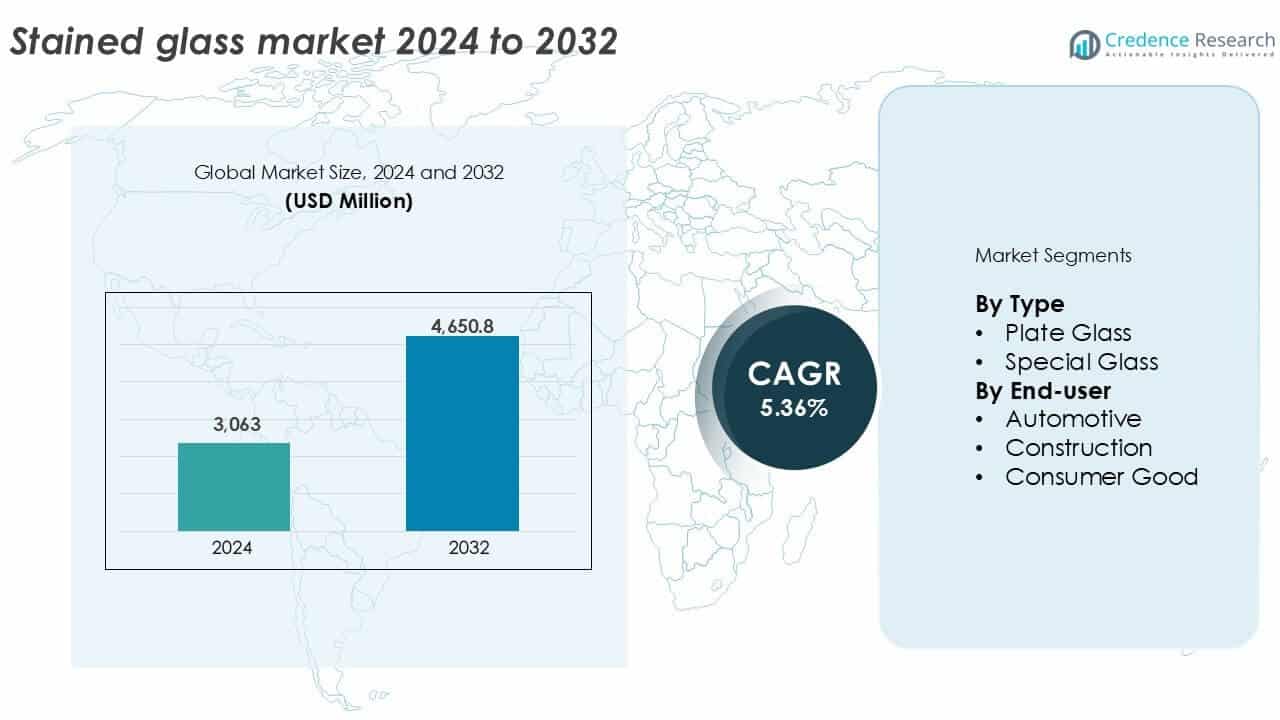
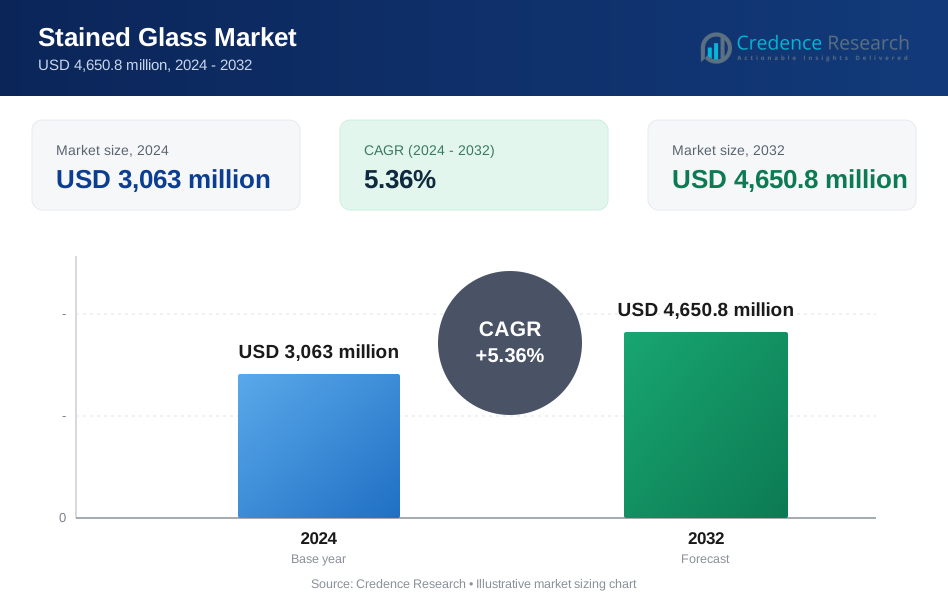
The stained-glass market size was valued at USD 3,063 million in 2024 and is anticipated to reach USD 4,650.8 million by 2032, growing at a CAGR of 5.36% during the forecast period.
| REPORT ATTRIBUTE | DETAILS |
|---|---|
| Historical Period | 2020-2024 |
| Base Year | 2025 |
| Forecast Period | 2026-2032 |
| Stained Glass Market Size 2024 | USD 3,063 million |
| Stained Glass Market, CAGR | 5.36% |
| Stained Glass Market Size 2032 | USD 4,650.8 million |
Stained Glass Market Insights
- Rising demand in luxury construction, religious restoration, and heritage architecture is driving consistent market expansion globally.
- Increasing use of stained glass in interior décor, boutique hotels, and modern retail spaces reflects evolving design preferences and custom installations.
- North America leads with a 35% market share, followed by Europe at 30%, supported by strong artisan presence and restoration projects; the construction segment accounts for 68% of end-user demand.
- High production costs and dependency on skilled artisans limit large-scale adoption, particularly in cost-sensitive and emerging regions.
Stained Glass Market Segmentation Analysis:
By Type
The stained-glass market by type is dominated by the plate glass segment, accounting for over 60% market share in 2024. Plate glass remains the most widely used due to its smooth finish, ease of cutting, and suitability for architectural applications. It is highly preferred in both traditional and modern stained-glass installations, especially for decorative panels, windows, and doors. The demand is further driven by its cost-effectiveness and wide availability. Special glass, while growing, holds a smaller share and finds niche applications in artistic and high-end decorative pieces requiring advanced light manipulation or unique textures.
- For instance, Saint-Gobain produces patterned and plate glass sheets up to 6,000 mm × 3,210 mm with thickness ranges from 2 mm to 19 mm, supporting large-format stained-glass panels for architectural installations.
By End-user
The construction segment leads the stained-glass market by end-user, holding around 68% market share in 2024. Demand is driven by increased use of stained glass in commercial buildings, religious institutions, and high-end residential projects. Architects and designers favor it for its aesthetic value, daylight control, and historical appeal. Innovations in tempered and laminated stained glass also support broader construction adoption. The automotive and consumer goods segments show limited but steady growth, with applications in sunroofs, custom interiors, decorative panels, and premium home décor accessories like lamps and partitions.
- For instance, AGC Glass Europe supplies Stratobel laminated safety glass certified to EN 14449 standards. This glass is tested under EN 12600 using a 50 kg pendulum weight, achieving classifications such as 1B1 or 2B2 (representing drop heights up to 1,200 mm) for use in commercial façades and interior partitions.
Key Growth Drivers
Rising Demand in Premium Architectural Applications
Stained glass is increasingly integrated into upscale architectural designs, driving strong demand across residential, commercial, and institutional construction. High-end buildings often feature stained glass in facades, windows, and interior dividers for both aesthetic and functional purposes. The material enhances visual appeal, provides privacy, and diffuses natural light in decorative ways. Growing investments in luxury real estate and boutique hospitality projects, particularly across urban centers and heritage restoration programs, are accelerating market expansion. Government-supported urban renewal schemes in Europe and Asia Pacific also contribute to the increased adoption of stained glass in heritage-style renovations and religious structures. With architecture shifting toward personalized and culturally inspired designs, stained glass finds relevance as a visual storytelling medium.
- For instance, Pilkington UK specializes in heritage restoration by supplying high-performance glass solutions, such as Pilkington Optilam™ laminated safety glass and Pilkington Optiwhite™ low-iron glass.
Growth in Religious and Cultural Restoration Projects
Religious institutions and historical buildings continue to rely heavily on stained glass for visual symbolism and restoration of classical aesthetics. As many of these structures undergo renovation, there is a rising demand for skilled glasswork and authentic stained glass panels. In Europe and North America, government and private funding for preserving cultural heritage sites boosts demand for traditional stained glass designs. Projects in cathedrals, mosques, temples, and museums often involve the replacement or replication of intricate glass art damaged over time. Furthermore, new religious infrastructure in emerging regions like the Middle East and Southeast Asia is incorporating stained glass to reflect traditional and regional influences. The role of stained glass in preserving identity, religious narratives, and art heritage makes it indispensable in restoration projects.
- For instance, Skilled artisan networks, digital design advancements, and handcrafting techniques have also evolved to support scalable reproduction of classic designs without compromising authenticity.
Technological Advancements in Glass Manufacturing
Innovations in stained glass production have significantly enhanced durability, safety, and design versatility. Manufacturers are integrating new techniques such as digital printing on glass, CNC cutting, laser etching, and improved color fusion processes. These advancements allow for more intricate and customized designs at scale, reducing production costs and increasing market accessibility. Enhanced coatings and treatments now enable stained glass to offer improved UV protection, thermal insulation, and acoustic control—key benefits in modern energy-efficient buildings. Laminated and tempered stained glass is also gaining traction for safety compliance in both interior and exterior applications. Digital tools for glass layout, CAD-based modeling, and AI-assisted design optimization are supporting the shift from artisanal to semi-automated manufacturing, especially for commercial orders. These innovations are attracting new customer segments in hospitality, retail, and public infrastructure, enabling broader adoption of stained glass in mainstream architectural and decorative solutions beyond traditional church windows or art panels.
Key Trends & Opportunities
Increasing Use in Interior Design and Consumer Decor
Stained glass is becoming a popular choice in modern interior design, especially in luxury homes, cafes, and boutique retail environments. Designers use it in room dividers, cabinet doors, ceiling panels, and lighting fixtures to create personalized and artistic spaces. The resurgence of vintage aesthetics and Art Deco influences in interior styling supports this trend. DIY home improvement and custom décor are also opening new opportunities for stained glass in smaller, consumer-grade applications. Manufacturers are responding with ready-to-install panels and modular kits for residential use. Advances in colorfastness, framing, and sealants ensure long-term performance without compromising design quality. In addition, online customization platforms allow customers to co-design unique patterns, further driving product differentiation.
- For instance, Kokomo Opalescent Glass produces over 22,000 color and texture variations in sheet sizes up to 1,200 mm × 800 mm, with color stability tested for long-term indoor light exposure in decorative interior applications.
Eco-Friendly Appeal and Recyclability of Glass
Sustainability trends across the construction and design sectors are creating a niche opportunity for stained glass, which is inherently recyclable and made from natural materials like sand, soda ash, and lime. As green building certification programs such as LEED, BREEAM, and WELL gain traction, architects are seeking materials that align with low-impact design goals. Stained glass, especially when produced with lead-free solder and eco-conscious methods, offers a sustainable decorative option that minimizes environmental footprint. Glass manufacturers are also shifting to cleaner production practices using electric melting, waste recovery, and lower-emission additives. Recycled glass use in stained panels further enhances environmental appeal. Eco-aware consumers and institutional buyers increasingly prefer such materials, especially for projects aiming to meet strict environmental standards. This positions stained glass as a creative yet responsible material choice in sustainable architecture, aligning with broader regulatory and consumer shifts toward greener building and product sourcing practices.
Key Challenges
High Cost and Skilled Labor Dependency
One of the major challenges in the stained glass market is its relatively high cost compared to alternative decorative materials. Custom stained glass requires specialized tools, materials, and skilled artisans, making it labor-intensive and time-consuming to produce. This leads to higher unit costs, limiting its adoption in cost-sensitive markets or mass-scale applications. Moreover, the number of trained glass artists and fabricators is declining in several regions due to lack of formal training and low interest among younger workers. This shortage creates production bottlenecks and hinders timely delivery of complex or large-scale projects. Companies also face increased operating costs due to the need for careful transport, handling, and installation. In competitive construction environments where budget constraints dominate decision-making, stained glass often loses out to more affordable, low-maintenance alternatives like printed acrylic or backlit films. This cost barrier remains a hurdle for broader adoption, especially in emerging economies.
Fragility and Maintenance Concerns in Harsh Environments
Despite improvements in processing, stained glass remains vulnerable to physical impact, thermal shock, and chemical degradation in certain conditions. In outdoor or high-traffic applications, glass panels are prone to chipping, cracking, or weather-induced fading if not properly treated or maintained. These issues raise long-term maintenance costs and create reluctance among buyers unfamiliar with upkeep requirements. In coastal or industrial zones, exposure to pollutants, salt air, or acid rain can deteriorate stained surfaces, especially in older installations that lack modern protective coatings. Vandalism and accidental breakage in public settings also pose risks, especially where protective glazing isn't feasible. Although modern glass variants offer better durability, consumer perception of fragility still affects adoption in practical design contexts. The need for periodic cleaning, inspection, and specialized repair services adds to the lifetime cost of ownership, making stained glass less appealing for large-scale commercial rollouts without dedicated facility management protocols.
Regional Analysis
North America
North America holds the largest share in the stained glass market, accounting for approximately 35% of global revenue in 2024. The region’s leadership stems from widespread use in architectural projects, religious institutions, and luxury real estate. The U.S. and Canada invest heavily in cultural preservation and church renovations, maintaining strong demand for traditional stained glass. Modern applications in interior design, high-end hospitality, and boutique retail spaces are also expanding. Technological innovations in glass manufacturing and the presence of skilled artisan networks support steady production and customization. Overall, North America remains the dominant market due to a balanced mix of heritage use and contemporary integration.
Europe
Europe follows closely with around 30% share in the stained glass market in 2024, driven by the continent’s deep-rooted cultural and religious heritage. Countries like France, Italy, Germany, and the UK invest in restoration of historical churches, cathedrals, and public monuments that prominently feature stained glass. Architectural firms also incorporate stained glass in luxury residential and commercial developments to blend modern aesthetics with historical character. Government support for heritage conservation and skilled craftsmanship availability contribute to sustained growth. Increasing demand from high-end interior designers for decorative glass in villas, hotels, and galleries reinforces Europe’s strong presence in the market.
Asia Pacific
Asia Pacific is an emerging force in the stained glass market, capturing nearly 20% market share in 2024 and projected to grow rapidly. Countries such as China, Japan, South Korea, and India are seeing rising interest in stained glass across commercial, religious, and residential construction. Urbanization, rising disposable income, and growing interest in culturally themed architecture support expansion. Southeast Asian nations, especially Thailand and Vietnam, use stained glass in temples and luxury resorts. Additionally, manufacturing advancements and lower production costs in countries like China are improving product availability and affordability. The region shows strong potential as demand shifts beyond traditional applications.
Middle East & Africa
The Middle East & Africa account for about 8% of the stained glass market in 2024, with growth supported by religious and cultural infrastructure projects. Countries like the UAE, Saudi Arabia, and Egypt invest in mosques, museums, and hospitality venues that integrate stained glass for artistic and spiritual symbolism. The region’s focus on luxury and themed architecture in tourism-driven developments also fuels demand. African nations are increasingly using stained glass in churches and public buildings. However, the market is still limited by lower artisan availability and higher import dependency, which restrains scalability outside major urban areas.
Latin America
Latin America holds around 7% market share in the stained glass market in 2024, with Brazil, Mexico, and Argentina leading regional demand. Stained glass is commonly used in churches, municipal buildings, and upscale homes across urban areas. Ongoing restoration of colonial-era architecture supports consistent demand for custom designs. Emerging applications in boutique hospitality and cultural centers also contribute to growth. However, the market faces constraints from economic volatility and limited local production capabilities, often relying on imports or regional artisans. Despite these challenges, rising tourism investments and heritage preservation initiatives present growth opportunities across select Latin American markets.
Stained Glass Market Segmentations:
By Type
- Plate Glass
- Special Glass
By End-user
- Automotive
- Construction
- Consumer Good
By Geography
- North America
- U.S.
- Canada
- Mexico
- Europe
- Germany
- France
- U.K.
- Italy
- Spain
- Rest of Europe
- Asia Pacific
- China
- Japan
- India
- South Korea
- South-east Asia
- Rest of Asia Pacific
- Latin America
- Brazil
- Argentina
- Rest of Latin America
- Middle East & Africa
- GCC Countries
- South Africa
- Rest of the Middle East and Africa
Competitive Landscape
The stained glass market features a mix of established studios, artisanal creators, and modern glass manufacturers competing across architectural, religious, and decorative applications. Key players such as Tiffany Studios, Willet Studios, and Glasmalerei Peters maintain strong reputations in heritage restoration and large-scale installations. Artists like Dale Chihuly and Brian Clarke contribute to market influence through high-profile projects that elevate stained glass as fine art. Studios including Jahn Studios, Yip Studio, and Lamtech Studios specialize in custom architectural work, while companies like Yōshoku Co., Ltd. blend traditional craftsmanship with contemporary design. Competition is shaped by artistic quality, technical innovation, and project scale. Collaborations with architects and interior designers are growing, especially in luxury real estate and hospitality. The market also sees rising interest from eco-conscious clients seeking sustainable and handcrafted decor. Players that offer digital customization, advanced coatings, and safety-enhanced products gain a competitive edge in modern commercial and residential developments.
Key Player Analysis
- Willet Studios
- Tiffany Studios
- Yip Studio
- Glasmalerei Peters
- Dale Chihuly
- Emma McClure
- Lamtech Studios
- Brian Clarke
- Jahn Studios
- Yōshoku Co., Ltd.
Recent Developments
- In October 2023, Guardian Glass will open new avenues for creating high-quality glass and show how Vinyl may be used to develop Ultra Mirror. A vinyl film is used on this mirror to improve safety by keeping broken glass from falling. Additionally, Ultra Mirror Life, which has two layers of lead-free paint, is being introduced by Guardian Glass.
- In January 2023, Therma-Tru has revealed its new range of steel and fiberglass products for 2023. These include an inventive system that combines storm and entry doors, attractive glass designs, a variety of paint and stain colors, extra sizes for well-liked types, and more.
Report Coverage
The research report offers an in-depth analysis based on Type, End-User and Geography. It details leading market players, providing an overview of their business, product offerings, investments, revenue streams, and key applications. Additionally, the report includes insights into the competitive environment, SWOT analysis, current market trends, as well as the primary drivers and constraints. Furthermore, it discusses various factors that have driven market expansion in recent years. The report also explores market dynamics, regulatory scenarios, and technological advancements that are shaping the industry. It assesses the impact of external factors and global economic changes on market growth. Lastly, it provides strategic recommendations for new entrants and established companies to navigate the complexities of the market.
Future Outlook
- Demand for stained glass in luxury real estate and hospitality projects will continue to grow.
- Restoration of religious and historical buildings will sustain long-term market stability.
- Use of stained glass in modern interior décor will expand across residential and commercial spaces.
- Digital printing and automation will improve production efficiency and design customization.
- Eco-friendly glass materials and recyclable products will attract sustainability-focused buyers.
- Asia Pacific will emerge as a key growth region due to rising construction activity.
- Online platforms will boost access to custom stained glass products for consumers.
- Collaborations between artists and architects will drive innovation in design applications.
- Increased adoption of tempered and laminated glass will enhance safety and durability.
- Rising costs and labor shortages may pressure small studios to adapt or consolidate.
Request a Free Sample
Fill in your details and we'll send you a free sample report.
- Sample data tables & charts
- Research methodology
Need a Custom Version of This Report?
Tailor the scope, geography, or segments to your exact requirements.
- Custom geography or segment scope
- Direct access to our analyst team
Frequently Asked Questions
What is the current market size for the stained glass market, and what is its projected size in 2032?
At what Compound Annual Growth Rate is the stained glass market projected to grow between 2024 and 2032?
Which stained glass market segment held the largest share in 2024?
What are the primary factors fueling the growth of the stained glass market?
Who are the leading companies in the stained glass market?
Which region commanded the largest share of the stained glass market in 2024?
Table of Content
Chapter 1. Report Introduction
- 1.1 Report Description & Purpose
- 1.1.1 Report Title & Market Definition
- 1.1.2 Unique Selling Propositions (USP) & Key Differentiators
- 1.1.3 Value Proposition for Stakeholders
- 1.2 Research Objectives
- 1.2.1 Market Sizing Objectives (Volume & Revenue)
- 1.2.2 Segmentation Objectives
- 1.2.3 Competitive Intelligence Objectives
- 1.2.4 Forecast & Scenario Objectives
- 1.3 Report Scope
- 1.3.1 Stained Glass Scope – Types & Subtypes Covered
- 1.3.2 Geographic Scope – Regions & Countries Covered
- 1.3.3 Historical Period, Base Year & Forecast Period (2024; forecast to 2032)
- 1.3.4 Inclusions & Exclusions
- 1.4 HS Code & Classification Framework
- 1.5 Currency, Units & Pricing Basis
- 1.6 Target Stakeholders
- 1.7 Limitations & Assumptions
Chapter 2. Executive Summary
- 2.1 Global Stained Glass Market Snapshot
- 2.1.1 Market Size – Historical (2024) & Forecast (2024-2032) (2024: USD 3,063 million → 2032: USD 4,650.8 million)
- 2.1.2 Volume & Revenue – Global Totals
- 2.1.3 Key Market Highlights – Top Five Facts
- 2.2 Stained Glass Market Segmentation Snapshot
- 2.2.1 Market Split by Region – 2024 vs. 2032
- 2.3 Competitive Snapshot
- 2.3.1 Top 10 Players by Revenue Share – 2024
- 2.3.2 Top 10 Players by Volume Share – 2024
- 2.3.3 Recent Strategic Developments (18-Month Summary)
- 2.4 Key Investment Highlights & Strategic Conclusions
Chapter 3. Stained Glass Market Dynamics & Industry Analysis
- 3.1 Market Overview & Context
- 3.1.1 Stained Glass Market Position in the Broader Automotive Value Chain
- 3.1.2 OEM vs. Replacement Market Dynamics
- 3.1.3 Market Maturity & Development Stage by Region
- 3.2 Stained Glass Market Drivers
- 3.3 Stained Glass Market Restraints & Challenges
- 3.4 Stained Glass Market Opportunities
- 3.5 Porter's Five Forces Analysis
- 3.5.1 Threat of New Entrants
- 3.5.2 Bargaining Power of Suppliers
- 3.5.3 Bargaining Power of Buyers
- 3.5.4 Threat of Substitutes
- 3.5.5 Competitive Rivalry – Intensity Assessment
- 3.6 Stained Glass Value Chain Analysis
- 3.6.1 Upstream – Raw Material/Input Suppliers
- 3.6.1.1 Raw Material/Input 1
- 3.6.1.2 Raw Material/Input 2
- 3.6.1.3 Raw Material/Input 3
- 3.6.2 Midstream – Production/Manufacturing/Service Delivery
- 3.6.2.1 Production/Process Overview
- 3.6.2.2 Key Facility Locations & Capacity by Manufacturer
- 3.6.3 Downstream – Distribution & End Consumer
- 3.6.3.1 Primary Channel – B2B/OEM
- 3.6.3.2 Secondary Channels – Dealer, Retail, Online, Direct
- 3.6.4 Value Chain Profitability Analysis
- 3.6.1 Upstream – Raw Material/Input Suppliers
- 3.7 PESTEL Analysis
- 3.7.1 Political Factors
- 3.7.2 Economic Factors
- 3.7.3 Social Factors
- 3.7.4 Technological Factors
- 3.7.5 Environmental Factors
- 3.7.6 Legal Factors
- 3.8 Stained Glass Supply Chain Analysis
- 3.8.1 Raw Material/Input Supply Risk Assessment
- 3.8.2 Manufacturing Concentration Risk (Geographic Exposure)
- 3.8.3 Trade Disruption Impact Analysis
- 3.9 Regulatory & Policy Landscape
Note: The regulatory and policy landscape section covers regulations based on their applicability to the market, Stained Glass category, geography, and scope of the study. Only regulatory frameworks with a material impact on operations, compliance, trade, sustainability, or market access are analyzed in detail.
Chapter 4. Key Investment Pockets & Opportunity Analysis
- 4.1 Stained Glass Market Attractiveness Analysis
- 4.1.1 By Region – Investment Attractiveness Matrix (Volume × CAGR)
- 4.2 Absolute Revenue Growth Opportunity
- 4.2.1 By Region – Absolute USD Growth Through 2032
- 4.3 Incremental Volume Opportunity
- 4.3.1 By Region – Incremental Volume Through 2032
- 4.3.2 Segment – Incremental Volume
- 4.4 Emerging Submarket Opportunity Deep Dive (Subject to Applicability)
- 4.5 Emerging Market Opportunity Scorecards
- 4.5.1 United States
- 4.5.2 Europe
- 4.5.3 Asia
- 4.5.4 Middle East & Africa
Note: Emerging Market Opportunity Scorecards will be included based on relevance and strategic importance. Regions listed are indicative and may vary depending on data availability and market dynamics.
Chapter 5. Stained Glass Import-Export Analysis & Trade Flows
- 5.1 Global Trade Overview
- 5.1.1 Global Export Value by Country (2024)
- 5.1.2 Global Export Volume by Country (2024)
- 5.1.3 Global Import Value by Country (2024)
- 5.1.4 Global Import Volume by Country (2024)
- 5.1.5 Net Trade Balance by Country (2024)
- 5.2 Export Analysis – Segment
- 5.2.1 Type 1 (HS Code)
- 5.2.2 Type 2 (HS Code)
- 5.2.3 Type 3 (HS Code)
- 5.2.4 Type 4 (HS Code)
- 5.2.5 Type 5 (HS Code)
- 5.3 Import Analysis – Segment
- 5.3.1 Type 1 (HS Code)
- 5.3.2 Type 2 (HS Code)
- 5.3.3 Type 3 (HS Code)
- 5.3.4 Type 4 (HS Code)
- 5.3.5 Type 5 (HS Code)
- 5.4 Average Unit Trade Prices
- 5.4.1 Average Export Price – Segment & Country
- 5.4.2 Average Import Price – Segment & Source Country
- 5.4.3 Price Trends (2024)
- 5.5 Key Trade Route Analysis
- 5.5.1 Trade Route 1
- 5.5.2 Trade Route 2
- 5.5.3 Trade Route 3
- 5.5.4 Trade Route 4
- 5.5.5 Trade Route 5
- 5.6 Trade Policy Impact Assessment
- 5.6.1 US Anti-Dumping & Section 301 Tariffs
- 5.6.2 EU Customs Union Impact
- 5.6.3 Major Free Trade Agreements
- 5.6.4 USMCA Rules of Origin
Note: Trade policy analysis will be included only where relevant to the Stained Glass market.
Chapter 6. Competitive Landscape & Company Benchmarking
- 6.1 Stained Glass Market Concentration & Structure
- 6.1.1 Herfindahl-Hirschman Index (HHI) – vs. 2024
- 6.1.2 Tier 1, Tier 2 & Tier 3 Market Structure
- 6.1.3 Global, Regional & Local Player Dynamics
- 6.2 Stained Glass Market Share Analysis – 2024
- 6.2.1 Global Revenue Share by Company
- 6.2.2 Global Volume Share by Company
- 6.2.3 Regional Revenue Share
- 6.2.4 Market Share Evolution ( vs. 2024)
- 6.2.5 OEM Segment Share by Company
- 6.2.6 Replacement Segment Share by Company
- 6.3 Production/Delivery Capacity & Facility Analysis
- 6.3.1 Global Installed Capacity
- 6.3.2 Capacity Utilization Rates
- 6.3.3 Production/Output Volume
- 6.3.4 Facility Locations & Capacity Map
- 6.3.5 Planned Capacity Additions
- 6.4 Stained Glass Competitive Benchmarking Matrix
- 6.4.1 Revenue, Volume, CAGR & Profitability Comparison
- 6.4.2 Channel Revenue Mix
- 6.4.3 Geographic Revenue Exposure
- 6.4.4 R&D Intensity
- 6.4.5 Sustainability Maturity
- 6.5 Strategic Developments in Stained Glass (Last 24 Months)
- 6.5.1 Mergers, Acquisitions & Divestments
- 6.5.2 New Stained Glass Launches
- 6.5.3 Facility Expansions
- 6.5.4 Strategic Alliances, Joint Ventures & Partnerships
- 6.5.5 Distribution Expansion & Market Entry
- 6.5.6 Sustainability & ESG Initiatives
- 6.6 Competitive Strategy Mapping
- 6.6.1 Leader, Challenger, Follower & Niche Classification
- 6.6.2 Pricing Strategy Comparison
- 6.6.3 Channel Strategy Matrix
Note: Strategic developments are included based on their materiality and the availability of reliable information.
Chapter 7. Global Stained Glass Market – By Distribution Channel
- 7.1 Segment Overview
- 7.1.1 Volume & Revenue Split by Channel (2024 & 2032)
- 7.1.2 Channel Mix Evolution (2024-2032)
Chapter 8. Regional Market Analysis – Global Overview
- 8.1 Global Regional Overview
- 8.1.1 Regional Volume Share
- 8.1.2 Regional Revenue Share
- 8.1.3 Regional Volume by Region
- 8.1.4 Regional Revenue by Region
- 8.1.5 Regional Forecast Through 2032
- 8.2 Cross-Regional Segment Analysis
- 8.2.1 By Distribution Channel
- 8.2.2 By Brand/Price Tier
Chapter 9. North America Stained Glass Market
- 9.1 United States
- 9.2 Canada
- 9.3 Mexico
Chapter 10. Europe Stained Glass Market
- 10.1 Germany
- 10.2 France
- 10.3 Italy
- 10.4 United Kingdom
- 10.5 Spain
- 10.6 Poland
- 10.7 Russia
- 10.8 Netherlands
- 10.9 Belgium
- 10.10 Sweden
- 10.11 Denmark
- 10.12 Norway
- 10.13 Rest of Europe
Chapter 11. Asia Pacific Stained Glass Market
- 11.1 China
- 11.2 India
- 11.3 Japan
- 11.4 South Korea
- 11.5 Thailand
- 11.6 Indonesia
- 11.7 Vietnam
- 11.8 Malaysia
- 11.9 Australia
- 11.10 Rest of Asia Pacific
Chapter 12. Latin America Stained Glass Market
- 12.1 Brazil
- 12.2 Argentina
- 12.3 Colombia
- 12.4 Chile
- 12.5 Rest of Latin America
Chapter 13. Middle East Stained Glass Market
- 13.1 Saudi Arabia
- 13.2 United Arab Emirates
- 13.3 Turkey
- 13.4 Israel
- 13.5 Iran
- 13.6 Rest of the Middle East
Chapter 14. Africa Stained Glass Market
- 14.1 South Africa
- 14.2 Egypt
- 14.3 Nigeria
- 14.4 Morocco
- 14.5 Rest of Africa
Chapter 15. Stained Glass Company Profiles
- 15.1 [Company 01]
- 15.1.1 Company Overview
- 15.1.2 Key Management Personnel
- 15.1.3 Products & Services Portfolio
- 15.1.4 Financial Performance
- 15.1.5 Key Market Focus & Geographic Presence
- 15.1.6 Recent Developments & Strategic Initiatives
Note: The company profile list is preliminary and may change based on research findings, market developments, data availability, and client requirements.
Chapter 16. Appendices
- Appendix A – List of Abbreviations & Acronyms
- Appendix B – Industry Classification Code Reference – Full Series
- Appendix C – Production & Capacity Data Tables
- Appendix D – End-Use & Demand Base Tables
- Appendix E – Consumption & Replacement Rate Assumptions
- Appendix F – ASP Reference Tables
- Appendix G – Manufacturing & Facility Database
- Appendix H – Import-Export Data Tables
- Appendix I – Regulatory Summary Tables
- Appendix J – Primary Research Participant List (Anonymized)
- Appendix K – Primary Research Questionnaire Framework
- Appendix L – Data Sources & Bibliography
- Appendix M – Market Size Divergence & Source Comparison
Chapter 17. Research Methodology
- 17.1 Research Framework & Philosophy
- 17.2 Secondary Research – Sources, Hierarchy & Data Extraction
- 17.3 Data Modeling – Bottom-Up & Top-Down Market Sizing
- 17.4 Primary Research – Stakeholder Framework, LOI & Sample Sizes
- 17.5 Forecast Methodology – Regression, Scenario & Sensitivity Analysis
- 17.6 Quality Control – Four-Layer Validation Framework
- 17.7 Limitations & Standard Assumptions
- 17.8 Disclaimer
