
| REPORT ATTRIBUTE | DETAILS |
|---|---|
| Historical Period | 2019-2022 |
| Base Year | 2023 |
| Forecast Period | 2024-2032 |
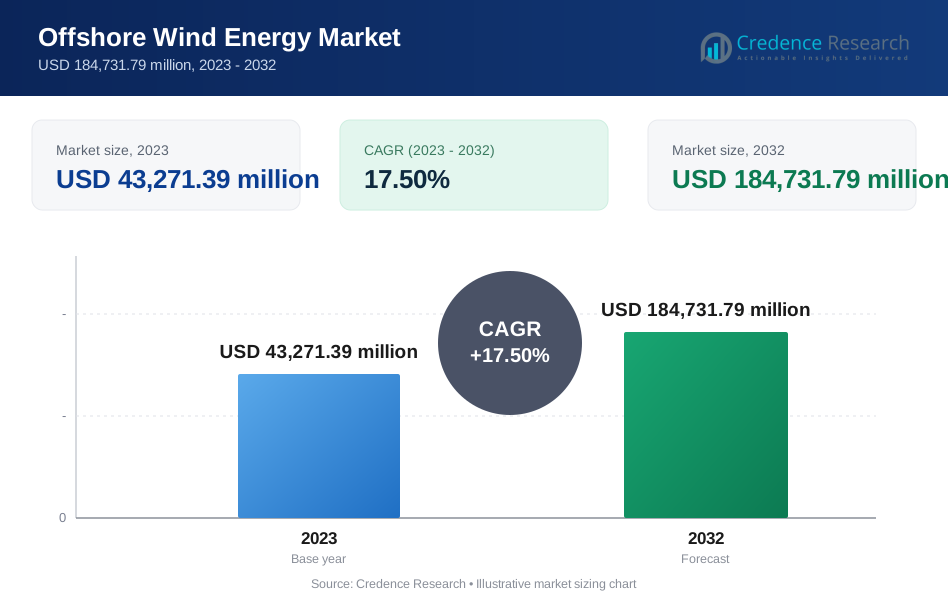
| Offshore Wind Energy Market Size 2023 | USD 43,271.39 million |
| Offshore Wind Energy Market, CAGR | 17.50% |
| Offshore Wind Energy Market Size 2032 | USD 184,731.79 million |
Market Overview
The Offshore wind energy market is projected to grow from USD 43,271.39 million in 2023 to an estimated USD 184,731.79 million by 2032, reflecting a robust compound annual growth rate (CAGR) of 17.50% from 2024 to 2032. This significant growth underscores the increasing shift towards renewable energy sources as nations strive to reduce carbon footprints and enhance energy security.
Driving the market are factors such as governmental support through incentives and regulatory frameworks, technological advancements in turbine capacity and efficiency, and a global push for cleaner energy sources to combat climate change. The escalating demand for sustainable energy has also fostered significant investments and partnerships among key stakeholders across various regions, ensuring steady market growth.
Geographically, Europe leads the offshore wind energy market, thanks to early adoption and extensive government support. However, Asia-Pacific is rapidly catching up, with China and Taiwan significantly investing in offshore wind projects. Key players dominating this market include Vestas, Siemens Gamesa Renewable Energy, GE Renewable Energy, and MHI Vestas Offshore Wind, which are pivotal in shaping the competitive landscape through innovation and strategic collaborations.
Market Drivers
Governmental Support and Regulatory Frameworks
Governmental support and favorable regulatory frameworks are driving significant growth in the offshore wind energy market. Many countries have introduced subsidies, tax incentives, and feed-in tariffs to promote offshore wind projects as part of efforts to reduce emissions and meet climate goals. For instance, data from the UK government shows that its Contracts for Difference scheme has been instrumental in accelerating offshore wind deployment. The European Wind Energy Association reports that stable policy environments in countries like Germany, Denmark and the Netherlands have attracted substantial investment in the sector. In the US, the Bureau of Ocean Energy Management has conducted multiple offshore wind lease auctions, with strong industry participation indicating growing confidence. China's National Energy Administration has outlined ambitious offshore wind targets in its Five Year Plans, spurring rapid expansion. Industry surveys by groups like WindEurope highlight how streamlined permitting processes and grid connection policies have reduced project risks. Government commitments to develop supporting infrastructure like ports and transmission networks are also facilitating growth. Overall, the policy landscape has evolved to provide the long-term certainty needed for large-scale offshore wind investments.
Technological Advancements in Turbine Design and Efficiency
Technological progress in turbine design and efficiency has been a key driver of offshore wind market growth. Industry data shows a clear trend towards larger, more powerful turbines over the past decade. For example, leading manufacturers like Siemens Gamesa and Vestas now offer turbines in the 14-15 MW range, compared to 3-5 MW models common previously. Surveys of developers indicate these high-capacity turbines enable more cost-effective projects by reducing the number of installations needed. Floating wind technology has expanded the potential for deep water sites, with several commercial-scale projects now in operation or development globally. Materials advances have improved turbine durability in harsh marine conditions, with operators reporting longer operational lifespans. More efficient blade designs and drivetrain components have boosted capacity factors, as evidenced in performance data from operational wind farms. Digital technologies for predictive maintenance and performance optimization are further enhancing productivity. The US National Renewable Energy Laboratory's cost projections show continued downward trends for offshore wind, driven largely by technology improvements. Overall, these innovations are making offshore wind increasingly competitive with other energy sources.
Global Shift Towards Renewable Energy and Decarbonization
The global push for renewable energy and decarbonization is propelling offshore wind market expansion. Government and industry data reveal accelerating offshore wind deployment across Europe, Asia, and North America as countries seek to meet climate targets. For instance, the International Energy Agency reports offshore wind is expected to become Europe's largest source of electricity generation by 2040. In Asia, both China and Japan have set ambitious national targets that are driving rapid growth, according to their respective energy agencies. US states along the Atlantic coast have collectively committed to procuring tens of gigawatts of offshore wind capacity. Surveys of utilities and power companies show increasing interest in offshore wind as a scalable, low-carbon generation source. The higher capacity factors of offshore wind compared to other renewables make it attractive for grid operators seeking reliable clean energy. Energy security concerns are also boosting offshore wind adoption in import-dependent regions, as highlighted in policy documents from the European Commission. Major oil and gas companies are increasingly investing in offshore wind as part of diversification strategies, demonstrating the sector's long-term potential. Overall, offshore wind is playing a growing role in decarbonization efforts worldwide.
Economic Benefits and Job Creation
The offshore wind energy market is also driven by the significant economic benefits and job creation associated with the development and operation of offshore wind farms. The construction and maintenance of offshore wind projects involve a wide range of industries, including manufacturing, engineering, construction, logistics, and environmental services. As a result, offshore wind projects can generate thousands of jobs, particularly in coastal regions where these farms are located. For instance, the offshore wind sector in Europe has already created tens of thousands of jobs, and this number is expected to grow as the industry expands. Moreover, the economic impact extends beyond job creation; offshore wind projects can stimulate local economies by attracting investments in infrastructure and services. Ports, shipyards, and manufacturing facilities are often upgraded or expanded to accommodate the needs of the offshore wind industry, leading to further economic development in these areas. In addition, the increasing competitiveness of offshore wind energy has attracted significant private sector investments, including from major energy companies and institutional investors. These investments not only contribute to the growth of the offshore wind market but also enhance the overall economic resilience of the regions where these projects are developed.
Market Trends
Expansion of Floating Offshore Wind Farms
The offshore wind energy market is experiencing a significant trend towards the expansion of floating offshore wind farms. This innovative technology allows for the installation of wind turbines in deeper waters, opening up vast new areas for offshore wind development. Floating wind farms are gaining traction globally, with several pilot projects already operational and larger commercial-scale projects in various stages of planning and development. For instance, surveys conducted by industry associations have shown a growing pipeline of floating offshore wind projects across multiple countries. Government authorities in coastal nations are increasingly recognizing the potential of floating wind technology and are implementing supportive policies and regulations to encourage its development. This trend is particularly notable in regions with limited shallow water resources suitable for fixed-bottom turbines. The expansion of floating offshore wind farms is driving technological advancements in mooring systems, floating platforms, and installation methods. As the technology matures and economies of scale are achieved, the costs associated with floating wind farms are expected to decrease, further accelerating their adoption and contributing to the overall growth of the offshore wind energy market.
Integration of Digitalization and Smart Technologies
Another prominent trend in the offshore wind energy market is the increasing integration of digitalization and smart technologies. Industry surveys have revealed a growing adoption of advanced data analytics, artificial intelligence (AI), and machine learning across the offshore wind sector. These technologies are being utilized to optimize various aspects of offshore wind farm operations, from performance monitoring to maintenance planning. For example, data from government energy authorities has shown a rise in the implementation of predictive maintenance systems in offshore wind farms, leading to reduced downtime and improved operational efficiency. The use of digital twin technology is also gaining momentum, allowing operators to create virtual replicas of wind farms for simulation and optimization purposes. Furthermore, the integration of offshore wind farms with energy storage solutions and smart grids is becoming more prevalent, as indicated by recent industry reports. This trend is enhancing grid stability and improving the management of intermittent renewable energy sources. The adoption of these digital and smart technologies is contributing to the overall reduction in the levelized cost of energy (LCOE) for offshore wind, making it increasingly competitive with traditional energy sources and driving further market growth.
Market Restraints and Challenges
High Initial Capital Investment and Financing Challenges
The offshore wind energy market faces significant hurdles due to the substantial upfront costs required for project development. For instance, industry surveys conducted by leading energy consultancies have consistently highlighted the capital-intensive nature of offshore wind farms as a primary concern among developers and investors. Government reports from countries actively pursuing offshore wind have also underscored the financial challenges, particularly in emerging markets. Data from financial institutions specializing in renewable energy projects indicates a trend of increasing project sizes, which, while potentially offering economies of scale, also amplify the financing hurdles. Surveys of industry stakeholders reveal a growing interest in innovative financing mechanisms to address these challenges. For example, green bonds have gained traction, with several successful issuances reported by major offshore wind developers. Additionally, public-private partnerships have emerged as a popular model, with government agencies reporting increased collaboration with private sector entities to share risks and costs. Despite these innovations, the long payback periods associated with offshore wind projects remain a concern, as evidenced by investor sentiment surveys conducted by financial advisory firms.
Environmental and Regulatory Hurdles
Environmental and regulatory challenges continue to pose significant restraints on the offshore wind energy market's growth. Surveys conducted by environmental agencies and marine research institutions have highlighted the complex interactions between offshore wind farms and marine ecosystems. For instance, studies tracking marine mammal populations in areas with offshore wind development have provided valuable data on potential impacts. Regulatory bodies in various countries have reported increasing numbers of environmental impact assessments being conducted, reflecting the growing scrutiny of offshore wind projects. Industry associations have compiled data on permitting timelines, revealing significant variations across different jurisdictions. Stakeholder surveys conducted in coastal communities have shed light on public perceptions of offshore wind farms, with concerns about visual impacts and interference with traditional activities frequently cited. Government reports have also noted the challenges in balancing renewable energy goals with the protection of marine protected areas and fishing grounds. Despite these challenges, data from environmental monitoring programs associated with existing offshore wind farms have provided insights into mitigation strategies and best practices, which are increasingly being incorporated into project planning and regulatory frameworks.
Market Segmentation Analysis
By Component
The offshore wind energy market is segmented into key components, with turbines playing a leading role. Manufacturers are developing larger, more efficient turbines to boost energy generation. For instance, GE Renewable Energy's Haliade-X 14 MW turbine, one of the most powerful in the world, is being deployed in several projects. The electrical infrastructure segment, crucial for power transmission, is expanding as wind farms move further offshore. Companies like ABB and Siemens are providing innovative solutions for subsea cables and offshore substations. The substructure segment is evolving with new foundation designs, particularly for floating wind projects. For example, Principle Power's WindFloat technology has been successfully deployed in multiple floating wind farms. The assembly, transportation, and installation segment is growing in importance, with specialized vessels being developed. Offshore wind energy companies are investing in purpose-built installation vessels to improve efficiency and reduce costs in project development.
By Location
Shallow water locations continue to dominate the offshore wind energy market due to their cost-effectiveness and ease of development. Many large-scale projects, such as Hornsea in the UK, are situated in shallow waters. However, the transitional water segment is gaining traction as technology advances enable development in deeper areas. Projects like Hywind Scotland, the world's first floating wind farm, demonstrate the feasibility of installations in transitional waters. The deep-water segment is emerging as a frontier for offshore wind, driven by floating turbine technology. Countries with limited shallow water resources, such as Japan and parts of the US West Coast, are particularly interested in deep-water wind farms. Floating wind projects like Hywind Tampen in Norway are paving the way for future deep-water developments. As floating technology matures and costs decrease, deep-water locations are expected to play an increasingly significant role in the offshore wind energy market, offering access to stronger and more consistent wind resources.
Segments
Based on Component
- Turbine
- Electrical Infrastructure
- Substructure
- Assembly, Transportation, and Installation
Based on Location
- Shallow Water
- Transitional Water
- Deep Water
Based on Capacity
- Up to 3 MW
- 3 MW - 5 MW
- Above 5 MW
Based on Region
- Europe
- Asia-Pacific
- North America
- Rest of the World
Regional Analysis
Europe (47%):
Europe continues to dominate the offshore wind energy market, accounting for approximately 47% of the global market share, with the United Kingdom and Germany leading the charge. For instance, the UK's Crown Estate recently announced plans for a new round of offshore wind leasing, aiming to add up to 7 GW of capacity. Germany has also made significant strides, with the Federal Network Agency reporting record-breaking auction results for offshore wind projects. Denmark and the Netherlands continue to expand their offshore wind portfolios, with Danish energy company Ørsted securing contracts for multiple large-scale projects. The European market's growth is further supported by technological advancements, such as Siemens Gamesa's introduction of larger, more efficient turbines specifically designed for offshore use.
Asia-Pacific (34%):
Asia-Pacific is the fastest-growing region in the offshore wind energy market, holding around 34% of the global market share. For instance, the China Renewable Energy Engineering Institute reported that the country's offshore wind installations more than doubled in the past year. Japan is making significant progress in floating offshore wind technology, with the Ministry of Economy, Trade and Industry approving several demonstration projects. Taiwan has also emerged as a key player, with the Bureau of Energy announcing ambitious targets for offshore wind development. South Korea is ramping up its efforts, with the government unveiling plans for a major offshore wind complex off the coast of Ulsan. The region's growth is further bolstered by collaborations between local and international companies, such as the partnership between Japan's JERA and France's ENGIE for offshore wind projects.
Key players
- Siems Wind Power GmbH & Co. KG
- DONG Energy A/S
- GE Renewable Energy
- Vestas Wind Systems A/S
- ADWEN Offshore, SL
- Samsung Heavy Industries Co., Ltd.
- Senvion S.A.
- Suzlon Energy Limited
- Nordex SE
- Sinovel Wind Group Co., Ltd.
Competitive Analysis
The offshore wind energy market is characterized by intense competition among key players who are continuously innovating to maintain their market positions. Vestas Wind Systems A/S and GE Renewable Energy lead the market with their extensive portfolios of advanced wind turbines and strong global presence. DONG Energy A/S (now Ørsted) is a significant player, particularly in Europe, where it has developed numerous large-scale offshore wind projects. Siems Wind Power GmbH & Co. KG and ADWEN Offshore, SL also contribute to the competitive landscape with their specialized technologies. Asian companies like Samsung Heavy Industries Co., Ltd. and Sinovel Wind Group Co., Ltd. are increasingly making their mark, leveraging their engineering expertise and targeting emerging markets. The competition is further intensified by the ongoing developments in floating wind turbines, with all key players striving to expand their reach into deeper waters.
Recent Developments
- In July 2023, Siemens Gamesa's first French offshore wind farm, SaintInBrieuc, began supplying electricity to the grid, marking its fourth European offshore project.
- In February 2023, Siemens Gamesa and Doosan Enerbility signed a binding framework agreement for a strategic partnership in South Korea's offshore wind market.
- In March 2024, Ørsted and WindEurope signed an MoU with the Azerbaijan Renewable Energy Agency to promote onshore and offshore wind energy in Azerbaijan and the Caspian Sea region.
- In April 2024, GE Vernova (GE's renewable energy division) continues to develop its HaliadeInX platform, featuring industryInleading capacity factors and producing more energy than any other offshore wind turbine on the market.
- In August 2023, Samsung Heavy Industries entered the offshore wind sector through an exclusive agreement with Equinor to supply floating wind turbine substructures for the proposed Bandibuli Offshore Wind Farm in South Korea.
- In April 2024, Nordex Group was commissioned by EDF Renewables in South Africa for two wind projects within the Koruson 2 cluster, developed with Anglo American via Envusa Energy.
Market Concentration and Characteristics
The offshore wind energy market is moderately concentrated, with a few dominant players such as Vestas Wind Systems A/S, GE Renewable Energy, and Ørsted (formerly DONG Energy) leading the industry. These companies benefit from their extensive experience, largeInscale project portfolios, and strong technological capabilities. However, the market is also characterized by the presence of several regional and emerging players, including Asian giants like Sinovel Wind Group Co., Ltd. and Samsung Heavy Industries Co., Ltd., who are increasingly gaining traction. The market is highly competitive, driven by continuous innovation, advancements in turbine technology, and the growing adoption of floating wind farms, which are expanding the geographical reach of offshore wind energy projects into deeper waters.
Report Coverage
The research report offers an inIndepth analysis based on Component, Location, Capacity and Region. It details leading market players, providing an overview of their business, product offerings, investments, revenue streams, and key applications. Additionally, the report includes insights into the competitive environment, SWOT analysis, current market trends, as well as the primary drivers and constraints. Furthermore, it discusses various factors that have driven market expansion in recent years. The report also explores market dynamics, regulatory scenarios, and technological advancements that are shaping the industry. It assesses the impact of external factors and global economic changes on market growth. Lastly, it provides strategic recommendations for new entrants and established companies to navigate the complexities of the market.
Future Outlook
- Continued advancements in turbine technology, including larger and more efficient turbines, are expected to drive the growth of the offshore wind energy market, enhancing energy output and reducing costs.
- The development and adoption of floating wind turbines will enable the expansion of offshore wind energy into deeper waters, significantly increasing the potential for new project sites.
- Strong government support, including subsidies, favorable policies, and ambitious renewable energy targets, will continue to be a major driver of the offshore wind energy market's growth.
- The offshore wind sector is attracting substantial investment from both public and private entities, driven by the growing demand for clean energy and the sector's proven profitability.
- The offshore wind energy market is expected to expand beyond Europe, with significant growth anticipated in AsiaInPacific and North America, driven by increasing energy needs and supportive regulatory frameworks.
- Ongoing innovations and economies of scale are expected to further reduce the levelized cost of electricity (LCOE) for offshore wind, making it increasingly competitive with traditional energy sources.
- The global shift towards reducing carbon emissions and combating climate change will continue to propel the offshore wind energy market, as it plays a crucial role in the transition to a sustainable energy future.
- As the market matures, there will be a greater focus on optimizing the supply chain, improving logistics, and reducing lead times, which will enhance project efficiency and profitability.
- The integration of offshore wind energy into national grids, along with the development of energy storage solutions, will be key to managing the variability of wind energy and ensuring a stable energy supply.
- Strategic collaborations and partnerships among industry leaders, technology providers, and governments will drive innovation, share risks, and accelerate the deployment of offshore wind projects globally.
Request a Free Sample
Fill in your details and we'll send you a free sample report.
- Sample data tables & charts
- Research methodology
Need a Custom Version of This Report?
Tailor the scope, geography, or segments to your exact requirements.
- Custom geography or segment scope
- Direct access to our analyst team
Frequently Asked Questions
What is the projected growth of the offshore wind energy market?
What factors are driving the growth of the offshore wind energymarket?
Which regions are leading in the offshore wind energy market?
Who are the key players in the offshore wind energy market?
Table of Content
Chapter 1. Report Introduction
- 1.1 Report Description & Purpose
- 1.1.1 Report Title & Market Definition
- 1.1.2 Unique Selling Propositions (USP) & Key Differentiators
- 1.1.3 Value Proposition for Stakeholders
- 1.2 Research Objectives
- 1.2.1 Market Sizing Objectives (Volume & Revenue)
- 1.2.2 Segmentation Objectives
- 1.2.3 Competitive Intelligence Objectives
- 1.2.4 Forecast & Scenario Objectives
- 1.3 Report Scope
- 1.3.1 Offshore Wind Energy Scope – Types & Subtypes Covered
- 1.3.2 Geographic Scope – Regions & Countries Covered
- 1.3.3 Historical Period, Base Year & Forecast Period (2023; forecast to 2032)
- 1.3.4 Inclusions & Exclusions
- 1.4 HS Code & Classification Framework
- 1.5 Currency, Units & Pricing Basis
- 1.6 Target Stakeholders
- 1.7 Limitations & Assumptions
Chapter 2. Executive Summary
- 2.1 Global Offshore Wind Energy Market Snapshot
- 2.1.1 Market Size – Historical (2023) & Forecast (2023-2032) (2023: USD 43,271.39 million → 2032: USD 184,731.79 million)
- 2.1.2 Volume & Revenue – Global Totals
- 2.1.3 Key Market Highlights – Top Five Facts
- 2.2 Offshore Wind Energy Market Segmentation Snapshot
- 2.2.1 Market Split by Region – 2023 vs. 2032
- 2.3 Competitive Snapshot
- 2.3.1 Top 10 Players by Revenue Share – 2023
- 2.3.2 Top 10 Players by Volume Share – 2023
- 2.3.3 Recent Strategic Developments (18-Month Summary)
- 2.4 Key Investment Highlights & Strategic Conclusions
Chapter 3. Offshore Wind Energy Market Dynamics & Industry Analysis
- 3.1 Market Overview & Context
- 3.1.1 Offshore Wind Energy Market Position in the Broader Automotive Value Chain
- 3.1.2 OEM vs. Replacement Market Dynamics
- 3.1.3 Market Maturity & Development Stage by Region
- 3.2 Offshore Wind Energy Market Drivers
- 3.3 Offshore Wind Energy Market Restraints & Challenges
- 3.4 Offshore Wind Energy Market Opportunities
- 3.5 Porter's Five Forces Analysis
- 3.5.1 Threat of New Entrants
- 3.5.2 Bargaining Power of Suppliers
- 3.5.3 Bargaining Power of Buyers
- 3.5.4 Threat of Substitutes
- 3.5.5 Competitive Rivalry – Intensity Assessment
- 3.6 Offshore Wind Energy Value Chain Analysis
- 3.6.1 Upstream – Raw Material/Input Suppliers
- 3.6.1.1 Raw Material/Input 1
- 3.6.1.2 Raw Material/Input 2
- 3.6.1.3 Raw Material/Input 3
- 3.6.2 Midstream – Production/Manufacturing/Service Delivery
- 3.6.2.1 Production/Process Overview
- 3.6.2.2 Key Facility Locations & Capacity by Manufacturer
- 3.6.3 Downstream – Distribution & End Consumer
- 3.6.3.1 Primary Channel – B2B/OEM
- 3.6.3.2 Secondary Channels – Dealer, Retail, Online, Direct
- 3.6.4 Value Chain Profitability Analysis
- 3.6.1 Upstream – Raw Material/Input Suppliers
- 3.7 PESTEL Analysis
- 3.7.1 Political Factors
- 3.7.2 Economic Factors
- 3.7.3 Social Factors
- 3.7.4 Technological Factors
- 3.7.5 Environmental Factors
- 3.7.6 Legal Factors
- 3.8 Offshore Wind Energy Supply Chain Analysis
- 3.8.1 Raw Material/Input Supply Risk Assessment
- 3.8.2 Manufacturing Concentration Risk (Geographic Exposure)
- 3.8.3 Trade Disruption Impact Analysis
- 3.9 Regulatory & Policy Landscape
Note: The regulatory and policy landscape section covers regulations based on their applicability to the market, Offshore Wind Energy category, geography, and scope of the study. Only regulatory frameworks with a material impact on operations, compliance, trade, sustainability, or market access are analyzed in detail.
Chapter 4. Key Investment Pockets & Opportunity Analysis
- 4.1 Offshore Wind Energy Market Attractiveness Analysis
- 4.1.1 By Region – Investment Attractiveness Matrix (Volume × CAGR)
- 4.2 Absolute Revenue Growth Opportunity
- 4.2.1 By Region – Absolute USD Growth Through 2032
- 4.3 Incremental Volume Opportunity
- 4.3.1 By Region – Incremental Volume Through 2032
- 4.3.2 Segment – Incremental Volume
- 4.4 Emerging Submarket Opportunity Deep Dive (Subject to Applicability)
- 4.5 Emerging Market Opportunity Scorecards
- 4.5.1 United States
- 4.5.2 Europe
- 4.5.3 Asia
- 4.5.4 Middle East & Africa
Note: Emerging Market Opportunity Scorecards will be included based on relevance and strategic importance. Regions listed are indicative and may vary depending on data availability and market dynamics.
Chapter 5. Offshore Wind Energy Import-Export Analysis & Trade Flows
- 5.1 Global Trade Overview
- 5.1.1 Global Export Value by Country (2023)
- 5.1.2 Global Export Volume by Country (2023)
- 5.1.3 Global Import Value by Country (2023)
- 5.1.4 Global Import Volume by Country (2023)
- 5.1.5 Net Trade Balance by Country (2023)
- 5.2 Export Analysis – Segment
- 5.2.1 Type 1 (HS Code)
- 5.2.2 Type 2 (HS Code)
- 5.2.3 Type 3 (HS Code)
- 5.2.4 Type 4 (HS Code)
- 5.2.5 Type 5 (HS Code)
- 5.3 Import Analysis – Segment
- 5.3.1 Type 1 (HS Code)
- 5.3.2 Type 2 (HS Code)
- 5.3.3 Type 3 (HS Code)
- 5.3.4 Type 4 (HS Code)
- 5.3.5 Type 5 (HS Code)
- 5.4 Average Unit Trade Prices
- 5.4.1 Average Export Price – Segment & Country
- 5.4.2 Average Import Price – Segment & Source Country
- 5.4.3 Price Trends (2023)
- 5.5 Key Trade Route Analysis
- 5.5.1 Trade Route 1
- 5.5.2 Trade Route 2
- 5.5.3 Trade Route 3
- 5.5.4 Trade Route 4
- 5.5.5 Trade Route 5
- 5.6 Trade Policy Impact Assessment
- 5.6.1 US Anti-Dumping & Section 301 Tariffs
- 5.6.2 EU Customs Union Impact
- 5.6.3 Major Free Trade Agreements
- 5.6.4 USMCA Rules of Origin
Note: Trade policy analysis will be included only where relevant to the Offshore Wind Energy market.
Chapter 6. Competitive Landscape & Company Benchmarking
- 6.1 Offshore Wind Energy Market Concentration & Structure
- 6.1.1 Herfindahl-Hirschman Index (HHI) – vs. 2023
- 6.1.2 Tier 1, Tier 2 & Tier 3 Market Structure
- 6.1.3 Global, Regional & Local Player Dynamics
- 6.2 Offshore Wind Energy Market Share Analysis – 2023
- 6.2.1 Global Revenue Share by Company
- 6.2.2 Global Volume Share by Company
- 6.2.3 Regional Revenue Share
- 6.2.4 Market Share Evolution ( vs. 2023)
- 6.2.5 OEM Segment Share by Company
- 6.2.6 Replacement Segment Share by Company
- 6.3 Production/Delivery Capacity & Facility Analysis
- 6.3.1 Global Installed Capacity
- 6.3.2 Capacity Utilization Rates
- 6.3.3 Production/Output Volume
- 6.3.4 Facility Locations & Capacity Map
- 6.3.5 Planned Capacity Additions
- 6.4 Offshore Wind Energy Competitive Benchmarking Matrix
- 6.4.1 Revenue, Volume, CAGR & Profitability Comparison
- 6.4.2 Channel Revenue Mix
- 6.4.3 Geographic Revenue Exposure
- 6.4.4 R&D Intensity
- 6.4.5 Sustainability Maturity
- 6.5 Strategic Developments in Offshore Wind Energy (Last 24 Months)
- 6.5.1 Mergers, Acquisitions & Divestments
- 6.5.2 New Offshore Wind Energy Launches
- 6.5.3 Facility Expansions
- 6.5.4 Strategic Alliances, Joint Ventures & Partnerships
- 6.5.5 Distribution Expansion & Market Entry
- 6.5.6 Sustainability & ESG Initiatives
- 6.6 Competitive Strategy Mapping
- 6.6.1 Leader, Challenger, Follower & Niche Classification
- 6.6.2 Pricing Strategy Comparison
- 6.6.3 Channel Strategy Matrix
Note: Strategic developments are included based on their materiality and the availability of reliable information.
Chapter 7. Global Offshore Wind Energy Market – By Distribution Channel
- 7.1 Segment Overview
- 7.1.1 Volume & Revenue Split by Channel (2023 & 2032)
- 7.1.2 Channel Mix Evolution (2023-2032)
Chapter 8. Regional Market Analysis – Global Overview
- 8.1 Global Regional Overview
- 8.1.1 Regional Volume Share
- 8.1.2 Regional Revenue Share
- 8.1.3 Regional Volume by Region
- 8.1.4 Regional Revenue by Region
- 8.1.5 Regional Forecast Through 2032
- 8.2 Cross-Regional Segment Analysis
- 8.2.1 By Distribution Channel
- 8.2.2 By Brand/Price Tier
Chapter 9. North America Offshore Wind Energy Market
- 9.1 United States
- 9.2 Canada
- 9.3 Mexico
Chapter 10. Europe Offshore Wind Energy Market
- 10.1 Germany
- 10.2 France
- 10.3 Italy
- 10.4 United Kingdom
- 10.5 Spain
- 10.6 Poland
- 10.7 Russia
- 10.8 Netherlands
- 10.9 Belgium
- 10.10 Sweden
- 10.11 Denmark
- 10.12 Norway
- 10.13 Rest of Europe
Chapter 11. Asia Pacific Offshore Wind Energy Market
- 11.1 China
- 11.2 India
- 11.3 Japan
- 11.4 South Korea
- 11.5 Thailand
- 11.6 Indonesia
- 11.7 Vietnam
- 11.8 Malaysia
- 11.9 Australia
- 11.10 Rest of Asia Pacific
Chapter 12. Latin America Offshore Wind Energy Market
- 12.1 Brazil
- 12.2 Argentina
- 12.3 Colombia
- 12.4 Chile
- 12.5 Rest of Latin America
Chapter 13. Middle East Offshore Wind Energy Market
- 13.1 Saudi Arabia
- 13.2 United Arab Emirates
- 13.3 Turkey
- 13.4 Israel
- 13.5 Iran
- 13.6 Rest of the Middle East
Chapter 14. Africa Offshore Wind Energy Market
- 14.1 South Africa
- 14.2 Egypt
- 14.3 Nigeria
- 14.4 Morocco
- 14.5 Rest of Africa
Chapter 15. Offshore Wind Energy Company Profiles
- 15.1 [Company 01]
- 15.1.1 Company Overview
- 15.1.2 Key Management Personnel
- 15.1.3 Products & Services Portfolio
- 15.1.4 Financial Performance
- 15.1.5 Key Market Focus & Geographic Presence
- 15.1.6 Recent Developments & Strategic Initiatives
Note: The company profile list is preliminary and may change based on research findings, market developments, data availability, and client requirements.
Chapter 16. Appendices
- Appendix A – List of Abbreviations & Acronyms
- Appendix B – Industry Classification Code Reference – Full Series
- Appendix C – Production & Capacity Data Tables
- Appendix D – End-Use & Demand Base Tables
- Appendix E – Consumption & Replacement Rate Assumptions
- Appendix F – ASP Reference Tables
- Appendix G – Manufacturing & Facility Database
- Appendix H – Import-Export Data Tables
- Appendix I – Regulatory Summary Tables
- Appendix J – Primary Research Participant List (Anonymized)
- Appendix K – Primary Research Questionnaire Framework
- Appendix L – Data Sources & Bibliography
- Appendix M – Market Size Divergence & Source Comparison
Chapter 17. Research Methodology
- 17.1 Research Framework & Philosophy
- 17.2 Secondary Research – Sources, Hierarchy & Data Extraction
- 17.3 Data Modeling – Bottom-Up & Top-Down Market Sizing
- 17.4 Primary Research – Stakeholder Framework, LOI & Sample Sizes
- 17.5 Forecast Methodology – Regression, Scenario & Sensitivity Analysis
- 17.6 Quality Control – Four-Layer Validation Framework
- 17.7 Limitations & Standard Assumptions
- 17.8 Disclaimer
