
| REPORT ATTRIBUTE | DETAILS |
|---|---|
| Historical Period | 2019-2022 |
| Base Year | 2023 |
| Forecast Period | 2024-2032 |
| Powder Coating Market Size 2023 | USD 15284.2 Million |
| Powder Coating Market, CAGR | 5.50% |
| Powder Coating Market Size 2032 | USD 15284.2 Million |
Market Insights
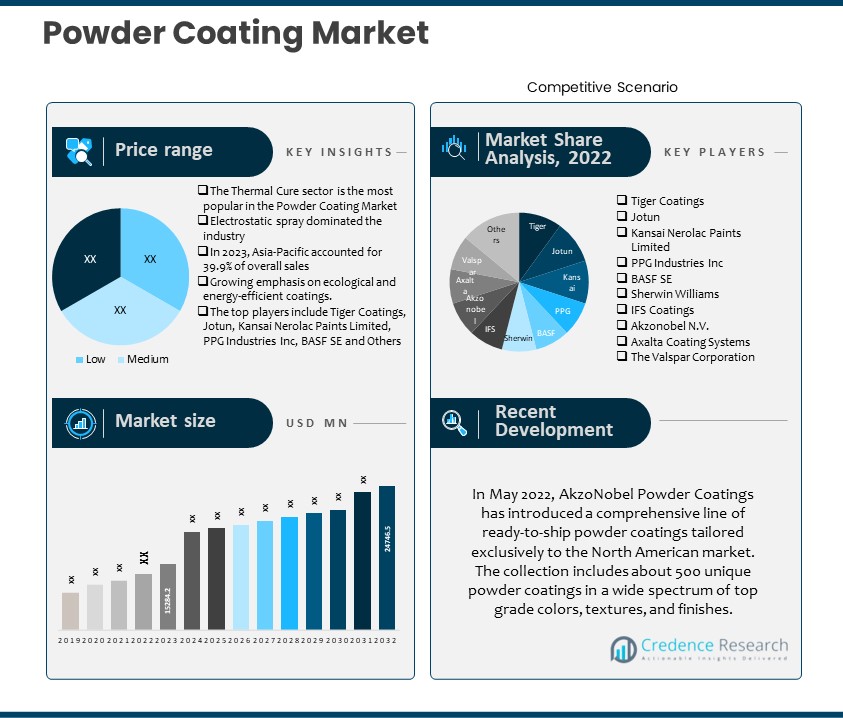
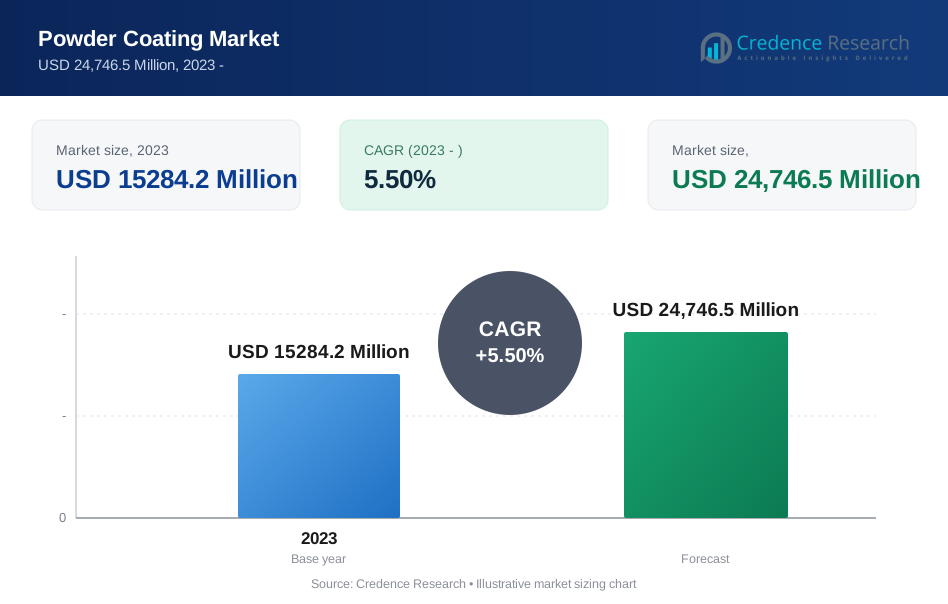
- The global demand for Powder Coating was valued at USD 15284.2 Million in 2023 and is expected to reach USD 24746.5 Million in 2032, growing at a CAGR of 5.50% between 2024 and 2032.
- The polyester resin type segment accounted for 28.0% of the volume share in 2023, while the epoxy-polyester (Hybrid) resin types are predicted to have the fastest CAGR during the forecast period.
- The Metal Substrates division is considered the most important area in the Powder Coating Market.
- The electrostatic spray category dominated the industry, with fluidized bed dip being another key area.
- Thermal Cure is the most prominent segment in the Powder Coating Market.
- In 2023, the Appliances and Consumer Goods sector dominated the global market, while the Automotive and Transportation segment is expected to grow the fastest during the projected period.
- Asia-Pacific accounted for 39.9% of total sales in 2023, while North America is expected to grow significantly.
- The Environmental Advantages of Powder Coatings Drive Market Growth
- High initial investment impedes market growth.
Executive Summary
Market Definition
Powder coating is a dry finishing method that involves applying free-flowing thermoplastic or thermoset powder material to a surface, melting it, and then allowing it to dry and harden into a protective coating. Thermoplastic powder coatings are made from polyolefins, polyvinyl chloride, polyvinyl fluoride, and polyester, whereas thermoset powder coatings are made from epoxy, polyester, acrylic, and polyurethanes. Powder coating provides a high-quality, long-lasting finish that improves efficiency while remaining environmentally friendly. Powder coatings are based on polymer resin systems. The powder coatings industry is driven by the environmental benefits they provide over liquid coating processes. The pandemic caused shortages of raw materials and supply chain disruptions. According to Echemi, a chemical industry B2B website, there were shortages of neopentyl glycol, which is used in several powder coating resins, as well as triglycidyl isocyanurate, a curing agent used in polyester powder coatings. This resulted in price increases of more than 60% in the Powder Coatings industry.
Market Overview
The global Powder Coating Market has witnessed steady growth in recent years and is expected to grow at a CAGR of 5.50% between 2024 and 2032. The market was valued at USD 15284.2 million in 2023 and is expected to reach USD 24746.5 million in 2032.
The desire for more sustainable solutions and growth in the building and manufacturing industries is creating new opportunities for the powder coatings business. Coating formulators and raw material suppliers are reacting with the development of revolutionary powder coating technologies that can be made and applied more efficiently, exhibit improved performance characteristics, and have a wider range of potential applications. For many years, the powder coatings industry has been, and continues to be, in a state of growth and revolution throughout a wide range of market segments. These needs are being driven by the emergence of technologies that address existing manufacturing productivity and cost challenges. One example is the extension and improvement of compact process systems.
Furthermore, The growth of the global powder coatings market is attributed to factors such as increased consumer spending, rising per capita income, shifting consumer preferences, and technological advancements. One of the primary factors influencing the overall product application potential is a higher utilization rate compared to liquid forms. Infrastructure development is also a key motivator for product demand on a global scale. Proficiency and overspray are important components of the market economy.
Segmentation By Resin Type
- The polyester resin type segment accounted for 28.0% of the volume share in 2023 because to polyester's advantageous qualities, such as quick-drying, chemical resistance, temperature resistance, abrasion resistance, and surface protection.
- Epoxy-polyester (Hybrid) resin types are expected to have the quickest CAGR throughout the forecast period due to their qualities, such as toughness, flexibility, weather resistance, and low cost when compared to other coatings.
Segmentation By Substrate Type
- The Metal Substrates section is regarded as the most important segment in the Powder Coating Market. Metal substrates are commonly utilized in a variety of industries, including automotive, appliances, furniture, and construction, making them a prime target for powder coating applications. Powder coatings are ideal for metal substrates because they stick effectively to metal surfaces, provide excellent corrosion protection, and have a long-lasting finish.
Segmentation By Application Method
- The electrostatic spray category dominated the market and is expected to grow fast throughout the forecast period. Electrostatic spray is the most common method for applying thermoset coatings. The particles of these coatings are electrically charged in the coating gun. The growing demand for thermoset powder coating in a variety of end-use industries is likely to drive up demand for electrostatic spray coating methods.
- The fluidized bed dip is a coating technique used largely for the application of thermoplastic powder. In addition, a fluidized bed is used in thermoset powder applications that demand a high film build.
Segmentation by Curing Method
- The Thermal Cure sector is the most popular in the Powder Coating Market, with the Hybrid Cure segment accounting for the majority of the market share. Thermal cure powder coatings are widely used and valued because they may offer a long-lasting and high-quality finish on a variety of substrates, particularly metal surfaces.
- On the other hand, Hybrid Cure powder coatings combine the benefits of thermal cure and UV cure technologies.
Segmentation by End-Use Industry
- The Appliances and Consumer Goods sector dominated the global market in 2023, accounting for 23.9% of the total value share. The segment is predicted to grow significantly during the forecast period. Growing purchasing power, excellent living standards, and rapid urbanization are likely to fuel the consumer goods sector, increasing product demand during the projection period.
- The Automotive and Transportation segment is predicted to expand the quickest during the projection period.
Segmentation by Region
- Asia-Pacific dominated the market, accounting for 39.9% of total revenue in 2023.
- North America is predicted to develop significantly.
- The rest of the world, including Latin America, the Middle East, and Africa, supplies the remaining demand for Powder Coating.
Asia-Pacific dominated the market, accounting for 39.9% of total revenue in 2023. Infrastructure development in China and India is predicted to increase the usage of powder coating in architectural applications such as aluminum extrusions for building facades, kitchen windows, doorframes, and kitchens. However, the strong preference for anodized aluminum extrusion is projected to limit demand for powder coating in architectural applications in Asia Pacific throughout the projection period.
Moreover, The North America market is expected to grow substantially due to the expansion of the automobile industry. Rising EV demand is boosting the car industry. The non-residential construction industry is booming in the United States, owing to strong economic growth and a thriving real estate sector. Furthermore, increased state and federal infrastructure spending for buildings and public works is expected to boost regional market growth.
Key Highlights of the Report
Resin Type, Substrate Type, Application Method, Curing Method, End-Use Industry and region segment the global Powder Coating Market. The Electrostatic Spray category led the market, while the Thermal Cure sector was the most popular in the Powder Coating Market. In addition, the Metal Substrates sector is considered the most essential segment. Epoxy-polyester (Hybrid) resin types are predicted to have the fastest CAGR during the forecast period and Asia Pacific, leading the market growth.
Growing awareness and adoption of eco-friendly coating solutions, technological breakthroughs that improve product performance and application efficiency, and rising demand from industries such as automotive, aerospace, and electronics are the market's key drivers. Furthermore, high initial investment costs for equipment and setup, limited heat resistance compared to some classic coating processes, and difficulties in attaining certain specific effects and finishes are the industry's primary limitations.
Asia-Pacific dominated the market in 2023. Infrastructure development in China and India is predicted to increase the usage of powder coating in architectural applications such as aluminum extrusions for building facades, kitchen windows, doorframes, and kitchens. Furthermore, the North American market is predicted to increase significantly due to the rise of the automotive industry.
What Are The Main Drivers Of The Global Powder Coating Market?
The Powder Coating Market is being favorably impacted by increased awareness and acceptance of ecologically friendly coating solutions. As more companies and consumers value sustainability, powder coatings, which have lower volatile organic compound (VOC) emissions and waste than liquid coatings, are gaining appeal.
What Are The Major Challenges Faced By The Global Powder Coating Market?
Despite the market's expansion, many constraints present obstacles to the Powder Coating Market. The high initial investment costs for specialized equipment and setup can dissuade smaller enterprises from entering the market or improving their coating operations. Furthermore, while powder coatings have numerous advantages, they may have lower heat resistance than some older coating processes, which can limit their use in high-temperature situations.
What Are The Growth Opportunities In The Global Powder Coating Market?
The Powder Coating Market has numerous chances for expansion and innovation. One significant opportunity is to expand into emerging regions and industries where powder coating adoption is still in its early stages. By tapping into these new categories, the market may widen its reach and fuel future growth. Another possibility is the development of fresh color options and finishes for powder coatings that satisfy the changing aesthetic preferences of consumers and industries.
Market Drivers
Several factors drive the global Powder Coating Market. The following are the key drivers of the global Powder Coating Market:
Environmental Advantages of Powder Coatings
Powder coating is the preferred environmentally friendly finishing procedure. It generates less waste than other finishing methods, such as liquid coating. Powder coating helps to reduce waste by allowing the powder coating overspray to be collected and reused after application. These reclamation procedures keep overhead expenses low while reducing environmental impact. Solvents include volatile organic compounds (VOCs), which harm the environment. The average VOC level in liquid coatings ranges from 3.5 to 5.5 pounds per gallon, which means that one-third to one-half of each gallon of liquid coating is emitted into the environment during the application process.
Since powder coating lines do not utilize solvents, they emit no VOCs and may run with less energy, faster curing, and lower temperatures. This makes powder coatings very appealing from an environmental standpoint. The powder coatings industry is always innovating to improve itself. For example, in early 2020, Sherwin-Williams General Industrial Coatings business introduced the Powdura ECO line, which is manufactured from a resin derived from pre-consumer recycled polyethylene terephthalate (rPET). As a result, the environmental benefits of powder coatings support market growth.
Market Restraints
The global Powder Coating Market faces some challenges that may hinder its growth. These include the following:
High Initial Investment
The primary impediment to the Powder Coatings market is the high initial investment required to set up the powder coating equipment. Liquid coating applications need a spray gun and a spray area. A powder coating workshop requires a spray gun, a spray booth, and a curing oven. The use of a curing oven greatly increases the initial price of powder coating. The size of the curing oven bought must take into account the largest part size that can be properly handled. Larger, thicker, and heavier pieces necessitate a larger and more powerful oven, which raises the overall equipment cost. Nonmetals require a fluidized bed powder coating technique, whereas metals can be powder coated utilizing electrostatic spray deposition. The requirement for a fluidized bed also raises the overall equipment expenses for establishing a full powder coating facility. This could be a hurdle for the powder coatings sector.
Opportunities
The global Powder Coating Market offers significant growth opportunities. These include the following:
Growing Use of Powder Coatings in Electric Vehicles
The rise in electric cars (EVs) can be ascribed to rising oil prices and growing concern about climate change. According to the International Energy Agency (IEA), electric vehicle sales will quadruple to 6.6 million in 2021, setting a new record. Sales continued to rise in 2022, with 2 million electric vehicles sold worldwide in the first quarter of 2022, up nearly 75% over the same period in 2021. Maintaining an optimal temperature range is critical for EV motors and batteries to operate efficiently. EV motors can sometimes reach operating temperatures of more than 200°C. Powder coatings are used to protect battery boxes and isolate heat activity. To capitalize on the burgeoning EV industry, powder coating manufacturers are releasing EV-specific products. For example, in January 2022, Arkema unveiled high-voltage coating solutions for electric cars. The two new polyamide 11 powder coating grades with UL certification have been released for usage in electric vehicle battery systems and other applications. As a result, the market is being driven by the increasing use of powder coatings for electric vehicles.
Competitive Landscape
Key Players
The global Powder Coating Market is highly competitive, with several key players. Some of the major players in the market and their market share are as follows:
- Tiger Coatings
- Jotun
- Kansai Nerolac Paints Limited
- PPG Industries Inc
- BASF SE
- Sherwin Williams
- IFS Coatings
- Akzonobel N.V.
- Axalta Coating Systems
- The Valspar Corporation
These organizations prioritize product innovation, End-Use Industry expansion, and mergers and acquisitions to stay competitive.
The global Powder Coating Market's key players continually seek to stay ahead by offering new products and developments.
In June 2022, Polychem has introduced a new powder coating line dubbed the Effects line. The collection includes powder special effects such as speckles, translucents, metallics, glitter translucent, veins, patina effects, river textures, fine textures, and dramatic illusion colors in a variety of colors.
In February 2022, PPG stated that it has agreed to acquire Arsonsisi's powder coatings business, which is situated in Milan, Italy. The acquisition will allow PPG to expand its powder coatings offerings throughout Europe, the Middle East, and Africa (EMEA).
Summary of Key Findings
- Increasing Use of Powder Coatings in Electric Vehicles
- Market segmented By Resin Type, Substrate Type, Application Method, Curing Method, End-Use Industry and region.
- The Powder Coating Market's most popular segment is Thermal Cure.
- Metal Substrates are regarded as the most important category in the Powder Coating Market.
- Asia Pacific is leading in market growth; the market is highly competitive with key players, including Tiger Coatings, Jotun, Kansai Nerolac Paints Limited, PPG Industries Inc, BASF SE and Others.
Future Outlook
- Technological developments contribute to greater performance and applicability.
- Increasing usage in several industries, including automotive, aerospace, and electronics.
- Market expansion in emerging markets.
- Growing emphasis on ecological and energy-efficient coatings.
How CXOs Can Benefit from the Credence Research Powder Coating Market Report
The Credence Research Powder Coating Market Report provides CXOs with a comprehensive overview of the market, including:
- Market size and growth forecast: The report provides detailed estimates of the global Powder Coating Market size, segmented By Resin Type, Substrate Type, Application Method, Curing Method , End-Use Industry and region. It also includes forecasts for the market through 2032 based on key trends and drivers.
- Market segmentation: The report segments the Powder Coating Market By Resin Type, Substrate Type, Application Method, Curing Method , End-Use Industry and region. This segmentation provides CXOs with a granular understanding of the market and the opportunities in each segment.
- Competitive Landscape: The report profiles the key players in the Powder Coating Market and provides insights into their strategies, product offerings, and financial performance. This information can help CXOs to identify and assess their competition.
- Key trends and drivers: The report identifies and analyzes the key trends and drivers that are shaping the Powder Coating Market. This information can help CXOs to make informed decisions about their investments and strategies.
CXOs can use the insights from the Credence Research Powder Coating Market Report to:
- Identify growth opportunities: The report can help CXOs identify new growth opportunities in the Powder Coating Market. By analyzing the data and trends in the report, they can make informed decisions about where to invest and expand their business.
- Make informed investment decisions: The report can help CXOs make informed investment decisions about Powder Coating. By examining the insights and trends in the report, they can strategically allocate resources and capitalize on the right opportunities in the market.
- Develop competitive strategies: The report can help CXOs develop competitive strategies for their Powder Coating businesses. For example, by delving into the insights and trends within the report, they can strategically position themselves in the market and stay ahead of the competition.
- Track market developments: The report can help CXOs monitor market developments and stay ahead of the curve. For example, it provides insights into the latest trends and innovations in the Powder Coating Market.
Overall, the Credence Research Powder Coating Market Report is a valuable resource for CXOs who are looking to gain a deeper understanding of the market and identify opportunities for growth.
Segmentation
- By Resin Type:
- Epoxy
- Polyester
- Polyurethane
- Acrylic
- Hybrid
- By Substrate Type:
- Metal Substrates
- Non-Metal Substrates
- By Application Method:
- Electrostatic Spray
- Fluidized Bed Dip
- Fluidized Bed Electrostatic Spray
- Triboelectric Spray
- Electrostatic Fluidized Bed
- By Curing Method:
- Thermal Cure
- UV Cure
- Hybrid Cure
- By End-Use Industry:
- Architectural and Construction
- Automotive and Transportation
- Appliances and Consumer Goods
- Industrial and Machinery
- Metal Fabrication and Manufacturing
- By Region
- North America
- The U.S.
- Canada
- Mexico
- Europe
- Germany
- France
- The U.K.
- Italy
- Spain
- Rest of Europe
- Asia Pacific
- China
- Japan
- India
- South Korea
- South-east Asia
- Rest of Asia Pacific
- Latin America
- Brazil
- Argentina
- Rest of Latin America
- Middle East & Africa
- GCC Countries
- South Africa
- Rest of the Middle East and Africa
- North America
Request a Free Sample
Fill in your details and we'll send you a free sample report.
- Sample data tables & charts
- Research methodology
Need a Custom Version of This Report?
Tailor the scope, geography, or segments to your exact requirements.
- Custom geography or segment scope
- Direct access to our analyst team
Frequently Asked Questions
What is the current size of the global Powder Coating Market?
What is the expected growth rate of the Powder Coating Market between 2024 and 2032?
Which segment is leading the market share in terms of Application Method?
Which Curing Method segment governs the demand for Powder Coating in the world?
Who are the major players in the global Powder Coating Market?
Table of Content
Chapter 1. Report Introduction
- 1.1 Report Description & Purpose
- 1.1.1 Report Title & Market Definition
- 1.1.2 Unique Selling Propositions (USP) & Key Differentiators
- 1.1.3 Value Proposition for Stakeholders
- 1.2 Research Objectives
- 1.2.1 Market Sizing Objectives (Volume & Revenue)
- 1.2.2 Segmentation Objectives
- 1.2.3 Competitive Intelligence Objectives
- 1.2.4 Forecast & Scenario Objectives
- 1.3 Report Scope
- 1.3.1 Powder Coating Scope – Types & Subtypes Covered
- 1.3.2 Geographic Scope – Regions & Countries Covered
- 1.3.3 Historical Period, Base Year & Forecast Period (2023; forecast to the forecast period)
- 1.3.4 Inclusions & Exclusions
- 1.4 HS Code & Classification Framework
- 1.5 Currency, Units & Pricing Basis
- 1.6 Target Stakeholders
- 1.7 Limitations & Assumptions
Chapter 2. Executive Summary
- 2.1 Global Powder Coating Market Snapshot
- 2.1.1 Market Size – Historical (2023) & Forecast (the forecast period) (2023: USD 15284.2 Million → forecast year: USD 24,746.5 Million)
- 2.1.2 Volume & Revenue – Global Totals
- 2.1.3 Key Market Highlights – Top Five Facts
- 2.2 Powder Coating Market Segmentation Snapshot
- 2.2.1 Market Split by Region – 2023 vs.
- 2.3 Competitive Snapshot
- 2.3.1 Top 10 Players by Revenue Share – 2023
- 2.3.2 Top 10 Players by Volume Share – 2023
- 2.3.3 Recent Strategic Developments (18-Month Summary)
- 2.4 Key Investment Highlights & Strategic Conclusions
Chapter 3. Powder Coating Market Dynamics & Industry Analysis
- 3.1 Market Overview & Context
- 3.1.1 Powder Coating Market Position in the Broader Automotive Value Chain
- 3.1.2 OEM vs. Replacement Market Dynamics
- 3.1.3 Market Maturity & Development Stage by Region
- 3.2 Powder Coating Market Drivers
- 3.3 Powder Coating Market Restraints & Challenges
- 3.4 Powder Coating Market Opportunities
- 3.5 Porter's Five Forces Analysis
- 3.5.1 Threat of New Entrants
- 3.5.2 Bargaining Power of Suppliers
- 3.5.3 Bargaining Power of Buyers
- 3.5.4 Threat of Substitutes
- 3.5.5 Competitive Rivalry – Intensity Assessment
- 3.6 Powder Coating Value Chain Analysis
- 3.6.1 Upstream – Raw Material/Input Suppliers
- 3.6.1.1 Raw Material/Input 1
- 3.6.1.2 Raw Material/Input 2
- 3.6.1.3 Raw Material/Input 3
- 3.6.2 Midstream – Production/Manufacturing/Service Delivery
- 3.6.2.1 Production/Process Overview
- 3.6.2.2 Key Facility Locations & Capacity by Manufacturer
- 3.6.3 Downstream – Distribution & End Consumer
- 3.6.3.1 Primary Channel – B2B/OEM
- 3.6.3.2 Secondary Channels – Dealer, Retail, Online, Direct
- 3.6.4 Value Chain Profitability Analysis
- 3.6.1 Upstream – Raw Material/Input Suppliers
- 3.7 PESTEL Analysis
- 3.7.1 Political Factors
- 3.7.2 Economic Factors
- 3.7.3 Social Factors
- 3.7.4 Technological Factors
- 3.7.5 Environmental Factors
- 3.7.6 Legal Factors
- 3.8 Powder Coating Supply Chain Analysis
- 3.8.1 Raw Material/Input Supply Risk Assessment
- 3.8.2 Manufacturing Concentration Risk (Geographic Exposure)
- 3.8.3 Trade Disruption Impact Analysis
- 3.9 Regulatory & Policy Landscape
Note: The regulatory and policy landscape section covers regulations based on their applicability to the market, Powder Coating category, geography, and scope of the study. Only regulatory frameworks with a material impact on operations, compliance, trade, sustainability, or market access are analyzed in detail.
Chapter 4. Key Investment Pockets & Opportunity Analysis
- 4.1 Powder Coating Market Attractiveness Analysis
- 4.1.1 By Region – Investment Attractiveness Matrix (Volume × CAGR)
- 4.2 Absolute Revenue Growth Opportunity
- 4.2.1 By Region – Absolute USD Growth Through the forecast period
- 4.3 Incremental Volume Opportunity
- 4.3.1 By Region – Incremental Volume Through the forecast period
- 4.3.2 Segment – Incremental Volume
- 4.4 Emerging Submarket Opportunity Deep Dive (Subject to Applicability)
- 4.5 Emerging Market Opportunity Scorecards
- 4.5.1 United States
- 4.5.2 Europe
- 4.5.3 Asia
- 4.5.4 Middle East & Africa
Note: Emerging Market Opportunity Scorecards will be included based on relevance and strategic importance. Regions listed are indicative and may vary depending on data availability and market dynamics.
Chapter 5. Powder Coating Import-Export Analysis & Trade Flows
- 5.1 Global Trade Overview
- 5.1.1 Global Export Value by Country (2023)
- 5.1.2 Global Export Volume by Country (2023)
- 5.1.3 Global Import Value by Country (2023)
- 5.1.4 Global Import Volume by Country (2023)
- 5.1.5 Net Trade Balance by Country (2023)
- 5.2 Export Analysis – Segment
- 5.2.1 Type 1 (HS Code)
- 5.2.2 Type 2 (HS Code)
- 5.2.3 Type 3 (HS Code)
- 5.2.4 Type 4 (HS Code)
- 5.2.5 Type 5 (HS Code)
- 5.3 Import Analysis – Segment
- 5.3.1 Type 1 (HS Code)
- 5.3.2 Type 2 (HS Code)
- 5.3.3 Type 3 (HS Code)
- 5.3.4 Type 4 (HS Code)
- 5.3.5 Type 5 (HS Code)
- 5.4 Average Unit Trade Prices
- 5.4.1 Average Export Price – Segment & Country
- 5.4.2 Average Import Price – Segment & Source Country
- 5.4.3 Price Trends (2023)
- 5.5 Key Trade Route Analysis
- 5.5.1 Trade Route 1
- 5.5.2 Trade Route 2
- 5.5.3 Trade Route 3
- 5.5.4 Trade Route 4
- 5.5.5 Trade Route 5
- 5.6 Trade Policy Impact Assessment
- 5.6.1 US Anti-Dumping & Section 301 Tariffs
- 5.6.2 EU Customs Union Impact
- 5.6.3 Major Free Trade Agreements
- 5.6.4 USMCA Rules of Origin
Note: Trade policy analysis will be included only where relevant to the Powder Coating market.
Chapter 6. Competitive Landscape & Company Benchmarking
- 6.1 Powder Coating Market Concentration & Structure
- 6.1.1 Herfindahl-Hirschman Index (HHI) – vs. 2023
- 6.1.2 Tier 1, Tier 2 & Tier 3 Market Structure
- 6.1.3 Global, Regional & Local Player Dynamics
- 6.2 Powder Coating Market Share Analysis – 2023
- 6.2.1 Global Revenue Share by Company
- 6.2.2 Global Volume Share by Company
- 6.2.3 Regional Revenue Share
- 6.2.4 Market Share Evolution ( vs. 2023)
- 6.2.5 OEM Segment Share by Company
- 6.2.6 Replacement Segment Share by Company
- 6.3 Production/Delivery Capacity & Facility Analysis
- 6.3.1 Global Installed Capacity
- 6.3.2 Capacity Utilization Rates
- 6.3.3 Production/Output Volume
- 6.3.4 Facility Locations & Capacity Map
- 6.3.5 Planned Capacity Additions
- 6.4 Powder Coating Competitive Benchmarking Matrix
- 6.4.1 Revenue, Volume, CAGR & Profitability Comparison
- 6.4.2 Channel Revenue Mix
- 6.4.3 Geographic Revenue Exposure
- 6.4.4 R&D Intensity
- 6.4.5 Sustainability Maturity
- 6.5 Strategic Developments in Powder Coating (Last 24 Months)
- 6.5.1 Mergers, Acquisitions & Divestments
- 6.5.2 New Powder Coating Launches
- 6.5.3 Facility Expansions
- 6.5.4 Strategic Alliances, Joint Ventures & Partnerships
- 6.5.5 Distribution Expansion & Market Entry
- 6.5.6 Sustainability & ESG Initiatives
- 6.6 Competitive Strategy Mapping
- 6.6.1 Leader, Challenger, Follower & Niche Classification
- 6.6.2 Pricing Strategy Comparison
- 6.6.3 Channel Strategy Matrix
Note: Strategic developments are included based on their materiality and the availability of reliable information.
Chapter 7. Global Powder Coating Market – By Distribution Channel
- 7.1 Segment Overview
- 7.1.1 Volume & Revenue Split by Channel (2023 & )
- 7.1.2 Channel Mix Evolution (the forecast period)
Chapter 8. Regional Market Analysis – Global Overview
- 8.1 Global Regional Overview
- 8.1.1 Regional Volume Share
- 8.1.2 Regional Revenue Share
- 8.1.3 Regional Volume by Region
- 8.1.4 Regional Revenue by Region
- 8.1.5 Regional Forecast Through the forecast period
- 8.2 Cross-Regional Segment Analysis
- 8.2.1 By Distribution Channel
- 8.2.2 By Brand/Price Tier
Chapter 9. North America Powder Coating Market
- 9.1 United States
- 9.2 Canada
- 9.3 Mexico
Chapter 10. Europe Powder Coating Market
- 10.1 Germany
- 10.2 France
- 10.3 Italy
- 10.4 United Kingdom
- 10.5 Spain
- 10.6 Poland
- 10.7 Russia
- 10.8 Netherlands
- 10.9 Belgium
- 10.10 Sweden
- 10.11 Denmark
- 10.12 Norway
- 10.13 Rest of Europe
Chapter 11. Asia Pacific Powder Coating Market
- 11.1 China
- 11.2 India
- 11.3 Japan
- 11.4 South Korea
- 11.5 Thailand
- 11.6 Indonesia
- 11.7 Vietnam
- 11.8 Malaysia
- 11.9 Australia
- 11.10 Rest of Asia Pacific
Chapter 12. Latin America Powder Coating Market
- 12.1 Brazil
- 12.2 Argentina
- 12.3 Colombia
- 12.4 Chile
- 12.5 Rest of Latin America
Chapter 13. Middle East Powder Coating Market
- 13.1 Saudi Arabia
- 13.2 United Arab Emirates
- 13.3 Turkey
- 13.4 Israel
- 13.5 Iran
- 13.6 Rest of the Middle East
Chapter 14. Africa Powder Coating Market
- 14.1 South Africa
- 14.2 Egypt
- 14.3 Nigeria
- 14.4 Morocco
- 14.5 Rest of Africa
Chapter 15. Powder Coating Company Profiles
- 15.1 [Company 01]
- 15.1.1 Company Overview
- 15.1.2 Key Management Personnel
- 15.1.3 Products & Services Portfolio
- 15.1.4 Financial Performance
- 15.1.5 Key Market Focus & Geographic Presence
- 15.1.6 Recent Developments & Strategic Initiatives
Note: The company profile list is preliminary and may change based on research findings, market developments, data availability, and client requirements.
Chapter 16. Appendices
- Appendix A – List of Abbreviations & Acronyms
- Appendix B – Industry Classification Code Reference – Full Series
- Appendix C – Production & Capacity Data Tables
- Appendix D – End-Use & Demand Base Tables
- Appendix E – Consumption & Replacement Rate Assumptions
- Appendix F – ASP Reference Tables
- Appendix G – Manufacturing & Facility Database
- Appendix H – Import-Export Data Tables
- Appendix I – Regulatory Summary Tables
- Appendix J – Primary Research Participant List (Anonymized)
- Appendix K – Primary Research Questionnaire Framework
- Appendix L – Data Sources & Bibliography
- Appendix M – Market Size Divergence & Source Comparison
Chapter 17. Research Methodology
- 17.1 Research Framework & Philosophy
- 17.2 Secondary Research – Sources, Hierarchy & Data Extraction
- 17.3 Data Modeling – Bottom-Up & Top-Down Market Sizing
- 17.4 Primary Research – Stakeholder Framework, LOI & Sample Sizes
- 17.5 Forecast Methodology – Regression, Scenario & Sensitivity Analysis
- 17.6 Quality Control – Four-Layer Validation Framework
- 17.7 Limitations & Standard Assumptions
- 17.8 Disclaimer
