
Market Overview:
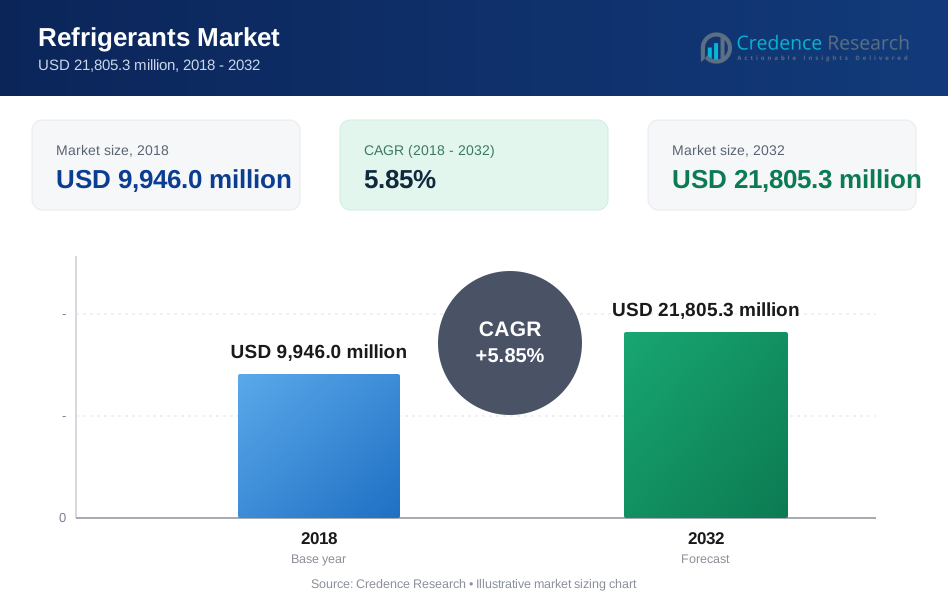
The Global Refrigerants Market size was valued at USD 9,946.0 million in 2018 to USD 13,863.1 million in 2024 and is anticipated to reach USD 21,805.3 million by 2032, at a CAGR of 5.85% during the forecast period.
| REPORT ATTRIBUTE | DETAILS |
|---|---|
| Historical Period | 2020-2023 |
| Base Year | 2024 |
| Forecast Period | 2025-2032 |
| Refrigerants Market Size 2024 | USD 13,863.1 million |
| Refrigerants Market, CAGR | 5.85% |
| Refrigerants Market Size 2032 | USD 21,805.3 million |
The market growth is driven by rising demand for air conditioning, refrigeration, and heat pump systems across residential, commercial, and industrial sectors. Rapid urbanization and increasing disposable income levels support cooling system adoption in developing economies. Environmental regulations have also encouraged the shift toward low-GWP and natural refrigerants, driving innovations in sustainable alternatives like ammonia, CO₂, and hydrocarbons.
Regionally, Asia-Pacific leads due to strong industrialization, expanding construction, and higher demand for cooling equipment in China, India, and Japan. North America and Europe follow, supported by strict environmental policies promoting the phase-out of high-GWP refrigerants. Emerging markets in Latin America and the Middle East show growing opportunities driven by climate conditions, urban growth, and increasing investments in cold chain infrastructure.

Market Insights:
- The Global Refrigerants Market size was valued at USD 9,946.0 million in 2018, reached USD 13,863.1 million in 2024, and is projected to reach USD 21,805.35 million by 2032, expanding at a CAGR of 5.85% during the forecast period.
- Asia Pacific holds the largest share at 37% due to strong industrialization, population growth, and expanding HVAC demand in China, India, and Japan. Europe follows with 27%, driven by strict environmental regulations and advanced refrigerant technologies. North America accounts for 19%, supported by mature infrastructure and growing replacement demand for low-GWP systems.
- The Middle East is the fastest-growing region with a 7.0% CAGR, fueled by high temperatures, large-scale infrastructure projects, and government investment in energy-efficient cooling systems.
- Air conditioning dominates the market with approximately 55% share, driven by rapid urbanization, higher living standards, and widespread adoption in residential and commercial sectors.
- Refrigeration accounts for about 45% share, supported by the growth of cold chain logistics, food preservation needs, and pharmaceutical storage expansion across developing regions.
Market Drivers:
Growing Demand for Air Conditioning and Refrigeration Across Multiple Sectors
The Global Refrigerants Market benefits from the rapid expansion of air conditioning and refrigeration systems in residential, commercial, and industrial applications. Rising urbanization, population growth, and lifestyle changes increase the need for temperature-controlled environments. Supermarkets, cold storage units, and data centers also expand their reliance on efficient cooling systems. The hospitality and retail sectors use refrigeration for food preservation and comfort, supporting market expansion. Climate change and rising global temperatures intensify cooling demand across regions. Manufacturers focus on developing advanced, high-performance refrigerants for next-generation cooling equipment. Government initiatives promoting energy-efficient HVAC systems further boost product adoption. The trend strengthens overall growth in the Global Refrigerants Market.
- For instance, Daikin Industries’ acquisition of DDC Solutions in August 2025 enabled its data center cooling technology to achieve rack-level thermal management up to 100 kW and whole-site modular deployments with cooling capacities exceeding 2,000 tons per Magnitude® WME-C Quad Chiller—directly supporting AI and hyperscale data center expansion in North America.
Shift Toward Environmentally Friendly and Low-GWP Refrigerants
Strict environmental regulations under the Montreal and Kigali amendments encourage the transition toward sustainable refrigerants. Manufacturers are investing in the development of natural and low-GWP alternatives such as CO₂, ammonia, and hydrocarbons. Consumers and industries seek solutions with minimal environmental impact while maintaining high efficiency. HVAC system producers are adapting their equipment to comply with emerging climate goals. The demand for HFOs grows due to their lower global warming potential compared to traditional HFCs. Sustainable technologies are becoming a key differentiator among suppliers. Governments support R&D programs that reduce the carbon footprint of the refrigeration sector. The growing regulatory alignment accelerates the green transformation of the Global Refrigerants Market.
- For instance, Arkema S.A., in partnership with Honeywell in May 2025, launched commercial HFO blends such as R454B and R513A, which offer GWP as low as 466—more than 60% lower than traditional R410A—enabling conversion of over 1 million HVAC units in the United States to next-generation refrigerant compliance within one year.
Technological Advancements in Cooling Systems and Refrigerant Formulations
Advances in compressor technologies, heat exchangers, and refrigerant compositions enhance energy efficiency. The Global Refrigerants Market witnesses growing interest in blends that optimize cooling performance while minimizing environmental risk. Manufacturers focus on thermal stability, flammability reduction, and higher compatibility with existing HVAC systems. Automation in industrial refrigeration systems improves temperature regulation and operational safety. Smart control technologies help manage refrigerant use more effectively. Research on phase-change materials and hybrid refrigerants broadens product innovation. Energy conservation goals across industries drive the adoption of advanced cooling technologies. The integration of IoT-enabled systems reshapes operational efficiency and sustainability.
Expansion of Cold Chain Logistics and Food Preservation Requirements
Rising global consumption of frozen and packaged foods supports the development of large-scale cold chain infrastructure. Pharmaceutical and healthcare industries depend on temperature-sensitive logistics for vaccine and drug storage. The Global Refrigerants Market benefits from this rising dependency on cold storage networks. Refrigeration units for transportation and warehouses require stable, long-life refrigerants to ensure product quality. The expansion of e-commerce grocery services increases demand for energy-efficient cooling solutions. Nations investing in food security initiatives are building large cold storage facilities. Industrial applications such as chemical processing and petrochemical cooling rely on specialized refrigerants. This trend creates consistent demand across multiple downstream sectors.
Market Trends:
Rising Adoption of Natural and Sustainable Refrigerant Alternatives Globally
The Global Refrigerants Market observes strong adoption of natural refrigerants such as CO₂, ammonia, and hydrocarbons. Sustainability goals are redefining product development strategies in the HVAC sector. Companies introduce innovative blends that balance performance with environmental compliance. Consumers and governments prefer eco-friendly solutions for both domestic and industrial cooling. Technological improvements make natural refrigerants safer and more compatible with modern systems. Regional initiatives promoting low-emission cooling accelerate this transition. Equipment redesign supports the broader application of natural gases in commercial refrigeration. Sustainability remains a key trend shaping long-term market evolution.
Integration of Smart Monitoring and IoT-Based Refrigeration Systems
Digitalization plays a vital role in managing refrigerant performance and reducing operational losses. The Global Refrigerants Market witnesses adoption of IoT-based control systems in HVAC and industrial refrigeration. These systems monitor pressure, temperature, and leakage in real time to optimize energy use. Predictive maintenance reduces downtime and extends equipment life. Smart systems help businesses meet efficiency standards and regulatory benchmarks. The adoption of digital sensors enhances transparency in refrigerant management. Building automation systems integrate data analytics for better performance monitoring. This integration ensures greater energy savings and environmental sustainability.
- For instance, The Chemours Company, a leader in performance chemicals, entered a strategic partnership with Navin Fluorine in May 2025 for Navin Fluorine to manufacture its Opteon™ two-phase immersion cooling fluid at a new facility in Surat, India. The new manufacturing plant, which supports the adoption of liquid cooling technologies for advanced data centers, is expected to become operational in the second quarter of 2026.
Expansion of the Heat Pump Sector in Residential and Commercial Applications
Energy-efficient heat pumps are gaining traction across developed and emerging markets. The Global Refrigerants Market benefits from their growing adoption due to government incentives promoting low-carbon heating and cooling. Heat pumps rely on advanced refrigerants for optimal energy transfer. Manufacturers are exploring HFO-based and natural options for future systems. Growing building renovation projects and net-zero targets drive product adoption. Integration of variable-speed compressors enhances performance under different climatic conditions. Policy support across Europe and Asia accelerates the shift to electric heat pumps. This expanding sector reinforces steady demand for innovative refrigerant solutions.
Increased Focus on Recycling and Circular Economy in Refrigerant Management
The refrigeration industry is shifting toward circular models to minimize environmental impact. The Global Refrigerants Market sees progress in refrigerant reclamation and recycling technologies. Companies develop recovery systems that reduce the release of harmful gases during servicing. Partnerships between OEMs and environmental agencies promote safe disposal and reuse. Regulatory frameworks encourage traceability in refrigerant recovery and certification. Advanced filtration techniques improve the quality of reclaimed gases for reuse. Industrial users implement refrigerant tracking programs to meet compliance targets. The trend supports long-term sustainability and resource conservation in the cooling industry.

Market Challenges Analysis:
Stringent Environmental Regulations and Transition Barriers in Developing Economies
The Global Refrigerants Market faces challenges from strict international protocols limiting the use of high-GWP substances. Many developing regions struggle to adopt alternative technologies due to high cost and lack of infrastructure. Small manufacturers face financial strain while replacing legacy systems. Limited awareness about sustainable refrigerant handling adds complexity. The transition demands training, certification, and specialized equipment, increasing operational costs. Supply shortages of approved alternatives slow down compliance timelines. Governments are under pressure to balance economic growth and environmental responsibility. These factors collectively create a slow pace of adoption across emerging markets.
Rising Raw Material Costs and Technological Compatibility Issues
Fluctuating raw material prices affect refrigerant production and system maintenance expenses. The Global Refrigerants Market experiences pricing instability, particularly in fluorochemicals and hydrocarbons. Retrofitting older systems for low-GWP refrigerants remains technically demanding. Compatibility issues with existing compressors and seals can increase equipment failures. Safety concerns linked with flammable or high-pressure alternatives limit adoption. Manufacturers face challenges maintaining global supply chains amid regulatory differences. Competitive pricing pressures reduce profitability in the long term. Addressing these challenges requires innovation, global coordination, and continuous investment in research and training.
Market Opportunities:
Expanding Demand for Energy-Efficient HVAC and Cold Chain Infrastructure
The Global Refrigerants Market holds significant potential in the growing HVAC and cold storage sectors. Urbanization, rising disposable income, and population growth support steady demand across emerging regions. Energy-efficient systems using sustainable refrigerants are gaining strong policy backing. New investments in supermarkets, pharmaceutical logistics, and healthcare drive product consumption. Governments promoting low-emission infrastructure create favorable conditions for technology adoption. Industry collaborations are introducing advanced cooling solutions with minimal environmental impact. Manufacturers can capture growth by expanding production capacity and localized distribution networks.
Advancement in Natural and Synthetic Refrigerant Blends Offering Improved Safety and Performance
Technological progress in blending synthetic and natural refrigerants opens new opportunities for manufacturers. The Global Refrigerants Market benefits from the shift toward safer, efficient, and climate-friendly solutions. Research in non-flammable and low-toxicity formulations strengthens product acceptance. Energy regulations in developed regions motivate companies to innovate hybrid refrigerants. Investment in R&D supports the creation of next-generation cooling technologies. Growing consumer awareness of sustainability encourages adoption of eco-certified refrigerants. Strategic partnerships and mergers will expand global product portfolios and accelerate innovation cycles.
Market Segmentation Analysis:
By Type
The Global Refrigerants Market is segmented by type into halocarbons, inorganics, zeotropic, hydrocarbons, and azeotropic refrigerants. Halocarbons dominate due to their widespread use in air conditioning and refrigeration applications. Within this group, CFCs and HCFCs are being phased out under environmental regulations, while HFCs remain in use but face similar scrutiny for their high global warming potential. Inorganic refrigerants such as ammonia and carbon dioxide are gaining traction for their eco-friendly properties and cost efficiency. Ammonia is popular in industrial refrigeration, while carbon dioxide is used in commercial and transport systems. Hydrocarbons and zeotropic blends are emerging as sustainable alternatives with strong performance and low environmental impact.
- For instance, in September 2025, Linde PLC completed the acquisition of an additional 41% stake in Airtec, a Kuwait-based industrial gas company (also known as Refrigeration & Oxygen Company Limited). This action increased Linde's total ownership to over 90% and enhanced its presence in the Middle East's industrial gas market, specifically across the GCC region. The acquisition was officially reported by the company and business news outlets.
By Application
By application, the Global Refrigerants Market is categorized into air conditioning and refrigeration. Air conditioning leads due to its growing demand in residential, commercial, and automotive sectors. Subsegments such as heat pumps, chillers, mobile AC, and stationary AC are driving adoption across varied climates and geographies. Refrigeration applications, including transportation, industrial, and commercial, show steady growth supported by the expansion of cold chain logistics and food preservation requirements. Industrial refrigeration benefits from technological upgrades that improve energy efficiency and reduce emissions. Rising consumer preference for sustainable cooling solutions across both categories continues to shape the product demand profile globally.
- For instance, SRF Limited completed the final phase of a multi-stage fluorocarbon refrigerant gas expansion project at its Dahej plant in February 2025. The initial approval for an expansion of up to 15,000 tonnes per annum was given in 2021 to meet growing market demand. In August 2025, the company also announced strategic agreements with Chemours to support the Indian market.

Segmentation:
By Type
- Halocarbons
- CFC
- HCFC
- HFC
- Inorganic
- Ammonia
- Carbon Dioxide
- Others
- Zeotropic
- Hydrocarbons
- Azeotropic
By Application
- Air Conditioning
- Heat Pumps
- Chillers
- Mobile AC
- Stationary AC
- Refrigeration
- Transportation
- Industrial
- Commercial
By Region
- North America
- S.
- Canada
- Mexico
- Europe
- UK
- France
- Germany
- Italy
- Spain
- Russia
- Rest of Europe
- Asia Pacific
- China
- Japan
- South Korea
- India
- Australia
- Southeast Asia
- Rest of Asia Pacific
- Latin America
- Brazil
- Argentina
- Rest of Latin America
- Middle East
- GCC Countries
- Israel
- Turkey
- Rest of Middle East
- Africa
- South Africa
- Egypt
- Rest of Africa
Regional Analysis:
North America
The North America Refrigerants Market size was valued at USD 1,967.33 million in 2018 to USD 2,697.55 million in 2024 and is anticipated to reach USD 4,149.56 million by 2032, at a CAGR of 5.6% during the forecast period. The region accounts for around 19% of the Global Refrigerants Market. Growth is supported by high demand for air conditioning and refrigeration across residential, commercial, and industrial sectors. The U.S. leads due to its strong construction activity, cold chain network, and regulatory focus on low-GWP refrigerants. Canada and Mexico show increasing demand driven by urbanization and expansion in food retail. The phase-down of HFCs under EPA regulations is encouraging the adoption of sustainable refrigerants such as CO₂, ammonia, and HFOs. Energy-efficient HVAC systems are being widely adopted in buildings and transport refrigeration. Strong R&D and technology integration across manufacturers continue to support long-term market expansion.
Europe
The Europe Refrigerants Market size was valued at USD 2,658.58 million in 2018 to USD 3,721.64 million in 2024 and is anticipated to reach USD 5,887.44 million by 2032, at a CAGR of 5.9% during the forecast period. The region represents nearly 27% of the Global Refrigerants Market. The market is driven by strict F-Gas regulations promoting low-emission and eco-friendly refrigerant use. European countries lead in adopting natural refrigerants such as CO₂, hydrocarbons, and ammonia in commercial and industrial applications. Germany, France, and the UK remain major contributors due to strong automotive and manufacturing bases. The growing emphasis on energy efficiency and sustainable building standards supports advanced HVAC technologies. Industrial refrigeration expansion for food processing and pharmaceuticals drives demand consistency. Innovation in recycling and reclamation of refrigerants further enhances compliance with environmental goals.
Asia Pacific
The Asia Pacific Refrigerants Market size was valued at USD 3,547.75 million in 2018 to USD 4,905.14 million in 2024 and is anticipated to reach USD 7,631.87 million by 2032, at a CAGR of 5.7% during the forecast period. The region accounts for approximately 37% of the Global Refrigerants Market, making it the largest regional contributor. Rapid industrialization, population growth, and urban development boost cooling equipment demand. China dominates production and consumption due to its vast manufacturing base and export capabilities. India and Southeast Asian nations show fast growth due to expanding residential and commercial infrastructure. Government initiatives to improve energy efficiency encourage the transition to natural and low-GWP refrigerants. The surge in e-commerce and cold chain logistics strengthens industrial refrigeration needs. Local players increasingly invest in domestic refrigerant production to reduce import dependency.
Latin America
The Latin America Refrigerants Market size was valued at USD 1,061.24 million in 2018 to USD 1,552.27 million in 2024 and is anticipated to reach USD 2,594.84 million by 2032, at a CAGR of 6.7% during the forecast period. The region represents about 13% of the Global Refrigerants Market. Economic growth, modernization of retail infrastructure, and expansion of the cold chain sector are key drivers. Brazil and Mexico are the largest contributors, supported by increasing use of HVAC and refrigeration in food, beverages, and pharmaceuticals. Manufacturers are introducing low-emission refrigerants to align with global sustainability standards. The demand for mobile and stationary air conditioning systems continues to rise in warmer climates. Industrial growth and urbanization spur higher energy demand, creating opportunities for efficient cooling solutions. Government support for energy efficiency programs also aids sustainable refrigerant adoption.
Middle East
The Middle East Refrigerants Market size was valued at USD 431.66 million in 2018 to USD 646.81 million in 2024 and is anticipated to reach USD 1,112.07 million by 2032, at a CAGR of 7.0% during the forecast period. The region captures nearly 5% of the Global Refrigerants Market. High ambient temperatures and growing urbanization significantly increase cooling demand. The GCC countries dominate due to major construction projects, hospitality growth, and industrial development. Refrigerant consumption in the region is mainly driven by HVAC systems in residential and commercial spaces. Companies are transitioning toward low-GWP refrigerants to comply with environmental policies. Smart building trends and government-backed sustainability initiatives are accelerating adoption of energy-efficient systems. Investments in district cooling and infrastructure modernization further expand the market scope.
Africa
The Africa Refrigerants Market size was valued at USD 279.48 million in 2018 to USD 339.64 million in 2024 and is anticipated to reach USD 429.57 million by 2032, at a CAGR of 3.0% during the forecast period. The region holds about 4% of the Global Refrigerants Market. Market growth is moderate but improving due to gradual industrialization and expanding retail sectors. South Africa leads with strong demand in automotive and industrial refrigeration. Egypt and Nigeria are emerging markets driven by population growth and infrastructure development. Limited awareness and lack of regulatory enforcement restrain faster adoption of eco-friendly refrigerants. However, international collaborations and regional investments are encouraging modernization of cold chain systems. The gradual entry of global HVAC manufacturers strengthens product availability and affordability. Sustainable development programs will shape future market evolution across the continent.
Key Player Analysis:
- Honeywell International Inc.
- Daikin Industries, Ltd.
- Arkema S.A.
- Dongyue Group
- The Chemours Company
- Orbita
- Sinochem Group Co., Ltd.
- Linde PLC
- Air Liquide S.A.
- SRF Limited
- Other Key Players: Gujarat Fluorochemicals Limited, Navin Fluorine International, A-Gas, Mexichem (Orbia Advance Corporation), Harp International, Arkema China Investment Co. Ltd., and Zhejiang Yonghe Refrigerant Co. Ltd.
Competitive Analysis:
The Global Refrigerants Market is highly competitive, with key players focusing on technological innovation, regulatory compliance, and sustainable product development. Major companies such as Honeywell International Inc., Daikin Industries, Ltd., Arkema S.A., and The Chemours Company dominate the landscape through diverse product portfolios and strong global distribution. It benefits from strategic partnerships and R&D initiatives that aim to develop low-GWP and natural refrigerants. The market is witnessing steady competition as regional manufacturers expand production capacity and strengthen supply networks. Continuous product innovation and government-supported energy-efficiency programs further intensify rivalry among participants.
Recent Developments:
- In October 2025, Honeywell finalized the spin-off of its Solstice Advanced Materials business, which includes its refrigerants segment, forming a standalone specialty materials company focused on innovative, low-global warming refrigerants and sustainable solutions. This strategic move aims to sharpen Honeywell’s focus on megatrends such as automation and energy transition, with the new entity leveraging its Solstice hydrofluoro-olefin (HFO) technology to support global HFC phase-down and provide advanced environmental benefits.
- In August 2025, Daikin Industries, Ltd. announced the acquisition of Dynamic Data Centers Solutions, Inc. (DDC Solutions), a U.S.-based company specializing in AI data center cooling systems, to enhance its global competitiveness in the high-performance HVAC and refrigerant market. The acquisition integrates DDC’s cutting-edge modular cooling technology into Daikin’s portfolio, supporting the rapid rise of AI data centers and aligning with Daikin’s broader goals for energy-efficient HVACR product innovation.
- In May 2025, Arkema S.A. expanded its portfolio of lower Global Warming Potential HFO refrigerants through a new commercial arrangement with Honeywell. This partnership strengthens global supply chains and allows Arkema to offer a range of next-generation refrigerant blends under the Forane brand, including R454B and R513A, catering to growing demand for sustainable cooling solutions following global regulatory shifts such as the Kigali Amendment.
Report Coverage:
The research report offers an in-depth analysis based on Type and Application segments. It details leading market players, providing an overview of their business, product offerings, investments, revenue streams, and key applications. Additionally, the report includes insights into the competitive environment, SWOT analysis, current market trends, as well as the primary drivers and constraints. Furthermore, it discusses various factors that have driven market expansion in recent years. The report also explores market dynamics, regulatory scenarios, and technological advancements that are shaping the industry. It assesses the impact of external factors and global economic changes on market growth. Lastly, it provides strategic recommendations for new entrants and established companies to navigate the complexities of the market.
Future Outlook:
- Increasing adoption of natural refrigerants will accelerate sustainable market transformation.
- Heat pump deployment will expand with rising demand for low-carbon HVAC systems.
- Stringent global regulations will drive the phase-out of high-GWP refrigerants.
- Technological innovation will enhance performance and safety in refrigerant applications.
- Industrial and food cold chain expansion will boost refrigerant demand.
- Energy-efficient cooling systems will gain traction in urban and commercial areas.
- Emerging economies will witness strong growth due to infrastructure development.
- Strategic alliances among manufacturers will strengthen supply and innovation capacity.
- Recycling and reclamation programs will shape the refrigerant lifecycle framework.
- Digital monitoring technologies will improve refrigerant management and operational control.
Request a Free Sample
Fill in your details and we'll send you a free sample report.
- Sample data tables & charts
- Research methodology
Need a Custom Version of This Report?
Tailor the scope, geography, or segments to your exact requirements.
- Custom geography or segment scope
- Direct access to our analyst team
Frequently Asked Questions
What is the current market size for the Global Refrigerants Market, and what is its projected size in 2032?
At what Compound Annual Growth Rate is the Global Refrigerants Market projected to grow between 2025 and 2032?
Which Global Refrigerants Market segment held the largest share in 2024?
What are the primary factors fueling the growth of the Global Refrigerants Market?
Who are the leading companies in the Global Refrigerants Market?
Who are the major players in this market?
Table of Content
Chapter 1. Report Introduction
- 1.1 Report Description & Purpose
- 1.1.1 Report Title & Market Definition
- 1.1.2 Unique Selling Propositions (USP) & Key Differentiators
- 1.1.3 Value Proposition for Stakeholders
- 1.2 Research Objectives
- 1.2.1 Market Sizing Objectives (Volume & Revenue)
- 1.2.2 Segmentation Objectives
- 1.2.3 Competitive Intelligence Objectives
- 1.2.4 Forecast & Scenario Objectives
- 1.3 Report Scope
- 1.3.1 Refrigerants Scope – Types & Subtypes Covered
- 1.3.2 Geographic Scope – Regions & Countries Covered
- 1.3.3 Historical Period, Base Year & Forecast Period (2018; forecast to 2032)
- 1.3.4 Inclusions & Exclusions
- 1.4 HS Code & Classification Framework
- 1.5 Currency, Units & Pricing Basis
- 1.6 Target Stakeholders
- 1.7 Limitations & Assumptions
Chapter 2. Executive Summary
- 2.1 Global Refrigerants Market Snapshot
- 2.1.1 Market Size – Historical (2018) & Forecast (2018-2032) (2018: USD 9,946.0 million → 2032: USD 21,805.3 million)
- 2.1.2 Volume & Revenue – Global Totals
- 2.1.3 Key Market Highlights – Top Five Facts
- 2.2 Refrigerants Market Segmentation Snapshot
- 2.2.1 Market Split by Region – 2018 vs. 2032
- 2.3 Competitive Snapshot
- 2.3.1 Top 10 Players by Revenue Share – 2018
- 2.3.2 Top 10 Players by Volume Share – 2018
- 2.3.3 Recent Strategic Developments (18-Month Summary)
- 2.4 Key Investment Highlights & Strategic Conclusions
Chapter 3. Refrigerants Market Dynamics & Industry Analysis
- 3.1 Market Overview & Context
- 3.1.1 Refrigerants Market Position in the Broader Automotive Value Chain
- 3.1.2 OEM vs. Replacement Market Dynamics
- 3.1.3 Market Maturity & Development Stage by Region
- 3.2 Refrigerants Market Drivers
- 3.3 Refrigerants Market Restraints & Challenges
- 3.4 Refrigerants Market Opportunities
- 3.5 Porter's Five Forces Analysis
- 3.5.1 Threat of New Entrants
- 3.5.2 Bargaining Power of Suppliers
- 3.5.3 Bargaining Power of Buyers
- 3.5.4 Threat of Substitutes
- 3.5.5 Competitive Rivalry – Intensity Assessment
- 3.6 Refrigerants Value Chain Analysis
- 3.6.1 Upstream – Raw Material/Input Suppliers
- 3.6.1.1 Raw Material/Input 1
- 3.6.1.2 Raw Material/Input 2
- 3.6.1.3 Raw Material/Input 3
- 3.6.2 Midstream – Production/Manufacturing/Service Delivery
- 3.6.2.1 Production/Process Overview
- 3.6.2.2 Key Facility Locations & Capacity by Manufacturer
- 3.6.3 Downstream – Distribution & End Consumer
- 3.6.3.1 Primary Channel – B2B/OEM
- 3.6.3.2 Secondary Channels – Dealer, Retail, Online, Direct
- 3.6.4 Value Chain Profitability Analysis
- 3.6.1 Upstream – Raw Material/Input Suppliers
- 3.7 PESTEL Analysis
- 3.7.1 Political Factors
- 3.7.2 Economic Factors
- 3.7.3 Social Factors
- 3.7.4 Technological Factors
- 3.7.5 Environmental Factors
- 3.7.6 Legal Factors
- 3.8 Refrigerants Supply Chain Analysis
- 3.8.1 Raw Material/Input Supply Risk Assessment
- 3.8.2 Manufacturing Concentration Risk (Geographic Exposure)
- 3.8.3 Trade Disruption Impact Analysis
- 3.9 Regulatory & Policy Landscape
Note: The regulatory and policy landscape section covers regulations based on their applicability to the market, Refrigerants category, geography, and scope of the study. Only regulatory frameworks with a material impact on operations, compliance, trade, sustainability, or market access are analyzed in detail.
Chapter 4. Key Investment Pockets & Opportunity Analysis
- 4.1 Refrigerants Market Attractiveness Analysis
- 4.1.1 By Region – Investment Attractiveness Matrix (Volume × CAGR)
- 4.2 Absolute Revenue Growth Opportunity
- 4.2.1 By Region – Absolute USD Growth Through 2032
- 4.3 Incremental Volume Opportunity
- 4.3.1 By Region – Incremental Volume Through 2032
- 4.3.2 Segment – Incremental Volume
- 4.4 Emerging Submarket Opportunity Deep Dive (Subject to Applicability)
- 4.5 Emerging Market Opportunity Scorecards
- 4.5.1 United States
- 4.5.2 Europe
- 4.5.3 Asia
- 4.5.4 Middle East & Africa
Note: Emerging Market Opportunity Scorecards will be included based on relevance and strategic importance. Regions listed are indicative and may vary depending on data availability and market dynamics.
Chapter 5. Refrigerants Import-Export Analysis & Trade Flows
- 5.1 Global Trade Overview
- 5.1.1 Global Export Value by Country (2018)
- 5.1.2 Global Export Volume by Country (2018)
- 5.1.3 Global Import Value by Country (2018)
- 5.1.4 Global Import Volume by Country (2018)
- 5.1.5 Net Trade Balance by Country (2018)
- 5.2 Export Analysis – Segment
- 5.2.1 Type 1 (HS Code)
- 5.2.2 Type 2 (HS Code)
- 5.2.3 Type 3 (HS Code)
- 5.2.4 Type 4 (HS Code)
- 5.2.5 Type 5 (HS Code)
- 5.3 Import Analysis – Segment
- 5.3.1 Type 1 (HS Code)
- 5.3.2 Type 2 (HS Code)
- 5.3.3 Type 3 (HS Code)
- 5.3.4 Type 4 (HS Code)
- 5.3.5 Type 5 (HS Code)
- 5.4 Average Unit Trade Prices
- 5.4.1 Average Export Price – Segment & Country
- 5.4.2 Average Import Price – Segment & Source Country
- 5.4.3 Price Trends (2018)
- 5.5 Key Trade Route Analysis
- 5.5.1 Trade Route 1
- 5.5.2 Trade Route 2
- 5.5.3 Trade Route 3
- 5.5.4 Trade Route 4
- 5.5.5 Trade Route 5
- 5.6 Trade Policy Impact Assessment
- 5.6.1 US Anti-Dumping & Section 301 Tariffs
- 5.6.2 EU Customs Union Impact
- 5.6.3 Major Free Trade Agreements
- 5.6.4 USMCA Rules of Origin
Note: Trade policy analysis will be included only where relevant to the Refrigerants market.
Chapter 6. Competitive Landscape & Company Benchmarking
- 6.1 Refrigerants Market Concentration & Structure
- 6.1.1 Herfindahl-Hirschman Index (HHI) – vs. 2018
- 6.1.2 Tier 1, Tier 2 & Tier 3 Market Structure
- 6.1.3 Global, Regional & Local Player Dynamics
- 6.2 Refrigerants Market Share Analysis – 2018
- 6.2.1 Global Revenue Share by Company
- 6.2.2 Global Volume Share by Company
- 6.2.3 Regional Revenue Share
- 6.2.4 Market Share Evolution ( vs. 2018)
- 6.2.5 OEM Segment Share by Company
- 6.2.6 Replacement Segment Share by Company
- 6.3 Production/Delivery Capacity & Facility Analysis
- 6.3.1 Global Installed Capacity
- 6.3.2 Capacity Utilization Rates
- 6.3.3 Production/Output Volume
- 6.3.4 Facility Locations & Capacity Map
- 6.3.5 Planned Capacity Additions
- 6.4 Refrigerants Competitive Benchmarking Matrix
- 6.4.1 Revenue, Volume, CAGR & Profitability Comparison
- 6.4.2 Channel Revenue Mix
- 6.4.3 Geographic Revenue Exposure
- 6.4.4 R&D Intensity
- 6.4.5 Sustainability Maturity
- 6.5 Strategic Developments in Refrigerants (Last 24 Months)
- 6.5.1 Mergers, Acquisitions & Divestments
- 6.5.2 New Refrigerants Launches
- 6.5.3 Facility Expansions
- 6.5.4 Strategic Alliances, Joint Ventures & Partnerships
- 6.5.5 Distribution Expansion & Market Entry
- 6.5.6 Sustainability & ESG Initiatives
- 6.6 Competitive Strategy Mapping
- 6.6.1 Leader, Challenger, Follower & Niche Classification
- 6.6.2 Pricing Strategy Comparison
- 6.6.3 Channel Strategy Matrix
Note: Strategic developments are included based on their materiality and the availability of reliable information.
Chapter 7. Global Refrigerants Market – By Distribution Channel
- 7.1 Segment Overview
- 7.1.1 Volume & Revenue Split by Channel (2018 & 2032)
- 7.1.2 Channel Mix Evolution (2018-2032)
Chapter 8. Regional Market Analysis – Global Overview
- 8.1 Global Regional Overview
- 8.1.1 Regional Volume Share
- 8.1.2 Regional Revenue Share
- 8.1.3 Regional Volume by Region
- 8.1.4 Regional Revenue by Region
- 8.1.5 Regional Forecast Through 2032
- 8.2 Cross-Regional Segment Analysis
- 8.2.1 By Distribution Channel
- 8.2.2 By Brand/Price Tier
Chapter 9. North America Refrigerants Market
- 9.1 United States
- 9.2 Canada
- 9.3 Mexico
Chapter 10. Europe Refrigerants Market
- 10.1 Germany
- 10.2 France
- 10.3 Italy
- 10.4 United Kingdom
- 10.5 Spain
- 10.6 Poland
- 10.7 Russia
- 10.8 Netherlands
- 10.9 Belgium
- 10.10 Sweden
- 10.11 Denmark
- 10.12 Norway
- 10.13 Rest of Europe
Chapter 11. Asia Pacific Refrigerants Market
- 11.1 China
- 11.2 India
- 11.3 Japan
- 11.4 South Korea
- 11.5 Thailand
- 11.6 Indonesia
- 11.7 Vietnam
- 11.8 Malaysia
- 11.9 Australia
- 11.10 Rest of Asia Pacific
Chapter 12. Latin America Refrigerants Market
- 12.1 Brazil
- 12.2 Argentina
- 12.3 Colombia
- 12.4 Chile
- 12.5 Rest of Latin America
Chapter 13. Middle East Refrigerants Market
- 13.1 Saudi Arabia
- 13.2 United Arab Emirates
- 13.3 Turkey
- 13.4 Israel
- 13.5 Iran
- 13.6 Rest of the Middle East
Chapter 14. Africa Refrigerants Market
- 14.1 South Africa
- 14.2 Egypt
- 14.3 Nigeria
- 14.4 Morocco
- 14.5 Rest of Africa
Chapter 15. Refrigerants Company Profiles
- 15.1 [Company 01]
- 15.1.1 Company Overview
- 15.1.2 Key Management Personnel
- 15.1.3 Products & Services Portfolio
- 15.1.4 Financial Performance
- 15.1.5 Key Market Focus & Geographic Presence
- 15.1.6 Recent Developments & Strategic Initiatives
Note: The company profile list is preliminary and may change based on research findings, market developments, data availability, and client requirements.
Chapter 16. Appendices
- Appendix A – List of Abbreviations & Acronyms
- Appendix B – Industry Classification Code Reference – Full Series
- Appendix C – Production & Capacity Data Tables
- Appendix D – End-Use & Demand Base Tables
- Appendix E – Consumption & Replacement Rate Assumptions
- Appendix F – ASP Reference Tables
- Appendix G – Manufacturing & Facility Database
- Appendix H – Import-Export Data Tables
- Appendix I – Regulatory Summary Tables
- Appendix J – Primary Research Participant List (Anonymized)
- Appendix K – Primary Research Questionnaire Framework
- Appendix L – Data Sources & Bibliography
- Appendix M – Market Size Divergence & Source Comparison
Chapter 17. Research Methodology
- 17.1 Research Framework & Philosophy
- 17.2 Secondary Research – Sources, Hierarchy & Data Extraction
- 17.3 Data Modeling – Bottom-Up & Top-Down Market Sizing
- 17.4 Primary Research – Stakeholder Framework, LOI & Sample Sizes
- 17.5 Forecast Methodology – Regression, Scenario & Sensitivity Analysis
- 17.6 Quality Control – Four-Layer Validation Framework
- 17.7 Limitations & Standard Assumptions
- 17.8 Disclaimer
