
Telluric Acid Market Overview:
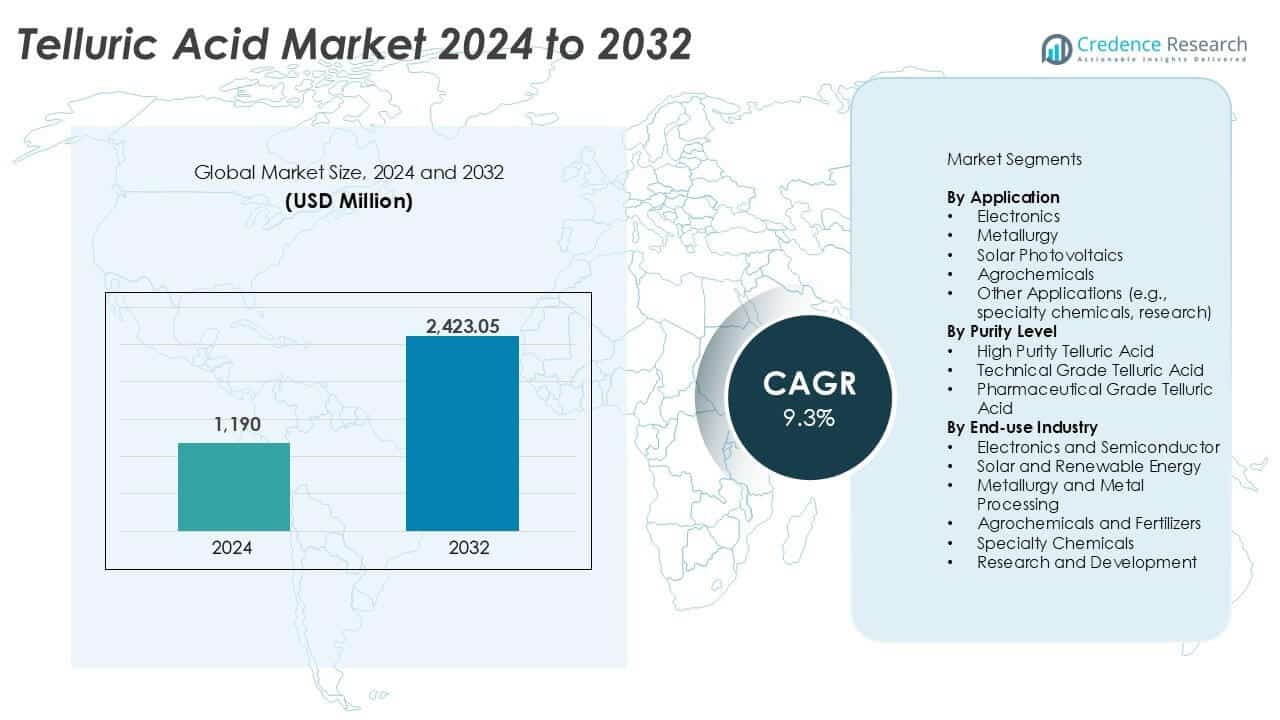
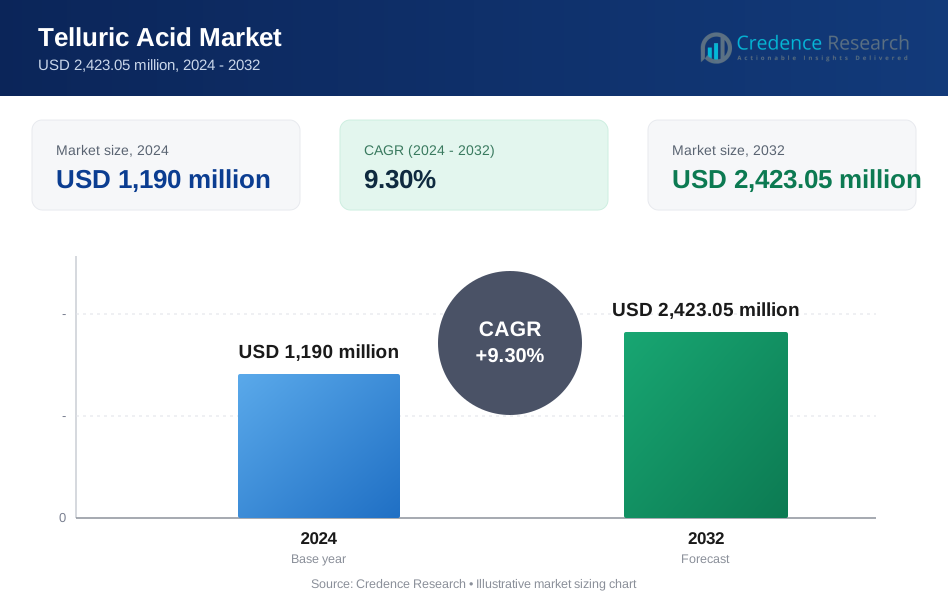
The Telluric Acid market size was valued at USD 1,190 million in 2024 and is anticipated to reach USD 2,423.05 million by 2032, at a CAGR of 9.3% during the forecast period.
| REPORT ATTRIBUTE | DETAILS |
|---|---|
| Historical Period | 2020-2023 |
| Base Year | 2024 |
| Forecast Period | 2025-2032 |
| Telluric Acid Market Size 2024 | USD 1,190 million |
| Telluric Acid Market, CAGR | 9.3% |
| Telluric Acid Market Size 2032 | USD 2,423.05 million |
The Telluric Acid market is led by prominent players such as Merck KGaA, Thermo Fisher Scientific Inc., Honeywell International Inc., Alfa Aesar, and Sigma-Aldrich Corporation. These companies dominate through extensive global reach, advanced purification technologies, and strong distribution networks. They serve high-purity demands across electronics, solar, and research sectors. American Elements, Strem Chemicals, and TCI America also maintain significant positions, supplying specialized grades for niche applications. Regionally, Asia Pacific leads the global market with a 38% share in 2024, driven by China’s control over tellurium refining and strong semiconductor and solar activity in Japan, South Korea, and Taiwan. North America and Europe follow, supported by robust clean energy policies and advanced material research.
Telluric Acid Market Insights
- The Telluric Acid market was valued at USD 1,190 million in 2024 and is projected to reach USD 2,423.05 million by 2032, growing at a CAGR of 9.3%.
- Demand is driven by growing use in semiconductors, solar thin-film technologies, and specialty alloy production.
- Thermoelectric research and cadmium telluride solar cells are key trends, along with rising demand for high-purity compounds in electronics.
- Merck KGaA, Thermo Fisher Scientific, and Honeywell lead the competitive landscape with strong supply chains and purity standards.
- Asia Pacific holds 38% market share, followed by North America at 28% and Europe at 22%; by application, electronics dominate with over 35% share, while high-purity telluric acid accounts for nearly 50% of the market.
Telluric Acid Market Segmentation Analysis:
By Application
The electronics segment dominated the Telluric Acid market in 2024, accounting for over 35% share. Growth is driven by its use in semiconductor etching, electroplating, and optical components. Demand rises as chipmakers seek ultra-high purity materials. Metallurgy follows closely, where telluric acid enhances alloy strength and grain refinement in steel and copper processing. Solar photovoltaics also show strong momentum due to the rising use of cadmium telluride (CdTe) thin-film cells. Agrochemicals and specialty chemicals form smaller segments, with telluric acid used in trace element formulations and niche catalytic processes.
- For instance, 5N Plus supplies tellurium compounds with purity levels up to 99.999% for semiconductor and optoelectronic applications, supporting advanced chip and infrared optics production.
By Purity Level
High purity telluric acid led the market in 2024 with nearly 50% share, backed by demand from semiconductor and solar cell manufacturers. Its high-performance characteristics make it essential for precision etching and deposition. Technical grade telluric acid finds usage in metallurgy and chemical processing, where ultra-purity is less critical. Pharmaceutical grade telluric acid remains a niche segment, used in research and potential oncology applications. Strict regulatory quality standards and expanding cleanroom manufacturing facilities sustain demand across purity levels, with a clear preference for ultra-refined materials in high-tech industries.
- For instance, Thermo Scientific (formerly Alfa Aesar) supplies telluric acid with metal trace impurities as low as 10 ppm (99.999% metals basis), which serves specialized research and specific electronics applications. However, advanced cleanroom semiconductor processes often require ultra-high purity grades with impurities in the parts per billion (ppb) range. Technical grade products continue to support metallurgical and general industrial chemical uses.
By End-use Industry
Electronics and semiconductor were the leading end-use industry in 2024, holding over 40% market share. Advanced chip fabrication processes rely on telluric acid for oxidation and cleaning applications. The solar and renewable energy segment is growing rapidly, driven by investments in CdTe solar panel production. Metallurgy and metal processing industries use telluric acid for alloying and corrosion-resistant treatments. Agrochemicals and specialty chemicals utilize it in low-volume but high-value applications. Research and development remains an emerging segment, as academic and industrial labs explore new catalytic and material science pathways involving tellurium compounds.
Telluric Acid Market Key Growth Drivers
Rising Demand from the Semiconductor and Electronics Sector
Telluric acid plays a crucial role in the semiconductor industry, particularly in photolithography and etching processes. As chip geometries shrink and demand for high-performance computing rises, manufacturers require ultra-high purity precursors. Telluric acid supports precise oxidation and doping processes, improving circuit stability and conductivity. With global semiconductor sales crossing USD 500 billion and rising investment in fab construction, demand for tellurium-based compounds continues to grow. Countries such as the U.S., South Korea, and Taiwan are expanding domestic semiconductor capacity, boosting regional consumption. The shift toward AI processors and quantum computing also increases material needs for high-frequency and thermoelectric components. This trend ensures a stable, long-term application base for telluric acid in microelectronics and optoelectronics.
- For instance, TSMC operates multiple 300 mm wafer fabs, each processing more than 1 million wafers per year, increasing consumption of high-purity specialty chemicals.
Expansion of Thin-Film Solar Photovoltaics
The solar energy sector is increasingly adopting cadmium telluride (CdTe) thin-film solar technology due to its low production cost and shorter energy payback time. Telluric acid is a precursor in producing tellurium compounds essential for CdTe photovoltaic layers. These modules exhibit strong efficiency in diffuse light and high temperatures, making them suitable for large-scale utility installations. First Solar, one of the largest CdTe panel producers, has significantly expanded its U.S. production footprint in recent years. With global solar PV capacity projected to exceed 5,000 GW by 2030, telluric acid demand is expected to grow in tandem. Its use in this segment benefits from decarbonization policies, clean energy investments, and solar manufacturing subsidies in the U.S., India, and Europe. The solar sector offers a robust growth avenue for telluric acid suppliers focused on long-term sustainability demand.
- For instance, First Solar reported cumulative production of more than 200 million CdTe thin-film panels across its global manufacturing network, including large U.S. facilities.
Strategic Importance in Metallurgical Additives and Alloys
Telluric acid’s utility in metallurgical applications drives demand across copper, stainless steel, and lead-based alloy production. It enhances machinability, reduces metal fatigue, and increases resistance to corrosion in industrial environments. Tellurium-based alloys are widely used in electrical connectors, thermoelectric devices, and automotive parts requiring dimensional stability. The growing focus on high-performance and corrosion-resistant materials in critical infrastructure projects strengthens the metallurgical application base. Governments investing in grid modernization, EV charging stations, and rail systems further boost alloy demand. In addition, the global trend toward miniaturization in electronics and lightweight automotive components drives the use of tellurium alloys. These factors support a steady growth trajectory for telluric acid in metal processing sectors.
Telluric Acid Market Key Trends & Opportunities
Emerging Applications in Thermoelectric and Energy Storage Materials
Telluric acid is gaining attention for its role in thermoelectric materials, which convert waste heat into electrical energy. Bismuth telluride and lead telluride, produced using telluric acid, are key materials in thermoelectric modules. Industries such as automotive, aerospace, and power generation are exploring thermoelectrics to boost energy efficiency. Global R&D investments in low-emission technologies are encouraging new material innovations, including tellurium-based compounds. Telluric acid is also under study for use in high-capacity lithium-tellurium batteries, offering higher energy density and safety than conventional lithium-ion chemistries. These evolving applications open new commercial opportunities beyond conventional markets. Academic and corporate partnerships continue to push the boundaries of tellurium chemistry, potentially expanding telluric acid’s value across the energy landscape.
- For instance, the Samsung Advanced Institute of Technology (SAIT) published research in Nature Energy on all-solid-state lithium-metal batteries demonstrating a volumetric energy density of 900 Wh/L and a lifespan of 1,000 cycles in lab-scale pouch cells.
Supply Chain Diversification and Government Strategic Stockpiles
Tellurium is considered a critical mineral by several countries, including the U.S., due to its limited global production and strategic importance. Telluric acid, as a refined derivative, benefits from increased attention to critical material security. Governments are establishing national reserves and encouraging domestic production to reduce dependence on imports. For instance, the U.S. Geological Survey monitors tellurium stockpiles and consumption trends. Meanwhile, mining firms and refineries in Canada, Kazakhstan, and China are expanding production to support domestic solar and electronics manufacturing. These efforts are creating new regional supply chains for telluric acid and reducing pricing volatility. Long-term contracts and offtake agreements are expected to shape future market dynamics, supporting more stable availability and enabling downstream industry planning.
Telluric Acid Market Key Challenges
Limited Availability and Geopolitical Concentration of Tellurium Sources
Tellurium is a by-product of copper refining and exists in trace concentrations. This makes its supply vulnerable to fluctuations in copper output and smelting activity. Over 60% of global tellurium production is concentrated in China, creating a high-risk supply chain for regions reliant on imports. Trade restrictions, export controls, and shifting geopolitical relations can disrupt the flow of tellurium and derivatives like telluric acid. This challenge hampers production planning for downstream users in semiconductors, solar, and alloy industries. Companies are increasingly exploring secondary sources and recycling methods, but current recovery rates remain low. The market faces long-term risks unless mining diversification, technological improvements in extraction, and regulatory support materialize to enhance supply resilience.
Handling Hazards and Environmental Regulations
Telluric acid is classified as a hazardous material due to its toxicity and oxidizing properties. Exposure to fumes or residues may cause health hazards such as respiratory irritation and organ damage. Stringent environmental and occupational safety regulations govern its storage, handling, and disposal. This imposes additional costs on manufacturers and users, especially in regions with strict compliance standards. Waste treatment, containment systems, and worker protection protocols increase operational complexity. Regulatory pressures could escalate if tellurium derivatives are further scrutinized for environmental persistence or bioaccumulation risks. These factors pose compliance burdens and may limit adoption in lower-regulation or price-sensitive regions unless safer alternatives or improved formulations become available.
Telluric Acid Market Regional Analysis
North America
North America accounted for approximately 28% of the Telluric Acid market in 2024. The region benefits from strong semiconductor manufacturing and advanced solar technology adoption. The United States leads regional demand due to large-scale chip fabrication plants and CdTe solar panel production. Federal incentives supporting domestic semiconductor supply chains strengthen material consumption. Research institutions also drive niche demand through material science and energy research. Canada contributes through metallurgical applications linked to mining and alloy processing. Stable regulatory frameworks and high-purity material standards support consistent demand across electronics, renewable energy, and specialty chemical applications in the region.
Europe
Europe held nearly 22% share of the global Telluric Acid market in 2024. Demand is driven by renewable energy expansion and advanced manufacturing. Countries such as Germany and France support usage through strong photovoltaic installations and electronics production. The region emphasizes sustainable materials and recycling, encouraging efficient use of tellurium derivatives. Metallurgy remains an important contributor, especially in specialty alloys for automotive and industrial equipment. Research-driven innovation across universities and public laboratories also supports consumption. Strict environmental regulations increase production costs but favor high-quality, compliant telluric acid suppliers.
Asia Pacific
Asia Pacific dominated the Telluric Acid market with about 38% share in 2024. China leads regional consumption due to its large semiconductor base and control over tellurium refining. Japan and South Korea contribute through advanced electronics and thermoelectric materials. Taiwan’s semiconductor foundries further boost demand for high-purity telluric acid. Rapid solar photovoltaic capacity additions across China and India strengthen CdTe-related consumption. Expanding electronics manufacturing and favorable industrial policies support long-term growth. The region also benefits from proximity to raw material supply, reducing procurement risks and costs.
Latin America
Latin America represented around 6% of the Telluric Acid market in 2024. Demand remains moderate but shows steady growth. The region benefits from metallurgical activities, especially copper refining, which supports downstream tellurium availability. Brazil leads consumption due to expanding electronics assembly and renewable energy projects. Chile plays a role through mining-linked applications and alloy processing. Limited local refining capacity restricts higher adoption, resulting in reliance on imports. Ongoing investments in solar energy and industrial modernization present gradual growth opportunities for telluric acid suppliers.
Middle East & Africa
The Middle East & Africa accounted for approximately 6% market share in 2024. Demand is driven by industrial diversification and renewable energy investments. Gulf countries support consumption through solar energy projects and specialty chemical imports. South Africa contributes via mining-linked metallurgy and research activities. Electronics manufacturing remains limited, restricting large-scale demand. However, regional governments increasingly invest in clean energy and advanced materials research. Infrastructure development and gradual industrial expansion support future growth. Market penetration remains low, but improving supply chains and technology transfer create long-term potential.
Telluric Acid Market Segmentations:
By Application
- Electronics
- Metallurgy
- Solar Photovoltaics
- Agrochemicals
- Other Applications (e.g., specialty chemicals, research)
By Purity Level
- High Purity Telluric Acid
- Technical Grade Telluric Acid
- Pharmaceutical Grade Telluric Acid
By End-use Industry
- Electronics and Semiconductor
- Solar and Renewable Energy
- Metallurgy and Metal Processing
- Agrochemicals and Fertilizers
- Specialty Chemicals
- Research and Development
By Geography
- North America
- U.S.
- Canada
- Mexico
- Europe
- Germany
- France
- U.K.
- Italy
- Spain
- Rest of Europe
- Asia Pacific
- China
- Japan
- India
- South Korea
- South-east Asia
- Rest of Asia Pacific
- Latin America
- Brazil
- Argentina
- Rest of Latin America
- Middle East & Africa
- GCC Countries
- South Africa
- Rest of the Middle East and Africa
Competitive Landscape
The Telluric Acid market features a diverse set of players ranging from global chemical giants to niche laboratory suppliers. Companies like Merck KGaA, Thermo Fisher Scientific, and Honeywell International dominate the high-purity and research-grade segments due to robust distribution networks and advanced purification technologies. Alfa Aesar, Sigma-Aldrich, and TCI America cater to specialty and academic needs, offering small-batch precision-grade products. Firms such as American Elements and Strem Chemicals serve high-tech industries with customized formulations. Meanwhile, regional players like Loba Chemie and Central Drug House (P) Ltd. focus on cost-effective supply to emerging markets. Vendors compete on product purity, delivery timelines, and regulatory compliance. Strategic moves include acquisitions, research collaborations, and expansion into fast-growing sectors like photovoltaics and semiconductors. The market sees growing interest in sustainable sourcing and recycling of tellurium. Overall, competition remains moderate, but firms offering high-quality, application-specific grades maintain a strong foothold in this specialized chemical landscape.
Key Player Analysis
- GFS Chemicals, Inc.
- Thermo Fisher Scientific Inc.
- Central Drug House (P) Ltd.
- Fisher Scientific International, Inc.
- Avantor, Inc.
- Strem Chemicals, Inc.
- Spectrum Chemical Manufacturing Corp.
- Sigma-Aldrich Corporation
- Tokyo Chemical Industry Co., Ltd.
- Merck KGaA
- Santa Cruz Biotechnology, Inc.
- Loba Chemie Pvt. Ltd.
- Acros Organics
- MP Biomedicals, LLC
- Alfa Aesar
- TCI America
- VWR International, LLC
- American Elements
- Honeywell International Inc.
- Biosynth Carbosynth
Report Coverage
The research report offers an in-depth analysis based on Application, Purity Level, End-use Industry and Geography. It details leading market players, providing an overview of their business, product offerings, investments, revenue streams, and key applications. Additionally, the report includes insights into the competitive environment, SWOT analysis, current market trends, as well as the primary drivers and constraints. Furthermore, it discusses various factors that have driven market expansion in recent years. The report also explores market dynamics, regulatory scenarios, and technological advancements that are shaping the industry. It assesses the impact of external factors and global economic changes on market growth. Lastly, it provides strategic recommendations for new entrants and established companies to navigate the complexities of the market.
Future Outlook
- Demand for telluric acid will grow with the expansion of global semiconductor manufacturing.
- Adoption of cadmium telluride solar panels will increase usage in the renewable energy sector.
- High-purity grade products will dominate due to rising precision needs in electronics.
- New applications in thermoelectric materials will support long-term demand growth.
- Investment in research and development will drive innovation in tellurium-based compounds.
- Supply chain diversification efforts will reduce dependence on limited refining regions.
- Recycling technologies may emerge to address raw material availability concerns.
- Regulatory focus on chemical safety will push companies to adopt safer handling practices.
- Asia Pacific will maintain leadership, supported by industrial growth and production capabilities.
- Collaborations between chemical producers and tech manufacturers will shape product development.
Request a Free Sample
Fill in your details and we'll send you a free sample report.
- Sample data tables & charts
- Research methodology
Need a Custom Version of This Report?
Tailor the scope, geography, or segments to your exact requirements.
- Custom geography or segment scope
- Direct access to our analyst team
Frequently Asked Questions
What is the current market size for the Telluric Acid market, and what is its projected size in 2032?
At what Compound Annual Growth Rate is the Telluric Acid market projected to grow between 2024 and 2032?
What are the primary factors fueling the growth of the Telluric Acid market?
Who are the leading companies in the Telluric Acid market?
Which region commanded the largest share of the Telluric Acid market in 2024?
Table of Content
Chapter 1. Report Introduction
- 1.1 Report Description & Purpose
- 1.1.1 Report Title & Market Definition
- 1.1.2 Unique Selling Propositions (USP) & Key Differentiators
- 1.1.3 Value Proposition for Stakeholders
- 1.2 Research Objectives
- 1.2.1 Market Sizing Objectives (Volume & Revenue)
- 1.2.2 Segmentation Objectives
- 1.2.3 Competitive Intelligence Objectives
- 1.2.4 Forecast & Scenario Objectives
- 1.3 Report Scope
- 1.3.1 Telluric Acid Scope – Types & Subtypes Covered
- 1.3.2 Geographic Scope – Regions & Countries Covered
- 1.3.3 Historical Period, Base Year & Forecast Period (2024; forecast to 2032)
- 1.3.4 Inclusions & Exclusions
- 1.4 HS Code & Classification Framework
- 1.5 Currency, Units & Pricing Basis
- 1.6 Target Stakeholders
- 1.7 Limitations & Assumptions
Chapter 2. Executive Summary
- 2.1 Global Telluric Acid Market Snapshot
- 2.1.1 Market Size – Historical (2024) & Forecast (2024-2032) (2024: USD 1,190 million → 2032: USD 2,423.05 million)
- 2.1.2 Volume & Revenue – Global Totals
- 2.1.3 Key Market Highlights – Top Five Facts
- 2.2 Telluric Acid Market Segmentation Snapshot
- 2.2.1 Market Split by Region – 2024 vs. 2032
- 2.3 Competitive Snapshot
- 2.3.1 Top 10 Players by Revenue Share – 2024
- 2.3.2 Top 10 Players by Volume Share – 2024
- 2.3.3 Recent Strategic Developments (18-Month Summary)
- 2.4 Key Investment Highlights & Strategic Conclusions
Chapter 3. Telluric Acid Market Dynamics & Industry Analysis
- 3.1 Market Overview & Context
- 3.1.1 Telluric Acid Market Position in the Broader Automotive Value Chain
- 3.1.2 OEM vs. Replacement Market Dynamics
- 3.1.3 Market Maturity & Development Stage by Region
- 3.2 Telluric Acid Market Drivers
- 3.3 Telluric Acid Market Restraints & Challenges
- 3.4 Telluric Acid Market Opportunities
- 3.5 Porter's Five Forces Analysis
- 3.5.1 Threat of New Entrants
- 3.5.2 Bargaining Power of Suppliers
- 3.5.3 Bargaining Power of Buyers
- 3.5.4 Threat of Substitutes
- 3.5.5 Competitive Rivalry – Intensity Assessment
- 3.6 Telluric Acid Value Chain Analysis
- 3.6.1 Upstream – Raw Material/Input Suppliers
- 3.6.1.1 Raw Material/Input 1
- 3.6.1.2 Raw Material/Input 2
- 3.6.1.3 Raw Material/Input 3
- 3.6.2 Midstream – Production/Manufacturing/Service Delivery
- 3.6.2.1 Production/Process Overview
- 3.6.2.2 Key Facility Locations & Capacity by Manufacturer
- 3.6.3 Downstream – Distribution & End Consumer
- 3.6.3.1 Primary Channel – B2B/OEM
- 3.6.3.2 Secondary Channels – Dealer, Retail, Online, Direct
- 3.6.4 Value Chain Profitability Analysis
- 3.6.1 Upstream – Raw Material/Input Suppliers
- 3.7 PESTEL Analysis
- 3.7.1 Political Factors
- 3.7.2 Economic Factors
- 3.7.3 Social Factors
- 3.7.4 Technological Factors
- 3.7.5 Environmental Factors
- 3.7.6 Legal Factors
- 3.8 Telluric Acid Supply Chain Analysis
- 3.8.1 Raw Material/Input Supply Risk Assessment
- 3.8.2 Manufacturing Concentration Risk (Geographic Exposure)
- 3.8.3 Trade Disruption Impact Analysis
- 3.9 Regulatory & Policy Landscape
Note: The regulatory and policy landscape section covers regulations based on their applicability to the market, Telluric Acid category, geography, and scope of the study. Only regulatory frameworks with a material impact on operations, compliance, trade, sustainability, or market access are analyzed in detail.
Chapter 4. Key Investment Pockets & Opportunity Analysis
- 4.1 Telluric Acid Market Attractiveness Analysis
- 4.1.1 By Region – Investment Attractiveness Matrix (Volume × CAGR)
- 4.2 Absolute Revenue Growth Opportunity
- 4.2.1 By Region – Absolute USD Growth Through 2032
- 4.3 Incremental Volume Opportunity
- 4.3.1 By Region – Incremental Volume Through 2032
- 4.3.2 Segment – Incremental Volume
- 4.4 Emerging Submarket Opportunity Deep Dive (Subject to Applicability)
- 4.5 Emerging Market Opportunity Scorecards
- 4.5.1 United States
- 4.5.2 Europe
- 4.5.3 Asia
- 4.5.4 Middle East & Africa
Note: Emerging Market Opportunity Scorecards will be included based on relevance and strategic importance. Regions listed are indicative and may vary depending on data availability and market dynamics.
Chapter 5. Telluric Acid Import-Export Analysis & Trade Flows
- 5.1 Global Trade Overview
- 5.1.1 Global Export Value by Country (2024)
- 5.1.2 Global Export Volume by Country (2024)
- 5.1.3 Global Import Value by Country (2024)
- 5.1.4 Global Import Volume by Country (2024)
- 5.1.5 Net Trade Balance by Country (2024)
- 5.2 Export Analysis – Segment
- 5.2.1 Type 1 (HS Code)
- 5.2.2 Type 2 (HS Code)
- 5.2.3 Type 3 (HS Code)
- 5.2.4 Type 4 (HS Code)
- 5.2.5 Type 5 (HS Code)
- 5.3 Import Analysis – Segment
- 5.3.1 Type 1 (HS Code)
- 5.3.2 Type 2 (HS Code)
- 5.3.3 Type 3 (HS Code)
- 5.3.4 Type 4 (HS Code)
- 5.3.5 Type 5 (HS Code)
- 5.4 Average Unit Trade Prices
- 5.4.1 Average Export Price – Segment & Country
- 5.4.2 Average Import Price – Segment & Source Country
- 5.4.3 Price Trends (2024)
- 5.5 Key Trade Route Analysis
- 5.5.1 Trade Route 1
- 5.5.2 Trade Route 2
- 5.5.3 Trade Route 3
- 5.5.4 Trade Route 4
- 5.5.5 Trade Route 5
- 5.6 Trade Policy Impact Assessment
- 5.6.1 US Anti-Dumping & Section 301 Tariffs
- 5.6.2 EU Customs Union Impact
- 5.6.3 Major Free Trade Agreements
- 5.6.4 USMCA Rules of Origin
Note: Trade policy analysis will be included only where relevant to the Telluric Acid market.
Chapter 6. Competitive Landscape & Company Benchmarking
- 6.1 Telluric Acid Market Concentration & Structure
- 6.1.1 Herfindahl-Hirschman Index (HHI) – vs. 2024
- 6.1.2 Tier 1, Tier 2 & Tier 3 Market Structure
- 6.1.3 Global, Regional & Local Player Dynamics
- 6.2 Telluric Acid Market Share Analysis – 2024
- 6.2.1 Global Revenue Share by Company
- 6.2.2 Global Volume Share by Company
- 6.2.3 Regional Revenue Share
- 6.2.4 Market Share Evolution ( vs. 2024)
- 6.2.5 OEM Segment Share by Company
- 6.2.6 Replacement Segment Share by Company
- 6.3 Production/Delivery Capacity & Facility Analysis
- 6.3.1 Global Installed Capacity
- 6.3.2 Capacity Utilization Rates
- 6.3.3 Production/Output Volume
- 6.3.4 Facility Locations & Capacity Map
- 6.3.5 Planned Capacity Additions
- 6.4 Telluric Acid Competitive Benchmarking Matrix
- 6.4.1 Revenue, Volume, CAGR & Profitability Comparison
- 6.4.2 Channel Revenue Mix
- 6.4.3 Geographic Revenue Exposure
- 6.4.4 R&D Intensity
- 6.4.5 Sustainability Maturity
- 6.5 Strategic Developments in Telluric Acid (Last 24 Months)
- 6.5.1 Mergers, Acquisitions & Divestments
- 6.5.2 New Telluric Acid Launches
- 6.5.3 Facility Expansions
- 6.5.4 Strategic Alliances, Joint Ventures & Partnerships
- 6.5.5 Distribution Expansion & Market Entry
- 6.5.6 Sustainability & ESG Initiatives
- 6.6 Competitive Strategy Mapping
- 6.6.1 Leader, Challenger, Follower & Niche Classification
- 6.6.2 Pricing Strategy Comparison
- 6.6.3 Channel Strategy Matrix
Note: Strategic developments are included based on their materiality and the availability of reliable information.
Chapter 7. Global Telluric Acid Market – By Distribution Channel
- 7.1 Segment Overview
- 7.1.1 Volume & Revenue Split by Channel (2024 & 2032)
- 7.1.2 Channel Mix Evolution (2024-2032)
Chapter 8. Regional Market Analysis – Global Overview
- 8.1 Global Regional Overview
- 8.1.1 Regional Volume Share
- 8.1.2 Regional Revenue Share
- 8.1.3 Regional Volume by Region
- 8.1.4 Regional Revenue by Region
- 8.1.5 Regional Forecast Through 2032
- 8.2 Cross-Regional Segment Analysis
- 8.2.1 By Distribution Channel
- 8.2.2 By Brand/Price Tier
Chapter 9. North America Telluric Acid Market
- 9.1 United States
- 9.2 Canada
- 9.3 Mexico
Chapter 10. Europe Telluric Acid Market
- 10.1 Germany
- 10.2 France
- 10.3 Italy
- 10.4 United Kingdom
- 10.5 Spain
- 10.6 Poland
- 10.7 Russia
- 10.8 Netherlands
- 10.9 Belgium
- 10.10 Sweden
- 10.11 Denmark
- 10.12 Norway
- 10.13 Rest of Europe
Chapter 11. Asia Pacific Telluric Acid Market
- 11.1 China
- 11.2 India
- 11.3 Japan
- 11.4 South Korea
- 11.5 Thailand
- 11.6 Indonesia
- 11.7 Vietnam
- 11.8 Malaysia
- 11.9 Australia
- 11.10 Rest of Asia Pacific
Chapter 12. Latin America Telluric Acid Market
- 12.1 Brazil
- 12.2 Argentina
- 12.3 Colombia
- 12.4 Chile
- 12.5 Rest of Latin America
Chapter 13. Middle East Telluric Acid Market
- 13.1 Saudi Arabia
- 13.2 United Arab Emirates
- 13.3 Turkey
- 13.4 Israel
- 13.5 Iran
- 13.6 Rest of the Middle East
Chapter 14. Africa Telluric Acid Market
- 14.1 South Africa
- 14.2 Egypt
- 14.3 Nigeria
- 14.4 Morocco
- 14.5 Rest of Africa
Chapter 15. Telluric Acid Company Profiles
- 15.1 [Company 01]
- 15.1.1 Company Overview
- 15.1.2 Key Management Personnel
- 15.1.3 Products & Services Portfolio
- 15.1.4 Financial Performance
- 15.1.5 Key Market Focus & Geographic Presence
- 15.1.6 Recent Developments & Strategic Initiatives
Note: The company profile list is preliminary and may change based on research findings, market developments, data availability, and client requirements.
Chapter 16. Appendices
- Appendix A – List of Abbreviations & Acronyms
- Appendix B – Industry Classification Code Reference – Full Series
- Appendix C – Production & Capacity Data Tables
- Appendix D – End-Use & Demand Base Tables
- Appendix E – Consumption & Replacement Rate Assumptions
- Appendix F – ASP Reference Tables
- Appendix G – Manufacturing & Facility Database
- Appendix H – Import-Export Data Tables
- Appendix I – Regulatory Summary Tables
- Appendix J – Primary Research Participant List (Anonymized)
- Appendix K – Primary Research Questionnaire Framework
- Appendix L – Data Sources & Bibliography
- Appendix M – Market Size Divergence & Source Comparison
Chapter 17. Research Methodology
- 17.1 Research Framework & Philosophy
- 17.2 Secondary Research – Sources, Hierarchy & Data Extraction
- 17.3 Data Modeling – Bottom-Up & Top-Down Market Sizing
- 17.4 Primary Research – Stakeholder Framework, LOI & Sample Sizes
- 17.5 Forecast Methodology – Regression, Scenario & Sensitivity Analysis
- 17.6 Quality Control – Four-Layer Validation Framework
- 17.7 Limitations & Standard Assumptions
- 17.8 Disclaimer
