Market Overview
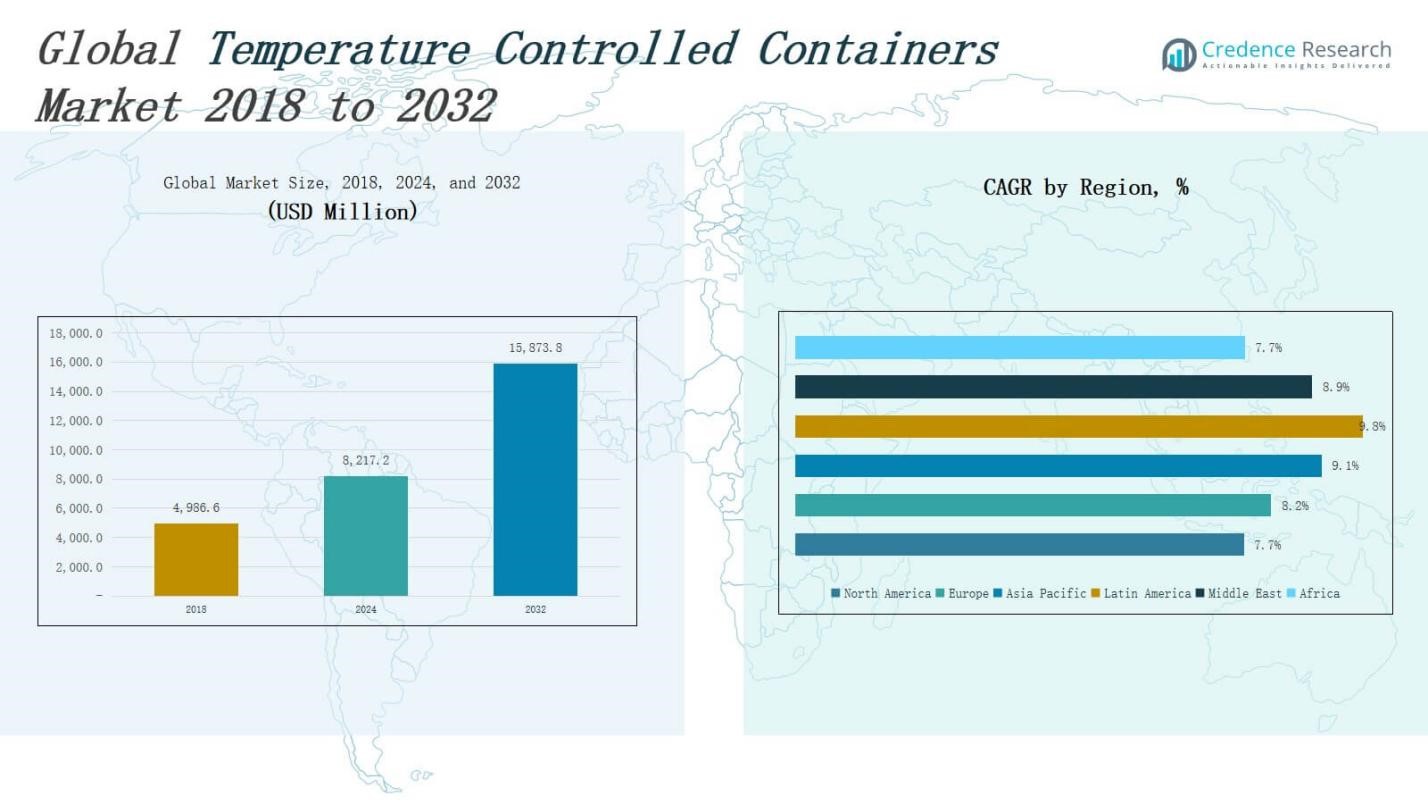
The Temperature Controlled Containers Market size was valued at USD 4,986.59 million in 2018 to USD 8,217.15 million in 2024 and is anticipated to reach USD 15,873.78 million by 2032, at a CAGR of 8.61% during the forecast period.
| REPORT ATTRIBUTE | DETAILS |
|---|---|
| Historical Period | 2020-2023 |
| Base Year | 2024 |
| Forecast Period | 2025-2032 |
| Temperature Controlled Containers Market Size 2024 | USD 8,217.15 Million |
| Temperature Controlled Containers Market, CAGR | 8.61% |
| Temperature Controlled Containers Market Size 2032 | USD 15,873.78 Million |
The Temperature Controlled Containers Market is driven by the growing demand for safe and efficient transportation of temperature-sensitive products across the pharmaceutical, food, and chemical industries. Increasing global trade in perishable goods, coupled with stringent regulatory requirements for cold chain logistics, is accelerating the adoption of temperature-controlled solutions. The rising prevalence of biologics, vaccines, and specialty drugs further underscores the need for reliable thermal packaging, especially in emerging markets with expanding healthcare infrastructure. Key trends shaping the market include the integration of IoT and real-time tracking technologies for enhanced visibility, the shift toward reusable and sustainable container systems to reduce environmental impact, and the development of advanced phase change materials and vacuum insulation panels to maintain thermal integrity. Companies are also focusing on modular container designs and multi-temperature configurations to support diverse product requirements, while the growth of e-commerce and direct-to-patient delivery models is creating new opportunities for innovation in last-mile cold chain logistics.
The Temperature Controlled Containers Market demonstrates strong geographic expansion across North America, Europe, Asia Pacific, Latin America, Middle East, and Africa. Asia Pacific holds the largest share, driven by rapid industrial growth and expanding cold chain infrastructure in China and India. North America and Europe follow, supported by advanced logistics networks and high pharmaceutical demand. Latin America and the Middle East show steady growth due to rising food exports and healthcare logistics investments. Africa remains an emerging market with growing demand for passive systems in medical and food sectors. Key players operating globally include Cold Chain Technologies, Envirotainer AB, Pelican BioThermal, Va-Q-Tec AG, Softbox Systems, Sofrigam, Cryopak, and Tempack. These companies focus on innovation, reusable container systems, and compliance with global cold chain standards to strengthen their presence across developed and emerging regions.
Market Insights
- The Temperature Controlled Containers Market was valued at USD 4,986.59 million in 2018 and is projected to reach USD 15,873.78 million by 2032, growing at a CAGR of 8.61%.
- Rising demand for biologics, vaccines, and specialty drugs is driving container adoption in pharmaceutical supply chains to ensure temperature stability and regulatory compliance.
- Stringent global regulations and food safety standards from agencies like FDA and WHO are pushing manufacturers to adopt validated and certified container systems.
- Integration of IoT, GPS, and real-time monitoring technologies is enhancing shipment visibility, operational efficiency, and audit readiness.
- High upfront cost, maintenance, and validation procedures pose challenges, particularly for small and mid-sized logistics providers in cost-sensitive regions.
- Asia Pacific leads the global market, followed by North America and Europe, while Latin America, the Middle East, and Africa show rising demand driven by exports and healthcare logistics.
- Key players include Cold Chain Technologies, Envirotainer AB, Pelican BioThermal, Va-Q-Tec AG, Softbox Systems, Sofrigam, Cryopak, and Tempack, all focusing on reusable systems and regulatory compliance.
Market Drivers
Rising Demand for Biopharmaceuticals and Specialty Drugs
The Temperature Controlled Containers Market is witnessing strong growth due to the increasing global demand for biologics, vaccines, and cell and gene therapies. These high-value pharmaceutical products require strict temperature stability during transit to maintain efficacy. The complexity and sensitivity of biologics drive the need for advanced cold chain infrastructure. It supports pharmaceutical manufacturers in ensuring compliance with regulatory standards. Expanding clinical trials and global vaccine distribution campaigns also contribute to this demand. Pharmaceutical companies prefer container systems offering precise thermal performance and validated transport data.
Stringent Regulations Across Pharmaceutical and Food Logistics
The Temperature Controlled Containers Market is influenced by strict regulatory frameworks enforced by agencies such as the FDA, EMA, and WHO. These bodies require end-to-end cold chain compliance for perishable and temperature-sensitive goods. It compels manufacturers and logistics providers to adopt certified, validated temperature-controlled packaging solutions. In the food sector, rising food safety concerns and global exports drive adoption. Compliance with HACCP, GDP, and ISO standards further promotes container upgrades. Non-compliance risks product rejection, recalls, and brand damage.
- For instance, Pfizer uses advanced packaging systems-such as specially designed thermal containers with real-time GPS and temperature tracking-to ship COVID-19 vaccines globally, ensuring compliance with WHO-mandated temperature standards and preventing spoilage during transit.
Expansion of Global Trade in Perishable Commodities
The Temperature Controlled Containers Market benefits from the rapid growth of international trade in perishable goods, including fresh produce, seafood, and dairy. Longer transportation distances and multi-modal logistics increase the complexity of maintaining product integrity. It places higher demand on reliable and robust thermal container solutions. Emerging economies are boosting exports, driving container demand in regions like Asia-Pacific and Latin America. Seasonal imbalances in food production further expand year-round shipping needs. High-value food exports depend on consistent cold chain performance.
- For instance, Maersk introduced its “Captain Peter” remote container management system to monitor temperature and humidity for fresh produce exports, helping global food companies reduce spoilage during extended transit.
Technology Integration for Visibility and Operational Efficiency
The Temperature Controlled Containers Market is driven by the integration of IoT, GPS, and real-time monitoring technologies. These innovations enhance shipment visibility, temperature control, and data logging for compliance and audit trails. It allows logistics managers to respond quickly to excursions or disruptions. Predictive analytics help optimize routes and reduce spoilage risks. Smart containers are becoming essential for pharmaceutical and perishable supply chains. Investment in digital cold chain infrastructure continues to grow, supported by logistics automation trends.
Market Trends
Growing Adoption of Reusable and Sustainable Container Solutions
The Temperature Controlled Containers Market is experiencing a shift toward reusable and eco-friendly containers. Companies are replacing single-use systems with durable, recyclable alternatives to reduce environmental impact and total cost of ownership. It helps businesses meet sustainability goals and comply with evolving environmental regulations. Leading manufacturers now offer reusable containers with validated thermal performance and extended lifespans. Demand for circular logistics solutions continues to rise, especially in pharmaceutical and food supply chains. Sustainability now drives procurement decisions across industries.
Increased Integration of Smart Monitoring and Tracking Technologies
The Temperature Controlled Containers Market is embracing IoT-enabled containers equipped with real-time temperature, location, and humidity sensors. These smart systems support full shipment traceability and improve risk management. It enables proactive intervention during transit disruptions, minimizing product loss. Data-driven insights help optimize operations and improve cold chain performance. Real-time visibility also supports compliance with Good Distribution Practices (GDP) and auditing requirements. Technology adoption is becoming a key differentiator in container system selection across healthcare and food logistics.
- For instance, Maersk has deployed over 380,000 IoT-enabled "Reefer" smart containers, which provide continuous temperature tracking and real-time location updates, enhancing cargo safety for pharmaceutical and food shipments by allowing immediate responses to temperature deviations.
Surge in Demand from Direct-to-Consumer and E-Commerce Channels
The Temperature Controlled Containers Market is evolving to meet the needs of e-commerce and direct-to-consumer delivery models. Rising demand for home delivery of temperature-sensitive pharmaceuticals and gourmet food products is accelerating innovation in small-format, last-mile container systems. It creates opportunities for lightweight, reusable packaging with extended cooling performance. Retailers and logistics companies are investing in cold chain solutions tailored for urban distribution. Shorter delivery windows and customer expectations for freshness raise performance benchmarks. E-commerce is reshaping container design and deployment strategies.
- For instance, Pfizer ships millions of COVID-19 vaccine doses globally using temperature-controlled containers packed with dry ice, ensuring that vials maintain efficacy throughout direct-to-pharmacy and direct-to-patient deliveries.
Modular and Multi-Temperature Container Designs Gaining Traction
The Temperature Controlled Containers Market is seeing rising interest in modular container solutions with the ability to manage multiple temperature zones. These designs allow shippers to consolidate shipments of various products within a single unit. It helps reduce logistics complexity and optimize transportation costs. Industries with diverse product profiles-such as pharmaceuticals and specialty foods-benefit most. Modular containers improve flexibility in both long-haul and regional deliveries. Manufacturers are focusing on customizable configurations to match specific route and storage needs.
Market Challenges Analysis
High Initial Investment and Operational Costs
The Temperature Controlled Containers Market faces significant challenges due to the high upfront cost of advanced container systems. Reusable, IoT-enabled, and phase-change technology-equipped containers require substantial capital investment. It poses a barrier for small and medium logistics providers and shippers operating on thin margins. Maintenance, cleaning, and validation procedures further add to recurring operational expenses. High costs may discourage adoption despite long-term savings. Companies must balance performance requirements with budget constraints, especially in cost-sensitive regions.
Infrastructure Limitations and Handling Inconsistencies
The Temperature Controlled Containers Market is also constrained by gaps in global cold chain infrastructure and inconsistent handling practices. Limited access to temperature-controlled warehouses and transport hubs in emerging markets increases the risk of temperature excursions. It affects shipment integrity and regulatory compliance. Variability in training, handling procedures, and equipment standards across regions compounds this challenge. Logistics providers must invest in specialized training and robust protocols. These limitations restrict container performance and reduce overall supply chain reliability.
Market Opportunities
Rising Demand in Emerging Healthcare and Food Markets
The Temperature Controlled Containers Market has strong growth potential in emerging economies with expanding healthcare infrastructure and food export industries. Demand for vaccines, biologics, and specialty drugs is increasing in Latin America, Southeast Asia, and Africa. It creates a need for reliable cold chain solutions tailored to regional conditions. Governments and private players are investing in logistics upgrades to meet global standards. Cold chain expansion supports food exports such as seafood, dairy, and exotic produce. These regions offer long-term revenue opportunities for container manufacturers and service providers.
Advancement of Smart and Connected Container Systems
The Temperature Controlled Containers Market can benefit from the integration of AI, blockchain, and cloud analytics into smart container platforms. These technologies enable predictive maintenance, automated reporting, and improved shipment security. It helps companies reduce spoilage risks, enhance efficiency, and meet compliance requirements with greater ease. Rising interest in data-driven logistics supports adoption of intelligent container systems. Pharmaceutical and high-value food segments are early adopters of connected technologies. Vendors offering integrated solutions can gain competitive advantage and expand market share.
Market Segmentation Analysis:
By Type
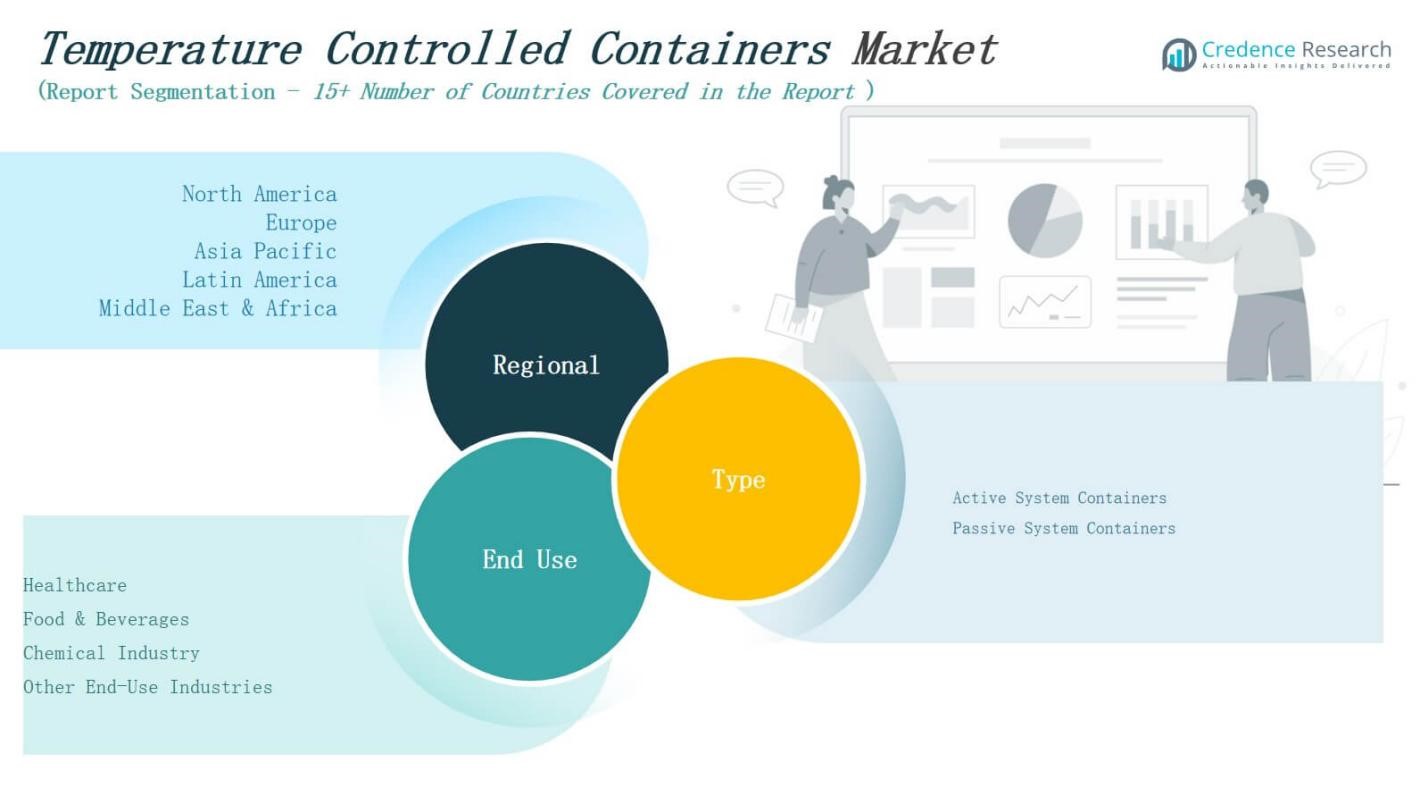
The Temperature Controlled Containers Market is segmented into Active System Containers and Passive System Containers. Active systems use powered mechanisms to regulate internal temperatures and are ideal for long-haul shipments of sensitive pharmaceuticals and biologics. These systems offer precise control and are preferred for critical cold chain applications. Passive containers rely on insulation and phase change materials without external power. They provide cost-effective solutions for short to medium-distance transport. It enables flexibility across healthcare and food supply chains where infrastructure or power access is limited.
- For instance, Haier Biomedical's RKN Active Temperature Controlled Containers are used for international air transportation of drugs, vaccines, and biological materials, with features such as rapid recharging (up to 10 hours fast charging) and robust temp control even during extreme outdoor conditions.
By End Use
The Temperature Controlled Containers Market serves a wide range of industries, with Healthcare leading due to the need for secure transport of vaccines, biologics, and temperature-sensitive drugs. Pharmaceutical companies rely on validated, GDP-compliant containers to prevent thermal excursions. Food & Beverages follows closely, driven by growing exports of seafood, dairy, and frozen goods that require uninterrupted cold chain logistics. The Chemical Industry also contributes to market demand, especially for temperature-sensitive solvents, reagents, and specialty chemicals. Other End-Use Industries, such as cosmetics and biotechnology, continue to adopt these containers to maintain product integrity throughout distribution.
- For instance, Hellmann Healthcare Logistics managed the export of active pharmaceutical ingredients (API) from the US to India by implementing a validated temperature-controlled shipping solution, using real-time 5G tracking loggers to maintain a strict 2°C–8°C range and comply with GDP standards throughout the journey.
Segments:
Based on Type
- Active System Containers
- Passive System Containers
Based on End Use
- Healthcare
- Food & Beverages
- Chemical Industry
- Other End-Use Industries
Based on Region
North America
- S.
- Canada
- Mexico
Europe
- UK
- France
- Germany
- Italy
- Spain
- Russia
- Rest of Europe
Asia Pacific
- China
- Japan
- South Korea
- India
- Australia
- Southeast Asia
- Rest of Asia Pacific
Latin America
- Brazil
- Argentina
- Rest of Latin America
Middle East
- GCC Countries
- Israel
- Turkey
- Rest of Middle East
Africa
- South Africa
- Egypt
- Rest of Africa
Regional Analysis
North America
The North America Temperature Controlled Containers Market size was valued at USD 935.48 million in 2018 to USD 1,471.81 million in 2024 and is anticipated to reach USD 2,663.62 million by 2032, at a CAGR of 7.7% during the forecast period. North America holds a significant share of the global market, supported by advanced cold chain infrastructure and strong demand from the pharmaceutical and food sectors. The United States dominates the region due to its large-scale vaccine distribution, high biologics output, and established logistics players. It benefits from regulatory emphasis on GDP-compliant systems and innovation in container technology. Healthcare remains the leading end-use segment, followed by food exports and specialty chemicals. Investments in real-time monitoring and reusable container systems continue to rise across major supply chains.
Europe
The Europe Temperature Controlled Containers Market size was valued at USD 1,366.32 million in 2018 to USD 2,202.20 million in 2024 and is anticipated to reach USD 4,127.18 million by 2032, at a CAGR of 8.2% during the forecast period. Europe contributes a substantial share to the global market, driven by stringent regulatory requirements and a strong pharmaceutical manufacturing base. Countries like Germany, France, and the UK are at the forefront of cold chain adoption. It sees growing usage of reusable containers and smart tracking solutions. Food exports, particularly dairy and meat, also rely on reliable temperature control. The region promotes sustainability through circular packaging systems and energy-efficient container designs.
Asia Pacific
The Asia Pacific Temperature Controlled Containers Market size was valued at USD 1,728.85 million in 2018 to USD 2,923.19 million in 2024 and is anticipated to reach USD 5,838.38 million by 2032, at a CAGR of 9.1% during the forecast period. Asia Pacific holds the largest market share, supported by rapid industrialization, rising healthcare access, and expanding food trade. China, India, and Japan lead the region with growing demand for cold chain logistics across biopharma and F&B sectors. It benefits from rising government investment in infrastructure and cold storage capacity. Urbanization and e-commerce growth further boost last-mile cold transport needs. Market players are focusing on cost-effective, scalable solutions tailored for diverse regional climates.
Latin America
The Latin America Temperature Controlled Containers Market size was valued at USD 498.66 million in 2018 to USD 880.53 million in 2024 and is anticipated to reach USD 1,852.47 million by 2032, at a CAGR of 9.8% during the forecast period. Latin America represents a growing market, fueled by rising exports of perishable foods and increasing pharmaceutical imports. Brazil and Mexico are major contributors, driven by expanding healthcare systems and food logistics investments. It faces infrastructure gaps, yet container manufacturers are addressing local challenges through passive systems and hybrid models. Regional trade agreements support cross-border cold chain expansion. Demand for smart containers is rising to improve traceability and reduce spoilage.
Middle East
The Middle East Temperature Controlled Containers Market size was valued at USD 192.98 million in 2018 to USD 323.29 million in 2024 and is anticipated to reach USD 638.13 million by 2032, at a CAGR of 8.9% during the forecast period. The region is witnessing growing demand from pharmaceutical re-exports, halal food exports, and temperature-sensitive chemical trade. The UAE and Saudi Arabia lead investments in healthcare and logistics infrastructure. It increasingly adopts temperature-controlled containers to meet international compliance and maintain supply chain integrity. Harsh climatic conditions drive the need for advanced insulation and long-duration cooling systems. Cross-border healthcare supply and food imports boost container usage across the Gulf region.
Africa
The Africa Temperature Controlled Containers Market size was valued at USD 264.29 million in 2018 to USD 416.14 million in 2024 and is anticipated to reach USD 754.00 million by 2032, at a CAGR of 7.7% during the forecast period. Africa holds emerging potential in cold chain development, supported by healthcare outreach programs and rising agricultural exports. South Africa, Egypt, and Kenya are key hubs investing in containerized cold storage and transport. It faces infrastructure limitations, yet the need for reliable vaccine and medicine delivery is accelerating container adoption. Passive systems dominate due to affordability and simplicity. Food security programs and donor-funded initiatives also contribute to cold chain expansion across the continent.
Key Player Analysis
- Cold Chain Technologies, Inc.
- Envirotainer AB
- Inmark, Inc.
- Intelsius – A DGP Company
- Pelican BioThermal LLC
- Sofrigam
- Tempack Packaging Solutions, S.L.
- TKT GmbH
- Inno Cool Pvt. Ltd.
- Other Key Players
Competitive Analysis
The Temperature Controlled Containers Market features a competitive landscape driven by technological innovation, strategic partnerships, and expanding global cold chain demand. Key players such as Cold Chain Technologies, Envirotainer AB, Pelican BioThermal, and Va-Q-Tec AG focus on offering high-performance containers with real-time monitoring, longer hold times, and reusable designs. It supports their positioning in pharmaceutical, food, and chemical logistics. Companies invest in R&D to enhance thermal insulation, reduce weight, and improve sustainability. Strategic collaborations with logistics firms and healthcare distributors help expand geographic presence and strengthen service offerings. Emerging players from Asia and Latin America are entering the market with cost-effective passive systems, intensifying competition. Market participants also compete on compliance, reliability, and customization, aiming to meet diverse regulatory and operational needs. Continuous product upgrades and global network expansion remain core to maintaining market share and customer loyalty.
Recent Developments
- In April 2025, Cold Chain Technologies introduced the CCT Tower Elite pallet shipper at LogiPharma. The reusable system supports various temperature ranges, offers IoT tracking, and accommodates both Euro and US pallets.
- In March 2025, Cold Chain Technologies acquired Global Cold Chain Solutions to strengthen its footprint in the Asia-Pacific region, specifically expanding operations in Australia and India.
- In February 2025, Envirotainer launched its new RelEye RKN container, designed for pharmaceutical air cargo. The unit features real-time monitoring, enhanced autonomy, and has received operational approval from six major airlines.
- In 2025, Peli BioThermal introduced its Crēdo Vault bulk shipper, a reusable container offering temperature stability for up to 168 hours. The unit includes IoT-enabled tracking and is engineered for higher payload efficiency and lightweight transport.
Market Concentration & Characteristics
The Temperature Controlled Containers Market is moderately concentrated, with a mix of global leaders and regional players competing on performance, compliance, and innovation. Major companies such as Cold Chain Technologies, Envirotainer AB, Pelican BioThermal, and Va-Q-Tec AG hold significant market share due to their advanced product portfolios and strong distribution networks. It features high entry barriers driven by regulatory requirements, specialized R&D, and the capital-intensive nature of container validation and certification. The market is characterized by rapid technological advancements, including IoT-enabled tracking, phase change materials, and reusable systems designed for long-term cost efficiency. Demand is largely driven by the pharmaceutical and food industries, where thermal stability and supply chain integrity are critical. Customer preference is shifting toward modular, sustainable, and smart containers that support real-time monitoring and reduce environmental impact. Regional differentiation is strong, with product customization and infrastructure alignment influencing vendor competitiveness across North America, Europe, Asia Pacific, and emerging markets.
Report Coverage
The research report offers an in-depth analysis based on Type, End-Use and Region. It details leading market players, providing an overview of their business, product offerings, investments, revenue streams, and key applications. Additionally, the report includes insights into the competitive environment, SWOT analysis, current market trends, as well as the primary drivers and constraints. Furthermore, it discusses various factors that have driven market expansion in recent years. The report also explores market dynamics, regulatory scenarios, and technological advancements that are shaping the industry. It assesses the impact of external factors and global economic changes on market growth. Lastly, it provides strategic recommendations for new entrants and established companies to navigate the complexities of the market.
Future Outlook
- Demand for reusable and sustainable containers will increase across pharmaceutical and food logistics.
- Companies will invest more in IoT-enabled smart containers for real-time monitoring and compliance.
- Growth in biologics and vaccine distribution will drive the need for high-performance thermal packaging.
- Expansion of cold chain infrastructure in emerging markets will create new business opportunities.
- Regulatory focus on GDP and HACCP compliance will push adoption of certified container systems.
- E-commerce and direct-to-patient delivery models will accelerate the demand for small-format cold containers.
- Manufacturers will develop modular containers to support multi-temperature shipping requirements.
- Logistics providers will prioritize predictive analytics to reduce spoilage and optimize delivery routes.
- Industry players will form partnerships to strengthen regional supply chain capabilities.
- Adoption of energy-efficient and lightweight materials will influence container design innovations.

Request a Free Sample
Fill in your details and we'll send you a free sample report.
- Sample data tables & charts
- Research methodology
Market Dynamics
Growth in Biopharmaceuticals and Specialty Drugs
The increasing global production and distribution of biologics, vaccines, and specialty pharmaceuticals require strict temperature control to maintain product efficacy, driving demand for advanced temperature controlled containers in healthcare logistics.
Stringent Regulatory Compliance
Regulations from agencies such as the FDA, EMA, and WHO mandate validated cold chain solutions for pharmaceuticals and food, compelling manufacturers and logistics providers to adopt certified temperature controlled containers to avoid product spoilage and regulatory penalties.
Expansion of Global Perishable Trade
Rising international trade in perishable goods like fresh produce, seafood, and dairy increases the need for reliable temperature controlled containers to ensure product quality over long distances and multi-modal transport routes.
Integration of IoT and Real-Time Monitoring
The adoption of IoT, GPS, and real-time monitoring technologies in containers enhances shipment visibility, enables proactive risk management, and supports compliance, making smart containers increasingly essential for both pharmaceutical and food supply chains.
Shift Toward Reusable and Sustainable Solutions
Growing environmental concerns and cost pressures are pushing companies to adopt reusable, eco-friendly container systems, reducing waste and total cost of ownership while meeting sustainability goals and evolving regulatory requirements.
Need a Custom Version of This Report?
Tailor the scope, geography, or segments to your exact requirements.
- Custom geography or segment scope
- Direct access to our analyst team
Frequently Asked Questions
What is the current size of the Temperature Controlled Containers Market?
What factors are driving the growth of the Temperature Controlled Containers Market?
What are the key segments within the Temperature Controlled Containers Market?
What are some challenges faced by the Temperature Controlled Containers Market?
Who are the major players in the Temperature Controlled Containers Market?
Table of Content
Chapter 1 Market Segmentation
- 1.1 Segmentation Framework
- 1.1.1 Product and Service Classification
- 1.1.2 Application and End-Use Classification
- 1.1.3 Technology and Solution Classification
- 1.1.4 Customer and Distribution Channel Classification
- 1.1.5 Geographic Segmentation
- 1.1.6 Market Segment Definitions and Boundaries
- 1.2 By Type
- 1.2.1 Active System Containers
- 1.2.2 Passive System Containers
- 1.3 By End Use
- 1.3.1 Healthcare
- 1.3.2 Food & Beverages
- 1.3.3 Chemical Industry
- 1.3.4 Other End-Use Industries
- 1.4 By Technology
- 1.4.1 IoT-Enabled Containers
- 1.4.2 Non-Connected Containers
- 1.4.3 Phase Change Material-Based Containers
Chapter 2 Introduction
- 2.1 Report Objectives and Scope
- 2.2 Product Definition and Industry Terminology
- 2.3 Market Inclusions and Exclusions
- 2.4 Research Process
- 2.4.1 Primary Research and Expert Interviews
- 2.4.2 Secondary Research and Source Review
- 2.4.3 Top-Down and Bottom-Up Estimation
- 2.4.4 Data Triangulation and Verification
- 2.5 Market Size Measurement Basis
- 2.5.1 2024: USD 8,217.15 million → 2032: USD 15,873.78 million
- 2.6 Historical and Forecast Reference Periods
- 2.6.1 Base Year: 2024
- 2.6.2 Forecast Period: 2024-2032
- 2.7 Research Assumptions and Limitations
Chapter 3 Executive Summary
- 3.1 Market Snapshot and Key Findings
- 3.2 Base-Year Market Size, 2024
- 3.3 Forecast Market Size, 2032
- 3.4 Revenue and Volume Growth Outlook
- 3.5 Key Demand and Supply Indicators
- 3.6 Leading Market Segments
- 3.7 Fastest-Growing Market Opportunities
- 3.8 Regional Performance Highlights
- 3.9 Technology and Industry Transformation
- 3.10 Competitive Landscape Summary
- 3.11 Analyst View and Strategic Implications
Chapter 4 Global Temperature Controlled Containers Market Trends and Developments
- 4.1 Historical Industry Development
- 4.2 Recent Market Trends and Developments
- 4.3 Demand and Customer Behavior Trends
- 4.4 Technology and Product Innovation
- 4.5 Artificial Intelligence, Automation and Digitalization
- 4.6 Local Manufacturing and Supply Chain Realignment
- 4.7 Industry Partnerships, Mergers and Acquisitions
- 4.8 Sustainability and Circular Economy Developments
- 4.9 Government and Private Sector Investment Trends
- 4.10 Emerging Business Models and Commercialization
- 4.11 Industry Developments and Announcements
Chapter 5 Global Temperature Controlled Containers Market Production, Supply and Demand Analysis
- 5.1 Demand Trend and Consumption Analysis
- 5.2 Demand Forecast, 2024-2032
- 5.3 Production and Output Trend
- 5.4 Production and Output Forecast, 2024-2032
- 5.5 Installed Capacity and Capacity Utilization
- 5.6 Company-Wise Production Plants and Statistics
- 5.6.1 Installed Production Capacity
- 5.6.2 Actual Production
- 5.6.3 Planned Capacity and Expansion Targets
- 5.7 Supply Chain Structure and Procurement Trends
- 5.8 Supply-Demand Gap and Bottlenecks
- 5.9 Import Dependence and Sourcing Structure
- 5.10 Contract Manufacturing and Outsourcing
- 5.11 Regional Supply and Demand Concentration
Chapter 6 Global Temperature Controlled Containers Market Pricing Analysis
- 6.1 Pricing Structure and Measurement
- 6.2 Historical Pricing Trends
- 6.3 Pricing Outlook, 2024-2032
- 6.4 Average Selling Price and Unit Economics
- 6.5 Pricing by Product and Market Segment
- 6.6 Geographic Pricing Differences
- 6.7 Key Input, Energy, Labor and Logistics Costs
- 6.8 Contract Pricing and Purchasing Models
- 6.9 Pricing Sensitivity and Competitive Positioning
- 6.10 Price, Margin and Profitability Implications
Chapter 7 Global Temperature Controlled Containers Market Dynamics
- 7.1 Market Growth Drivers
- 7.1.1 Demand-Side Drivers
- 7.1.2 Technology and Innovation Drivers
- 7.1.3 Infrastructure and Investment Drivers
- 7.1.4 Regulatory and Policy Drivers
- 7.2 Market Restraints
- 7.2.1 Cost and Affordability Constraints
- 7.2.2 Technology and Adoption Barriers
- 7.2.3 Supply Chain and Operational Constraints
- 7.3 Market Challenges
- 7.3.1 Competitive Pressure and Margin Erosion
- 7.3.2 Skills, Infrastructure and Implementation Gaps
- 7.4 Emerging Market Opportunities
- 7.5 Market Dynamics Impact and Time-Horizon Assessment
Chapter 8 Global Temperature Controlled Containers Value Chain Analysis
- 8.1 Industry Value Chain Overview
- 8.2 Upstream Suppliers and Critical Inputs
- 8.3 Technology and Component Providers
- 8.4 Manufacturing or Service Delivery
- 8.5 Distribution, Channel Partners and Integrators
- 8.6 Downstream Applications and End Users
- 8.7 Value Addition and Profit Pools
- 8.8 Vertical Integration and Outsourcing
- 8.9 Supplier Concentration and Risk
- 8.10 Supply Chain Localization and Resilience
Chapter 9 Global Temperature Controlled Containers Market Regulations and Policies
- 9.1 Relevant Laws, Standards and Compliance Frameworks
- 9.2 Product, Service, Safety and Quality Requirements
- 9.3 Government Policies, Incentives and Subsidies
- 9.4 Imports, Exports and Trade Barriers
- 9.5 Public Procurement and Local Content Requirements
- 9.6 Environmental and Sustainability Compliance
- 9.7 Upcoming Policy Changes and Market Implications
Chapter 10 Global Temperature Controlled Containers Market Hotspots and Opportunities
- 10.1 Market Opportunity Mapping and Growth Hotspots
- 10.2 High-Growth Applications and Customer Groups
- 10.3 Underserved Markets and White-Space Opportunities
- 10.4 Emerging Technology and Product Opportunities
- 10.5 New Capacity and Investment Hotspots
- 10.6 Market Entry and Expansion Opportunities
- 10.7 Distribution and Partnership Opportunities
- 10.8 Near-Term and Long-Term Commercial Potential
- 10.9 Opportunity Attractiveness and Execution Risks
Chapter 11 Global Temperature Controlled Containers Market Outlook, 2024-2032
- 11.1 Market Size and Analysis
- 11.1.1 Revenue (Market Measurement: 2024: USD 8,217.15 million → 2032: USD 15,873.78 million)
- 11.1.2 Market Volume and Quantity Sold
- 11.1.3 Historical Market Size
- 11.1.4 Base-Year Market Size, 2024
- 11.2 Market Forecast, 2024-2032
- 11.2.1 Revenue Forecast to 2032
- 11.2.2 Volume Forecast to 2032
- 11.2.3 CAGR and Year-on-Year Growth
- 11.2.4 Incremental Revenue Opportunity
- 11.3 Forecast Assumptions and Scenario Analysis
- 11.3.1 Base-Case Forecast
- 11.3.2 Optimistic and Conservative Scenarios
- 11.3.3 Technology, Pricing and Policy Sensitivities
- 11.4 Market Attractiveness and Growth Outlook
Chapter 12 Global Temperature Controlled Containers Market Segmentation and Outlook
- 12.1 Segmentation Summary and Market Shares, 2024
- 12.2 Largest and Fastest-Growing Segments
- 12.3 By Type - Market Size and Forecast, 2024-2032
- 12.3.1 Segment Definition and Scope
- 12.3.2 Historical Market Size
- 12.3.3 Revenue Forecast, 2024-2032
- 12.3.4 Volume Forecast, 2024-2032
- 12.3.5 Base-Year Market Share, 2024
- 12.3.6 Segment CAGR and Growth Drivers
- 12.3.7 Subsegment Market Size and Forecast
- 12.3.7.1 Active System Containers
- 12.3.7.2 Passive System Containers
- 12.3.8 Subsegment Pricing and Adoption Trends
- 12.3.9 Leading Suppliers and Competition
- 12.3.10 Regional Demand and Opportunities
- 12.4 By End Use - Market Size and Forecast, 2024-2032
- 12.4.1 Segment Definition and Scope
- 12.4.2 Historical Market Size
- 12.4.3 Revenue Forecast, 2024-2032
- 12.4.4 Volume Forecast, 2024-2032
- 12.4.5 Base-Year Market Share, 2024
- 12.4.6 Segment CAGR and Growth Drivers
- 12.4.7 Subsegment Market Size and Forecast
- 12.4.7.1 Healthcare
- 12.4.7.2 Food & Beverages
- 12.4.7.3 Chemical Industry
- 12.4.7.4 Other End-Use Industries
- 12.4.8 Subsegment Pricing and Adoption Trends
- 12.4.9 Leading Suppliers and Competition
- 12.4.10 Regional Demand and Opportunities
- 12.5 By Technology - Market Size and Forecast, 2024-2032
- 12.5.1 Segment Definition and Scope
- 12.5.2 Historical Market Size
- 12.5.3 Revenue Forecast, 2024-2032
- 12.5.4 Volume Forecast, 2024-2032
- 12.5.5 Base-Year Market Share, 2024
- 12.5.6 Segment CAGR and Growth Drivers
- 12.5.7 Subsegment Market Size and Forecast
- 12.5.7.1 IoT-Enabled Containers
- 12.5.7.2 Non-Connected Containers
- 12.5.7.3 Phase Change Material-Based Containers
- 12.5.8 Subsegment Pricing and Adoption Trends
- 12.5.9 Leading Suppliers and Competition
- 12.5.10 Regional Demand and Opportunities
- 12.6 Segment Growth Comparison
- 12.7 Segment Attractiveness and Priority Matrix
Chapter 13 Global Temperature Controlled Containers End-Use and Application Market Outlook
- 13.1 End-Use Industry and Customer Demand Structure
- 13.2 Leading Applications and Customer Groups
- 13.3 End-Use Market Size, Share and Forecast
- 13.4 Major End-Use Industry Deep Dives
- 13.4.1 Customer Requirements and Use Cases
- 13.4.2 Demand and Replacement Cycles
- 13.4.3 Technical and Regulatory Considerations
- 13.4.4 Purchasing and Procurement Models
- 13.4.5 Leading Vendors and Distribution Channels
- 13.4.6 Forecast and Commercial Opportunities
- 13.5 Emerging Applications and Cross-Segment Demand
- 13.6 End-Use Industry Investment Priorities
Chapter 14 Global Temperature Controlled Containers Geographic Market Outlook, 2024-2032
- 14.1 Regional Market Size and Share, 2024
- 14.2 Regional Market Forecast, 2024-2032
- 14.3 Regional Pricing, Production and Demand Differences
- 14.4 North America
- 14.4.1 United States
- 14.4.2 Canada
- 14.4.3 Mexico
- 14.5 Europe
- 14.5.1 Germany
- 14.5.2 France
- 14.5.3 Italy
- 14.5.4 United Kingdom
- 14.5.5 Spain
- 14.5.6 Poland
- 14.5.7 Russia
- 14.5.8 Netherlands
- 14.5.9 Belgium
- 14.5.10 Sweden
- 14.5.11 Denmark
- 14.5.12 Norway
- 14.5.13 Rest of Europe
- 14.6 Asia Pacific
- 14.6.1 China
- 14.6.2 India
- 14.6.3 Japan
- 14.6.4 South Korea
- 14.6.5 Thailand
- 14.6.6 Indonesia
- 14.6.7 Vietnam
- 14.6.8 Malaysia
- 14.6.9 Australia
- 14.6.10 Rest of Asia Pacific
- 14.7 Latin America
- 14.7.1 Brazil
- 14.7.2 Argentina
- 14.7.3 Colombia
- 14.7.4 Chile
- 14.7.5 Rest of Latin America
- 14.8 Middle East
- 14.8.1 Saudi Arabia
- 14.8.2 United Arab Emirates
- 14.8.3 Turkey
- 14.8.4 Israel
- 14.8.5 Iran
- 14.8.6 Rest of the Middle East
- 14.9 Africa
- 14.9.1 South Africa
- 14.9.2 Egypt
- 14.9.3 Nigeria
- 14.9.4 Morocco
- 14.9.5 Rest of Africa
- 14.10 Regional Investment, Policy and Supply Chain Differences
- 14.11 Regional Competitive Landscape
- 14.12 Geographic Growth Hotspots
Chapter 15 Global Temperature Controlled Containers Technology, Innovation and Sustainability Outlook
- 15.1 Technology Landscape and Maturity
- 15.2 Product, Process and Service Innovation
- 15.3 AI, Automation and Digital Tools in the Industry
- 15.4 Technology Adoption and Performance Benchmarking
- 15.5 Innovation Pipeline and R&D Investment
- 15.6 Patent and Intellectual Property Trends
- 15.7 Energy Efficiency and Resource Management
- 15.8 Sustainability, Recycling and Circularity
- 15.9 Technology Roadmap, 2024-2032
- 15.10 Risks of Obsolescence and Technology Substitution
Chapter 16 Global Temperature Controlled Containers Market Key Strategic Imperatives
- 16.1 Growth and Market Entry Priorities
- 16.2 High-Return Products and Segments
- 16.3 Pricing, Profitability and Cost Optimization
- 16.4 Technology Investment and Product Differentiation
- 16.5 Supply Chain Localization and Resilience
- 16.6 Distribution and Customer Acquisition
- 16.7 Partnership, Acquisition and Capacity Strategy
- 16.8 Regional Expansion Priorities
- 16.9 Short-, Medium- and Long-Term Actions
Chapter 17 Competition Outlook
- 17.1 Industry Competition Characteristics
- 17.2 Market Structure and Concentration
- 17.3 Market Share and Competitive Positioning, 2024
- 17.4 Company-Wise Revenue and Product Benchmarking
- 17.5 Production and Service Capacity Benchmarking
- 17.6 Technology, Pricing and Differentiation
- 17.7 Regional Footprint and Distribution Strength
- 17.8 Mergers, Acquisitions and Strategic Alliances
- 17.9 New Entrants and Competitive Threats
- 17.10 Porter's Five Forces and Industry Attractiveness
- 17.11 Competitive Outlook, 2024-2032
Chapter 18 Company Profiles
- 18.1 Company Coverage and Selection Criteria
- 18.2 Cold Chain Technologies, Inc.
- 18.2.1 Business Description
- 18.2.2 Company Ownership and Geographic Presence
- 18.2.3 Product and Service Portfolio
- 18.2.4 Manufacturing and Operating Footprint
- 18.2.5 Production Capacity and Expansion Plans
- 18.2.6 Financial Performance and Investment
- 18.2.7 Market Share and Competitive Position
- 18.2.8 Technology and Innovation Capabilities
- 18.2.9 Strategic Alliances or Partnerships
- 18.2.10 Recent Developments
- 18.2.11 Growth Strategy and Outlook
- 18.3 Envirotainer AB
- 18.4 Pelican BioThermal LLC
- 18.5 Va-Q-Tec AG
- 18.6 Softbox Systems
- 18.7 Sofrigam
- 18.8 Cryopak
- 18.9 Tempack Packaging Solutions, S.L.
- 18.10 Inmark, Inc.
- 18.11 Intelsius – A DGP Company
- 18.12 Other Relevant Market Participants
Note: Every listed company is profiled on the structure shown under the first company. The company list is preliminary and may change based on research findings, market developments, data availability and client requirements.
Chapter 19 Disclaimer
- 19.1 Research and Forecast Disclaimer
- 19.2 Data Source and Estimation Limitations
Note: The depth of individual sections depends on data availability for this market. Volume, capacity, trade and other unit-based metrics are included where applicable.