
| REPORT ATTRIBUTE | DETAILS |
|---|---|
| Historical Period | 2019-2022 |
| Base Year | 2023 |
| Forecast Period | 2024-2032 |
| Thermoformed Plastic Products Market Size 2023 | USD 42518.2 Million |
| Thermoformed Plastic Products Market, CAGR | 5.00% |
| Thermoformed Plastic Products Market Size 2032 | USD 65959.6 Million |
Market Insights
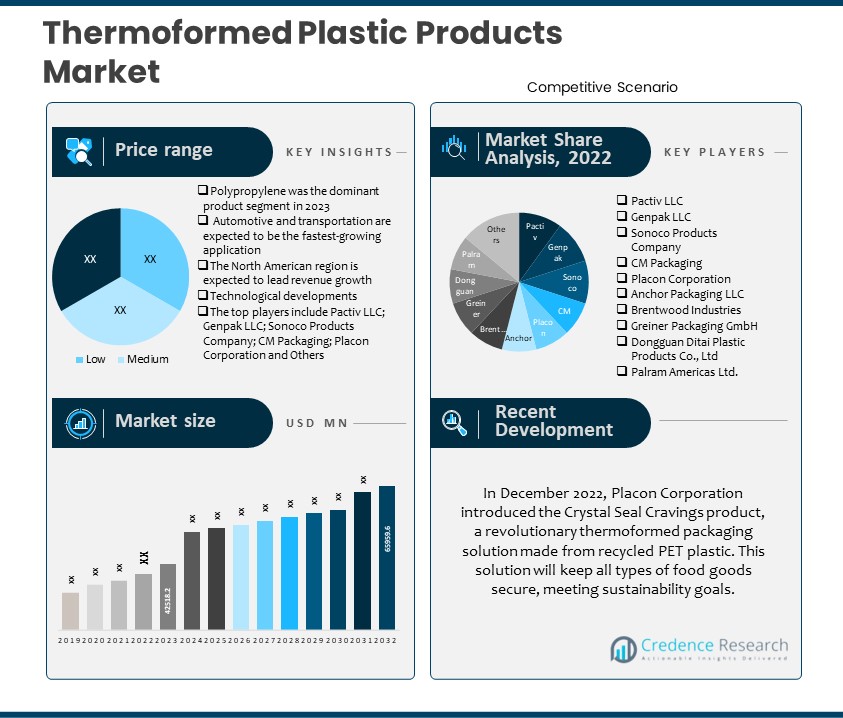
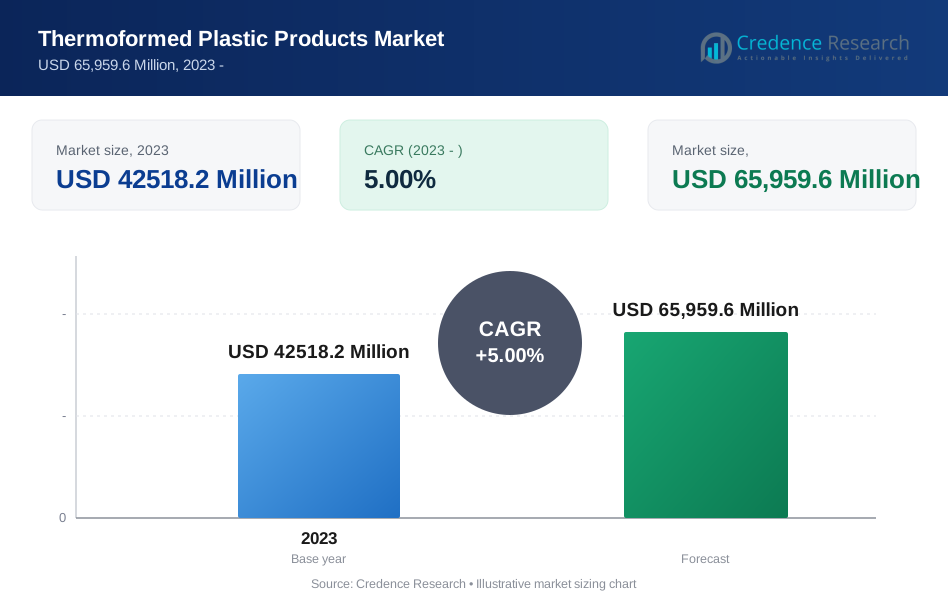
- The global demand for Thermoformed Plastic Products was valued at USD 42518.2 Million in 2023 and is expected to reach USD 65959.6 Million in 2032, growing at a CAGR of 5.00% between 2024 and 2032.
- In 2023, polypropylene was the dominant product sector, accounting for more than 21.0% of revenue. The Polypropylene (PP) category is predicted to have the highest CAGR throughout the projection period.
- The packaging product category dominates the market, with medical and healthcare products being the most popular industry segment, followed by electronic packaging.
- Food and beverage was the most popular application segment in 2023, while automotive and transportation are predicted to be the fastest-growing application categories.
- Vacuum Forming is a key portion of the Thermoformed Plastic Products Market, while Pressure Forming is another important market category.
- Through 2023, the North American area is predicted to lead the sector's revenue growth. It increased by 54.2% the previous year, and Asia Pacific is predicted to be the fastest-expanding market.
- Rising demand for consumer durables fuels growth in the evolving plastic sector.
- Strict environmental laws limiting the use of plastics may impede industry expansion.
Executive Summary
Market Definition
Thermoformed plastics are synthetic and semi-synthetic materials produced and processed by thermoforming techniques. Heating sheets make them of acrylic, biodegradable polymers, polycarbonate, acrylonitrile butadiene styrene (ABS), and polyvinyl chloride (PVC) until they become malleable, at which point they are molded and trimmed into the required shape of the finished product. Vacuum snapback, plug assist molding, and thick and thin wall thermoforming processes are all used to make thermoformed polymers. They provide better aesthetic and design freedom, ease of manufacturing large-scale components, efficient use of raw resources, and lower manufacturing costs. As a result, thermoformed polymers are commonly utilized to make automobile dashboards, seats, interior panels, air ducts and bumpers, lighting fixtures, and control panels.
Market Overview
The global Thermoformed Plastic Products Market has witnessed steady growth in recent years and is expected to grow at a CAGR of 5.00% between 2024 and 2032. The market was valued at USD 42518.2 million in 2023 and is expected to reach USD 65959.6 million in 2032.
Rising demand for effective packaging solutions across all industries is one of the primary drivers of market growth. Clamshell packages, package blisters, mailer trays, and retail package liners are all routinely made from thermoformed plastics. Furthermore, widespread acceptance of the products in the food and beverage industry is driving market expansion. Thermoformed plastics are commonly used for food sealing due to their barrier characteristics against bacteria, smells, and moisture particles. It is also utilized in the medical sector to make pre-filled syringes, pharmaceutical bottles, capsules, tablets, and electronic systems.
Furthermore, the rising adoption of in-mold labeling (IML) technology, which binds paper labels to the body of plastic containers, is another growth driver. IML technology enables product makers to create aesthetically beautiful, finely designed labels that communicate material more effectively. Other factors predicted to drive market expansion include the proliferation of online retail platforms and multi-brand convenience stores, as well as growing public concerns about sanitation and product safety.
Segmentation By Material Type
- Polypropylene was the dominant product segment in 2023, accounting for more than 21.0% of revenue. This tendency is projected to persist during the projection period. Polyethylene (PE), polystyrene (PS), and polypropylene are common thermoformed plastic polymers. PP is a thermoplastic polymer that is commonly used in the production of food packaging products such as cups, trays, margarine tubs, sandwich packs, disposables, beverage glasses, and microwaveable containers.
- The Polypropylene (PP) category is expected to have the highest CAGR over the forecast period.
Segmentation By Product Type
- The packaging product category is the largest in the market. Because of the increased use of lightweight and ecological packing materials. Thermoformed plastics are recyclable and can be created from renewable resources, making them an environmentally beneficial packaging material.
- Medical & Healthcare Products are the most popular segment in the Thermoformed Plastic Products Market. The healthcare industry's tight rules, precision requirements, and necessity for sterile packaging make it a high-demand market for thermoformed plastic products.
- Electronic packaging is another key industry segment.
Segmentation by End-Use Industry
- In 2023, the leading application segment was food and beverage, accounting for more than 42% of total sales. Thermoformed plastics are commonly used in the food industry to package fruits and vegetables, confectionary goods, meat, poultry, and fish, as well as prepared meals. Thermoformed plastic packaging is also appropriate for use in the medical and healthcare sectors since it contains a variety of components that improve the appearance of the finished product.
- Automotive and transportation are expected to be the fastest-growing application segments during the projection period. Thermoformed polymers are ideal for electric vehicles since they are both sturdy and lightweight. Increasing demand for automotive panels, liners, and vehicle parts is likely to fuel segment expansion during the forecast period.
Segmentation By Technology and Process
- The vacuum-forming sector dominated the market. Vacuum forming is the process of heating a sheet of plastic, stretching it over a mold, and applying vacuum pressure to make the required shape.
- Another important market category is Pressure Forming, which uses pressure to mold plastic sheets into complicated shapes with great detail and precision.
Segmentation by Region
- The North America region is expected to lead revenue growth in the sector through 2023. It grew by 54.2% in the previous time.
- The Asia Pacific area is expected to be the most rapidly growing market.
- The rest of the world, including Latin America, the Middle East, and Africa, supplies the remaining demand for Thermoformed Plastic Products.
The North America region has dominated revenue growth in the industry till 2023. It had grown by 54.2% in the previous period due to increased industrialization and developments in the packaging sector. The North American area is expected to drive regional market expansion for these thermoformed plastics during the forecast period. The increased number of producers and suppliers of thermoform plastic goods in the North American region is predicted to boost industry growth. The United States is a significant market for thermoforming plastic, followed by Canada.
Furthermore, The Asia Pacific region is also predicted to be the fastest-expanding regional market over the projection period. Many growing economies in the Asia Pacific area, including China and India, have experienced rapid economic expansion in recent years. China is the major producer and supplier of thermoform plastics equipment. Because of a rise in per capita income, disposable income has increased, and this region is experiencing increasing urbanization, which is fueling market expansion. The market is also growing due to increased demand for automobiles and, as a result, lightweight components. To improve vehicle efficiency, thermoformed polymers are employed.
Key Highlights of the Report
Material Type, Product Type, End-Use Industry, Technology and Process, and region segments of the global Thermoformed Plastic Products Market. The vacuum-forming industry dominated the market, with automotive and transportation predicted to be the fastest-growing segments. In addition, the Polypropylene (PP) category is predicted to have the highest CAGR during the forecast period, and electronic packaging is another major industry sector and North America, leading the market growth.
The key market drivers are increasing awareness and demand for sustainable and recyclable packaging solutions, technological advancements that improve the efficiency and customization of thermoformed plastic products, and the expansion of end-use industries such as food packaging, healthcare, and electronics, which boosts market demand. Furthermore, challenges associated with recycling and disposal of thermoformed plastic goods, fluctuating raw material prices affecting production costs, and competition from alternative packaging materials affecting market share are the primary limitations of the market.
In 2023, the North American area dominated industry revenue growth. It climbed by 54.2% in the previous period as a result of increased industrialization and innovations in the packaging sector. Furthermore, the Asia Pacific region is expected to be the fastest-growing regional market over the forecast period. Many emerging economies in the Asia Pacific area, particularly China and India, have witnessed fast economic growth in recent years.
What Are The Main Drivers Of The Global Thermoformed Plastic Products Market?
Several factors are fueling growth. One significant driver is the growing need for sustainable and recyclable packaging solutions, which coincides with greater environmental consciousness among consumers and enterprises. Furthermore, technical improvements improve the efficiency and customization options of thermoformed plastic goods, catering to a wide range of industry requirements.
What Are The Major Challenges Faced By The Global Thermoformed Plastic Products Market?
On the other side, the market has some constraints that may restrict its growth. Challenges associated with the recycling and disposal of thermoformed plastic items provide a substantial barrier to attaining a fully sustainable packaging cycle. Fluctuating raw material prices are another constraint, as they can affect manufacturing costs and thus the overall profitability of thermoformed plastic businesses.
What Are The Growth Opportunities In The Global Thermoformed Plastic Products Market?
Despite these challenges, the Thermoformed Plastic Products Market has tremendous growth opportunities. The growing emphasis on eco-friendly packaging solutions makes it easier for thermoformed plastic products to obtain market share. Furthermore, continued progress in material technology is likely to improve the features and functions of thermoformed plastic goods, making them more appealing to a wider range of businesses.
Market Drivers
Several factors drive the global Thermoformed Plastic Products Market. The following are the key drivers of the global Thermoformed Plastic Products Market:
Rising Demand For Consumer Durables
The growing need for consumer durables is likely to drive the evolving plastics market forward. Consumer durables are goods that have a lengthy life (more than three years) and are used repeatedly. An increase in demand for consumer durables will raise demand for thermoforming plastic, given the majority of consumer durables are made from transforming plastic. According to research by the Indian Brand Equity Foundation, an Indian government export promotion body, the consumer durables business is predicted to reach USD34 billion by 2032. As a result, rising demand for consumer durables will fuel the expansion of the thermoforming plastic market.
Market Restraints
The global Thermoformed Plastic Products Market faces some challenges that may hinder its growth. These include the following:
Strict Environmental Restrictions Governing The Usage Of Plastics
According to the United States Environmental Protection Agency (EPA) Plastics Molding and Forming Effluent Guidelines and Standards (40 CFR Part 463), the guidelines apply to any plastics molding and forming process that releases or may release pollutants into water or that releases pollutants into a publicly owned treatment facility. The discharge limitations rules and requirements also apply to research and development facilities that manufacture plastic items using plastic molding and forming methods. No process should emit any discharge that exceeds the legal limit, or it may face a penalty. As a result, stringent restrictions governing the use of plastics in molding or forming may limit industry growth.
Opportunities
The global Thermoformed Plastic Products Market offers significant growth opportunities. These include the following:
Thermoforming Plastics Market Soars With The Surge In Online Retail Sales
Increasing online retail sales during the forecast period will propel the thermoforming plastics market. Online sales and purchases are increasing due to increased consumer demand and the convenience that e-commerce provides. As e-commerce grows, so will the demand for thermoforming plastic, which is commonly used to carefully package products to prevent damage during transit.
For instance, according to the US Census Bureau of the Department of Commerce, US retail e-commerce sales increased by $265.9 billion in the third quarter of 2022, or 3% over the same time the previous year. In the third quarter of 2022, e-commerce sales were 14.8% of total sales. As a result, an increase in online retail sales will drive the thermoforming plastic market over the projection period.
Competitive Landscape
Key Players
The global Thermoformed Plastic Products Market is highly competitive, with several key players. Some of the major players in the market and their market share are as follows:
- Pactiv LLC
- Genpak LLC
- Sonoco Products Company
- CM Packaging
- Placon Corporation
- Anchor Packaging LLC
- Brentwood Industries
- Greiner Packaging GmbH
- Dongguan Ditai Plastic Products Co., Ltd
- Palram Americas Ltd.
These organizations prioritize product innovation, End-Use Industry expansion, and mergers and acquisitions to stay competitive.
The global Thermoformed Plastic Products Market's key players continually seek to stay ahead by offering new products and developments.
In April 2023, Greiner Packaging GmbH collaborated with Engel and Brink BV to produce thin-walled plastic cups using thermoformed plastics as a production technology. These cups are lightweight since they are manufactured from r-PET material, which contributes to sustainable packaging.
In November 2019, Sabert Corporation reached a formal agreement to buy LBP Manufacturing LLC. LBP's position in Quick Service Restaurants, along with Sabert's sales network and global presence, will enable the company to add value to the industry and gain global consumers.
In January 2020, Fabri-Kal, a leading producer of bespoke thermoformed packaging solutions, is working with the Michigan Department of Environment to quadruple the recycling rate of packaging goods by 2025.
Summary of Key Findings
- The thermoforming plastics market grows with the surge of online retail sales.
- The market is segmented by Material Type: Product Type, End-Use Industry, Technology and Process, and regions.
- Automotive and transportation are predicted to be the fastest-growing application categories.
- Medical and healthcare products are the most common
- North America is leading in market growth; the market is highly competitive, with key players including Pactiv LLC; Genpak LLC; Sonoco Products Company; CM Packaging; Placon Corporation and Others.
Future Outlook
- Technological developments contribute to better product design and personalization.
- Increasing use of thermoformed plastic products in a variety of sectors.
- The expansion of the food packaging industry is driving market growth.
How CXOs Can Benefit from the Credence Research Thermoformed Plastic Products Market Report
The Credence Research Thermoformed Plastic Products Market Report provides CXOs with a comprehensive overview of the market, including:
- Market size and growth forecast: The report provides detailed estimates of the global Thermoformed Plastic Products Market size, segmented By Material Type, Product Type, End-Use Industry, Technology and Process and region. It also includes forecasts for the market through 2032 based on key trends and drivers.
- Market segmentation: The report segments the Thermoformed Plastic Products Market By Material Type, Product Type, End-Use Industry, Technology and Process and region. This segmentation provides CXOs with a granular understanding of the market and the opportunities in each segment.
- Competitive Landscape: The report profiles the key players in the Thermoformed Plastic Products Market and provides insights into their strategies, product offerings, and financial performance. This information can help CXOs to identify and assess their competition.
- Key trends and drivers: The report identifies and analyzes the key trends and drivers that are shaping the Thermoformed Plastic Products Market. This information can help CXOs to make informed decisions about their investments and strategies.
CXOs can use the insights from the Credence Research Thermoformed Plastic Products Market Report to:
- Identify growth opportunities: The report can help CXOs to identify new growth opportunities in the Thermoformed Plastic Products Market. For example, by analyzing the data and trends in the report, they can make informed decisions on where to invest and expand their business.
- Make informed investment decisions: The report can help CXOs make informed investment decisions about Thermoformed Plastic Products. For example, it may provide useful insights into market trends, customer preferences, the competitive landscape, and growth prospects in the mobile accessories business..
- Develop competitive strategies: The report can help CXOs develop competitive strategies for their Thermoformed Plastic Products businesses. For example, by analyzing market trends, client preferences, and the competitive environment mentioned in the report, CXOs can fine-tune their strategies, differentiate their offers, and effectively position their firms in the marketplace.
- Track market developments: The report can help CXOs monitor market developments and stay ahead of the curve. For example, it provides insights into the latest trends and innovations in the Thermoformed Plastic Products Market.
Overall, the Credence Research Thermoformed Plastic Products Market Report is a valuable resource for CXOs who are looking to gain a deeper understanding of the market and identify .opportunities for growth.
Segmentation
- By Material Type:
- Polyethylene (PE)
- Polypropylene (PP)
- Polyethylene Terephthalate (PET)
- Polystyrene (PS)
- Polyvinyl Chloride (PVC)
- By Product Type:
- Packaging Products
- Transportation Components
- Construction Materials
- Consumer Goods
- Medical and Healthcare Products
- Electronics Packaging
- By End-Use Industry:
- Food and Beverage
- Healthcare and Pharmaceuticals
- Automotive and Transportation
- Consumer Goods
- Electronics and Electrical
- Construction and Building
- By Technology and Process:
- Vacuum Forming
- Pressure Forming
- Twin-Sheet Forming
- By Region
- North America
- The U.S.
- Canada
- Mexico
- Europe
- Germany
- France
- The U.K.
- Italy
- Spain
- Rest of Europe
- Asia Pacific
- China
- Japan
- India
- South Korea
- South-east Asia
- Rest of Asia Pacific
- Latin America
- Brazil
- Argentina
- Rest of Latin America
- Middle East & Africa
- GCC Countries
- South Africa
- Rest of the Middle East and Africa
- North America
Request a Free Sample
Fill in your details and we'll send you a free sample report.
- Sample data tables & charts
- Research methodology
Need a Custom Version of This Report?
Tailor the scope, geography, or segments to your exact requirements.
- Custom geography or segment scope
- Direct access to our analyst team
Frequently Asked Questions
What is the current size of the global Thermoformed Plastic Products Market?
What is the expected growth rate of the Thermoformed Plastic Products Market between 2024 and 2032?
Which segment is leading the market share in terms of Material Type?
Which Product Type segment governs the demand for Thermoformed Plastic Products in the world?
What are the major market drivers of the Thermoformed Plastic Products industry
Table of Content
Chapter 1. Report Introduction
- 1.1 Report Description & Purpose
- 1.1.1 Report Title & Market Definition
- 1.1.2 Unique Selling Propositions (USP) & Key Differentiators
- 1.1.3 Value Proposition for Stakeholders
- 1.2 Research Objectives
- 1.2.1 Market Sizing Objectives (Volume & Revenue)
- 1.2.2 Segmentation Objectives
- 1.2.3 Competitive Intelligence Objectives
- 1.2.4 Forecast & Scenario Objectives
- 1.3 Report Scope
- 1.3.1 Thermoformed Plastic Products Scope – Types & Subtypes Covered
- 1.3.2 Geographic Scope – Regions & Countries Covered
- 1.3.3 Historical Period, Base Year & Forecast Period (2023; forecast to the forecast period)
- 1.3.4 Inclusions & Exclusions
- 1.4 HS Code & Classification Framework
- 1.5 Currency, Units & Pricing Basis
- 1.6 Target Stakeholders
- 1.7 Limitations & Assumptions
Chapter 2. Executive Summary
- 2.1 Global Thermoformed Plastic Products Market Snapshot
- 2.1.1 Market Size – Historical (2023) & Forecast (the forecast period) (2023: USD 42518.2 Million → forecast year: USD 65,959.6 Million)
- 2.1.2 Volume & Revenue – Global Totals
- 2.1.3 Key Market Highlights – Top Five Facts
- 2.2 Thermoformed Plastic Products Market Segmentation Snapshot
- 2.2.1 Market Split by Region – 2023 vs.
- 2.3 Competitive Snapshot
- 2.3.1 Top 10 Players by Revenue Share – 2023
- 2.3.2 Top 10 Players by Volume Share – 2023
- 2.3.3 Recent Strategic Developments (18-Month Summary)
- 2.4 Key Investment Highlights & Strategic Conclusions
Chapter 3. Thermoformed Plastic Products Market Dynamics & Industry Analysis
- 3.1 Market Overview & Context
- 3.1.1 Thermoformed Plastic Products Market Position in the Broader Automotive Value Chain
- 3.1.2 OEM vs. Replacement Market Dynamics
- 3.1.3 Market Maturity & Development Stage by Region
- 3.2 Thermoformed Plastic Products Market Drivers
- 3.3 Thermoformed Plastic Products Market Restraints & Challenges
- 3.4 Thermoformed Plastic Products Market Opportunities
- 3.5 Porter's Five Forces Analysis
- 3.5.1 Threat of New Entrants
- 3.5.2 Bargaining Power of Suppliers
- 3.5.3 Bargaining Power of Buyers
- 3.5.4 Threat of Substitutes
- 3.5.5 Competitive Rivalry – Intensity Assessment
- 3.6 Thermoformed Plastic Products Value Chain Analysis
- 3.6.1 Upstream – Raw Material/Input Suppliers
- 3.6.1.1 Raw Material/Input 1
- 3.6.1.2 Raw Material/Input 2
- 3.6.1.3 Raw Material/Input 3
- 3.6.2 Midstream – Production/Manufacturing/Service Delivery
- 3.6.2.1 Production/Process Overview
- 3.6.2.2 Key Facility Locations & Capacity by Manufacturer
- 3.6.3 Downstream – Distribution & End Consumer
- 3.6.3.1 Primary Channel – B2B/OEM
- 3.6.3.2 Secondary Channels – Dealer, Retail, Online, Direct
- 3.6.4 Value Chain Profitability Analysis
- 3.6.1 Upstream – Raw Material/Input Suppliers
- 3.7 PESTEL Analysis
- 3.7.1 Political Factors
- 3.7.2 Economic Factors
- 3.7.3 Social Factors
- 3.7.4 Technological Factors
- 3.7.5 Environmental Factors
- 3.7.6 Legal Factors
- 3.8 Thermoformed Plastic Products Supply Chain Analysis
- 3.8.1 Raw Material/Input Supply Risk Assessment
- 3.8.2 Manufacturing Concentration Risk (Geographic Exposure)
- 3.8.3 Trade Disruption Impact Analysis
- 3.9 Regulatory & Policy Landscape
Note: The regulatory and policy landscape section covers regulations based on their applicability to the market, Thermoformed Plastic Products category, geography, and scope of the study. Only regulatory frameworks with a material impact on operations, compliance, trade, sustainability, or market access are analyzed in detail.
Chapter 4. Key Investment Pockets & Opportunity Analysis
- 4.1 Thermoformed Plastic Products Market Attractiveness Analysis
- 4.1.1 By Region – Investment Attractiveness Matrix (Volume × CAGR)
- 4.2 Absolute Revenue Growth Opportunity
- 4.2.1 By Region – Absolute USD Growth Through the forecast period
- 4.3 Incremental Volume Opportunity
- 4.3.1 By Region – Incremental Volume Through the forecast period
- 4.3.2 Segment – Incremental Volume
- 4.4 Emerging Submarket Opportunity Deep Dive (Subject to Applicability)
- 4.5 Emerging Market Opportunity Scorecards
- 4.5.1 United States
- 4.5.2 Europe
- 4.5.3 Asia
- 4.5.4 Middle East & Africa
Note: Emerging Market Opportunity Scorecards will be included based on relevance and strategic importance. Regions listed are indicative and may vary depending on data availability and market dynamics.
Chapter 5. Thermoformed Plastic Products Import-Export Analysis & Trade Flows
- 5.1 Global Trade Overview
- 5.1.1 Global Export Value by Country (2023)
- 5.1.2 Global Export Volume by Country (2023)
- 5.1.3 Global Import Value by Country (2023)
- 5.1.4 Global Import Volume by Country (2023)
- 5.1.5 Net Trade Balance by Country (2023)
- 5.2 Export Analysis – Segment
- 5.2.1 Type 1 (HS Code)
- 5.2.2 Type 2 (HS Code)
- 5.2.3 Type 3 (HS Code)
- 5.2.4 Type 4 (HS Code)
- 5.2.5 Type 5 (HS Code)
- 5.3 Import Analysis – Segment
- 5.3.1 Type 1 (HS Code)
- 5.3.2 Type 2 (HS Code)
- 5.3.3 Type 3 (HS Code)
- 5.3.4 Type 4 (HS Code)
- 5.3.5 Type 5 (HS Code)
- 5.4 Average Unit Trade Prices
- 5.4.1 Average Export Price – Segment & Country
- 5.4.2 Average Import Price – Segment & Source Country
- 5.4.3 Price Trends (2023)
- 5.5 Key Trade Route Analysis
- 5.5.1 Trade Route 1
- 5.5.2 Trade Route 2
- 5.5.3 Trade Route 3
- 5.5.4 Trade Route 4
- 5.5.5 Trade Route 5
- 5.6 Trade Policy Impact Assessment
- 5.6.1 US Anti-Dumping & Section 301 Tariffs
- 5.6.2 EU Customs Union Impact
- 5.6.3 Major Free Trade Agreements
- 5.6.4 USMCA Rules of Origin
Note: Trade policy analysis will be included only where relevant to the Thermoformed Plastic Products market.
Chapter 6. Competitive Landscape & Company Benchmarking
- 6.1 Thermoformed Plastic Products Market Concentration & Structure
- 6.1.1 Herfindahl-Hirschman Index (HHI) – vs. 2023
- 6.1.2 Tier 1, Tier 2 & Tier 3 Market Structure
- 6.1.3 Global, Regional & Local Player Dynamics
- 6.2 Thermoformed Plastic Products Market Share Analysis – 2023
- 6.2.1 Global Revenue Share by Company
- 6.2.2 Global Volume Share by Company
- 6.2.3 Regional Revenue Share
- 6.2.4 Market Share Evolution ( vs. 2023)
- 6.2.5 OEM Segment Share by Company
- 6.2.6 Replacement Segment Share by Company
- 6.3 Production/Delivery Capacity & Facility Analysis
- 6.3.1 Global Installed Capacity
- 6.3.2 Capacity Utilization Rates
- 6.3.3 Production/Output Volume
- 6.3.4 Facility Locations & Capacity Map
- 6.3.5 Planned Capacity Additions
- 6.4 Thermoformed Plastic Products Competitive Benchmarking Matrix
- 6.4.1 Revenue, Volume, CAGR & Profitability Comparison
- 6.4.2 Channel Revenue Mix
- 6.4.3 Geographic Revenue Exposure
- 6.4.4 R&D Intensity
- 6.4.5 Sustainability Maturity
- 6.5 Strategic Developments in Thermoformed Plastic Products (Last 24 Months)
- 6.5.1 Mergers, Acquisitions & Divestments
- 6.5.2 New Thermoformed Plastic Products Launches
- 6.5.3 Facility Expansions
- 6.5.4 Strategic Alliances, Joint Ventures & Partnerships
- 6.5.5 Distribution Expansion & Market Entry
- 6.5.6 Sustainability & ESG Initiatives
- 6.6 Competitive Strategy Mapping
- 6.6.1 Leader, Challenger, Follower & Niche Classification
- 6.6.2 Pricing Strategy Comparison
- 6.6.3 Channel Strategy Matrix
Note: Strategic developments are included based on their materiality and the availability of reliable information.
Chapter 7. Global Thermoformed Plastic Products Market – By Distribution Channel
- 7.1 Segment Overview
- 7.1.1 Volume & Revenue Split by Channel (2023 & )
- 7.1.2 Channel Mix Evolution (the forecast period)
Chapter 8. Regional Market Analysis – Global Overview
- 8.1 Global Regional Overview
- 8.1.1 Regional Volume Share
- 8.1.2 Regional Revenue Share
- 8.1.3 Regional Volume by Region
- 8.1.4 Regional Revenue by Region
- 8.1.5 Regional Forecast Through the forecast period
- 8.2 Cross-Regional Segment Analysis
- 8.2.1 By Distribution Channel
- 8.2.2 By Brand/Price Tier
Chapter 9. North America Thermoformed Plastic Products Market
- 9.1 United States
- 9.2 Canada
- 9.3 Mexico
Chapter 10. Europe Thermoformed Plastic Products Market
- 10.1 Germany
- 10.2 France
- 10.3 Italy
- 10.4 United Kingdom
- 10.5 Spain
- 10.6 Poland
- 10.7 Russia
- 10.8 Netherlands
- 10.9 Belgium
- 10.10 Sweden
- 10.11 Denmark
- 10.12 Norway
- 10.13 Rest of Europe
Chapter 11. Asia Pacific Thermoformed Plastic Products Market
- 11.1 China
- 11.2 India
- 11.3 Japan
- 11.4 South Korea
- 11.5 Thailand
- 11.6 Indonesia
- 11.7 Vietnam
- 11.8 Malaysia
- 11.9 Australia
- 11.10 Rest of Asia Pacific
Chapter 12. Latin America Thermoformed Plastic Products Market
- 12.1 Brazil
- 12.2 Argentina
- 12.3 Colombia
- 12.4 Chile
- 12.5 Rest of Latin America
Chapter 13. Middle East Thermoformed Plastic Products Market
- 13.1 Saudi Arabia
- 13.2 United Arab Emirates
- 13.3 Turkey
- 13.4 Israel
- 13.5 Iran
- 13.6 Rest of the Middle East
Chapter 14. Africa Thermoformed Plastic Products Market
- 14.1 South Africa
- 14.2 Egypt
- 14.3 Nigeria
- 14.4 Morocco
- 14.5 Rest of Africa
Chapter 15. Thermoformed Plastic Products Company Profiles
- 15.1 [Company 01]
- 15.1.1 Company Overview
- 15.1.2 Key Management Personnel
- 15.1.3 Products & Services Portfolio
- 15.1.4 Financial Performance
- 15.1.5 Key Market Focus & Geographic Presence
- 15.1.6 Recent Developments & Strategic Initiatives
Note: The company profile list is preliminary and may change based on research findings, market developments, data availability, and client requirements.
Chapter 16. Appendices
- Appendix A – List of Abbreviations & Acronyms
- Appendix B – Industry Classification Code Reference – Full Series
- Appendix C – Production & Capacity Data Tables
- Appendix D – End-Use & Demand Base Tables
- Appendix E – Consumption & Replacement Rate Assumptions
- Appendix F – ASP Reference Tables
- Appendix G – Manufacturing & Facility Database
- Appendix H – Import-Export Data Tables
- Appendix I – Regulatory Summary Tables
- Appendix J – Primary Research Participant List (Anonymized)
- Appendix K – Primary Research Questionnaire Framework
- Appendix L – Data Sources & Bibliography
- Appendix M – Market Size Divergence & Source Comparison
Chapter 17. Research Methodology
- 17.1 Research Framework & Philosophy
- 17.2 Secondary Research – Sources, Hierarchy & Data Extraction
- 17.3 Data Modeling – Bottom-Up & Top-Down Market Sizing
- 17.4 Primary Research – Stakeholder Framework, LOI & Sample Sizes
- 17.5 Forecast Methodology – Regression, Scenario & Sensitivity Analysis
- 17.6 Quality Control – Four-Layer Validation Framework
- 17.7 Limitations & Standard Assumptions
- 17.8 Disclaimer
