
Market Overview
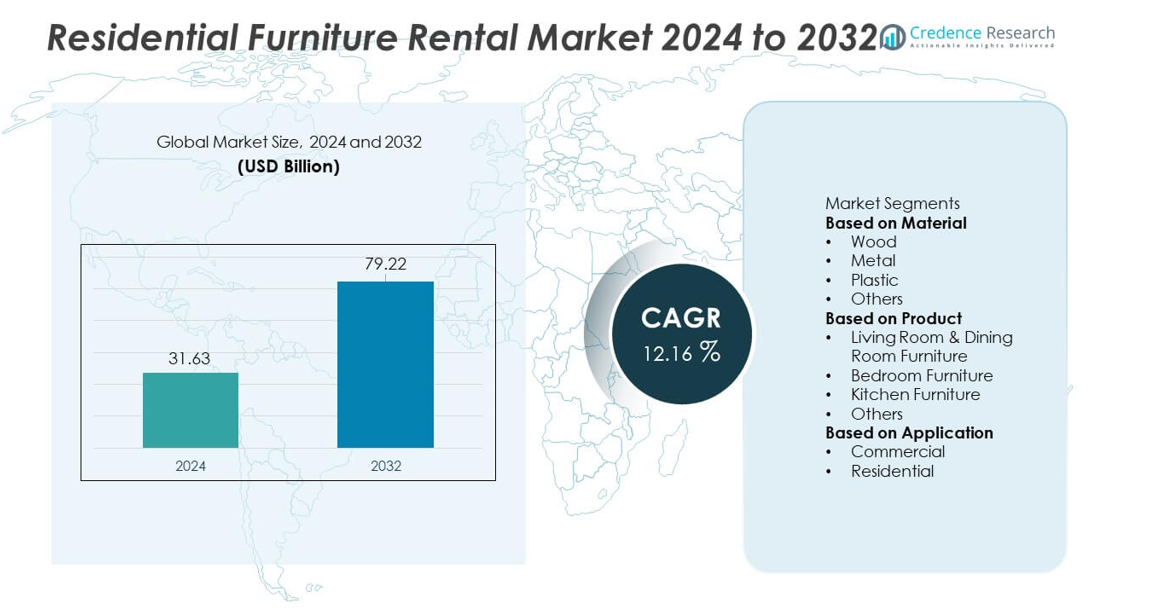
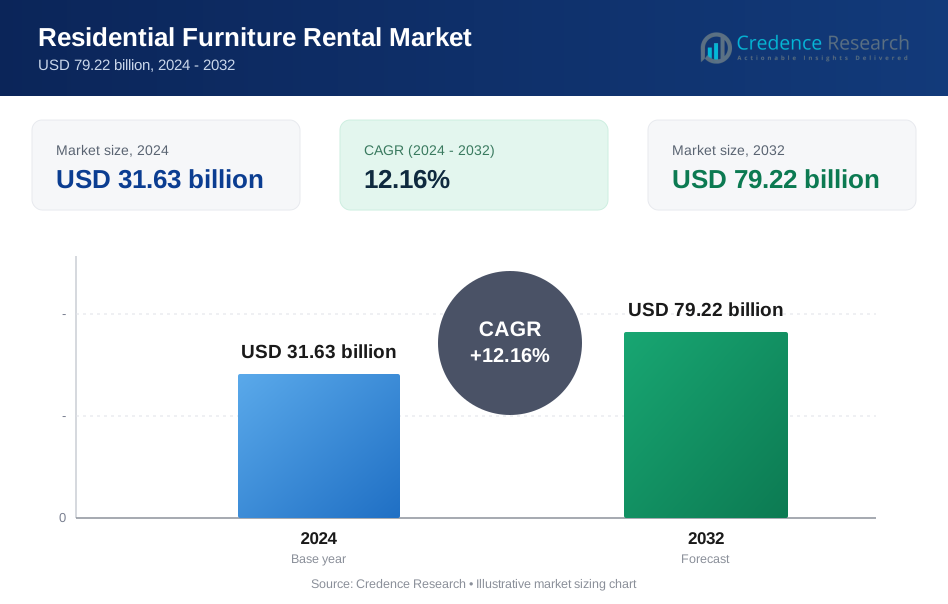
The Residential Furniture Rental market reached USD 31.63 billion in 2024 and is projected to rise to USD 79.22 billion by 2032, registering a CAGR of 12.16% during the forecast period.
| REPORT ATTRIBUTE | DETAILS |
|---|---|
| Historical Period | 2020-2023 |
| Base Year | 2024 |
| Forecast Period | 2025-2032 |
| Residential Furniture Rental Market Size 2024 | USD 31.63 billion |
| Residential Furniture Rental Market, CAGR | 12.16% |
| Residential Furniture Rental Market Size 2032 | USD 79.22 billion |
The Residential Furniture Rental market is shaped by key players such as Furlenco, Rentomojo, Feather, CORT, Fernish, Brook Furniture Rental, CasaOne, Freedom Furniture & Electronics, Inhabitr, and The Everset. These companies expand their presence through flexible subscription models, curated furniture packages, and technology-driven rental platforms that appeal to mobile professionals, students, and corporate clients. North America leads the global market with a 38% share, supported by high rental housing demand and strong adoption of subscription-based living. Asia Pacific follows with a 28% share, driven by rapid urbanization and rising millennial renters, while Europe holds a 27% share backed by growing furnished rental spaces and sustainability-focused consumption trends.
Market Insights
- The Residential Furniture Rental market reached USD 31.63 billion in 2024 and will grow at a CAGR of 12.16% through 2032.
- Demand increases as young professionals and students choose flexible, low-investment furnishing solutions, with wood-based furniture leading the material segment with a 54% share.
- Subscription-based models, digital rental platforms, and sustainable circular-use practices shape market trends as renters seek convenience and design flexibility.
- Competition strengthens as major players expand curated packages, improve logistics networks, and introduce customizable rental plans to attract both short-term and long-term tenants.
- North America leads with a 38% share, followed by Asia Pacific at 28% and Europe at 27%, while living room and dining room furniture dominate the product segment with a 46% share across global markets.
Market Segmentation Analysis:
By Material
Wood dominates the material segment with a 54% share, driven by strong consumer preference for premium aesthetics, durability, and versatility in rental furniture. Rental providers offer modular wooden pieces that suit short-term stays, student housing, and urban apartments, boosting demand. Metal furniture gains traction for its strength and modern design appeal, while plastic options grow among budget-conscious renters seeking lightweight and easy-maintenance solutions. Other materials, including glass and composite finishes, serve niche décor needs. The rise of furnished rentals and flexible living arrangements continues to strengthen the leadership of wood-based rental furniture across global markets.
- For instance, the furniture firm Featherlite expanded its product lines, including office modular workstations, to meet growing demand. The company employs advanced technology and machinery, such as CNC equipment and precision tools, to ensure high quality and consistency across its manufacturing processes.
By Product
Living room and dining room furniture lead the product segment with a 46% share, supported by consistent demand from tenants, shared housing users, and corporate clients seeking complete home setup solutions. Sofas, tables, chairs, and storage units form the core of rental packages, making this category the most utilized. Bedroom furniture follows, driven by the need for beds, wardrobes, and dressers among urban renters and students. Kitchen furniture and other categories expand as customers prefer end-to-end furnishing solutions. Growing mobility, rising renting trends, and subscription-based living models reinforce strong adoption of living and dining furniture rentals.
- For instance, Furlenco enhanced its living room category with a sofa production line that has significant manufacturing capabilities. The company also introduced an assembly system that facilitates quick setup time for delivered packages, with some products available for delivery within a few days.
By Application
Residential applications dominate with a 68% share, as urban households, students, and young professionals increasingly choose flexible rental furniture to avoid upfront purchase costs. The category grows with the rise of relocations, co-living spaces, and short-term rentals. Commercial applications, including corporate housing, serviced apartments, and temporary office setups, hold a steady share as businesses adopt rental models to optimize budgets and enhance workspace flexibility. The residential segment continues to lead due to changing lifestyle patterns, preference for low-commitment furnishing options, and expansion of rental platforms offering customizable packages and subscription-based services.
Key Growth Drivers
Rising Urbanization and Mobility Trends
Rapid urban migration and increasing workforce mobility drive strong demand for residential furniture rental services. Young professionals, students, and short-term tenants prefer flexible furnishing options that reduce upfront investment and support frequent relocations. Rental platforms offer customizable packages, doorstep delivery, and easy returns, making them attractive alternatives to traditional purchases. The rise of co-living spaces and furnished rentals further accelerates adoption. As urban living becomes more dynamic and space-efficient, furniture rental solutions continue to gain traction across major cities worldwide.
- For instance, RentoMojo has scaled rapidly by leveraging automation for efficient operations, including completely automating its consumer verification process. The company offers free delivery and installation services across its many operational cities and has expanded to numerous locations.
Increasing Popularity of Subscription-Based Living Models
-based furniture services attract consumers seeking convenience, affordability, and design flexibility. These models allow renters to upgrade, swap, or return items without long-term commitments, aligning with shifting lifestyle preferences. Companies offer curated packages for living rooms, bedrooms, and full-home setups, appealing to tenants who want stylish interiors without high upfront costs. Growing acceptance of consumption-as-a-service and sustainable use patterns strengthens the market. As more households embrace on-demand living solutions, subscription-driven furniture rental continues to expand rapidly.
- For instance, Furlenco manages active subscription orders supported by a centralized inventory system. The firm's assembly unit manufactures furniture pieces which are built for easy refurbishment.
Expanding Real Estate and Hospitality Sectors
Growth in furnished rentals, serviced apartments, and corporate housing boosts demand for rental furniture. Property owners use rental furniture to stage homes, improve occupancy rates, and reduce capital expenditure. Hospitality operators rely on flexible rental agreements to manage seasonal demand and upgrade interiors without major investments. The rise of temporary housing for relocated employees also contributes to market expansion. As real estate developers increasingly integrate ready-to-move-in solutions, furniture rental becomes a cost-effective option that enhances tenant experience and operational efficiency.
Key Trends & Opportunities
Sustainability and Circular Economy Adoption
Consumers and businesses increasingly seek sustainable furnishing options, creating opportunities for rental providers offering refurbished, reusable, and long-life furniture. Rental models support circular economy principles by extending product lifespan and reducing waste. Companies invest in durable materials, repair services, and eco-friendly sourcing to meet environmental expectations. Growing awareness of responsible consumption strengthens the appeal of renting over buying. This shift enables providers to differentiate through sustainability-focused product lines and green business practices.
- For instance, Fernish operates a refurbishment facility capable of restoring furniture units using a repair workflow as part of its circular model that aims to prevent furniture from going to landfill.
Technology-Driven Personalization and Service Innovation
Digital platforms enhance customer experience through 3D room visualization, AI-based furniture recommendations, and automated subscription management. Technology enables efficient inventory tracking, predictive maintenance, and faster delivery. Online marketplaces expand reach, making rental services accessible to a broader customer base. As consumers seek personalized home décor, platforms offering modular designs, flexible upgrades, and tailored packages gain competitive advantage. These innovations create new growth opportunities by improving convenience and customer engagement.
- For instance, the former furniture rental company CasaOne was reported to build technology for inventory, supply chain, and large format logistics. The platform offered services such as personalized product suggestions, three-dimensional visualizations, and space-planning expertise.
Key Challenges
High Logistics and Maintenance Costs
Furniture rental businesses face significant operational costs related to transportation, warehousing, cleaning, and repairs. Frequent movement of bulky items increases logistics complexity and reduces profit margins. Maintaining quality standards across rentals requires continuous refurbishment and inspection, raising expenses. Companies must optimize supply chains, adopt durable materials, and streamline reverse logistics to remain competitive. These cost pressures challenge scalability, especially for smaller providers.
Lower Awareness and Adoption in Emerging Markets
In many emerging regions, consumers still prefer owning furniture, limiting rental market penetration. Lack of awareness, limited platform availability, and cultural preference for long-term purchases slow adoption. Trust concerns related to product quality, hygiene, and contract terms also hinder growth. Providers need strong marketing, transparent pricing, and localized service models to build acceptance. Overcoming these barriers is essential for expanding the residential furniture rental market globally.
Regional Analysis
North America
North America holds a 38% share of the Residential Furniture Rental market, driven by strong demand from young professionals, students, and corporate housing sectors. High mobility across major cities, rising preference for flexible living arrangements, and the growth of furnished rental properties contribute to market expansion. Companies offer subscription-based and customizable furniture packages that appeal to tenants seeking convenience and modern interiors. The U.S. leads adoption due to its large rental population and growing co-living spaces. Increasing relocation trends and sustained real estate activity continue to support the region’s leadership in residential furniture rentals.
Europe
Europe accounts for a 27% share, supported by rising urbanization, expanding expatriate communities, and increasing demand for cost-effective furnishing solutions. Countries such as the U.K., Germany, and France see strong adoption due to high rental housing rates and lifestyle shifts toward flexible consumption models. The growth of student accommodation and furnished short-stay apartments further boosts market demand. Sustainability awareness also drives preference for rental furniture as a circular and waste-reducing alternative. Strong digital adoption and expanding rental platforms strengthen Europe’s position as a significant market for furniture rental services.
Asia Pacific
Asia Pacific holds a 28% share, driven by rapid urban growth, rising millennial populations, and the expansion of tech-driven rental service providers. India, China, Japan, and Southeast Asia see increasing demand for flexible home furnishing solutions as young professionals move frequently for work and education. The region benefits from affordable rental plans, fast-growing co-living spaces, and expanding furnished rental housing. Digital platforms offering subscription-based furniture packages accelerate adoption. As urban living becomes more compact and mobile, Asia Pacific continues emerging as one of the fastest-growing markets for residential furniture rentals.
Latin America
Latin America holds a 4% share, supported by rising urbanization and growing interest in cost-effective furnishing options among young renters. Brazil, Mexico, and Colombia lead adoption as rental housing becomes more common in major cities. Furniture rental gains traction among students, expatriates, and professionals seeking temporary setups without long-term investment. Economic constraints also encourage consumers to choose rental models over purchasing new furniture. Although the market is still developing, increasing digital penetration and expansion of rental service providers contribute to steady growth.
Middle East & Africa
The Middle East & Africa region accounts for a 3% share, driven by demand from expatriates, corporate housing, and short-term rental properties. Countries such as the UAE, Saudi Arabia, and South Africa see rising adoption as mobile professionals seek convenient and flexible furnishing solutions. The hospitality sector also contributes through serviced apartments and temporary accommodation. Growing real estate development and the expansion of urban rental communities support market potential. While awareness levels remain lower than in developed regions, increasing workforce mobility and expanding digital platforms continue to drive gradual market growth.
Market Segmentations:
By Material
- Wood
- Metal
- Plastic
- Others
By Product
- Living Room & Dining Room Furniture
- Bedroom Furniture
- Kitchen Furniture
- Others
By Application
- Commercial
- Residential
By Geography
- North America
- U.S.
- Canada
- Mexico
- Europe
- Germany
- France
- U.K.
- Italy
- Spain
- Rest of Europe
- Asia Pacific
- China
- Japan
- India
- South Korea
- South-east Asia
- Rest of Asia Pacific
- Latin America
- Brazil
- Argentina
- Rest of Latin America
- Middle East & Africa
- GCC Countries
- South Africa
- Rest of the Middle East and Africa
Competitive Landscape
The Residential Furniture Rental market features leading players such as Furlenco, Rentomojo, Feather, CORT, Fernish, Brook Furniture Rental, CasaOne, Freedom Furniture & Electronics, Inhabitr, and The Everset. These companies compete by offering flexible subscription models, customizable rental packages, and value-added services such as free delivery, maintenance, and easy upgrades. Many players focus on digital platforms to streamline ordering, enhance customer experience, and support seamless inventory management. Sustainability initiatives, including refurbishment programs and circular-use models, help strengthen brand differentiation. Strategic partnerships with real estate developers, co-living operators, and corporate housing providers expand market presence. Continuous investment in design, durability, and logistics efficiency enables companies to serve mobile professionals, students, and short-term renters. As demand for cost-effective and hassle-free furnishing grows, key players prioritize innovation and customer-centric services to maintain competitiveness.
Key Player Analysis
- Furlenco
- Rentomojo
- Feather
- CORT (A Berkshire Hathaway Company)
- Fernish
- Brook Furniture Rental
- CasaOne
- Freedom Furniture & Electronics
- Inhabitr
- The Everset
Recent Developments
- In September 2025, Furlenco expanded high-end offerings and added swappable kids’ furniture.
- In August 2024, CORT Furniture Rental extended its partnership with Move For Hunger to run new hunger-relief initiatives across the U.S.
- In August 2023, Brook Furniture Rental was acquired by AFR Furniture Rental, which will now handle Brook’s existing customers
Report Coverage
The research report offers an in-depth analysis based on Material, Product, Application and Geography. It details leading market players, providing an overview of their business, product offerings, investments, revenue streams, and key applications. Additionally, the report includes insights into the competitive environment, SWOT analysis, current market trends, as well as the primary drivers and constraints. Furthermore, it discusses various factors that have driven market expansion in recent years. The report also explores market dynamics, regulatory scenarios, and technological advancements that are shaping the industry. It assesses the impact of external factors and global economic changes on market growth. Lastly, it provides strategic recommendations for new entrants and established companies to navigate the complexities of the market.
Future Outlook
- Demand for rental furniture will rise as mobility increases among urban professionals.
- Subscription-based and flexible rental plans will become standard across major service providers.
- Digital platforms will expand, offering personalized packages through AI-driven recommendations.
- Sustainable and circular-use furniture models will gain stronger adoption.
- Partnerships with real estate developers and co-living operators will accelerate market penetration.
- Premium and designer furniture rentals will grow as consumers seek aesthetic upgrades without ownership costs.
- Logistics efficiency and faster delivery cycles will become key competitive factors.
- Refurbished and long-life furniture lines will gain traction to reduce operational costs.
- Emerging markets will adopt rental services as awareness and digital access increase.
- Corporate housing and relocation services will expand their reliance on rental furniture solutions.
Request a Free Sample
Fill in your details and we'll send you a free sample report.
- Sample data tables & charts
- Research methodology
Need a Custom Version of This Report?
Tailor the scope, geography, or segments to your exact requirements.
- Custom geography or segment scope
- Direct access to our analyst team
Frequently Asked Questions
What is the current market size for the Residential Furniture Rental market, and what is its projected size in 2032?
At what Compound Annual Growth Rate is the Residential Furniture Rental market projected to grow between 2025 and 2032?
Which segment is leading the market in terms of rental duration?
Which end-user segment is estimated to have the highest CAGR throughout the forecast period?
Who are the key participants in the market for residential furniture rental globally?
What main market factors drive the residential furniture rental sector?
What main market challenges prevent the residential furniture rental sector from growing?
What are the leading market opportunities for the residential furniture rental sector?
Which Residential Furniture Rental market segment held the largest share in 2024?
Table of Content
Chapter 1. Report Introduction
- 1.1 Report Description & Purpose
- 1.1.1 Report Title & Market Definition
- 1.1.2 Unique Selling Propositions (USP) & Key Differentiators
- 1.1.3 Value Proposition for Stakeholders
- 1.2 Research Objectives
- 1.2.1 Market Sizing Objectives (Volume & Revenue) (Volume Where Applicable)
- 1.2.2 Segmentation Objectives
- 1.2.3 Competitive Intelligence Objectives
- 1.2.4 Forecast & Scenario Objectives
- 1.3 Report Scope
- 1.3.1 Residential Furniture Rental Scope – Segments & Subsegments Covered
- 1.3.2 Geographic Scope – Regions & Countries Covered
- 1.3.3 Historical Period, Base Year & Forecast Period (2024; forecast to 2032)
- 1.3.4 Inclusions & Exclusions
- 1.4 Industry Classification & Applicable Codes
- 1.5 Currency, Measurement Units & Valuation Basis
- 1.6 Target Stakeholders
- 1.7 Limitations & Assumptions
Chapter 2. Executive Summary
- 2.1 Global Residential Furniture Rental Market Snapshot
- 2.1.1 Market Size – Historical (2024) & Forecast (2024-2032) (2024: USD 31.63 billion → 2032: USD 79.22 billion)
- 2.1.2 Volume & Revenue – Global Totals (Volume Where Applicable)
- 2.1.3 Key Market Highlights – Top Five Facts
- 2.2 Residential Furniture Rental Market Segmentation Snapshot
- 2.2.1 Market Split by Region – 2024 vs. 2032
- 2.3 Competitive Snapshot
- 2.3.1 Top 10 Players by Revenue Share – 2024
- 2.3.2 Top 10 Players by Volume Share – 2024 (Volume Where Applicable)
- 2.3.3 Recent Strategic Developments (18-Month Summary)
- 2.4 Key Investment Highlights & Strategic Conclusions
Chapter 3. Residential Furniture Rental Market Dynamics & Industry Analysis
- 3.1 Market Overview & Context
- 3.1.1 Residential Furniture Rental Market Position in the Broader Industry Value Chain
- 3.1.2 Demand Structure & Purchasing Dynamics
- 3.1.3 Market Maturity & Development Stage by Region
- 3.2 Residential Furniture Rental Market Drivers
- 3.3 Residential Furniture Rental Market Restraints & Challenges
- 3.4 Residential Furniture Rental Market Opportunities
- 3.5 Porter's Five Forces Analysis
- 3.5.1 Threat of New Entrants
- 3.5.2 Bargaining Power of Suppliers
- 3.5.3 Bargaining Power of Buyers
- 3.5.4 Threat of Substitutes
- 3.5.5 Competitive Rivalry – Intensity Assessment
- 3.6 Residential Furniture Rental Value Chain Analysis
- 3.6.1 Upstream – Key Inputs, Resources & Suppliers
- 3.6.1.1 Key Input/Resource 1
- 3.6.1.2 Key Input/Resource 2
- 3.6.1.3 Key Input/Resource 3
- 3.6.2 Midstream – Core Operations & Value Creation
- 3.6.2.1 Operating Model & Process Overview
- 3.6.2.2 Key Operating Locations & Capabilities by Company
- 3.6.3 Downstream – Market Channels & End Users
- 3.6.3.1 Direct Sales & Customer Engagement Channels
- 3.6.3.2 Indirect Sales, Intermediaries & Partner Channels
- 3.6.4 Value Chain Profitability Analysis
- 3.6.1 Upstream – Key Inputs, Resources & Suppliers
- 3.7 PESTEL Analysis
- 3.7.1 Political Factors
- 3.7.2 Economic Factors
- 3.7.3 Social Factors
- 3.7.4 Technological Factors
- 3.7.5 Environmental Factors
- 3.7.6 Legal Factors
- 3.8 Residential Furniture Rental Supply Chain Analysis
- 3.8.1 Critical Input & Resource Availability Risk Assessment
- 3.8.2 Supplier & Operational Concentration Risk (Geographic Exposure)
- 3.8.3 Supply & Service Disruption Impact Analysis
- 3.9 Regulatory & Policy Landscape
Note: The regulatory and policy landscape section covers regulations based on their applicability to the market, Residential Furniture Rental category, geography, and scope of the study. Only regulatory frameworks with a material impact on operations, compliance, trade, sustainability, or market access are analyzed in detail.
Chapter 4. Key Investment Pockets & Opportunity Analysis
- 4.1 Residential Furniture Rental Market Attractiveness Analysis
- 4.1.1 By Region – Investment Attractiveness Matrix (Market Size × CAGR)
- 4.2 Absolute Revenue Growth Opportunity
- 4.2.1 By Region – Absolute Revenue Growth Through 2032
- 4.3 Incremental Demand Opportunity
- 4.3.1 By Region – Incremental Demand Through 2032
- 4.3.2 Segment – Incremental Demand
- 4.4 Emerging Submarket Opportunity Deep Dive (Subject to Applicability)
- 4.5 Priority Market Opportunity Scorecards
- 4.5.1 United States
- 4.5.2 Europe
- 4.5.3 Asia
- 4.5.4 Middle East & Africa
Note: Priority market opportunity scorecards reflect the geographic scope and strategic relevance of the study. Listed markets are indicative and may be adapted to the industry.
Chapter 5. Residential Furniture Rental Cross-Border Trade & Market Access Analysis
- 5.1 International Trade & Cross-Border Activity Overview
- 5.1.1 Global Export Value by Country (2024)
- 5.1.2 Global Export Volume by Country (2024) (Volume Where Applicable)
- 5.1.3 Global Import Value by Country (2024)
- 5.1.4 Global Import Volume by Country (2024) (Volume Where Applicable)
- 5.1.5 Net Trade Balance by Country (2024)
- 5.2 Export Analysis – Segment
- 5.2.1 Category 1 (Applicable Classification Code)
- 5.2.2 Category 2 (Applicable Classification Code)
- 5.2.3 Category 3 (Applicable Classification Code)
- 5.2.4 Category 4 (Applicable Classification Code)
- 5.2.5 Category 5 (Applicable Classification Code)
- 5.3 Import Analysis – Segment
- 5.3.1 Category 1 (Applicable Classification Code)
- 5.3.2 Category 2 (Applicable Classification Code)
- 5.3.3 Category 3 (Applicable Classification Code)
- 5.3.4 Category 4 (Applicable Classification Code)
- 5.3.5 Category 5 (Applicable Classification Code)
- 5.4 Cross-Border Pricing & Transaction Benchmarks
- 5.4.1 Export Pricing – Segment & Country
- 5.4.2 Import Pricing – Segment & Source Country
- 5.4.3 Price Trends (2024)
- 5.5 Key Cross-Border Trade & Delivery Routes
- 5.5.1 Cross-Border Trade/Delivery Route 1
- 5.5.2 Cross-Border Trade/Delivery Route 2
- 5.5.3 Cross-Border Trade/Delivery Route 3
- 5.5.4 Cross-Border Trade/Delivery Route 4
- 5.5.5 Cross-Border Trade/Delivery Route 5
- 5.6 Trade Policy & Market Access Impact Assessment
- 5.6.1 Tariff & Non-Tariff Barriers
- 5.6.2 Regional Trade & Economic Integration Frameworks
- 5.6.3 Bilateral & Multilateral Trade Agreements
- 5.6.4 Cross-Border Operating, Licensing & Localization Requirements
Note: This chapter applies where cross-border trade or delivery is relevant to Residential Furniture Rental. Goods, services, and digital offerings are assessed using applicable classifications and transaction measures. Import-export volumes, trade balances, and route analyses are included only where meaningful to the market.
Chapter 6. Competitive Landscape & Company Benchmarking
- 6.1 Residential Furniture Rental Market Concentration & Structure
- 6.1.1 Herfindahl-Hirschman Index (HHI) – vs. 2024
- 6.1.2 Leading, Mid-Sized & Emerging Player Structure
- 6.1.3 Global, Regional & Local Player Dynamics
- 6.2 Residential Furniture Rental Market Share Analysis – 2024
- 6.2.1 Global Revenue Share by Company
- 6.2.2 Global Volume Share by Company (Volume Where Applicable)
- 6.2.3 Regional Revenue Share
- 6.2.4 Market Share Evolution ( vs. 2024)
- 6.2.5 Company Market Share by Key Segment
- 6.2.6 Company Market Share by Customer Group
- 6.3 Operating Scale, Capacity & Infrastructure Analysis
- 6.3.1 Global Operating Scale & Supply Capacity
- 6.3.2 Resource Utilization & Operating Efficiency
- 6.3.3 Output, Service Delivery & Activity Metrics
- 6.3.4 Operating Footprint & Infrastructure Map
- 6.3.5 Planned Operational & Capacity Expansion
- 6.4 Residential Furniture Rental Competitive Benchmarking Matrix
- 6.4.1 Revenue, Growth, Profitability & Operating Metric Comparison
- 6.4.2 Channel Revenue Mix
- 6.4.3 Geographic Revenue Exposure
- 6.4.4 R&D Intensity
- 6.4.5 Sustainability Maturity
- 6.5 Strategic Developments in Residential Furniture Rental (Last 24 Months)
- 6.5.1 Mergers, Acquisitions & Divestments
- 6.5.2 New Products, Services & Solutions in Residential Furniture Rental
- 6.5.3 Operational & Infrastructure Expansions
- 6.5.4 Strategic Alliances, Joint Ventures & Partnerships
- 6.5.5 Distribution Expansion & Market Entry
- 6.5.6 Sustainability & ESG Initiatives
- 6.6 Competitive Strategy Mapping
- 6.6.1 Leader, Challenger, Follower & Niche Classification
- 6.6.2 Pricing Strategy Comparison
- 6.6.3 Channel Strategy Matrix
Note: Strategic developments are included based on their materiality and the availability of reliable information.
Chapter 7. Global Residential Furniture Rental Market – By Sales & Delivery Channel
- 7.1 Segment Overview
- 7.1.1 Volume & Revenue Split by Channel (2024 & 2032) (Volume Where Applicable)
- 7.1.2 Channel Mix Evolution (2024-2032)
Chapter 8. Regional Market Analysis – Global Overview
- 8.1 Global Regional Overview
- 8.1.1 Regional Volume Share (Volume Where Applicable)
- 8.1.2 Regional Revenue Share
- 8.1.3 Regional Volume by Region (Volume Where Applicable)
- 8.1.4 Regional Revenue by Region
- 8.1.5 Regional Forecast Through 2032
- 8.2 Cross-Regional Segment Analysis
- 8.2.1 By Sales & Delivery Channel
- 8.2.2 By Competitive Positioning & Price Tier
Chapter 9. North America Residential Furniture Rental Market
- 9.1 United States
- 9.2 Canada
- 9.3 Mexico
Chapter 10. Europe Residential Furniture Rental Market
- 10.1 Germany
- 10.2 France
- 10.3 Italy
- 10.4 United Kingdom
- 10.5 Spain
- 10.6 Poland
- 10.7 Russia
- 10.8 Netherlands
- 10.9 Belgium
- 10.10 Sweden
- 10.11 Denmark
- 10.12 Norway
- 10.13 Rest of Europe
Chapter 11. Asia Pacific Residential Furniture Rental Market
- 11.1 China
- 11.2 India
- 11.3 Japan
- 11.4 South Korea
- 11.5 Thailand
- 11.6 Indonesia
- 11.7 Vietnam
- 11.8 Malaysia
- 11.9 Australia
- 11.10 Rest of Asia Pacific
Chapter 12. Latin America Residential Furniture Rental Market
- 12.1 Brazil
- 12.2 Argentina
- 12.3 Colombia
- 12.4 Chile
- 12.5 Rest of Latin America
Chapter 13. Middle East Residential Furniture Rental Market
- 13.1 Saudi Arabia
- 13.2 United Arab Emirates
- 13.3 Turkey
- 13.4 Israel
- 13.5 Iran
- 13.6 Rest of the Middle East
Chapter 14. Africa Residential Furniture Rental Market
- 14.1 South Africa
- 14.2 Egypt
- 14.3 Nigeria
- 14.4 Morocco
- 14.5 Rest of Africa
Chapter 15. Residential Furniture Rental Company Profiles
- 15.1 [Company 01]
- 15.1.1 Company Overview
- 15.1.2 Key Management Personnel
- 15.1.3 Products & Services Portfolio
- 15.1.4 Financial Performance
- 15.1.5 Key Market Focus & Geographic Presence
- 15.1.6 Recent Developments & Strategic Initiatives
Note: The company profile list is preliminary and may change based on research findings, market developments, data availability, and client requirements.
Chapter 16. Appendices
- Appendix A – List of Abbreviations & Acronyms
- Appendix B – Industry Classification Code Reference – Full Series
- Appendix C – Supply, Output & Operating Capacity Data Tables
- Appendix D – End-Use & Demand Base Tables
- Appendix E – Demand, Adoption & Usage Assumptions
- Appendix F – Pricing & Revenue Metric Reference Tables
- Appendix G – Company Operations & Infrastructure Database
- Appendix H – Cross-Border Trade & Activity Data Tables (Where Applicable)
- Appendix I – Regulatory Summary Tables
- Appendix J – Primary Research Participant List (Anonymized)
- Appendix K – Primary Research Questionnaire Framework
- Appendix L – Data Sources & Bibliography
- Appendix M – Market Size Divergence & Source Comparison
Chapter 17. Research Methodology
- 17.1 Research Framework & Philosophy
- 17.2 Secondary Research – Sources, Hierarchy & Data Extraction
- 17.3 Data Modeling – Bottom-Up & Top-Down Market Sizing
- 17.4 Primary Research – Stakeholder Framework, LOI & Sample Sizes
- 17.5 Forecast Methodology – Regression, Scenario & Sensitivity Analysis
- 17.6 Quality Control – Four-Layer Validation Framework
- 17.7 Limitations & Standard Assumptions
- 17.8 Disclaimer
