
Market Overview:
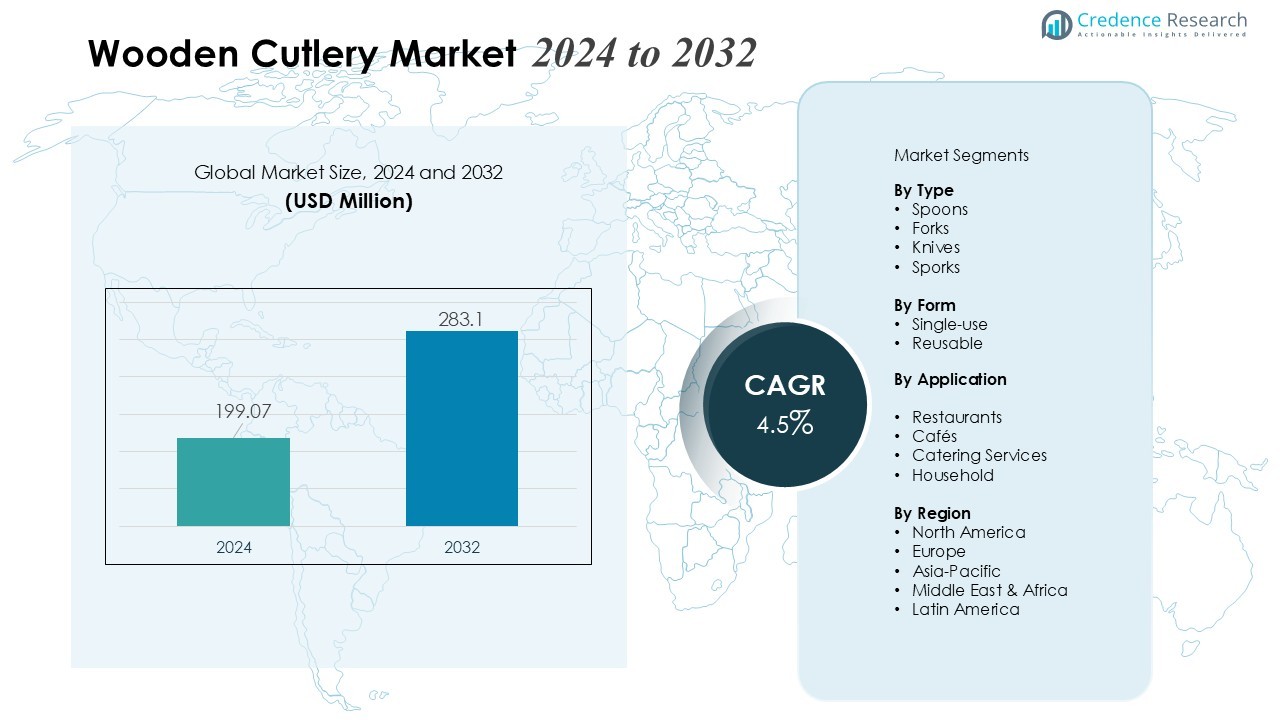
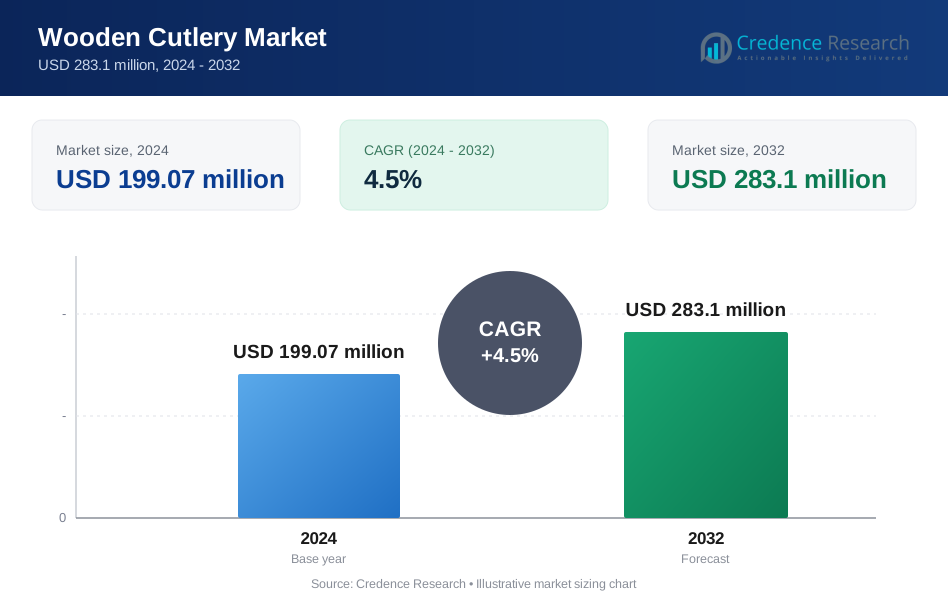
The Wooden Cutlery Market size was valued at USD 199.07 million in 2024 and is anticipated to reach USD 283.1 million by 2032, at a CAGR of 4.5% during the forecast period (2024-2032).
| REPORT ATTRIBUTE | DETAILS |
|---|---|
| Historical Period | 2020-2023 |
| Base Year | 2024 |
| Forecast Period | 2025-2032 |
| Wooden Cutlery Market Size 2024 | USD 199.07 Million |
| Wooden Cutlery Market, CAGR | 4.5% |
| Wooden Cutlery Market Size 2032 | USD 283.1 Million |
Market growth is being driven by rising environmental awareness and increasing regulatory pressure against single-use plastics. Many foodservice operators, including quick‑service restaurants, cafes, and catering services, are shifting toward biodegradable and compostable cutlery. Improved manufacturing processes also enhance the durability and finish of wooden cutlery, making it a viable alternative to plastic while aligning with consumer demand for sustainable lifestyle choices.
Regionally, the market sees robust adoption across multiple geographies. North America and Europe remain significant players due to stricter regulations on plastic use and high consumer eco‑consciousness. Meanwhile, the Asia‑Pacific region - including rapidly urbanizing and populous countries - is witnessing accelerated uptake owing to expanding foodservice infrastructure and rising consumer awareness about sustainable living.
Market Insights:
- The Wooden Cutlery Market was valued at USD 199.07 million in 2024 and is projected to reach USD 283.1 million by 2032, registering a CAGR of 4.5% during the forecast period. Growth is driven by environmental awareness and regulatory pressures against single-use plastics.
- Heightened consumer and business focus on sustainability encourages a shift from plastic to biodegradable wooden cutlery, reducing ecological footprint and supporting waste reduction initiatives.
- Restaurants, cafés, quick service outlets, and catering services form the primary demand base, with operators adopting wooden utensils to meet eco-conscious dining expectations and sustainability goals.
- Consumers increasingly prefer natural, chemical-free, and renewable materials, reinforcing wooden cutlery’s appeal over plastic and metal alternatives and aligning with eco-conscious lifestyles.
- Manufacturing innovations improve durability, finish quality, and design of wooden cutlery, addressing previous reliability concerns while enhancing consumer satisfaction and repeat usage.
- High production costs and dependence on sustainable timber remain key challenges, as raw material availability, pricing fluctuations, and deforestation regulations impact consistent supply and quality.
- North America leads with 34 % of global demand, Europe contributes 21 %, and Asia-Pacific along with emerging regions hold 45 %, with Asia-Pacific showing the fastest growth due to urbanization, foodservice expansion, and rising consumer awareness.
 Market Drivers:
Growing Environmental Awareness and Plastic‑Waste Reduction
The Wooden Cutlery Market benefits substantially from heightened environmental awareness and increasing public concern about plastic pollution. Consumers and businesses increasingly reject single‑use plastic cutlery in favour of wood‑based alternatives that offer biodegradability and a lower ecological footprint. This shift toward environmentally friendly dining products drives demand steadily upward, especially among those valuing sustainability and waste reduction.
- For instance, Green Science Alliance developed a natural biomass material from paper waste, wood, plants, and scrap trees in 2019, enabling complete biodegradability in 180 days under composting conditions
Demand from Foodservice and Hospitality Sectors
Restaurants, cafés, quick‑service outlets, catering services, and other food‑service establishments represent a major demand base for wooden cutlery. Many operators adopt wood‑based utensils to align with their sustainability commitments and satisfy consumer expectations for eco‑friendly dining. Rising consumer preference for sustainable packaging and dining experiences encourages food‑service businesses to replace plastic cutlery with wooden alternatives.
- For instance, McDonald's replaced plastic cutlery with paper-based variants in all its UK and Ireland restaurants during late 2022 and early 2023. This strategic transition, which was part of their 'Plan for Change' sustainability goals, is expected to eliminate approximately 858 metric tonnes of plastic each year from their system in that region alone.
Preference for Natural Materials and Lifestyle Alignment
Consumers increasingly favour products made from natural, chemical‑free, and renewable materials. Wood, bamboo, or similar sustainable resources provide an organic and “authentic” dining experience that resonates with those embracing natural or eco‑conscious lifestyles. This preference strengthens the appeal of wooden cutlery over conventional plastic or metal alternatives.
Innovation in Manufacturing, Quality, and Supply‑Chain Reach
Manufacturers continue to improve design, durability, and finish quality of wooden utensils, addressing earlier concerns about reliability and user experience. Advances in production and finishing processes make wooden cutlery more durable and appealing. Simultaneously, expansion of distribution channels - including online retail and direct-to-consumer sales - enables broader market penetration beyond institutional buyers. This combination of better product quality and easier accessibility supports market expansion.
Market Trends:
Rising Demand for Sustainable and Eco-Friendly Foodservice Solutions
The Wooden Cutlery Market is witnessing strong growth driven by increasing consumer preference for sustainable and biodegradable alternatives to plastic utensils. Regulatory initiatives promoting single-use plastic bans across North America, Europe, and Asia-Pacific have accelerated the adoption of wooden cutlery in restaurants, catering services, and household applications. It benefits from the growing awareness of environmental pollution and the demand for products that reduce carbon footprint. Manufacturers are focusing on offering premium-quality wooden utensils that combine durability with aesthetic appeal. Rising investments in research and development aim to improve product strength, water resistance, and cost efficiency. Partnerships with foodservice providers and e-commerce platforms are expanding distribution channels and enhancing market reach. Consumer trends indicate a shift toward eco-conscious dining experiences, reinforcing long-term demand for wooden cutlery.
- For instance, Huhtamaki's BioWare line achieving 100% compostability under EN 13432 standards with over 90 days degradation in industrial facilities.
Technological Advancements and Strategic Market Expansion
Technological improvements in manufacturing processes have lowered production costs while ensuring high-quality, hygienic, and uniform wooden cutlery. Automation and precision cutting techniques have enhanced efficiency, allowing manufacturers to meet rising global demand without compromising on quality. It also benefits from innovative designs tailored to premium dining, casual catering, and takeaway services, increasing its adoption across diverse segments. Strategic collaborations, mergers, and acquisitions among key players support market expansion in emerging economies with growing foodservice sectors. Market players increasingly invest in sustainable sourcing of raw materials to maintain environmental compliance and brand credibility. Rising awareness of health and hygiene standards further drives the preference for wooden cutlery over plastic alternatives. Overall, these factors strengthen the market’s growth trajectory while positioning it as a critical solution in sustainable foodservice.
- For Instance, SSHL Machinery's automated cutlery production lines use components such as servo feeders and hydraulic presses to optimize manufacturing efficiency, significantly reducing the number of operators required per shift and thereby decreasing overall labor costs.
Market Challenges Analysis:
High Production Costs and Raw Material Dependence
The Wooden Cutlery Market faces challenges due to the higher production costs compared to conventional plastic alternatives. It relies heavily on sustainable timber, which can be affected by seasonal availability, deforestation regulations, and fluctuating raw material prices. Maintaining consistent quality while sourcing eco-friendly wood adds pressure on manufacturers to optimize supply chains. Smaller producers may struggle to compete with established brands that benefit from economies of scale. Limited availability of certified sustainable wood in certain regions further restricts expansion. Market players must invest in efficient manufacturing techniques and material management to remain competitive.
Product Durability and Market Acceptance Constraints
Wooden cutlery often faces skepticism regarding durability and performance, particularly for hot or heavy meals. It can warp or break under specific conditions, affecting user experience and repeat purchases. Consumer preference for reusable or more robust alternatives, such as metal or bamboo, limits widespread adoption in some segments. It also faces logistical challenges in packaging and transportation to prevent damage. Educating end-users about product benefits and improving product design are critical to overcoming these hurdles. Market growth depends on addressing these durability concerns while maintaining eco-friendly attributes.
Market Opportunities:
Expansion in Eco-Conscious Foodservice and Retail Sectors
The Wooden Cutlery Market presents significant opportunities driven by the rising adoption of sustainable practices in the foodservice and retail industries. It benefits from increasing demand among restaurants, cafes, and catering services seeking eco-friendly alternatives to single-use plastic. Rising consumer awareness about environmental impact encourages retailers to stock biodegradable utensils, expanding market reach. Collaborations with e-commerce platforms enable broader distribution and direct access to environmentally conscious buyers. Innovation in product design, including premium and customizable cutlery, enhances appeal for high-end dining and corporate events. Government incentives promoting sustainable materials further stimulate adoption across diverse sectors.
Technological Innovations and Emerging Regional Markets
Technological advancements in automated manufacturing and wood treatment techniques offer opportunities to produce stronger, cost-effective, and water-resistant cutlery. It can cater to diverse consumer needs, including durable options for hot meals and large-scale catering. Emerging economies in Asia-Pacific and Latin America, with growing foodservice sectors and environmental regulations, provide untapped growth potential. Investment in sustainable sourcing and certification strengthens brand credibility and consumer trust. Expanding educational campaigns on environmental benefits supports wider market penetration. These factors position wooden cutlery as a viable and scalable solution in global sustainable foodservice markets.
Market Segmentation Analysis:
By Type
The Wooden Cutlery Market is primarily segmented into spoons, forks, knives, and sporks. Spoons and forks hold the largest share due to their frequent use in quick-service restaurants, catering, and household dining. Knives are gaining traction in premium and takeaway foodservice segments where cutting capability and durability are critical. Sporks serve niche segments combining multiple functionalities and appeal to convenience-focused consumers. It benefits from consistent demand across both individual and bulk purchases in foodservice channels. Product innovation in ergonomics and finish enhances usability, supporting wider adoption.
- For Instance, Driven by demand in quick-service restaurants and catering sectors, companies like Eco-Products are prominent suppliers in the rapidly growing market for wooden and compostable cutlery.
By Form
The market divides into single-use and reusable wooden cutlery. Single-use wooden utensils dominate due to regulatory restrictions on plastics and their widespread application in catering, fast-food, and event services. Reusable forms are emerging in premium dining, eco-conscious households, and corporate environments where sustainability and long-term use are priorities. It achieves increased acceptance through improvements in durability, water resistance, and finish quality. Expanding retail and e-commerce distribution channels further drive adoption of both forms, offering consumers flexibility in usage and purchase.
- For Instance,Huhtamaki's sustainable product offerings include a 'Future Friendly' range of plain, compostable wooden cutlery made from responsibly sourced timber, providing a functional and eco-friendly alternative to single-use plastics.
By Application
Applications include restaurants, cafés, catering services, and household consumption. Foodservice establishments represent the largest segment due to regulatory pressures and consumer demand for sustainable dining solutions. Household usage grows steadily, driven by awareness of environmental impact and lifestyle preferences for natural materials. It supports market expansion through continuous product innovation, premium designs, and targeted distribution. Growing interest in eco-friendly events, takeaway meals, and institutional catering strengthens the demand across all application segments.
Segmentations:
By Type- Spoons
- Forks
- Knives
- Sporks
- Single-use
- Reusable
- Restaurants
- Cafés
- Catering Services
- Household
- North America
- U.S.
- Canada
- Mexico
- Europe
- Germany
- France
- U.K.
- Italy
- Spain
- Rest of Europe
- Asia Pacific
- China
- Japan
- India
- South Korea
- South-east Asia
- Rest of Asia Pacific
- Latin America
- Brazil
- Argentina
- Rest of Latin America
- Middle East & Africa
- GCC Countries
- South Africa
- Rest of the Middle East and Africa
Regional Analysis:
North America – Clear Leadership with 34 % Share
North America holds 34 % of the global wooden cutlery demand. Strong enforcement of plastic-use restrictions and established foodservice and hospitality sectors support heavy adoption of wooden cutlery across restaurants, catering, and retail. High consumer spending capacity and sustainability awareness drive consistent use in both institutional and household segments. Well-developed supply chains and distribution networks ensure reliable product availability. This foundation helps maintain the region’s leadership in the global market.
Europe – Significant Contribution with 21 % Share
Europe accounts for 21 % of the global wooden cutlery market. Environmental regulations limiting single-use plastics, combined with widespread consumer preference for compostable products, push demand for wood-based cutlery in restaurants, cafés, public institutions, and retail. Demand remains stable across major markets such as Germany, France, and the United Kingdom. Certified sourcing and sustainable-wood supply chains reinforce confidence among buyers and regulators. This stability underpins Europe’s firm position in the global market.
Asia‑Pacific & Other Regions – Combined Share 45 %, Asia‑Pacific Leading Growth
Asia‑Pacific, together with other emerging regions including Latin America, Middle East, and Africa, constitutes the remaining 45 % share of the global market. Asia‑Pacific shows the fastest growth trajectory driven by rising urbanization, expanding foodservice industry, growing environmental awareness, and increasing demand for sustainable disposables in countries such as India, China, and Japan. Local manufacturing capabilities and access to raw-material sources help reduce costs and support broad deployment. Demand from institutional catering, food delivery, and retail segments in emerging economies positions this region as a key growth engine for the market.
Key Player Analysis:
- Bio Futura
- Biopac
- Caoxian Luyi Wooden
- Chefast kitchen accessories
- Ecoriti
- Greenwood (Dalian) Industrial
- Huhtamaki Group Oyj
- Leafware
- Mede Cutlery Company
- Natural Tableware
- Packnwood (First Pack)
- Pappco Greenware
- Vegware
- VerTerra Dinnerware
Competitive Analysis:
The Wooden Cutlery Market is highly competitive, with numerous global and regional players striving to expand their presence through product innovation, sustainable sourcing, and strategic partnerships. Leading manufacturers focus on improving durability, finish, and design quality to differentiate their offerings and meet growing consumer demand for eco-friendly alternatives. It benefits from collaborations with foodservice chains, retail distributors, and e-commerce platforms to enhance market penetration. Companies increasingly invest in automated production technologies and certified sustainable raw materials to optimize costs and ensure consistent supply. Pricing strategies, brand reputation, and compliance with environmental regulations play a crucial role in maintaining competitiveness. Emerging players leverage regional manufacturing advantages and niche product designs to capture local demand, particularly in high-growth regions like Asia-Pacific. Continuous focus on sustainability, product quality, and distribution efficiency drives market positioning and long-term growth opportunities.
Recent Developments:
- In September 2025, BioFuture hosted the BioFuture™ 2025 conference in New York City from October 13–15, focusing on innovation, policy, and investment in the biopharma sector, with a virtual partnering component following October 21–23.
- In February 2024, Vegware announced expansion of its compostable catering disposables range, including new bagasse products, to meet growing demand in the UK market.
Report Coverage:
The research report offers an in-depth analysis based on Type, Form, Application and Region. It details leading market players, providing an overview of their business, product offerings, investments, revenue streams, and key applications. Additionally, the report includes insights into the competitive environment, SWOT analysis, current market trends, as well as the primary drivers and constraints. Furthermore, it discusses various factors that have driven market expansion in recent years. The report also explores market dynamics, regulatory scenarios, and technological advancements that are shaping the industry. It assesses the impact of external factors and ITALY economic changes on market growth. Lastly, it provides strategic recommendations for new entrants and established companies to navigate the complexities of the market.
Future Outlook:
- The Wooden Cutlery Market will continue to expand due to rising consumer preference for sustainable and biodegradable products.
- Increasing regulatory restrictions on single-use plastics globally will drive higher adoption across foodservice and retail sectors.
- Manufacturers will focus on improving product durability, water resistance, and finish to enhance user experience and acceptance.
- Growth in quick-service restaurants, cafés, and catering services will sustain consistent demand for wooden cutlery.
- E-commerce platforms and direct-to-consumer channels will play a critical role in increasing accessibility and market reach.
- Technological advancements in automated production and efficient supply chain management will reduce costs and improve scalability.
- Rising environmental awareness among households will expand adoption beyond institutional and commercial segments.
- Emerging markets in Asia-Pacific, Latin America, and Middle East will present significant growth opportunities due to urbanization and expanding foodservice infrastructure.
- Manufacturers will increasingly invest in certified sustainable raw materials to strengthen brand credibility and comply with environmental standards.
- Innovation in premium and customized wooden cutlery designs will attract niche segments and reinforce long-term market sustainability.
Request a Free Sample
Fill in your details and we'll send you a free sample report.
- Sample data tables & charts
- Research methodology
Need a Custom Version of This Report?
Tailor the scope, geography, or segments to your exact requirements.
- Custom geography or segment scope
- Direct access to our analyst team
Frequently Asked Questions
What is the current market size for the Wooden Cutlery Market, and what is its projected size in 2032?
At what Compound Annual Growth Rate is the Wooden Cutlery Market projected to grow between 2024 and 2032?
Which Wooden Cutlery Market segment held the largest share in 2024?
What are the primary factors fueling the growth of the Wooden Cutlery Market?
Which region commanded the largest share of the Wooden Cutlery Market in 2024?
Table of Content
Chapter 1. Report Introduction
- 1.1 Report Description & Purpose
- 1.1.1 Report Title & Market Definition
- 1.1.2 Unique Selling Propositions (USP) & Key Differentiators
- 1.1.3 Value Proposition for Stakeholders
- 1.2 Research Objectives
- 1.2.1 Market Sizing Objectives (Volume & Revenue) (Volume Where Applicable)
- 1.2.2 Segmentation Objectives
- 1.2.3 Competitive Intelligence Objectives
- 1.2.4 Forecast & Scenario Objectives
- 1.3 Report Scope
- 1.3.1 Wooden Cutlery Scope – Segments & Subsegments Covered
- 1.3.2 Geographic Scope – Regions & Countries Covered
- 1.3.3 Historical Period, Base Year & Forecast Period (2024; forecast to 2032)
- 1.3.4 Inclusions & Exclusions
- 1.4 Industry Classification & Applicable Codes
- 1.5 Currency, Measurement Units & Valuation Basis
- 1.6 Target Stakeholders
- 1.7 Limitations & Assumptions
Chapter 2. Executive Summary
- 2.1 Global Wooden Cutlery Market Snapshot
- 2.1.1 Market Size – Historical (2024) & Forecast (2024-2032) (2024: USD 199.07 million → 2032: USD 283.1 million)
- 2.1.2 Volume & Revenue – Global Totals (Volume Where Applicable)
- 2.1.3 Key Market Highlights – Top Five Facts
- 2.2 Wooden Cutlery Market Segmentation Snapshot
- 2.2.1 Market Split by Region – 2024 vs. 2032
- 2.3 Competitive Snapshot
- 2.3.1 Top 10 Players by Revenue Share – 2024
- 2.3.2 Top 10 Players by Volume Share – 2024 (Volume Where Applicable)
- 2.3.3 Recent Strategic Developments (18-Month Summary)
- 2.4 Key Investment Highlights & Strategic Conclusions
Chapter 3. Wooden Cutlery Market Dynamics & Industry Analysis
- 3.1 Market Overview & Context
- 3.1.1 Wooden Cutlery Market Position in the Broader Industry Value Chain
- 3.1.2 Demand Structure & Purchasing Dynamics
- 3.1.3 Market Maturity & Development Stage by Region
- 3.2 Wooden Cutlery Market Drivers
- 3.3 Wooden Cutlery Market Restraints & Challenges
- 3.4 Wooden Cutlery Market Opportunities
- 3.5 Porter's Five Forces Analysis
- 3.5.1 Threat of New Entrants
- 3.5.2 Bargaining Power of Suppliers
- 3.5.3 Bargaining Power of Buyers
- 3.5.4 Threat of Substitutes
- 3.5.5 Competitive Rivalry – Intensity Assessment
- 3.6 Wooden Cutlery Value Chain Analysis
- 3.6.1 Upstream – Key Inputs, Resources & Suppliers
- 3.6.1.1 Key Input/Resource 1
- 3.6.1.2 Key Input/Resource 2
- 3.6.1.3 Key Input/Resource 3
- 3.6.2 Midstream – Core Operations & Value Creation
- 3.6.2.1 Operating Model & Process Overview
- 3.6.2.2 Key Operating Locations & Capabilities by Company
- 3.6.3 Downstream – Market Channels & End Users
- 3.6.3.1 Direct Sales & Customer Engagement Channels
- 3.6.3.2 Indirect Sales, Intermediaries & Partner Channels
- 3.6.4 Value Chain Profitability Analysis
- 3.6.1 Upstream – Key Inputs, Resources & Suppliers
- 3.7 PESTEL Analysis
- 3.7.1 Political Factors
- 3.7.2 Economic Factors
- 3.7.3 Social Factors
- 3.7.4 Technological Factors
- 3.7.5 Environmental Factors
- 3.7.6 Legal Factors
- 3.8 Wooden Cutlery Supply Chain Analysis
- 3.8.1 Critical Input & Resource Availability Risk Assessment
- 3.8.2 Supplier & Operational Concentration Risk (Geographic Exposure)
- 3.8.3 Supply & Service Disruption Impact Analysis
- 3.9 Regulatory & Policy Landscape
Note: The regulatory and policy landscape section covers regulations based on their applicability to the market, Wooden Cutlery category, geography, and scope of the study. Only regulatory frameworks with a material impact on operations, compliance, trade, sustainability, or market access are analyzed in detail.
Chapter 4. Key Investment Pockets & Opportunity Analysis
- 4.1 Wooden Cutlery Market Attractiveness Analysis
- 4.1.1 By Region – Investment Attractiveness Matrix (Market Size × CAGR)
- 4.2 Absolute Revenue Growth Opportunity
- 4.2.1 By Region – Absolute Revenue Growth Through 2032
- 4.3 Incremental Demand Opportunity
- 4.3.1 By Region – Incremental Demand Through 2032
- 4.3.2 Segment – Incremental Demand
- 4.4 Emerging Submarket Opportunity Deep Dive (Subject to Applicability)
- 4.5 Priority Market Opportunity Scorecards
- 4.5.1 United States
- 4.5.2 Europe
- 4.5.3 Asia
- 4.5.4 Middle East & Africa
Note: Priority market opportunity scorecards reflect the geographic scope and strategic relevance of the study. Listed markets are indicative and may be adapted to the industry.
Chapter 5. Wooden Cutlery Cross-Border Trade & Market Access Analysis
- 5.1 International Trade & Cross-Border Activity Overview
- 5.1.1 Global Export Value by Country (2024)
- 5.1.2 Global Export Volume by Country (2024) (Volume Where Applicable)
- 5.1.3 Global Import Value by Country (2024)
- 5.1.4 Global Import Volume by Country (2024) (Volume Where Applicable)
- 5.1.5 Net Trade Balance by Country (2024)
- 5.2 Export Analysis – Segment
- 5.2.1 Category 1 (Applicable Classification Code)
- 5.2.2 Category 2 (Applicable Classification Code)
- 5.2.3 Category 3 (Applicable Classification Code)
- 5.2.4 Category 4 (Applicable Classification Code)
- 5.2.5 Category 5 (Applicable Classification Code)
- 5.3 Import Analysis – Segment
- 5.3.1 Category 1 (Applicable Classification Code)
- 5.3.2 Category 2 (Applicable Classification Code)
- 5.3.3 Category 3 (Applicable Classification Code)
- 5.3.4 Category 4 (Applicable Classification Code)
- 5.3.5 Category 5 (Applicable Classification Code)
- 5.4 Cross-Border Pricing & Transaction Benchmarks
- 5.4.1 Export Pricing – Segment & Country
- 5.4.2 Import Pricing – Segment & Source Country
- 5.4.3 Price Trends (2024)
- 5.5 Key Cross-Border Trade & Delivery Routes
- 5.5.1 Cross-Border Trade/Delivery Route 1
- 5.5.2 Cross-Border Trade/Delivery Route 2
- 5.5.3 Cross-Border Trade/Delivery Route 3
- 5.5.4 Cross-Border Trade/Delivery Route 4
- 5.5.5 Cross-Border Trade/Delivery Route 5
- 5.6 Trade Policy & Market Access Impact Assessment
- 5.6.1 Tariff & Non-Tariff Barriers
- 5.6.2 Regional Trade & Economic Integration Frameworks
- 5.6.3 Bilateral & Multilateral Trade Agreements
- 5.6.4 Cross-Border Operating, Licensing & Localization Requirements
Note: This chapter applies where cross-border trade or delivery is relevant to Wooden Cutlery. Goods, services, and digital offerings are assessed using applicable classifications and transaction measures. Import-export volumes, trade balances, and route analyses are included only where meaningful to the market.
Chapter 6. Competitive Landscape & Company Benchmarking
- 6.1 Wooden Cutlery Market Concentration & Structure
- 6.1.1 Herfindahl-Hirschman Index (HHI) – vs. 2024
- 6.1.2 Leading, Mid-Sized & Emerging Player Structure
- 6.1.3 Global, Regional & Local Player Dynamics
- 6.2 Wooden Cutlery Market Share Analysis – 2024
- 6.2.1 Global Revenue Share by Company
- 6.2.2 Global Volume Share by Company (Volume Where Applicable)
- 6.2.3 Regional Revenue Share
- 6.2.4 Market Share Evolution ( vs. 2024)
- 6.2.5 Company Market Share by Key Segment
- 6.2.6 Company Market Share by Customer Group
- 6.3 Operating Scale, Capacity & Infrastructure Analysis
- 6.3.1 Global Operating Scale & Supply Capacity
- 6.3.2 Resource Utilization & Operating Efficiency
- 6.3.3 Output, Service Delivery & Activity Metrics
- 6.3.4 Operating Footprint & Infrastructure Map
- 6.3.5 Planned Operational & Capacity Expansion
- 6.4 Wooden Cutlery Competitive Benchmarking Matrix
- 6.4.1 Revenue, Growth, Profitability & Operating Metric Comparison
- 6.4.2 Channel Revenue Mix
- 6.4.3 Geographic Revenue Exposure
- 6.4.4 R&D Intensity
- 6.4.5 Sustainability Maturity
- 6.5 Strategic Developments in Wooden Cutlery (Last 24 Months)
- 6.5.1 Mergers, Acquisitions & Divestments
- 6.5.2 New Products, Services & Solutions in Wooden Cutlery
- 6.5.3 Operational & Infrastructure Expansions
- 6.5.4 Strategic Alliances, Joint Ventures & Partnerships
- 6.5.5 Distribution Expansion & Market Entry
- 6.5.6 Sustainability & ESG Initiatives
- 6.6 Competitive Strategy Mapping
- 6.6.1 Leader, Challenger, Follower & Niche Classification
- 6.6.2 Pricing Strategy Comparison
- 6.6.3 Channel Strategy Matrix
Note: Strategic developments are included based on their materiality and the availability of reliable information.
Chapter 7. Global Wooden Cutlery Market – By Sales & Delivery Channel
- 7.1 Segment Overview
- 7.1.1 Volume & Revenue Split by Channel (2024 & 2032) (Volume Where Applicable)
- 7.1.2 Channel Mix Evolution (2024-2032)
Chapter 8. Regional Market Analysis – Global Overview
- 8.1 Global Regional Overview
- 8.1.1 Regional Volume Share (Volume Where Applicable)
- 8.1.2 Regional Revenue Share
- 8.1.3 Regional Volume by Region (Volume Where Applicable)
- 8.1.4 Regional Revenue by Region
- 8.1.5 Regional Forecast Through 2032
- 8.2 Cross-Regional Segment Analysis
- 8.2.1 By Sales & Delivery Channel
- 8.2.2 By Competitive Positioning & Price Tier
Chapter 9. North America Wooden Cutlery Market
- 9.1 United States
- 9.2 Canada
- 9.3 Mexico
Chapter 10. Europe Wooden Cutlery Market
- 10.1 Germany
- 10.2 France
- 10.3 Italy
- 10.4 United Kingdom
- 10.5 Spain
- 10.6 Poland
- 10.7 Russia
- 10.8 Netherlands
- 10.9 Belgium
- 10.10 Sweden
- 10.11 Denmark
- 10.12 Norway
- 10.13 Rest of Europe
Chapter 11. Asia Pacific Wooden Cutlery Market
- 11.1 China
- 11.2 India
- 11.3 Japan
- 11.4 South Korea
- 11.5 Thailand
- 11.6 Indonesia
- 11.7 Vietnam
- 11.8 Malaysia
- 11.9 Australia
- 11.10 Rest of Asia Pacific
Chapter 12. Latin America Wooden Cutlery Market
- 12.1 Brazil
- 12.2 Argentina
- 12.3 Colombia
- 12.4 Chile
- 12.5 Rest of Latin America
Chapter 13. Middle East Wooden Cutlery Market
- 13.1 Saudi Arabia
- 13.2 United Arab Emirates
- 13.3 Turkey
- 13.4 Israel
- 13.5 Iran
- 13.6 Rest of the Middle East
Chapter 14. Africa Wooden Cutlery Market
- 14.1 South Africa
- 14.2 Egypt
- 14.3 Nigeria
- 14.4 Morocco
- 14.5 Rest of Africa
Chapter 15. Wooden Cutlery Company Profiles
- 15.1 [Company 01]
- 15.1.1 Company Overview
- 15.1.2 Key Management Personnel
- 15.1.3 Products & Services Portfolio
- 15.1.4 Financial Performance
- 15.1.5 Key Market Focus & Geographic Presence
- 15.1.6 Recent Developments & Strategic Initiatives
Note: The company profile list is preliminary and may change based on research findings, market developments, data availability, and client requirements.
Chapter 16. Appendices
- Appendix A – List of Abbreviations & Acronyms
- Appendix B – Industry Classification Code Reference – Full Series
- Appendix C – Supply, Output & Operating Capacity Data Tables
- Appendix D – End-Use & Demand Base Tables
- Appendix E – Demand, Adoption & Usage Assumptions
- Appendix F – Pricing & Revenue Metric Reference Tables
- Appendix G – Company Operations & Infrastructure Database
- Appendix H – Cross-Border Trade & Activity Data Tables (Where Applicable)
- Appendix I – Regulatory Summary Tables
- Appendix J – Primary Research Participant List (Anonymized)
- Appendix K – Primary Research Questionnaire Framework
- Appendix L – Data Sources & Bibliography
- Appendix M – Market Size Divergence & Source Comparison
Chapter 17. Research Methodology
- 17.1 Research Framework & Philosophy
- 17.2 Secondary Research – Sources, Hierarchy & Data Extraction
- 17.3 Data Modeling – Bottom-Up & Top-Down Market Sizing
- 17.4 Primary Research – Stakeholder Framework, LOI & Sample Sizes
- 17.5 Forecast Methodology – Regression, Scenario & Sensitivity Analysis
- 17.6 Quality Control – Four-Layer Validation Framework
- 17.7 Limitations & Standard Assumptions
- 17.8 Disclaimer
