
Market Overview:
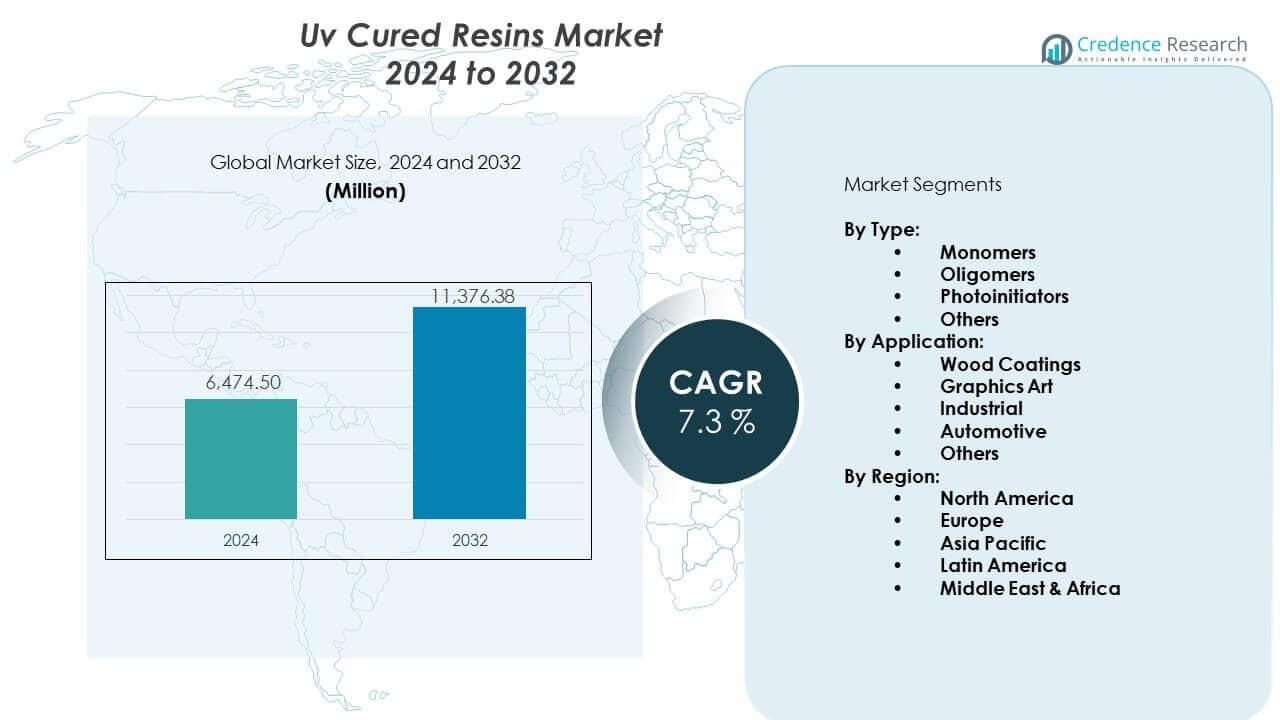
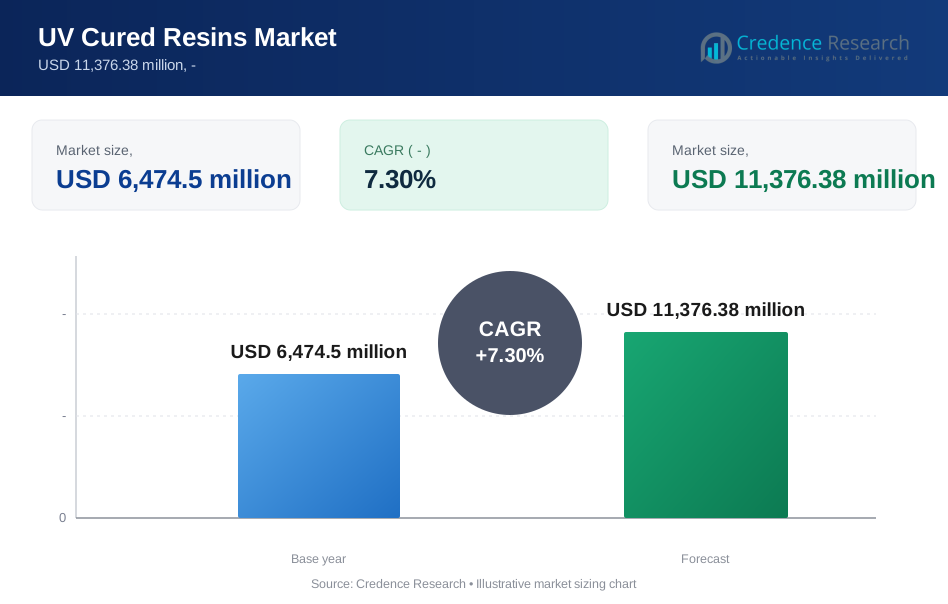
The Uv Cured Resins Market is projected to grow from USD 6474.5 million in 2024 to an estimated USD 11376.38 million by 2032, with a compound annual growth rate (CAGR) of 7.3% from 2024 to 2032.
| REPORT ATTRIBUTE | DETAILS |
|---|---|
| Historical Period | 2020-2023 |
| Base Year | 2024 |
| Forecast Period | 2025-2032 |
| Uv Cured Resins Market Size 2024 | USD 6474.5 Million |
| Uv Cured Resins Market, CAGR | 7.3% |
| Uv Cured Resins Market Size 2032 | USD 11376.38 Million |
Growth is driven by rising use across coatings, adhesives, and 3D printing applications. Manufacturers favor these resins due to fast curing, low emissions, and strong surface durability. Demand strengthens in electronics, where compact components require precise and stable resin performance. Automotive suppliers adopt UV-cured systems to speed finishing cycles. Packaging producers shift to UV coatings to meet sustainability goals.
Asia Pacific leads due to strong industrial expansion and high resin adoption in electronics, automotive, and printing. China, Japan, and South Korea remain major contributors because of advanced manufacturing capacity. North America grows steadily due to technological upgrades and wider adoption in medical and industrial applications. Europe follows with strong demand for eco-friendly coatings. Emerging markets in Southeast Asia and Latin America increase usage as local industries scale production.
Market Insights:
- The Uv cured resins market stands at USD 6,474.5 million in 2024 and is projected to reach USD 11,376.38 million by 2032, growing at a 7.3% CAGR during the forecast period.
- Asia Pacific (39%), North America (28%), and Europe (26%) hold the largest shares due to strong manufacturing bases, high UV-coating adoption, and strict VOC regulations that encourage faster curing technologies.
- Asia Pacific is also the fastest-growing region, supported by rapid expansion in electronics, automotive, and printing industries across China, Japan, India, and Southeast Asia.
- The Wood Coatings segment leads the market with an estimated 30% share, driven by strong demand for durable, low-emission finishes across furniture and flooring.
- The Industrial segment follows at roughly 25%, supported by high use of UV systems in electronics, metal parts, and packaging applications.
Market Drivers:
Rising Demand for Fast-Curing Coating Systems
The Uv cured resins market expands due to high demand from industries that need fast drying systems. Manufacturers prefer UV coatings because they raise output and cut waiting time. The technology helps users meet low-VOC standards set by global rules. Electronics players rely on UV systems to protect fine components. Automotive units use UV curing to speed painting cycles. Packaging firms integrate UV coatings to improve surface finish. Wood and furniture producers shift toward safer chemistries. It supports wider adoption across large production clusters.
- For instance, allnex reports that switching textile and leather lines from thermo-curing to UV/EB energy-curable resins can deliver 70–80% energy savings while 100%-solids UV coatings achieve little to no VOC emissions.
Growing Use in Electronics and Precision Components
Rising use in electronics strengthens growth for the Uv cured resins market. Makers of sensors and boards rely on UV systems for stable performance. The resins help protect parts from heat, dust, and chemical exposure. Precision goods need uniform coats that UV systems deliver with high accuracy. LED makers depend on UV adhesives for strong bonding. Flexible electronics benefit from lower heat output during curing. Firms prefer cleaner coating steps to reduce defects. It helps factories maintain stable yield across advanced lines.
- For instance, Henkel’s cationic UV pressure-sensitive adhesives support through-cure at coat weights double to triple those of traditional systems while lowering energy consumption in electronics and label lines.
Shift Toward Sustainable and Low-Emission Materials
Sustainability goals raise demand for safer UV resin systems. UV curing cuts emissions across coating and printing units. Many regions enforce strict limits on solvent use. Furniture and décor firms adopt UV coatings to reduce odor and improve indoor air quality. Medical and food packaging segments depend on cleaner formulas for safer handling. Low-emission coatings help brands gain stronger ratings. Users aim to switch from solvent systems to UV chemistries. It supports long-term adoption across regulated markets.
Expanding Use in 3D Printing and Additive Manufacturing
Wider use in 3D printing creates strong momentum across industries. UV-curable resins support sharper edges and stable layering. Dental labs use UV materials for repeatable shaping of trays and models. Designers gain smoother parts for prototype testing. New UV blends improve surface texture in industrial prints. Custom manufacturing relies on UV curing for fast throughput. Additive facilities invest in stable resin grades for consistent strength. It creates new pathways for future growth.
Market Trends:
Rising Preference for LED-Based UV Curing Equipment
Users shift to LED curing due to lower heat, safer use, and long operating life. LED tools cut energy use and provide stable beam output. Printers choose LED systems for heat-sensitive films. Electronics players depend on LED curing for cleaner steps. LED units allow compact workstation design across factories. The shift reduces maintenance downtime. The Uv cured resins market aligns well with LED-compatible grades. It encourages upgrades across many industries.
- For instance, industry data show UV LED curing systems can reduce energy consumption by about 50–75% compared with conventional mercury lamps while extending lamp life and improving curing on heat-sensitive substrates.
Expansion of Bio-Based and Hybrid Resin Formulations
Producers launch bio-based variants to meet sustainability standards. Hybrid blends improve hardness, flexibility, and chemical stability. Medical users favor these resins for safer coating needs. Packaging converters test bio-resins to lower carbon output. New feedstock sources help reduce environmental load. Hybrid chemistries support better wear resistance. The Uv cured resins market benefits from interest in green materials. It drives trials across multiple product lines.
- For instance, Arkema’s Sartomer and Sarbio UV-curable lines offer bio-attributed and bio-segregated monomers and oligomers with up to 85–88% biobased content and reported carbon-footprint reductions of up to 40% for selected grades.
Higher Adoption in Luxury Goods and High-Gloss Finishes
Demand grows across luxury goods that need durable and high-shine surfaces. UV systems deliver bright finishes without long curing cycles. Home décor goods use UV layers for lasting color stability. Toys gain strong gloss with UV coatings. Metal and plastic parts benefit from improved surface strength. New resin grades maintain shine under frequent handling. High-gloss finishes gain wider retail attention. It helps brands meet rising consumer expectations.
Integration with Smart Manufacturing and Digital Printing Units
Digital printing pushes strong demand for UV-stable inks. UV chemistries allow sharp print edges at high speeds. Packaging converters rely on UV systems for short and custom runs. Smart plants integrate real-time curing checks to avoid defects. Automation tools guide resin flow across print lines. The Uv cured resins market aligns with rising industrial digitalization. Data systems support better process control. It strengthens adoption across advanced plants.
Market Challenges Analysis:
High Cost of Advanced Curing Equipment and Skilled Operation
The Uv cured resins market faces issues linked to equipment cost. LED curing units cost more than thermal systems and delay adoption. Smaller plants struggle to justify early investment. Skilled operators are needed for accurate curing setup. Variations in line speed create quality problems. Resin grades need exact pairing with curing tools. Training requirements keep barriers high for new users. It slows penetration in cost-sensitive markets.
Regulatory Variations and Instability in Raw Material Supply
Regulatory differences across countries create compliance hurdles. Some regions need extensive testing for market entry. Raw material shortages disrupt steady resin output. Feedstock price changes affect smaller producers. Chemical checks raise documentation pressure. Import rules lead to delays for many users. Firms seek stable supply partnerships to avoid downtime. It increases pressure on producers in regulated regions.
Market Opportunities
Rising Potential in Medical Devices and Dental Manufacturing
The Uv cured resins market gains momentum from medical and dental applications. These sectors need precise curing and clean surfaces. Dental aligner makers use UV blends for accurate shaping. Medical device firms test UV coatings for biocompatible finishes. Health tech investment supports newer applications. Clinics adopt 3D printers with UV materials. Demand for custom devices expands growth scope. It creates long-term commercial opportunity.
Expanding Scope Across Fast-Growth Packaging and Consumer Goods
Packaging units need durable coatings that maintain label clarity. Folding boxes gain strong edge protection with UV coatings. Electronics makers use UV bonds for compact assemblies. E-commerce growth increases demand for clean print quality. UV inks support sharp graphics for branding goals. Consumer firms test new resin blends for product design upgrades. The Uv cured resins market gains traction across retail packaging. It helps producers capture emerging demand waves.
Market Segmentation Analysis:
By Type
The Uv cured resins market features four primary material categories that support varied industrial needs. Monomers hold a strong role because they provide fast curing and help producers achieve smooth film formation. Oligomers gain wide use due to strong mechanical strength and chemical resistance in high-performance coatings. Photoinitiators drive polymerisation efficiency and support precise curing across electronics and graphics work. The remaining category covers specialty blends tailored for niche uses where custom performance is needed. Each type supports different production cycles, and it strengthens market flexibility across sectors.
- For instance, market studies highlight oligomers and waterborne UV resins as leading revenue contributors in UV-curable systems, while Sartomer’s ISCC+ certified monomer and oligomer range now includes grades with up to 85% biobased content.
By Application
Key applications define long-term demand across several industrial segments. Wood coatings maintain steady growth due to strong adoption in furniture, flooring, and decorative surfaces that need durable and low-emission finishes. Graphics art uses UV-curable inks and coatings for sharp print quality, fast drying, and higher run efficiency. Industrial uses cover electronics, metal parts, and packaging where UV systems improve consistency and throughput. Automotive demand grows with the need for scratch-resistant and quick-curing layers. Other uses expand across plastics, medical items, and custom components that benefit from stable curing. The Uv cured resins market supports each segment with tailored grades that match specific performance targets.
- For instance, BASF and allnex report that waterborne and UV/EB automotive and industrial coatings can deliver rapid cure with substantial energy savings and near-zero VOC levels while maintaining high hardness and solvent resistance on wood, metal, and plastic substrates.
Segmentation:
By Type:
- Monomers
- Oligomers
- Photoinitiators
- Others
By Application:
- Wood Coatings
- Graphics Art
- Industrial
- Automotive
- Others
By Region:
- North America
- U.S.
- Canada
- Mexico
- Europe
- Germany
- France
- U.K.
- Italy
- Spain
- Rest of Europe
- Asia Pacific
- China
- Japan
- India
- South Korea
- South-east Asia
- Rest of Asia Pacific
- Latin America
- Brazil
- Argentina
- Rest of Latin America
- Middle East & Africa
- GCC Countries
- South Africa
- Rest of the Middle East and Africa
Regional Analysis:
North America
North America holds an estimated 28% share of the Uv cured resins market, supported by strong use across industrial coatings, electronics, and packaging. Demand grows due to the region’s early adoption of UV-curing systems and strict VOC rules that encourage safer chemistries. The U.S. leads production with large suppliers and advanced curing infrastructure across manufacturing hubs. Canada contributes steady demand from wood coatings and commercial printing. Local firms upgrade curing lines to meet higher productivity standards. The market benefits from rising use in automotive refinish and electronic component protection. It continues to expand with new investments in LED-based curing systems.
Europe
Europe accounts for nearly 26% share, driven by strong regulatory pressure for low-emission coatings and advanced industrial processes. The region benefits from mature manufacturing clusters in Germany, the U.K., France, and Italy. Wood coatings and graphics art remain major contributors due to strong furniture production and packaging operations. UV adoption rises across automotive suppliers that seek faster curing cycles and improved surface durability. Eastern Europe provides new opportunities through expanding metal and plastic part production. The Uv cured resins market gains support from European firms that focus on bio-based and hybrid resin innovation. It remains a priority region for sustainable technology deployment.
Asia Pacific, Latin America, and Middle East & Africa
Asia Pacific commands the largest global share at nearly 39%, driven by rapid industrial growth in China, Japan, India, and Southeast Asia. Electronics, automotive, and printing industries scale production, creating strong demand for UV-curable systems. Latin America holds around 4% share, with growth led by Brazil and Mexico through packaging and wood finishing applications. Middle East & Africa account for close to 3% share, supported by GCC investments in industrial and construction coatings. Emerging economies adopt UV systems to improve output and meet stricter environmental expectations. The Uv cured resins market gains momentum in these regions through expanding manufacturing bases and rising demand for fast-curing materials.
Key Player Analysis:
- BASF SE
- Henkel AG & Co. KGaA
- Arkema SA / Arkema Group
- DIC Corporation
- Miwon Specialty Chemical Co., Ltd.
- Asahi Kasei Corporation
- Evonik Industries AG
- Shin-Etsu Chemical Co., Ltd.
- Huntsman Corporation
- RPM International Inc.
- 3M Company
- Allnex Netherlands B.V.
- Dow Chemical Company
- Eastman Chemical Company
- Covestro AG
- IGM Resins
- Wanhua Chemical Group Co., Ltd.
Competitive Analysis:
The Uv cured resins market features strong competition among global chemical majors and specialized UV players. Large companies such as BASF, Arkema, Allnex, Covestro, Wanhua, Henkel, and Evonik compete on technology depth, product breadth, and regional reach. Mid-sized suppliers and niche firms focus on photoinitiators, waterborne UV systems, and custom oligomer lines. Pricing pressure remains high in commoditized monomers, while specialty oligomers and initiators command stronger margins. Partnerships with coating formulators, printers, and OEMs shape long-term supply contracts. Strong R&D pipelines, regulatory compliance, and sustainability credentials influence buyer preference across key regions. It remains a technology-driven market where innovation and service support are central advantages.
Recent Developments:
- In September 2025, BASF SE formed a partnership with AkzoNobel and Arkema to lower the carbon footprint of architectural powder coatings. This collaboration aims to drive reduced carbon emissions in the paint and coatings industry by leveraging renewable bio-attributed raw materials supplied by BASF. The partnership published an industry case study highlighting the transition to more sustainable, lower emission powder coatings, which play a key role in decarbonizing the built environment.
Report Coverage:
The research report offers an in-depth analysis based on By Type (Monomers, Oligomers, Photoinitiators, Others) and By Application (Wood Coatings, Graphics Art, Industrial, Automotive, Others). It details leading market players, providing an overview of their business, product offerings, investments, revenue streams, and key applications. Additionally, the report includes insights into the competitive environment, SWOT analysis, current market trends, as well as the primary drivers and constraints. Furthermore, it discusses various factors that have driven market expansion in recent years. The report also explores market dynamics, regulatory scenarios, and technological advancements that are shaping the industry. It assesses the impact of external factors and global economic changes on market growth. Lastly, it provides strategic recommendations for new entrants and established companies to navigate the complexities of the market.
Future Outlook:
- Demand will rise from wood coatings and furniture due to low-VOC and fast-curing needs.
- Graphics and digital printing will expand usage for high-speed, high-quality print runs.
- Growth in electronics and microcomponents will support more protective UV formulations.
- 3D printing and additive manufacturing will create new resin design opportunities.
- Bio-based and waterborne UV systems will gain share under strict regulatory rules.
- LED-based curing lines will replace traditional lamps in many production plants.
- Regional producers will scale capabilities in Asia Pacific and emerging economies.
- Strategic partnerships will deepen between resin makers and coating formulators.
- Innovation in photoinitiators will improve cure speed and energy efficiency.
- It will benefit from rising investments in sustainable and efficient coating technologies.
Request a Free Sample
Fill in your details and we'll send you a free sample report.
- Sample data tables & charts
- Research methodology
Need a Custom Version of This Report?
Tailor the scope, geography, or segments to your exact requirements.
- Custom geography or segment scope
- Direct access to our analyst team
Frequently Asked Questions
What is the current market size for Uv cured resins market, and what is its projected size in 2032?
At what Compound Annual Growth Rate is the Uv cured resins market projected to grow between 2024 and 2032?
Which Uv cured resins market segment held the largest share in 2024?
What are the primary factors fueling the growth of the Uv cured resins market?
Who are the leading companies in the Uv cured resins market?
Which region commanded the largest share of the Uv cured resins market in 2024?
Table of Content
Chapter 1. Report Introduction
- 1.1 Report Description & Purpose
- 1.1.1 Report Title & Market Definition
- 1.1.2 Unique Selling Propositions (USP) & Key Differentiators
- 1.1.3 Value Proposition for Stakeholders
- 1.2 Research Objectives
- 1.2.1 Market Sizing Objectives (Volume & Revenue)
- 1.2.2 Segmentation Objectives
- 1.2.3 Competitive Intelligence Objectives
- 1.2.4 Forecast & Scenario Objectives
- 1.3 Report Scope
- 1.3.1 UV Cured Resins Scope – Types & Subtypes Covered
- 1.3.2 Geographic Scope – Regions & Countries Covered
- 1.3.3 Historical Period, Base Year & Forecast Period (the historical period; forecast to the forecast period)
- 1.3.4 Inclusions & Exclusions
- 1.4 HS Code & Classification Framework
- 1.5 Currency, Units & Pricing Basis
- 1.6 Target Stakeholders
- 1.7 Limitations & Assumptions
Chapter 2. Executive Summary
- 2.1 Global UV Cured Resins Market Snapshot
- 2.1.1 Market Size – Historical (the historical period) & Forecast (the forecast period) (base year: USD 6,474.5 million → forecast year: USD 11,376.38 million)
- 2.1.2 Volume & Revenue – Global Totals
- 2.1.3 Key Market Highlights – Top Five Facts
- 2.2 UV Cured Resins Market Segmentation Snapshot
- 2.2.1 Market Split by Region – vs.
- 2.3 Competitive Snapshot
- 2.3.1 Top 10 Players by Revenue Share –
- 2.3.2 Top 10 Players by Volume Share –
- 2.3.3 Recent Strategic Developments (18-Month Summary)
- 2.4 Key Investment Highlights & Strategic Conclusions
Chapter 3. UV Cured Resins Market Dynamics & Industry Analysis
- 3.1 Market Overview & Context
- 3.1.1 UV Cured Resins Market Position in the Broader Automotive Value Chain
- 3.1.2 OEM vs. Replacement Market Dynamics
- 3.1.3 Market Maturity & Development Stage by Region
- 3.2 UV Cured Resins Market Drivers
- 3.3 UV Cured Resins Market Restraints & Challenges
- 3.4 UV Cured Resins Market Opportunities
- 3.5 Porter's Five Forces Analysis
- 3.5.1 Threat of New Entrants
- 3.5.2 Bargaining Power of Suppliers
- 3.5.3 Bargaining Power of Buyers
- 3.5.4 Threat of Substitutes
- 3.5.5 Competitive Rivalry – Intensity Assessment
- 3.6 UV Cured Resins Value Chain Analysis
- 3.6.1 Upstream – Raw Material/Input Suppliers
- 3.6.1.1 Raw Material/Input 1
- 3.6.1.2 Raw Material/Input 2
- 3.6.1.3 Raw Material/Input 3
- 3.6.2 Midstream – Production/Manufacturing/Service Delivery
- 3.6.2.1 Production/Process Overview
- 3.6.2.2 Key Facility Locations & Capacity by Manufacturer
- 3.6.3 Downstream – Distribution & End Consumer
- 3.6.3.1 Primary Channel – B2B/OEM
- 3.6.3.2 Secondary Channels – Dealer, Retail, Online, Direct
- 3.6.4 Value Chain Profitability Analysis
- 3.6.1 Upstream – Raw Material/Input Suppliers
- 3.7 PESTEL Analysis
- 3.7.1 Political Factors
- 3.7.2 Economic Factors
- 3.7.3 Social Factors
- 3.7.4 Technological Factors
- 3.7.5 Environmental Factors
- 3.7.6 Legal Factors
- 3.8 UV Cured Resins Supply Chain Analysis
- 3.8.1 Raw Material/Input Supply Risk Assessment
- 3.8.2 Manufacturing Concentration Risk (Geographic Exposure)
- 3.8.3 Trade Disruption Impact Analysis
- 3.9 Regulatory & Policy Landscape
Note: The regulatory and policy landscape section covers regulations based on their applicability to the market, UV Cured Resins category, geography, and scope of the study. Only regulatory frameworks with a material impact on operations, compliance, trade, sustainability, or market access are analyzed in detail.
Chapter 4. Key Investment Pockets & Opportunity Analysis
- 4.1 UV Cured Resins Market Attractiveness Analysis
- 4.1.1 By Region – Investment Attractiveness Matrix (Volume × CAGR)
- 4.2 Absolute Revenue Growth Opportunity
- 4.2.1 By Region – Absolute USD Growth Through the forecast period
- 4.3 Incremental Volume Opportunity
- 4.3.1 By Region – Incremental Volume Through the forecast period
- 4.3.2 Segment – Incremental Volume
- 4.4 Emerging Submarket Opportunity Deep Dive (Subject to Applicability)
- 4.5 Emerging Market Opportunity Scorecards
- 4.5.1 United States
- 4.5.2 Europe
- 4.5.3 Asia
- 4.5.4 Middle East & Africa
Note: Emerging Market Opportunity Scorecards will be included based on relevance and strategic importance. Regions listed are indicative and may vary depending on data availability and market dynamics.
Chapter 5. UV Cured Resins Import-Export Analysis & Trade Flows
- 5.1 Global Trade Overview
- 5.1.1 Global Export Value by Country (the historical period)
- 5.1.2 Global Export Volume by Country (the historical period)
- 5.1.3 Global Import Value by Country (the historical period)
- 5.1.4 Global Import Volume by Country (the historical period)
- 5.1.5 Net Trade Balance by Country (the historical period)
- 5.2 Export Analysis – Segment
- 5.2.1 Type 1 (HS Code)
- 5.2.2 Type 2 (HS Code)
- 5.2.3 Type 3 (HS Code)
- 5.2.4 Type 4 (HS Code)
- 5.2.5 Type 5 (HS Code)
- 5.3 Import Analysis – Segment
- 5.3.1 Type 1 (HS Code)
- 5.3.2 Type 2 (HS Code)
- 5.3.3 Type 3 (HS Code)
- 5.3.4 Type 4 (HS Code)
- 5.3.5 Type 5 (HS Code)
- 5.4 Average Unit Trade Prices
- 5.4.1 Average Export Price – Segment & Country
- 5.4.2 Average Import Price – Segment & Source Country
- 5.4.3 Price Trends (the historical period)
- 5.5 Key Trade Route Analysis
- 5.5.1 Trade Route 1
- 5.5.2 Trade Route 2
- 5.5.3 Trade Route 3
- 5.5.4 Trade Route 4
- 5.5.5 Trade Route 5
- 5.6 Trade Policy Impact Assessment
- 5.6.1 US Anti-Dumping & Section 301 Tariffs
- 5.6.2 EU Customs Union Impact
- 5.6.3 Major Free Trade Agreements
- 5.6.4 USMCA Rules of Origin
Note: Trade policy analysis will be included only where relevant to the UV Cured Resins market.
Chapter 6. Competitive Landscape & Company Benchmarking
- 6.1 UV Cured Resins Market Concentration & Structure
- 6.1.1 Herfindahl-Hirschman Index (HHI) – vs.
- 6.1.2 Tier 1, Tier 2 & Tier 3 Market Structure
- 6.1.3 Global, Regional & Local Player Dynamics
- 6.2 UV Cured Resins Market Share Analysis –
- 6.2.1 Global Revenue Share by Company
- 6.2.2 Global Volume Share by Company
- 6.2.3 Regional Revenue Share
- 6.2.4 Market Share Evolution ( vs. )
- 6.2.5 OEM Segment Share by Company
- 6.2.6 Replacement Segment Share by Company
- 6.3 Production/Delivery Capacity & Facility Analysis
- 6.3.1 Global Installed Capacity
- 6.3.2 Capacity Utilization Rates
- 6.3.3 Production/Output Volume
- 6.3.4 Facility Locations & Capacity Map
- 6.3.5 Planned Capacity Additions
- 6.4 UV Cured Resins Competitive Benchmarking Matrix
- 6.4.1 Revenue, Volume, CAGR & Profitability Comparison
- 6.4.2 Channel Revenue Mix
- 6.4.3 Geographic Revenue Exposure
- 6.4.4 R&D Intensity
- 6.4.5 Sustainability Maturity
- 6.5 Strategic Developments in UV Cured Resins (Last 24 Months)
- 6.5.1 Mergers, Acquisitions & Divestments
- 6.5.2 New UV Cured Resins Launches
- 6.5.3 Facility Expansions
- 6.5.4 Strategic Alliances, Joint Ventures & Partnerships
- 6.5.5 Distribution Expansion & Market Entry
- 6.5.6 Sustainability & ESG Initiatives
- 6.6 Competitive Strategy Mapping
- 6.6.1 Leader, Challenger, Follower & Niche Classification
- 6.6.2 Pricing Strategy Comparison
- 6.6.3 Channel Strategy Matrix
Note: Strategic developments are included based on their materiality and the availability of reliable information.
Chapter 7. Global UV Cured Resins Market – By Distribution Channel
- 7.1 Segment Overview
- 7.1.1 Volume & Revenue Split by Channel ( & )
- 7.1.2 Channel Mix Evolution (the forecast period)
Chapter 8. Regional Market Analysis – Global Overview
- 8.1 Global Regional Overview
- 8.1.1 Regional Volume Share
- 8.1.2 Regional Revenue Share
- 8.1.3 Regional Volume by Region
- 8.1.4 Regional Revenue by Region
- 8.1.5 Regional Forecast Through the forecast period
- 8.2 Cross-Regional Segment Analysis
- 8.2.1 By Distribution Channel
- 8.2.2 By Brand/Price Tier
Chapter 9. North America UV Cured Resins Market
- 9.1 United States
- 9.2 Canada
- 9.3 Mexico
Chapter 10. Europe UV Cured Resins Market
- 10.1 Germany
- 10.2 France
- 10.3 Italy
- 10.4 United Kingdom
- 10.5 Spain
- 10.6 Poland
- 10.7 Russia
- 10.8 Netherlands
- 10.9 Belgium
- 10.10 Sweden
- 10.11 Denmark
- 10.12 Norway
- 10.13 Rest of Europe
Chapter 11. Asia Pacific UV Cured Resins Market
- 11.1 China
- 11.2 India
- 11.3 Japan
- 11.4 South Korea
- 11.5 Thailand
- 11.6 Indonesia
- 11.7 Vietnam
- 11.8 Malaysia
- 11.9 Australia
- 11.10 Rest of Asia Pacific
Chapter 12. Latin America UV Cured Resins Market
- 12.1 Brazil
- 12.2 Argentina
- 12.3 Colombia
- 12.4 Chile
- 12.5 Rest of Latin America
Chapter 13. Middle East UV Cured Resins Market
- 13.1 Saudi Arabia
- 13.2 United Arab Emirates
- 13.3 Turkey
- 13.4 Israel
- 13.5 Iran
- 13.6 Rest of the Middle East
Chapter 14. Africa UV Cured Resins Market
- 14.1 South Africa
- 14.2 Egypt
- 14.3 Nigeria
- 14.4 Morocco
- 14.5 Rest of Africa
Chapter 15. UV Cured Resins Company Profiles
- 15.1 [Company 01]
- 15.1.1 Company Overview
- 15.1.2 Key Management Personnel
- 15.1.3 Products & Services Portfolio
- 15.1.4 Financial Performance
- 15.1.5 Key Market Focus & Geographic Presence
- 15.1.6 Recent Developments & Strategic Initiatives
Note: The company profile list is preliminary and may change based on research findings, market developments, data availability, and client requirements.
Chapter 16. Appendices
- Appendix A – List of Abbreviations & Acronyms
- Appendix B – Industry Classification Code Reference – Full Series
- Appendix C – Production & Capacity Data Tables
- Appendix D – End-Use & Demand Base Tables
- Appendix E – Consumption & Replacement Rate Assumptions
- Appendix F – ASP Reference Tables
- Appendix G – Manufacturing & Facility Database
- Appendix H – Import-Export Data Tables
- Appendix I – Regulatory Summary Tables
- Appendix J – Primary Research Participant List (Anonymized)
- Appendix K – Primary Research Questionnaire Framework
- Appendix L – Data Sources & Bibliography
- Appendix M – Market Size Divergence & Source Comparison
Chapter 17. Research Methodology
- 17.1 Research Framework & Philosophy
- 17.2 Secondary Research – Sources, Hierarchy & Data Extraction
- 17.3 Data Modeling – Bottom-Up & Top-Down Market Sizing
- 17.4 Primary Research – Stakeholder Framework, LOI & Sample Sizes
- 17.5 Forecast Methodology – Regression, Scenario & Sensitivity Analysis
- 17.6 Quality Control – Four-Layer Validation Framework
- 17.7 Limitations & Standard Assumptions
- 17.8 Disclaimer
