
Market Overview:
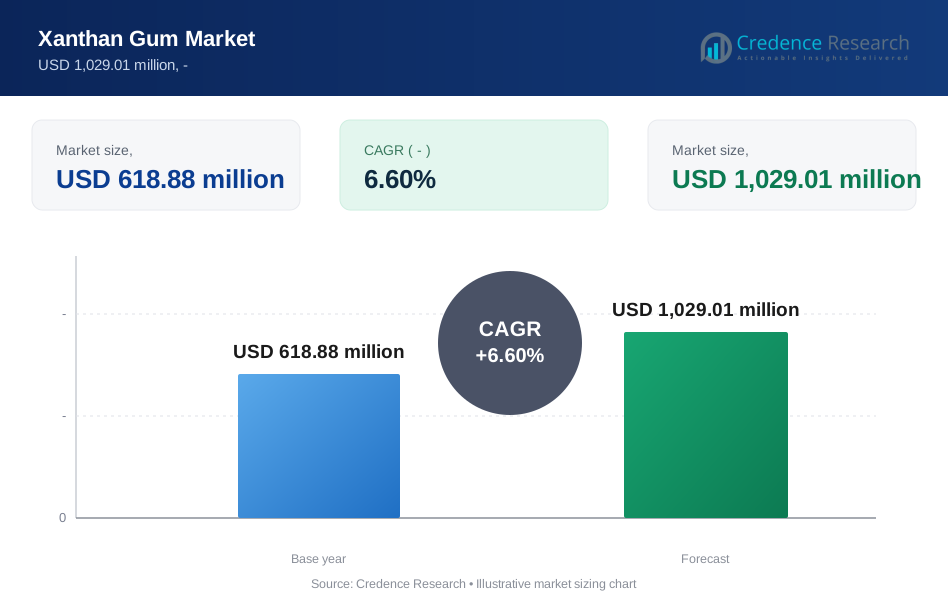
The Global Xanthan Gum Market size was valued at USD 427.32 million in 2018 to USD 618.88 million in 2024 and is anticipated to reach USD 1,029.01 million by 2032, at a CAGR of 6.60% during the forecast period.
| REPORT ATTRIBUTE | DETAILS |
|---|---|
| Historical Period | 2020-2023 |
| Base Year | 2024 |
| Forecast Period | 2025-2032 |
| Xanthan Gum Market Size 2024 | USD 618.88 million |
| Xanthan Gum Market, CAGR | 6.60% |
| Xanthan Gum Market Size 2032 | USD 1,029.01 million |
The market thrives due to rising demand in food and beverage, pharmaceuticals, cosmetics, and oil and gas sectors. It reflects steady, demand-driven growth across multiple industries. Manufacturers increasingly adopt xanthan gum as a natural thickener and stabilizer-its ability to enhance texture, stability, and shelf life fits well with clean-label and gluten-free trends. Simultaneously, its biodegradability and rheological properties support oilfield and drilling applications. Additionally, ongoing process improvements in fermentation and extraction lower costs and improve supply chain efficiency.
Regionally, the Asia‑Pacific region leads consumption and production, driven by strong food processing growth, rising urbanization, and cost-effective manufacturing infrastructure in China, India, and Southeast Asia. North America and Europe maintain significant demand through robust health‑conscious food, personal care, and pharmaceutical sectors. Meanwhile, the Middle East & Africa and Latin America are emerging markets, fuelled by expanding oil and gas exploration and increased consumption of processed foods. Cost‑efficient raw materials and regulatory support facilitate their growth trajectories.

Market Insights:
- The Global Xanthan Gum Market was valued at USD 427.32 million in 2018, increased to USD 618.88 million in 2024, and is projected to reach USD 1,029.01 million by 2032, growing at a CAGR of 6.60%.
- The food and beverage sector accounts for a significant portion of demand, with xanthan gum widely used in gluten-free products, sauces, and dairy due to its stability across pH 2–10 and shelf-life extension.
- The oil & gas industry utilizes xanthan gum in drilling fluids, especially in deep-sea and shale operations, driven by thermal stability above 100°C and solid suspension capabilities in countries like the U.S. and Saudi Arabia.
- The pharmaceutical and personal care sectors are expanding usage in syrups, tablets, creams, and gels, benefiting from xanthan gum’s non-toxic, non-irritant, and stable nature; demand aligns global pharma market.
- The clean-label and eco-friendly trend is accelerating xanthan gum demand as it is biodegradable and derived through natural fermentation from corn or wheat, aligning with green chemistry and sustainability certifications.
- Market growth is restrained by raw material supply volatility, with sugar sources like corn and wheat influenced by climate events, geopolitical risks, and commodity price shifts, leading to cost fluctuations in production.
- Asia Pacific holds the largest market share, led by China and India due to low-cost manufacturing and growing processed food consumption; North America and Europe follow with demand from health-conscious and pharmaceutical sectors; Latin America and MEA are emerging regions driven by oil exploration and rising packaged food demand.
Market Drivers:
Rising Demand in Food Industry:
Global Xanthan Gum Market is witnessing strong growth due to the rising demand for natural food additives in the food and beverage sector. Xanthan gum acts as a thickener and stabilizer in salad dressings, sauces, dairy products, and gluten-free bakery items. Consumers increasingly prefer plant-based, clean-label products that align with health-conscious lifestyles. Food manufacturers use xanthan gum to improve product texture and shelf stability. The additive’s ability to perform across a wide pH range makes it versatile. Government approvals for food-grade usage further boost demand. Fast-food chains and ready-to-eat meals are also contributing to market expansion.
- For instance, xanthan gum plays a critical role in water-based drilling fluids, enhancing viscosity, thermal stability, and solid suspension under varied operational conditions. Its usage ensures stability of drilling operations, particularly in demanding environments such as deep-well and shale drilling.
Oil & Gas Industry Applications:
Global Xanthan Gum Market benefits from growing oil and gas exploration activities worldwide. Xanthan gum is extensively used in drilling fluids to maintain viscosity and suspend solids. Its high thermal stability makes it ideal for harsh environments in deep-sea and shale gas drilling. Companies in North America and the Middle East are investing in energy infrastructure, increasing the uptake of industrial-grade xanthan gum. Innovations in extraction techniques are further enhancing its usage. The demand for energy security and fuel independence continues to sustain its growth. Customized formulations have widened application in enhanced oil recovery techniques.
- For instance, Bob's Red Mill produces gluten-free flour blends that include xanthan gum as a key ingredient for structure and texture. Their "1-to-1" baking flours and other mixes use xanthan gum as a gluten substitute, ensuring safe consumption for those with celiac disease or gluten sensitivity.
Pharmaceutical & Personal Care Growth:
Global Xanthan Gum Market is expanding in pharmaceutical and personal care sectors. It serves as a suspending agent in syrups, creams, gels, and tablets, offering consistent drug delivery and product uniformity. Its non-toxic, non-irritant, and stable characteristics make it ideal for dermatological and ophthalmic formulations. In cosmetics, xanthan gum improves product texture, stabilizes emulsions, and enhances sensory feel. Consumers’ preference for natural, skin-friendly products is accelerating adoption. Regulatory compliance and cost-effective sourcing also encourage pharmaceutical manufacturers to choose xanthan gum. Product innovation in skincare and topical delivery systems further supports market growth.
Shift Toward Eco-Friendly Additives:
Global Xanthan Gum Market aligns with sustainability trends in chemical and food industries. Being biodegradable and derived from natural fermentation, xanthan gum is favored as an environmentally friendly additive. Manufacturers and consumers are moving away from synthetic thickeners, increasing reliance on microbial polysaccharides. Regulatory pressure to reduce synthetic ingredients and plasticizers in packaged foods and personal care is boosting natural gum demand. Green chemistry innovations are reducing energy and water usage in xanthan gum production. Its role in biodegradable formulations, including paints and household cleaners, expands its market reach. Sustainability certifications and traceability add competitive advantage.
Market Trends:
Surge in Vegan and Gluten-Free Products:
Global Xanthan Gum Market is driven by increased consumer preference for vegan and gluten-free diets. As a versatile stabilizer, xanthan gum is used in plant-based meat alternatives, dairy-free desserts, and gluten-free baked goods. The trend is especially prominent in North America and Europe, where health-conscious consumers demand transparent labeling. Food brands reformulate legacy products using xanthan gum to meet evolving dietary needs. This shift is fueling demand across retail and foodservice. Manufacturers are scaling operations to cater to specialty product makers. E-commerce is accelerating access to xanthan gum in home-cooking kits and wellness-focused bundles.
- For instance, The fermentation process for xanthan gum production is routinely optimized by industry players, with studies showing yields up to 11.19 g/L using selected strains under controlled agitation and inoculation parameters.
Innovation in Formulation Technology:
Global Xanthan Gum Market is evolving with advancements in fermentation technology and formulation optimization. Companies are investing in precision fermentation to increase yield, reduce impurities, and create specialized grades for niche applications. R&D initiatives are enhancing solubility, shear-thinning behavior, and heat stability of xanthan gum. These improvements enable its broader use across complex industrial environments. Enhanced compatibility with other hydrocolloids is expanding its usage in multifunctional blends. These innovations are also supporting custom applications in pharmaceuticals and construction materials.
- For instance, Cargill is a prominent global supplier of xanthan gum for food and beverage applications, offering bulk supplies that comply with regulatory and safety requirements. Their xanthan gum is utilized for texture enhancement in bakery products, sauces, dressings, dairy, ice cream, and other foods, and it is produced in ISO-certified facilities.
Expansion in Emerging Markets:
Global Xanthan Gum Market is growing rapidly in Asia Pacific, Latin America, and the Middle East due to industrial expansion and improved food processing capabilities. Government policies favoring investment in agriculture and manufacturing are encouraging xanthan gum use in multiple sectors. Local production capacity in China and India is expanding, lowering dependence on imports. Rising disposable income and urbanization are boosting consumption of processed foods, personal care items, and pet foods. Distributors are building local partnerships to ensure market penetration. The affordability of xanthan gum compared to synthetic alternatives supports adoption among small-scale producers.
Rise of E-commerce and D2C Channels:
Global Xanthan Gum Market is benefiting from the growth of direct-to-consumer (D2C) brands and e-commerce platforms. Specialty and clean-label food companies are leveraging online sales to reach niche consumer bases. Xanthan gum’s versatility and shelf stability make it ideal for small-batch and home-prepared formulations. Online retailers also cater to DIY cosmetic and health food markets, where xanthan gum is sold as an additive. The convenience of e-commerce drives bulk purchases and subscription models. Global logistics improvements and digital marketing help expand visibility for xanthan gum suppliers across regions.
Market Challenges Analysis:
Volatility in Raw Material Supply Chains Hampers Growth:
Global Xanthan Gum Market faces disruption due to fluctuations in raw material availability and pricing. The primary substrate for xanthan gum production is derived from sugar sources like corn and wheat, which are susceptible to geopolitical issues, climate variability, and export restrictions. Supply chain disruptions affect fermentation yields, increase production costs, and lead to pricing instability. Manufacturers struggle to maintain consistent profit margins when facing raw material shortages and energy price volatility. These fluctuations create challenges in long-term production planning and pricing strategy for key industry players.
Intense Competition from Substitute Hydrocolloids:
Global Xanthan Gum Market is under competitive pressure from alternative thickeners and stabilizers such as guar gum, carrageenan, gellan gum, and cellulose derivatives. These substitutes offer similar functionalities and are often priced competitively. Some industries prefer substitutes due to regional availability, regulatory approval, or application-specific performance. New product innovations in substitute hydrocolloids reduce market share opportunities for xanthan gum. This challenge requires sustained product differentiation, brand loyalty, and regulatory clarity to maintain xanthan gum’s position in various end-use markets.
Market Opportunities:
Growth in Pharmaceutical and Nutraceutical Formulations:
Global Xanthan Gum Market has strong potential in the expanding pharmaceutical and nutraceutical space. Xanthan gum’s compatibility with excipients and APIs allows it to serve as a binder, emulsifier, and controlled-release agent in tablets and syrups. As consumer interest in preventive healthcare grows, demand for dietary supplements and wellness products increases. Xanthan gum is gaining attention as a functional additive in vitamins, probiotics, and herbal formulations. Pharmaceutical regulations are also supportive of excipient standardization, creating new demand in both branded and generic drug manufacturing.
Rising Demand for Organic and Clean-Label Additives:
Global Xanthan Gum Market is positioned to benefit from the worldwide shift toward organic and clean-label ingredients. Consumers increasingly scrutinize ingredient lists, preferring recognizable and minimal components. Food and personal care brands are reformulating products to eliminate synthetic thickeners, driving adoption of microbial polysaccharides like xanthan gum. Certification standards for organic and non-GMO products further enhance xanthan gum’s appeal. Market participants offering organically certified xanthan gum variants stand to gain significant traction from health-conscious consumers and retailers.
Market Segmentation Analysis:
By Form
Global Xanthan Gum Market is segmented by form into liquid and dry categories. The dry form dominates due to its longer shelf life, ease of handling, and superior stability across temperatures and pH conditions. It is widely used in food processing and industrial applications where high viscosity and easy dispersion are required. Liquid xanthan gum is gaining traction for its ease of mixing in beverage and personal care formulations. The growth of convenience and ready-to-use formats is gradually enhancing the share of liquid formulations in select markets.
- For instance, Leading ingredient companies such as Jungbunzlauer supply xanthan gum for both dry and liquid applications. Their solutions address beverage stabilization and mouthfeel improvement using xanthan gum, which helps prevent sedimentation and imparts desirable textures in dairy, plant-based, and low-calorie beverages.
By Application
Global Xanthan Gum Market is segmented by application into oil & gas, food & beverage, pharmaceutical, cosmetics, and others. Food & beverage is the leading segment, driven by increasing use in sauces, dressings, dairy products, and gluten-free goods. In oil & gas, xanthan gum is a critical agent for drilling fluids, offering superior viscosity and stability under extreme conditions. The pharmaceutical segment benefits from its function as a suspending and emulsifying agent. Cosmetics rely on xanthan gum for texture improvement, while other sectors include household and industrial applications.
· For instance, The food and beverage sector is the dominant segment for xanthan gum, accounting for about 45% of global demand as of 2024, due to its widespread use in bakery products, sauces, and gluten-free foods.

Segmentation:
By Form:
- Liquid
- Dry
By Application:
- Oil & Gas
- Food & Beverage
- Pharmaceutical
- Cosmetics
- Others
Based on the Geography:
- North America
- U.S.
- Canada
- Mexico
- Europe
- Germany
- France
- U.K.
- Italy
- Spain
- Rest of Europe
- Asia Pacific
- China
- Japan
- India
- South Korea
- South-east Asia
- Rest of Asia Pacific
- Latin America
- Brazil
- Argentina
- Rest of Latin America
- Middle East & Africa
- GCC Countries
- South Africa
- Rest of the Middle East and Africa
Regional Analysis:
North America
The North America Xanthan Gum Market size was valued at USD 93.07 million in 2018 to USD 130.07 million in 2024 and is anticipated to reach USD 205.80 million by 2032, at a CAGR of 6.3% during the forecast period. North America accounts for approximately 21% of the Global Xanthan Gum Market in 2024. Strong demand across food, pharmaceutical, and personal care industries supports regional growth. It benefits from established clean-label trends and growing gluten-free product adoption in the U.S. and Canada. The presence of key food manufacturers and investment in product innovation strengthen consumption. The region also shows consistent usage in oilfield operations, especially in shale gas exploration. Regulatory approvals and health-conscious consumer preferences further reinforce xanthan gum’s role across diverse applications.
Europe
The Europe Xanthan Gum Market size was valued at USD 117.09 million in 2018 to USD 167.00 million in 2024 and is anticipated to reach USD 271.97 million by 2032, at a CAGR of 6.3% during the forecast period. Europe holds around 27% of the Global Xanthan Gum Market in 2024, driven by rising demand for natural and sustainable food ingredients. It sees widespread use in bakery, dairy, and ready-to-eat segments. Pharmaceutical and cosmetic industries adopt xanthan gum due to strict regulatory frameworks promoting safe and bio-compatible excipients. Leading countries such as Germany, France, and the UK contribute significantly through advanced formulation capabilities. Consumer awareness regarding product labelling and environmental impact continues to shape purchasing decisions. It maintains stable demand across multiple end-use sectors with support from regional research institutions.
Asia Pacific
The Asia Pacific Xanthan Gum Market size was valued at USD 148.15 million in 2018 to USD 220.75 million in 2024 and is anticipated to reach USD 380.73 million by 2032, at a CAGR of 7.1% during the forecast period. Asia Pacific dominates the Global Xanthan Gum Market with a market share of over 36% in 2024. It is the largest producer and consumer, led by China and India with cost-effective manufacturing and rising processed food demand. Rapid urbanization and expanding oil and gas exploration contribute to industrial-grade xanthan gum usage. Domestic pharmaceutical and cosmetic sectors are also adopting xanthan gum due to affordability and functionality. Government initiatives supporting food safety and local production drive further expansion. It remains a key export hub, supplying xanthan gum to neighboring regions.
Latin America
The Latin America Xanthan Gum Market size was valued at USD 42.73 million in 2018 to USD 63.08 million in 2024 and is anticipated to reach USD 107.53 million by 2032, at a CAGR of 6.9% during the forecast period. Latin America holds nearly 10% share of the Global Xanthan Gum Market in 2024. It is witnessing growth due to rising consumption of processed foods and bakery products in Brazil, Mexico, and Argentina. Industrial applications in oil recovery and drilling fluids are gaining traction in oil-exporting nations. The regional market benefits from expanding pharmaceutical manufacturing and cosmetics industries. Increasing investments in local production and distribution networks improve accessibility. It shows strong potential in both consumer and industrial applications with a stable growth outlook.
Middle East
The Middle East Xanthan Gum Market size was valued at USD 16.54 million in 2018 to USD 24.91 million in 2024 and is anticipated to reach USD 43.53 million by 2032, at a CAGR of 7.3% during the forecast period. The Middle East represents about 4% of the Global Xanthan Gum Market in 2024. High demand from the oil and gas industry drives xanthan gum usage in drilling operations across Saudi Arabia, UAE, and Kuwait. It supports water-based drilling fluids and enhanced oil recovery systems. Food sector adoption is increasing due to rising packaged and convenience food consumption. Regulatory focus on food quality and industrial sustainability is shaping regional trends. It benefits from infrastructure development and regional sourcing efforts to reduce import dependency.
Africa
The Africa Xanthan Gum Market size was valued at USD 9.74 million in 2018 to USD 13.08 million in 2024 and is anticipated to reach USD 19.45 million by 2032, at a CAGR of 5.1% during the forecast period. Africa contributes about 2% to the Global Xanthan Gum Market in 2024. It shows emerging growth supported by increasing urbanization and food processing activities in countries like South Africa, Nigeria, and Egypt. Oil and gas exploration projects are accelerating demand for industrial-grade xanthan gum. Its adoption in personal care and pharmaceutical products is also rising, driven by local manufacturing growth. Limited production infrastructure and import reliance constrain short-term growth. It holds long-term potential as infrastructure and regulatory environments evolve.
Key Player Analysis:
- Cargill, Inc.
- CP Kelco
- Deosen Biochemical Ltd.
- I. du Pont de Nemours and Company
- Fufeng Group Company Ltd.
- Jungbunzlauer Suisse AG.
- Qingdao Unichem International Trade Co. Ltd.
- Ingredion
- Hebei Xinhe Biochemical CO., LTD
- Meihua Holdings Group CO., LTD.
- Other Key Players
Competitive Analysis:
The Global Xanthan Gum Market is highly competitive, with key players focusing on product quality, cost efficiency, and application versatility. Major companies such as CP Kelco, Cargill, Ingredion Incorporated, Deosen Biochemical Ltd., and Fufeng Group dominate global supply, leveraging large-scale fermentation capabilities and established distribution networks. It benefits from strategic mergers, capacity expansions, and R&D investment aimed at improving yield and reducing production costs. Companies actively develop specialized grades tailored for food, pharmaceutical, and industrial applications to differentiate offerings. The market sees increasing interest in sustainable and clean-label formulations, prompting players to enhance sourcing transparency and secure certifications. Emerging regional manufacturers in Asia Pacific intensify competition through price advantage and proximity to raw materials. It demands continuous innovation and regulatory compliance to maintain market share. Competitive positioning depends on global reach, technical expertise, and ability to meet evolving consumer and industry-specific requirements across diverse end-use sectors.
Recent Developments:
- In July 2025, Jungbunzlauer Suisse AG introduced TayaGel® LA, a new low-acyl gellan gum, expanding its texturants portfolio which now features a comprehensive range of xanthan gum grades. The launch took place at IFT FIRST 2025 in Chicago and demonstrates Jungbunzlauer’s commitment to innovative, label-friendly ingredient solutions and customizable blends for enhanced suspension and gel formation in food and beverage applications.
- In January 2025, CP Kelco strengthened its sustainability agenda by promoting its Keltrol range of biodegradable, COSMOS- and NATRUE-certified xanthan gums for personal care and cosmetics. These variants are designed to meet vegan, non-GMO, and cruelty-free standards, catering to global demand for environmentally responsible and high-performance thickening and stabilizing agents in consumer products.
Market Concentration & Characteristics:
The Global Xanthan Gum Market exhibits moderate to high market concentration, with a few large players accounting for a significant share of global production. It is characterized by high entry barriers due to capital-intensive fermentation processes, stringent quality standards, and regulatory compliance. The market favors companies with vertically integrated operations and established supply chains. It remains demand-driven across multiple sectors, including food and beverage, pharmaceuticals, personal care, and oil and gas. Product differentiation is minimal, making pricing, consistency, and application-specific performance critical for competitive advantage. Regional producers in Asia Pacific are expanding rapidly, intensifying price-based competition. Strategic sourcing of raw materials and advances in microbial fermentation technology influence operational efficiency and long-term sustainability in this market.
Future Outlook:
- Demand will rise in food and beverage applications driven by clean-label, gluten-free, and plant-based product trends.
- Pharmaceutical and personal care sectors will adopt xanthan gum for natural, non-toxic formulations with consistent performance.
- Oil and gas exploration activities will sustain industrial-grade usage due to xanthan gum’s stability in harsh drilling environments.
- Asia Pacific will maintain leadership through low-cost manufacturing, strong domestic demand, and export capacity.
- Technological improvements in fermentation and extraction will enhance production efficiency and cost control.
- Sustainability initiatives will boost demand for biodegradable, microbial-based thickeners over synthetic alternatives.
- Strategic partnerships and capacity expansions will strengthen supply chain resilience and regional presence.
- Regulatory support for natural additives will drive market penetration in developed and emerging economies.
- New product development targeting functional food and specialized pharmaceuticals will expand application scope.
- Competitive pricing and innovation will shape long-term positioning amid rising pressure from substitute hydrocolloids.
Report Coverage:
The research report offers an in-depth analysis based on Form and Application. It details leading market players, providing an overview of their business, product offerings, investments, revenue streams, and key applications. Additionally, the report includes insights into the competitive environment, SWOT analysis, current market trends, as well as the primary drivers and constraints. Furthermore, it discusses various factors that have driven market expansion in recent years. The report also explores market dynamics, regulatory scenarios, and technological advancements that are shaping the industry. It assesses the impact of external factors and global economic changes on market growth. Lastly, it provides strategic recommendations for new entrants and established companies to navigate the complexities of the market.
Request a Free Sample
Fill in your details and we'll send you a free sample report.
- Sample data tables & charts
- Research methodology
Market Dynamics
Expansion of Clean-Label and Gluten-Free Food Products
Food manufacturers are increasingly using xanthan gum as a natural thickener and stabilizer in gluten-free and clean-label products, responding to consumer demand for healthier, plant-based, and minimally processed foods. Its ability to improve texture and shelf life across a wide pH range makes it a preferred additive in sauces, dairy, and bakery items.
Growth in Oil & Gas Exploration Activities
Xanthan gum is widely adopted in drilling fluids for oil and gas exploration due to its superior viscosity, thermal stability, and solid suspension properties, especially in deep-sea and shale drilling. The expansion of energy infrastructure in regions like North America and the Middle East is driving industrial-grade xanthan gum demand.
Rising Adoption in Pharmaceuticals and Personal Care
Pharmaceutical and cosmetic industries are utilizing xanthan gum for its non-toxic, non-irritant, and stable properties in syrups, creams, gels, and tablets. The trend toward natural, skin-friendly, and bio-compatible ingredients is accelerating its use in drug delivery and personal care formulations.
Shift Toward Eco-Friendly and Biodegradable Additives
Xanthan gum’s biodegradability and natural fermentation origin align with sustainability trends in food, chemical, and personal care sectors. Regulatory pressure to reduce synthetic additives and consumer preference for environmentally responsible products are boosting demand for xanthan gum as a green alternative.
Process Innovations and Cost Efficiency
Advancements in fermentation and extraction technologies are improving xanthan gum yields and reducing production costs, making it more accessible for a wider range of applications. These process improvements also enhance supply chain efficiency and support the market’s expansion into emerging regions.
Need a Custom Version of This Report?
Tailor the scope, geography, or segments to your exact requirements.
- Custom geography or segment scope
- Direct access to our analyst team
Frequently Asked Questions
What is the current size of the Global Xanthan Gum Market Market?
What are the key segments within the Global Xanthan Gum Market Market?
What are some challenges faced by the Global Xanthan Gum Market Market?
Who are the major players in the Global Xanthan Gum Market Market?
Table of Content
Chapter 1 Market Segmentation
- 1.1 Segmentation Framework
- 1.1.1 Product and Service Classification
- 1.1.2 Application and End-Use Classification
- 1.1.3 Technology and Solution Classification
- 1.1.4 Customer and Distribution Channel Classification
- 1.1.5 Geographic Segmentation
- 1.1.6 Market Segment Definitions and Boundaries
- 1.2 By Form
- 1.2.1 Dry
- 1.2.2 Liquid
- 1.3 By Application
- 1.3.1 Food & Beverage
- 1.3.2 Oil & Gas
- 1.3.3 Pharmaceutical
- 1.3.4 Cosmetics
- 1.3.5 Others
Chapter 2 Introduction
- 2.1 Report Objectives and Scope
- 2.2 Product Definition and Industry Terminology
- 2.3 Market Inclusions and Exclusions
- 2.4 Research Process
- 2.4.1 Primary Research and Expert Interviews
- 2.4.2 Secondary Research and Source Review
- 2.4.3 Top-Down and Bottom-Up Estimation
- 2.4.4 Data Triangulation and Verification
- 2.5 Market Size Measurement Basis
- 2.5.1 2018: USD 618.88 million → 2032: USD 1,029.01 million
- 2.6 Historical and Forecast Reference Periods
- 2.6.1 Base Year: 2018
- 2.6.2 Forecast Period: 2018-2032
- 2.7 Research Assumptions and Limitations
Chapter 3 Executive Summary
- 3.1 Market Snapshot and Key Findings
- 3.2 Base-Year Market Size, 2018
- 3.3 Forecast Market Size, 2032
- 3.4 Revenue and Volume Growth Outlook
- 3.5 Key Demand and Supply Indicators
- 3.6 Leading Market Segments
- 3.7 Fastest-Growing Market Opportunities
- 3.8 Regional Performance Highlights
- 3.9 Technology and Industry Transformation
- 3.10 Competitive Landscape Summary
- 3.11 Analyst View and Strategic Implications
Chapter 4 Global Xanthan Gum Market Trends and Developments
- 4.1 Historical Industry Development
- 4.2 Recent Market Trends and Developments
- 4.3 Demand and Customer Behavior Trends
- 4.4 Technology and Product Innovation
- 4.5 Artificial Intelligence, Automation and Digitalization
- 4.6 Local Manufacturing and Supply Chain Realignment
- 4.7 Industry Partnerships, Mergers and Acquisitions
- 4.8 Sustainability and Circular Economy Developments
- 4.9 Government and Private Sector Investment Trends
- 4.10 Emerging Business Models and Commercialization
- 4.11 Industry Developments and Announcements
Chapter 5 Global Xanthan Gum Market Production, Supply and Demand Analysis
- 5.1 Demand Trend and Consumption Analysis
- 5.2 Demand Forecast, 2018-2032
- 5.3 Production and Output Trend
- 5.4 Production and Output Forecast, 2018-2032
- 5.5 Installed Capacity and Capacity Utilization
- 5.6 Company-Wise Production Plants and Statistics
- 5.6.1 Installed Production Capacity
- 5.6.2 Actual Production
- 5.6.3 Planned Capacity and Expansion Targets
- 5.7 Supply Chain Structure and Procurement Trends
- 5.8 Supply-Demand Gap and Bottlenecks
- 5.9 Import Dependence and Sourcing Structure
- 5.10 Contract Manufacturing and Outsourcing
- 5.11 Regional Supply and Demand Concentration
Chapter 6 Global Xanthan Gum Market Pricing Analysis
- 6.1 Pricing Structure and Measurement
- 6.2 Historical Pricing Trends
- 6.3 Pricing Outlook, 2018-2032
- 6.4 Average Selling Price and Unit Economics
- 6.5 Pricing by Product and Market Segment
- 6.6 Geographic Pricing Differences
- 6.7 Key Input, Energy, Labor and Logistics Costs
- 6.8 Contract Pricing and Purchasing Models
- 6.9 Pricing Sensitivity and Competitive Positioning
- 6.10 Price, Margin and Profitability Implications
Chapter 7 Global Xanthan Gum Market Dynamics
- 7.1 Market Growth Drivers
- 7.1.1 Demand-Side Drivers
- 7.1.2 Technology and Innovation Drivers
- 7.1.3 Infrastructure and Investment Drivers
- 7.1.4 Regulatory and Policy Drivers
- 7.2 Market Restraints
- 7.2.1 Cost and Affordability Constraints
- 7.2.2 Technology and Adoption Barriers
- 7.2.3 Supply Chain and Operational Constraints
- 7.3 Market Challenges
- 7.3.1 Competitive Pressure and Margin Erosion
- 7.3.2 Skills, Infrastructure and Implementation Gaps
- 7.4 Emerging Market Opportunities
- 7.5 Market Dynamics Impact and Time-Horizon Assessment
Chapter 8 Global Xanthan Gum Value Chain Analysis
- 8.1 Industry Value Chain Overview
- 8.2 Upstream Suppliers and Critical Inputs
- 8.3 Technology and Component Providers
- 8.4 Manufacturing or Service Delivery
- 8.5 Distribution, Channel Partners and Integrators
- 8.6 Downstream Applications and End Users
- 8.7 Value Addition and Profit Pools
- 8.8 Vertical Integration and Outsourcing
- 8.9 Supplier Concentration and Risk
- 8.10 Supply Chain Localization and Resilience
Chapter 9 Global Xanthan Gum Market Regulations and Policies
- 9.1 Relevant Laws, Standards and Compliance Frameworks
- 9.2 Product, Service, Safety and Quality Requirements
- 9.3 Government Policies, Incentives and Subsidies
- 9.4 Imports, Exports and Trade Barriers
- 9.5 Public Procurement and Local Content Requirements
- 9.6 Environmental and Sustainability Compliance
- 9.7 Upcoming Policy Changes and Market Implications
Chapter 10 Global Xanthan Gum Market Hotspots and Opportunities
- 10.1 Market Opportunity Mapping and Growth Hotspots
- 10.2 High-Growth Applications and Customer Groups
- 10.3 Underserved Markets and White-Space Opportunities
- 10.4 Emerging Technology and Product Opportunities
- 10.5 New Capacity and Investment Hotspots
- 10.6 Market Entry and Expansion Opportunities
- 10.7 Distribution and Partnership Opportunities
- 10.8 Near-Term and Long-Term Commercial Potential
- 10.9 Opportunity Attractiveness and Execution Risks
Chapter 11 Global Xanthan Gum Market Outlook, 2018-2032
- 11.1 Market Size and Analysis
- 11.1.1 Revenue (Market Measurement: 2018: USD 618.88 million → 2032: USD 1,029.01 million)
- 11.1.2 Market Volume and Quantity Sold
- 11.1.3 Historical Market Size
- 11.1.4 Base-Year Market Size, 2018
- 11.2 Market Forecast, 2018-2032
- 11.2.1 Revenue Forecast to 2032
- 11.2.2 Volume Forecast to 2032
- 11.2.3 CAGR and Year-on-Year Growth
- 11.2.4 Incremental Revenue Opportunity
- 11.3 Forecast Assumptions and Scenario Analysis
- 11.3.1 Base-Case Forecast
- 11.3.2 Optimistic and Conservative Scenarios
- 11.3.3 Technology, Pricing and Policy Sensitivities
- 11.4 Market Attractiveness and Growth Outlook
Chapter 12 Global Xanthan Gum Market Segmentation and Outlook
- 12.1 Segmentation Summary and Market Shares, 2018
- 12.2 Largest and Fastest-Growing Segments
- 12.3 By Form - Market Size and Forecast, 2018-2032
- 12.3.1 Segment Definition and Scope
- 12.3.2 Historical Market Size
- 12.3.3 Revenue Forecast, 2018-2032
- 12.3.4 Volume Forecast, 2018-2032
- 12.3.5 Base-Year Market Share, 2018
- 12.3.6 Segment CAGR and Growth Drivers
- 12.3.7 Subsegment Market Size and Forecast
- 12.3.7.1 Dry
- 12.3.7.2 Liquid
- 12.3.8 Subsegment Pricing and Adoption Trends
- 12.3.9 Leading Suppliers and Competition
- 12.3.10 Regional Demand and Opportunities
- 12.4 By Application - Market Size and Forecast, 2018-2032
- 12.4.1 Segment Definition and Scope
- 12.4.2 Historical Market Size
- 12.4.3 Revenue Forecast, 2018-2032
- 12.4.4 Volume Forecast, 2018-2032
- 12.4.5 Base-Year Market Share, 2018
- 12.4.6 Segment CAGR and Growth Drivers
- 12.4.7 Subsegment Market Size and Forecast
- 12.4.7.1 Food & Beverage
- 12.4.7.2 Oil & Gas
- 12.4.7.3 Pharmaceutical
- 12.4.7.4 Cosmetics
- 12.4.7.5 Others
- 12.4.8 Subsegment Pricing and Adoption Trends
- 12.4.9 Leading Suppliers and Competition
- 12.4.10 Regional Demand and Opportunities
- 12.5 Segment Growth Comparison
- 12.6 Segment Attractiveness and Priority Matrix
Chapter 13 Global Xanthan Gum End-Use and Application Market Outlook
- 13.1 End-Use Industry and Customer Demand Structure
- 13.2 Leading Applications and Customer Groups
- 13.3 End-Use Market Size, Share and Forecast
- 13.4 Major End-Use Industry Deep Dives
- 13.4.1 Customer Requirements and Use Cases
- 13.4.2 Demand and Replacement Cycles
- 13.4.3 Technical and Regulatory Considerations
- 13.4.4 Purchasing and Procurement Models
- 13.4.5 Leading Vendors and Distribution Channels
- 13.4.6 Forecast and Commercial Opportunities
- 13.5 Emerging Applications and Cross-Segment Demand
- 13.6 End-Use Industry Investment Priorities
Chapter 14 Global Xanthan Gum Geographic Market Outlook, 2018-2032
- 14.1 Regional Market Size and Share, 2018
- 14.2 Regional Market Forecast, 2018-2032
- 14.3 Regional Pricing, Production and Demand Differences
- 14.4 North America
- 14.4.1 United States
- 14.4.2 Canada
- 14.4.3 Mexico
- 14.5 Europe
- 14.5.1 Germany
- 14.5.2 France
- 14.5.3 Italy
- 14.5.4 United Kingdom
- 14.5.5 Spain
- 14.5.6 Poland
- 14.5.7 Russia
- 14.5.8 Netherlands
- 14.5.9 Belgium
- 14.5.10 Sweden
- 14.5.11 Denmark
- 14.5.12 Norway
- 14.5.13 Rest of Europe
- 14.6 Asia Pacific
- 14.6.1 China
- 14.6.2 India
- 14.6.3 Japan
- 14.6.4 South Korea
- 14.6.5 Thailand
- 14.6.6 Indonesia
- 14.6.7 Vietnam
- 14.6.8 Malaysia
- 14.6.9 Australia
- 14.6.10 Rest of Asia Pacific
- 14.7 Latin America
- 14.7.1 Brazil
- 14.7.2 Argentina
- 14.7.3 Colombia
- 14.7.4 Chile
- 14.7.5 Rest of Latin America
- 14.8 Middle East
- 14.8.1 Saudi Arabia
- 14.8.2 United Arab Emirates
- 14.8.3 Turkey
- 14.8.4 Israel
- 14.8.5 Iran
- 14.8.6 Rest of the Middle East
- 14.9 Africa
- 14.9.1 South Africa
- 14.9.2 Egypt
- 14.9.3 Nigeria
- 14.9.4 Morocco
- 14.9.5 Rest of Africa
- 14.10 Regional Investment, Policy and Supply Chain Differences
- 14.11 Regional Competitive Landscape
- 14.12 Geographic Growth Hotspots
Chapter 15 Global Xanthan Gum Technology, Innovation and Sustainability Outlook
- 15.1 Technology Landscape and Maturity
- 15.2 Product, Process and Service Innovation
- 15.3 AI, Automation and Digital Tools in the Industry
- 15.4 Technology Adoption and Performance Benchmarking
- 15.5 Innovation Pipeline and R&D Investment
- 15.6 Patent and Intellectual Property Trends
- 15.7 Energy Efficiency and Resource Management
- 15.8 Sustainability, Recycling and Circularity
- 15.9 Technology Roadmap, 2018-2032
- 15.10 Risks of Obsolescence and Technology Substitution
Chapter 16 Global Xanthan Gum Market Key Strategic Imperatives
- 16.1 Growth and Market Entry Priorities
- 16.2 High-Return Products and Segments
- 16.3 Pricing, Profitability and Cost Optimization
- 16.4 Technology Investment and Product Differentiation
- 16.5 Supply Chain Localization and Resilience
- 16.6 Distribution and Customer Acquisition
- 16.7 Partnership, Acquisition and Capacity Strategy
- 16.8 Regional Expansion Priorities
- 16.9 Short-, Medium- and Long-Term Actions
Chapter 17 Competition Outlook
- 17.1 Industry Competition Characteristics
- 17.2 Market Structure and Concentration
- 17.3 Market Share and Competitive Positioning, 2018
- 17.4 Company-Wise Revenue and Product Benchmarking
- 17.5 Production and Service Capacity Benchmarking
- 17.6 Technology, Pricing and Differentiation
- 17.7 Regional Footprint and Distribution Strength
- 17.8 Mergers, Acquisitions and Strategic Alliances
- 17.9 New Entrants and Competitive Threats
- 17.10 Porter's Five Forces and Industry Attractiveness
- 17.11 Competitive Outlook, 2018-2032
Chapter 18 Company Profiles
- 18.1 Company Coverage and Selection Criteria
- 18.2 Cargill, Inc.
- 18.2.1 Business Description
- 18.2.2 Company Ownership and Geographic Presence
- 18.2.3 Product and Service Portfolio
- 18.2.4 Manufacturing and Operating Footprint
- 18.2.5 Production Capacity and Expansion Plans
- 18.2.6 Financial Performance and Investment
- 18.2.7 Market Share and Competitive Position
- 18.2.8 Technology and Innovation Capabilities
- 18.2.9 Strategic Alliances or Partnerships
- 18.2.10 Recent Developments
- 18.2.11 Growth Strategy and Outlook
- 18.3 CP Kelco
- 18.4 Deosen Biochemical Ltd.
- 18.5 Fufeng Group Company Ltd.
- 18.6 Jungbunzlauer Suisse AG
- 18.7 Ingredion Incorporated
- 18.8 Meihua Holdings Group Co., Ltd.
- 18.9 Hebei Xinhe Biochemical Co., Ltd.
- 18.10 Qingdao Unichem International Trade Co. Ltd.
- 18.11 I. du Pont de Nemours and Company
- 18.12 Other Relevant Market Participants
Note: Every listed company is profiled on the structure shown under the first company. The company list is preliminary and may change based on research findings, market developments, data availability and client requirements.
Chapter 19 Disclaimer
- 19.1 Research and Forecast Disclaimer
- 19.2 Data Source and Estimation Limitations
Note: The depth of individual sections depends on data availability for this market. Volume, capacity, trade and other unit-based metrics are included where applicable.

