Home » Chemicals » Sulfur Recovery Technology Market

Sulfur Recovery Technology Market By Feedstock (Crude Oil, Natural Gas, Oil Sands, Shale Gas, Coal, Others); By Technology (Claus Process, Tail Gas Treatment, Other Advanced Technologies); By End User (Oil and Gas, Chemicals and Petrochemicals, Others) – Growth, Share, Opportunities & Competitive Analysis, 2024 – 2032

Report ID: 10041 | Report Format : Excel, PDF

Market Overview

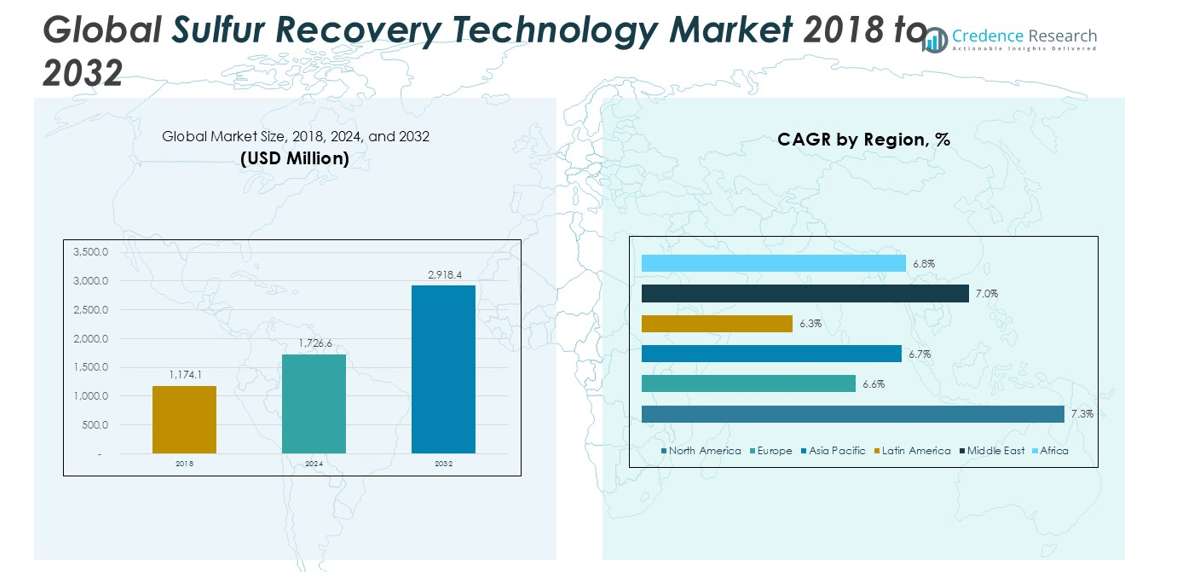
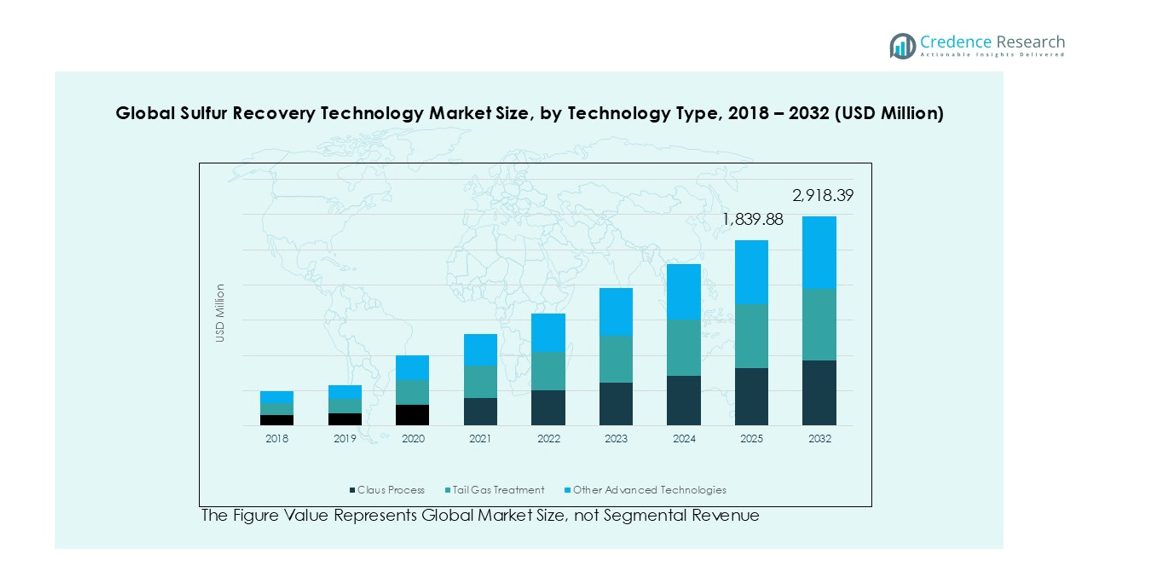
The Sulfur Recovery Technology Market size was valued at USD 1,174.1 million in 2018 and increased to USD 1,726.6 million in 2024. It is anticipated to reach USD 2,918.4 million by 2032, growing at a CAGR of 6.81% during the forecast period.

REPORT ATTRIBUTE DETAILS
Historical Period 2020-2023
Base Year 2024
Forecast Period 2025-2032
Sulfur Recovery Technology Market Size 2024 USD 1,726.6 million
Sulfur Recovery Technology Market, CAGR 6.81%
Sulfur Recovery Technology Market Size 2032 USD 2,918.4 million


The Sulfur Recovery Technology Market is highly competitive, led by prominent players including Jacobs Engineering Group, Chiyoda Corporation, John Wood Group (Amec Foster Wheeler), Technip FMC, Worley Parsons, Linde AG, Fluor Corporation, KT-Kinetics Technology SpA, GTC Technology US, and Heurtey Petrochem. These companies drive innovation through advanced Claus, tail gas treatment, and hybrid recovery technologies, strengthening operational efficiency and ensuring compliance with stringent environmental regulations. Regionally, Asia Pacific dominates with a 23% market share, fueled by rapid industrialization, refinery expansions, and rising natural gas and oil production in China, India, and Australia. Europe follows with 19%, supported by strict sulfur emission standards and demand for ultra-low sulfur fuels, while North America accounts for 14%, driven by shale gas and LNG infrastructure development. Collectively, these regions represent the primary growth hubs for technology adoption and market expansion in sulfur recovery.

Sulfur Recovery Technology Market size

Market Insights

  • The Sulfur Recovery Technology Market was valued at USD 1,726.6 million in 2024 and is projected to reach USD 2,918.4 million by 2032, growing at a CAGR of 6.81%.
  • Rising demand for cleaner fuels and stricter environmental regulations globally are driving the adoption of advanced sulfur recovery technologies, particularly in oil and gas refineries and petrochemical plants.
  • Industry trends show a shift toward sustainable operations, retrofitting older plants, and processing high-sulfur feedstocks using advanced Claus, superclaus, and hybrid processes to improve efficiency and reduce emissions.
  • The market is highly competitive, led by key players such as Jacobs Engineering Group, Chiyoda Corporation, Technip FMC, Worley Parsons, Linde AG, and Fluor Corporation, focusing on R&D, partnerships, and technology optimization to capture high-value contracts.
  • Regionally, Asia Pacific leads with a 23% market share, Europe holds 19%, North America 14%, Latin America 5%, Middle East 4%, and Africa 2%, while the natural gas feedstock segment dominates with 35% share and the Claus process leads technology adoption with 60%.

Access crucial information at unmatched prices!

Request your sample report today & start making informed decisions powered by Credence Research Inc.!

Download Sample

Market Segmentation Analysis:

By Feedstock

The Natural Gas sub-segment dominates the Sulfur Recovery Technology Market within the feedstock category, accounting for 35% of the market share. This leadership is driven by the rapid expansion of natural gas production and stringent environmental regulations requiring sulfur recovery to reduce emissions. Crude oil and coal also hold significant shares, supported by refinery expansions and coal-to-chemical processes. Oil sands and shale gas are witnessing gradual adoption due to technological advancements in sulfur removal. Overall, the feedstock segment growth is fueled by rising energy demand, cleaner fuel mandates, and increasing focus on sustainable operations.

  • For instance, China’s national mandates on sulfur dioxide emissions have prompted Sinopec to retrofit older Claus units with modern tail gas conversion reactors and hydrogenation systems, enhancing sulfur recovery efficiency

By Technology

Within the technology segment, the Claus Process holds a dominant position with 60% market share, owing to its widespread implementation, proven reliability, and cost-effectiveness in sulfur recovery. Tail Gas Treatment follows closely, enhancing overall sulfur recovery efficiency and meeting stringent environmental standards. Other advanced technologies, including superclaus and hybrid processes, are gradually gaining traction due to higher recovery rates and compatibility with complex feedstocks. The segment growth is primarily driven by refinery modernization, rising petrochemical output, and regulatory mandates on sulfur emissions in key global markets.

  • For instance, ExxonMobil’s Fawley Refinery in the UK employs the three-stage Claus Process to recover more than 95% of elemental sulfur from acid gas streams, ensuring compliance with low-emission standards.

By End User

The Oil and Gas sub-segment leads the market with a share of 50%, reflecting extensive adoption of sulfur recovery technologies in refineries, gas processing plants, and petrochemical complexes. The chemicals and petrochemicals segment is expanding steadily due to increased production of fertilizers and industrial chemicals that require sulfur management. The “Others” category, encompassing power plants and coal gasification, contributes modestly but is poised for growth with emerging energy projects. Overall, end-user segment expansion is driven by stringent environmental regulations, rising global energy demand, and investment in clean fuel technologies.

Key Growth Drivers

Rising Demand for Cleaner Fuels

The increasing global focus on reducing sulfur emissions in fuels has significantly driven the adoption of sulfur recovery technologies. Stricter environmental regulations and government policies, especially in North America, Europe, and Asia Pacific, compel refineries and gas processing plants to implement efficient sulfur recovery solutions. The demand for ultra-low sulfur fuels in transportation and industrial sectors directly supports the growth of Claus process and tail gas treatment technologies. This regulatory push ensures steady investments and modernization of sulfur recovery infrastructure globally.

  • For instance, Shell implemented advanced sulfur recovery units at its Pernis refinery in the Netherlands to meet the European Union’s ultra-low sulfur fuel standards.

Expansion of Oil and Gas Industry

Rapid growth in crude oil and natural gas production, particularly in emerging economies, fuels the demand for sulfur recovery solutions. The need to process high-sulfur feedstocks efficiently in refineries and gas plants drives the adoption of advanced sulfur recovery technologies. Investments in exploration, production, and refining facilities increase the market size while encouraging integration of tail gas treatment and hybrid recovery processes. Expansion of LNG production and shale gas development further boosts the adoption of sulfur recovery units to meet operational and environmental standards.

  • For instance, Honeywell UOP has installed over 100 sulfur recovery units worldwide with recovery efficiencies up to 99.95%, incorporating technologies like the Shell Claus Off-gas Treating (SCOT) and Callidus Tailgas Scrubbing to achieve ultra-low sulfur emissions in refinery and gas processing plants.

Technological Advancements in Recovery Processes

Innovation in sulfur recovery technologies, including advanced Claus, superclaus, and hybrid processes, enhances efficiency and reduces operational costs. These technologies improve recovery rates from complex feedstocks such as shale gas and oil sands. Automation, process optimization, and integration with tail gas treatment solutions allow plants to meet stricter emission norms while maintaining profitability. Continuous R&D efforts and collaboration between engineering service providers and refineries accelerate adoption, offering a competitive advantage and driving market growth across regions.

Sulfur Recovery Technology Market share

Key Trends & Opportunities

Shift Toward Sustainable and Low-Emission Operations

Industry players are increasingly focusing on sustainable operations and reducing sulfur emissions across refineries and petrochemical plants. Adoption of energy-efficient recovery systems and integration with renewable energy sources presents growth opportunities. Additionally, retrofitting older plants with modern sulfur recovery technologies creates significant demand. Companies leveraging eco-friendly processes gain regulatory compliance and operational efficiency, positioning themselves strategically to benefit from the rising global emphasis on cleaner fuel production and low-carbon industrial practices.

  • For instance, Dow Chemical is working toward carbon neutrality by 2050 by expanding its use of renewable energy and improving operational efficiencies in its petrochemical plants.

Emergence of High-Sulfur Feedstock Projects

The rising development of oil sands, shale gas, and heavy crude projects creates opportunities for advanced sulfur recovery solutions. Processing high-sulfur feedstocks requires robust technologies like superclaus and hybrid processes, offering high recovery efficiency. Companies investing in specialized equipment and tailored solutions can capture niche markets in regions with abundant high-sulfur resources. This trend is reinforced by the growing global energy demand and the need for sustainable refinery operations while maintaining compliance with environmental standards.

  • For instance, Haldor Topsoe and Comprimo developed the TopClaus® technology, combining Claus and Wet Gas Sulfuric Acid (WSA) processes, to achieve sulfur recovery in excess of 99.9% while reducing energy intensity and equipment count.

Key Challenges

High Capital and Operational Costs

The installation and maintenance of sulfur recovery units, particularly advanced Claus and tail gas treatment systems, require substantial capital expenditure. Operational costs, including energy consumption, catalyst replacement, and skilled labor, further increase the total investment. Smaller refineries and developing markets often struggle with cost-effectiveness, slowing adoption. Balancing operational efficiency with regulatory compliance remains a challenge, and companies need to strategically plan investments and optimize recovery processes to ensure profitability while meeting stringent sulfur emission standards.

Stringent Regulatory Compliance and Environmental Norms

Meeting global environmental standards, such as ultra-low sulfur fuel mandates, poses significant challenges for refineries and gas processing facilities. Non-compliance can lead to heavy fines and operational restrictions, necessitating continuous monitoring and technology upgrades. Additionally, variations in regional regulations increase complexity for multinational operators. The need for consistent performance under stringent emission limits pressures companies to adopt advanced recovery technologies and tailor solutions for different feedstocks, creating both operational and strategic challenges in managing sulfur recovery operations efficiently.

Regional Analysis

North America

North America was valued at USD 254.42 million in 2018 and is expected to grow to USD 385.47 million in 2024 and USD 677.07 million by 2032, representing a CAGR of 7.3%. The region holds a market share of 14%, driven by stringent environmental regulations, refinery modernization, and expansion of natural gas and shale gas projects. The U.S. and Canada lead adoption of Claus and tail gas treatment technologies, while investments in LNG infrastructure and cleaner fuel production continue to propel market growth across the region.

Europe

Europe’s sulfur recovery technology market was valued at USD 335.31 million in 2018, projected to reach USD 486.60 million in 2024 and USD 807.81 million by 2032, growing at a CAGR of 6.6%. With a market share of 19%, Europe benefits from strict sulfur emission regulations and rising demand for ultra-low sulfur fuels. Germany, France, and the UK lead the market with refinery upgrades and chemical processing expansions. Advanced Claus and tail gas treatment technologies, combined with environmental compliance mandates, drive sustained adoption throughout the region.

Asia Pacific

Asia Pacific accounted for USD 400.47 million in 2018, expected to reach USD 586.49 million in 2024 and USD 985.83 million by 2032, with a CAGR of 6.7% and a market share of 23%. Growth is fueled by rapid industrialization, refinery expansions, and increasing natural gas and oil production in China, India, and Australia. Rising demand for cleaner fuels and adoption of advanced recovery technologies, including Claus and tail gas treatment, enhance operational efficiency. Strong energy demand and regulatory mandates make Asia Pacific the fastest-growing regional market.

Latin America

Latin America was valued at USD 85.94 million in 2018, projected to reach USD 123.20 million in 2024 and USD 201.08 million by 2032, at a CAGR of 6.3%, holding 5% of global market share. Brazil and Argentina lead the market with refinery modernization and high-sulfur crude processing projects. Environmental regulations and demand for cleaner fuels drive the adoption of advanced sulfur recovery technologies, while ongoing exploration and production expansions provide additional growth opportunities across the region.

Middle East

The Middle East market stood at USD 67.86 million in 2018, expected to grow to USD 100.76 million in 2024 and USD 172.48 million by 2032, at a CAGR of 7.0%. With a market share of 4%, growth is supported by rising oil and gas production, large-scale refinery projects, and stringent emission standards. GCC countries lead the adoption of advanced Claus and tail gas treatment technologies to ensure regulatory compliance and high recovery efficiency, while expansion of petrochemical facilities further strengthens market demand.

Africa

Africa’s sulfur recovery technology market was valued at USD 30.06 million in 2018, projected to reach USD 44.05 million in 2024 and USD 74.13 million by 2032, with a CAGR of 6.8% and a market share of 2%. South Africa and Egypt dominate regional growth, supported by refinery expansions and increased natural gas processing. Rising adoption of Claus and tail gas treatment technologies, coupled with stricter environmental regulations and industrial development projects, drives market expansion and creates long-term growth potential across Africa.

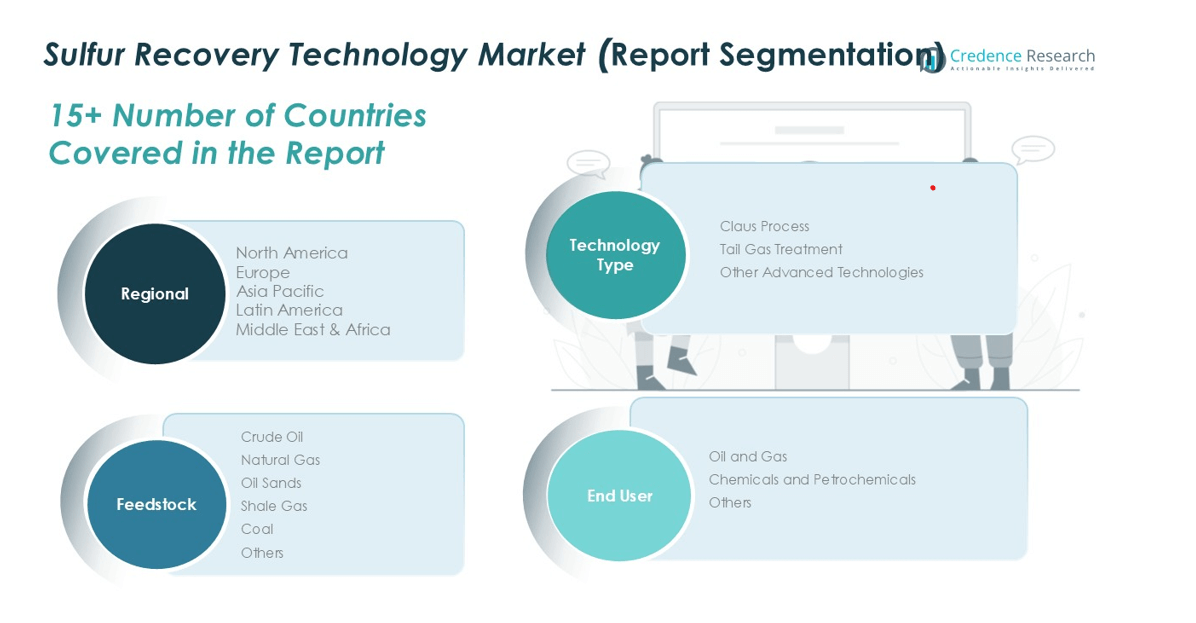
Sulfur Recovery Technology Market segmentation

Market Segmentations:

By Feedstock

  • Crude Oil
  • Natural Gas
  • Oil Sands
  • Shale Gas
  • Coal
  • Others

By Technology

  • Claus Process
  • Tail Gas Treatment
  • Other Advanced Technologies

By End User

  • Oil and Gas
  • Chemicals and Petrochemicals
  • Others

By Region:

  • North America
    • U.S.
    • Canada
    • Mexico
  • Europe
    • Germany
    • France
    • U.K.
    • Italy
    • Spain
    • Rest of Europe
  • Asia Pacific
    • China
    • Japan
    • India
    • South Korea
    • South-east Asia
    • Rest of Asia Pacific
  • Latin America
    • Brazil
    • Argentina
    • Rest of Latin America
  • Middle East & Africa
    • GCC Countries
    • South Africa
    • Rest of the Middle East and Africa

Competitive Landscape

The competitive landscape of the Sulfur Recovery Technology Market is led by key players including Jacobs Engineering Group, Chiyoda Corporation, John Wood Group (Amec Foster Wheeler), Technip FMC, Worley Parsons, Linde AG, Fluor Corporation, KT-Kinetics Technology SpA, GTC Technology US, and Heurtey Petrochem. Market competition is driven by the increasing adoption of advanced Claus, tail gas treatment, and hybrid sulfur recovery technologies to meet stringent environmental regulations and growing demand for cleaner fuels. Companies focus on strategic partnerships, mergers, and acquisitions to expand regional presence and enhance technological capabilities. Continuous innovation, including process optimization and automation, is key to improving recovery efficiency and reducing operational costs. Strong R&D investments, coupled with customer-centric solutions, allow players to differentiate offerings and capture high-value contracts across oil and gas, chemical, and petrochemical end-user segments globally. These dynamics intensify competition while promoting overall market growth.

Shape Your Report to Specific Countries or Regions & Enjoy 30% Off!

Key Player Analysis

Recent Developments

  • In May 2025, AMETEK Process Instruments and Worley Comprimo announced a partnership to deliver the 2ACT™ Solution, a fully automated technology for sulfur recovery units.
  • In July 2024, American Industrial Partners acquired Veolia North America’s sulfuric acid regeneration business, rebranding it as Nexpera.
  • In April 2024, Merichem Technologies, a portfolio company of Black Bay Energy Capital, acquired Chemical Products Industries (CPI), a provider of novel chemistries for sulfur removal and industrial cleaning applications.
  • In August 2025, Marimaca Copper Corp. announced an option to acquire a 150,000 tonnes per annum (ktpa) sulfuric acid plant from CEMIN Holding Minero in Chile. This acquisition aims to secure a significant portion of the sulfuric acid supply for the Marimaca Oxide Deposit, reducing exposure to volatile acid markets

Report Coverage

The research report offers an in-depth analysis based on Feedstock, Technology, End User and Region. It details leading market players, providing an overview of their business, product offerings, investments, revenue streams, and key applications. Additionally, the report includes insights into the competitive environment, SWOT analysis, current market trends, as well as the primary drivers and constraints. Furthermore, it discusses various factors that have driven market expansion in recent years. The report also explores market dynamics, regulatory scenarios, and technological advancements that are shaping the industry. It assesses the impact of external factors and global economic changes on market growth. Lastly, it provides strategic recommendations for new entrants and established companies to navigate the complexities of the market.

Future Outlook

  1. The market is expected to grow steadily due to increasing demand for ultra-low sulfur fuels.
  2. Expansion of oil, gas, and petrochemical industries will drive adoption of sulfur recovery technologies.
  3. Technological advancements, including hybrid and superclaus processes, will enhance recovery efficiency.
  4. Stricter environmental regulations globally will continue to push refineries to upgrade sulfur recovery units.
  5. Emerging markets in Asia Pacific and the Middle East will offer significant growth opportunities.
  6. Retrofitting older refineries with advanced recovery technologies will support sustained market expansion.
  7. Increasing investment in cleaner fuel production and sustainable operations will boost market demand.
  8. Collaboration between engineering service providers and refineries will accelerate technology adoption.
  9. Rising production of high-sulfur feedstocks will require more robust and efficient recovery solutions.

Continuous R&D and process optimization will create opportunities for cost reduction and higher operational efficiency.

CHAPTER NO. 1 :   GENESIS OF THE MARKET       

1.1 Market Prelude – Introduction & Scope

1.2 The Big Picture – Objectives & Vision

1.3 Strategic Edge – Unique Value Proposition

1.4 Stakeholder Compass – Key Beneficiaries

CHAPTER NO. 2 :   EXECUTIVE LENS

2.1 Pulse of the Industry – Market Snapshot

2.2 Growth Arc – Revenue Projections (USD Million)

2.3. Premium Insights – Based on Primary Interviews

CHAPTER NO. 3 :   SULFUR RECOVERY TECHNOLOGY MARKET FORCES & INDUSTRY PULSE

3.1 Foundations of Change – Market Overview
3.2 Catalysts of Expansion – Key Market Drivers
3.2.1 Momentum Boosters – Growth Triggers
3.2.2 Innovation Fuel – Disruptive Technologies
3.3 Headwinds & Crosswinds – Market Restraints
3.3.1 Regulatory Tides – Compliance Challenges
3.3.2 Economic Frictions – Inflationary Pressures
3.4 Untapped Horizons – Growth Potential & Opportunities
3.5 Strategic Navigation – Industry Frameworks
3.5.1 Market Equilibrium – Porter’s Five Forces
3.5.2 Ecosystem Dynamics – Value Chain Analysis
3.5.3 Macro Forces – PESTEL Breakdown

CHAPTER NO. 4 : KEY INVESTMENT EPICENTER 

4.1 Regional Goldmines – High-Growth Geographies

4.2 Product Frontiers – Lucrative Feedstock Categories

4.3 End User Sweet Spots – Emerging Demand Segments

CHAPTER NO. 5: REVENUE TRAJECTORY & WEALTH MAPPING

5.1 Momentum Metrics – Forecast & Growth Curves

5.2 Regional Revenue Footprint – Market Share Insights

5.3 Segmental Wealth Flow – Feedstock, Technology, and End User Revenue

CHAPTER NO. 6 : TRADE & COMMERCE ANALYSIS        

6.1.      Import Analysis By Region

6.1.1.   Global Sulfur Recovery Technology Market Import Revenue By Region

6.2.      Export Analysis By Region

6.2.1.   Global Sulfur Recovery Technology Market Export Revenue By Region

CHAPTER NO. 7 :   COMPETITION ANALYSIS         

7.1.      Company Market Share Analysis

7.1.1.   Global Sulfur Recovery Technology Market: Company Market Share

7.2.      Global Sulfur Recovery Technology Market Company Revenue Market Share

7.3.      Strategic Developments

7.3.1.   Acquisitions & Mergers

7.3.2.   New Product Launch

7.3.3.   Regional Expansion

7.4.      Competitive Dashboard

7.5.      Company Assessment Metrics, 2024

CHAPTER NO. 8 : SULFUR RECOVERY TECHNOLOGY MARKET – BY FEEDSTOCK SEGMENT ANALYSIS

8.1.      Sulfur Recovery Technology Market Overview By Feedstock Segment

8.1.1.   Sulfur Recovery Technology Market Revenue Share By Feedstock

8.2.       Crude Oil

8.3.       Natural Gas

8.4.       Oil Sands

8.5.       Shale Gas

8.6.       Coal

8.7.       Others

PolyethyleneCHAPTER NO. 9 : SULFUR RECOVERY TECHNOLOGY MARKET – BY TECHNOLOGY SEGMENT ANALYSIS

9.1.      Sulfur Recovery Technology Market Overview By Technology Segment

9.1.1.   Sulfur Recovery Technology Market Revenue Share By Technology

9.2.      Claus Process

9.3.      Tail Gas Treatment

9.4.      Other Advanced Technologies

CHAPTER NO. 10 : SULFUR RECOVERY TECHNOLOGY MARKET – BY END USER SEGMENT ANALYSIS

10.1.    Sulfur Recovery Technology Market Overview By End User Segment

10.1.1. Sulfur Recovery Technology Market Revenue Share By End User

10.2.    Oil and Gas

10.3.    Chemicals and Petrochemicals

10.4.    Others

CHAPTER NO. 11 : SULFUR RECOVERY TECHNOLOGY MARKET – REGIONAL ANALYSIS

11.1.    Sulfur Recovery Technology Market Overview By Region Segment

11.1.1. Global Sulfur Recovery Technology Market Revenue Share By Region

10.1.2. Regions

11.1.3. Global Sulfur Recovery Technology Market Revenue By Region

11.1.4. Feedstock

11.1.5. Global Sulfur Recovery Technology Market Revenue By Feedstock

11.1.6. Technology

11.1.7. Global Sulfur Recovery Technology Market Revenue By Technology

11.1.8. End User

11.1.9. Global Sulfur Recovery Technology Market Revenue By End User

CHAPTER NO. 12 : NORTH AMERICA SULFUR RECOVERY TECHNOLOGY MARKET – COUNTRY ANALYSIS

12.1.    North America Sulfur Recovery Technology Market Overview By Country Segment

12.1.1. North America Sulfur Recovery Technology Market Revenue Share By Region

12.2.    North America

12.2.1. North America Sulfur Recovery Technology Market Revenue By Country

12.2.2. Feedstock

12.2.3. North America Sulfur Recovery Technology Market Revenue By Feedstock

12.2.4. Technology

12.2.5. North America Sulfur Recovery Technology Market Revenue By Technology

12.2.6. End User

12.2.7. North America Sulfur Recovery Technology Market Revenue By End User

12.3.    U.S.

12.4.    Canada

12.5.    Mexico

CHAPTER NO. 13 : EUROPE SULFUR RECOVERY TECHNOLOGY MARKET – COUNTRY ANALYSIS

13.1.    Europe Sulfur Recovery Technology Market Overview By Country Segment

13.1.1. Europe Sulfur Recovery Technology Market Revenue Share By Region

13.2.    Europe

13.2.1. Europe Sulfur Recovery Technology Market Revenue By Country

13.2.2. Feedstock

13.2.3. Europe Sulfur Recovery Technology Market Revenue By Feedstock

13.2.4. Technology

13.2.5. Europe Sulfur Recovery Technology Market Revenue By Technology

13.2.6. End User

13.2.7. Europe Sulfur Recovery Technology Market Revenue By End User

13.3.    UK

13.4.    France

13.5.    Germany

13.6.    Italy

13.7.    Spain

13.8.    Russia

13.9.    Rest of Europe

CHAPTER NO. 14 : ASIA PACIFIC SULFUR RECOVERY TECHNOLOGY MARKET – COUNTRY ANALYSIS

14.1.    Asia Pacific Sulfur Recovery Technology Market Overview By Country Segment

14.1.1. Asia Pacific Sulfur Recovery Technology Market Revenue Share By Region

14.2.    Asia Pacific

14.2.1. Asia Pacific Sulfur Recovery Technology Market Revenue By Country

14.2.2. Feedstock

14.2.3. Asia Pacific Sulfur Recovery Technology Market Revenue By Feedstock

14.2.4. Technology

14.2.5. Asia Pacific Sulfur Recovery Technology Market Revenue By Technology

14.2.6. End User

14.2.7. Asia Pacific Sulfur Recovery Technology Market Revenue By End User

14.3.    China

14.4.    Japan

14.5.    South Korea

14.6.    India

14.7.    Australia

14.8.    Southeast Asia

14.9.    Rest of Asia Pacific

CHAPTER NO. 15 : LATIN AMERICA SULFUR RECOVERY TECHNOLOGY MARKET – COUNTRY ANALYSIS

15.1.    Latin America Sulfur Recovery Technology Market Overview By Country Segment

15.1.1. Latin America Sulfur Recovery Technology Market Revenue Share By Region

15.2.    Latin America

15.2.1. Latin America Sulfur Recovery Technology Market Revenue By Country

15.2.2. Feedstock

15.2.3. Latin America Sulfur Recovery Technology Market Revenue By Feedstock

15.2.4. Technology

15.2.5. Latin America Sulfur Recovery Technology Market Revenue By Technology

15.2.6. End User

15.2.7. Latin America Sulfur Recovery Technology Market Revenue By End User

15.3.    Brazil

15.4.    Argentina

15.5.    Rest of Latin America

CHAPTER NO. 16 : MIDDLE EAST SULFUR RECOVERY TECHNOLOGY MARKET – COUNTRY ANALYSIS

16.1.    Middle East Sulfur Recovery Technology Market Overview By Country Segment

16.1.1. Middle East Sulfur Recovery Technology Market Revenue Share By Region

16.2.    Middle East

16.2.1. Middle East Sulfur Recovery Technology Market Revenue By Country

16.2.2. Feedstock

16.2.3. Middle East Sulfur Recovery Technology Market Revenue By Feedstock

16.2.4. Technology

16.2.5. Middle East Sulfur Recovery Technology Market Revenue By Technology

16.2.6. End User

16.2.7. Middle East Sulfur Recovery Technology Market Revenue By End User

16.3.    GCC Countries

16.4.    Israel

16.5.    Turkey

16.6.    Rest of Middle East

CHAPTER NO. 17 : AFRICA SULFUR RECOVERY TECHNOLOGY MARKET – COUNTRY ANALYSIS

17.1.    Africa Sulfur Recovery Technology Market Overview By Country Segment

17.1.1. Africa Sulfur Recovery Technology Market Revenue Share By Region

17.2.    Africa

17.2.1. Africa Sulfur Recovery Technology Market Revenue By Country

17.2.2. Feedstock

17.2.3. Africa Sulfur Recovery Technology Market Revenue By Feedstock

17.2.4. Technology

17.2.5. Africa Sulfur Recovery Technology Market Revenue By Technology

17.2.6. End User

17.2.7. Africa Sulfur Recovery Technology Market Revenue By End User

17.3.    South Africa

17.4.    Egypt

17.5.    Rest of Africa

CHAPTER NO. 18 : COMPANY PROFILES     

18.1.     Jacobs Engineering Group

18.1.1. Company Overview

18.1.2. Product Portfolio

18.1.3. Financial Overview

18.1.4. Recent Developments

18.1.5. Growth Strategy

18.1.6. SWOT Analysis

18.2.    Chiyoda Corporation

18.3.    John Wood Group (Amec Foster Wheeler)

18.4.    Technip FMC

18.5.  Worley Parsons

18.6.  Linde AG

18.7.   Fluor Corporation

18.8.   KT-Kinetics Technology SpA

18.9.   GTC Technology US

18.10.  Heurtey Petrochem

18.12.  Other Key Players

Request Free Sample

We prioritize the confidentiality and security of your data. Our promise: your information remains private.

Ready to Transform Data into Decisions?

Request Your Sample Report and Start Your Journey of Informed Choices


Providing the strategic compass for industry titans.

cr-clients-logos

Frequently Asked Question:

What is the current market size for Sulfur Recovery Technology Market, and what is its projected size in 2032?

The Sulfur Recovery Technology Market is currently valued at USD 1,726.6 million and is projected to reach USD 2,918.4 million by 2032.

At what Compound Annual Growth Rate is the Sulfur Recovery Technology Market
projected to grow between 2025 and 2032?

The Sulfur Recovery Technology Market is expected to grow at a CAGR of 6.81% during the forecast period.

Which Sulfur Recovery Technology Market segment held the largest share in 2024?

Within the Sulfur Recovery Technology Market, the Claus Process segment held the largest share in 2024 with 60% of the market.

What are the primary factors fueling the growth of the Sulfur Recovery Technology Market?

Key growth factors for the Sulfur Recovery Technology Market include rising demand for cleaner fuels, expansion of oil and gas industries, and technological advancements in recovery processes.

Who are the major players in this market?

Jacobs Engineering Group Inc., Exxon Mobil, The Linde Group, Chiyoda Corporation, and John Wood Group Plc. On March 1, 2016, Fluor Corp. acquired the Netherlands-based Stork Holding B.V. are some of the major players in the global market.

Which region commanded the largest share of the Sulfur Recovery Technology Market in 2024?

Asia Pacific commanded the largest share of the Sulfur Recovery Technology Market in 2024 with 23% of the global market.

About Author

Shweta Bisht

Shweta Bisht

Healthcare & Biotech Analyst

Shweta is a healthcare and biotech researcher with strong analytical skills in chemical and agri domains.

View Profile

Related Reports

Polypropylene Absorbent Hygiene Market

The Polypropylene Absorbent Hygiene Market is projected to grow from USD 17,377.6 million in 2024 to an estimated USD 25,674.63 million by 2032, with a compound annual growth rate (CAGR) of 5% from 2024 to 2032.

Polypropylene Nonwoven Fabrics Market

The Polypropylene (PP) Nonwoven Fabrics Market is projected to grow from USD 39,506.88 million in 2024 to an estimated USD 64,407.86 million by 2032, with a compound annual growth rate (CAGR) of 6.3% from 2024 to 2032.

Polyphenylsulfone Market

The Polyphenylsulfone Market is projected to grow from USD 416.44 million in 2024 to an estimated USD 773.65 million by 2032, with a compound annual growth rate (CAGR) of 8.05% from 2024 to 2032.

Polyphenylene Ether Alloy (PPE) Market

The Polyphenylene Ether Alloy (PPE) Market is projected to grow from USD 1,694.41 million in 2024 to an estimated USD 2,600.38 million by 2032, with a compound annual growth rate (CAGR) of 5.5% from 2024 to 2032.  

Polyphenylene Sulfide (PPS) Market

The Global Polyphenylene Sulfide (PPS) Market is projected to grow from USD 1,620.18 million in 2024 to an estimated USD 3,094.39 million by 2032, registering a compound annual growth rate (CAGR) of 8.42% from 2025 to 2032

Friction Modifiers Organic Inorganic Market

The global friction modifiers (organic & inorganic) market was valued at USD 1.24 billion in 2024 and is projected to reach USD 1.72 billion by 2032, registering a CAGR of 4.1% over the forecast period.

Epoxy Silanes Market

The epoxy silanes market was valued at USD 1.2 billion in 2024 and is projected to reach USD 2.1 billion by 2032, reflecting a CAGR of 7.3% over the forecast period.

E-Gasoline Market

The global e-gasoline market was valued at USD 1.21 billion in 2024 and is projected to reach USD 11.2 billion by 2032, expanding at a CAGR of 32.1% over the forecast period.

Polyketone Market

The Polyketone (PK) Market size was valued at USD 1387.6 million in 2024 and is anticipated to reach USD 2097.45 million by 2032, at a CAGR of 5.3% during the forecast period (2024-2032).

Polyisoprene Elastomers Market

The Polyisoprene Elastomers Market size was valued at USD 1187.6 million in 2024 and is anticipated to reach USD 1795.14 million by 2032, at a CAGR of 5.3% during the forecast period (2024-2032).

Polyisobutylene Market

The Polyisobutylene (PIB) Market size was valued at USD 2272.6 million in 2024 and is anticipated to reach USD 3649.61 million by 2032, at a CAGR of 6.1% during the forecast period (2024-2032).

Polyimide Films Market

The Polyimide Films Market size was valued at USD 774.79 million in 2024 and is anticipated to reach USD 1658.42 million by 2032, at a CAGR of 9.98% during the forecast period (2024-2032).

Licence Option

The report comes as a view-only PDF document, optimized for individual clients. This version is recommended for personal digital use and does not allow printing. Use restricted to one purchaser only.
$4999

To meet the needs of modern corporate teams, our report comes in two formats: a printable PDF and a data-rich Excel sheet. This package is optimized for internal analysis. Unlimited users allowed within one corporate location (e.g., regional office).
$6999

The report will be delivered in printable PDF format along with the report’s data Excel sheet. This license offers 100 Free Analyst hours where the client can utilize Credence Research Inc. research team. Permitted for unlimited global use by all users within the purchasing corporation, such as all employees of a single company.
$12999

Report delivery within 24 to 48 hours

Credence Staff 3

WILLIAM, North America

Support Staff at Credence Research

KEITH PHILLIPS, Europe

Lee - CR Sales Staff

LEE VALLANCE, Asia Pacific

Kieran Jameson

KIERAN JAMESON, Australia

Smallform of Sample request
User Review

Thank you for the data! The numbers are exactly what we asked for and what we need to build our business case.

Materials Scientist
(privacy requested)

User Review

The report was an excellent overview of the Industrial Burners market. This report does a great job of breaking everything down into manageable chunks.

Imre Hof
Management Assistant, Bekaert

cr-clients-logos

Request Sample