Market Overview:
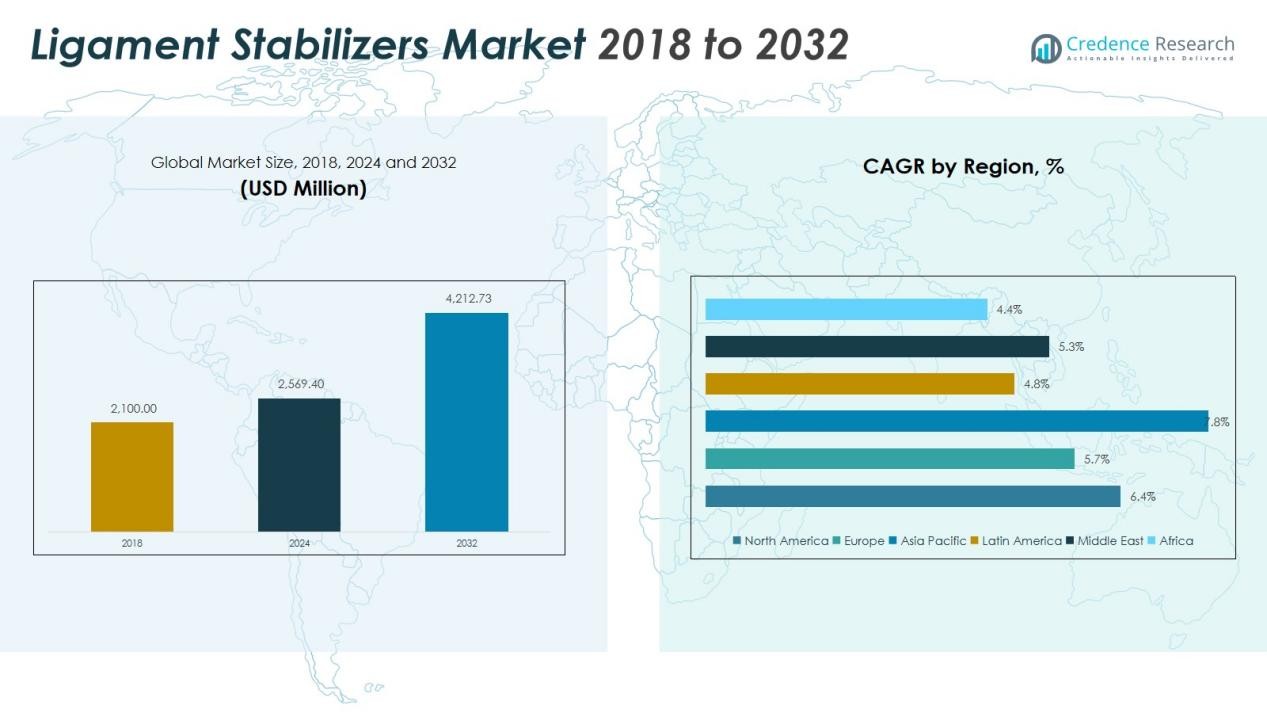
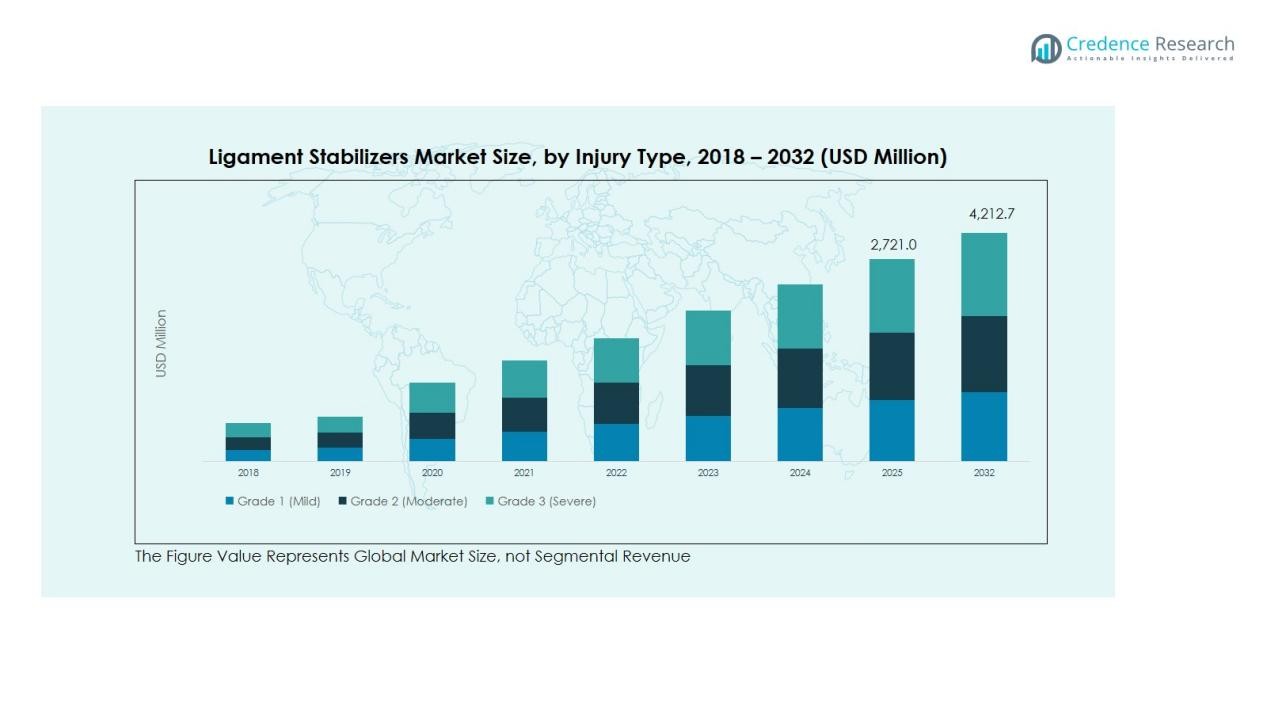
The Global Ligament Stabilizers Market size was valued at USD 2,100 million in 2018 to USD 2,569.40 million in 2024 and is anticipated to reach USD 4,212.73 million by 2032, at a CAGR of 6.44% during the forecast period.
| REPORT ATTRIBUTE |
DETAILS |
| Historical Period |
2020-2023 |
| Base Year |
2024 |
| Forecast Period |
2025-2032 |
| Ligament Stabilizers Market Size 2024 |
USD 2,569.40 Million |
| Ligament Stabilizers Market, CAGR |
6.44% |
| Ligament Stabilizers Market Size 2032 |
USD 4,212.73 Million |
The market growth is influenced by several drivers, including the growing geriatric population and advancements in orthopedic support technologies. Increased participation in physical and athletic activities has led to a higher incidence of ligament tears and joint instabilities. The development of lightweight, adjustable, and breathable stabilizers enhances user comfort and compliance, while e-commerce platforms enable greater accessibility to customized products.
Regionally, North America dominates the global market with a 38% share in 2024, supported by high healthcare spending, technological innovation, and widespread use of orthopedic braces. Europe holds a strong position due to established sports medicine practices and reimbursement support. Asia-Pacific is expected to be the fastest-growing region, driven by expanding healthcare infrastructure, rising sports participation, and growing awareness of non-invasive treatment solutions.
Access crucial information at unmatched prices!
Request your sample report today & start making informed decisions powered by Credence Research Inc.!
Download Sample
Market Insights:
- The Global Ligament Stabilizers Market was valued at USD 2,569.40 million in 2024 and is projected to reach USD 4,212.73 million by 2032, growing at a CAGR of 6.44%.
- High product cost and limited reimbursement coverage remain key challenges restricting access in developing markets.
- North America leads with a 38% share in 2024, supported by advanced healthcare systems and high awareness of orthopedic care.
- Europe holds a 27% share, driven by reimbursement support, growing osteoarthritis cases, and eco-friendly product innovation.
- Asia Pacific emerges as the fastest-growing region with a 23% share, supported by healthcare expansion, sports participation, and affordable non-invasive treatments.
Market Drivers:
Rising Incidence of Sports Injuries and Orthopedic Disorders
The Global Ligament Stabilizers Market is driven by the growing number of sports-related injuries and orthopedic conditions worldwide. Increased participation in high-intensity activities has elevated the demand for supportive devices that prevent ligament damage and promote recovery. Knee and ankle ligament tears are among the most common injuries requiring stabilizers. The market benefits from greater awareness of early treatment and rehabilitation for musculoskeletal injuries. It continues to expand as both athletes and recreational users seek preventive and therapeutic solutions.
Growing Geriatric Population and Age-Related Joint Weakness
An aging global population contributes significantly to market growth due to rising cases of arthritis, osteoporosis, and ligament degeneration. Elderly individuals often experience reduced joint stability, increasing reliance on external support devices. It benefits from advanced designs that provide comfort, flexibility, and long-term wearability. Demand for lightweight and adjustable stabilizers is growing in homecare and clinical rehabilitation settings. The trend aligns with the focus on maintaining mobility and independence among older adults.
- For instance, Enovis DJO launched the DonJoy ROAM OA knee brace in January 2024, featuring a unique design that fits left lateral and right medial configurations in only 6 SKUs compared to traditional braces requiring as many as 56 SKUs for the same range of patient fit.
Advancements in Product Design and Material Innovation
Continuous innovation in materials and product design strengthens the market outlook. Manufacturers are developing breathable fabrics, 3D-knit structures, and ergonomic shapes to enhance support without compromising comfort. It is witnessing higher adoption due to improved durability and better patient compliance. Companies emphasize customized and anatomically fitted products for sports medicine and clinical rehabilitation. These innovations improve performance outcomes and patient satisfaction, boosting market expansion.
- For example, Bauerfeind AG offers the GenuTrain S Pro knee brace, featuring 3D-knitted breathable fabric and adjustable hinges that ensure stable joint alignment and pressure relief. This design is intended to enable faster recovery time for sports-related knee injuries.
Expanding Access Through E-Commerce and Retail Distribution
The widespread availability of ligament stabilizers through online and retail channels supports market penetration. Consumers prefer accessible purchasing options with product comparisons and personalized fitting guides. It benefits from rising online medical device sales and distribution partnerships with healthcare suppliers. Global brands are investing in omnichannel strategies to enhance product visibility and consumer engagement. This accessibility strengthens adoption among athletes, rehabilitation centers, and general consumers worldwide.
Market Trends:
Integration of Smart and Functional Materials in Ligament Support Devices
The Global Ligament Stabilizers Market is experiencing a strong shift toward smart and functional materials that enhance user comfort and performance. Manufacturers are integrating advanced fabrics with moisture-wicking, antimicrobial, and temperature-regulating properties. These innovations help prevent skin irritation during extended use and improve the overall rehabilitation experience. It is also adopting sensor-based technologies that track joint motion and stability, enabling better injury assessment and therapy feedback. The use of lightweight composites and elastic polymers enhances flexibility and durability, catering to both athletes and clinical patients. Demand for customizable stabilizers with adjustable compression and targeted support zones continues to grow. This material innovation trend supports product differentiation and aligns with the increasing focus on user-centric orthopedic care.
- For instance, DonJoy introduced its C-6 Fabric Technology featuring pure carbon threads woven into moisture-wicking antimicrobial fabric that naturally repels odor and provides temperature control in their Clima-Flex OA and Defiance PRO custom knee braces.
Rise of Preventive Orthopedic Care and Home-Based Rehabilitation Solutions
Growing awareness of preventive orthopedic care is shaping the market direction toward early injury management and home-use products. Consumers are adopting ligament stabilizers not only for post-injury recovery but also for protection during physical activities. It benefits from the rising preference for non-surgical and cost-effective rehabilitation methods. The expansion of telehealth and remote physiotherapy services encourages the use of self-managed stabilizers at home. Manufacturers are introducing easy-to-use designs that combine comfort, adjustability, and medical-grade support for home application. Professional athletes and fitness enthusiasts are increasingly integrating stabilizers into daily training routines to avoid ligament strain. This trend highlights the shift toward preventive care and the growing consumer focus on proactive musculoskeletal health management.
- For instance, BetterGuard launched its ankle brace utilizing micro-hydraulic pistons that stabilize the ankle joint up to 4 times faster than natural body response, and was selected by NBA Launchpad in 2022 for innovation in ankle injury prevention and rehabilitation
Market Challenges Analysis:
High Product Cost and Limited Reimbursement Coverage
The Global Ligament Stabilizers Market faces challenges due to high product prices and limited insurance reimbursement. Advanced stabilizers with smart materials or sensor integration remain costly, restricting access for low- and middle-income consumers. Many healthcare systems categorize stabilizers as non-essential or over-the-counter items, reducing reimbursement eligibility. It creates financial barriers for patients requiring long-term or multiple-use support devices. Hospitals and clinics often prioritize low-cost alternatives, which affects premium product adoption. The lack of standardized reimbursement frameworks across regions slows market penetration and limits technological innovation investment.
Counterfeit Products and Variability in Quality Standards
The growing availability of counterfeit and low-quality stabilizers poses a significant challenge to market integrity. Inconsistent manufacturing practices among small-scale producers lead to differences in product performance and safety. It undermines consumer trust and affects brand reputation for established players. Poorly designed stabilizers can cause discomfort or aggravate injuries, leading to negative clinical outcomes. The absence of strict regulatory oversight in developing regions increases counterfeit circulation. Manufacturers face the ongoing task of maintaining quality assurance, certification, and consumer education to ensure product reliability and compliance.
Market Opportunities:
Expansion of Personalized and Custom-Fit Orthopedic Solutions
The Global Ligament Stabilizers Market holds strong growth potential through personalized and custom-fit product development. Advances in 3D scanning and printing technologies allow manufacturers to create stabilizers tailored to individual anatomy. It enables better alignment, comfort, and recovery outcomes for patients. Customization appeals to athletes and patients seeking precision-based support for specific ligament injuries. The integration of digital fitting tools and mobile applications simplifies measurement and product selection. This technological direction supports premium product demand and enhances patient compliance, creating new value opportunities for manufacturers.
Growing Adoption in Emerging Healthcare Markets
Expanding healthcare infrastructure in emerging economies opens new opportunities for ligament stabilizer producers. Rising disposable incomes, government healthcare initiatives, and growing sports participation drive adoption across Asia-Pacific, Latin America, and the Middle East. It benefits from increasing availability of orthopedic care and rehabilitation centers in these regions. Global brands are forming partnerships with local distributors to improve market access and affordability. Awareness campaigns promoting joint health and injury prevention further enhance product demand. The expansion into underserved regions strengthens brand visibility and supports sustainable revenue growth.
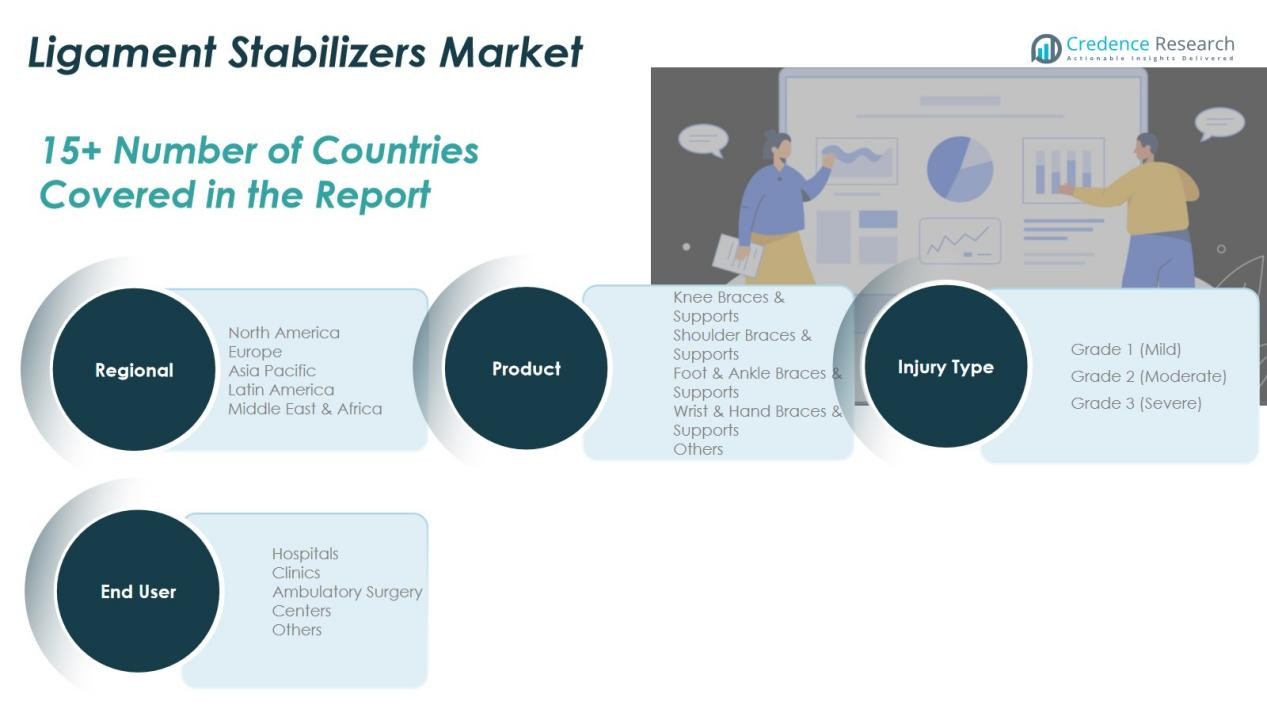
Market Segmentation Analysis:
By Product
The Global Ligament Stabilizers Market is segmented into knee braces & supports, shoulder braces & supports, foot & ankle braces & supports, wrist & hand braces & supports, and others. Knee braces & supports hold the largest share due to their wide use in treating sports injuries and postoperative recovery. It benefits from strong adoption among athletes and patients with ligament tears or arthritis. Shoulder and ankle stabilizers are gaining demand due to increased awareness of joint protection and early rehabilitation. Compact and adjustable wrist supports attract growing use in daily activities and occupational safety applications.
- For Instance, Icarus Medical Innovation launched the Adonis Knee brace in 2025, which incorporates joint-distraction technology that extends by 1 centimeter during walking to separate the affected joint compartment.
By Injury Type
The market is divided into Grade 1 (mild), Grade 2 (moderate), and Grade 3 (severe) injuries. Grade 2 injuries lead the segment, driven by rising cases requiring moderate support for recovery. It is widely used in sports medicine and physiotherapy clinics. Grade 1 injuries follow, supported by preventive applications in low-impact physical activities. The Grade 3 segment is smaller but growing, fueled by demand for advanced stabilizers with enhanced compression and durability.
- For instance, lace-up ankle braces demonstrated a 61% reduction in acute ankle injuries among high school football players across 2,081 participants from 50 schools during the 2010 season.
By End-User
The end-user segmentation includes hospitals, clinics, ambulatory surgery centers, and others. Hospitals dominate due to high patient inflow and advanced orthopedic treatment facilities. Clinics contribute significantly through rehabilitation and physiotherapy services. It is witnessing steady growth in ambulatory centers due to increasing minor procedures and non-invasive treatments. The homecare segment also shows potential, supported by self-use stabilizers and online distribution networks.
Segmentations:
By Product:
- Knee Braces & Supports
- Shoulder Braces & Supports
- Foot & Ankle Braces & Supports
- Wrist & Hand Braces & Supports
- Others
By Injury Type:
- Grade 1 (Mild)
- Grade 2 (Moderate)
- Grade 3 (Severe)
By End-User:
- Hospitals
- Clinics
- Ambulatory Surgery Centers
- Others
By Region:
- North America
- Europe
- Germany
- France
- U.K.
- Italy
- Spain
- Rest of Europe
- Asia Pacific
- China
- Japan
- India
- South Korea
- South-east Asia
- Rest of Asia Pacific
- Latin America
- Brazil
- Argentina
- Rest of Latin America
- Middle East & Africa
- GCC Countries
- South Africa
- Rest of the Middle East and Africa
Regional Analysis:
North America
The North America Ligament Stabilizers Market size was valued at USD 808.50 million in 2018, increased to USD 977.90 million in 2024, and is anticipated to reach USD 1,601.27 million by 2032, at a CAGR of 6.4% during the forecast period. The Global Ligament Stabilizers Market Market is led by North America, accounting for a 38% share in 2024. It benefits from advanced healthcare infrastructure, strong sports culture, and high spending on injury management and orthopedic rehabilitation. Technological advancements and the widespread use of smart materials support continuous product innovation. The presence of major manufacturers and growing e-commerce distribution further strengthen regional dominance. Rising awareness about preventive orthopedic care and early rehabilitation drives steady demand from both hospitals and consumers.
Europe
The Europe Ligament Stabilizers Market size was valued at USD 575.40 million in 2018, grew to USD 677.74 million in 2024, and is anticipated to reach USD 1,052.14 million by 2032, at a CAGR of 5.7% during the forecast period. Europe holds a 27% share of the Global Ligament Stabilizers Market Market, supported by strong healthcare reimbursement policies and established orthopedic product standards. It experiences rising adoption of braces and supports in physiotherapy and sports medicine. The growing aging population and high prevalence of osteoarthritis sustain long-term market demand. Regional players are investing in sustainable and eco-friendly materials to meet European medical device regulations. Increasing collaboration between sports associations and medical device firms drives innovation and clinical validation.
Asia Pacific
The Asia Pacific Ligament Stabilizers Market size was valued at USD 486.15 million in 2018, reached USD 622.68 million in 2024, and is projected to reach USD 1,132.39 million by 2032, growing at a CAGR of 7.8% during the forecast period. The region captures a 23% share of the Global Ligament Stabilizers Market Market and is the fastest-growing segment globally. It benefits from rapid healthcare infrastructure development, expanding sports participation, and increasing disposable incomes. Government initiatives promoting injury prevention and affordable rehabilitation solutions support growth. Local manufacturers are entering partnerships with global brands to enhance product availability. Rising awareness of non-invasive orthopedic treatments boosts adoption in hospitals and homecare sectors.
Latin America
The Latin America Ligament Stabilizers Market size was valued at USD 80.85 million in 2018, expanded to USD 97.35 million in 2024, and is anticipated to reach USD 140.58 million by 2032, registering a CAGR of 4.8% during the forecast period. The region holds a 6% share in the Global Ligament Stabilizers Market Market, driven by gradual improvement in healthcare systems and growing public awareness of sports injuries. It faces challenges from limited insurance coverage and affordability barriers. However, demand for affordable, durable stabilizers is increasing across Brazil, Mexico, and Argentina. Expanding sports medicine practices and rehabilitation centers support the regional outlook. Growing distribution networks and retail expansion enhance market accessibility for consumers.
Middle East
The Middle East Ligament Stabilizers Market size was valued at USD 94.92 million in 2018, increased to USD 109.95 million in 2024, and is projected to reach USD 165.58 million by 2032, growing at a CAGR of 5.3% during the forecast period. The region represents a 4% share of the Global Ligament Stabilizers Market Market. It experiences rising demand driven by higher sports participation and increased investment in healthcare modernization. Hospitals are adopting advanced orthopedic supports for post-surgical recovery and preventive care. The expansion of medical tourism in countries like the UAE and Saudi Arabia strengthens market potential. Local distributors are partnering with global brands to enhance product availability and training support.
Africa
The Africa Ligament Stabilizers Market size was valued at USD 54.18 million in 2018, grew to USD 83.77 million in 2024, and is projected to reach USD 120.78 million by 2032, at a CAGR of 4.4% during the forecast period. The region accounts for a 2% share in the Global Ligament Stabilizers Market Market, supported by gradual healthcare improvements and growing rehabilitation needs. It faces challenges from low awareness and limited product accessibility in rural areas. Urban centers in South Africa, Nigeria, and Egypt are leading adoption due to better healthcare infrastructure. Non-governmental organizations and health programs promoting mobility aids are supporting market development. Expanding retail networks and affordable product lines are expected to drive future regional growth.
Shape Your Report to Specific Countries or Regions & Enjoy 30% Off!
Key Player Analysis:
Competitive Analysis:
The Global Ligament Stabilizers Market is highly competitive, with key players focusing on innovation, quality, and distribution strength. Major companies include Bauerfeind AG, BSN Medical GmbH, Össur hf, 3M Company, DJO Global Inc., Otto Bock Healthcare GmbH, and THUASNE SA. It is characterized by continuous product advancements, such as lightweight materials, breathable fabrics, and customizable designs that enhance patient comfort and compliance. Leading firms invest in R&D to integrate smart technologies for better performance tracking and rehabilitation outcomes. Partnerships with hospitals, clinics, and sports institutions strengthen market reach and brand visibility. Companies are also expanding online retail presence and focusing on ergonomic, user-centric product designs. Strategic acquisitions and geographic expansion remain key to sustaining competitiveness in both developed and emerging healthcare markets.
Recent Developments:
- In February 2025, 3M announced its participation in the US-JOINT Consortium, a strategic partnership with 12 leading semiconductor suppliers to accelerate research and development of next-generation semiconductor packaging and processing technologies.
- In January 2025, medi-G (a medi GmbH & Co. KG business segment) completed its business transfer to KARL STORZ SE & Co. KG, following an acquisition originally announced in July 2024.
Report Coverage:
The research report offers an in-depth analysis based on Product, Injury Type, End-User and Region. It details leading market players, providing an overview of their business, product offerings, investments, revenue streams, and key applications. Additionally, the report includes insights into the competitive environment, SWOT analysis, current market trends, as well as the primary drivers and constraints. Furthermore, it discusses various factors that have driven market expansion in recent years. The report also explores market dynamics, regulatory scenarios, and technological advancements that are shaping the industry. It assesses the impact of external factors and global economic changes on market growth. Lastly, it provides strategic recommendations for new entrants and established companies to navigate the complexities of the market.
Future Outlook:
- The Global Ligament Stabilizers Market is expected to expand steadily with growing awareness of preventive orthopedic care.
- Demand for advanced, lightweight, and breathable materials will shape future product innovation.
- Integration of smart sensors and connected rehabilitation technologies will enhance treatment precision.
- It will experience higher adoption in home-based care due to the rise of telehealth and remote physiotherapy.
- Manufacturers will focus on personalized and 3D-printed stabilizers for improved patient comfort.
- Expanding healthcare infrastructure in Asia-Pacific and Latin America will open new growth avenues.
- Strategic collaborations between medical device companies and sports organizations will promote product development.
- Sustainability and eco-friendly material usage will gain attention in manufacturing processes.
- E-commerce and digital distribution channels will continue to strengthen consumer accessibility and awareness.
- Ongoing product diversification targeting athletes, elderly users, and post-surgery patients will maintain market competitiveness.



