Home » Chemicals » Metal Deactivator Additives Market

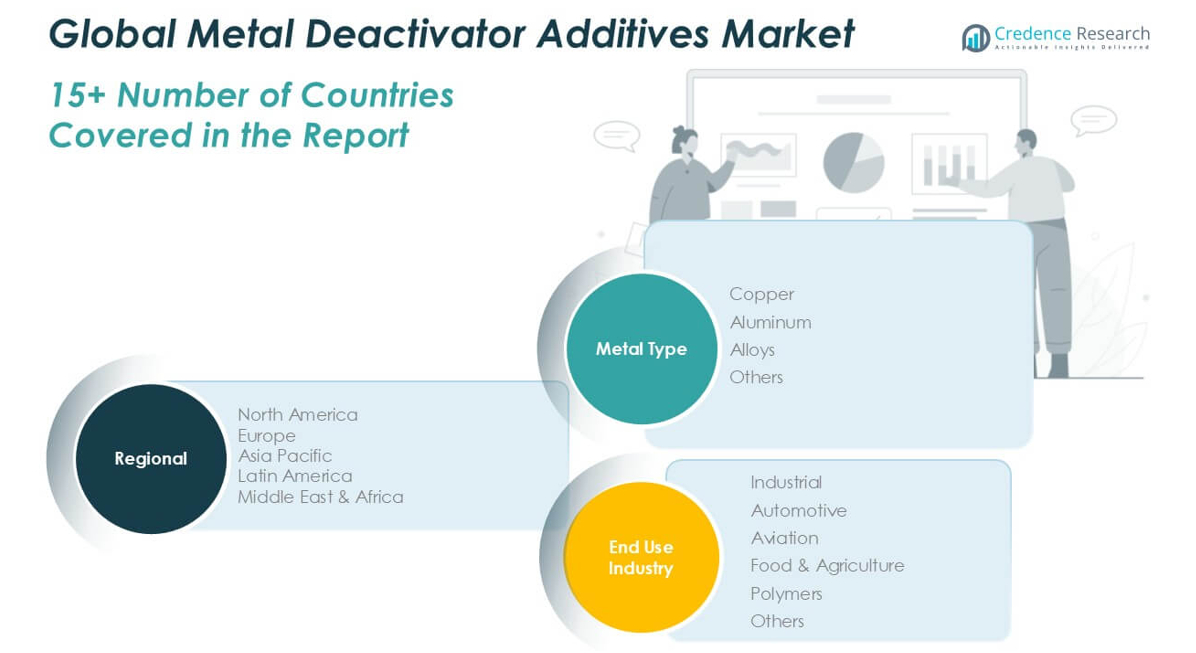
Metal Deactivator Additives Market By Metal Type (Copper, Aluminum, Alloys, Others); By End Use Industry (Industrial, Automotive, Aviation, Food & Agriculture, Polymers, Others) – Growth, Share, Opportunities & Competitive Analysis, 2024 – 2032

Report ID: 14088 | Report Format : Excel, PDF
REPORT ATTRIBUTE DETAILS
Historical Period 2020-2023
Base Year 2024
Forecast Period 2025-2032
Metal Deactivator Additives Market Size 2024 USD 244.2 million
Metal Deactivator Additives Market, CAGR 5.40%
Metal Deactivator Additives Market Size 2032 USD 371.9 million

Market overview

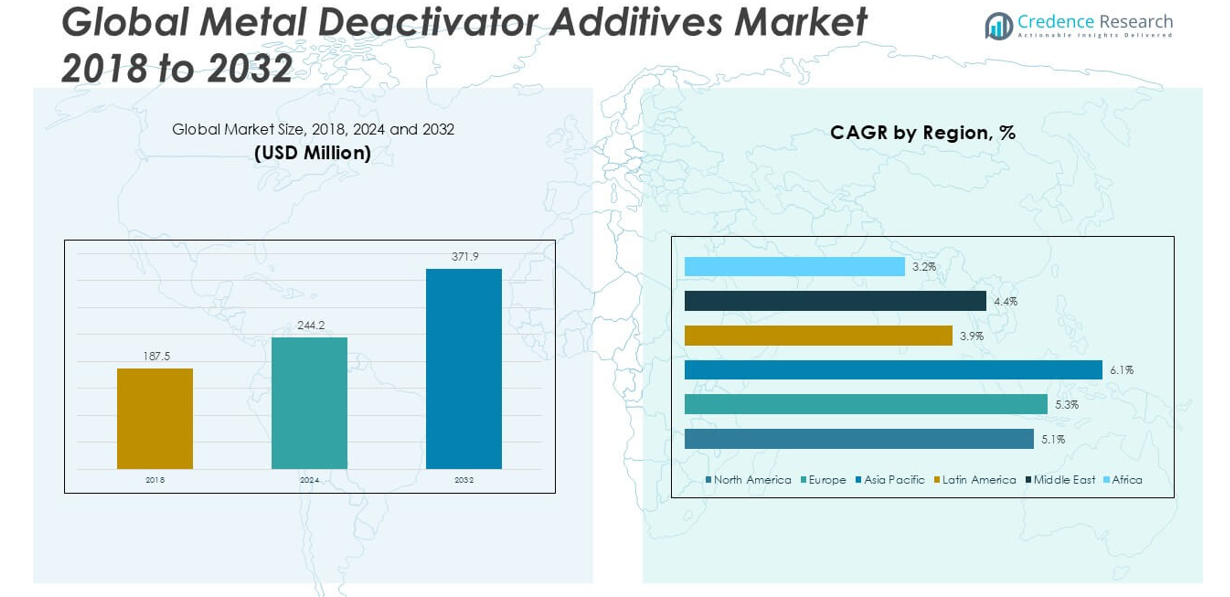
The Metal Deactivator Additives market size was valued at USD 187.5 million in 2018, increased to USD 244.2 million in 2024, and is anticipated to reach USD 371.9 million by 2032, at a CAGR of 5.40% during the forecast period.

The Metal Deactivator Additives market is shaped by key players such as Afton Chemical Corporation, The Lubrizol Corporation, BASF SE, Chevron Oronite Company LLC, Innospec Inc., and Dorf Ketal Chemicals, who actively drive innovation through advanced additive formulations and strategic regional expansions. These companies focus on enhancing additive performance to meet the growing demands of automotive, industrial, and polymer applications. Asia Pacific leads the global market, holding approximately 38% of the total market share in 2024, driven by rapid industrialization, expanding automotive production, and increasing consumption across manufacturing sectors. North America and Europe follow as significant contributors, supported by high-performance lubricant demand and stringent regulatory compliance. The market remains competitive, with a strong emphasis on sustainable, multi-functional solutions.

Metal Deactivator Additives Market size

Market Insights

  • The Metal Deactivator Additives market was valued at USD 187.5 million in 2018, reached USD 244.2 million in 2024, and is expected to attain USD 371.9 million by 2032, growing at a CAGR of 5.40% during the forecast period.
  • Increasing demand from the automotive sector for enhanced fuel stability and engine longevity is a key driver, with the copper segment holding the largest market share due to its wide application in fuel systems.
  • A strong market trend is the shift toward sustainable and multifunctional metal deactivator formulations, with leading companies focusing on environmentally friendly and high-performance additives.
  • The market faces restraints such as stringent environmental regulations and raw material price volatility, which challenge manufacturers in product development and pricing stability.
  • Asia Pacific dominates the global market with around 38% share in 2024, while the automotive end-use segment leads overall consumption across all regions.

Access crucial information at unmatched prices!

Request your sample report today & start making informed decisions powered by Credence Research Inc.!

Download Sample

Market Segmentation Analysis:

By Metal Type:

In the Metal Deactivator Additives market, the copper segment dominates, accounting for a significant market share due to its widespread use in fuels, lubricants, and polymers where copper ions accelerate oxidation and degradation. The high susceptibility of copper to catalytic degradation drives the demand for effective metal deactivators to improve product stability and longevity. Additionally, copper’s extensive applications in automotive radiators, electrical systems, and industrial machinery contribute to its leading position. The aluminum and alloy segments are also growing steadily, supported by rising demand in aviation and automotive sectors, though their market shares remain secondary to copper.

  • For instance, Chevron Oronite Company LLC introduced OLOA® 49800, which reduced aluminum-induced oxidation by 2.5 mg of sludge formation in a 100-hour bench test.

By End Use Industry

The automotive segment holds the largest share in the Metal Deactivator Additives market, driven by the high requirement for additives in fuel systems and lubricants to prevent metal-catalyzed oxidation, which can compromise engine performance. Increasing global vehicle production and the growing focus on fuel efficiency and engine longevity support the dominance of this segment. The industrial segment also contributes significantly, with demand stemming from machinery and equipment maintenance. Meanwhile, the aviation, food & agriculture, and polymers sectors present moderate growth opportunities, supported by the need to enhance product stability and meet stringent performance standards in specialized applications.

  • For instance, Innospec Inc. developed Trident™ 6200 specifically for polymer systems, which improved oxidative color retention by 6 Hunter Lab color units after accelerated aging tests.

Market Overview

Rising Demand from Automotive Industry

The automotive sector significantly drives the growth of the Metal Deactivator Additives market. Increasing vehicle production and the growing emphasis on enhancing fuel efficiency and engine life have accelerated the adoption of these additives. Metal deactivators prevent catalytic oxidation caused by metal ions, thereby improving fuel stability and lubricant performance. As manufacturers prioritize cleaner engines and longer service intervals, the demand for efficient metal deactivator formulations continues to grow, particularly in regions with strict emission and performance standards.

  • For instance, Infineum International Limited’s Infineum P6130 achieved a reduction in deposit formation by 25 mg per 50 ml of oil in diesel engine bench tests conducted over 100 hours.

Expansion of Industrial Applications

Industrial machinery and equipment heavily rely on metal deactivator additives to maintain operational efficiency and minimize maintenance costs. The growing use of metal deactivators in various industrial lubricants and fluids helps prevent oxidation and sludge formation, enhancing the lifespan of machinery components. Increasing investments in manufacturing, mining, and heavy equipment sectors globally contribute to the rising consumption of these additives, creating consistent demand from industrial end users aiming to improve reliability and reduce downtime.

  • For instance, LANXESS’s Additin® RC 8230 lowered wear scar diameter by 0.06 mm in the Four Ball Wear Test conducted on mining equipment hydraulic fluids.

Growing Polymer and Packaging Sector

The polymer industry presents a substantial growth driver for the Metal Deactivator Additives market, particularly in packaging applications where metal contamination can accelerate product degradation. Metal deactivators are essential in polymer processing to prevent discoloration and loss of material properties caused by metal traces. The expanding packaging sector, driven by food safety regulations and consumer demand for durable products, further supports the use of these additives. Their ability to ensure polymer stability and improve product shelf life strengthens their market relevance.

Key Trends & Opportunities

Increasing Demand for High-Performance Additives

The market is witnessing a growing preference for advanced, multi-functional metal deactivator additives that offer superior thermal stability and compatibility across diverse base fluids. Manufacturers are focusing on developing next-generation additives that perform effectively under extreme temperature and pressure conditions. This trend is particularly prominent in high-performance automotive and aviation applications, presenting opportunities for additive producers to introduce differentiated products that meet evolving technical standards and customer requirements.

  • For instance, Evonik Industries AG’s VISCOPLEX® metal deactivator maintained thermal stability up to 240°C without additive degradation during extended lubricant heat tests.

Rising Focus on Sustainable Formulations

There is a notable trend towards environmentally friendly and low-toxicity metal deactivator additives driven by stringent regulatory pressures and sustainability goals. Companies are increasingly investing in the development of non-toxic, biodegradable additive solutions that align with green chemistry principles. This shift opens opportunities for innovation in sustainable formulations that can serve industries aiming to reduce their environmental footprint while maintaining product performance, especially in sectors like food packaging and agriculture.

  • For instance, Croda International Plc launched CrodaTherm™ MDA, which achieved complete degradation in 21 days under simulated composting conditions in accordance with ISO 14855 standards.

Key Challenges

Stringent Regulatory Compliance

The Metal Deactivator Additives market faces challenges in meeting evolving regulatory standards related to environmental impact and chemical safety. Regulatory bodies, particularly in Europe and North America, impose strict restrictions on the use of certain chemicals, driving the need for continuous reformulation. Adapting to these changing requirements increases production costs and slows the introduction of new products, posing a significant challenge for manufacturers seeking to maintain competitiveness.

Volatility in Raw Material Prices

Fluctuating raw material costs present a persistent challenge for the Metal Deactivator Additives market. Key ingredients used in additive production are often subject to price variations influenced by global supply chain disruptions, geopolitical tensions, and fluctuating crude oil prices. This cost instability can negatively affect profit margins for additive manufacturers and may lead to higher end-product pricing, impacting customer adoption in cost-sensitive industries.

Limited Awareness in Emerging Markets

One of the key obstacles to market expansion is the limited awareness and adoption of metal deactivator additives in emerging economies. Many small-scale manufacturers in these regions may not fully understand the benefits of metal deactivators in extending product life and improving performance. This lack of awareness can restrict market penetration and growth potential, especially in industries where cost minimization is prioritized over product longevity and quality enhancement.

Regional Analysis

North America

In the Metal Deactivator Additives market, North America accounted for USD 45.9 million in 2018 and reached USD 54.9 million in 2024. The market is projected to grow to USD 74.4 million by 2032, registering a CAGR of 5.1% during the forecast period. North America holds approximately 22.5% of the global market share in 2024, supported by robust demand from the automotive and industrial sectors. The region’s emphasis on high-performance lubricants and stringent regulatory compliance regarding engine efficiency continues to drive growth. Technological advancements and the presence of leading automotive manufacturers further enhance regional consumption.

Europe

Europe held a significant position in the Metal Deactivator Additives market, with a value of USD 49.7 million in 2018, increasing to USD 61.1 million in 2024. The market is expected to reach USD 85.5 million by 2032, growing at a CAGR of 5.3%. Europe represents around 25% of the global market share in 2024, driven by strong automotive production and widespread use in industrial applications. The region’s commitment to sustainable and high-performance additives fuels continuous product innovation. Additionally, strict environmental policies across the European Union have accelerated the adoption of advanced metal deactivator solutions.

Asia Pacific

Asia Pacific leads the Metal Deactivator Additives market, with a market size of USD 67.9 million in 2018, expanding to USD 92.8 million in 2024. It is projected to reach USD 159.9 million by 2032, growing at the fastest CAGR of 6.1%. Asia Pacific holds approximately 38% of the global market share in 2024, supported by rapidly growing automotive, industrial, and polymer sectors in countries like China, India, and Japan. The increasing focus on manufacturing, rising vehicle production, and expanding consumer goods sectors continue to propel demand, positioning the region as the key growth hub globally.

Latin America

In Latin America, the Metal Deactivator Additives market was valued at USD 7.9 million in 2018 and reached USD 11.0 million in 2024. It is projected to grow to USD 18.6 million by 2032, at a CAGR of 3.9% during the forecast period. The region accounts for around 4.5% of the global market share in 2024. Growth is driven by the gradual development of the automotive and industrial sectors, especially in Brazil and Mexico. However, the market remains relatively small due to lower levels of industrialization and limited adoption of advanced additive technologies in some parts of the region.

Middle East

The Middle East Metal Deactivator Additives market recorded USD 11.3 million in 2018, increasing to USD 14.7 million in 2024. The market is anticipated to reach USD 23.1 million by 2032, growing at a CAGR of 4.4%. The Middle East holds approximately 6% of the global market share in 2024. The demand is primarily driven by the industrial sector, lubricants market, and moderate automotive demand. Investments in manufacturing and increasing industrialization, particularly in Gulf Cooperation Council (GCC) countries, support market expansion. However, the market is still emerging compared to more mature regions such as North America and Europe.

Africa

Africa’s Metal Deactivator Additives market was valued at USD 4.9 million in 2018, rising to USD 9.8 million in 2024. It is expected to reach USD 10.4 million by 2032, growing at a CAGR of 3.2%. Africa represents approximately 4% of the global market share in 2024. The region shows limited growth due to lower industrial penetration and slower adoption rates of advanced additive technologies. However, gradual infrastructure development and increasing automotive activities in select countries like South Africa and Egypt offer moderate opportunities. The market remains in its early growth stage with potential for expansion in the long term.

Metal Deactivator Additives Market segmentation

Market Segmentations:

By Metal Type:

  • Copper
  • Aluminum
  • Alloys
  • Others

By End Use Industry:

  • Industrial
  • Automotive
  • Aviation
  • Food & Agriculture
  • Polymers
  • Others

By Geography:

  • North America
    • U.S.
    • Canada
    • Mexico
  • Europe
    • Germany
    • France
    • U.K.
    • Italy
    • Spain
    • Rest of Europe
  • Asia Pacific
    • China
    • Japan
    • India
    • South Korea
    • South-east Asia
    • Rest of Asia Pacific
  • Latin America
    • Brazil
    • Argentina
    • Rest of Latin America
  • Middle East & Africa
    • GCC Countries
    • South Africa
    • Rest of the Middle East and Africa

Competitive Landscape

The Metal Deactivator Additives market is moderately consolidated, with key players focusing on product innovation, strategic partnerships, and geographic expansion to strengthen their market positions. Leading companies such as Afton Chemical Corporation, The Lubrizol Corporation, BASF SE, and Chevron Oronite Company LLC actively invest in research and development to offer advanced, multi-functional additives that meet evolving industry standards. These players emphasize improving additive efficiency and compatibility with diverse base fluids to cater to the automotive, industrial, and polymer sectors. Companies like Innospec Inc. and Dorf Ketal Chemicals are expanding their regional presence through collaborations and distribution agreements to capture emerging market opportunities in Asia Pacific and Latin America. Additionally, sustainability is becoming a competitive focus, with several manufacturers developing environmentally friendly formulations to comply with stringent regulatory requirements. The market’s competitive dynamics are driven by continuous product differentiation, expanding application portfolios, and a growing emphasis on meeting customer-specific performance requirements across diverse end-use industries.

Shape Your Report to Specific Countries or Regions & Enjoy 30% Off!

Key Player Analysis

  • Afton Chemical Corporation
  • The Lubrizol Corporation
  • BASF SE
  • Chevron Oronite Company LLC
  • Innospec Inc.
  • Dorf Ketal Chemicals
  • LANXESS
  • Infineum International Limited
  • King Industries, Inc.
  • ADEKA Corporation
  • PMC Group, Inc.
  • Croda International Plc
  • Clariant AG
  • Evonik Industries AG

Recent Developments

  • In 2025, Afton Chemicalcontinues to enhance its portfolio of metal deactivator additives. These additives, crucial for fuel stability, neutralize the catalytic effects of metals like copper and iron, which can cause gum and sediment formation by accelerating fuel oxidation. Even trace amounts of these metals can significantly impact fuel stability, making metal deactivators essential.
  • In 2025, Chevron Oronite is continuing its focus on developing innovative fuel and lubricant additive technology, particularly for lower carbon solutions and advanced testing. While R&D efforts are ongoing, there are no specific new metal deactivator products publicly announced by the company so far this year.
  • In December 2024, Lubrizol announced new innovations, emphasizing sustainability, agile development, and local manufacturing, but didn’t specifically mention new metal deactivator additives. Despite this, Lubrizol is recognized as a key player in the metal deactivator additives market and actively invests in R&D for rapid product development.
  • In October 2024, Dorf Ketal introduced a breakthrough “reactive adjunct chemistry” for desalting, which, while not a traditional metal deactivator additive, represents a significant innovation in metals removal and process protection for refineries. This technology enhances desalter efficiency, improves rag layer control, and offers advanced metals removal solutions, especially for challenging crudes. Dorf Ketal’s portfolio also includes solutions specifically for metals removal in desalters, helping protect refining assets from metal-catalyzed issues.

Market Concentration & Characteristics

The Metal Deactivator Additives Market is moderately concentrated, with a few key players controlling a significant portion of the global supply. It features strong competition among established companies that focus on advanced product development and strategic partnerships to expand their reach. The market is characterized by a high degree of technical expertise, driven by the need for additives that offer superior thermal stability and broad fluid compatibility. It demands strict compliance with environmental and safety regulations, which influences both product formulation and market entry barriers. Companies continuously invest in research to develop sustainable and high-performance solutions that align with evolving industry standards. It exhibits consistent demand from the automotive, industrial, and polymer sectors, where metal deactivators play a critical role in enhancing product life and operational efficiency. The competitive landscape encourages differentiation through innovative, multi-functional additive solutions. Emerging markets, particularly in Asia Pacific, present significant growth opportunities, supported by expanding manufacturing activities and rising consumer awareness. It also faces challenges linked to raw material price fluctuations and regulatory complexities that require constant monitoring and product adaptation.

Report Coverage

The research report offers an in-depth analysis based on Metal Type, End Use Industry and Geography. It details leading market players, providing an overview of their business, product offerings, investments, revenue streams, and key applications. Additionally, the report includes insights into the competitive environment, SWOT analysis, current market trends, as well as the primary drivers and constraints. Furthermore, it discusses various factors that have driven market expansion in recent years. The report also explores market dynamics, regulatory scenarios, and technological advancements that are shaping the industry. It assesses the impact of external factors and global economic changes on market growth. Lastly, it provides strategic recommendations for new entrants and established companies to navigate the complexities of the market.

Future Outlook

  1. The demand for metal deactivator additives will grow steadily in the automotive sector due to the focus on improving fuel stability and engine performance.
  2. Manufacturers will continue to develop environmentally friendly and sustainable additive formulations to meet stricter global regulations.
  3. The Asia Pacific region will remain the fastest-growing market, supported by rapid industrialization and increasing automotive production.
  4. Companies will invest more in research and development to create multi-functional additives with higher thermal stability and broader application compatibility.
  5. The polymer and packaging industries will drive additional demand for metal deactivators to prevent product degradation and extend material life.
  6. Partnerships, mergers, and acquisitions will become key strategies for market players aiming to strengthen global distribution networks.
  7. Rising demand from the aviation sector will create new growth avenues for high-performance metal deactivator additives.
  8. The market will face ongoing challenges related to fluctuating raw material costs and supply chain disruptions.
  9. Adoption of metal deactivator additives in emerging markets will increase as awareness of their benefits improves among manufacturers.
  10. Regulatory changes will continue to shape product innovation, pushing companies to prioritize safer and more compliant additive solutions.

CHAPTER NO. 1: GENESIS OF THE MARKET     

1.1 Market Prelude – Introduction & Scope

1.2 The Big Picture – Objectives & Vision

1.3 Strategic Edge – Unique Value Proposition

1.4 Stakeholder Compass – Key Beneficiaries

CHAPTER NO. 2: EXECUTIVE LENS

2.1 Pulse of the Industry – Market Snapshot

2.2 Growth Arc – Revenue Projections (USD Million)

2.3. Premium Insights – Based on Primary Interviews

CHAPTER NO. 3: METAL DEACTIVATOR ADDITIVES MARKET FORCES & INDUSTRY PULSE

3.1 Foundations of Change – Market Overview
3.2 Catalysts of Expansion – Key Market Drivers
3.2.1 Momentum Boosters – Growth Triggers
3.2.2 Innovation Fuel – Disruptive Technologies
3.3 Headwinds & Crosswinds – Market Restraints
3.3.1 Regulatory Tides – Compliance Challenges
3.3.2 Economic Frictions – Inflationary Pressures
3.4 Untapped Horizons – Growth Potential & Opportunities
3.5 Strategic Navigation – Industry Frameworks
3.5.1 Market Equilibrium – Porter’s Five Forces
3.5.2 Ecosystem Dynamics – Value Chain Analysis
3.5.3 Macro Forces – PESTEL Breakdown

3.6 Price Trend Analysis

3.6.1 Regional Price Trend
3.6.2 Price Trend by product

CHAPTER NO. 4: KEY INVESTMENT EPICENTER         

4.1 Regional Goldmines – High-Growth Geographies

4.2 Product Frontiers – Lucrative Product Categories

4.3 End Use Industry Sweet Spots – Emerging Demand Segments

CHAPTER NO. 5: REVENUE TRAJECTORY & WEALTH MAPPING

5.1 Momentum Metrics – Forecast & Growth Curves

5.2 Regional Revenue Footprint – Market Share Insights

5.3 Segmental Wealth Flow – Metal Type & End Use Industry Revenue

CHAPTER NO. 6: TRADE & COMMERCE ANALYSIS     

6.1.      Import Analysis by Region

6.1.1.    Global Metal Deactivator Additives Market Import Volume By Region

6.2.      Export Analysis by Region

6.2.1.    Global Metal Deactivator Additives Market Export Volume By Region

CHAPTER NO. 7: COMPETITION ANALYSIS       

7.1.      Company Market Share Analysis

7.1.1.    Global Metal Deactivator Additives Market: Company Market Share

7.1.      Global Metal Deactivator Additives Market Company Volume Market Share

7.2.      Global Metal Deactivator Additives Market Company Revenue Market Share

7.3.      Strategic Developments

7.3.1.    Acquisitions & Mergers

7.3.2.    New Product Launch

7.3.3.    Regional Expansion

7.4.      Competitive Dashboard

7.5.    Company Assessment Metrics, 2024

CHAPTER NO. 8: METAL DEACTIVATOR ADDITIVES MARKET – BY METAL TYPE SEGMENT ANALYSIS

8.1.      Metal Deactivator Additives Market Overview by Metal Type Segment

8.1.1.    Metal Deactivator Additives Market Volume Share By Metal Type

8.1.2.    Metal Deactivator Additives Market Revenue Share By Metal Type

8.2.      Copper

8.3.      Aluminum

8.4.      Alloys

8.5.      Others

CHAPTER NO. 9: METAL DEACTIVATOR ADDITIVES MARKET – BY END USE INDUSTRY SEGMENT ANALYSIS

9.1.      Metal Deactivator Additives Market Overview by End Use Industry Segment

9.1.1.    Metal Deactivator Additives Market Volume Share By End Use Industry

9.1.2.    Metal Deactivator Additives Market Revenue Share By End Use Industry

9.2.      Industrial

9.3.      Automotive

9.4.      Aviation

9.5.      Food & Agriculture

9.6.      Polymers

9.7.      Others

CHAPTER NO. 10: METAL DEACTIVATOR ADDITIVES MARKET – REGIONAL ANALYSIS     

10.1.     Metal Deactivator Additives Market Overview by Region Segment

10.1.1.  Global Metal Deactivator Additives Market Volume Share By Region

10.1.2.  Global Metal Deactivator Additives Market Revenue Share By Region

10.1.3.  Regions

10.1.4.  Global Metal Deactivator Additives Market Volume By Region

10.1.5.  Global Metal Deactivator Additives Market Revenue By Region

10.1.6.  Metal Type

10.1.7.  Global Metal Deactivator Additives Market Volume By Metal Type

10.1.8.  Global Metal Deactivator Additives Market Revenue By Metal Type

10.1.9.  End Use Industry

10.1.10. Global Metal Deactivator Additives Market Volume By End Use Industry

10.1.11. Global Metal Deactivator Additives Market Revenue By End Use Industry

CHAPTER NO. 11: NORTH AMERICA METAL DEACTIVATOR ADDITIVES MARKET – COUNTRY ANALYSIS 

11.1.     North America Metal Deactivator Additives Market Overview by Country Segment

11.1.1.  North America Metal Deactivator Additives Market Volume Share By Region

11.1.2.  North America Metal Deactivator Additives Market Revenue Share By Region

11.2.     North America

11.2.1.  North America Metal Deactivator Additives Market Volume By Country

11.2.2.  North America Metal Deactivator Additives Market Revenue By Country

11.2.3.  Metal Type

11.2.4.  North America Metal Deactivator Additives Market Volume By Metal Type

11.2.5.  North America Metal Deactivator Additives Market Revenue By Metal Type

11.2.6.  End Use Industry

11.2.7.  North America Metal Deactivator Additives Market Volume By End Use Industry

11.2.8.  North America Metal Deactivator Additives Market Revenue By End Use Industry

11.3.     U.S.

11.4.     Canada

11.5.     Mexico

CHAPTER NO. 12: EUROPE METAL DEACTIVATOR ADDITIVES MARKET – COUNTRY ANALYSIS

12.1.     Europe Metal Deactivator Additives Market Overview by Country Segment

12.1.1.  Europe Metal Deactivator Additives Market Volume Share By Region

12.1.2.  Europe Metal Deactivator Additives Market Revenue Share By Region

12.2.     Europe

12.2.1.  Europe Metal Deactivator Additives Market Volume By Country

12.2.2.  Europe Metal Deactivator Additives Market Revenue By Country

12.2.3.  Metal Type

12.2.4.  Europe Metal Deactivator Additives Market Volume By Metal Type

12.2.5.  Europe Metal Deactivator Additives Market Revenue By Metal Type

12.2.6.  End Use Industry

12.2.7.  Europe Metal Deactivator Additives Market Volume By End Use Industry

12.2.8.  Europe Metal Deactivator Additives Market Revenue By End Use Industry

12.3.     UK

12.4.     France

12.5.     Germany

12.6.     Italy

12.7.     Spain

12.8.     Russia

12.9.   Rest of Europe

CHAPTER NO. 13: ASIA PACIFIC METAL DEACTIVATOR ADDITIVES MARKET – COUNTRY ANALYSIS

13.1.     Asia Pacific Metal Deactivator Additives Market Overview by Country Segment

13.1.1.  Asia Pacific Metal Deactivator Additives Market Volume Share By Region

13.1.2.  Asia Pacific Metal Deactivator Additives Market Revenue Share By Region

13.2.     Asia Pacific

13.2.1.  Asia Pacific Metal Deactivator Additives Market Volume By Country

13.2.2.  Asia Pacific Metal Deactivator Additives Market Revenue By Country

13.2.3.  Metal Type

13.2.4.  Asia Pacific Metal Deactivator Additives Market Volume By Metal Type

13.2.5.  Asia Pacific Metal Deactivator Additives Market Revenue By Metal Type

13.2.6.  End Use Industry

13.2.7.  Asia Pacific Metal Deactivator Additives Market Volume By End Use Industry

13.2.8.  Asia Pacific Metal Deactivator Additives Market Revenue By End Use Industry

13.3.     China

13.4.     Japan

13.5.     South Korea

13.6.     India

13.7.     Australia

13.8.     Southeast Asia

13.9.     Rest of Asia Pacific

CHAPTER NO. 14: LATIN AMERICA METAL DEACTIVATOR ADDITIVES MARKET – COUNTRY ANALYSIS

14.1.     Latin America Metal Deactivator Additives Market Overview by Country Segment

14.1.1.  Latin America Metal Deactivator Additives Market Volume Share By Region

14.1.2.  Latin America Metal Deactivator Additives Market Revenue Share By Region

14.2.     Latin America

14.2.1.  Latin America Metal Deactivator Additives Market Volume By Country

14.2.2.  Latin America Metal Deactivator Additives Market Revenue By Country

14.2.3.  Metal Type

14.2.4.  Latin America Metal Deactivator Additives Market Volume By Metal Type

14.2.5.  Latin America Metal Deactivator Additives Market Revenue By Metal Type

14.2.6.  End Use Industry

14.2.7.  Latin America Metal Deactivator Additives Market Volume By End Use Industry

14.2.8.  Latin America Metal Deactivator Additives Market Revenue By End Use Industry

14.3.     Brazil

14.4.     Argentina

14.5.     Rest of Latin America

CHAPTER NO. 15: MIDDLE EAST METAL DEACTIVATOR ADDITIVES MARKET – COUNTRY ANALYSIS

15.1.     Middle East Metal Deactivator Additives Market Overview by Country Segment

15.1.1.  Middle East Metal Deactivator Additives Market Volume Share By Region

15.1.2.  Middle East Metal Deactivator Additives Market Revenue Share By Region

15.2.     Middle East

15.2.1.  Middle East Metal Deactivator Additives Market Volume By Country

15.2.2.  Middle East Metal Deactivator Additives Market Revenue By Country

15.2.3.  Metal Type

15.2.4.  Middle East Metal Deactivator Additives Market Volume By Metal Type

15.2.5.  Middle East Metal Deactivator Additives Market Revenue By Metal Type

15.2.6.  End Use Industry

15.2.7.  Middle East Metal Deactivator Additives Market Volume By End Use Industry

15.2.8.  Middle East Metal Deactivator Additives Market Revenue By End Use Industry

15.3.     GCC Countries

15.4.     Israel

15.5.     Turkey

15.6.     Rest of Middle East

CHAPTER NO. 16: AFRICA METAL DEACTIVATOR ADDITIVES MARKET – COUNTRY ANALYSIS

16.1.     Africa Metal Deactivator Additives Market Overview by Country Segment

16.1.1.  Africa Metal Deactivator Additives Market Volume Share By Region

16.1.2.  Africa Metal Deactivator Additives Market Revenue Share By Region

16.2.     Africa

16.2.1.  Africa Metal Deactivator Additives Market Volume By Country

16.2.2.  Africa Metal Deactivator Additives Market Revenue By Country

16.2.3.  Metal Type

16.2.4.  Africa Metal Deactivator Additives Market Volume By Metal Type

16.2.5.  Africa Metal Deactivator Additives Market Revenue By Metal Type

16.2.6.  End Use Industry

16.2.7.  Africa Metal Deactivator Additives Market Volume By End Use Industry

16.2.8.  Africa Metal Deactivator Additives Market Revenue By End Use Industry

16.3.     South Africa

16.4.     Egypt

16.5.     Rest of Africa

CHAPTER NO. 17: COMPANY PROFILES 

17.1.     Afton Chemical Corporation

17.1.1.  Company Overview

17.1.2.  Product Portfolio

17.1.3.  Financial Overview

17.1.4.  Recent Developments

17.1.5.  Growth Strategy

17.1.6.  SWOT Analysis

17.2.     The Lubrizol Corporation

17.3.     BASF SE

17.4.     Chevron Oronite Company LLC

17.5.     Innospec Inc.

17.6.     Dorf Ketal Chemicals

17.7.     LANXESS

17.8.     Infineum International Limited

17.9.     King Industries, Inc.

17.10.   ADEKA Corporation

17.11.   PMC Group, Inc.

17.12.   Croda International Plc

17.13.   Clariant AG

17.14.   Evonik Industries AG

Request Free Sample

We prioritize the confidentiality and security of your data. Our promise: your information remains private.

Ready to Transform Data into Decisions?

Request Your Sample Report and Start Your Journey of Informed Choices


Providing the strategic compass for industry titans.

cr-clients-logos
What is the current size of the Metal Deactivator Additives Market?

The Metal Deactivator Additives Market size is valued at USD 244.2 million in 2024.

What are the key segments within the Metal Deactivator Additives Market?

The market is segmented by Metal Type (Copper, Aluminum, Alloys, Others) and by End Use Industry (Automotive, Industrial, Aviation, Food & Agriculture, Polymers, Others).

What are some challenges faced by the Metal Deactivator Additives Market?

The market faces challenges such as stringent environmental regulations, raw material price fluctuations, and limited awareness in emerging regions.

Who are the major players in the Metal Deactivator Additives Market?

Key players include Afton Chemical Corporation, The Lubrizol Corporation, BASF SE, Chevron Oronite Company LLC, and Innospec Inc.

About Author

Shweta Bisht

Shweta Bisht

Healthcare & Biotech Analyst

Shweta is a healthcare and biotech researcher with strong analytical skills in chemical and agri domains.

View Profile


Related Reports

Organotin Stabilizers Market

The Organotin Stabilizers Market size was valued at USD 1,100.00 million in 2018 to USD 1,295.92 million in 2024 and is anticipated to reach USD 2,064.02 million by 2032, at a CAGR of 6.11% during the forecast period.

Citric Acid Market

The Citric Acid Market size was valued at USD 3,500.00 million in 2018 to USD 3,880.69 million in 2024 and is anticipated to reach USD 5,299.62 million by 2032, at a CAGR of 4.01% during the forecast period.

Pneumatic Bolting Tool Market

The Pneumatic bolting tool market is projected to grow from USD 1,923 million in 2024 to USD 3,025.6 million by 2032, at a CAGR of 5.83% from 2024 to 2032.

Plastics Market

The Plastics market is projected to grow steadily during the forecast period. The market stood at USD 524,473 million in 2024 and is expected to reach USD 769,000.9 million by 2032. The Plastics market is projected to grow at a CAGR of 4.9% from 2024 to 2032.

Plasticizers Market

The Plasticizers market was valued at USD 17,743 million in 2024. The market is projected to reach USD 25,621 million by 2032. This growth reflects a 4.7% CAGR from 2024 to 2032.

Pigment Dispersion Market

The Pigment dispersion market is projected to grow from USD 27,012 million in 2024 to USD 37,396.2 million by 2032. The market is expected to record a CAGR of 4.15% during the 2024–2032 period.

Piping And Fittings Market

The Piping and fittings market is projected to grow from USD 83,185 million in 2024 to USD 131,586.7 million by 2032. This expansion reflects a compound annual growth rate of 5.9% from 2024 to 2032.

PFAS Filtration Market

The PFAS filtration market is projected to grow from USD 2,033 million in 2024 to an estimated USD 3,469.3 million by 2032, with a CAGR of 6.91% from 2024 to 2032.

Petroleum Refining Hydrogen Market

The Petroleum refining hydrogen market is projected to grow from USD 139,882 million in 2024 to USD 357,377.4 million by 2032. The market is expected to expand at a CAGR of 12.44% from 2024 to 2032.

Photochromic Materials Market

The Photochromic materials market is projected to grow from USD 1,313 million in 2024 to USD 2,247.2 million by 2032, with a compound annual growth rate of 6.95% from 2024 to 2032.

Paraffin Inhibitors Market

The Paraffin inhibitors market is projected to grow from USD 696.5 million in 2024 to USD 1001.9 million by 2032. The market is expected to expand at a CAGR of 4.65% during the forecast period.

Packed Bed Reactor Market

The Packed bed reactor market is projected to grow from USD 2,533 million in 2024 to USD 4,021.7 million by 2032, at a CAGR of 5.95% during the forecast period.

Licence Option

The report comes as a view-only PDF document, optimized for individual clients. This version is recommended for personal digital use and does not allow printing. Use restricted to one purchaser only.
$4999

To meet the needs of modern corporate teams, our report comes in two formats: a printable PDF and a data-rich Excel sheet. This package is optimized for internal analysis. Unlimited users allowed within one corporate location (e.g., regional office).
$6999

The report will be delivered in printable PDF format along with the report’s data Excel sheet. This license offers 100 Free Analyst hours where the client can utilize Credence Research Inc. research team. Permitted for unlimited global use by all users within the purchasing corporation, such as all employees of a single company.
$12999

Report delivery within 24 to 48 hours

Europe

North America

Email

Smallform of Sample request
User Review

Thank you for the data! The numbers are exactly what we asked for and what we need to build our business case.

Materials Scientist
(privacy requested)

User Review

The report was an excellent overview of the Industrial Burners market. This report does a great job of breaking everything down into manageable chunks.

Imre Hof
Management Assistant, Bekaert

cr-clients-logos

Request Sample