Home » Chemicals » Aerospace Coatings Market

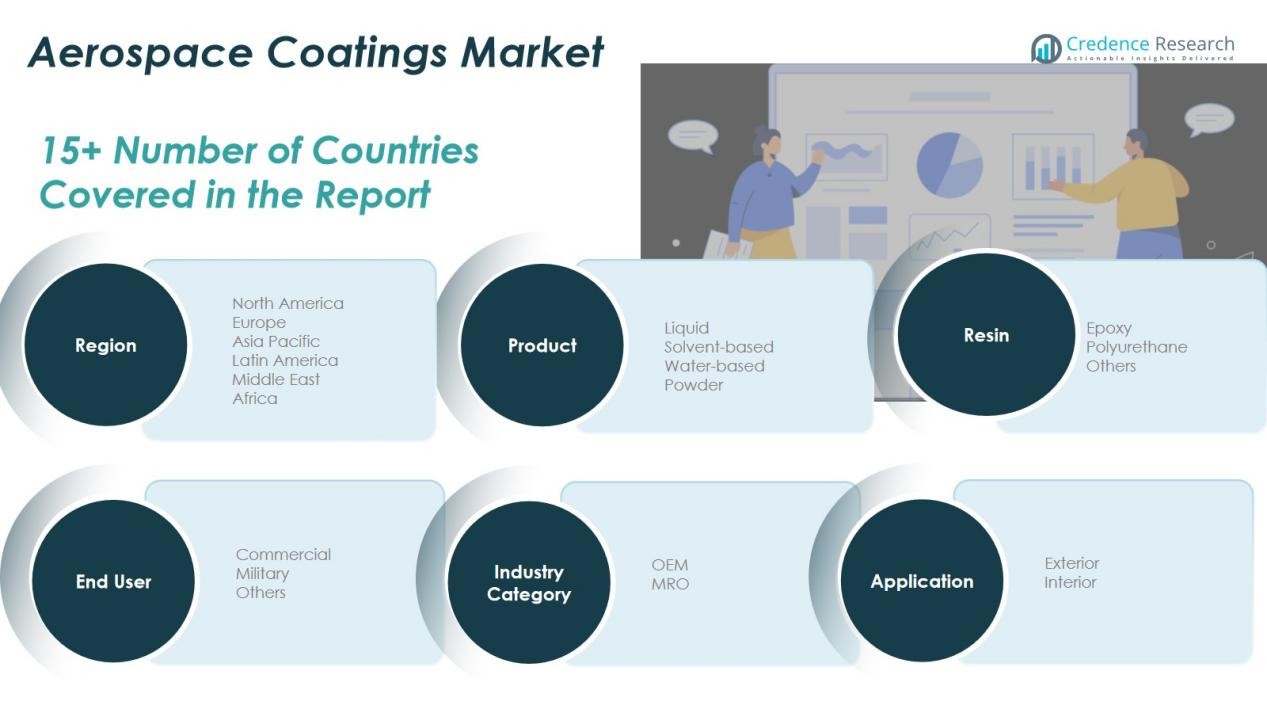
Aerospace Coatings Market By Product Type (Liquid, Solvent-based, Water-based, Powder); By Application (Exterior, Interior); By Industry Category (OEM, MRO); By Resin Type (Epoxy, Polyurethane, Others); By End User (Commercial, Military, Others); By Region – Growth, Share, Opportunities & Competitive Analysis, 2024 – 2032

Report ID: 2590 | Report Format : Excel, PDF

Market Overview:

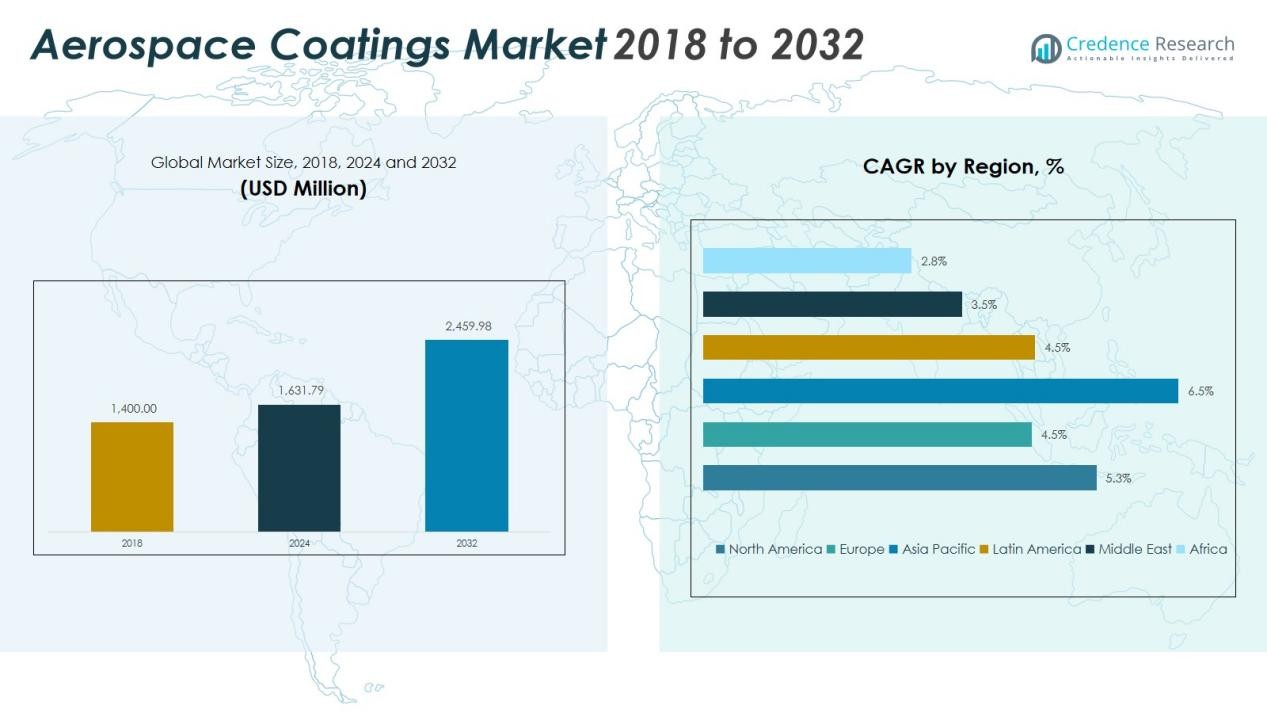
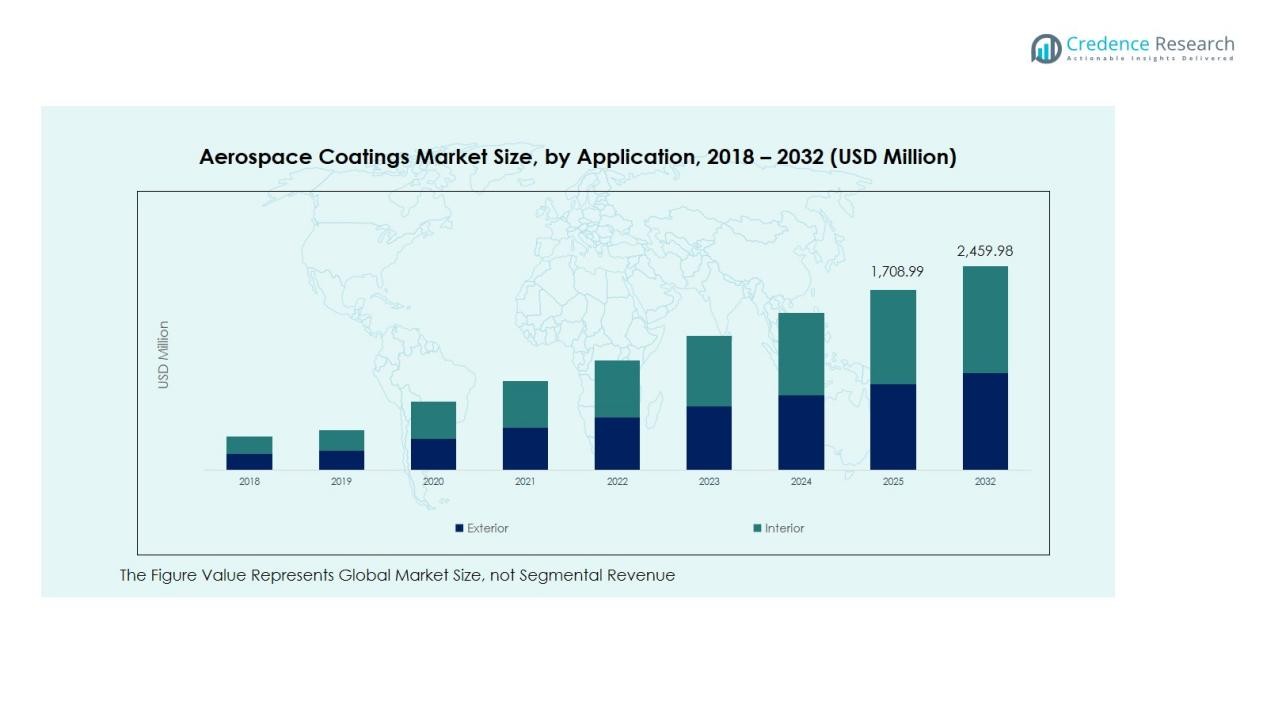
The Global Aerospace Coatings Market size was valued at USD 1,400 million in 2018 to USD  1,631.79 million in 2024 and is anticipated to reach USD  2,459.98 million by 2032, at a CAGR of 5.34% during the forecast period.

REPORT ATTRIBUTE DETAILS
Historical Period 2020-2023
Base Year 2024
Forecast Period 2025-2032
Aerospace Coatings Market Size 2024 USD 1,631.79 Million
Aerospace Coatings Market, CAGR 5.34%
Aerospace Coatings Market Size 2032 USD 2,459.98 Million


Growth is driven by increased production of commercial aircraft and expanding global air travel, which raise demand for coatings in both original equipment and maintenance sectors. Advancements in lightweight and eco-friendly coatings, coupled with stricter environmental regulations, are supporting product innovation. Rising military and space-craft applications are further driving adoption of coatings that provide superior corrosion resistance, durability, and thermal protection.

North America holds the largest share of the aerospace coatings market due to its strong aircraft manufacturing base and extensive maintenance, repair, and overhaul (MRO) operations. Europe follows, supported by technological innovation and regulatory emphasis on sustainable aviation materials. The Asia-Pacific region is expected to record the fastest growth, driven by expanding commercial aviation fleets in China and India and increasing regional MRO infrastructure.

Access crucial information at unmatched prices!

Request your sample report today & start making informed decisions powered by Credence Research Inc.!

Download Sample

Market Insights:

  • The Global Aerospace Coatings Market was valued at USD 1,400 million in 2018, reached USD 1,631.79 million in 2024, and is projected to attain USD 2,459.98 million by 2032, expanding at a CAGR of 5.34% during the forecast period.
  • North America holds 35% of the market share, driven by strong aircraft manufacturing, defense investments, and large MRO infrastructure led by Boeing and Lockheed Martin.
  • Europe accounts for 25% of the share, supported by Airbus-led aerospace production, strict environmental compliance, and advanced coating technologies developed by AkzoNobel and Mankiewicz.
  • Asia Pacific represents 28% of the share and remains the fastest-growing region due to expanding commercial aviation fleets, rising passenger traffic, and government-backed aircraft manufacturing initiatives in China and India.
  • By segment, liquid coatings dominate with 40% share owing to their superior finish and widespread use in OEM applications, while the OEM category leads with 55% share driven by increasing aircraft deliveries and fleet modernization.

Aerospace Coatings Market Size

Market Drivers:

Rising Aircraft Production and Fleet Expansion Accelerating Coating Demand

The Global Aerospace Coatings Market benefits from growing aircraft production and fleet modernization across commercial and defense sectors. Increasing passenger traffic and new aircraft orders from major manufacturers such as Boeing and Airbus strengthen coating requirements for protection and performance. Airlines are investing in repainting and maintenance programs to improve fuel efficiency and visual appeal. It continues to gain traction as lightweight, high-durability coatings reduce maintenance costs and extend aircraft lifespan.

  • For instance, Boeing reported a firm order backlog of over 5,500 commercial airplanes, specifically 5,595 at year-end 2024 [2, 3].

Technological Advancements in High-Performance and Eco-Friendly Coatings

Continuous innovation in coating formulations is a major growth driver. The market is witnessing increased adoption of nanotechnology-based coatings and advanced polyurethane systems that enhance corrosion and UV resistance. Demand for low-VOC, chrome-free, and waterborne coatings is rising due to stricter environmental standards. It supports aircraft manufacturers in meeting sustainability goals while maintaining high surface protection standards.

  • For instance, PPG’s PR-2940 epoxy syntactic paste adhesive (ESPA) for aircraft internal structures combines exceptional mechanical strength with flexibility and microcracking resistance across operating temperature ranges, enabling lightweight potency through honeycomb structure reinforcement in aircraft wings, galleys, and flooring—delivering significant performance and sustainability advantages through structural lightweighting.

Growing Maintenance, Repair, and Overhaul (MRO) Activities Enhancing Market Growth

Expanding MRO operations worldwide create strong opportunities for aerospace coating suppliers. Airlines and defense forces are extending aircraft service life through regular repainting and refurbishing. Increased air traffic drives faster turnaround needs for repainting operations. It helps MRO service providers use advanced coatings that ensure quicker application, reduced drying time, and long-lasting finishes.

Rising Defense Expenditure and Space Exploration Programs Fueling Demand

The defense and space sectors significantly influence market expansion. Growing investments in military aircraft, satellites, and spacecraft require specialized coatings for thermal stability and radiation resistance. Countries such as the U.S., China, and India are accelerating aerospace projects that demand high-performance coatings. It positions aerospace coatings as critical for mission safety, durability, and operational performance.

Aerospace Coatings Market Share

Market Trends:

Shift Toward Sustainable and High-Performance Coating Technologies

The Global Aerospace Coatings Market is witnessing a clear shift toward sustainable and high-performance formulations driven by stricter environmental regulations and operational efficiency goals. Manufacturers are developing chrome-free primers, waterborne systems, and eco-friendly polyurethane coatings that reduce VOC emissions while maintaining durability. The demand for lightweight coatings that enhance fuel efficiency and resist corrosion is increasing among aircraft manufacturers and MRO operators. It is also experiencing adoption of smart coatings capable of self-healing and detecting surface damage, which improves safety and maintenance efficiency. Nanotechnology-based coatings are gaining prominence due to their superior UV, abrasion, and temperature resistance properties. Sustainability commitments by major players, including PPG Industries and AkzoNobel, are encouraging industry-wide transitions toward greener production and lifecycle practices.

  • For instance, AkzoNobel’s new generation waterborne basecoat technology introduced in early 2025, while marketed for car refinishes rather than aerospace applications, can achieve material savings of around 15% on average due to its high pigmentation and coverage in 1.5 layers.

Rising Adoption of Advanced Coating Application and Digital Technologies

Digital transformation and process automation are emerging as key trends in aerospace coating applications. Robotic and automated spray systems are reducing application time, improving uniformity, and lowering operational costs for aircraft manufacturers. It is also integrating digital monitoring tools that ensure consistency in coating thickness and quality during production and maintenance stages. Data-driven quality control methods enhance precision while minimizing waste and rework rates. Increasing use of 3D printing for aircraft components is prompting the development of specialized coatings tailored for additive manufacturing materials. Global collaborations among OEMs, coating suppliers, and aerospace research institutions are accelerating advancements in efficiency, performance, and sustainability. These developments position advanced coating and digital application technologies at the center of the industry’s modernization strategy.

  • For instance, Aerobotix’s robotic coating system for F-22 aircraft inlet duct maintenance achieved a 50% increase in first-pass yield and quality while reducing rework per aircraft, with the system’s precision application enabling savings of approximately $40,000 per aircraft through reduced coating waste at $1,000 per gallon.

Market Challenges Analysis:

Stringent Environmental Regulations and High Compliance Costs

The Global Aerospace Coatings Market faces major challenges due to strict environmental and safety regulations governing VOC emissions and hazardous chemical use. Manufacturers must comply with evolving international standards such as REACH and EPA regulations, which restrict the use of heavy metals and solvent-based compounds. Meeting these norms demands investment in R&D and reformulation of existing products, increasing operational costs. It must balance performance expectations with compliance requirements without compromising coating durability. The need for advanced, eco-friendly alternatives also slows product approvals and extends development timelines. These factors create financial pressure on small and mid-sized manufacturers seeking to maintain competitiveness.

Complex Application Processes and High Production Costs

Applying aerospace coatings involves precision, skilled labor, and advanced equipment, which elevate production and maintenance costs. The multi-layer coating systems require controlled environments and strict adherence to temperature and humidity standards. It faces challenges in reducing downtime and achieving consistent quality during large-scale or MRO operations. High raw material costs, especially for specialty resins and pigments, further affect profitability. The shortage of trained applicators and technical experts limits efficiency in emerging regions. These complexities continue to challenge manufacturers and service providers striving for cost-effective and reliable coating performance.

Market Opportunities:

Expansion of Commercial Aviation and MRO Infrastructure in Emerging Economies

The Global Aerospace Coatings Market holds strong opportunities in emerging economies with expanding commercial aviation fleets. Rapid air traffic growth in Asia-Pacific, the Middle East, and Latin America is creating demand for new aircraft and maintenance services. Governments are investing in aviation infrastructure and MRO facilities to support fleet modernization and safety compliance. It benefits from this trend through increased requirements for corrosion-resistant, fuel-efficient, and aesthetically advanced coatings. Local manufacturing partnerships and technology transfers further enhance supply chain efficiency. Growing regional airline competition is also pushing carriers to adopt premium coatings that improve performance and reduce operational costs.

Rising Demand for Smart and Functional Coating Technologies

The market is moving toward functional coatings that extend beyond surface protection. Smart coatings with anti-icing, self-healing, and temperature-sensing properties offer significant innovation potential. It creates new opportunities for suppliers specializing in nanotechnology and advanced materials. Defense and space programs are adopting multifunctional coatings to enhance stealth, thermal resistance, and radiation protection. Demand for digitalized coating processes that integrate predictive maintenance tools is also growing. These advancements position high-performance and intelligent coatings as a key revenue growth frontier for the industry.

Market Segmentation Analysis:

By Product Type

The Global Aerospace Coatings Market is segmented into liquid, solvent-based, water-based, and powder coatings. Liquid coatings hold a dominant share due to their superior finish quality and ease of application across aircraft surfaces. Solvent-based variants remain preferred in heavy-duty aerospace maintenance for their durability and weather resistance. Water-based coatings are gaining traction with stricter VOC regulations and sustainability goals. It benefits from the shift toward powder coatings, which provide efficient coverage, minimal waste, and enhanced corrosion protection.

  • For instance, PPG’s Deft 03-GY-444 polyurethane topcoat, a MIL-PRF-85285E-compliant aerospace liquid coating system, provides exceptional corrosion protection and is capable of achieving performance that can exceed 1000 hours of salt spray exposure in specific test conditions, all while maintaining superior gloss retention and dimensional stability on aircraft exteriors.

By Application

The market is divided into exterior and interior applications. Exterior coatings lead the segment due to their critical role in protection against UV radiation, temperature extremes, and corrosion. They are widely used to maintain aerodynamic efficiency and improve fuel performance. Interior coatings focus on aesthetics, wear resistance, and fire safety in cabin components. It continues to see innovation in lightweight coatings that extend surface life while reducing maintenance downtime.

  • For instance, Japan Airlines (JAL) applied O-Well Corporation’s riblet-shaped coating to a Boeing 787-9 aircraft in January 2025, achieving a 0.24% drag reduction during cruising, which translates to annual fuel savings of 119 tons and CO2 emission reductions of 381 tons per aircraft.

By Industry Category

Based on industry category, the market is classified into OEM and MRO. The OEM segment dominates due to rising aircraft deliveries and production expansion by major manufacturers. The MRO segment shows strong growth driven by fleet modernization and refurbishing programs. It gains further momentum from the increasing lifespan of aircraft, fueling steady coating replacement demand.

Aerospace Coatings Market Segmentation

Segmentations:

By Product Type

  • Liquid
  • Solvent-based
  • Water-based
  • Powder

By Application

  • Exterior
  • Interior

By Industry Category

  • OEM
  • MRO

By Resin Type

  • Epoxy
  • Polyurethane
  • Others

By End User

  • Commercial
  • Military
  • Others

By Region

  • North America
    • U.S.
    • Canada
    • Mexico
  • Europe
    • Germany
    • France
    • U.K.
    • Italy
    • Spain
    • Rest of Europe
  • Asia Pacific
    • China
    • Japan
    • India
    • South Korea
    • South-east Asia
    • Rest of Asia Pacific
  • Latin America
    • Brazil
    • Argentina
    • Rest of Latin America
  • Middle East & Africa
    • GCC Countries
    • South Africa
    • Rest of the Middle East and Africa

Regional Analysis:

North America

The North America Aerospace Coatings Market size was valued at USD 516.46 million in 2018 to USD 594.78 million in 2024 and is anticipated to reach USD 895.44 million by 2032, at a CAGR of 5.3% during the forecast period. North America holds 35% of the total share of the Global Aerospace Coatings Market. The United States drives regional dominance through high aircraft production, robust MRO infrastructure, and strong defense spending. Leading manufacturers such as Boeing and Lockheed Martin create consistent demand for advanced coating systems. It benefits from the presence of key players including PPG Industries and Sherwin-Williams, which invest heavily in R&D for sustainable coatings. The region’s focus on eco-friendly technologies and digital maintenance solutions continues to accelerate market expansion.

Europe

The Europe Aerospace Coatings Market size was valued at USD 314.30 million in 2018 to USD 349.65 million in 2024 and is anticipated to reach USD 492.62 million by 2032, at a CAGR of 4.5% during the forecast period. Europe holds 25% of the global market share, led by countries such as Germany, France, and the UK. The region benefits from strong aerospace manufacturing supported by Airbus and other OEMs. Stringent environmental policies are driving adoption of waterborne and chrome-free coatings. It also witnesses steady demand from defense aviation modernization programs across NATO nations. Advanced coating technologies from AkzoNobel and Mankiewicz strengthen Europe’s position as a hub for sustainable aerospace coating innovation.

Asia Pacific

The Asia Pacific Aerospace Coatings Market size was valued at USD 398.30 million in 2018 to USD 481.94 million in 2024 and is anticipated to reach USD 791.62 million by 2032, at a CAGR of 6.5% during the forecast period. Asia Pacific holds 28% of the Global Aerospace Coatings Market share and is the fastest-growing region. Rising air passenger traffic in China, India, and Southeast Asia fuels demand for new aircraft and MRO services. It gains traction from expanding commercial aviation fleets and infrastructure investments. Regional governments are promoting domestic aircraft production, supporting long-term coating demand. Increasing partnerships between local and global manufacturers drive technology transfer and capacity expansion across the region.

Latin America

The Latin America Aerospace Coatings Market size was valued at USD 102.20 million in 2018 to USD 118.13 million in 2024 and is anticipated to reach USD 166.96 million by 2032, at a CAGR of 4.5% during the forecast period. Latin America holds 7% of the global market share, supported by growing MRO activities and airline modernization efforts. Brazil remains the primary hub, driven by Embraer’s operations and regional air transport expansion. It experiences increasing adoption of durable and cost-effective coatings that extend aircraft service life. Economic recovery and regional airline growth encourage maintenance investments. The demand for eco-compliant and high-performance coatings continues to rise across civil and defense aviation sectors.

Middle East

The Middle East Aerospace Coatings Market size was valued at USD 40.46 million in 2018 to USD 43.23 million in 2024 and is anticipated to reach USD 56.59 million by 2032, at a CAGR of 3.5% during the forecast period. The Middle East holds 3% of the global market share, anchored by strong airline operators such as Emirates and Qatar Airways. The region’s MRO facilities in the UAE and Saudi Arabia support consistent coating demand for large commercial fleets. It benefits from continued investments in aviation infrastructure and fleet expansion. The defense sector also contributes through modernization of aircraft and helicopters. Coating manufacturers are focusing on weather-resistant and high-gloss finishes suited to desert environments.

Africa

The Africa Aerospace Coatings Market size was valued at USD 28.28 million in 2018 to USD 44.06 million in 2024 and is anticipated to reach USD 56.75 million by 2032, at a CAGR of 2.8% during the forecast period. Africa holds 2% of the Global Aerospace Coatings Market share and is gradually emerging with increasing investments in aviation. South Africa and Egypt are leading contributors with expanding commercial and maintenance operations. It faces challenges of limited local manufacturing and higher import dependency for coating materials. Growing regional connectivity and airport modernization projects support gradual market expansion. Partnerships with global suppliers are improving product access and technical expertise across the continent.

Key Player Analysis:

  • AkzoNobel N.V.
  • PPG Industries, Inc.
  • Sherwin-Williams
  • Hentzen Coatings, Inc.
  • Mankiewicz Gebr. & Co
  • Axalta Coating Systems Ltd
  • Saint-Gobain S.A.
  • Henkel Corporation
  • IHI Ionbond AG
  • Zircotec Ltd
  • LORD Corporation
  • AHC Oberflächentechnik
  • BryCoat Inc.
  • NV Specialty Coatings

Competitive Analysis:

The Global Aerospace Coatings Market is characterized by strong competition among leading multinational and specialized coating manufacturers. Key participants include AkzoNobel N.V., PPG Industries, Inc., Sherwin-Williams, Hentzen Coatings, Inc., Mankiewicz Gebr. & Co, Axalta Coating Systems Ltd, Saint-Gobain S.A., Henkel Corporation, and IHI Ionbond AG. It is driven by innovation, quality, and compliance with stringent aerospace standards. Companies focus on developing eco-friendly, high-durability coatings that meet VOC and REACH regulations. Strategic alliances with aircraft OEMs and MRO providers enhance brand positioning and long-term contracts. Continuous investment in R&D, automation, and nanotechnology-based coatings supports product differentiation. Competition remains intense, with players emphasizing sustainability, performance, and customer service to maintain global market leadership.

Shape Your Report to Specific Countries or Regions & Enjoy 30% Off!

Recent Developments:

  • In June 2025, AkzoNobel signs an agreement to sell Akzo Nobel India Limited to the JSW Group for about €1.4 billion; closing anticipated in Q4 2025.
  • In October 2025, AkzoNobel becomes exclusive supplier for solar-absorbing wall technology

Report Coverage:

The research report offers an in-depth analysis based on Product Type, Application, Industry Category, Resin Type, End User and Region. It details leading market players, providing an overview of their business, product offerings, investments, revenue streams, and key applications. Additionally, the report includes insights into the competitive environment, SWOT analysis, current market trends, as well as the primary drivers and constraints. Furthermore, it discusses various factors that have driven market expansion in recent years. The report also explores market dynamics, regulatory scenarios, and technological advancements that are shaping the industry. It assesses the impact of external factors and global economic changes on market growth. Lastly, it provides strategic recommendations for new entrants and established companies to navigate the complexities of the market.

Future Outlook:

  • The Global Aerospace Coatings Market will witness steady growth driven by increasing aircraft production and fleet expansion across commercial and defense sectors.
  • It will experience rising adoption of eco-friendly, low-VOC, and chrome-free coatings due to tightening environmental regulations.
  • Technological innovation in nanocoatings and self-healing materials will enhance surface protection and operational efficiency.
  • Expansion of MRO facilities in developing regions will create consistent demand for high-performance coating solutions.
  • It will benefit from growing investments in lightweight coating systems that improve fuel efficiency and reduce maintenance costs.
  • Digitalization and automation in coating application processes will improve precision, reduce waste, and enhance productivity.
  • Defense and space programs will drive demand for advanced coatings offering thermal stability, stealth, and corrosion resistance.
  • Partnerships between OEMs and coating manufacturers will increase, ensuring tailored solutions for evolving aircraft designs.
  • It will see a growing shift toward waterborne and powder coatings aligned with sustainability goals.
  • Rising air passenger traffic and infrastructure development in emerging economies will sustain long-term market expansion.

CHAPTER NO. 1 : GENESIS OF THE MARKET

1.1 Market Prelude – Introduction & Scope

1.2 The Big Picture – Objectives & Vision

1.3 Strategic Edge – Unique Value Proposition

1.4 Stakeholder Compass – Key Beneficiaries

CHAPTER NO. 2 : EXECUTIVE LENS

2.1 Pulse of the Industry – Market Snapshot

2.2 Growth Arc – Revenue Projections (USD Million)

2.3. Premium Insights – Based on Primary Interviews

CHAPTER NO. 3 : AEROSPACE COATINGS MARKET FORCES & INDUSTRY PULSE

3.1 Foundations of Change – Market Overview

3.2 Catalysts of Expansion – Key Market Drivers

3.2.1 Momentum Boosters – Growth Triggers

3.2.2 Innovation Fuel – Disruptive Technologies

3.3 Headwinds & Crosswinds – Market Restraints

3.3.1 Regulatory Tides – Compliance Challenges

3.3.2 Economic Frictions – Inflationary Pressures

3.4 Untapped Horizons – Growth Potential & Opportunities

3.5 Strategic Navigation – Industry Frameworks

3.5.1 Market Equilibrium – Porter’s Five Forces

3.5.2 Ecosystem Dynamics – Value Chain Analysis

3.5.3 Macro Forces – PESTEL Breakdown

3.6 Price Trend Analysis

3.6.1 Regional Price Trend

3.6.2 Price Trend by product

CHAPTER NO. 4 : KEY INVESTMENT EPICENTER

4.1 Regional Goldmines – High-Growth Geographies

4.2 Product Frontiers – Lucrative Product Categories

4.3 Application Sweet Spots – Emerging Demand Segments

CHAPTER NO. 5: REVENUE TRAJECTORY & WEALTH MAPPING

5.1 Momentum Metrics – Forecast & Growth Curves

5.2 Regional Revenue Footprint – Market Share Insights

5.3 Segmental Wealth Flow – Product Type & Application Revenue

CHAPTER NO. 6 : TRADE & COMMERCE ANALYSIS

6.1. Import Analysis by Region

6.1.1. Global Aerospace Coatings Market Import Revenue By Region

6.2. Export Analysis by Region

6.2.1. Global Aerospace Coatings Market Export Revenue By Region

CHAPTER NO. 7 : COMPETITION ANALYSIS

7.1. Company Market Share Analysis

7.1.1. Global Aerospace Coatings Market: Company Market Share

7.2. Global Aerospace Coatings Market Company Revenue Market Share

7.3. Strategic Developments

7.3.1. Acquisitions & Mergers

7.3.2. New Product Launch

7.3.3. Regional Expansion

7.4. Competitive Dashboard

7.5. Company Assessment Metrics, 2024

CHAPTER NO. 8 : AEROSPACE COATINGS MARKET – BY PRODUCT SEGMENT ANALYSIS

8.1. Aerospace Coatings Market Overview by Product Segment

8.1.1. Aerospace Coatings Market Revenue Share By Product

8.2. Liquid

8.3 Solvent-based

8.4. Water-based

8.5. Powder

CHAPTER NO. 9 : AEROSPACE COATINGS MARKET – BY APPLICATION SEGMENT ANALYSIS

9.1. Aerospace Coatings Market Overview by Application Segment

9.1.1. Aerospace Coatings Market Revenue Share By Application

9.2. Exterior

9.3. Interior

CHAPTER NO. 10 : AEROSPACE COATINGS MARKET – BY INDUSTRY CATEGORY SEGMENT ANALYSIS

10.1. Aerospace Coatings Market Overview by Industry Category Segment

10.1.1. Aerospace Coatings Market Revenue Share By Industry Category

10.2. OEM

10.3. MRO

CHAPTER NO. 11 : AEROSPACE COATINGS MARKET – BY RESIN SEGMENT ANALYSIS

11.1. Aerospace Coatings Market Overview by Resin

11.1.1. Aerospace Coatings Market Revenue Share By Resin

11.2. Epoxy

11.3 Polyurethane

11.4. Others

CHAPTER NO. 12 : AEROSPACE COATINGS MARKET – BY END USER SEGMENT ANALYSIS

12.1. Aerospace Coatings Market Overview by End User Segment

12.1.1. Aerospace Coatings Market Revenue Share By End User

12.2. Commercial

12.3. Military

12.4. Others

CHAPTER NO. 13 : AEROSPACE COATINGS MARKET – REGIONAL ANALYSIS

13.1. Aerospace Coatings Market Overview by Region Segment

13.1.1. Global Aerospace Coatings Market Revenue Share By Region

13.1.2. Regions

13.1.3. Global Aerospace Coatings Market Revenue By Region

13.1.4. Product Type

13.1.5. Global Aerospace Coatings Market Revenue By Product Type

13.1.6. Application

13.1.7. Global Aerospace Coatings Market Revenue By Application

13.1.8. Industry Category

13.1.9. Global Aerospace Coatings Market Revenue By Industry Category

13.1.10. Resin

13.1.12. Global Aerospace Coatings Market Revenue By Resin

13.1.13. End User

13.1.14. Global Aerospace Coatings Market Revenue By End User

CHAPTER NO. 14 : NORTH AMERICA AEROSPACE COATINGS MARKET – COUNTRY ANALYSIS

14.1. North America Aerospace Coatings Market Overview by Country Segment

14.1.1. North America Aerospace Coatings Market Revenue Share By Region

14.2. North America

14.2.1. North America Aerospace Coatings Market Revenue By Country

14.2.2. Product Type

14.2.3. North America Aerospace Coatings Market Revenue By Product Type

14.2.4. Application

14.2.5. North America Aerospace Coatings Market Revenue By Application

14.2.6. Industry Category

14.2.7. North America Aerospace Coatings Market Revenue By Industry Category

14.2.8. Resin

14.2.9. North America Aerospace Coatings Market Revenue By Resin

14.2.10. End User

14.2.11. North America Aerospace Coatings Market Revenue By End User

14.3. U.S.

14.4. Canada

14.5. Mexico

CHAPTER NO. 15 : EUROPE AEROSPACE COATINGS MARKET – COUNTRY ANALYSIS

15.1. Europe Aerospace Coatings Market Overview by Country Segment

15.1.1. Europe Aerospace Coatings Market Revenue Share By Region

15.2. Europe

15.2.1. Europe Aerospace Coatings Market Revenue By Country

15.2.2. Product Type

15.2.3. Europe Aerospace Coatings Market Revenue By Product Type

15.2.4. Application

15.2.5. Europe Aerospace Coatings Market Revenue By Application

15.2.6. Industry Category

15.2.7. Europe Aerospace Coatings Market Revenue By Industry Category

15.2.8. Resin

15.2.9. Europe Aerospace Coatings Market Revenue By Resin

15.2.10. End User

15.2.11. Europe Aerospace Coatings Market Revenue By End User

15.3. UK

15.4. France

15.5. Germany

15.6. Italy

15.7. Spain

15.8. Russia

15.9. Rest of Europe

CHAPTER NO. 16 : ASIA PACIFIC AEROSPACE COATINGS MARKET – COUNTRY ANALYSIS

16.1. Asia Pacific Aerospace Coatings Market Overview by Country Segment

16.1.1. Asia Pacific Aerospace Coatings Market Revenue Share By Region

16.2. Asia Pacific

16.2.1. Asia Pacific Aerospace Coatings Market Revenue By Country

16.2.2. Product Type

16.2.3. Asia Pacific Aerospace Coatings Market Revenue By Product Type

16.2.4. Application

16.2.5. Asia Pacific Aerospace Coatings Market Revenue By Application

16.2.6. Industry Category

16.2.7. Asia Pacific Aerospace Coatings Market Revenue By Industry Category

16.2.8. Resin

16.2.9. Asia Pacific Aerospace Coatings Market Revenue By Resin

16.2.10. End User

16.2.11. Asia Pacific Aerospace Coatings Market Revenue By End User

16.3. China

16.4. Japan

16.5. South Korea

16.6. India

16.7. Australia

16.8. Southeast Asia

16.9. Rest of Asia Pacific

CHAPTER NO. 17 : LATIN AMERICA AEROSPACE COATINGS MARKET – COUNTRY ANALYSIS

17.1. Latin America Aerospace Coatings Market Overview by Country Segment

17.1.1. Latin America Aerospace Coatings Market Revenue Share By Region

17.2. Latin America

17.2.1. Latin America Aerospace Coatings Market Revenue By Country

17.2.2. Product Type

17.2.3. Latin America Aerospace Coatings Market Revenue By Product Type

17.2.4. Application

17.2.5. Latin America Aerospace Coatings Market Revenue By Application

17.2.6. Industry Category

17.2.7. Latin America Aerospace Coatings Market Revenue By Industry Category

17.2.8. Resin

17.2.9. Latin America Aerospace Coatings Market Revenue By Resin

17.2.10. End User

17.2.11. Latin America Aerospace Coatings Market Revenue By End User

17.3. Brazil

17.4. Argentina

17.5. Rest of Latin America

CHAPTER NO. 18 : MIDDLE EAST AEROSPACE COATINGS MARKET – COUNTRY ANALYSIS

18.1. Middle East Aerospace Coatings Market Overview by Country Segment

18.1.1. Middle East Aerospace Coatings Market Revenue Share By Region

18.2. Middle East

18.2.1. Middle East Aerospace Coatings Market Revenue By Country

18.2.2. Product Type

18.2.3. Middle East Aerospace Coatings Market Revenue By Product Type

18.2.4. Application

18.2.5. Middle East Aerospace Coatings Market Revenue By Application

18.2.6. Industry Category

18.2.7. Middle East Aerospace Coatings Market Revenue By Industry Category

18.2.8. Resin

18.2.9. Middle East Aerospace Coatings Market Revenue By Resin

18.2.10. End User

18.2.11. Middle East Aerospace Coatings Market Revenue By End User

18.3. GCC Countries

18.4. Israel

18.5. Turkey

18.6. Rest of Middle East

CHAPTER NO. 19 : AFRICA AEROSPACE COATINGS MARKET – COUNTRY ANALYSIS

19.1. Africa Aerospace Coatings Market Overview by Country Segment

19.1.1. Africa Aerospace Coatings Market Revenue Share By Region

19.2. Africa

19.2.1. Africa Aerospace Coatings Market Revenue By Country

19.2.2. Product Type

19.2.3. Africa Aerospace Coatings Market Revenue By Product Type

19.2.4. Application

19.2.5. Africa Aerospace Coatings Market Revenue By Application

19.2.6. Industry Category

19.2.7. Africa Aerospace Coatings Market Revenue By Industry Category

19.2.8. Resin

19.2.9. Africa Aerospace Coatings Market Revenue By Resin

19.2.10. End User

19.2.11. Africa Aerospace Coatings Market Revenue By End User

19.3. South Africa

19.4. Egypt

19.5. Rest of Africa

CHAPTER NO. 20 : COMPANY PROFILES

20.1. AkzoNobel N.V

20.1.1. Company Overview

20.1.2. Product Portfolio

20.1.3. Financial Overview

20.1.4. Recent Developments

20.1.5. Growth Strategy

20.1.6. SWOT Analysis

20.2. PPG Industries, Inc.

20.3. Sherwin-Williams

20.4. Hentzen Coatings, Inc.

20.5. Mankiewicz Gebr. & Co

20.6. Axalta Coating Systems Ltd

20.7. Saint-Gobain S.A

20.8. Henkel Corporation

20.9. IHI Ionbond AG

20.10. Zircotec Ltd

20.11. LORD Corporation

20.12. AHC Oberflächentechnik

20.13. BryCoat Inc.

20.14. NV Specialty Coatings.

Request Free Sample

We prioritize the confidentiality and security of your data. Our promise: your information remains private.

Ready to Transform Data into Decisions?

Request Your Sample Report and Start Your Journey of Informed Choices


Providing the strategic compass for industry titans.

cr-clients-logos

Frequently Asked Questions

Which is the leading regional market for Aerospace Coatings?

North America is the largest regional market with highest share in the total volume of Aerospace Coatings consumed in 2020

What is the major growth hindering factors for global Aerospace Coatings market?

High cost, rapidly increasing cost of raw materials has been remained one of the major points of concern for the Aerospace Coatings manufacturers

Which is major segment in Aerospace Coatings market by application?

Exterior segment dominated the consumption of Aerospace Coatings

Which is major segment in Aerospace Coatings market by materials?

Polyurethane was the largest segment of Aerospace Coatings in 2020

How COVID 19 Impacted Aerospace Coatings Market?

COVID 19 has brought down aviation industry to ground in 2020. This in turn resulted into decline of over 20% in demand for aerospace coatings. However, demand is likely to restore in 2021 with revival of operations of aviation industry

About Author

Shweta Bisht

Shweta Bisht

Healthcare & Biotech Analyst

Shweta is a healthcare and biotech researcher with strong analytical skills in chemical and agri domains.

View Profile

Related Reports

Polyphenylene Sulfide (PPS) Market

The Global Polyphenylene Sulfide (PPS) Market is projected to grow from USD 1,620.18 million in 2024 to an estimated USD 3,094.39 million by 2032, registering a compound annual growth rate (CAGR) of 8.42% from 2025 to 2032

Friction Modifiers Organic Inorganic Market

The global friction modifiers (organic & inorganic) market was valued at USD 1.24 billion in 2024 and is projected to reach USD 1.72 billion by 2032, registering a CAGR of 4.1% over the forecast period.

Epoxy Silanes Market

The epoxy silanes market was valued at USD 1.2 billion in 2024 and is projected to reach USD 2.1 billion by 2032, reflecting a CAGR of 7.3% over the forecast period.

E-Gasoline Market

The global e-gasoline market was valued at USD 1.21 billion in 2024 and is projected to reach USD 11.2 billion by 2032, expanding at a CAGR of 32.1% over the forecast period.

Polyketone Market

The Polyketone (PK) Market size was valued at USD 1387.6 million in 2024 and is anticipated to reach USD 2097.45 million by 2032, at a CAGR of 5.3% during the forecast period (2024-2032).

Polyisoprene Elastomers Market

The Polyisoprene Elastomers Market size was valued at USD 1187.6 million in 2024 and is anticipated to reach USD 1795.14 million by 2032, at a CAGR of 5.3% during the forecast period (2024-2032).

Polyisobutylene Market

The Polyisobutylene (PIB) Market size was valued at USD 2272.6 million in 2024 and is anticipated to reach USD 3649.61 million by 2032, at a CAGR of 6.1% during the forecast period (2024-2032).

Polyimide Films Market

The Polyimide Films Market size was valued at USD 774.79 million in 2024 and is anticipated to reach USD 1658.42 million by 2032, at a CAGR of 9.98% during the forecast period (2024-2032).

Polyimide Fiber Market

The Polyimide Fiber Market size was valued at USD 535.62 million in 2024 and is anticipated to reach USD 791.35 million by 2032, at a CAGR of 5% during the forecast period (2024-2032).

Polyhydroxyalkanoate Market

The Polyhydroxyalkanoate Market size was valued at USD 21.66 million in 2024 and is anticipated to reach USD 65.34 million by 2032, at a CAGR of 14.8% during the forecast period (2024-2032).

Polyglycerol Sebacate Market

The Polyglycerol Sebacate Market size was valued at USD 61.32 million in 2024 and is anticipated to reach USD 135.32 million by 2032, at a CAGR of 10.4% during the forecast period (2024-2032).

Polyethylene Wax Market

The Polyethylene Wax Market size was valued at USD 1087.6 million in 2024 and is anticipated to reach USD 1594.68 million by 2032, at a CAGR of 4.9% during the forecast period (2024-2032).

Licence Option

The report comes as a view-only PDF document, optimized for individual clients. This version is recommended for personal digital use and does not allow printing. Use restricted to one purchaser only.
$4999

To meet the needs of modern corporate teams, our report comes in two formats: a printable PDF and a data-rich Excel sheet. This package is optimized for internal analysis. Unlimited users allowed within one corporate location (e.g., regional office).
$6999

The report will be delivered in printable PDF format along with the report’s data Excel sheet. This license offers 100 Free Analyst hours where the client can utilize Credence Research Inc. research team. Permitted for unlimited global use by all users within the purchasing corporation, such as all employees of a single company.
$12999

Report delivery within 24 to 48 hours

Credence Staff 3

WILLIAM, North America

Support Staff at Credence Research

KEITH PHILLIPS, Europe

Lee - CR Sales Staff

LEE VALLANCE, Asia Pacific

Kieran Jameson

KIERAN JAMESON, Australia

Smallform of Sample request
User Review

Thank you for the data! The numbers are exactly what we asked for and what we need to build our business case.

Materials Scientist
(privacy requested)

User Review

The report was an excellent overview of the Industrial Burners market. This report does a great job of breaking everything down into manageable chunks.

Imre Hof
Management Assistant, Bekaert

cr-clients-logos

Request Sample