Market Overview
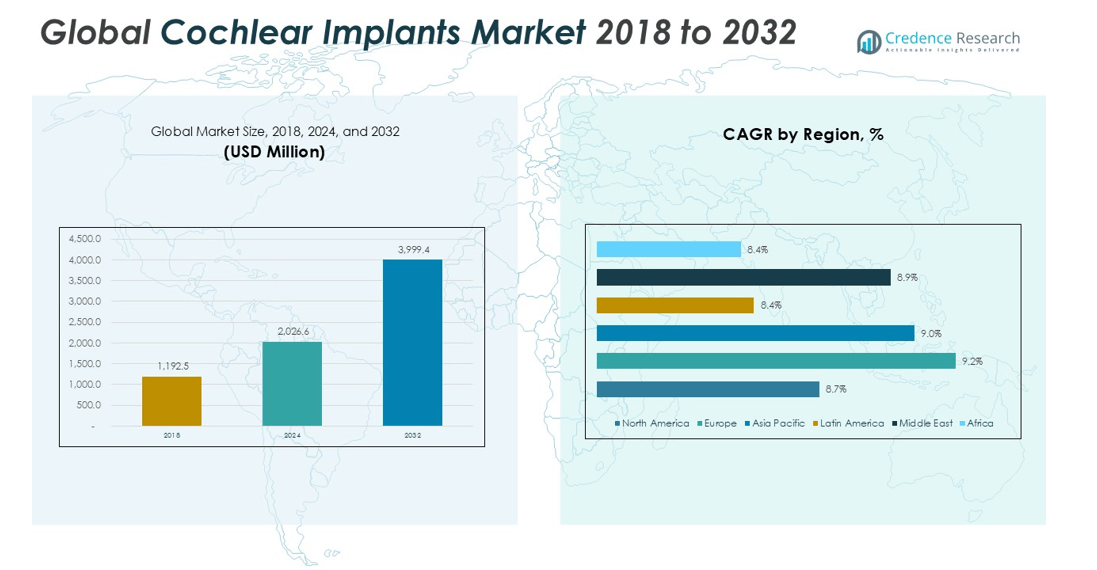
The Cochlear Implant Systems Market was valued at USD 1,619.00 million in 2024 and is projected to reach USD 2,845.00 million by 2032, expanding at a CAGR of 7.3% during the forecast period (2025–2032).
| REPORT ATTRIBUTE |
DETAILS |
| Historical Period |
2020-2023 |
| Base Year |
2024 |
| Forecast Period |
2025-2032 |
| Cochlear Implant Systems Market Size 2024 |
USD 1,619.00 Million |
| Cochlear Implant Systems Market, CAGR |
7.3% |
| Cochlear Implant Systems Market Size 2032 |
USD 2,845.00 Million |
The Cochlear Implant Systems Market is dominated by key players such as Cochlear Limited, MED-EL Medical Electronics, Sonova Holding AG (Advanced Bionics), Oticon Medical, and Nurotron Biotechnology Co., Ltd. These companies maintain strong global positions through continuous innovation in sound processing, wireless connectivity, and biocompatible implant materials. Their strategic focus on clinical collaborations, product reliability, and patient support programs enhances long-term competitiveness. North America leads the market with a 38% share in 2024, supported by advanced healthcare infrastructure and favorable reimbursement policies. Europe follows with 29%, driven by established clinical networks and high adoption in countries such as Germany, France, and the U.K.
Access crucial information at unmatched prices!
Request your sample report today & start making informed decisions powered by Credence Research Inc.!
Download Sample
Market Insights
- The Cochlear Implant Systems Market was valued at USD 1,619.00 million in 2024 and is projected to reach USD 2,845.00 million by 2032, growing at a CAGR of 7.3% during 2025–2032.
- Rising cases of hearing loss, expanding newborn screening programs, and favorable reimbursement policies are driving market demand across hospitals and ENT clinics globally.
- Technological advancements such as AI-enabled sound processing, wireless connectivity, and MRI-compatible implants are improving patient outcomes and boosting adoption rates.
- The market is moderately consolidated, with Cochlear Limited, MED-EL, and Sonova Holding AG leading through innovation and strong global distribution networks.
- North America held 38% of the market in 2024, followed by Europe with 29% and Asia-Pacific with 23%. Among product segments, Unilateral Implants dominated the market, while the Adult patient segment represented the largest user base.
Market Segmentation Analysis:
By Type
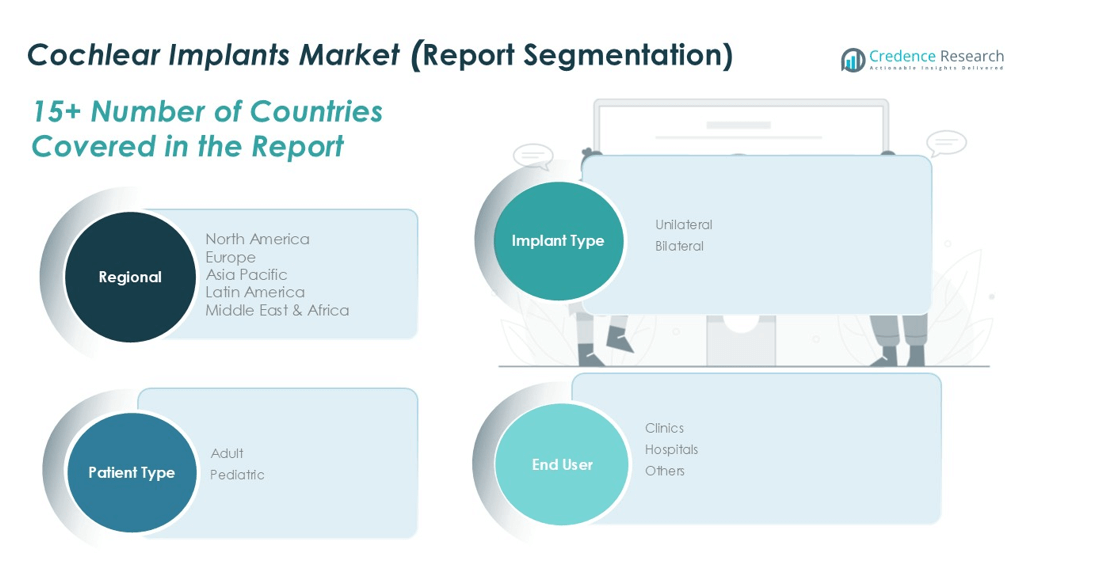
Unilateral implants dominated the Cochlear Implant Systems Market in 2024, accounting for the largest revenue share. The dominance is driven by their cost-effectiveness, simpler surgical procedure, and wide adoption in first-time implant patients. These systems provide significant improvement in hearing for individuals with profound hearing loss in one ear. Bilateral implants, though gaining traction, remain less common due to higher costs and reimbursement limitations. However, growing clinical evidence showing enhanced speech perception and sound localization in bilateral users is expected to boost their adoption during the forecast period.
- For instance, a randomized clinical trial with 19 adults using bilateral CI (two implants) achieved a median correct sound-localisation score of 96.7% at 60° trajectory compared to 50.0% for unilateral CI (one implant) users.
By Patient Type
The adult segment held the largest market share in 2024, driven by rising prevalence of age-related and noise-induced hearing loss. Increased awareness, availability of advanced implant technology, and supportive reimbursement policies further strengthened adoption among adults. The pediatric segment, however, is expected to record faster growth, supported by early diagnosis programs and the proven benefits of early implantation on language development. Governments and health organizations worldwide are expanding newborn hearing screening programs, fueling steady demand for pediatric cochlear implant systems.
- For instance, Cochlear Limited reported that in fiscal year 2023 they helped over 44,000 individuals of all ages receive a cochlear or acoustic implant.
By End Use
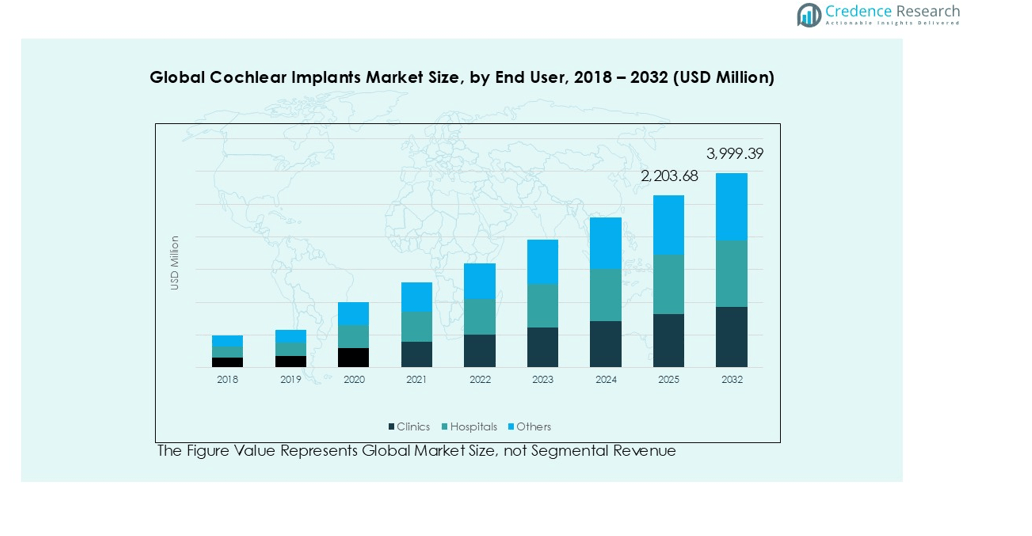
Hospitals accounted for the dominant share of the Cochlear Implant Systems Market in 2024 due to advanced infrastructure, availability of skilled surgeons, and strong insurance coverage for surgical procedures. ENT clinics are witnessing growing demand as they provide specialized post-implant care and follow-up services. Ambulatory surgical centers are also expanding their presence owing to shorter procedure times, reduced costs, and patient preference for minimally invasive environments. The rising integration of diagnostic and surgical services in outpatient settings continues to support market expansion across these end-use segments.

Key Growth Drivers
Rising Prevalence of Hearing Loss and Expanding Diagnosis Rates
The increasing global incidence of sensorineural hearing loss is a major growth driver for the cochlear implant systems market. According to WHO data, over 430 million people worldwide currently suffer from disabling hearing loss, with projections indicating growth to over 700 million by 2050. Enhanced awareness and improved diagnostic programs have led to early identification of hearing disorders in both adults and children. Governments and healthcare providers are promoting screening programs, particularly newborn hearing assessments, which significantly boost early intervention rates. As diagnosis becomes more accessible, the adoption of cochlear implants continues to rise, supporting sustained market expansion.
- For instance, World Health Organization estimates that 430 million people worldwide require rehabilitation for disabling hearing loss.
Technological Advancements in Cochlear Implant Design
Continuous innovation in device miniaturization, sound processing, and wireless connectivity is driving strong adoption across healthcare facilities. Advanced cochlear implants now feature improved frequency resolution, adaptive sound algorithms, and compatibility with smartphones for audio streaming. Leading manufacturers are investing heavily in R&D to improve patient comfort, speech clarity, and battery efficiency. These advancements are transforming patient outcomes, making implants more appealing to both adult and pediatric users. Additionally, innovations such as hybrid electro-acoustic stimulation and MRI-compatible implants are expanding the eligible patient population. Such developments enhance product differentiation and reinforce manufacturer competitiveness in the global market.
- For instance, Cochlear Limited’s Nucleus 8 Sound Processor weighs 4 g when paired with the Power Extend battery module and has a length of 43.4 mm and depth of 41.3 mm.
Favorable Reimbursement Policies and Government Support
Supportive reimbursement structures and government initiatives are accelerating market growth across developed and emerging economies. Many national healthcare systems, such as those in the U.S., U.K., and Germany, offer partial or full reimbursement for cochlear implant procedures. Public funding and charitable programs have further improved affordability for low-income populations. For instance, countries like Australia and Japan provide subsidies for pediatric cochlear implantation as part of national disability inclusion programs. Such support significantly reduces patient financial burden and encourages greater adoption. Expanding insurance coverage and structured reimbursement for bilateral implants are expected to further stimulate market demand in the forecast period.
Key Trends & Opportunities
Integration of Artificial Intelligence in Sound Processing
Artificial intelligence (AI) is emerging as a transformative force in cochlear implant systems, enhancing the accuracy of sound interpretation and noise reduction. Modern AI-driven processors can automatically adapt to changing acoustic environments, improving speech recognition in crowded or noisy settings. This capability significantly enhances user comfort and hearing quality. Manufacturers are also integrating machine learning algorithms to customize hearing profiles based on user preferences and auditory patterns. As AI continues to mature, it is expected to revolutionize patient rehabilitation by enabling real-time tuning and remote device optimization, opening new opportunities for smart implant ecosystems.
- For instance, MED‑EL GmbH’s SONNET 2 audio processor demonstrated an objective speech perception benefit of 1.26 to 55 dB signal-to-noise ratio improvement when using its Adaptive Intelligence features compared with the prior model.
Expanding Adoption in Emerging Economies
The growing availability of affordable cochlear implants in emerging markets such as India, China, and Brazil presents substantial opportunities for global manufacturers. Rising disposable incomes, healthcare infrastructure development, and government-backed awareness campaigns are improving access to advanced hearing restoration technologies. Partnerships between implant producers and regional distributors are expanding product reach in underserved areas. Additionally, the presence of non-profit organizations providing subsidies and free surgeries is increasing adoption among children and elderly patients. This regional diversification not only drives revenue growth but also strengthens global healthcare equity in auditory treatment.
- For instance, Cochlear Ltd. is a major supplier of implants used in China’s extensive government-supported programs which provide free or subsidized cochlear implant surgeries, primarily for children.
Remote Programming and Tele-Audiology Services
The post-pandemic emphasis on remote healthcare has encouraged the adoption of tele-audiology and cloud-based programming in cochlear implant systems. Patients can now receive software updates, hearing assessments, and programming adjustments remotely through secure digital platforms. This reduces the need for frequent clinic visits and enhances convenience, particularly for patients in rural areas. Manufacturers are developing integrated telehealth features compatible with mobile apps, offering personalized guidance and usage analytics. The expansion of tele-audiology capabilities is expected to streamline rehabilitation, improve accessibility, and open new revenue streams through subscription-based remote care services.
Key Challenge
High Cost of Implantation and Maintenance
The high upfront cost of cochlear implant systems, combined with surgical and post-operative expenses, remains a major market restraint. The total cost can range from USD 25,000 to USD 50,000 per patient, depending on device type, country, and healthcare coverage. Many low- and middle-income regions lack sufficient reimbursement structures, making implants unaffordable for a large segment of the population. Furthermore, ongoing maintenance costs, such as battery replacement and processor upgrades, add to the long-term financial burden. This challenge continues to limit market penetration in developing economies despite technological progress.
Surgical Risks and Post-Operative Complications
Cochlear implantation involves invasive surgery, which carries potential risks including infection, device failure, and facial nerve injury. Post-operative complications such as tinnitus, vertigo, or device migration can affect patient satisfaction and clinical outcomes. Additionally, rehabilitation requires long-term auditory training and follow-up visits, which may discourage patient compliance. Limited availability of skilled surgeons and audiologists in certain regions further complicates the procedure’s success rate. Addressing these risks through minimally invasive surgical techniques, enhanced safety protocols, and patient education remains essential for improving adoption rates globally.
Regional Analysis
North America
North America dominated the Cochlear Implant Systems Market in 2024 with a market share of 38%. The region’s leadership stems from advanced healthcare infrastructure, early adoption of implant technology, and strong reimbursement frameworks. The United States remains the largest contributor due to high diagnosis rates of hearing loss and the presence of key manufacturers. Continuous R&D investments and government-funded hearing assistance programs further accelerate growth. Canada also shows rising adoption supported by public healthcare coverage and expanding awareness initiatives aimed at improving accessibility for pediatric and adult hearing-impaired patients.
Europe
Europe accounted for 29% of the global market share in 2024, driven by strong adoption in Germany, the U.K., France, and the Nordic countries. The region benefits from favorable healthcare reimbursement, robust clinical research, and wide access to ENT specialists. Countries like Germany and the Netherlands have integrated cochlear implantation into national health programs, ensuring broad patient coverage. Increasing geriatric population and early pediatric screening programs are further supporting market demand. Ongoing collaborations between hospitals and device manufacturers enhance awareness and expand the availability of technologically advanced implants across Europe.
Asia-Pacific
Asia-Pacific held 23% of the Cochlear Implant Systems Market in 2024 and is expected to record the fastest growth through 2032. Rapid healthcare modernization, rising disposable income, and government-backed hearing restoration initiatives are key growth drivers. China, Japan, India, and Australia are leading contributors, with expanding implant programs and strong focus on pediatric treatment. Local manufacturers are emerging alongside global players, improving product affordability. Awareness campaigns and NGO partnerships are also expanding access in rural areas. The region’s large untreated patient population and improving insurance coverage position it as a major future revenue hub.
Latin America
Latin America captured 6% of the global market share in 2024, with Brazil, Mexico, and Argentina leading regional demand. Growth is supported by public healthcare investments and awareness campaigns addressing congenital and acquired hearing loss. Brazil’s inclusion of cochlear implants in national health programs has notably increased adoption. However, challenges such as limited specialist availability and uneven reimbursement policies persist. Expanding partnerships between hospitals and implant providers, along with improving distribution networks, are expected to enhance access. The region’s gradual healthcare reforms continue to create opportunities for market expansion.
Middle East & Africa
The Middle East & Africa accounted for 4% of the market share in 2024, primarily driven by demand from the UAE, Saudi Arabia, and South Africa. Growing investments in specialized ENT facilities and adoption of advanced implant technologies are fueling market development. Governments are promoting hearing healthcare through subsidy programs and collaborations with global device manufacturers. Despite limited penetration in low-income regions, expanding awareness and training initiatives are improving diagnosis rates. Continued healthcare modernization and growing medical tourism in Gulf countries are expected to support future growth of the cochlear implant systems market.
Market Segmentations:
By Type
- Unilateral Implants
- Bilateral Implants
By Patient Type
By End Use
- Hospitals
- ENT Clinics
- Ambulatory Surgical Centers
By Geography
- North America
- Europe
- Germany
- France
- U.K.
- Italy
- Spain
- Rest of Europe
- Asia Pacific
- China
- Japan
- India
- South Korea
- South-east Asia
- Rest of Asia Pacific
- Latin America
- Brazil
- Argentina
- Rest of Latin America
- Middle East & Africa
- GCC Countries
- South Africa
- Rest of the Middle East and Africa
Competitive Landscape
The Cochlear Implant Systems Market is moderately consolidated, with a few global players holding significant market shares. Leading companies such as Cochlear Limited, MED-EL Medical Electronics, Sonova Holding AG (Advanced Bionics), and Oticon Medical dominate through strong product portfolios and continuous technological innovation. These firms focus on developing next-generation sound processors, wireless connectivity features, and MRI-compatible implant designs to enhance patient comfort and performance. Strategic initiatives such as mergers, collaborations with hospitals, and government partnerships strengthen their market positions. Emerging players are targeting cost-effective systems for developing economies to gain share. Continuous R&D investments, coupled with expansion into tele-audiology and AI-based programming, are shaping competitive dynamics. The market also witnesses growing competition from regional manufacturers offering affordable implants, intensifying the focus on product differentiation, after-sales service, and long-term patient support programs.
Shape Your Report to Specific Countries or Regions & Enjoy 30% Off!
Key Player Analysis
- Neubio AG (Switzerland)
- Shanghai Listent Medical TECH Co., Ltd. (China)
- Sonova (Switzerland)
- Cochlear Ltd. (Australia)
- Demant A/S (Denmark)
- Zhejiang Nurotron Biotechnology Co., Ltd. (China)
- MED-El Corporation (Austria)
Recent Developments
- In July 2025, Cochlear Limited announced that the U.S. Food and Drug Administration (FDA) had approved the Cochlear Nucleus Nexa System, a smart cochlear implant system. The device featured upgradeable firmware, providing users with continuous access to new innovations and enhanced hearing performance. This approval is expected to strengthen Cochlear’s market position by highlighting its commitment to technological advancement and improving patient outcomes, thereby driving adoption in the market.
- In November 2024, MED-EL Corporation announced that the U.S. Food and Drug Administration (FDA) had approved new indications for its cochlear implants, including the recognition of hearing preservation outcomes. The expanded indication allowed adults with bilateral moderate-to-profound sensorineural hearing loss and lower aided word recognition scores to qualify for MED-EL implants. This approval broadened patient eligibility, strengthened MED-EL’s competitive edge, and is expected to drive increased adoption in the cochlear implants market.
- In September 2024, MED-EL Medical Electronics, Austria, launched the audio processor SONNET 3. This is an advanced BTE audio processor that boasts exceptional hearing performance and seamless connectivity for cochlear implant users. With state-of-the-art technology, the SONNET 3 will set another milestone in further improving the hearing experience and seamlessly integrating into daily life.
- In May 2024, Cochlear Ltd. acquired Demant’s Oticon Medical Cochlear Implant business. The acquisition strengthened Cochlear’s market position by expanding its customer base and technology portfolio.
Report Coverage
The research report offers an in-depth analysis based on Type, Patient type, End-Use and Geography. It details leading market players, providing an overview of their business, product offerings, investments, revenue streams, and key applications. Additionally, the report includes insights into the competitive environment, SWOT analysis, current market trends, as well as the primary drivers and constraints. Furthermore, it discusses various factors that have driven market expansion in recent years. The report also explores market dynamics, regulatory scenarios, and technological advancements that are shaping the industry. It assesses the impact of external factors and global economic changes on market growth. Lastly, it provides strategic recommendations for new entrants and established companies to navigate the complexities of the market.
Future Outlook
- Advancements in AI-driven sound processing will enhance speech clarity and personalized hearing experiences.
- Integration of wireless connectivity and Bluetooth LE Audio will improve device usability and user satisfaction.
- Rising global awareness and early screening programs will increase adoption among children and adults.
- Expanding insurance coverage and government funding will make implants more accessible in emerging economies.
- Miniaturization of devices will improve comfort, aesthetics, and long-term patient compliance.
- Growing tele-audiology services will enable remote programming and post-implantation support.
- Technological collaborations between medical device companies and software firms will accelerate innovation.
- Increasing demand for bilateral implants will boost procedure volumes across hospitals and ENT centers.
- Surge in geriatric population with age-related hearing loss will strengthen market demand.
- Continuous clinical research and FDA approvals will drive product diversification and patient outcomes.