
Piping and Fittings Market to Reach USD 131.6 Billion by 2032 - Credence Research
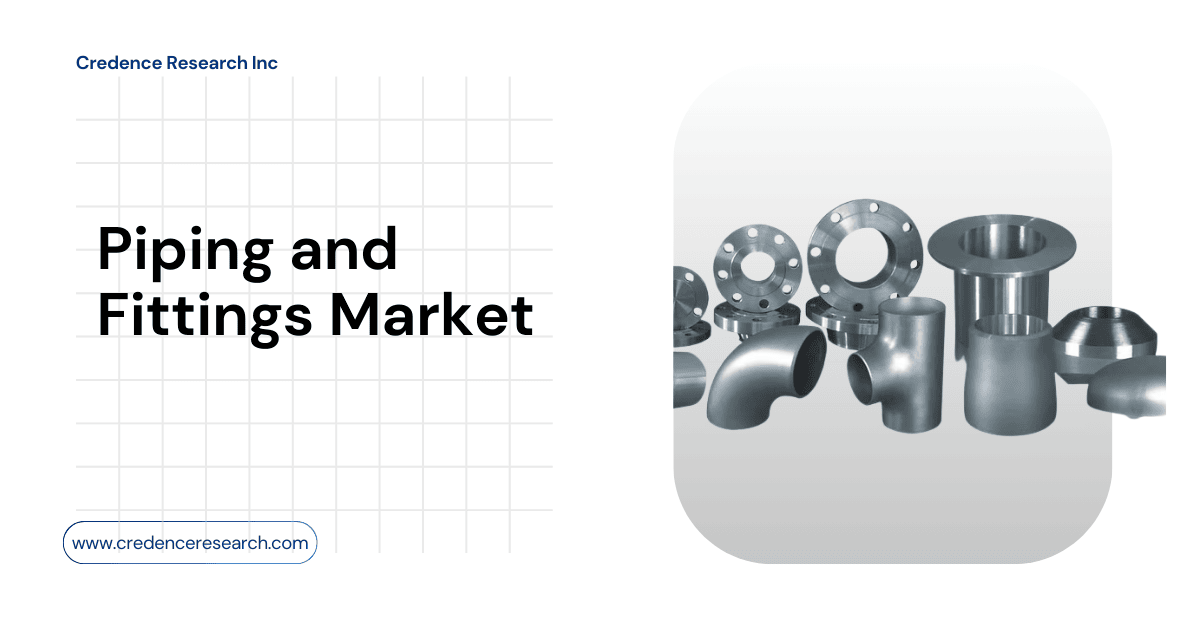
According to the latest report published by Credence Research, “Piping and Fittings Market: Growth, Future Prospects, and Competitive Analysis, 2024 – 2032,” the global Piping and Fittings market is projected to grow from USD 83,185 million in 2024 to USD 131,586.7 million by 2032, reflecting a steady compound annual growth rate (CAGR) of 5.9% over the forecast period.
The piping and fittings industry foundational to infrastructure development and industrial operations is experiencing a robust growth phase, propelled by dynamic trends in urban development, industrial automation, material innovation, and modular construction techniques. With its critical role in sectors ranging from water supply and wastewater management to oil & gas, energy, and chemical processing, the industry’s evolution signals both a response to and a driver of global development trends.
Market Drivers Fueling Growth
Rapid Expansion of Urban Infrastructure and Utility Networks in Developing Economies
One of the most pivotal growth engines for the piping and fittings market is the global wave of urbanization, especially in developing regions such as Asia Pacific, Latin America, and parts of Africa. Governments are pouring substantial investments into improving and expanding water supply, sanitation, and drainage networks each of which depends on high-quality, reliable piping systems.
Smart city initiatives in India, Southeast Asia, and the Middle East demand sophisticated water and energy transport systems. Mass housing schemes further bolster demand for standard fittings and efficient installation systems. These infrastructure developments ensure consistent, long-term demand for pipes and fittings across municipal, residential, and commercial segments.
Saint-Gobain, through its PAM brand, has contributed to over 200,000 km of ductile iron pipeline installations globally. These systems have improved pressure reliability and reduced leakage key performance metrics that resonate with the needs of municipal water projects and smart city programs.
Accelerated Industrial Output and Process Automation
Global industrial growth especially in manufacturing, petrochemicals, food and beverage, and energy is another key catalyst for the piping and fittings industry. These sectors require precise, safe, and durable piping systems for transporting fluids, gases, or semi-solid materials under varied operating conditions.
From high-temperature chemical transport to hygienic food-grade applications, specialized fittings and corrosion-resistant materials have become essential. Automation in factories further amplifies the need for precision-engineered components that can withstand long hours of operation and strict safety norms.
Discover the full report and in-depth market insights here: https://www.credenceresearch.com/report/piping-and-fittings-market
Adoption of Advanced Materials for Longer Service Life
Materials science is transforming the piping industry. Traditional steel and PVC systems are giving way to more advanced materials such as composites, multilayer plastics, and corrosion-resistant alloys. These innovations provide longer operational life, lower maintenance costs, and better resilience in demanding environments attributes that appeal to both public utility planners and industrial engineers.
The focus on materials with enhanced thermal stability, reduced weight, and easier installation processes is also helping project developers and contractors meet tight timelines without compromising on quality or safety.
Rise in Prefabricated and Modular Piping Solutions
In both construction and industrial project management, time is money. As a result, there is a significant shift toward prefabricated and modular piping systems that can be assembled in factory-controlled environments and quickly installed on-site.
Modular systems not only reduce installation time but also enhance quality control, lower labor costs, and support sustainable practices through minimized waste. These systems are increasingly being adopted across sectors such as power plants, commercial buildings, and water treatment facilities.
This shift aligns with the broader industry trend toward digital engineering, lean construction, and predictive maintenance all of which demand modularity and system integration.
Despite these growth drivers, the piping and fittings market does face several notable challenges:
Raw Material Price Volatility
The industry remains vulnerable to fluctuations in the prices of key inputs such as steel, copper, aluminum, and various polymers. These fluctuations are often driven by geopolitical tensions, trade restrictions, energy price movements, and currency instability. Manufacturers struggle to maintain pricing consistency, often facing margin pressures during volatile cycles.
Small to mid-sized suppliers, in particular, may find it difficult to absorb these costs or adjust procurement strategies rapidly, leading to disrupted production schedules or missed project deadlines.
Asia Pacific Leads with Infrastructure Investments and Industrial Growth
Asia Pacific remains the dominant force in the global piping and fittings market, accounting for approximately 42% of global demand in 2024. This region continues to be the epicenter of construction activity, infrastructure investment, and industrial production.
China, with its massive pipeline projects for water, energy, and manufacturing, leads the charge. India, meanwhile, benefits from its ambitious urban housing schemes, industrial corridor development, and sanitation missions under government initiatives like AMRUT and Swachh Bharat.
In Southeast Asia, countries like Vietnam, Indonesia, and Thailand are investing in infrastructure upgrades and manufacturing hubs, further boosting regional demand.
Additionally, the relatively lower production costs and abundant availability of raw materials in Asia Pacific have helped establish the region as a strong supply base for both local and international markets.
North America, capturing around 25% of the global market, exhibits strong demand for pipe and fitting replacements especially in water utilities, oil & gas, and aging municipal infrastructure. The U.S. government’s investments in clean water infrastructure and energy pipeline projects are creating sustained opportunities.
Key Players:
- Saint-Gobain
- Aliaxis Group
- Georg Fischer
- Mueller Industries
- JM Eagle
Segmentation Analysis: Breaking Down the Market
By Type / Material
- Steel Pipe
- Plastic / PVC Pipe
- Aluminium Pipe
- Copper Pipe
- Others (Glass Pipe, Brass)
By Application / End-Use
- Residential
- Commercial
- Industrial
By Region
- North America
- U.S.
- Canada
- Mexico
- Europe
- Germany
- France
- U.K.
- Italy
- Spain
- Rest of Europe
- Asia Pacific
- China
- Japan
- India
- South Korea
- South-east Asia
- Rest of Asia Pacific
- Latin America
- Brazil
- Argentina
- Rest of Latin America
- Middle East & Africa
- GCC Countries
- South Africa
- Rest of the Middle East and Africa
To access the complete report, including detailed segmentation data, regional forecasts, and company profiles, visit: https://www.credenceresearch.com/report/piping-and-fittings-market#report_summary
Contact Us
Credence Research Inc,
Tower C-1105 , S 25,
Akash Tower, Vishal Nahar,
Pimple Nilakh, Haveli,
Pune – 411027, India
About the Author

Healthcare & Biotech Analyst