
| REPORT ATTRIBUTE | DETAILS |
|---|---|
| Historical Period | 2020-2023 |
| Base Year | 2024 |
| Forecast Period | 2025-2032 |
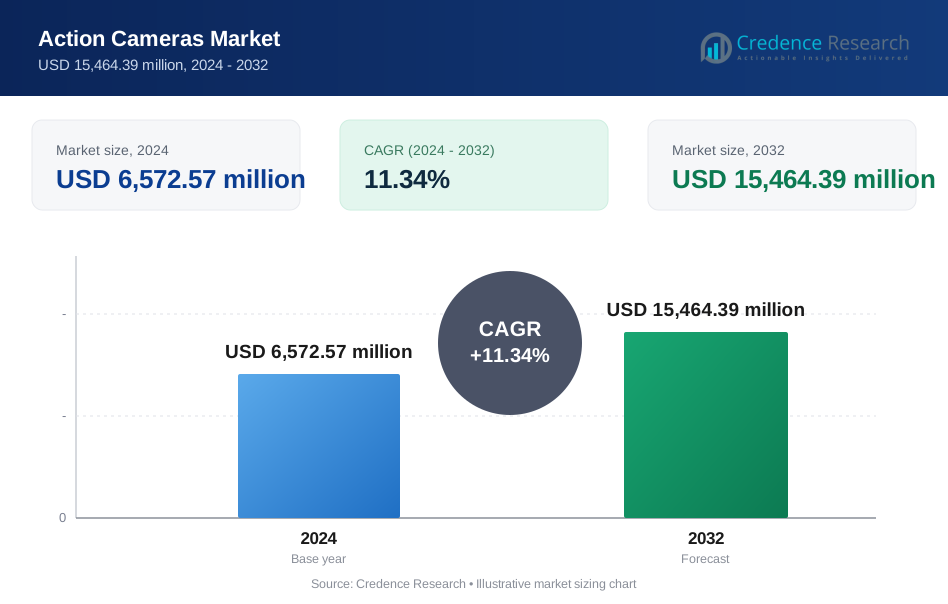
| Action Cameras Market Size 2024 | USD 6,572.57 million |
| Action Cameras Market, CAGR | 11.34% |
| Action Cameras Market Size 2032 | USD 15,464.39 million |
Market Overview
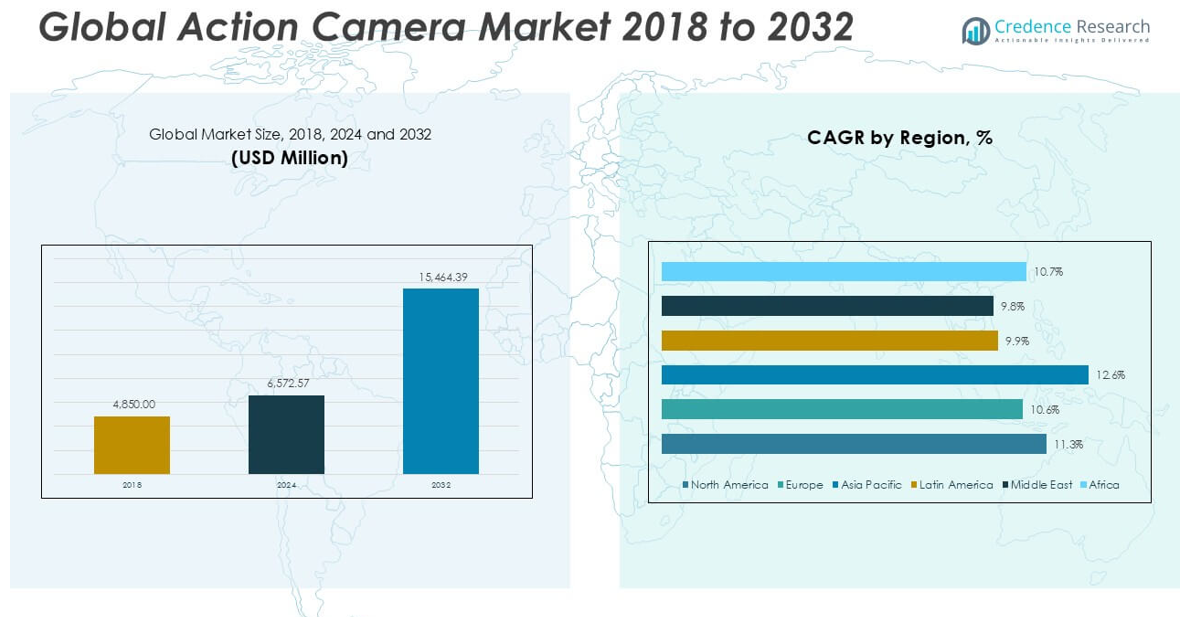
The Action Camera market size was valued at USD 4,850.00 million in 2018, reached USD 6,572.57 million in 2024, and is anticipated to reach USD 15,464.39 million by 2032, at a CAGR of 11.34% during the forecast period.
The Action Camera market is dominated by key players such as GoPro Inc., Sony Group Corporation, Garmin Ltd., Nikon Inc., DJI, Olympus Corporation, Panasonic Holdings Corporation, ARASHI VISION INC. (Insta360), DRIFT, SJCAM, YI Technology, and AKASO Tech LLC. These companies focus on product innovation, high-resolution imaging, waterproofing, and 360-degree capture to strengthen their market positions. GoPro Inc. and Sony Group Corporation hold significant shares due to their strong global brand presence and advanced technology offerings. North America leads the market with a 36% share in 2024, driven by high consumer purchasing power and the popularity of adventure sports. Asia Pacific follows closely, emerging as the fastest-growing region, supported by rising disposable incomes and expanding digital communities.
Market Insights
- The Action Camera market was valued at USD 4,850.00 million in 2018, reached USD 6,572.57 million in 2024, and is projected to hit USD 15,464.39 million by 2032, growing at a CAGR of 11.34% during the forecast period.
- The market is driven by rising consumer demand for high-quality video recording in adventure sports, travel, and social media content creation, with the Sports and Adventure segment holding the largest share due to growing vlogging and outdoor activity trends.
- Growing adoption of 360-degree and VR-enabled cameras and the popularity of compact, wearable designs are key trends shaping the market, alongside increasing sales through e-commerce platforms.
- Intense competition among leading players like GoPro, Sony, Garmin, and DJI and pricing pressure from low-cost alternatives act as major market restraints, along with concerns over battery life and storage limitations.
- North America leads with a 36% share in 2024, followed by Europe at 28% and Asia Pacific at 25%, which is also the fastest-growing region.
Market Segmentation Analysis:
By Product:
In the Action Camera market, the Box Style Camera segment holds the largest market share, driven by its robust design, versatility, and high-resolution capabilities suitable for extreme sports and professional use. Its dominance is supported by increasing consumer preference for durable and waterproof devices that perform well in challenging environments. The segment benefits from steady advancements in image stabilization and wide-angle lens technology, which enhance recording quality. Additionally, its compatibility with various mounting accessories makes it a preferred choice for adventure enthusiasts and content creators seeking high-performance equipment.
- For instance, the GoPro HERO12 Black boasts a 27 MP sensor capturing video at up to 5.3 K @ 60 fps and 4 K @ 120 fps, paired with HyperSmooth 6.0 stabilization and waterproofing to 10 m (33 ft).
By Application and Resolution:
The Sports and Adventure segment leads the market in terms of application, capturing a significant share due to the rising popularity of adventure tourism, extreme sports, and vlogging activities. Growing consumer interest in capturing high-action moments with precision drives the demand for action cameras in this segment. By resolution, the 4K and Above category dominates the market, supported by increasing consumer expectations for ultra-high-definition video quality and seamless playback on modern digital devices. The combination of high-resolution demand and sports applications is further fueled by social media trends and the rising number of professional and amateur content creators.
- For example, the DJI Osmo Action 4 records in 4 K @ 120 fps with a 1/1.3″ sensor, 10-bit D‑Log M color, and a 155° field of view.
By Distribution Channel:
The E-commerce segment emerges as the dominant distribution channel, holding a substantial market share due to the convenience, competitive pricing, and wide product availability offered by online platforms. Consumers increasingly prefer online shopping to access a broader range of action camera models, detailed product reviews, and attractive discounts. E-commerce growth is further accelerated by the digitalization of retail and the rise of specialized online marketplaces dedicated to photography and adventure gear. Quick delivery services and easy return policies provided by e-commerce giants also contribute to the dominance of this channel in the action camera market.
Market Overview
Rising Popularity of Adventure and Sports Activities
The increasing consumer inclination towards adventure sports, travel, and outdoor recreational activities significantly drives the demand for action cameras. These cameras are highly favored by athletes, travelers, and vloggers seeking to capture high-speed and high-impact moments with precision and durability. The surge in adventure tourism, extreme sports events, and sporting communities further supports market growth. Additionally, the growing influence of social media platforms has amplified the trend of documenting personal adventures, thereby boosting the widespread adoption of action cameras across diverse user segments.
- For instance, the GoPro HERO12 Black can capture video at 5.3K resolution at 60 frames per second and includes a TimeWarp 3.0 feature that enables stabilized time-lapse recording during high-speed activities, making it a preferred choice for action sports enthusiasts.
Technological Advancements in Camera Features
Continuous innovations in action camera technology, including advancements in 4K and 8K resolution, image stabilization, waterproofing, and wide-angle recording, propel market growth. Manufacturers are focusing on enhancing product durability, portability, and performance to meet evolving consumer expectations. Features such as slow-motion capture, live streaming, and 360-degree recording appeal to professional and casual users alike. Furthermore, the integration of artificial intelligence, GPS tracking, and voice control functionalities contributes to the improved user experience, making action cameras increasingly attractive in both consumer and commercial applications.
- For instance, the Insta360 X3 captures 360-degree video at 5.7K resolution and offers AI-powered subject tracking and automatic horizon leveling, while the camera remains waterproof up to 10 meters without additional housing, demonstrating significant technological advancement.
Growth of E-commerce and Digital Sales Channels
The rapid expansion of e-commerce platforms has significantly facilitated the accessibility and visibility of action cameras. Consumers increasingly prefer online purchasing due to competitive pricing, wider product assortments, and detailed customer reviews. Digital platforms offer easy comparison, attractive discounts, and quick delivery services, which encourage purchase decisions. The growing trend of direct-to-consumer sales by manufacturers further enhances market penetration. Additionally, the rise of social media and online marketing campaigns has strengthened consumer engagement and brand visibility, accelerating the growth of digital sales channels.
Key Trends & Opportunities
Increased Adoption of 360-Degree and VR-Enabled Cameras
A notable trend in the action camera market is the rising popularity of 360-degree and virtual reality (VR)-enabled cameras. These advanced cameras offer immersive experiences, allowing users to capture dynamic content suitable for VR applications, interactive videos, and panoramic recording. Content creators and professionals in tourism, sports, and real estate industries are increasingly utilizing these devices for marketing and entertainment purposes. This trend presents a significant opportunity for manufacturers to develop innovative, compact, and user-friendly VR-compatible cameras that cater to the evolving preferences of tech-savvy consumers.
- For instance, the Insta360 ONE RS 1-Inch 360 Edition captures 360-degree video at 6K resolution with dual 1-inch CMOS sensors, offering a maximum video bitrate of 120 Mbps and automatic horizon leveling, enabling professional-grade VR content creation with exceptional image clarity.
Emergence of Compact, Wearable Action Cameras
The demand for lightweight, wearable action cameras is gaining momentum, particularly among sports enthusiasts, travelers, and vloggers who prioritize convenience and hands-free recording. Wearable cameras with advanced mounting systems allow seamless recording without hindering user activity. The growing preference for compact designs with high durability and enhanced image quality presents an opportunity for companies to introduce more versatile and ergonomic models. This trend aligns with the increasing popularity of fitness tracking and body-mounted devices, opening new avenues for product development in the wearable camera segment.
- For instance, the DJI Action 2 camera weighs 56 grams and measures 39 × 39 × 22.3 millimeters, offering 4K video recording at 120 frames per second with magnetic mounting options, making it highly suitable for wearable and hands-free use during fast-paced activities.
Key Challenges
Intense Market Competition and Pricing Pressure
The action camera market faces stiff competition from established brands and new entrants offering technologically advanced products at competitive prices. This intense rivalry leads to significant pricing pressure, forcing companies to continuously innovate while maintaining cost efficiency. Additionally, the availability of counterfeit products and low-cost alternatives affects profit margins and brand reputation. Companies must invest heavily in product differentiation, quality enhancement, and marketing strategies to sustain their market position amidst increasing competition and price sensitivity among consumers.
Limited Battery Life and Storage Constraints
Battery life and storage capacity remain key challenges limiting the extended use of action cameras, especially during long-duration activities such as hiking, diving, or professional filming. Despite technological advancements, current battery technologies often fail to support prolonged high-resolution recording sessions. Similarly, storage limitations hinder the seamless capture of ultra-HD videos, requiring frequent data transfers or additional memory accessories. Overcoming these constraints through improved power management and higher-capacity storage solutions is essential to enhance user satisfaction and long-term market adoption.
Susceptibility to Damage in Extreme Conditions
Although designed for rugged use, action cameras are still vulnerable to damage under extreme environmental conditions such as severe impacts, extreme temperatures, or prolonged water exposure beyond specified limits. The risk of malfunctioning or breakage poses reliability concerns, particularly for professional users who rely on uninterrupted performance. Manufacturers must continually invest in research and development to improve durability, waterproofing, and shock resistance to address this challenge and meet the stringent demands of adventure enthusiasts and industry professionals.
Regional Analysis
North America:
North America accounted for the largest share of the Action Camera market, holding approximately 36% of the total market in 2024. The market size was valued at USD 1,770.25 million in 2018, growing to USD 2,370.03 million in 2024, and is projected to reach USD 5,557.75 million by 2032, at a CAGR of 11.3% during the forecast period. This growth is primarily driven by the rising popularity of outdoor sports, adventure tourism, and content creation across the U.S. and Canada. The region benefits from strong consumer purchasing power, a tech-savvy population, and the rapid adoption of premium, high-resolution cameras.
Europe:
Europe captured around 28% market share in 2024, supported by a strong demand for action cameras in travel, extreme sports, and professional vlogging. The market was valued at USD 1,401.65 million in 2018, increased to USD 1,832.25 million in 2024, and is anticipated to reach USD 4,094.24 million by 2032, growing at a CAGR of 10.6%. The region’s growth is influenced by the expanding adventure tourism sector and the increasing use of wearable and compact cameras in daily life and recreational activities. Additionally, Europe’s strong e-commerce landscape significantly enhances market accessibility and product availability.
Asia Pacific:
Asia Pacific is the fastest-growing region, holding approximately 25% of the market share in 2024. The market size stood at USD 1,178.55 million in 2018, reached USD 1,668.42 million in 2024, and is expected to hit USD 4,297.84 million by 2032, registering a CAGR of 12.6%. Rapid urbanization, rising disposable incomes, and increasing participation in sports and adventure activities are major growth drivers. The region benefits from the growing influence of social media, a rising base of amateur content creators, and the expansion of affordable action camera offerings, particularly in countries such as China, India, and Japan.
Latin America:
Latin America accounted for nearly 4.5% of the global market share in 2024. The market was valued at USD 221.16 million in 2018, grew to USD 295.70 million in 2024, and is projected to reach USD 625.84 million by 2032, with a CAGR of 9.9%. Growth in this region is driven by increasing consumer interest in action sports, tourism, and vlogging, especially in Brazil and Mexico. However, price sensitivity and limited brand penetration slightly restrain growth. The expansion of e-commerce platforms is gradually improving product accessibility and driving the adoption of action cameras across the region.
Middle East:
The Middle East contributed around 3.2% market share in 2024, with the market valued at USD 167.33 million in 2018, rising to USD 210.94 million in 2024, and projected to reach USD 442.37 million by 2032, at a CAGR of 9.8%. Growth in the region is supported by a growing number of adventure enthusiasts and expanding tourism hubs, particularly in the UAE and Saudi Arabia. Increasing social media influence and demand for high-quality video content also contribute to market expansion. However, limited local manufacturing and reliance on imports slightly impact overall growth momentum.
Africa:
Africa held a 3% market share in 2024, with the market size rising from USD 111.07 million in 2018 to USD 195.23 million in 2024, and is forecasted to reach USD 446.35 million by 2032, growing at a CAGR of 10.7%. The region's growth is driven by rising urbanization, increasing digital connectivity, and a growing interest in sports and cultural event coverage. Though the market is at a developing stage, improving e-commerce infrastructure and expanding tourism are expected to create growth opportunities. Limited consumer awareness and pricing constraints remain key challenges for widespread market penetration in Africa.
Market Segmentations:
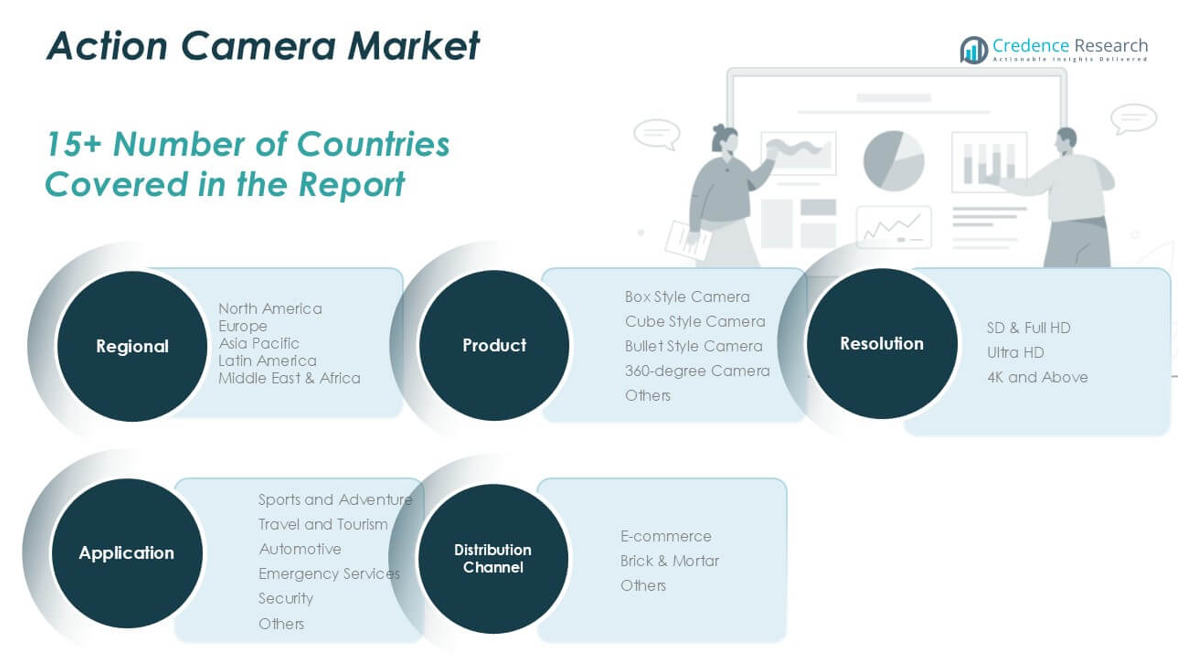
By Product:
- Box Style Camera
- Cube Style Camera
- Bullet Style Camera
- 360-degree Camera
- Others
By Application:
- Sports and Adventure
- Travel and Tourism
- Emergency Services
- Security
- Others
By Resolution:
- SD & Full HD
- Ultra HD
- 4K and Above
By Distribution Channel:
- E-commerce
- Brick & Mortar
- Others
By Geography:
- North America
- U.S.
- Canada
- Mexico
- Europe
- Germany
- France
- U.K.
- Italy
- Spain
- Rest of Europe
- Asia Pacific
- China
- Japan
- India
- South Korea
- South-east Asia
- Rest of Asia Pacific
- Latin America
- Brazil
- Argentina
- Rest of Latin America
- Middle East & Africa
- GCC Countries
- South Africa
- Rest of the Middle East and Africa
Competitive Landscape
The Action Camera market is highly competitive, characterized by the presence of several established players and emerging brands striving for market share through technological innovation and strategic partnerships. Key companies such as GoPro Inc., Sony Group Corporation, Garmin Ltd., and Nikon Inc. lead the market with extensive product portfolios, strong brand recognition, and continuous advancements in camera features like 4K resolution, image stabilization, waterproofing, and live streaming capabilities. Companies like DJI and ARASHI VISION INC. (Insta360) are expanding their presence by introducing 360-degree and VR-enabled cameras, catering to the growing demand for immersive content. Additionally, brands such as DRIFT, AKASO Tech LLC, and SJCAM are gaining traction by offering cost-effective, feature-rich alternatives to premium models, enhancing competitive pressure. Market players are also leveraging e-commerce channels and social media marketing to increase visibility and consumer engagement. The competitive landscape is driven by rapid innovation, pricing strategies, and the ability to meet evolving consumer preferences.
Key Player Analysis
- DRIFT
- Garmin Ltd.
- GoPro Inc.
- Nikon Inc.
- Olympus Corporation
- Panasonic Holdings Corporation
- Sony Group Corporation
- SJCAM
- DJI
- YI Technology
- ARASHI VISION INC. (Insta360)
- AKASO Tech LLC
Recent Developments
- In September 2024, DJI announced the launch of the Osmo Action 5 Pro camera, which features a cutting-edge 1/1.3-inch sensor with a pixel size of 2.4 μm and a dynamic range of up to 13.5 stops. The device can shoot low-light and high-dynamic videos at 4K and 60fps, while the use of the SuperNight mode with AI-enabled noise reduction algorithms can yield clear footage in low-light environments.
- In September 2024, GoPro announced the launch of two cameras: the advanced HERO13 Black with HB-Series Lenses, and a basic 4K camera, the HERO. The former offers capabilities such as GPS, magnetic latch mounting, four swappable HB-Series lens choices with auto detection to ensure ideal capture settings, an ultra-wide POV, and macro with variable focus, among other features. On the other hand, the HERO is an extremely compact camera that weighs under 100 grams and offers 4K resolution with a simple user interface.
- In November 2023, SJCAM unveiled the world's first SJ20 dual-lens action camera. This innovative device boasts a cutting-edge night-specific lens, capturing over twice the light of its competitors. A surge in companies rolling out similar products, both regionally and globally, has fostered competitive pricing strategies, steadily broadening the user base.
Market Concentration & Characteristics
The Action Camera Market demonstrates a moderate to high level of market concentration, with a few dominant players such as GoPro Inc., Sony Group Corporation, Garmin Ltd., and DJI holding significant global shares. It is highly competitive, driven by rapid technological advancements and evolving consumer preferences for high-resolution, durable, and compact cameras. The market favors companies that can deliver superior image quality, waterproof features, and seamless integration with social media platforms. New entrants face challenges due to strong brand loyalty and the high costs of continuous innovation. Price sensitivity in emerging markets influences product strategies, pushing manufacturers to offer affordable yet feature-rich options. E-commerce plays a pivotal role in shaping consumer purchasing behavior, with online platforms offering extensive product visibility and competitive pricing. Product differentiation remains critical, as consumers seek versatile cameras capable of supporting sports, travel, and professional content creation. The Action Camera Market responds quickly to shifting trends, including the growing interest in wearable devices and 360-degree video capture. It exhibits a fast-paced development cycle, where companies must consistently upgrade models to sustain consumer interest. This environment fosters intense rivalry among established brands while creating limited space for unproven players.
Report Coverage
The research report offers an in-depth analysis based on Product, Application, Resolution, Distribution Channel and Geography. It details leading market players, providing an overview of their business, product offerings, investments, revenue streams, and key applications. Additionally, the report includes insights into the competitive environment, SWOT analysis, current market trends, as well as the primary drivers and constraints. Furthermore, it discusses various factors that have driven market expansion in recent years. The report also explores market dynamics, regulatory scenarios, and technological advancements that are shaping the industry. It assesses the impact of external factors and global economic changes on market growth. Lastly, it provides strategic recommendations for new entrants and established companies to navigate the complexities of the market.
Future Outlook
- The Action Camera market is expected to grow steadily, driven by increasing consumer interest in adventure sports and travel documentation.
- Demand for 4K, 8K, and ultra-HD video capabilities will continue to rise, influencing product development.
- Compact, lightweight, and wearable camera designs will gain more popularity among consumers.
- The market will see increasing adoption of 360-degree and VR-enabled cameras for immersive content creation.
- Integration of advanced features like GPS tracking, AI-powered editing, and voice control will become more common.
- E-commerce channels will remain the primary sales driver, supported by expanding online marketing and social media influence.
- Asia Pacific will continue to be the fastest-growing regional market, driven by increasing disposable incomes and a young consumer base.
- Companies will focus on improving battery life and storage capacity to meet consumer expectations for long-duration usage.
- Competition will intensify as low-cost manufacturers offer feature-rich alternatives at affordable prices.
- Manufacturers will prioritize product durability, waterproofing, and rugged designs to support extreme usage scenarios.
Request a Free Sample
Fill in your details and we'll send you a free sample report.
- Sample data tables & charts
- Research methodology
Need a Custom Version of This Report?
Tailor the scope, geography, or segments to your exact requirements.
- Custom geography or segment scope
- Direct access to our analyst team
Frequently Asked Questions
What is the current size of the Action Camera Market?
How do technological advancements contribute to the increasing demand for action cameras, and what specific features are driving consumer preferences?
What regions are expected to be key contributors to the substantial growth in the action camera market, and what factors influence their market dynamics?
How does the increasing trend of content creation and sharing on social media platforms impact the demand for action cameras, and what role does this play in the market's future trajectory?
Who are the major players in this market?
Table of Content
Chapter 1. Report Introduction
- 1.1 Report Description & Purpose
- 1.1.1 Report Title & Market Definition
- 1.1.2 Unique Selling Propositions (USP) & Key Differentiators
- 1.1.3 Value Proposition for Stakeholders
- 1.2 Research Objectives
- 1.2.1 Market Sizing Objectives (Volume & Revenue) (Volume Where Applicable)
- 1.2.2 Segmentation Objectives
- 1.2.3 Competitive Intelligence Objectives
- 1.2.4 Forecast & Scenario Objectives
- 1.3 Report Scope
- 1.3.1 Action Cameras Scope – Segments & Subsegments Covered
- 1.3.2 Geographic Scope – Regions & Countries Covered
- 1.3.3 Historical Period, Base Year & Forecast Period (2024; forecast to 2032)
- 1.3.4 Inclusions & Exclusions
- 1.4 Industry Classification & Applicable Codes
- 1.5 Currency, Measurement Units & Valuation Basis
- 1.6 Target Stakeholders
- 1.7 Limitations & Assumptions
Chapter 2. Executive Summary
- 2.1 Global Action Cameras Market Snapshot
- 2.1.1 Market Size – Historical (2024) & Forecast (2024-2032) (2024: USD 6,572.57 million → 2032: USD 15,464.39 million)
- 2.1.2 Volume & Revenue – Global Totals (Volume Where Applicable)
- 2.1.3 Key Market Highlights – Top Five Facts
- 2.2 Action Cameras Market Segmentation Snapshot
- 2.2.1 Market Split by Region – 2024 vs. 2032
- 2.3 Competitive Snapshot
- 2.3.1 Top 10 Players by Revenue Share – 2024
- 2.3.2 Top 10 Players by Volume Share – 2024 (Volume Where Applicable)
- 2.3.3 Recent Strategic Developments (18-Month Summary)
- 2.4 Key Investment Highlights & Strategic Conclusions
Chapter 3. Action Cameras Market Dynamics & Industry Analysis
- 3.1 Market Overview & Context
- 3.1.1 Action Cameras Market Position in the Broader Industry Value Chain
- 3.1.2 Demand Structure & Purchasing Dynamics
- 3.1.3 Market Maturity & Development Stage by Region
- 3.2 Action Cameras Market Drivers
- 3.3 Action Cameras Market Restraints & Challenges
- 3.4 Action Cameras Market Opportunities
- 3.5 Porter's Five Forces Analysis
- 3.5.1 Threat of New Entrants
- 3.5.2 Bargaining Power of Suppliers
- 3.5.3 Bargaining Power of Buyers
- 3.5.4 Threat of Substitutes
- 3.5.5 Competitive Rivalry – Intensity Assessment
- 3.6 Action Cameras Value Chain Analysis
- 3.6.1 Upstream – Key Inputs, Resources & Suppliers
- 3.6.1.1 Key Input/Resource 1
- 3.6.1.2 Key Input/Resource 2
- 3.6.1.3 Key Input/Resource 3
- 3.6.2 Midstream – Core Operations & Value Creation
- 3.6.2.1 Operating Model & Process Overview
- 3.6.2.2 Key Operating Locations & Capabilities by Company
- 3.6.3 Downstream – Market Channels & End Users
- 3.6.3.1 Direct Sales & Customer Engagement Channels
- 3.6.3.2 Indirect Sales, Intermediaries & Partner Channels
- 3.6.4 Value Chain Profitability Analysis
- 3.6.1 Upstream – Key Inputs, Resources & Suppliers
- 3.7 PESTEL Analysis
- 3.7.1 Political Factors
- 3.7.2 Economic Factors
- 3.7.3 Social Factors
- 3.7.4 Technological Factors
- 3.7.5 Environmental Factors
- 3.7.6 Legal Factors
- 3.8 Action Cameras Supply Chain Analysis
- 3.8.1 Critical Input & Resource Availability Risk Assessment
- 3.8.2 Supplier & Operational Concentration Risk (Geographic Exposure)
- 3.8.3 Supply & Service Disruption Impact Analysis
- 3.9 Regulatory & Policy Landscape
Note: The regulatory and policy landscape section covers regulations based on their applicability to the market, Action Cameras category, geography, and scope of the study. Only regulatory frameworks with a material impact on operations, compliance, trade, sustainability, or market access are analyzed in detail.
Chapter 4. Key Investment Pockets & Opportunity Analysis
- 4.1 Action Cameras Market Attractiveness Analysis
- 4.1.1 By Region – Investment Attractiveness Matrix (Market Size × CAGR)
- 4.2 Absolute Revenue Growth Opportunity
- 4.2.1 By Region – Absolute Revenue Growth Through 2032
- 4.3 Incremental Demand Opportunity
- 4.3.1 By Region – Incremental Demand Through 2032
- 4.3.2 Segment – Incremental Demand
- 4.4 Emerging Submarket Opportunity Deep Dive (Subject to Applicability)
- 4.5 Priority Market Opportunity Scorecards
- 4.5.1 United States
- 4.5.2 Europe
- 4.5.3 Asia
- 4.5.4 Middle East & Africa
Note: Priority market opportunity scorecards reflect the geographic scope and strategic relevance of the study. Listed markets are indicative and may be adapted to the industry.
Chapter 5. Action Cameras Cross-Border Trade & Market Access Analysis
- 5.1 International Trade & Cross-Border Activity Overview
- 5.1.1 Global Export Value by Country (2024)
- 5.1.2 Global Export Volume by Country (2024) (Volume Where Applicable)
- 5.1.3 Global Import Value by Country (2024)
- 5.1.4 Global Import Volume by Country (2024) (Volume Where Applicable)
- 5.1.5 Net Trade Balance by Country (2024)
- 5.2 Export Analysis – Segment
- 5.2.1 Category 1 (Applicable Classification Code)
- 5.2.2 Category 2 (Applicable Classification Code)
- 5.2.3 Category 3 (Applicable Classification Code)
- 5.2.4 Category 4 (Applicable Classification Code)
- 5.2.5 Category 5 (Applicable Classification Code)
- 5.3 Import Analysis – Segment
- 5.3.1 Category 1 (Applicable Classification Code)
- 5.3.2 Category 2 (Applicable Classification Code)
- 5.3.3 Category 3 (Applicable Classification Code)
- 5.3.4 Category 4 (Applicable Classification Code)
- 5.3.5 Category 5 (Applicable Classification Code)
- 5.4 Cross-Border Pricing & Transaction Benchmarks
- 5.4.1 Export Pricing – Segment & Country
- 5.4.2 Import Pricing – Segment & Source Country
- 5.4.3 Price Trends (2024)
- 5.5 Key Cross-Border Trade & Delivery Routes
- 5.5.1 Cross-Border Trade/Delivery Route 1
- 5.5.2 Cross-Border Trade/Delivery Route 2
- 5.5.3 Cross-Border Trade/Delivery Route 3
- 5.5.4 Cross-Border Trade/Delivery Route 4
- 5.5.5 Cross-Border Trade/Delivery Route 5
- 5.6 Trade Policy & Market Access Impact Assessment
- 5.6.1 Tariff & Non-Tariff Barriers
- 5.6.2 Regional Trade & Economic Integration Frameworks
- 5.6.3 Bilateral & Multilateral Trade Agreements
- 5.6.4 Cross-Border Operating, Licensing & Localization Requirements
Note: This chapter applies where cross-border trade or delivery is relevant to Action Cameras. Goods, services, and digital offerings are assessed using applicable classifications and transaction measures. Import-export volumes, trade balances, and route analyses are included only where meaningful to the market.
Chapter 6. Competitive Landscape & Company Benchmarking
- 6.1 Action Cameras Market Concentration & Structure
- 6.1.1 Herfindahl-Hirschman Index (HHI) – vs. 2024
- 6.1.2 Leading, Mid-Sized & Emerging Player Structure
- 6.1.3 Global, Regional & Local Player Dynamics
- 6.2 Action Cameras Market Share Analysis – 2024
- 6.2.1 Global Revenue Share by Company
- 6.2.2 Global Volume Share by Company (Volume Where Applicable)
- 6.2.3 Regional Revenue Share
- 6.2.4 Market Share Evolution ( vs. 2024)
- 6.2.5 Company Market Share by Key Segment
- 6.2.6 Company Market Share by Customer Group
- 6.3 Operating Scale, Capacity & Infrastructure Analysis
- 6.3.1 Global Operating Scale & Supply Capacity
- 6.3.2 Resource Utilization & Operating Efficiency
- 6.3.3 Output, Service Delivery & Activity Metrics
- 6.3.4 Operating Footprint & Infrastructure Map
- 6.3.5 Planned Operational & Capacity Expansion
- 6.4 Action Cameras Competitive Benchmarking Matrix
- 6.4.1 Revenue, Growth, Profitability & Operating Metric Comparison
- 6.4.2 Channel Revenue Mix
- 6.4.3 Geographic Revenue Exposure
- 6.4.4 R&D Intensity
- 6.4.5 Sustainability Maturity
- 6.5 Strategic Developments in Action Cameras (Last 24 Months)
- 6.5.1 Mergers, Acquisitions & Divestments
- 6.5.2 New Products, Services & Solutions in Action Cameras
- 6.5.3 Operational & Infrastructure Expansions
- 6.5.4 Strategic Alliances, Joint Ventures & Partnerships
- 6.5.5 Distribution Expansion & Market Entry
- 6.5.6 Sustainability & ESG Initiatives
- 6.6 Competitive Strategy Mapping
- 6.6.1 Leader, Challenger, Follower & Niche Classification
- 6.6.2 Pricing Strategy Comparison
- 6.6.3 Channel Strategy Matrix
Note: Strategic developments are included based on their materiality and the availability of reliable information.
Chapter 7. Global Action Cameras Market – By Sales & Delivery Channel
- 7.1 Segment Overview
- 7.1.1 Volume & Revenue Split by Channel (2024 & 2032) (Volume Where Applicable)
- 7.1.2 Channel Mix Evolution (2024-2032)
Chapter 8. Regional Market Analysis – Global Overview
- 8.1 Global Regional Overview
- 8.1.1 Regional Volume Share (Volume Where Applicable)
- 8.1.2 Regional Revenue Share
- 8.1.3 Regional Volume by Region (Volume Where Applicable)
- 8.1.4 Regional Revenue by Region
- 8.1.5 Regional Forecast Through 2032
- 8.2 Cross-Regional Segment Analysis
- 8.2.1 By Sales & Delivery Channel
- 8.2.2 By Competitive Positioning & Price Tier
Chapter 9. North America Action Cameras Market
- 9.1 United States
- 9.2 Canada
- 9.3 Mexico
Chapter 10. Europe Action Cameras Market
- 10.1 Germany
- 10.2 France
- 10.3 Italy
- 10.4 United Kingdom
- 10.5 Spain
- 10.6 Poland
- 10.7 Russia
- 10.8 Netherlands
- 10.9 Belgium
- 10.10 Sweden
- 10.11 Denmark
- 10.12 Norway
- 10.13 Rest of Europe
Chapter 11. Asia Pacific Action Cameras Market
- 11.1 China
- 11.2 India
- 11.3 Japan
- 11.4 South Korea
- 11.5 Thailand
- 11.6 Indonesia
- 11.7 Vietnam
- 11.8 Malaysia
- 11.9 Australia
- 11.10 Rest of Asia Pacific
Chapter 12. Latin America Action Cameras Market
- 12.1 Brazil
- 12.2 Argentina
- 12.3 Colombia
- 12.4 Chile
- 12.5 Rest of Latin America
Chapter 13. Middle East Action Cameras Market
- 13.1 Saudi Arabia
- 13.2 United Arab Emirates
- 13.3 Turkey
- 13.4 Israel
- 13.5 Iran
- 13.6 Rest of the Middle East
Chapter 14. Africa Action Cameras Market
- 14.1 South Africa
- 14.2 Egypt
- 14.3 Nigeria
- 14.4 Morocco
- 14.5 Rest of Africa
Chapter 15. Action Cameras Company Profiles
- 15.1 [Company 01]
- 15.1.1 Company Overview
- 15.1.2 Key Management Personnel
- 15.1.3 Products & Services Portfolio
- 15.1.4 Financial Performance
- 15.1.5 Key Market Focus & Geographic Presence
- 15.1.6 Recent Developments & Strategic Initiatives
Note: The company profile list is preliminary and may change based on research findings, market developments, data availability, and client requirements.
Chapter 16. Appendices
- Appendix A – List of Abbreviations & Acronyms
- Appendix B – Industry Classification Code Reference – Full Series
- Appendix C – Supply, Output & Operating Capacity Data Tables
- Appendix D – End-Use & Demand Base Tables
- Appendix E – Demand, Adoption & Usage Assumptions
- Appendix F – Pricing & Revenue Metric Reference Tables
- Appendix G – Company Operations & Infrastructure Database
- Appendix H – Cross-Border Trade & Activity Data Tables (Where Applicable)
- Appendix I – Regulatory Summary Tables
- Appendix J – Primary Research Participant List (Anonymized)
- Appendix K – Primary Research Questionnaire Framework
- Appendix L – Data Sources & Bibliography
- Appendix M – Market Size Divergence & Source Comparison
Chapter 17. Research Methodology
- 17.1 Research Framework & Philosophy
- 17.2 Secondary Research – Sources, Hierarchy & Data Extraction
- 17.3 Data Modeling – Bottom-Up & Top-Down Market Sizing
- 17.4 Primary Research – Stakeholder Framework, LOI & Sample Sizes
- 17.5 Forecast Methodology – Regression, Scenario & Sensitivity Analysis
- 17.6 Quality Control – Four-Layer Validation Framework
- 17.7 Limitations & Standard Assumptions
- 17.8 Disclaimer
