
Market Overview
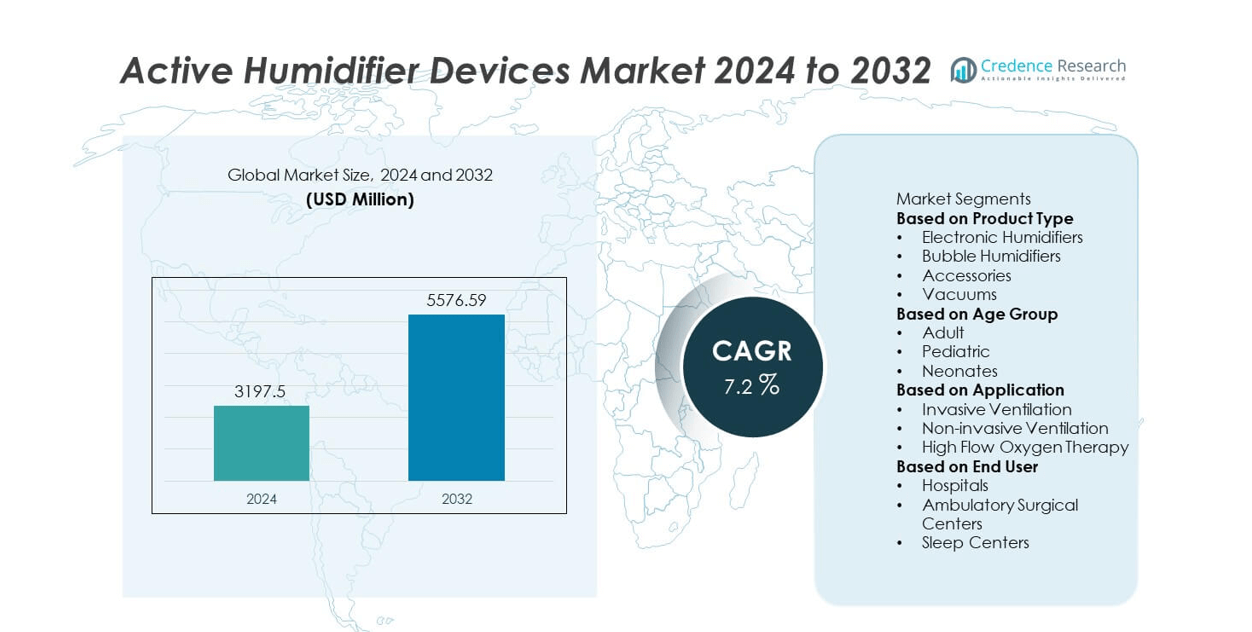
The Active Humidifier Devices market was valued at USD 3,197.5 million in 2024 and is projected to reach USD 5,576.59 million by 2032, registering a CAGR of 7.2% during the forecast period.
| REPORT ATTRIBUTE | DETAILS |
|---|---|
| Historical Period | 2020-2023 |
| Base Year | 2024 |
| Forecast Period | 2025-2032 |
| Active Humidifier Devices Market Size 2024 | USD 3,197.5 million |
| Active Humidifier Devices Market, CAGR | 7.2% |
| Active Humidifier Devices Market Size 2032 | USD 5,576.59 million |
The Active Humidifier Devices market is driven by leading companies such as Fisher & Paykel Healthcare, Teleflex Incorporated, Draegerwerk AG & Co. KGaA, Medtronic plc, Armstrong Medical, Hamilton Medical, Vapotherm Inc., Heinen + Löwenstein GmbH, Flexicare Medical Limited, and Intersurgical Ltd. These manufacturers focus on electronic humidifiers, high-flow oxygen therapy devices, and advanced circuit accessories that support invasive and non-invasive ventilation in critical care and home-care settings. Innovation centers on infection-control design, automated humidity regulation, and neonatal-safe temperature management. North America leads the market with a 38% share, supported by strong ICU capacity and home respiratory therapy adoption. Europe holds 27%, driven by advanced critical care protocols, while Asia Pacific accounts for 23% due to expanding neonatal and respiratory care infrastructure.
Market Insights
- The Active Humidifier Devices market reached USD 3,197.5 million in 2024 and is expected to expand at a 7.2% CAGR through 2032, supported by rising demand for advanced respiratory care in hospitals and home settings.
- Growing incidence of COPD, asthma, and post-viral respiratory complications drives adoption of humidification systems, with electronic humidifiers holding a 52% segment share due to precise humidity control and improved airway protection during invasive and non-invasive ventilation.
- Key trends include wider use of high-flow oxygen therapy and smart humidity regulation, along with increasing neonatal and pediatric respiratory support in NICUs and emergency units, enhancing clinical outcomes and patient comfort.
- Competitive activity intensifies as major players invest in infection-prevention features, disposable humidification chambers, and automated temperature monitoring, while higher device cost and complex maintenance remain key restraints in cost-sensitive healthcare environments.
- North America leads with 38% regional share, followed by Europe at 27% and Asia Pacific at 23%, supported by expanding critical care infrastructure, while Latin America holds 7% and Middle East & Africa 5%, reflecting gradual improvements in respiratory care capacity.
Market Segmentation Analysis:
By Product Type:
Electronic humidifiers lead the market with a 52% share, driven by growing adoption in intensive care units and advanced respiratory therapy. These systems offer precise temperature and humidity control, improving airway protection and patient comfort during ventilation. Hospitals prefer electronic humidifiers due to better infection control, real-time monitoring, and compatibility with invasive and non-invasive ventilation equipment. Bubble humidifiers maintain usage in low-acuity oxygen therapy, especially in cost-sensitive settings. Accessories such as breathing circuits, heaters, and chambers generate recurring sales and support long-term device utilization. Vacuums represent a smaller share, mainly for secretion management in respiratory care facilities.
- For instance, Medline Industries acquired a significant portion of the Teleflex respiratory business (under the Hudson RCI brand), including products for oxygen and aerosol therapy and active humidification
By Age Group:
The adult segment dominates with a 64% share in the Active Humidifier Devices market due to rising incidence of COPD, asthma, and post-operative respiratory complications in aging populations. Ventilated adults require active humidification to reduce airway dryness, improve mucociliary function, and minimize infection risk. Pediatric and neonatal segments collectively contribute significant demand, particularly in NICUs where humidified gas therapy supports premature and low-birth-weight infants. Neonatal care devices are designed with controlled temperature delivery to protect fragile lung tissue. Growth in neonatal respiratory distress cases and expanded critical care infrastructure support steady demand in these patient categories.
- For instance, Hamilton Medical's HAMILTON-H900 humidifier is designed for critical care ventilation solutions, enhancing humidity delivery for a variety of patients, including pediatric and neonatal, and can be used for non-invasive ventilation. It is used in numerous installations worldwide.
By Application:
Invasive ventilation holds the largest share at 47%, driven by its essential role in ICU respiratory management for trauma, surgical recovery, and severe pulmonary disease. Active humidifiers help reduce airway obstruction, ventilator-associated infections, and patient discomfort during prolonged ventilation. Non-invasive ventilation shows strong growth as hospitals expand treatment for obstructive sleep apnea, COPD exacerbations, and emergency respiratory support. High flow oxygen therapy gains traction in emergency and home-care settings, offering heated and humidified gas delivery for hypoxemic patients. Increased adoption in step-down units and tele-respiratory support strengthens long-term utilization across care environments.
Key Growth Drivers
Rising Burden of Respiratory Diseases
Increasing prevalence of chronic respiratory disorders such as COPD, asthma, and pulmonary infections drives steady adoption of active humidifier devices across hospitals and home-care settings. Patients receiving invasive or non-invasive ventilation require humidified airflow to maintain mucosal moisture, reduce airway inflammation, and prevent secretion buildup. Growing global pollution levels, smoking habits, and post-viral respiratory complications also contribute to higher patient admissions requiring respiratory support. Healthcare systems expand ICU capacity and invest in advanced humidification systems to improve outcomes and reduce ventilator-associated complications, strengthening market demand across both developed and emerging regions.
- For instance, Philips Respironics initiated a major recall involving approximately 15 million ventilators, CPAP, and BiPAP devices globally in June 2021 due to potential health risks associated with the breakdown of PE-PUR sound abatement foam.
Growing Demand for Critical and Neonatal Care
Rising neonatal respiratory distress cases and increased survival rates among preterm infants support the use of active humidifiers in NICUs. Controlled humidification protects delicate airway tissue and improves oxygen delivery efficiency in neonates and pediatric patients. In adult intensive care, growing surgical procedures and trauma cases require long-term mechanical ventilation, further driving product adoption. Expansion of critical care infrastructure, especially in Asia Pacific and Latin America, increases equipment procurement. Healthcare providers emphasize patient comfort and faster recovery, positioning active humidifiers as essential components of advanced respiratory care systems.
- For instance, Drägerwerk AG & Co. KGaA supplied ventilators to more than 120 countries, almost tripling its production in 2020 due to the COVID-19 pandemic, and is a leading player in the Brazil market.
Expansion of Home-Based Respiratory Therapy
Rapid growth in home healthcare fuels demand for user-friendly active humidifier devices that support long-term respiratory management. Patients with chronic conditions benefit from continuous humidified airflow while using CPAP, BiPAP, or high-flow oxygen systems outside hospital settings. Aging populations choose home therapy to minimize hospitalization and reduce medical expenses. Telehealth and remote monitoring help clinicians adjust humidification settings, ensuring safer therapy at home. Increasing reimbursement coverage and availability of compact, quiet, and energy-efficient humidifiers strengthen adoption, especially in North America and Europe.
Key Trends & Opportunities
Integration of Smart Monitoring and Automation
Manufacturers incorporate digital interfaces, auto-adjust humidity controls, and connectivity features that support real-time monitoring and improved clinical outcomes. Smart humidification systems evaluate airway temperature, flow rates, and patient breathing patterns to optimize moisture delivery. IoT-based platforms allow respiratory therapists to track performance and predict maintenance needs. These advancements reduce complications and support precision respiratory therapy. As remote respiratory care expands, connected humidifiers present strong commercial potential for hospitals and home-care providers seeking data-driven treatment solutions.
- For instance, Draegerwerk AG & Co. KGaA produces the Evita ventilator platform, which supports comprehensive lung-protective ventilation strategies across adult, pediatric, and neonatal patients.
Rising Opportunity in High-Flow Oxygen and Non-Invasive Therapy
High-flow nasal cannula therapy adoption grows rapidly for treating hypoxemia, post-surgical recovery, and viral respiratory complications. Active humidifiers improve patient tolerance and reduce airway dryness, expanding usage in emergency departments and step-down units. Non-invasive ventilation also gains traction for sleep apnea and COPD management. Market growth accelerates as physicians prefer heated and humidified gas therapy to enhance comfort and prevent mucosal injury. Increasing clinical research and expanded product availability in ambulatory and home-care settings present long-term adoption opportunities.
- For instance, Vapotherm confirmed that its Precision Flow systems have supported more than 17 million high-flow therapy patient hours across hospitals and transport units.
Key Challenges
High Equipment Cost and Limited Access in Low-Resource Markets
Active humidifier systems and replacement accessories require higher investment than basic bubble humidifiers, limiting adoption in cost-sensitive healthcare settings. Hospitals in low-income regions may prioritize essential ventilators over advanced humidification technologies. Limited reimbursement coverage for respiratory equipment also restricts home-care use. Manufacturers face pricing pressures and must provide cost-effective models and flexible procurement programs to expand penetration.
Risk of Contamination and Maintenance Complexity
Active humidifier devices require strict hygiene, regular disinfection, and proper water management to prevent microbial contamination and hospital-acquired infections. Inadequate training can lead to condensation buildup, circuit blockage, and inconsistent temperature control. These issues increase clinical risk and may discourage adoption in settings lacking skilled respiratory technicians. Manufacturers must enhance infection control features and provide training to address safety concerns and improve device utilization.
Regional Analysis
North America
North America holds a 38% share of the Active Humidifier Devices market, supported by advanced respiratory care infrastructure and high adoption of invasive and non-invasive ventilation systems. The United States leads demand due to a strong incidence of COPD, asthma, and post-viral respiratory complications requiring humidified oxygen therapy. Hospitals and home-care providers invest in electronic humidifiers with automated temperature and humidity controls. Canada contributes steady growth with government-supported respiratory treatment programs and expanding usage in neonatal intensive care units. Strong reimbursement systems and continuous product innovation reinforce regional dominance across acute and chronic respiratory care settings.
Europe
Europe accounts for a 27% share, driven by well-established hospital networks and growing emphasis on critical care and infection prevention. Germany, the United Kingdom, and France lead adoption of heated active humidifiers in intensive care units and long-term ventilation therapy. Rising prevalence of chronic respiratory diseases and policies supporting neonatal and pediatric care enhance market growth. Manufacturers benefit from increasing demand for energy-efficient systems and accessories, including sterile circuits and disposable chambers. Expansion of home-based respiratory therapy and remote monitoring solutions also supports broader use across the region.
Asia Pacific
Asia Pacific holds a 23% share and represents the fastest-growing region, driven by rising healthcare spending, expanding ICU capacity, and increasing neonatal respiratory distress cases. China, Japan, India, and South Korea show strong adoption of active humidification for invasive ventilation, high-flow oxygen therapy, and non-invasive respiratory support. Urban pollution, smoking rates, and seasonal viral outbreaks drive higher patient volumes requiring humidified oxygen delivery. Growth of home-care respiratory services and medical device production encourages cost-efficient product availability, strengthening market penetration in both top-tier and secondary hospital networks.
Latin America
Latin America accounts for a 7% share, supported by expanding access to respiratory therapy and increasing hospital admissions for asthma, COPD, and post-infection lung complications. Brazil and Mexico lead adoption, with growing investment in neonatal care and emergency treatment units. Public and private healthcare systems gradually incorporate electronic humidifiers to improve ventilator outcomes and reduce airway complications. Economic constraints encourage procurement of cost-effective devices and replacement accessories. Training programs in respiratory medicine and partnerships with global medical device suppliers improve availability across regional healthcare facilities.
Middle East & Africa
The Middle East & Africa region holds a 5% share, driven by expanding critical care capacity and greater focus on neonatal and trauma respiratory management. The United Arab Emirates and Saudi Arabia adopt advanced humidification systems for invasive and non-invasive ventilation in tertiary hospitals. African markets show increasing demand for essential respiratory devices due to rising infectious respiratory diseases and premature birth rates. Limited hospital infrastructure and budget constraints restrict broad adoption, particularly in rural areas. Growing healthcare modernization programs and NGO-supported neonatal initiatives gradually enhance market access for active humidifier devices.
Market Segmentations:
By Product Type
- Electronic Humidifiers
- Bubble Humidifiers
- Accessories
- Vacuums
By Age Group
- Adult
- Pediatric
- Neonates
By Application
- Invasive Ventilation
- Non-invasive Ventilation
- High Flow Oxygen Therapy
By End User
- Hospitals
- Ambulatory Surgical Centers
- Sleep Centers
By Geography
- North America
- U.S.
- Canada
- Mexico
- Europe
- Germany
- France
- U.K.
- Italy
- Spain
- Rest of Europe
- Asia Pacific
- China
- Japan
- India
- South Korea
- South-east Asia
- Rest of Asia Pacific
- Latin America
- Brazil
- Argentina
- Rest of Latin America
- Middle East & Africa
- GCC Countries
- South Africa
- Rest of the Middle East and Africa
Competitive Landscape
Competitive landscape or analysis of the Active Humidifier Devices market includes key players such as Fisher & Paykel Healthcare, Teleflex Incorporated, Draegerwerk AG & Co. KGaA, Medtronic plc, Armstrong Medical, Hamilton Medical, Vapotherm Inc., Heinen + Löwenstein GmbH, Flexicare Medical Limited, and Intersurgical Ltd. These companies compete by offering advanced humidification systems designed for invasive ventilation, non-invasive ventilation, and high-flow oxygen therapy across ICU, emergency, and home-care environments. Leading manufacturers focus on precision temperature and humidity control, infection-prevention features, and compatibility with modern ventilators and respiratory circuits. Product strategies emphasize disposable chambers, integrated monitoring sensors, and automated humidification modes that improve patient comfort and reduce airway complications. Companies strengthen market presence through hospital partnerships, clinical training programs, and technology upgrades supporting neonatal and critical care units. Rising demand for home-based respiratory therapy encourages suppliers to develop compact, quiet, and energy-efficient humidifiers. Competitive differentiation continues to center on safety, reliability, and lower total cost of ownership for long-term respiratory management.
Key Player Analysis
- Fisher & Paykel Healthcare
- Teleflex Incorporated
- Draegerwerk AG & Co. KGaA
- Medtronic plc
- Armstrong Medical
- Hamilton Medical
- Vapotherm Inc.
- Heinen + Löwenstein GmbH
- Flexicare Medical Limited
- Intersurgical Ltd
Recent Developments
- In August 2024, Fisher & Paykel Healthcare launched the F&P my820 System in the U.S., its new humidifier for home mechanical ventilation with automatic temperature adaptation to reduce condensate.
- In April 2024, Condair announced that Konvekta, an energy recovery specialist, is utilizing the Condair ME evaporative humidifier as a standard adiabatic cooling solution in its exhaust air cooling systems. The company aims to achieve up to 92% annual energy recovery for its clients' buildings.
- In March 2024, Vapotherm announced plans to unveil its Access365 home ventilation solution at MEDTRADE Dallas (held March 27-28, 2024) as a product "under development" which includes a built-in medical-grade humidifier and integrated Bluetooth pulse oximetry and spirometry, with anticipated FDA clearance in early 2025.
- In September 2023, Smartmi introduced its High-Capacity Evaporative Humidifier 3, designed to improve air quality and convenienc
Report Coverage
The research report offers an in-depth analysis based on Product Type, Age Group, Application, End User and Geography. It details leading market players, providing an overview of their business, product offerings, investments, revenue streams, and key applications. Additionally, the report includes insights into the competitive environment, SWOT analysis, current market trends, as well as the primary drivers and constraints. Furthermore, it discusses various factors that have driven market expansion in recent years. The report also explores market dynamics, regulatory scenarios, and technological advancements that are shaping the industry. It assesses the impact of external factors and global economic changes on market growth. Lastly, it provides strategic recommendations for new entrants and established companies to navigate the complexities of the market.
Future Outlook
- Demand for active humidifiers will increase with higher respiratory disease prevalence.
- ICUs and emergency care units will continue adopting automated humidification systems.
- Neonatal care expansion will strengthen usage in NICUs and pediatric units.
- High-flow oxygen therapy will gain wider adoption in hospitals and home care.
- Smart sensors and remote monitoring will enhance treatment precision and safety.
- Disposable chambers and circuits will grow due to stronger infection control needs.
- Hybrid systems integrating humidifiers with ventilators will improve workflow efficiency.
- Training and clinical education will support safe device use in emerging markets.
- Cost-optimized humidifiers will create opportunities in low-resource healthcare settings.
- Partnerships between respiratory device manufacturers and telehealth platforms will enhance long-term respiratory management.

Request a Free Sample
Fill in your details and we'll send you a free sample report.
- Sample data tables & charts
- Research methodology
Need a Custom Version of This Report?
Tailor the scope, geography, or segments to your exact requirements.
- Custom geography or segment scope
- Direct access to our analyst team
Frequently Asked Questions
What is the current market size for Active Humidifier Devices market, and what is its projected size in 2032?
At what Compound Annual Growth Rate is the Active Humidifier Devices market projected to grow between 2025 and 2032?
Which end-user segment is estimated to post the highest CAGR during the forecast period?
Who are the major global active humidifier device market players?
What are the major market drivers of the active humidifier devices industry?
What are the major market restraints of the active humidifier devices industry?
What are the major market opportunities of the active humidifier devices industry?
Who are the leading companies in the Active Humidifier Devices market?
Table of Content
Chapter 1. Report Introduction
- 1.1 Report Description & Purpose
- 1.1.1 Report Title & Market Definition
- 1.1.2 Unique Selling Propositions (USP) & Key Differentiators
- 1.1.3 Value Proposition for Stakeholders
- 1.2 Research Objectives
- 1.2.1 Market Sizing Objectives (Volume & Revenue) (Volume Where Applicable)
- 1.2.2 Segmentation Objectives
- 1.2.3 Competitive Intelligence Objectives
- 1.2.4 Forecast & Scenario Objectives
- 1.3 Report Scope
- 1.3.1 Active Humidifier Devices Scope – Segments & Subsegments Covered
- 1.3.2 Geographic Scope – Regions & Countries Covered
- 1.3.3 Historical Period, Base Year & Forecast Period (2024; forecast to 2032)
- 1.3.4 Inclusions & Exclusions
- 1.4 Industry Classification & Applicable Codes
- 1.5 Currency, Measurement Units & Valuation Basis
- 1.6 Target Stakeholders
- 1.7 Limitations & Assumptions
Chapter 2. Executive Summary
- 2.1 Global Active Humidifier Devices Market Snapshot
- 2.1.1 Market Size – Historical (2024) & Forecast (2024-2032) (2024: USD 3,197.5 million → 2032: USD 5,576.59 million)
- 2.1.2 Volume & Revenue – Global Totals (Volume Where Applicable)
- 2.1.3 Key Market Highlights – Top Five Facts
- 2.2 Active Humidifier Devices Market Segmentation Snapshot
- 2.2.1 Market Split by Region – 2024 vs. 2032
- 2.3 Competitive Snapshot
- 2.3.1 Top 10 Players by Revenue Share – 2024
- 2.3.2 Top 10 Players by Volume Share – 2024 (Volume Where Applicable)
- 2.3.3 Recent Strategic Developments (18-Month Summary)
- 2.4 Key Investment Highlights & Strategic Conclusions
Chapter 3. Active Humidifier Devices Market Dynamics & Industry Analysis
- 3.1 Market Overview & Context
- 3.1.1 Active Humidifier Devices Market Position in the Broader Industry Value Chain
- 3.1.2 Demand Structure & Purchasing Dynamics
- 3.1.3 Market Maturity & Development Stage by Region
- 3.2 Active Humidifier Devices Market Drivers
- 3.3 Active Humidifier Devices Market Restraints & Challenges
- 3.4 Active Humidifier Devices Market Opportunities
- 3.5 Porter's Five Forces Analysis
- 3.5.1 Threat of New Entrants
- 3.5.2 Bargaining Power of Suppliers
- 3.5.3 Bargaining Power of Buyers
- 3.5.4 Threat of Substitutes
- 3.5.5 Competitive Rivalry – Intensity Assessment
- 3.6 Active Humidifier Devices Value Chain Analysis
- 3.6.1 Upstream – Key Inputs, Resources & Suppliers
- 3.6.1.1 Key Input/Resource 1
- 3.6.1.2 Key Input/Resource 2
- 3.6.1.3 Key Input/Resource 3
- 3.6.2 Midstream – Core Operations & Value Creation
- 3.6.2.1 Operating Model & Process Overview
- 3.6.2.2 Key Operating Locations & Capabilities by Company
- 3.6.3 Downstream – Market Channels & End Users
- 3.6.3.1 Direct Sales & Customer Engagement Channels
- 3.6.3.2 Indirect Sales, Intermediaries & Partner Channels
- 3.6.4 Value Chain Profitability Analysis
- 3.6.1 Upstream – Key Inputs, Resources & Suppliers
- 3.7 PESTEL Analysis
- 3.7.1 Political Factors
- 3.7.2 Economic Factors
- 3.7.3 Social Factors
- 3.7.4 Technological Factors
- 3.7.5 Environmental Factors
- 3.7.6 Legal Factors
- 3.8 Active Humidifier Devices Supply Chain Analysis
- 3.8.1 Critical Input & Resource Availability Risk Assessment
- 3.8.2 Supplier & Operational Concentration Risk (Geographic Exposure)
- 3.8.3 Supply & Service Disruption Impact Analysis
- 3.9 Regulatory & Policy Landscape
Note: The regulatory and policy landscape section covers regulations based on their applicability to the market, Active Humidifier Devices category, geography, and scope of the study. Only regulatory frameworks with a material impact on operations, compliance, trade, sustainability, or market access are analyzed in detail.
Chapter 4. Key Investment Pockets & Opportunity Analysis
- 4.1 Active Humidifier Devices Market Attractiveness Analysis
- 4.1.1 By Region – Investment Attractiveness Matrix (Market Size × CAGR)
- 4.2 Absolute Revenue Growth Opportunity
- 4.2.1 By Region – Absolute Revenue Growth Through 2032
- 4.3 Incremental Demand Opportunity
- 4.3.1 By Region – Incremental Demand Through 2032
- 4.3.2 Segment – Incremental Demand
- 4.4 Emerging Submarket Opportunity Deep Dive (Subject to Applicability)
- 4.5 Priority Market Opportunity Scorecards
- 4.5.1 United States
- 4.5.2 Europe
- 4.5.3 Asia
- 4.5.4 Middle East & Africa
Note: Priority market opportunity scorecards reflect the geographic scope and strategic relevance of the study. Listed markets are indicative and may be adapted to the industry.
Chapter 5. Active Humidifier Devices Cross-Border Trade & Market Access Analysis
- 5.1 International Trade & Cross-Border Activity Overview
- 5.1.1 Global Export Value by Country (2024)
- 5.1.2 Global Export Volume by Country (2024) (Volume Where Applicable)
- 5.1.3 Global Import Value by Country (2024)
- 5.1.4 Global Import Volume by Country (2024) (Volume Where Applicable)
- 5.1.5 Net Trade Balance by Country (2024)
- 5.2 Export Analysis – Segment
- 5.2.1 Category 1 (Applicable Classification Code)
- 5.2.2 Category 2 (Applicable Classification Code)
- 5.2.3 Category 3 (Applicable Classification Code)
- 5.2.4 Category 4 (Applicable Classification Code)
- 5.2.5 Category 5 (Applicable Classification Code)
- 5.3 Import Analysis – Segment
- 5.3.1 Category 1 (Applicable Classification Code)
- 5.3.2 Category 2 (Applicable Classification Code)
- 5.3.3 Category 3 (Applicable Classification Code)
- 5.3.4 Category 4 (Applicable Classification Code)
- 5.3.5 Category 5 (Applicable Classification Code)
- 5.4 Cross-Border Pricing & Transaction Benchmarks
- 5.4.1 Export Pricing – Segment & Country
- 5.4.2 Import Pricing – Segment & Source Country
- 5.4.3 Price Trends (2024)
- 5.5 Key Cross-Border Trade & Delivery Routes
- 5.5.1 Cross-Border Trade/Delivery Route 1
- 5.5.2 Cross-Border Trade/Delivery Route 2
- 5.5.3 Cross-Border Trade/Delivery Route 3
- 5.5.4 Cross-Border Trade/Delivery Route 4
- 5.5.5 Cross-Border Trade/Delivery Route 5
- 5.6 Trade Policy & Market Access Impact Assessment
- 5.6.1 Tariff & Non-Tariff Barriers
- 5.6.2 Regional Trade & Economic Integration Frameworks
- 5.6.3 Bilateral & Multilateral Trade Agreements
- 5.6.4 Cross-Border Operating, Licensing & Localization Requirements
Note: This chapter applies where cross-border trade or delivery is relevant to Active Humidifier Devices. Goods, services, and digital offerings are assessed using applicable classifications and transaction measures. Import-export volumes, trade balances, and route analyses are included only where meaningful to the market.
Chapter 6. Competitive Landscape & Company Benchmarking
- 6.1 Active Humidifier Devices Market Concentration & Structure
- 6.1.1 Herfindahl-Hirschman Index (HHI) – vs. 2024
- 6.1.2 Leading, Mid-Sized & Emerging Player Structure
- 6.1.3 Global, Regional & Local Player Dynamics
- 6.2 Active Humidifier Devices Market Share Analysis – 2024
- 6.2.1 Global Revenue Share by Company
- 6.2.2 Global Volume Share by Company (Volume Where Applicable)
- 6.2.3 Regional Revenue Share
- 6.2.4 Market Share Evolution ( vs. 2024)
- 6.2.5 Company Market Share by Key Segment
- 6.2.6 Company Market Share by Customer Group
- 6.3 Operating Scale, Capacity & Infrastructure Analysis
- 6.3.1 Global Operating Scale & Supply Capacity
- 6.3.2 Resource Utilization & Operating Efficiency
- 6.3.3 Output, Service Delivery & Activity Metrics
- 6.3.4 Operating Footprint & Infrastructure Map
- 6.3.5 Planned Operational & Capacity Expansion
- 6.4 Active Humidifier Devices Competitive Benchmarking Matrix
- 6.4.1 Revenue, Growth, Profitability & Operating Metric Comparison
- 6.4.2 Channel Revenue Mix
- 6.4.3 Geographic Revenue Exposure
- 6.4.4 R&D Intensity
- 6.4.5 Sustainability Maturity
- 6.5 Strategic Developments in Active Humidifier Devices (Last 24 Months)
- 6.5.1 Mergers, Acquisitions & Divestments
- 6.5.2 New Products, Services & Solutions in Active Humidifier Devices
- 6.5.3 Operational & Infrastructure Expansions
- 6.5.4 Strategic Alliances, Joint Ventures & Partnerships
- 6.5.5 Distribution Expansion & Market Entry
- 6.5.6 Sustainability & ESG Initiatives
- 6.6 Competitive Strategy Mapping
- 6.6.1 Leader, Challenger, Follower & Niche Classification
- 6.6.2 Pricing Strategy Comparison
- 6.6.3 Channel Strategy Matrix
Note: Strategic developments are included based on their materiality and the availability of reliable information.
Chapter 7. Global Active Humidifier Devices Market – By Sales & Delivery Channel
- 7.1 Segment Overview
- 7.1.1 Volume & Revenue Split by Channel (2024 & 2032) (Volume Where Applicable)
- 7.1.2 Channel Mix Evolution (2024-2032)
Chapter 8. Regional Market Analysis – Global Overview
- 8.1 Global Regional Overview
- 8.1.1 Regional Volume Share (Volume Where Applicable)
- 8.1.2 Regional Revenue Share
- 8.1.3 Regional Volume by Region (Volume Where Applicable)
- 8.1.4 Regional Revenue by Region
- 8.1.5 Regional Forecast Through 2032
- 8.2 Cross-Regional Segment Analysis
- 8.2.1 By Sales & Delivery Channel
- 8.2.2 By Competitive Positioning & Price Tier
Chapter 9. North America Active Humidifier Devices Market
- 9.1 United States
- 9.2 Canada
- 9.3 Mexico
Chapter 10. Europe Active Humidifier Devices Market
- 10.1 Germany
- 10.2 France
- 10.3 Italy
- 10.4 United Kingdom
- 10.5 Spain
- 10.6 Poland
- 10.7 Russia
- 10.8 Netherlands
- 10.9 Belgium
- 10.10 Sweden
- 10.11 Denmark
- 10.12 Norway
- 10.13 Rest of Europe
Chapter 11. Asia Pacific Active Humidifier Devices Market
- 11.1 China
- 11.2 India
- 11.3 Japan
- 11.4 South Korea
- 11.5 Thailand
- 11.6 Indonesia
- 11.7 Vietnam
- 11.8 Malaysia
- 11.9 Australia
- 11.10 Rest of Asia Pacific
Chapter 12. Latin America Active Humidifier Devices Market
- 12.1 Brazil
- 12.2 Argentina
- 12.3 Colombia
- 12.4 Chile
- 12.5 Rest of Latin America
Chapter 13. Middle East Active Humidifier Devices Market
- 13.1 Saudi Arabia
- 13.2 United Arab Emirates
- 13.3 Turkey
- 13.4 Israel
- 13.5 Iran
- 13.6 Rest of the Middle East
Chapter 14. Africa Active Humidifier Devices Market
- 14.1 South Africa
- 14.2 Egypt
- 14.3 Nigeria
- 14.4 Morocco
- 14.5 Rest of Africa
Chapter 15. Active Humidifier Devices Company Profiles
- 15.1 [Company 01]
- 15.1.1 Company Overview
- 15.1.2 Key Management Personnel
- 15.1.3 Products & Services Portfolio
- 15.1.4 Financial Performance
- 15.1.5 Key Market Focus & Geographic Presence
- 15.1.6 Recent Developments & Strategic Initiatives
Note: The company profile list is preliminary and may change based on research findings, market developments, data availability, and client requirements.
Chapter 16. Appendices
- Appendix A – List of Abbreviations & Acronyms
- Appendix B – Industry Classification Code Reference – Full Series
- Appendix C – Supply, Output & Operating Capacity Data Tables
- Appendix D – End-Use & Demand Base Tables
- Appendix E – Demand, Adoption & Usage Assumptions
- Appendix F – Pricing & Revenue Metric Reference Tables
- Appendix G – Company Operations & Infrastructure Database
- Appendix H – Cross-Border Trade & Activity Data Tables (Where Applicable)
- Appendix I – Regulatory Summary Tables
- Appendix J – Primary Research Participant List (Anonymized)
- Appendix K – Primary Research Questionnaire Framework
- Appendix L – Data Sources & Bibliography
- Appendix M – Market Size Divergence & Source Comparison
Chapter 17. Research Methodology
- 17.1 Research Framework & Philosophy
- 17.2 Secondary Research – Sources, Hierarchy & Data Extraction
- 17.3 Data Modeling – Bottom-Up & Top-Down Market Sizing
- 17.4 Primary Research – Stakeholder Framework, LOI & Sample Sizes
- 17.5 Forecast Methodology – Regression, Scenario & Sensitivity Analysis
- 17.6 Quality Control – Four-Layer Validation Framework
- 17.7 Limitations & Standard Assumptions
- 17.8 Disclaimer
