Agarose Resin Market Overview:
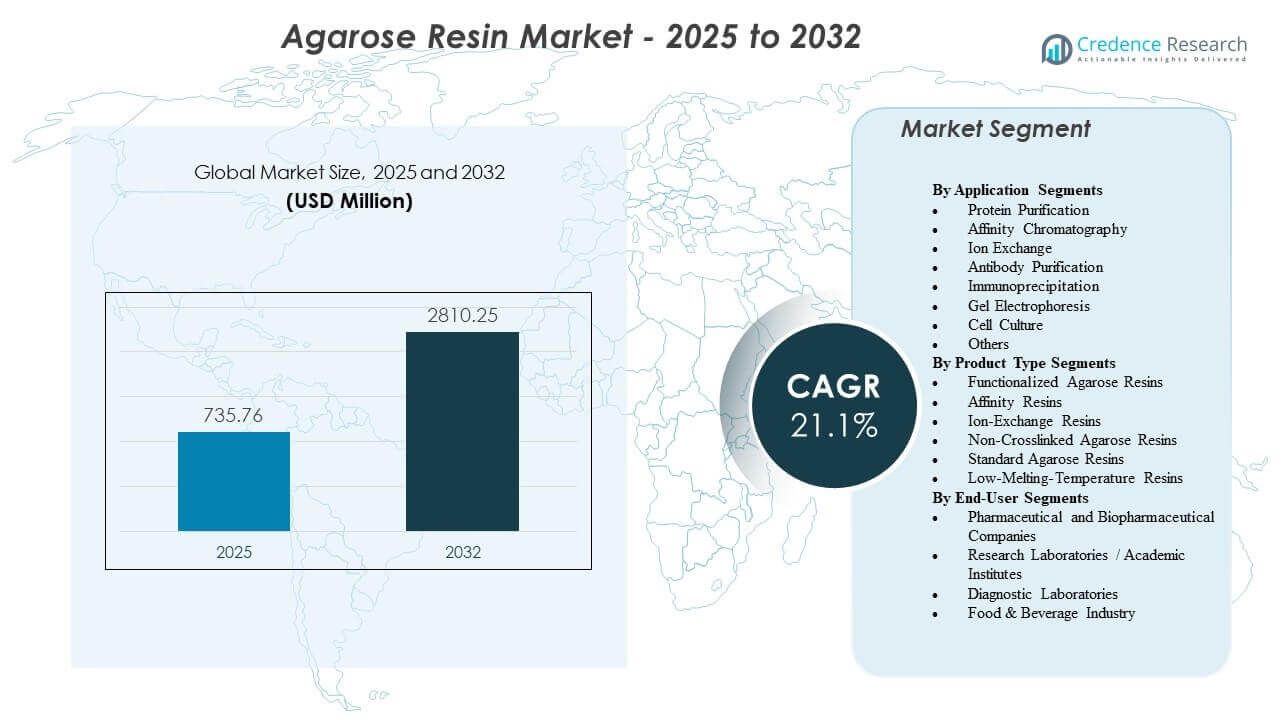
The Agarose Resin Market is projected to grow from USD 735.76 million in 2025 to an estimated USD 2810.25 million by 2032, with a compound annual growth rate (CAGR) of 21.1% from 2025 to 2032. Growth in the market is driven by rising demand for high-purity chromatography materials across biologics manufacturing.
| REPORT ATTRIBUTE |
DETAILS |
| Historical Period |
2020-2024 |
| Base Year |
2025 |
| Forecast Period |
2026-2032 |
| Agarose Resin Market Size 2025 |
USD 735.76 million |
| Agarose Resin Market, CAGR |
21.1% |
| Agarose Resin Market Size 2032 |
USD 2810.25 million |
Agarose Resin Market Insights:
- Demand strengthens due to rising biologics production, expanding monoclonal antibody workflows, and increased reliance on high-purity chromatography tools across research and manufacturing.
- Growth is restrained by high production costs, supply chain pressures, and competition from alternative resin types that offer lower-cost purification options.
- North America leads market share due to advanced biopharma capacity, with Europe following through strong CDMO activity and established research ecosystems.
- Asia-Pacific emerges as the fastest-growing region driven by rapid expansion of biologics facilities in China, India, and South Korea, supported by increasing investment in modern purification technologies.
Agarose Resin Market Drivers
Growing Adoption of Advanced Purification Platforms Across Biopharma and Research Environments
The Agarose Resin Market reports strong demand from biopharma facilities that expand complex purification workflows. The adoption of high-capacity resins supports consistent protein isolation across large and small production lines. Many developers strengthen downstream processing to improve yield. Companies focus on upgrading chromatography steps to meet regulatory expectations. Growing therapeutic innovation pushes interest in robust purification tools. Research units rely on agarose-based media to support precision separation. It reinforces a shift toward scalable solutions across biologics programs. Demand stays firm due to rising interest in novel modalities.
Access crucial information at unmatched prices!
Request your sample report today & start making informed decisions powered by Credence Research Inc.!
Download Sample
Rising Focus on High-Purity Biologics and Streamlined Downstream Processing Solutions
Manufacturers push to produce high-purity biologics that meet strict approval standards. Many adopt agarose resins to improve clarity and reduce impurities. It supports cleaner workflows that help teams maintain compliance. Biologics pipelines expand across monoclonal antibodies, recombinant proteins, and vaccines. Companies refine downstream steps to shorten processing cycles. Research centers adopt stronger resin types to support rapid method development. High-quality chromatography tools reduce batch failures and operational delays. The Agarose Resin Market gains traction from this strong shift toward purity-driven manufacturing.
- For instance, Purolite Life Sciences utilized its “jetted” bead technology to develop the Praesto Jetted A50 resin, which provides a uniform particle size distribution of 50 µm, resulting in a 30% reduction in buffer consumption and significantly improved pressure-flow characteristics.
Expansion of Gene Therapy, Vaccine Programs, and Novel Therapeutic Areas Globally
Gene therapy and viral vector programs adopt robust purification media to improve consistency. Many research teams enhance vector production to support clinical trials. It promotes the use of agarose resins for precise separation of biomolecules. Vaccine developers rely on strong purification tools to support global immunization programs. Growth in recombinant platforms fuels steady resin use across major markets. Therapy developers need scalable solutions for rising demand. Bio-manufacturers upgrade infrastructure to address complex pipelines. The Agarose Resin Market benefits from the rapid expansion of advanced therapeutic fields.
Increased Investments in Bioprocessing Infrastructure and Chromatography Innovation Worldwide
Governments and private firms invest in large bioprocessing hubs to support biologics production. Many initiatives strengthen capabilities of CDMOs and biotech clusters. It encourages adoption of advanced chromatography media across diverse operations. Companies build new plants that require efficient purification lines. Developers integrate automation tools to increase accuracy. Resin manufacturers upgrade product lines to support high throughput. Market players improve production efficiency to meet global demand. The Agarose Resin Market advances with this rapid expansion in manufacturing capacity.
- For instance, Merck KGaA invested €130 million in expanding its Molsheim, France facility in 2022 to boost manufacturing of single-use technologies that support large-scale biologics purification workflows. The company’s Eshmuno chromatography resins are engineered to maintain high resolution at flow rates up to 1,000 cm/h, reinforcing their use in advanced downstream processing.
Agarose Resin Market Trends
Shift Toward Single-Use Chromatography Systems and Modular Bioprocessing Designs
Single-use systems gain strong acceptance across modern bioprocessing facilities. Many firms seek flexible tools that reduce cleaning steps. It improves operational speed for multiproduct plants. Modular equipment supports faster changeovers during production cycles. Biotech units prefer formats that reduce contamination risks. Resin suppliers offer designs that integrate easily with disposable flow paths. Investments focus on improving compatibility across upstream and downstream units. The Agarose Resin Market grows with the wider transition toward single-use platforms.
- For instance, Repligen Corporation has expanded global adoption of its OPUS pre-packed chromatography columns, which are offered in diameters up to 80 cm and are compatible with multiple agarose resin types. These ready-to-use columns help bioprocessing facilities cut equipment preparation and cleaning validation time by up to 75% compared with traditional stainless-steel or glass columns.
Rising Preference for High-Flow Agarose Matrices Optimized for Speed and Performance
Production teams seek resin formats that handle higher flow rates without performance loss. Improved matrices reduce processing time during large-scale purification. It enables facilities to handle increased biologics volume efficiently. Manufacturers design resins that maintain stable binding even under fast operation. Facilities benefit from shorter cycle times across complex runs. Teams focus on maintaining quality while improving throughput. Suppliers strengthen research on advanced matrix structures. The Agarose Resin Market sees interest rise for resins designed for speed and productivity.
- For instance, Bio-Rad Laboratories, Inc. developed its Nuvia HP-Q anion-exchange resin on a rigid, high-flow agarose matrix engineered for fast processing. The resin maintains a dynamic binding capacity of about 50 mg/mL at linear velocities near 600 cm/h, enabling efficient purification of large feed volumes without loss of performance.
Integration of Automation, AI-Driven Analytics, and Smart Chromatography Systems
Automation tools enter downstream processing to reduce manual steps. AI platforms help teams analyze separation profiles with higher accuracy. It supports rapid decision-making across purification programs. Facilities install smart systems that monitor flow, pressure, and impurity levels. Digital tools predict performance deviations early. Operators improve batch consistency through automated adjustments. Vendors design resins suitable for tightly controlled environments. The Agarose Resin Market aligns with the industry’s move toward intelligent processing ecosystems.
Growing Use of Customized Resin Formulations Tailored to Emerging Biologic Modalities
Developers request resins tailored for specific biomolecules and therapeutic formats. Customized media helps improve recovery during specialized purification tasks. It offers better performance for emerging formats like fusion proteins or viral vectors. Bioprocess teams refine protocols to match new resin features. Suppliers invest in collaborative development programs with biopharma clients. Production teams value materials that reduce downstream bottlenecks. Customization strengthens certainty during scale-up. The Agarose Resin Market evolves with this strong demand for tailor-made purification solutions.
Agarose Resin Market Challenges Analysis
High Production Costs, Complex Manufacturing Needs, and Competition From Alternative Resin Types
Producers face rising manufacturing costs tied to specialized agarose processing. Many suppliers must maintain strict purity and quality controls. It increases operational complexity across production lines. Synthetic resin alternatives challenge agarose-based options in price-sensitive facilities. Companies examine total cost ownership before upgrading purification media. Users require consistent batch quality, which adds pressure on suppliers. Price volatility of raw materials affects planning cycles. The Agarose Resin Market navigates these constraints while supporting growing purification needs.
Limited Scalability in Some Applications and Operational Barriers in Large-Scale Facilities
Some resin formats encounter performance limits when scaled across very large bioprocessing setups. Flow restrictions or pressure limitations reduce efficiency during bulk purification. It forces developers to adjust protocols, which impacts speed. Production sites require resins that support aggressive flow requirements. Switching between resin types disrupts established workflows. Many facilities hesitate to adopt new formats without clear performance proof. Supply chain constraints introduce delays. The Agarose Resin Market must address these technical and operational barriers to support wider industrial adoption.
Agarose Resin Market Opportunities
Expansion of Biologic Pipelines, Contract Manufacturing Growth, and Need for High-Performance Purification Tools
Biologic development accelerates across therapeutic categories. Many firms outsource production to CDMOs that need versatile purification media. It opens strong opportunities for resin manufacturers offering scalable solutions. Demand grows for resins designed for high-purity biologics. Companies pursue broader product portfolios to support rapid clinical programs. Vendors improve features to meet strict regulatory norms. Facilities target shorter purification timelines to improve output. The Agarose Resin Market benefits from expanding infrastructure across global biomanufacturing hubs.
Emerging Markets, Custom Resin Development, and Adoption of Digital Bioprocessing Platforms
Countries in Asia, Latin America, and the Middle East invest in new biotech ecosystems. Many facilities upgrade to advanced chromatography tools. It strengthens the need for high-capacity agarose-based media. Custom resin development supports niche therapeutic formats. Digital bioprocessing enables improved monitoring and performance optimization. Vendors collaborate with biotech innovators to design specialized solutions. Demand rises for flexible materials that support scale-up. The Agarose Resin Market gains opportunities as global players expand into new research and manufacturing regions.
Agarose Resin Market Segmentation Analysis:
By Application Segments
The Agarose Resin Market records strong demand across protein purification, affinity chromatography, and ion-exchange processes. Protein purification secures a leading role due to its use in biologics and recombinant protein workflows. Affinity chromatography supports targeted separation where high specificity is required. Ion-exchange systems gain traction due to flexible binding capabilities across varied biomolecules. Antibody purification strengthens growth due to the rise of monoclonal antibody pipelines. Immunoprecipitation remains important for research teams that require precise isolation steps. Gel electrophoresis supports nucleic acid and protein analysis tasks. Cell culture workflows and other applications reinforce adoption in research and production units.
- For instance, Cytiva’s MabSelect PrismA protein A affinity resin demonstrates a dynamic binding capacity of 80 mg IgG per mL of resin at a 6-minute residence time, significantly enhancing the productivity of antibody purification cycles compared to standard legacy resins.
By Product Type Segments
The Agarose Resin Market expands through broad product categories that support diverse purification needs. Functionalized agarose resins serve high-performance separation tasks where strong interaction control is required. Affinity resins maintain steady use for selective purification steps across complex biomolecules. Ion-exchange resins provide adaptable binding profiles for large-scale and small-scale workflows. Non-crosslinked agarose resins offer flexibility for analytical and preparative tasks. Standard agarose resins support routine laboratory use across multiple research procedures. Low-melting-temperature resins remain important for molecular biology teams that require gentle processing conditions.
By End-User Segments
The Agarose Resin Market gains strong adoption across pharmaceutical and biopharmaceutical companies that depend on robust purification tools. Research laboratories and academic institutes drive consistent demand due to extensive protein and nucleic acid analysis needs. Diagnostic laboratories rely on stable resin formats to support assay development and routine testing workflows. The food and beverage industry uses agarose-based materials for quality control and analytical processes. It supports a broad end-user base that spans development, production, and applied research environments.
- For instance, Lonza Group uses its SeaPlaque™ low-melting-temperature agarose in applications requiring gentle DNA handling, enabling efficient recovery of high-molecular-weight fragments up to roughly 40 kb. The gel’s low melt point preserves high enzymatic activity for downstream cloning, ligation, and in-gel reactions, making it a preferred matrix for sensitive molecular workflows.
Segmentation:
By Application Segments
- Protein Purification
- Affinity Chromatography
- Ion Exchange
- Antibody Purification
- Immunoprecipitation
- Gel Electrophoresis
- Cell Culture
- Others
By Product Type Segments
- Functionalized Agarose Resins
- Affinity Resins
- Ion-Exchange Resins
- Non-Crosslinked Agarose Resins
- Standard Agarose Resins
- Low-Melting-Temperature Resins
By End-User Segments
- Pharmaceutical and Biopharmaceutical Companies
- Research Laboratories / Academic Institutes
- Diagnostic Laboratories
- Food & Beverage Industry
By Region Segments
- North America
- Europe
- Germany
- France
- U.K.
- Italy
- Spain
- Rest of Europe
- Asia Pacific
- China
- Japan
- India
- South Korea
- South-east Asia
- Rest of Asia Pacific
- Latin America
- Brazil
- Argentina
- Rest of Latin America
- Middle East & Africa
- GCC Countries
- South Africa
- Rest of the Middle East and Africa
Regional Analysis:
North America secures the largest share of the Agarose Resin Market, holding close to 40% of global demand. Strong biopharma clusters, advanced chromatography capabilities, and continuous investment in biologics production drive this lead. The region benefits from high adoption of premium resin formats that support large-scale purification. Research institutions maintain steady consumption across protein analysis workflows. Companies upgrade downstream processing platforms to match expanding therapeutic pipelines. The Agarose Resin Market strengthens its position in this region due to consistent demand across development and commercial manufacturing.
Europe holds roughly 30% market share, supported by established biotechnology hubs and a mature regulatory environment that reinforces quality-driven production standards. Many CDMOs rely on agarose resins for antibody purification, gene therapy development, and viral vector preparation. The region maintains strong adoption of functionalized and affinity resin types due to advanced research programs. Demand remains steady in Germany, the UK, and France due to concentration of high-value biologics projects. Companies in this region focus on purification efficiency and process optimization. It sustains stable growth due to strong collaboration between academia and industry.
Asia-Pacific expands rapidly and captures close to 25% of global share, driven by growing biologics manufacturing in China, India, and South Korea. The region invests in new bioprocessing facilities that require large volumes of chromatography resins. Local developers strengthen capabilities in monoclonal antibodies, recombinant proteins, and vaccines. Rapid growth in contract manufacturing boosts resin use across diverse applications. Governments support biotechnology expansion through infrastructure and policy initiatives. The Agarose Resin Market gains strong momentum here due to rising capacity across production and research ecosystems.
Shape Your Report to Specific Countries or Regions & Enjoy 30% Off!
Key Player Analysis:
- Ecolab Inc. (Purolite)
- Takara Bio Inc.
- Bio-Rad Laboratories, Inc.
- Cube Biotech Inc.
- Cytiva (GE Healthcare)
- Agarose Bead Technologies
- Merck KGaA
- Thermo Fisher Scientific Inc.
- Bio-Works
- Tosoh Bioscience LLC
- Repligen Corporation
- Lonza Group
- Agilent Technologies
- Fujifilm Irvine Scientific
- Sartorius AG
- Kaneka Corporation
Competitive Analysis:
Competition in the Agarose Resin Market centers on product innovation, scalability, and performance enhancements across purification workflows. Leading companies focus on developing resin types that improve binding strength, flow stability, and cycle durability to support advanced bioprocessing. Many suppliers introduce specialized formulations to meet growing demand for antibody purification and gene therapy vectors. It encourages firms to expand portfolios that address both routine laboratory needs and industrial-scale manufacturing. Competitors strengthen partnerships with CDMOs and biopharma developers to support customized purification solutions. Pricing strategies, technical support, and global distribution networks influence market positioning. The Agarose Resin Market evolves through continuous upgrades in chromatography technology and increased focus on application-specific performance.
Recent Developments:
- In October 2025, Agarose Bead Technologies announced plans to continue expanding its production capacity and international presence to better support biopharmaceutical firms developing advanced biologic therapies, strengthening its position in the agarose resin market.
- In June 2024, Ecolab Inc.’s Purolite resin business, in partnership with Repligen Corporation, commercially launched DurA Cycle, a protein A chromatography resin designed for large-scale purification processes in bioprocessing applications.
- In June 2024, Agarose Bead Technologies completed a major facility expansion in Burgos, Spain, boosting its annual agarose resin production capacity to 100,000 liters to meet rising global demand for novel therapies like monoclonal antibodies and vaccines.
- In February 2024, Purolite (an Ecolab company) and Repligen Corporation introduced Praesto CH1, a new 70-micrometer agarose-based affinity resin aimed at enhancing bioprocessing efficiency within the agarose resin sector.
Report Coverage:
The research report offers an in-depth analysis based on Application Segments, Product Type Segments, and End-User Segments. It details leading market players, providing an overview of their business, product offerings, investments, revenue streams, and key applications. Additionally, the report includes insights into the competitive environment, SWOT analysis, current market trends, as well as the primary drivers and constraints. Furthermore, it discusses various factors that have driven market expansion in recent years. The report also explores market dynamics, regulatory scenarios, and technological advancements that are shaping the industry. It assesses the impact of external factors and global economic changes on market growth. Lastly, it provides strategic recommendations for new entrants and established companies to navigate the complexities of the market.
Future Outlook:
- Demand for high-purity chromatography materials will grow as biologics production expands across global manufacturing hubs.
- Adoption of advanced resin formats will rise due to increased focus on efficient downstream purification.
- Investments in gene therapy and viral vector development will support wider use of specialized agarose matrices.
- Growth in monoclonal antibody pipelines will strengthen long-term demand for affinity and ion-exchange resin types.
- Automation and digital bioprocessing tools will encourage adoption of resins compatible with smart purification systems.
- Contract manufacturing expansion will elevate resin consumption across large-scale and clinical production lines.
- Single-use bioprocessing trends will influence new resin designs optimized for rapid changeover workflows.
- Emerging markets will accelerate resin uptake due to rising biologics infrastructure and new facility construction.
- Custom resin development will gain traction as developers seek application-specific performance enhancements.
- Global suppliers will expand collaborative programs to support innovation across evolving therapeutic platforms.



