
Air Cooler Market Overview:
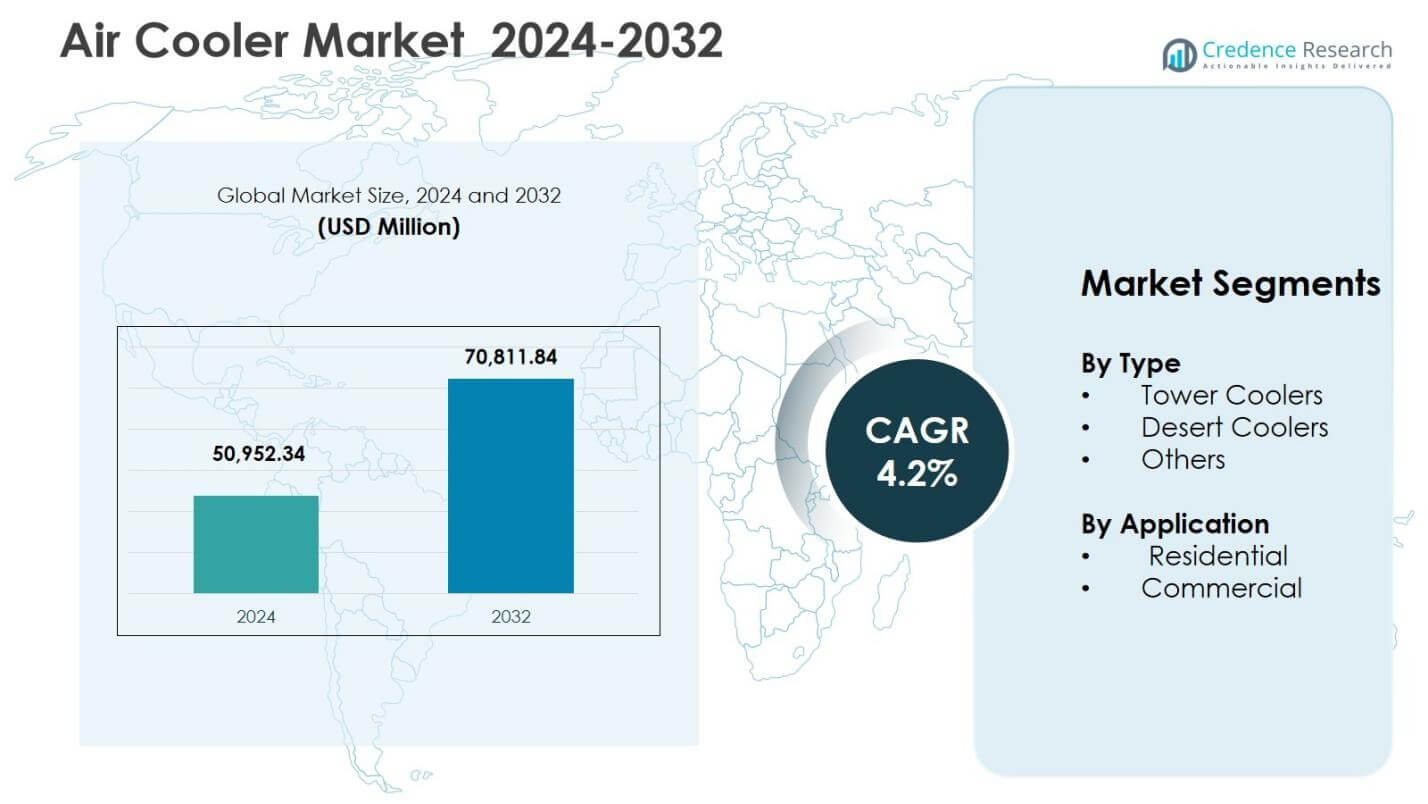
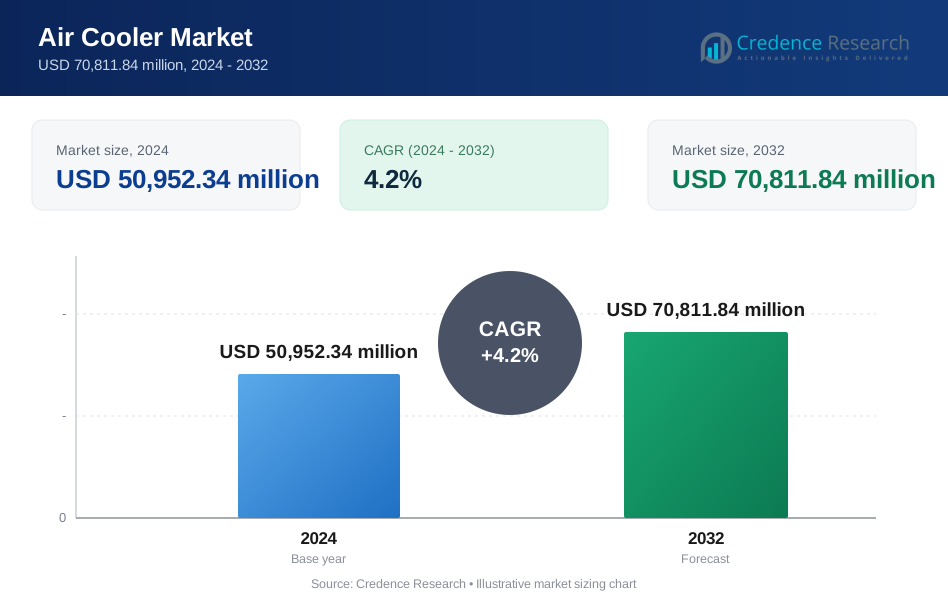
The air cooler market was valued at USD 50,952.34 million in 2024 and is expected to reach USD 70,811.84 million by 2032, reflecting a CAGR of 4.2% over the forecast period.
| REPORT ATTRIBUTE | DETAILS |
|---|---|
| Historical Period | 2020-2023 |
| Base Year | 2024 |
| Forecast Period | 2025-2032 |
| Air Cooler Market Size 2024 | USD 50,952.34 million |
| Air Cooler Market , CAGR | 4.2% |
| Air Cooler Market Size 2032 | USD 70,811.84 million |
The market includes both global and regional manufacturers competing mainly on energy performance, price positioning, and distribution coverage. Key participants include Symphony, Bajaj Electricals, Havells India Ltd, Honeywell International Inc., and Seeley International, with strategies that commonly emphasize product development, efficiency improvements, and expansion of retail and dealer networks.
Asia-Pacific accounted for 48.9% of the market in 2024, supported by hotter climatic conditions, high population density, and demand for lower-cost cooling options with relatively low power consumption, including in India and China. North America and Europe represent smaller shares, with demand linked to more frequent heat events and interest in portable and potentially lower-impact cooling alternatives compared with some conventional options.
Air Cooler Market Insights
- The air cooler market was valued at USD 50,952.34 million in 2024 and is projected to reach USD 70,811.84 million by 2032, reflecting a CAGR of 4.2% over the forecast period. Demand is supported by continued residential and commercial use across both emerging and developed economies.
- Growth is linked to higher temperatures, rising electricity costs, and preference for cooling options with lower energy use and lower upfront prices. The residential segment led the market in 2024 with a 62.4% share, indicating that household adoption remains the main demand base.
- Key trends include feature upgrades such as smart controls, inverter compatibility, and improved cooling pads, alongside expanding e-commerce reach. Desert coolers led by type in 2024 with a 46.8% share, reflecting stronger performance in hot, dry conditions where evaporative cooling is typically more effective.
- Competition is moderately fragmented, with established brands and regional manufacturers competing on price, distribution coverage, and seasonal promotions. Product differentiation and brand positioning remain important given low switching costs in many retail channels.
- Asia-Pacific held the largest share in 2024 at 48.9%, followed by North America (14.6%), Middle East & Africa (13.3%), Europe (12.8%), and Latin America (10.4%). These differences are linked to climate conditions, purchasing power, and the penetration of cooling infrastructure such as air-conditioning and household appliance ownership.
Air Cooler Market Segmentation Analysis:
By Type
Desert coolers accounted for 46.8% of the market in 2024. This share is associated with higher cooling capacity, larger water storage, and stronger effectiveness in hot and dry climates across parts of Asia-Pacific and the Middle East & Africa. Demand is supported by affordability relative to air conditioners, particularly in semi-urban and rural areas. Tower coolers follow due to their compact footprint and fit for smaller urban homes, while other formats (including window and personal coolers) continue to see steady use where space constraints or lower price points drive purchase decisions.
- For instance, Symphony markets desert models such as the Winter and Sumo series for high-heat, low-humidity regions, highlighting larger tank capacity and longer operating cycles between refills.
By Application
The residential segment held a 62.4% share in 2024. Demand is supported by rising temperatures, household sensitivity to electricity costs, and preference for appliances positioned as lower-energy options. Growth in middle-income households and broader appliance penetration in emerging markets also supports first-time purchases and replacement cycles. Commercial demand (retail stores, offices, workshops, and hospitality) is growing more steadily as operators evaluate lower-cost cooling options for seasonal use or for spaces where full air-conditioning is not installed.
- For instance, Crompton Greaves Consumer Electricals positions several residential coolers around inverter-compatible operation and lower wattage, aligning with household concerns about power bills and summer outages in India.
Air Cooler Market Key Growth Drivers
Rising Demand for Energy-Efficient and Cost-Effective Cooling Solutions
Demand is supported by consumer focus on operating cost control as electricity tariffs rise in many markets. Air coolers generally use less electricity than air conditioners and typically have lower purchase prices and simpler installation requirements, which can appeal to price-sensitive households and small commercial users. Their role can be stronger in regions with intermittent power supply, where inverter-compatible designs may be preferred. However, the cost advantage can vary by climate and usage patterns, and consumer satisfaction depends on humidity and room size.
- For instance, India’s Bureau of Energy Efficiency (BEE) and similar agencies in other markets promote efficient appliance use and demand-side energy management, which can favor lower-wattage cooling options.
Growing Urbanization and Expanding Residential Construction
Urbanization and residential construction support cooler purchases through growth in household formation, rental markets, and appliance replacement demand. Portability and the ability to serve different room sizes can make air coolers relevant in space-constrained urban homes. Rising disposable incomes in middle-income segments also support upgrades to higher-capacity or feature-rich models. Heatwaves and longer warm seasons can intensify seasonal demand, although purchase timing remains concentrated around summer months.
- For instance, India’s urban population was about 36% in 2021 (World Bank), indicating an expanding base of urban households that can support demand for compact and portable cooling devices.
Climatic Changes and Increasing Heat Intensity
Higher average temperatures and more frequent heat events increase the need for accessible cooling solutions in homes and workplaces. Air coolers are generally more effective in low-humidity conditions, which supports adoption across many inland and arid regions. Increased awareness of heat-related health risks can also expand usage beyond households into small businesses and community settings during peak summer periods. At the same time, performance limitations in humid climates can constrain adoption or lead consumers to alternative cooling technologies.
Air Cooler Market Key Trends & Opportunities
Technological Advancements and Product Innovation
Manufacturers are adding features to improve usability and differentiate products in competitive retail channels. Smart controls, remote operation, inverter compatibility, improved cooling media, and noise-reduction features are increasingly present in mid-range and premium models. Some products also add filtration layers or antimicrobial materials, reflecting consumer concerns about indoor air quality and hygiene. These features can support higher average selling prices, but the willingness to pay varies, and performance still depends heavily on climate conditions and proper maintenance.
- For instance, Symphony has launched models with multi-stage filtration under i-Pure branding, alongside remote-control features and diagnostics-oriented functions in selected product lines.
Expansion of E-Commerce and Omnichannel Retailing
E-commerce growth is widening access and enabling more price comparison, which can intensify competition while improving reach in smaller cities. Online marketplaces help brands present broader portfolios, run seasonal promotions, and use reviews to influence purchase decisions. Omnichannel approaches that link offline dealer networks with online fulfillment can improve availability and service coverage. However, online channels also tend to increase price transparency, which can pressure margins in highly seasonal categories.
- For instance, Symphony and Bajaj sell desert, tower, and personal coolers through major marketplaces such as Amazon and Flipkart in India, often using seasonal discounts and bundles targeted at value-focused buyers.
Air Cooler Market Key Challenges
Performance Limitations in High-Humidity Regions
Air coolers rely on evaporative cooling, which typically becomes less effective as humidity increases. This reduces their temperature drop and perceived comfort in coastal and tropical climates, limiting adoption in some geographies. Addressing this constraint may require design changes or hybrid approaches, but such solutions can add cost and may narrow the traditional price advantage versus other cooling options.
Seasonal Demand Fluctuations and Intense Competition
Sales are concentrated in summer months, which increases forecasting risk and can create inventory and cash-flow pressure across manufacturers and dealers. Competition from low-cost local players can intensify price pressure during peak season, compressing margins. Established brands often respond through promotions, wider distribution coverage, and feature-led differentiation, which can increase marketing and channel costs.
Air Cooler Market Regional Analysis
North America
North America accounted for 14.6% of the market in 2024. Demand is supported by warmer summer periods in parts of the region and interest in portable cooling for specific spaces such as garages, workshops, and small commercial areas. Air conditioners are widely used, which limits air coolers mainly to supplemental or seasonal roles. Product features such as improved cooling pads and smart controls can support adoption, but performance remains constrained in higher-humidity areas.
Europe
Europe held a 12.8% share in 2024, with higher adoption in southern and parts of central Europe where summers are warmer and historical air-conditioning penetration has been lower than in some other developed markets. Interest in energy-efficient appliances and rising electricity costs support demand for portable cooling. However, cooler climates in northern Europe and the prevalence of HVAC in many commercial buildings limit broader market expansion.
Asia-Pacific
Asia-Pacific led with a 48.9% share in 2024, supported by higher population density, large residential demand, and strong need for affordable cooling in markets such as India and China. Lower upfront cost and comparatively lower power use support adoption, particularly where grid reliability varies and inverter operation is valued. Penetration is also supported by growth in small commercial usage, though performance varies across humid sub-regions.
Latin America
Latin America accounted for 10.4% of the market in 2024. Warm climates and urban population growth support demand for cost-conscious cooling solutions, with adoption often positioned as an alternative to air conditioners due to lower operating costs. Retail expansion and improving e-commerce logistics increase accessibility, while higher humidity in some areas can reduce cooling effectiveness and limit consumer satisfaction.
Middle East & Africa
Middle East & Africa represented 13.3% of the market in 2024. Extremely high temperatures and arid conditions in several sub-regions support evaporative cooling performance and demand across residential and light commercial settings. Lower energy requirements compared with air-conditioning can also be relevant where electricity costs or grid capacity are constraints. Water availability and competition from air-conditioning in premium segments remain constraints, particularly where water use concerns are increasing.
Air Cooler Market Segmentations:
By Type
- Tower Coolers
- Desert Coolers
- Others
By Application
- Residential
- Commercial
By Geography
- North America
- U.S.
- Canada
- Mexico
- Europe
- Germany
- France
- U.K.
- Italy
- Spain
- Rest of Europe
- Asia Pacific
- China
- Japan
- India
- South Korea
- South-east Asia
- Rest of Asia Pacific
- Latin America
- Brazil
- Argentina
- Rest of Latin America
- Middle East & Africa
- GCC Countries
- South Africa
- Rest of the Middle East and Africa
Competitive Landscape
The air cooler market is moderately fragmented, with established brands and regional manufacturers competing on pricing, channel reach, and product features. Leading participants such as Symphony, Bajaj Electricals, Havells India Ltd, Honeywell International Inc., and Seeley International commonly focus on portfolio expansion, improvements in cooling media, inverter compatibility, and selected smart features. Other players, including De’ Longhi Appliances S.r.l., NewAir, and Fujian Jinghui Environmental Technology Co., Ltd., compete through design differentiation and regional expansion. Price competition from local manufacturers and seasonality reinforce the need for ongoing product refresh cycles and channel-focused marketing across offline and online sales.
Key Player Analysis
- Honeywell International Inc.
- Voltas Limited
- Symphony
- Fujian Jinghui Environmental Technology Co., Ltd.
- Havells India Ltd
- NewAir
- Crompton Greaves Consumer Electricals
- De’ Longhi Appliances S.r.l.
- Seeley International
- Bajaj Electricals India
Recent Developments
- In September 2025, Orient Electric expanded its air cooler portfolio with launches including Smartchill 125L, Avante 105L, Titan 100L, and Maxochill 100L, positioned around higher capacity and updated feature sets.
- In August 2025, Kenstar launched a 5-star rated air cooler range in India, featuring BLDC-based technology and airflow and cooling enhancements.
- In March 2025, CG Power and Industrial Solutions Ltd announced a new air cooler range using JetChill technology, positioned around improved airflow efficiency and faster cooling.
Report Coverage
The report analyzes the market by type, application, and geography. It profiles leading companies by business focus and product positioning and reviews competitive dynamics, including market trends, key drivers, and constraints. It also considers regulatory context and technology developments influencing product design and adoption. The analysis discusses external factors and macroeconomic conditions that can affect demand and includes strategic considerations for both new entrants and established participants.
Future Outlook
- The market is expected to expand steadily, supported by warmer conditions and longer summer periods in several regions.
- Preference for lower-energy cooling solutions is likely to support demand, particularly among price-sensitive users.
- Residential use is expected to remain the main demand base due to lower upfront cost and simpler installation.
- Urbanization and middle-income household growth are expected to support first-time purchases and replacement demand.
- Product development is expected to continue, with emphasis on smart functions and improved cooling performance.
- Online and omnichannel expansion is likely to improve accessibility, while increasing price transparency may pressure margins.
- Demand from small commercial spaces is expected to grow gradually where air-conditioning is not installed or is used selectively.
- Asia-Pacific is expected to remain the largest regional market given climate conditions and population scale.
- Competition is expected to intensify as regional players expand portfolios and larger brands invest in distribution and marketing.
- Seasonality is expected to remain a structural feature, influencing production planning, inventory cycles, and promotional intensity.
Request a Free Sample
Fill in your details and we'll send you a free sample report.
- Sample data tables & charts
- Research methodology
Need a Custom Version of This Report?
Tailor the scope, geography, or segments to your exact requirements.
- Custom geography or segment scope
- Direct access to our analyst team
Frequently Asked Questions
What is the current market size for the Air Cooler market, and what is its projected size in 2032?
At what Compound Annual Growth Rate is the Air Cooler market projected to grow between 2024 and 2032?
Which Air Cooler market segment held the largest share in 2024?
What are the primary factors fueling the growth of the Air Cooler market?
Who are the leading companies in the Air Cooler market?
Which region commanded the largest share of the Air Cooler market in 2024?
Table of Content
Chapter 1. Report Introduction
- 1.1 Report Description & Purpose
- 1.1.1 Report Title & Market Definition
- 1.1.2 Unique Selling Propositions (USP) & Key Differentiators
- 1.1.3 Value Proposition for Stakeholders
- 1.2 Research Objectives
- 1.2.1 Market Sizing Objectives (Volume & Revenue)
- 1.2.2 Segmentation Objectives
- 1.2.3 Competitive Intelligence Objectives
- 1.2.4 Forecast & Scenario Objectives
- 1.3 Report Scope
- 1.3.1 Air Cooler Scope – Types & Subtypes Covered
- 1.3.2 Geographic Scope – Regions & Countries Covered
- 1.3.3 Historical Period, Base Year & Forecast Period (2024; forecast to 2032)
- 1.3.4 Inclusions & Exclusions
- 1.4 HS Code & Classification Framework
- 1.5 Currency, Units & Pricing Basis
- 1.6 Target Stakeholders
- 1.7 Limitations & Assumptions
Chapter 2. Executive Summary
- 2.1 Global Air Cooler Market Snapshot
- 2.1.1 Market Size – Historical (2024) & Forecast (2024-2032) (2024: USD 50,952.34 million → 2032: USD 70,811.84 million)
- 2.1.2 Volume & Revenue – Global Totals
- 2.1.3 Key Market Highlights – Top Five Facts
- 2.2 Air Cooler Market Segmentation Snapshot
- 2.2.1 Market Split by Region – 2024 vs. 2032
- 2.3 Competitive Snapshot
- 2.3.1 Top 10 Players by Revenue Share – 2024
- 2.3.2 Top 10 Players by Volume Share – 2024
- 2.3.3 Recent Strategic Developments (18-Month Summary)
- 2.4 Key Investment Highlights & Strategic Conclusions
Chapter 3. Air Cooler Market Dynamics & Industry Analysis
- 3.1 Market Overview & Context
- 3.1.1 Air Cooler Market Position in the Broader Automotive Value Chain
- 3.1.2 OEM vs. Replacement Market Dynamics
- 3.1.3 Market Maturity & Development Stage by Region
- 3.2 Air Cooler Market Drivers
- 3.3 Air Cooler Market Restraints & Challenges
- 3.4 Air Cooler Market Opportunities
- 3.5 Porter's Five Forces Analysis
- 3.5.1 Threat of New Entrants
- 3.5.2 Bargaining Power of Suppliers
- 3.5.3 Bargaining Power of Buyers
- 3.5.4 Threat of Substitutes
- 3.5.5 Competitive Rivalry – Intensity Assessment
- 3.6 Air Cooler Value Chain Analysis
- 3.6.1 Upstream – Raw Material/Input Suppliers
- 3.6.1.1 Raw Material/Input 1
- 3.6.1.2 Raw Material/Input 2
- 3.6.1.3 Raw Material/Input 3
- 3.6.2 Midstream – Production/Manufacturing/Service Delivery
- 3.6.2.1 Production/Process Overview
- 3.6.2.2 Key Facility Locations & Capacity by Manufacturer
- 3.6.3 Downstream – Distribution & End Consumer
- 3.6.3.1 Primary Channel – B2B/OEM
- 3.6.3.2 Secondary Channels – Dealer, Retail, Online, Direct
- 3.6.4 Value Chain Profitability Analysis
- 3.6.1 Upstream – Raw Material/Input Suppliers
- 3.7 PESTEL Analysis
- 3.7.1 Political Factors
- 3.7.2 Economic Factors
- 3.7.3 Social Factors
- 3.7.4 Technological Factors
- 3.7.5 Environmental Factors
- 3.7.6 Legal Factors
- 3.8 Air Cooler Supply Chain Analysis
- 3.8.1 Raw Material/Input Supply Risk Assessment
- 3.8.2 Manufacturing Concentration Risk (Geographic Exposure)
- 3.8.3 Trade Disruption Impact Analysis
- 3.9 Regulatory & Policy Landscape
Note: The regulatory and policy landscape section covers regulations based on their applicability to the market, Air Cooler category, geography, and scope of the study. Only regulatory frameworks with a material impact on operations, compliance, trade, sustainability, or market access are analyzed in detail.
Chapter 4. Key Investment Pockets & Opportunity Analysis
- 4.1 Air Cooler Market Attractiveness Analysis
- 4.1.1 By Region – Investment Attractiveness Matrix (Volume × CAGR)
- 4.2 Absolute Revenue Growth Opportunity
- 4.2.1 By Region – Absolute USD Growth Through 2032
- 4.3 Incremental Volume Opportunity
- 4.3.1 By Region – Incremental Volume Through 2032
- 4.3.2 Segment – Incremental Volume
- 4.4 Emerging Submarket Opportunity Deep Dive (Subject to Applicability)
- 4.5 Emerging Market Opportunity Scorecards
- 4.5.1 United States
- 4.5.2 Europe
- 4.5.3 Asia
- 4.5.4 Middle East & Africa
Note: Emerging Market Opportunity Scorecards will be included based on relevance and strategic importance. Regions listed are indicative and may vary depending on data availability and market dynamics.
Chapter 5. Air Cooler Import-Export Analysis & Trade Flows
- 5.1 Global Trade Overview
- 5.1.1 Global Export Value by Country (2024)
- 5.1.2 Global Export Volume by Country (2024)
- 5.1.3 Global Import Value by Country (2024)
- 5.1.4 Global Import Volume by Country (2024)
- 5.1.5 Net Trade Balance by Country (2024)
- 5.2 Export Analysis – Segment
- 5.2.1 Type 1 (HS Code)
- 5.2.2 Type 2 (HS Code)
- 5.2.3 Type 3 (HS Code)
- 5.2.4 Type 4 (HS Code)
- 5.2.5 Type 5 (HS Code)
- 5.3 Import Analysis – Segment
- 5.3.1 Type 1 (HS Code)
- 5.3.2 Type 2 (HS Code)
- 5.3.3 Type 3 (HS Code)
- 5.3.4 Type 4 (HS Code)
- 5.3.5 Type 5 (HS Code)
- 5.4 Average Unit Trade Prices
- 5.4.1 Average Export Price – Segment & Country
- 5.4.2 Average Import Price – Segment & Source Country
- 5.4.3 Price Trends (2024)
- 5.5 Key Trade Route Analysis
- 5.5.1 Trade Route 1
- 5.5.2 Trade Route 2
- 5.5.3 Trade Route 3
- 5.5.4 Trade Route 4
- 5.5.5 Trade Route 5
- 5.6 Trade Policy Impact Assessment
- 5.6.1 US Anti-Dumping & Section 301 Tariffs
- 5.6.2 EU Customs Union Impact
- 5.6.3 Major Free Trade Agreements
- 5.6.4 USMCA Rules of Origin
Note: Trade policy analysis will be included only where relevant to the Air Cooler market.
Chapter 6. Competitive Landscape & Company Benchmarking
- 6.1 Air Cooler Market Concentration & Structure
- 6.1.1 Herfindahl-Hirschman Index (HHI) – vs. 2024
- 6.1.2 Tier 1, Tier 2 & Tier 3 Market Structure
- 6.1.3 Global, Regional & Local Player Dynamics
- 6.2 Air Cooler Market Share Analysis – 2024
- 6.2.1 Global Revenue Share by Company
- 6.2.2 Global Volume Share by Company
- 6.2.3 Regional Revenue Share
- 6.2.4 Market Share Evolution ( vs. 2024)
- 6.2.5 OEM Segment Share by Company
- 6.2.6 Replacement Segment Share by Company
- 6.3 Production/Delivery Capacity & Facility Analysis
- 6.3.1 Global Installed Capacity
- 6.3.2 Capacity Utilization Rates
- 6.3.3 Production/Output Volume
- 6.3.4 Facility Locations & Capacity Map
- 6.3.5 Planned Capacity Additions
- 6.4 Air Cooler Competitive Benchmarking Matrix
- 6.4.1 Revenue, Volume, CAGR & Profitability Comparison
- 6.4.2 Channel Revenue Mix
- 6.4.3 Geographic Revenue Exposure
- 6.4.4 R&D Intensity
- 6.4.5 Sustainability Maturity
- 6.5 Strategic Developments in Air Cooler (Last 24 Months)
- 6.5.1 Mergers, Acquisitions & Divestments
- 6.5.2 New Air Cooler Launches
- 6.5.3 Facility Expansions
- 6.5.4 Strategic Alliances, Joint Ventures & Partnerships
- 6.5.5 Distribution Expansion & Market Entry
- 6.5.6 Sustainability & ESG Initiatives
- 6.6 Competitive Strategy Mapping
- 6.6.1 Leader, Challenger, Follower & Niche Classification
- 6.6.2 Pricing Strategy Comparison
- 6.6.3 Channel Strategy Matrix
Note: Strategic developments are included based on their materiality and the availability of reliable information.
Chapter 7. Global Air Cooler Market – By Distribution Channel
- 7.1 Segment Overview
- 7.1.1 Volume & Revenue Split by Channel (2024 & 2032)
- 7.1.2 Channel Mix Evolution (2024-2032)
Chapter 8. Regional Market Analysis – Global Overview
- 8.1 Global Regional Overview
- 8.1.1 Regional Volume Share
- 8.1.2 Regional Revenue Share
- 8.1.3 Regional Volume by Region
- 8.1.4 Regional Revenue by Region
- 8.1.5 Regional Forecast Through 2032
- 8.2 Cross-Regional Segment Analysis
- 8.2.1 By Distribution Channel
- 8.2.2 By Brand/Price Tier
Chapter 9. North America Air Cooler Market
- 9.1 United States
- 9.2 Canada
- 9.3 Mexico
Chapter 10. Europe Air Cooler Market
- 10.1 Germany
- 10.2 France
- 10.3 Italy
- 10.4 United Kingdom
- 10.5 Spain
- 10.6 Poland
- 10.7 Russia
- 10.8 Netherlands
- 10.9 Belgium
- 10.10 Sweden
- 10.11 Denmark
- 10.12 Norway
- 10.13 Rest of Europe
Chapter 11. Asia Pacific Air Cooler Market
- 11.1 China
- 11.2 India
- 11.3 Japan
- 11.4 South Korea
- 11.5 Thailand
- 11.6 Indonesia
- 11.7 Vietnam
- 11.8 Malaysia
- 11.9 Australia
- 11.10 Rest of Asia Pacific
Chapter 12. Latin America Air Cooler Market
- 12.1 Brazil
- 12.2 Argentina
- 12.3 Colombia
- 12.4 Chile
- 12.5 Rest of Latin America
Chapter 13. Middle East Air Cooler Market
- 13.1 Saudi Arabia
- 13.2 United Arab Emirates
- 13.3 Turkey
- 13.4 Israel
- 13.5 Iran
- 13.6 Rest of the Middle East
Chapter 14. Africa Air Cooler Market
- 14.1 South Africa
- 14.2 Egypt
- 14.3 Nigeria
- 14.4 Morocco
- 14.5 Rest of Africa
Chapter 15. Air Cooler Company Profiles
- 15.1 [Company 01]
- 15.1.1 Company Overview
- 15.1.2 Key Management Personnel
- 15.1.3 Products & Services Portfolio
- 15.1.4 Financial Performance
- 15.1.5 Key Market Focus & Geographic Presence
- 15.1.6 Recent Developments & Strategic Initiatives
Note: The company profile list is preliminary and may change based on research findings, market developments, data availability, and client requirements.
Chapter 16. Appendices
- Appendix A – List of Abbreviations & Acronyms
- Appendix B – Industry Classification Code Reference – Full Series
- Appendix C – Production & Capacity Data Tables
- Appendix D – End-Use & Demand Base Tables
- Appendix E – Consumption & Replacement Rate Assumptions
- Appendix F – ASP Reference Tables
- Appendix G – Manufacturing & Facility Database
- Appendix H – Import-Export Data Tables
- Appendix I – Regulatory Summary Tables
- Appendix J – Primary Research Participant List (Anonymized)
- Appendix K – Primary Research Questionnaire Framework
- Appendix L – Data Sources & Bibliography
- Appendix M – Market Size Divergence & Source Comparison
Chapter 17. Research Methodology
- 17.1 Research Framework & Philosophy
- 17.2 Secondary Research – Sources, Hierarchy & Data Extraction
- 17.3 Data Modeling – Bottom-Up & Top-Down Market Sizing
- 17.4 Primary Research – Stakeholder Framework, LOI & Sample Sizes
- 17.5 Forecast Methodology – Regression, Scenario & Sensitivity Analysis
- 17.6 Quality Control – Four-Layer Validation Framework
- 17.7 Limitations & Standard Assumptions
- 17.8 Disclaimer
