
Market Overview:
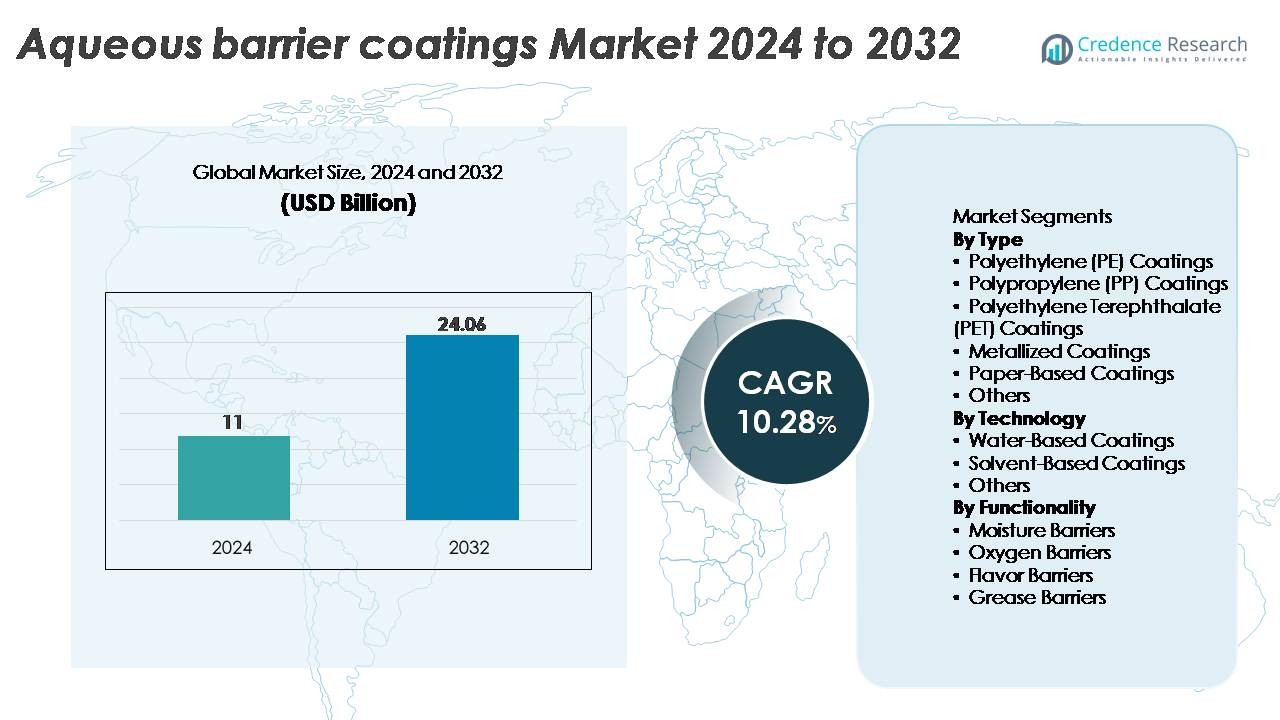
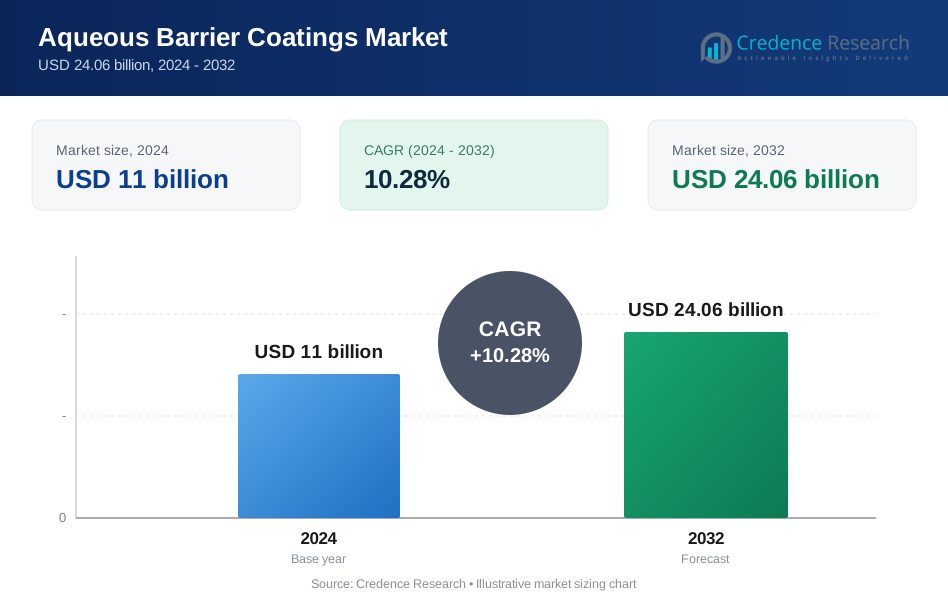
The global aqueous barrier coatings market was valued at USD 11 billion in 2024 and is projected to reach USD 24.06 billion by 2032, reflecting a compound annual growth rate (CAGR) of 10.28% over the forecast period.
| REPORT ATTRIBUTE | DETAILS |
|---|---|
| Historical Period | 2020-2023 |
| Base Year | 2024 |
| Forecast Period | 2025-2032 |
| Aqueous Barrier Coatings Market Size 2024 | USD 11 Billion |
| Aqueous Barrier Coatings Market, CAGR | 10.28% |
| Aqueous Barrier Coatings Market Size 2032 | USD 24.06 Billion |
The aqueous barrier coatings market is shaped by a mix of global chemical leaders and specialized coating manufacturers, including Cork Industries, DuPont, Follmann, Amcor, H.B. Fuller, Chemline Global, Avery Dennison, Cattie Adhesives, Clariant, and Dow Chemical. These companies compete through advancements in water-based polymer dispersions, PFAS-free grease barriers, and recyclable packaging solutions tailored for foodservice, e-commerce, and consumer goods. Regionally, North America leads the market with approximately 32% share, supported by strong regulatory pressure and rapid adoption of repulpable packaging. Asia-Pacific follows closely at about 30%, driven by high-volume packaging production and growing sustainability mandates.
Market Insights:
- The global aqueous barrier coatings market was valued at USD 11 billion in 2024 and is projected to reach USD 24.06 billion by 2032, expanding at a CAGR of 10.28% during the forecast period.
- Strong demand for recyclable, PFAS-free, and repulpable packaging in foodservice, beverages, and e-commerce continues to drive adoption, with polyethylene (PE) coatings holding the largest segment share due to their superior moisture-barrier performance.
- Key trends include the rapid shift toward bio-based dispersions, hybrid barrier chemistries, and high-performance waterborne systems, supported by sustainability mandates across global packaging supply chains.
- The competitive landscape is shaped by major players such as Amcor, DuPont, Clariant, Dow Chemical, H.B. Fuller, and others focusing on technological innovation, capacity expansion, and customized solutions for converters.
- Regionally, North America leads with ~32% share, followed by Asia-Pacific at ~30% and Europe at ~28%, reflecting strong regulatory pressure and increasing adoption of fiber-based, recyclable packaging formats.
Market Segmentation Analysis:
By Type
Polyethylene (PE) coatings represent the dominant segment, accounting for the largest market share due to their strong moisture resistance, excellent film-forming properties, and compatibility with high-speed packaging lines. PE’s widespread use in foodservice cups, paperboard cartons, and flexible packaging strengthens its leadership position. Polypropylene (PP) and PET coatings are gaining traction in applications requiring enhanced heat resistance and clarity, while metallized coatings support premium oxygen-barrier needs. Paper-based coatings continue to expand as brands transition toward recyclable and PFAS-free packaging. The “Others” category includes specialty polymers used in niche barrier formats.
- For instance, Dow’s PE-based barrier coating resins, such as INNATE™ precision packaging polymers, provide exceptional stiffness and toughness that enable the creation of high-performance paper and flexible packaging structures.
By Technology
Water-based coatings dominate the market, driven by regulatory pressure to reduce VOC emissions and the accelerating shift toward sustainable, non-toxic packaging solutions. Their ease of application, strong adhesion to paper substrates, and compatibility with food-contact standards reinforce their widespread adoption. Solvent-based coatings retain relevance in industrial environments requiring high durability and rapid drying, though their share is gradually declining. The “Others” segment includes hybrid and bio-based formulations that appeal to manufacturers pursuing next-generation eco-friendly packaging. Continuous improvements in waterborne barrier chemistries further solidify this segment’s leadership across global packaging lines.
- For instance, H.B. Fuller’s Flextra™ water-based barrier coating exhibits a water vapor transmission rate of as low as 0.3 g/m²·day at 38°C/90% RH, while maintaining heat-seal strengths above 4 N/15 mm on paper substrates, enabling high-performance, repulpable barrier packaging.
By Functionality
Moisture-barrier coatings hold the largest market share, supported by their essential role in safeguarding packaged foods, pharmaceuticals, and consumer goods from humidity-driven degradation. Their dominance stems from robust performance, cost-effectiveness, and broad compatibility with paper and flexible substrates. Oxygen-barrier coatings are expanding in categories requiring extended shelf life, while flavor-barrier technologies address aroma protection in confectionery and beverage packaging. Grease-barrier coatings continue to rise as PFAS-free solutions gain regulatory and consumer favor. The “Others” segment includes multifunctional coatings designed to deliver combined barrier properties for high-performance applications.
Key Growth Drivers:
Rising Demand for Sustainable and Recyclable Packaging Solutions
Sustainability commitments across FMCG, foodservice, and e-commerce sectors are driving rapid adoption of aqueous barrier coatings as brands move away from plastic laminates, wax coatings, and PFAS-based grease barriers. These water-based solutions enable recyclability and repulpability, aligning with global mandates such as EPR policies, single-use plastic restrictions, and corporate net-zero roadmaps. Manufacturers increasingly replace polyethylene or extrusion coatings with aqueous formulations to maintain barrier performance while ensuring compatibility with fiber-recycling systems. Paper cup producers, corrugated packaging manufacturers, and flexible packaging converters benefit from lower carbon footprints and improved end-of-life outcomes. As leading multinationals pledge to transition to fully recyclable or compostable packaging by the end of the decade, demand for aqueous barriers strengthens across high-volume applications such as cartons, wraps, and folding boxes.
- For instance, Stora Enso’s aqueous dispersion-coated Cupforma Natura™ achieved a recyclability rate above 95% in standard mill pulping tests and demonstrated grease-resistance levels up to KIT 12, enabling large beverage brands to transition toward fully repulpable cup solutions.
Expansion of Foodservice and Ready-to-Eat Packaging Applications
Growth in quick-service restaurants, delivery platforms, and convenience-based consumption patterns significantly accelerates the need for grease-resistant, moisture-proof, and food-safe coating technologies. Aqueous barrier coatings are increasingly preferred due to their ability to maintain product integrity without compromising recyclability. In foodservice formats such as clamshells, trays, paper wraps, and drink cups aqueous systems provide durable resistance against oil and vapor migration. As regulations tighten against fluorinated grease-barrier chemicals, food packaging suppliers rapidly adopt PFAS-free aqueous alternatives to ensure compliance while preserving performance. Additionally, the expansion of frozen, chilled, and microwave-ready meals drives demand for coatings with enhanced thermal stability. Growth in bakery, confectionery, and dairy packaging further reinforces adoption as brand owners standardize on safer, eco-friendly barrier chemistries.
- For instance, Solenis’ TOPSCREEN™ family of PFAS-free aqueous barrier coatingsis designed to provide effective oil, grease, and water resistance for paper-based food packaging. These water-based polymer and biowax formulations replace traditional materials like polyethylene (PE) and paraffin wax to enable repulpability, recyclability, and often compostability.
Advances in High-Performance Water-Based Barrier Chemistries
Technological improvements in polymer dispersion, crosslinking, and nanocomposite barrier systems are expanding the functional capabilities of aqueous barrier coatings. Modern formulations now deliver multi-functional protection, combining moisture, oxygen, and grease resistance in a single layer, reducing dependence on multilayer plastic structures. Innovations in bio-based polymers, hybrid acrylic systems, and enhanced film-forming additives enable performance levels comparable to solvent-based or extrusion coatings. Improved runnability on high-speed coaters, better heat-seal performance, and tunable barrier properties allow converters to tailor solutions for applications with stricter shelf-life requirements. As major coating manufacturers invest heavily in R&D for next-generation repulpable, compostable, and migration-compliant coatings, the market benefits from expanding application breadth across both primary and secondary packaging formats.
Key Trends & Opportunities:
Shift Toward PFAS-Free and Regulatory-Compliant Coating Alternatives
Global bans and restrictions on PFAS chemicals have created substantial opportunities for aqueous coating suppliers to develop next-generation grease- and moisture-barrier solutions. Governments in Europe, North America, and parts of Asia are accelerating legislative actions targeting harmful fluorochemicals, pushing converters to transition to compliant alternatives. This regulatory momentum is prompting a surge in adoption of fluorine-free aqueous coatings that deliver excellent oil resistance while maintaining recyclability. Suppliers are capitalizing by launching high-performance grease-barrier solutions for fast-food wrappers, bakery display packs, and molded fiber containers. The transition opens long-term opportunities for companies capable of delivering coatings that meet stringent migration, compostability, and food-contact standards.
- For instance, Michelman’s PFAS-free Hydrastar® 3000 aqueous barrier coating delivers grease resistance up to KIT 12, achieves a Cobb60 water absorption value below 20 g/m², and meets FDA 21 CFR food-contact limits, enabling converters to replace legacy fluorinated barriers without compromising functionality.
Rising Adoption of Fiber-Based Packaging in E-Commerce and Retail
The e-commerce sector’s shift toward curbside-recyclable packaging is creating new avenues for aqueous barrier coatings. As retailers replace plastic mailers, bubble wraps, and laminated pouches with fiber-based mailers and bags, demand for strong moisture and abrasion-resistant coatings increases. Aqueous barriers enhance durability during transit and protect contents from humidity, condensation, and mechanical damage. Additionally, premium retail brands are integrating coated paper solutions to support plastic-free branding strategies. Rapid proliferation of molded fiber packaging such as protective inserts and trays also boosts opportunities for aqueous systems that provide uniform coating performance on complex geometries.
- For instance, Henkel manufactures a variety of water-based barrier coatings within its AQUENCE® FBproduct line that are designed to enhance the water and grease resistance of paper and cardboard packaging, making them suitable for applications such as e-commerce mailers and molded fiber components.
Growth of Bio-Based and Compostable Barrier Technologies
An emerging trend centers on bio-based aqueous coatings derived from starches, polysaccharides, proteins, or plant-based polymers. These materials align with the global move toward compostable packaging for foodservice and single-use applications. Innovations in biodegradable coatings offer enhanced barrier strength, improved water resistance, and compatibility with industrial composting environments. As consumer-facing brands pursue certification pathways such as EN 13432 and ASTM D6400, suppliers developing bio-based coatings are well positioned to capture early-stage growth. The combination of sustainability, regulatory alignment, and growing R&D investment accelerates opportunities in this segment.
Key Challenges:
Performance Limitations Compared to Traditional Plastic-Based Barriers
Despite rapid advancements, aqueous barrier coatings still face constraints when compared with high-performance plastic laminates or metallized films especially in applications requiring extremely low oxygen transmission rates, high thermal endurance, or long shelf life. Products such as high-fat snacks, dehydrated foods, and pharmaceuticals still rely on multilayer barrier structures where aqueous coatings cannot yet match performance. Moisture sensitivity, seal integrity, and durability under extreme storage or processing conditions pose additional challenges. These performance gaps slow adoption in certain premium packaging formats, requiring continued R&D in polymer chemistry, crosslinking technologies, and hybrid barrier systems.
Processing Complexities and Cost Pressures for Converters
Transitioning from traditional extrusion coatings or solvent-based systems to aqueous alternatives often demands capital investment in drying systems, coating equipment upgrades, and process optimization. Aqueous formulations generally require longer drying times, higher energy input, and precise humidity control, affecting throughput on high-speed lines. In cost-sensitive industries, these operational changes create barriers to adoption, particularly for small and mid-sized converters with limited budget flexibility. Fluctuations in raw material pricing for specialty polymers and functional additives also contribute to cost challenges. Balancing sustainability with performance and operational efficiency remains a critical obstacle for large-scale market penetration.
Regional Analysis:
North America
North America leads the aqueous barrier coatings market with approximately 32% share, driven by rapid adoption of recyclable, PFAS-free, and repulpable packaging across foodservice, beverages, and e-commerce. The region’s strong regulatory environment supported by EPA guidelines and state-level bans on fluorinated grease barriers accelerates the transition to water-based coatings. The U.S. commands the majority of demand due to its advanced converting infrastructure and high consumption of coated paper products. Growth is further supported by investments from major packaging converters in fiber-based alternatives for quick-service restaurants, frozen foods, and sustainable retail packaging.
Europe
Europe accounts for around 28% of the market, supported by stringent sustainability directives such as the EU Single-Use Plastics Directive and aggressive PFAS phase-out initiatives. Major economies including Germany, France, Italy, and the Nordics are driving strong demand for water-based coatings in folding cartons, beverage cups, bakery wraps, and premium retail packaging. The region’s well-established recycling systems favor aqueous coatings over multilayer laminates, aiding circularity goals. Innovation in bio-based and compostable barrier chemistries is expanding rapidly, reinforced by corporate commitments to fiber-based packaging across foodservice, confectionery, and personal-care applications.
Asia-Pacific
Asia-Pacific holds nearly 30% of the market and remains the fastest-growing region, propelled by high-volume packaging production and rising demand from food delivery, quick-commerce, and processed food industries. China, India, Japan, and Indonesia are major contributors, with increasing regulatory efforts to curb plastic waste accelerating the shift to repulpable aqueous barrier systems. Export-oriented packaging suppliers in APAC are adopting water-based coatings to meet Western sustainability standards. Growth in molded fiber applications, takeaway packaging, and moisture-resistant food wraps further strengthens demand, positioning the region as a critical hub for long-term market expansion.
Latin America
Latin America represents about 6% of the global market, showing steady adoption as sustainability awareness rises among packaging producers and consumer goods companies. Brazil and Mexico drive most regional demand, transitioning from PE laminates and wax coatings toward recyclable, water-based alternatives. Regulatory initiatives targeting single-use plastics support uptake in foodservice, bakery, and dairy packaging. Although infrastructure modernization progresses slowly, multinational packaging firms are expanding local operations, increasing availability of aqueous barrier solutions. Growth in quick-service restaurants, beverage cups, and fast-moving consumer goods reinforces the region’s gradual but consistent market penetration.
Middle East & Africa
The Middle East & Africa region holds roughly 4% share, with adoption driven by growing packaged food consumption, urbanization, and expanding foodservice chains. Saudi Arabia, the UAE, and South Africa lead demand as companies adopt recyclable, PFAS-free aqueous coatings to align with emerging sustainability frameworks. Moisture- and grease-resistant coatings gain traction in bakery, confectionery, and takeaway packaging. While limited local converting capacity poses challenges, rising investment in modern coating and paper-processing facilities is improving supply availability. Increasing collaboration with global packaging manufacturers supports broader adoption across retail, hospitality, and fast-food sectors.
Market Segmentations:
By Type
- Polyethylene (PE) Coatings
- Polypropylene (PP) Coatings
- Polyethylene Terephthalate (PET) Coatings
- Metallized Coatings
- Paper-Based Coatings
- Others
By Technology
- Water-Based Coatings
- Solvent-Based Coatings
- Others
By Functionality
- Moisture Barriers
- Oxygen Barriers
- Flavor Barriers
- Grease Barriers
By Geography
- North America
- U.S.
- Canada
- Mexico
- Europe
- Germany
- France
- U.K.
- Italy
- Spain
- Rest of Europe
- Asia Pacific
- China
- Japan
- India
- South Korea
- South-east Asia
- Rest of Asia Pacific
- Latin America
- Brazil
- Argentina
- Rest of Latin America
- Middle East & Africa
- GCC Countries
- South Africa
- Rest of the Middle East and Africa
Competitive Landscape:
The competitive landscape of the aqueous barrier coatings market is characterized by strong participation from global chemical producers, specialty coating formulators, and major paper-packaging converters focused on delivering recyclable and PFAS-free barrier solutions. Leading players compete on technology innovation, regulatory compliance, film performance, and compatibility with high-speed coating lines. Companies are investing heavily in advanced polymer dispersions, bio-based binders, and hybrid barrier chemistries that enhance moisture, oxygen, and grease resistance while maintaining repulpability. Strategic collaborations between coating manufacturers and packaging converters are strengthening product customization for foodservice, e-commerce, and premium retail applications. Several players are expanding production capacity and regional distribution networks to meet rising demand for sustainable packaging. Continuous R&D investment, performance differentiation, and adherence to evolving global food-contact and environmental standards remain critical factors shaping competitive positioning across the market.
Key Player Analysis:
- Cork Industries
- DuPont
- Follmann
- Amcor
- H.B. Fuller
- Chemline Global
- Avery Dennison
- Cattie Adhesives
- Clariant
- Dow Chemical
Recent Developments:
- In November 2025, Amcor the company announced a new “Amcor Lift-Off Winter 2025/26 Challenge”, inviting start-ups globally to develop high-performance compostable or recyclable barrier coatings for flexible and paper-based packaging.
- In April 2024, Siegwerk has introduced a new mono-PE (polyethylene) pet food bag featuring recyclable barrier coatings. This innovative packaging solution is designed to enhance sustainability in the pet food industry by allowing for easier recycling while maintaining product protection.
- In March 2024, Berry Global and Mitsubishi Gas Chemical Company have collaborated to introduce a recyclable, EVOH-free barrier coating designed for food packaging applications, specifically targeting thermoformed tubes, jars, and bottles. This innovative solution utilizes Mitsubishi's MXD6 barrier resin, which aims to enhance the recyclability of food packaging while maintaining product freshness and safety.
Report Coverage:
The research report offers an in-depth analysis based on Type, Technology, Functionality and Geography. It details leading market players, providing an overview of their business, product offerings, investments, revenue streams, and key applications. Additionally, the report includes insights into the competitive environment, SWOT analysis, current market trends, as well as the primary drivers and constraints. Furthermore, it discusses various factors that have driven market expansion in recent years. The report also explores market dynamics, regulatory scenarios, and technological advancements that are shaping the industry. It assesses the impact of external factors and global economic changes on market growth. Lastly, it provides strategic recommendations for new entrants and established companies to navigate the complexities of the market.
Future Outlook:
- Demand for aqueous barrier coatings will accelerate as global brands commit to fully recyclable and PFAS-free packaging formats.
- Water-based barrier technologies will continue replacing plastic laminates and wax coatings in foodservice, retail, and e-commerce applications.
- Advances in polymer dispersions and crosslinking chemistry will enhance moisture, oxygen, and grease resistance across broader packaging categories.
- Bio-based and compostable aqueous coating systems will gain traction as regulators tighten sustainability and end-of-life requirements.
- Adoption of high-speed, energy-efficient coating equipment will improve production efficiency for converters.
- Hybrid barrier systems combining multiple functionalities in a single layer will expand their presence in high-performance packaging.
- More global converters will integrate aqueous coatings to meet export packaging standards aligned with Western recyclability guidelines.
- Partnerships between coating manufacturers and packaging producers will drive customized, application-specific product development.
- Growing molded fiber packaging demand will create new opportunities for uniform and durable aqueous barrier solutions.
- Regulatory pressures targeting fluorochemicals and multilayer plastics will continue strengthening the market’s long-term growth trajectory.
Request a Free Sample
Fill in your details and we'll send you a free sample report.
- Sample data tables & charts
- Research methodology
Need a Custom Version of This Report?
Tailor the scope, geography, or segments to your exact requirements.
- Custom geography or segment scope
- Direct access to our analyst team
Frequently Asked Questions
What is the current market size for the Aqueous Barrier Coatings market, and what is its projected size in 2032?
At what Compound Annual Growth Rate is the Aqueous Barrier Coatings market projected to grow between 2024 and 2032?
Which Aqueous Barrier Coatings segment held the largest share in 2024?
What are the primary factors fueling the growth of the Aqueous Barrier Coatings market?
Who are the leading companies in the Aqueous Barrier Coatings market?
Which region commanded the largest share of the Aqueous Barrier Coatings market in 2024?
Table of Content
Chapter 1. Report Introduction
- 1.1 Report Description & Purpose
- 1.1.1 Report Title & Market Definition
- 1.1.2 Unique Selling Propositions (USP) & Key Differentiators
- 1.1.3 Value Proposition for Stakeholders
- 1.2 Research Objectives
- 1.2.1 Market Sizing Objectives (Volume & Revenue)
- 1.2.2 Segmentation Objectives
- 1.2.3 Competitive Intelligence Objectives
- 1.2.4 Forecast & Scenario Objectives
- 1.3 Report Scope
- 1.3.1 Aqueous Barrier Coatings Scope – Types & Subtypes Covered
- 1.3.2 Geographic Scope – Regions & Countries Covered
- 1.3.3 Historical Period, Base Year & Forecast Period (2024; forecast to 2032)
- 1.3.4 Inclusions & Exclusions
- 1.4 HS Code & Classification Framework
- 1.5 Currency, Units & Pricing Basis
- 1.6 Target Stakeholders
- 1.7 Limitations & Assumptions
Chapter 2. Executive Summary
- 2.1 Global Aqueous Barrier Coatings Market Snapshot
- 2.1.1 Market Size – Historical (2024) & Forecast (2024-2032) (2024: USD 11 billion → 2032: USD 24.06 billion)
- 2.1.2 Volume & Revenue – Global Totals
- 2.1.3 Key Market Highlights – Top Five Facts
- 2.2 Aqueous Barrier Coatings Market Segmentation Snapshot
- 2.2.1 Market Split by Region – 2024 vs. 2032
- 2.3 Competitive Snapshot
- 2.3.1 Top 10 Players by Revenue Share – 2024
- 2.3.2 Top 10 Players by Volume Share – 2024
- 2.3.3 Recent Strategic Developments (18-Month Summary)
- 2.4 Key Investment Highlights & Strategic Conclusions
Chapter 3. Aqueous Barrier Coatings Market Dynamics & Industry Analysis
- 3.1 Market Overview & Context
- 3.1.1 Aqueous Barrier Coatings Market Position in the Broader Automotive Value Chain
- 3.1.2 OEM vs. Replacement Market Dynamics
- 3.1.3 Market Maturity & Development Stage by Region
- 3.2 Aqueous Barrier Coatings Market Drivers
- 3.3 Aqueous Barrier Coatings Market Restraints & Challenges
- 3.4 Aqueous Barrier Coatings Market Opportunities
- 3.5 Porter's Five Forces Analysis
- 3.5.1 Threat of New Entrants
- 3.5.2 Bargaining Power of Suppliers
- 3.5.3 Bargaining Power of Buyers
- 3.5.4 Threat of Substitutes
- 3.5.5 Competitive Rivalry – Intensity Assessment
- 3.6 Aqueous Barrier Coatings Value Chain Analysis
- 3.6.1 Upstream – Raw Material/Input Suppliers
- 3.6.1.1 Raw Material/Input 1
- 3.6.1.2 Raw Material/Input 2
- 3.6.1.3 Raw Material/Input 3
- 3.6.2 Midstream – Production/Manufacturing/Service Delivery
- 3.6.2.1 Production/Process Overview
- 3.6.2.2 Key Facility Locations & Capacity by Manufacturer
- 3.6.3 Downstream – Distribution & End Consumer
- 3.6.3.1 Primary Channel – B2B/OEM
- 3.6.3.2 Secondary Channels – Dealer, Retail, Online, Direct
- 3.6.4 Value Chain Profitability Analysis
- 3.6.1 Upstream – Raw Material/Input Suppliers
- 3.7 PESTEL Analysis
- 3.7.1 Political Factors
- 3.7.2 Economic Factors
- 3.7.3 Social Factors
- 3.7.4 Technological Factors
- 3.7.5 Environmental Factors
- 3.7.6 Legal Factors
- 3.8 Aqueous Barrier Coatings Supply Chain Analysis
- 3.8.1 Raw Material/Input Supply Risk Assessment
- 3.8.2 Manufacturing Concentration Risk (Geographic Exposure)
- 3.8.3 Trade Disruption Impact Analysis
- 3.9 Regulatory & Policy Landscape
Note: The regulatory and policy landscape section covers regulations based on their applicability to the market, Aqueous Barrier Coatings category, geography, and scope of the study. Only regulatory frameworks with a material impact on operations, compliance, trade, sustainability, or market access are analyzed in detail.
Chapter 4. Key Investment Pockets & Opportunity Analysis
- 4.1 Aqueous Barrier Coatings Market Attractiveness Analysis
- 4.1.1 By Region – Investment Attractiveness Matrix (Volume × CAGR)
- 4.2 Absolute Revenue Growth Opportunity
- 4.2.1 By Region – Absolute USD Growth Through 2032
- 4.3 Incremental Volume Opportunity
- 4.3.1 By Region – Incremental Volume Through 2032
- 4.3.2 Segment – Incremental Volume
- 4.4 Emerging Submarket Opportunity Deep Dive (Subject to Applicability)
- 4.5 Emerging Market Opportunity Scorecards
- 4.5.1 United States
- 4.5.2 Europe
- 4.5.3 Asia
- 4.5.4 Middle East & Africa
Note: Emerging Market Opportunity Scorecards will be included based on relevance and strategic importance. Regions listed are indicative and may vary depending on data availability and market dynamics.
Chapter 5. Aqueous Barrier Coatings Import-Export Analysis & Trade Flows
- 5.1 Global Trade Overview
- 5.1.1 Global Export Value by Country (2024)
- 5.1.2 Global Export Volume by Country (2024)
- 5.1.3 Global Import Value by Country (2024)
- 5.1.4 Global Import Volume by Country (2024)
- 5.1.5 Net Trade Balance by Country (2024)
- 5.2 Export Analysis – Segment
- 5.2.1 Type 1 (HS Code)
- 5.2.2 Type 2 (HS Code)
- 5.2.3 Type 3 (HS Code)
- 5.2.4 Type 4 (HS Code)
- 5.2.5 Type 5 (HS Code)
- 5.3 Import Analysis – Segment
- 5.3.1 Type 1 (HS Code)
- 5.3.2 Type 2 (HS Code)
- 5.3.3 Type 3 (HS Code)
- 5.3.4 Type 4 (HS Code)
- 5.3.5 Type 5 (HS Code)
- 5.4 Average Unit Trade Prices
- 5.4.1 Average Export Price – Segment & Country
- 5.4.2 Average Import Price – Segment & Source Country
- 5.4.3 Price Trends (2024)
- 5.5 Key Trade Route Analysis
- 5.5.1 Trade Route 1
- 5.5.2 Trade Route 2
- 5.5.3 Trade Route 3
- 5.5.4 Trade Route 4
- 5.5.5 Trade Route 5
- 5.6 Trade Policy Impact Assessment
- 5.6.1 US Anti-Dumping & Section 301 Tariffs
- 5.6.2 EU Customs Union Impact
- 5.6.3 Major Free Trade Agreements
- 5.6.4 USMCA Rules of Origin
Note: Trade policy analysis will be included only where relevant to the Aqueous Barrier Coatings market.
Chapter 6. Competitive Landscape & Company Benchmarking
- 6.1 Aqueous Barrier Coatings Market Concentration & Structure
- 6.1.1 Herfindahl-Hirschman Index (HHI) – vs. 2024
- 6.1.2 Tier 1, Tier 2 & Tier 3 Market Structure
- 6.1.3 Global, Regional & Local Player Dynamics
- 6.2 Aqueous Barrier Coatings Market Share Analysis – 2024
- 6.2.1 Global Revenue Share by Company
- 6.2.2 Global Volume Share by Company
- 6.2.3 Regional Revenue Share
- 6.2.4 Market Share Evolution ( vs. 2024)
- 6.2.5 OEM Segment Share by Company
- 6.2.6 Replacement Segment Share by Company
- 6.3 Production/Delivery Capacity & Facility Analysis
- 6.3.1 Global Installed Capacity
- 6.3.2 Capacity Utilization Rates
- 6.3.3 Production/Output Volume
- 6.3.4 Facility Locations & Capacity Map
- 6.3.5 Planned Capacity Additions
- 6.4 Aqueous Barrier Coatings Competitive Benchmarking Matrix
- 6.4.1 Revenue, Volume, CAGR & Profitability Comparison
- 6.4.2 Channel Revenue Mix
- 6.4.3 Geographic Revenue Exposure
- 6.4.4 R&D Intensity
- 6.4.5 Sustainability Maturity
- 6.5 Strategic Developments in Aqueous Barrier Coatings (Last 24 Months)
- 6.5.1 Mergers, Acquisitions & Divestments
- 6.5.2 New Aqueous Barrier Coatings Launches
- 6.5.3 Facility Expansions
- 6.5.4 Strategic Alliances, Joint Ventures & Partnerships
- 6.5.5 Distribution Expansion & Market Entry
- 6.5.6 Sustainability & ESG Initiatives
- 6.6 Competitive Strategy Mapping
- 6.6.1 Leader, Challenger, Follower & Niche Classification
- 6.6.2 Pricing Strategy Comparison
- 6.6.3 Channel Strategy Matrix
Note: Strategic developments are included based on their materiality and the availability of reliable information.
Chapter 7. Global Aqueous Barrier Coatings Market – By Distribution Channel
- 7.1 Segment Overview
- 7.1.1 Volume & Revenue Split by Channel (2024 & 2032)
- 7.1.2 Channel Mix Evolution (2024-2032)
Chapter 8. Regional Market Analysis – Global Overview
- 8.1 Global Regional Overview
- 8.1.1 Regional Volume Share
- 8.1.2 Regional Revenue Share
- 8.1.3 Regional Volume by Region
- 8.1.4 Regional Revenue by Region
- 8.1.5 Regional Forecast Through 2032
- 8.2 Cross-Regional Segment Analysis
- 8.2.1 By Distribution Channel
- 8.2.2 By Brand/Price Tier
Chapter 9. North America Aqueous Barrier Coatings Market
- 9.1 United States
- 9.2 Canada
- 9.3 Mexico
Chapter 10. Europe Aqueous Barrier Coatings Market
- 10.1 Germany
- 10.2 France
- 10.3 Italy
- 10.4 United Kingdom
- 10.5 Spain
- 10.6 Poland
- 10.7 Russia
- 10.8 Netherlands
- 10.9 Belgium
- 10.10 Sweden
- 10.11 Denmark
- 10.12 Norway
- 10.13 Rest of Europe
Chapter 11. Asia Pacific Aqueous Barrier Coatings Market
- 11.1 China
- 11.2 India
- 11.3 Japan
- 11.4 South Korea
- 11.5 Thailand
- 11.6 Indonesia
- 11.7 Vietnam
- 11.8 Malaysia
- 11.9 Australia
- 11.10 Rest of Asia Pacific
Chapter 12. Latin America Aqueous Barrier Coatings Market
- 12.1 Brazil
- 12.2 Argentina
- 12.3 Colombia
- 12.4 Chile
- 12.5 Rest of Latin America
Chapter 13. Middle East Aqueous Barrier Coatings Market
- 13.1 Saudi Arabia
- 13.2 United Arab Emirates
- 13.3 Turkey
- 13.4 Israel
- 13.5 Iran
- 13.6 Rest of the Middle East
Chapter 14. Africa Aqueous Barrier Coatings Market
- 14.1 South Africa
- 14.2 Egypt
- 14.3 Nigeria
- 14.4 Morocco
- 14.5 Rest of Africa
Chapter 15. Aqueous Barrier Coatings Company Profiles
- 15.1 [Company 01]
- 15.1.1 Company Overview
- 15.1.2 Key Management Personnel
- 15.1.3 Products & Services Portfolio
- 15.1.4 Financial Performance
- 15.1.5 Key Market Focus & Geographic Presence
- 15.1.6 Recent Developments & Strategic Initiatives
Note: The company profile list is preliminary and may change based on research findings, market developments, data availability, and client requirements.
Chapter 16. Appendices
- Appendix A – List of Abbreviations & Acronyms
- Appendix B – Industry Classification Code Reference – Full Series
- Appendix C – Production & Capacity Data Tables
- Appendix D – End-Use & Demand Base Tables
- Appendix E – Consumption & Replacement Rate Assumptions
- Appendix F – ASP Reference Tables
- Appendix G – Manufacturing & Facility Database
- Appendix H – Import-Export Data Tables
- Appendix I – Regulatory Summary Tables
- Appendix J – Primary Research Participant List (Anonymized)
- Appendix K – Primary Research Questionnaire Framework
- Appendix L – Data Sources & Bibliography
- Appendix M – Market Size Divergence & Source Comparison
Chapter 17. Research Methodology
- 17.1 Research Framework & Philosophy
- 17.2 Secondary Research – Sources, Hierarchy & Data Extraction
- 17.3 Data Modeling – Bottom-Up & Top-Down Market Sizing
- 17.4 Primary Research – Stakeholder Framework, LOI & Sample Sizes
- 17.5 Forecast Methodology – Regression, Scenario & Sensitivity Analysis
- 17.6 Quality Control – Four-Layer Validation Framework
- 17.7 Limitations & Standard Assumptions
- 17.8 Disclaimer
