
| REPORT ATTRIBUTE | DETAILS |
|---|---|
| Historical Period | 2020-2023 |
| Base Year | 2024 |
| Forecast Period | 2025-2032 |
| Artificial Tendons and Ligaments Market Size 2024 | USD 44.01 million |
| Artificial Tendons and Ligaments Market, CAGR | 11.51% |
| Artificial Tendons and Ligaments Market Size 2032 | USD 104.85 million |
Market Overview:
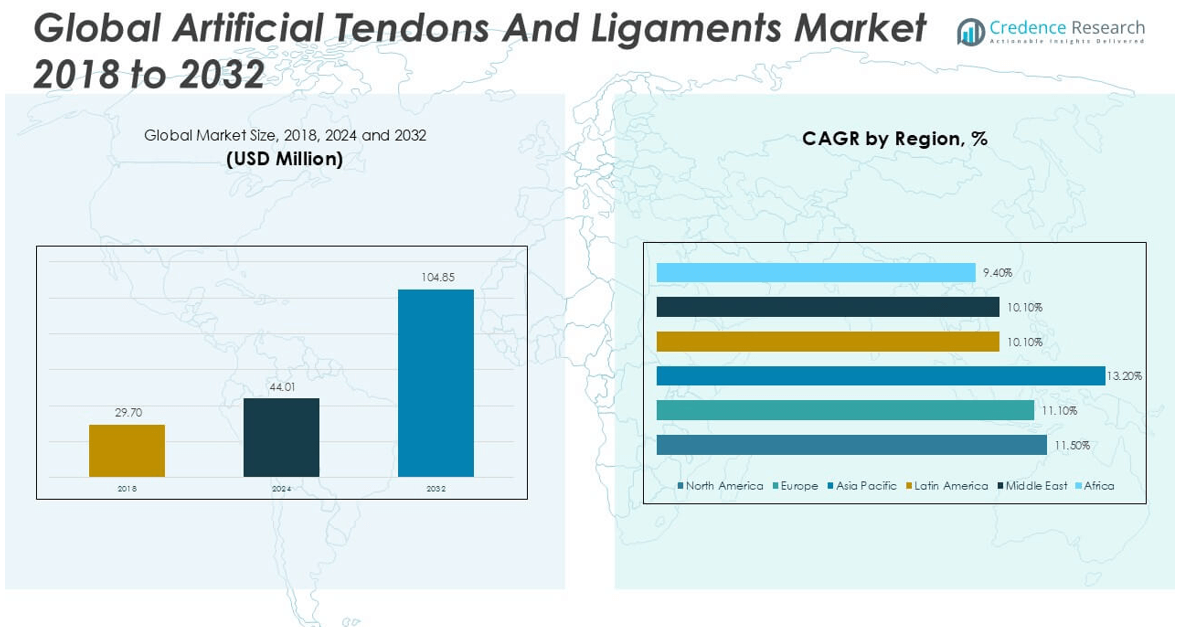
The Artificial Tendons and Ligaments market size was valued at USD 29.70 million in 2018, increased to USD 44.01 million in 2024, and is anticipated to reach USD 104.85 million by 2032, at a CAGR of 11.51% during the forecast period.
The Artificial Tendons and Ligaments market is led by prominent players such as Smith+Nephew, Zimmer Biomet, Stryker, Xiros Ltd. (Neoligaments), COUSIN SURGERY, Arthrex Inc., and Enovis Corporation (Mathys AG Bettlach), each contributing to innovation in synthetic graft technologies. These companies leverage advanced research, product development, and strategic collaborations to maintain competitive advantage. Europe emerged as the leading regional market, accounting for 47.6% of the global share in 2024, driven by a robust healthcare infrastructure, high adoption of orthopedic technologies, and a growing aging population. North America and Asia Pacific follow, supported by strong demand for sports injury management and increasing awareness of advanced surgical treatments.
Market Insights
- The global Artificial Tendons and Ligaments market was valued at USD 44.01 million in 2024 and is projected to reach USD 104.85 million by 2032, growing at a CAGR of 11.51% during the forecast period.
- Rising cases of sports-related injuries and degenerative joint conditions, particularly among aging populations and athletes, are driving demand for synthetic ligament and tendon implants.
- A key trend includes growing adoption of minimally invasive surgeries and integration of biologics with synthetic grafts, enhancing healing and recovery outcomes.
- The market is competitive with major players like Smith+Nephew, Zimmer Biomet, and Stryker focusing on product innovation, while emerging players in Asia expand through cost-effective offerings; however, high procedure costs and limited access in low-income regions remain key restraints.
- Europe leads the market with a 47.6% share in 2024, followed by North America at 20.9% and Asia Pacific at 19.8%; knee injury applications dominate with over 40% segment share.
Market Segmentation Analysis:
By End Use
The hospitals segment held the dominant share in the Artificial Tendons and Ligaments market, accounting for over 50% of the total revenue in 2024. This dominance is driven by the high volume of orthopedic surgeries performed in hospital settings, availability of advanced surgical infrastructure, and access to skilled medical professionals. Moreover, the increasing incidence of sports-related injuries and traumatic accidents requiring reconstructive surgeries further fuels demand in hospitals. Hospitals are also the preferred setting for complex procedures due to comprehensive post-operative care and rehabilitation facilities.
- For instance, Smith+Nephew reported performing over 70,000 ligament and tendon repair procedures across hospital-based settings globally in 2023, supported by its LCP Ligament product line, which is approved in more than 60 countries.
By Application
Knee injuries emerged as the leading application segment, contributing more than 40% of the global market share in 2024. The rising prevalence of anterior cruciate ligament (ACL) tears, particularly among athletes and physically active individuals, has significantly increased the adoption of artificial ligaments in knee reconstruction. Shoulder injuries represent the second-largest application segment, driven by the growing number of rotator cuff and labral tear cases among older adults and athletes. Foot and ankle injuries are also gaining traction due to rising cases of Achilles tendon ruptures and chronic tendinopathies. These segments collectively accounted for a considerable share, supported by the increasing use of artificial grafts in revision surgeries and delayed tendon repairs.
- For instance, Xiros Ltd. (Neoligaments) has supplied over 45,000 artificial ligaments for ACL and shoulder reconstructions globally, including the Leeds-Keio ligament, which has been implanted in over 25,000 ACL reconstructions alone since its launch.
Market Overview
Rising Sports Injuries and Active Lifestyle Adoption
The increasing participation in sports and recreational activities worldwide has significantly contributed to the surge in tendon and ligament injuries, particularly among young adults and athletes. As physical fitness gains popularity, cases of knee, shoulder, and ankle ligament tears have become more frequent, driving demand for artificial tendon and ligament implants. This trend is further supported by rising awareness about early treatment and functional recovery. As a result, healthcare providers are increasingly adopting synthetic grafts that offer enhanced durability and quicker rehabilitation compared to traditional solutions.
- For instance, Arthrex Inc. reported that its ACL TightRope fixation system was used in more than 100,000 procedures worldwide in 2023, reflecting the increased demand from sports medicine practices for minimally invasive, rapid-recovery solutions.
Technological Advancements in Synthetic Graft Materials
Innovations in biomaterials and manufacturing technologies have considerably improved the performance, biocompatibility, and longevity of artificial tendons and ligaments. Modern synthetic grafts offer enhanced mechanical strength, reduced rejection rates, and quicker integration with the host tissue. Advancements in minimally invasive surgical techniques, 3D printing, and tissue engineering are also expanding the application of artificial ligaments across orthopedic procedures. These developments not only improve patient outcomes but also encourage adoption among orthopedic surgeons, particularly in revision surgeries and complex reconstructions.
- For instance, Zimmer Biomet’s LARS™ ligament system, composed of terephthalic polyethylene fibers, demonstrated mechanical failure strength exceeding 2500 N in bench testing-outperforming many biological grafts and significantly improving outcomes in both primary and revision ACL surgeries.
Increasing Geriatric Population and Joint Degeneration Cases
The global aging population is contributing to the growing burden of degenerative joint conditions, including tendon weakening and ligament deterioration. Older adults are more prone to chronic musculoskeletal conditions that often require surgical intervention. Artificial tendons and ligaments offer a reliable solution in such cases where autografts or allografts may not be feasible due to poor tissue quality or comorbidities. The rising volume of orthopedic procedures among elderly patients is expected to further drive market expansion, particularly in developed regions with advanced healthcare infrastructure.
Key Trends & Opportunities
Expansion of Outpatient Orthopedic Procedures
The increasing shift toward outpatient surgical settings has created new opportunities for artificial tendons and ligaments, especially in ambulatory surgical centers and specialized orthopedic clinics. Advancements in surgical techniques and post-operative care have reduced the need for prolonged hospitalization, making procedures more cost-effective and accessible. This trend is particularly relevant in urban areas where patients seek faster recovery and reduced healthcare costs. Manufacturers are responding by developing user-friendly implants and kits tailored for outpatient use, enhancing market penetration across emerging economies.
- For instance, Enovis Corporation introduced its outpatient-compatible Arsenal Foot Plating System in 2023, with over 12,000 kits distributed across ambulatory centers in North America, enabling day-care ligament reconstructions with reduced OR time by up to 30 minutes per case.
Integration of Biologic Agents with Synthetic Implants
A growing trend involves the integration of biologic components such as growth factors and stem cells with synthetic ligament grafts to enhance healing and tissue regeneration. These bio-enhanced implants are gaining traction for their potential to improve patient outcomes and reduce recovery times. Research collaborations between biotech companies and orthopedic device manufacturers are accelerating product development in this area. This innovation opens new growth avenues, particularly in complex cases where traditional synthetic grafts may have limited efficacy.
- For instance, in 2023, Stryker partnered with Galen Biologics to co-develop a synthetic-biohybrid graft enhanced with BMP-7 (Bone Morphogenetic Protein). Pre-clinical trials showed a 35% increase in tendon-bone integration strength within 8 weeks compared to synthetic-only implants, accelerating timelines for orthopedic healing.
Key Challenges
High Cost of Implants and Procedures
Despite technological progress, the high cost of artificial tendons and ligaments remains a significant barrier, particularly in low- and middle-income countries. Expenses associated with implantable devices, surgical procedures, and post-operative care can be substantial. Additionally, limited reimbursement coverage in certain healthcare systems restricts patient access. Cost constraints often lead to preference for traditional grafts or conservative treatments, thereby limiting the widespread adoption of synthetic alternatives in resource-constrained settings.
Post-Operative Complications and Implant Failures
Concerns regarding post-operative complications such as infection, graft failure, and implant rejection present a major challenge in the adoption of artificial tendons and ligaments. Although new materials have improved biocompatibility, some patients still experience inflammatory responses or insufficient integration with surrounding tissue. Such complications can result in revision surgeries, prolonged rehabilitation, and increased healthcare costs. Ensuring long-term reliability and safety of synthetic grafts remains a key concern for both manufacturers and healthcare providers.
Regulatory Hurdles and Approval Delays
The artificial tendons and ligaments market is subject to stringent regulatory frameworks, particularly in regions such as North America and Europe. Obtaining approvals for novel biomaterials and devices involves extensive clinical trials, safety assessments, and documentation. These regulatory requirements often lead to prolonged product launch timelines and increased development costs. For smaller players and startups, navigating complex approval processes can delay innovation and limit market entry, slowing overall industry growth.
Regional Analysis
North America
North America accounted for approximately 20.9% of the global artificial tendons and ligaments market in 2024, with a market size of USD 9.18 million, up from USD 6.33 million in 2018. The region is projected to reach USD 21.82 million by 2032, expanding at a CAGR of 11.5%. This growth is primarily driven by advanced healthcare infrastructure, strong reimbursement systems, and rising incidences of sports-related injuries. The high adoption of technologically advanced implants and minimally invasive procedures further supports market expansion. The U.S. leads regional growth due to its innovation in orthopedic devices and strong regulatory compliance frameworks.
Europe
Europe held the largest share in the artificial tendons and ligaments market in 2024, contributing around 47.6% with a valuation of USD 20.94 million, up from USD 14.43 million in 2018. The market is projected to grow at a CAGR of 11.1%, reaching USD 48.42 million by 2032. This dominance is attributed to widespread awareness, strong presence of key market players, and the rising geriatric population with joint degeneration issues. Countries like Germany, France, and the UK are leading adopters due to well-established healthcare systems and high investments in orthopedic innovations and sports injury management solutions.
Asia Pacific
Asia Pacific represented about 19.8% of the global market share in 2024, with the market growing from USD 5.55 million in 2018 to USD 8.71 million in 2024. It is forecast to reach USD 23.52 million by 2032, registering the highest regional CAGR of 13.2%. Growth is driven by increasing healthcare expenditure, a growing aging population, and rising awareness of advanced orthopedic treatments in countries such as China, Japan, and India. Government initiatives to improve healthcare access and the rapid expansion of sports and fitness culture are also contributing to the strong market outlook across the region.
Latin America
Latin America held a modest 4.8% share of the global artificial tendons and ligaments market in 2024, with the market size rising from USD 1.43 million in 2018 to USD 2.09 million in 2024. It is expected to reach USD 4.50 million by 2032, at a CAGR of 10.1%. The market is supported by increasing awareness of sports injury management and gradual improvement in healthcare infrastructure, particularly in Brazil and Mexico. While adoption remains limited compared to developed regions, rising investment in healthcare technologies and medical tourism is gradually enhancing the region's market penetration.
Middle East
The Middle East contributed around 3.7% of the global market in 2024, with the market expanding from USD 1.16 million in 2018 to USD 1.61 million in 2024. It is projected to grow to USD 3.46 million by 2032, registering a CAGR of 10.1%. Growth is fueled by increasing cases of orthopedic injuries, improving access to specialized care, and rising demand for advanced surgical solutions. The United Arab Emirates and Saudi Arabia are key contributors, supported by government investment in healthcare modernization and a growing focus on sports medicine and rehabilitation services across the region.
Africa
Africa accounted for approximately 3.4% of the global artificial tendons and ligaments market in 2024, with the market growing from USD 0.80 million in 2018 to USD 1.49 million in 2024. It is expected to reach USD 3.14 million by 2032, at a CAGR of 9.4%. Market growth remains moderate due to limited access to advanced orthopedic care and high procedure costs. However, gradual improvements in healthcare infrastructure and increasing investments in medical technologies are anticipated to improve market conditions. South Africa remains the primary contributor, with potential growth expected in Kenya and Nigeria as healthcare systems evolve.
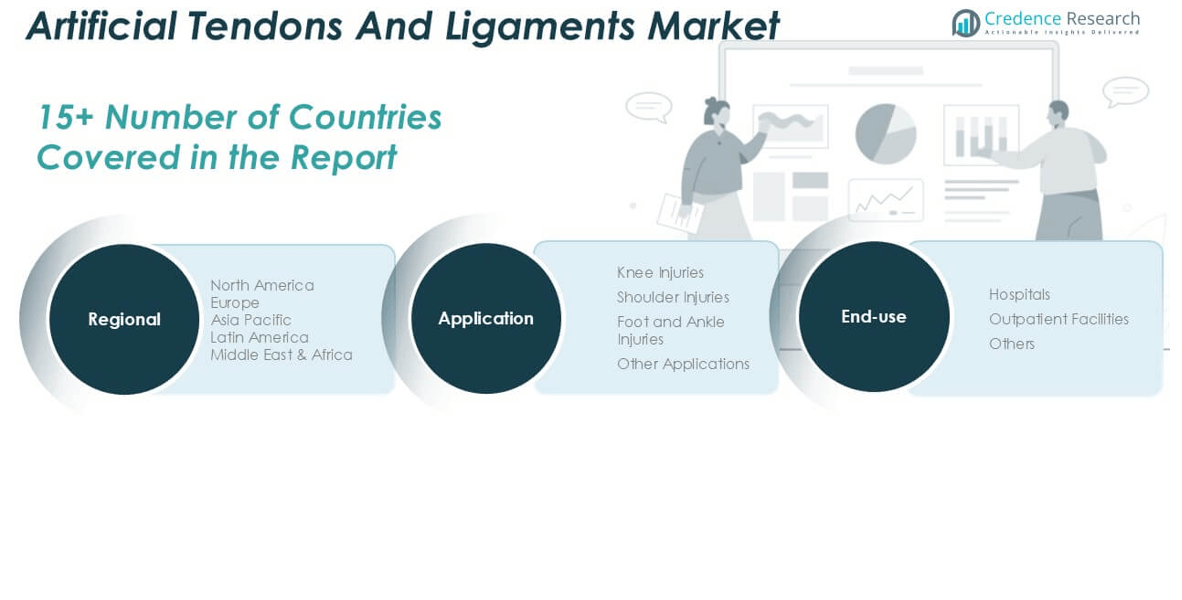
Market Segmentations:
By End Use:
- Hospitals
- Outpatient Facilities
- Others
By Application:
- Knee Injuries
- Shoulder Injuries
- Foot and Ankle Injuries
- Other Applications
By Geography:
- North America
- U.S.
- Canada
- Mexico
- Europe
- Germany
- France
- U.K.
- Italy
- Spain
- Rest of Europe
- Asia Pacific
- China
- Japan
- India
- South Korea
- South-east Asia
- Rest of Asia Pacific
- Latin America
- Brazil
- Argentina
- Rest of Latin America
- Middle East & Africa
- GCC Countries
- South Africa
- Rest of the Middle East and Africa
Competitive Landscape
The competitive landscape of the Artificial Tendons and Ligaments market is characterized by the presence of both global medical device leaders and specialized orthopedic companies focusing on synthetic graft technologies. Key players such as Smith+Nephew, Zimmer Biomet, and Stryker dominate the market with strong product portfolios, advanced research capabilities, and global distribution networks. Companies like Xiros Ltd. (Neoligaments), COUSIN SURGERY, and Orthomed offer specialized synthetic ligament solutions, contributing to niche market innovation. Strategic collaborations, product launches, and geographic expansions remain central to their growth strategies. For instance, Arthrex and Enovis Corporation (Mathys AG Bettlach) have invested significantly in sports medicine technologies to strengthen their positions. Emerging players in Asia, such as Shanghai PINE&POWER Biotech, are gaining traction through cost-effective solutions and regional market penetration. The industry is also witnessing increasing investments in bioengineered materials and minimally invasive technologies, which are expected to intensify competition and fuel product differentiation in the coming years.
Key Player Analysis
- COUSIN SURGERY
- Smith+Nephew
- Zimmer Biomet
- Xiros Ltd. (Neoligaments)
- Orthomed
- Shanghai PINE&POWER Biotech
- Arthrex Inc.
- Corin Group
- Enovis Corporation (Mathys AG Bettlach)
- Stryker
- GROUP FH ORTH
Recent Developments
- In March 2025, Smith+Nephew highlighted the Spatial Surgery System - a new surgical innovation for joint repair and the FDA-approved CARTIHEAL AGILI-C Cartilage Repair Implant at AAOS 2025. Also, stressed the integration of real-time tracking and AR to improve operative planning and execution.
- In March 2025, At the AAOS 2025 Annual Meeting, Zimmer Biomet showcased a broad range of orthopedic and musculoskeletal innovations. However, the publicly available details did not specifically announce a novel artificial tendon or ligament product or technology update for 2025. The company remains a major player in the sector, but no direct recent development in artificial tendons and ligaments such as a new implant system or next-gen enhancement was specified in the latest press coverage.
- In January 2024, Arthrex promoted TheNanoExperience.com, educating patients and surgeons about the benefits of its Nano arthroscopy technology-a minimally invasive surgical technique that aids in rapid recovery and reduced pain for ligament and tendon procedures.
Market Concentration & Characteristics
The Artificial Tendons and Ligaments Market exhibits moderate to high market concentration, with a few major players controlling a significant share of global revenue. Companies such as Smith+Nephew, Zimmer Biomet, Stryker, and Xiros Ltd. hold strong positions through established product lines, technical expertise, and global distribution networks. It reflects characteristics of a technology-driven and innovation-focused sector, with continuous product advancements and clinical research playing a critical role in differentiation. The market favors companies with strong regulatory capabilities, particularly in North America and Europe, where stringent approval processes limit the entry of smaller firms. It also shows high dependence on orthopedic procedure volumes, especially in sports medicine and trauma care. Hospitals remain the primary end-use segment due to the complexity of surgical procedures and need for specialized care. Knee injuries dominate the application landscape, supported by rising cases of ligament tears among active and aging populations. Price sensitivity is higher in developing regions, where limited reimbursement restricts access. Strategic partnerships and product approvals significantly influence competitive positioning.
Report Coverage
The research report offers an in-depth analysis based on End Use, Application and Geography. It details leading market players, providing an overview of their business, product offerings, investments, revenue streams, and key applications. Additionally, the report includes insights into the competitive environment, SWOT analysis, current market trends, as well as the primary drivers and constraints. Furthermore, it discusses various factors that have driven market expansion in recent years. The report also explores market dynamics, regulatory scenarios, and technological advancements that are shaping the industry. It assesses the impact of external factors and global economic changes on market growth. Lastly, it provides strategic recommendations for new entrants and established companies to navigate the complexities of the market.
Future Outlook
- The market is expected to witness robust growth driven by increasing cases of sports injuries and joint degeneration.
- Advancements in biomaterials will enhance the durability, biocompatibility, and performance of synthetic grafts.
- Growing demand for minimally invasive orthopedic procedures will support wider adoption of artificial ligaments.
- The rise in outpatient and ambulatory surgical centers will open new avenues for market expansion.
- Integration of biologic agents with synthetic implants will offer improved healing and recovery outcomes.
- Emerging markets in Asia Pacific and Latin America will present significant growth opportunities due to rising healthcare access.
- Aging populations worldwide will continue to drive demand for orthopedic reconstruction solutions.
- Regulatory approvals and clinical validation will remain critical for new product launches and global expansion.
- Strategic partnerships and acquisitions will shape competitive dynamics and product portfolios.
- Increased focus on cost-effective and patient-specific solutions will influence future product development.

Request a Free Sample
Fill in your details and we'll send you a free sample report.
- Sample data tables & charts
- Research methodology
Market Dynamics
Rising Incidence of Sports Injuries
Increasing participation in sports and recreational activities has led to a higher prevalence of tendon and ligament injuries, particularly among young adults and athletes, driving demand for artificial implants for rapid recovery and functional restoration.
Technological Advancements in Synthetic Grafts
Innovations in biomaterials, 3D printing, and tissue engineering have improved the mechanical strength, biocompatibility, and integration of artificial tendons and ligaments, making them more attractive to surgeons and patients for both primary and revision procedures.
Aging Population and Degenerative Joint Conditions
The global rise in the geriatric population is increasing the incidence of degenerative joint diseases and chronic musculoskeletal conditions, creating a greater need for artificial tendons and ligaments where autografts or allografts are not viable.
Shift Toward Minimally Invasive and Outpatient Procedures
Advancements in minimally invasive surgical techniques and the expansion of outpatient and ambulatory surgical centers are making artificial tendon and ligament procedures more accessible, cost-effective, and appealing to both patients and healthcare providers.
Integration of Biologics with Synthetic Implants
The development of bio-enhanced synthetic grafts, combining growth factors or stem cells with artificial ligaments, is improving healing outcomes and expanding the use of these products in complex or challenging orthopedic cases.
Need a Custom Version of This Report?
Tailor the scope, geography, or segments to your exact requirements.
- Custom geography or segment scope
- Direct access to our analyst team
Frequently Asked Questions
What is the current size of the Artificial Tendons and Ligaments Market?
What are the key segments within the Artificial Tendons and Ligaments Market?
What are some challenges faced by the Artificial Tendons and Ligaments Market?
Who are the major players in the Artificial Tendons and Ligaments Market?
Table of Content
Chapter 1 Market Segmentation
- 1.1 Segmentation Framework
- 1.1.1 Product and Service Classification
- 1.1.2 Application and End-Use Classification
- 1.1.3 Technology and Solution Classification
- 1.1.4 Customer and Distribution Channel Classification
- 1.1.5 Geographic Segmentation
- 1.1.6 Market Segment Definitions and Boundaries
- 1.2 By End Use
- 1.2.1 Hospitals
- 1.2.2 Outpatient Facilities
- 1.2.3 Others
- 1.3 By Application
- 1.3.1 Knee Injuries
- 1.3.2 Shoulder Injuries
- 1.3.3 Foot and Ankle Injuries
- 1.3.4 Other Applications
Chapter 2 Introduction
- 2.1 Report Objectives and Scope
- 2.2 Product Definition and Industry Terminology
- 2.3 Market Inclusions and Exclusions
- 2.4 Research Process
- 2.4.1 Primary Research and Expert Interviews
- 2.4.2 Secondary Research and Source Review
- 2.4.3 Top-Down and Bottom-Up Estimation
- 2.4.4 Data Triangulation and Verification
- 2.5 Market Size Measurement Basis
- 2.5.1 2024: USD 44.01 million → 2032: USD 104.85 million
- 2.6 Historical and Forecast Reference Periods
- 2.6.1 Base Year: 2024
- 2.6.2 Forecast Period: 2024-2032
- 2.7 Research Assumptions and Limitations
Chapter 3 Executive Summary
- 3.1 Market Snapshot and Key Findings
- 3.2 Base-Year Market Size, 2024
- 3.3 Forecast Market Size, 2032
- 3.4 Revenue and Volume Growth Outlook
- 3.5 Key Demand and Supply Indicators
- 3.6 Leading Market Segments
- 3.7 Fastest-Growing Market Opportunities
- 3.8 Regional Performance Highlights
- 3.9 Technology and Industry Transformation
- 3.10 Competitive Landscape Summary
- 3.11 Analyst View and Strategic Implications
Chapter 4 Global Artificial Tendons And Ligaments Market Trends and Developments
- 4.1 Historical Industry Development
- 4.2 Recent Market Trends and Developments
- 4.3 Demand and Customer Behavior Trends
- 4.4 Technology and Product Innovation
- 4.5 Artificial Intelligence, Automation and Digitalization
- 4.6 Local Manufacturing and Supply Chain Realignment
- 4.7 Industry Partnerships, Mergers and Acquisitions
- 4.8 Sustainability and Circular Economy Developments
- 4.9 Government and Private Sector Investment Trends
- 4.10 Emerging Business Models and Commercialization
- 4.11 Industry Developments and Announcements
Chapter 5 Global Artificial Tendons And Ligaments Market Production, Supply and Demand Analysis
- 5.1 Demand Trend and Consumption Analysis
- 5.2 Demand Forecast, 2024-2032
- 5.3 Production and Output Trend
- 5.4 Production and Output Forecast, 2024-2032
- 5.5 Installed Capacity and Capacity Utilization
- 5.6 Company-Wise Production Plants and Statistics
- 5.6.1 Installed Production Capacity
- 5.6.2 Actual Production
- 5.6.3 Planned Capacity and Expansion Targets
- 5.7 Supply Chain Structure and Procurement Trends
- 5.8 Supply-Demand Gap and Bottlenecks
- 5.9 Import Dependence and Sourcing Structure
- 5.10 Contract Manufacturing and Outsourcing
- 5.11 Regional Supply and Demand Concentration
Chapter 6 Global Artificial Tendons And Ligaments Market Pricing Analysis
- 6.1 Pricing Structure and Measurement
- 6.2 Historical Pricing Trends
- 6.3 Pricing Outlook, 2024-2032
- 6.4 Average Selling Price and Unit Economics
- 6.5 Pricing by Product and Market Segment
- 6.6 Geographic Pricing Differences
- 6.7 Key Input, Energy, Labor and Logistics Costs
- 6.8 Contract Pricing and Purchasing Models
- 6.9 Pricing Sensitivity and Competitive Positioning
- 6.10 Price, Margin and Profitability Implications
Chapter 7 Global Artificial Tendons And Ligaments Market Dynamics
- 7.1 Market Growth Drivers
- 7.1.1 Demand-Side Drivers
- 7.1.2 Technology and Innovation Drivers
- 7.1.3 Infrastructure and Investment Drivers
- 7.1.4 Regulatory and Policy Drivers
- 7.2 Market Restraints
- 7.2.1 Cost and Affordability Constraints
- 7.2.2 Technology and Adoption Barriers
- 7.2.3 Supply Chain and Operational Constraints
- 7.3 Market Challenges
- 7.3.1 Competitive Pressure and Margin Erosion
- 7.3.2 Skills, Infrastructure and Implementation Gaps
- 7.4 Emerging Market Opportunities
- 7.5 Market Dynamics Impact and Time-Horizon Assessment
Chapter 8 Global Artificial Tendons And Ligaments Value Chain Analysis
- 8.1 Industry Value Chain Overview
- 8.2 Upstream Suppliers and Critical Inputs
- 8.3 Technology and Component Providers
- 8.4 Manufacturing or Service Delivery
- 8.5 Distribution, Channel Partners and Integrators
- 8.6 Downstream Applications and End Users
- 8.7 Value Addition and Profit Pools
- 8.8 Vertical Integration and Outsourcing
- 8.9 Supplier Concentration and Risk
- 8.10 Supply Chain Localization and Resilience
Chapter 9 Global Artificial Tendons And Ligaments Market Regulations and Policies
- 9.1 Relevant Laws, Standards and Compliance Frameworks
- 9.2 Product, Service, Safety and Quality Requirements
- 9.3 Government Policies, Incentives and Subsidies
- 9.4 Imports, Exports and Trade Barriers
- 9.5 Public Procurement and Local Content Requirements
- 9.6 Environmental and Sustainability Compliance
- 9.7 Upcoming Policy Changes and Market Implications
Chapter 10 Global Artificial Tendons And Ligaments Market Hotspots and Opportunities
- 10.1 Market Opportunity Mapping and Growth Hotspots
- 10.2 High-Growth Applications and Customer Groups
- 10.3 Underserved Markets and White-Space Opportunities
- 10.4 Emerging Technology and Product Opportunities
- 10.5 New Capacity and Investment Hotspots
- 10.6 Market Entry and Expansion Opportunities
- 10.7 Distribution and Partnership Opportunities
- 10.8 Near-Term and Long-Term Commercial Potential
- 10.9 Opportunity Attractiveness and Execution Risks
Chapter 11 Global Artificial Tendons And Ligaments Market Outlook, 2024-2032
- 11.1 Market Size and Analysis
- 11.1.1 Revenue (Market Measurement: 2024: USD 44.01 million → 2032: USD 104.85 million)
- 11.1.2 Market Volume and Quantity Sold
- 11.1.3 Historical Market Size
- 11.1.4 Base-Year Market Size, 2024
- 11.2 Market Forecast, 2024-2032
- 11.2.1 Revenue Forecast to 2032
- 11.2.2 Volume Forecast to 2032
- 11.2.3 CAGR and Year-on-Year Growth
- 11.2.4 Incremental Revenue Opportunity
- 11.3 Forecast Assumptions and Scenario Analysis
- 11.3.1 Base-Case Forecast
- 11.3.2 Optimistic and Conservative Scenarios
- 11.3.3 Technology, Pricing and Policy Sensitivities
- 11.4 Market Attractiveness and Growth Outlook
Chapter 12 Global Artificial Tendons And Ligaments Market Segmentation and Outlook
- 12.1 Segmentation Summary and Market Shares, 2024
- 12.2 Largest and Fastest-Growing Segments
- 12.3 By End Use - Market Size and Forecast, 2024-2032
- 12.3.1 Segment Definition and Scope
- 12.3.2 Historical Market Size
- 12.3.3 Revenue Forecast, 2024-2032
- 12.3.4 Volume Forecast, 2024-2032
- 12.3.5 Base-Year Market Share, 2024
- 12.3.6 Segment CAGR and Growth Drivers
- 12.3.7 Subsegment Market Size and Forecast
- 12.3.7.1 Hospitals
- 12.3.7.2 Outpatient Facilities
- 12.3.7.3 Others
- 12.3.8 Subsegment Pricing and Adoption Trends
- 12.3.9 Leading Suppliers and Competition
- 12.3.10 Regional Demand and Opportunities
- 12.4 By Application - Market Size and Forecast, 2024-2032
- 12.4.1 Segment Definition and Scope
- 12.4.2 Historical Market Size
- 12.4.3 Revenue Forecast, 2024-2032
- 12.4.4 Volume Forecast, 2024-2032
- 12.4.5 Base-Year Market Share, 2024
- 12.4.6 Segment CAGR and Growth Drivers
- 12.4.7 Subsegment Market Size and Forecast
- 12.4.7.1 Knee Injuries
- 12.4.7.2 Shoulder Injuries
- 12.4.7.3 Foot and Ankle Injuries
- 12.4.7.4 Other Applications
- 12.4.8 Subsegment Pricing and Adoption Trends
- 12.4.9 Leading Suppliers and Competition
- 12.4.10 Regional Demand and Opportunities
- 12.5 Segment Growth Comparison
- 12.6 Segment Attractiveness and Priority Matrix
Chapter 13 Global Artificial Tendons And Ligaments End-Use and Application Market Outlook
- 13.1 End-Use Industry and Customer Demand Structure
- 13.2 Leading Applications and Customer Groups
- 13.3 End-Use Market Size, Share and Forecast
- 13.4 Major End-Use Industry Deep Dives
- 13.4.1 Customer Requirements and Use Cases
- 13.4.2 Demand and Replacement Cycles
- 13.4.3 Technical and Regulatory Considerations
- 13.4.4 Purchasing and Procurement Models
- 13.4.5 Leading Vendors and Distribution Channels
- 13.4.6 Forecast and Commercial Opportunities
- 13.5 Emerging Applications and Cross-Segment Demand
- 13.6 End-Use Industry Investment Priorities
Chapter 14 Global Artificial Tendons And Ligaments Geographic Market Outlook, 2024-2032
- 14.1 Regional Market Size and Share, 2024
- 14.2 Regional Market Forecast, 2024-2032
- 14.3 Regional Pricing, Production and Demand Differences
- 14.4 North America
- 14.4.1 United States
- 14.4.2 Canada
- 14.4.3 Mexico
- 14.5 Europe
- 14.5.1 Germany
- 14.5.2 France
- 14.5.3 Italy
- 14.5.4 United Kingdom
- 14.5.5 Spain
- 14.5.6 Poland
- 14.5.7 Russia
- 14.5.8 Netherlands
- 14.5.9 Belgium
- 14.5.10 Sweden
- 14.5.11 Denmark
- 14.5.12 Norway
- 14.5.13 Rest of Europe
- 14.6 Asia Pacific
- 14.6.1 China
- 14.6.2 India
- 14.6.3 Japan
- 14.6.4 South Korea
- 14.6.5 Thailand
- 14.6.6 Indonesia
- 14.6.7 Vietnam
- 14.6.8 Malaysia
- 14.6.9 Australia
- 14.6.10 Rest of Asia Pacific
- 14.7 Latin America
- 14.7.1 Brazil
- 14.7.2 Argentina
- 14.7.3 Colombia
- 14.7.4 Chile
- 14.7.5 Rest of Latin America
- 14.8 Middle East
- 14.8.1 Saudi Arabia
- 14.8.2 United Arab Emirates
- 14.8.3 Turkey
- 14.8.4 Israel
- 14.8.5 Iran
- 14.8.6 Rest of the Middle East
- 14.9 Africa
- 14.9.1 South Africa
- 14.9.2 Egypt
- 14.9.3 Nigeria
- 14.9.4 Morocco
- 14.9.5 Rest of Africa
- 14.10 Regional Investment, Policy and Supply Chain Differences
- 14.11 Regional Competitive Landscape
- 14.12 Geographic Growth Hotspots
Chapter 15 Global Artificial Tendons And Ligaments Technology, Innovation and Sustainability Outlook
- 15.1 Technology Landscape and Maturity
- 15.2 Product, Process and Service Innovation
- 15.3 AI, Automation and Digital Tools in the Industry
- 15.4 Technology Adoption and Performance Benchmarking
- 15.5 Innovation Pipeline and R&D Investment
- 15.6 Patent and Intellectual Property Trends
- 15.7 Energy Efficiency and Resource Management
- 15.8 Sustainability, Recycling and Circularity
- 15.9 Technology Roadmap, 2024-2032
- 15.10 Risks of Obsolescence and Technology Substitution
Chapter 16 Global Artificial Tendons And Ligaments Market Key Strategic Imperatives
- 16.1 Growth and Market Entry Priorities
- 16.2 High-Return Products and Segments
- 16.3 Pricing, Profitability and Cost Optimization
- 16.4 Technology Investment and Product Differentiation
- 16.5 Supply Chain Localization and Resilience
- 16.6 Distribution and Customer Acquisition
- 16.7 Partnership, Acquisition and Capacity Strategy
- 16.8 Regional Expansion Priorities
- 16.9 Short-, Medium- and Long-Term Actions
Chapter 17 Competition Outlook
- 17.1 Industry Competition Characteristics
- 17.2 Market Structure and Concentration
- 17.3 Market Share and Competitive Positioning, 2024
- 17.4 Company-Wise Revenue and Product Benchmarking
- 17.5 Production and Service Capacity Benchmarking
- 17.6 Technology, Pricing and Differentiation
- 17.7 Regional Footprint and Distribution Strength
- 17.8 Mergers, Acquisitions and Strategic Alliances
- 17.9 New Entrants and Competitive Threats
- 17.10 Porter's Five Forces and Industry Attractiveness
- 17.11 Competitive Outlook, 2024-2032
Chapter 18 Company Profiles
- 18.1 Company Coverage and Selection Criteria
- 18.2 Smith+Nephew
- 18.2.1 Business Description
- 18.2.2 Company Ownership and Geographic Presence
- 18.2.3 Product and Service Portfolio
- 18.2.4 Manufacturing and Operating Footprint
- 18.2.5 Production Capacity and Expansion Plans
- 18.2.6 Financial Performance and Investment
- 18.2.7 Market Share and Competitive Position
- 18.2.8 Technology and Innovation Capabilities
- 18.2.9 Strategic Alliances or Partnerships
- 18.2.10 Recent Developments
- 18.2.11 Growth Strategy and Outlook
- 18.3 Zimmer Biomet
- 18.4 Stryker
- 18.5 Xiros Ltd. (Neoligaments)
- 18.6 COUSIN SURGERY
- 18.7 Arthrex Inc.
- 18.8 Enovis Corporation (Mathys AG Bettlach)
- 18.9 Orthomed
- 18.10 Shanghai PINE&POWER Biotech
- 18.11 Corin Group
- 18.12 Other Relevant Market Participants
Note: Every listed company is profiled on the structure shown under the first company. The company list is preliminary and may change based on research findings, market developments, data availability and client requirements.
Chapter 19 Disclaimer
- 19.1 Research and Forecast Disclaimer
- 19.2 Data Source and Estimation Limitations
Note: The depth of individual sections depends on data availability for this market. Volume, capacity, trade and other unit-based metrics are included where applicable.

