
Automotive Adaptive Lighting Market Overview:
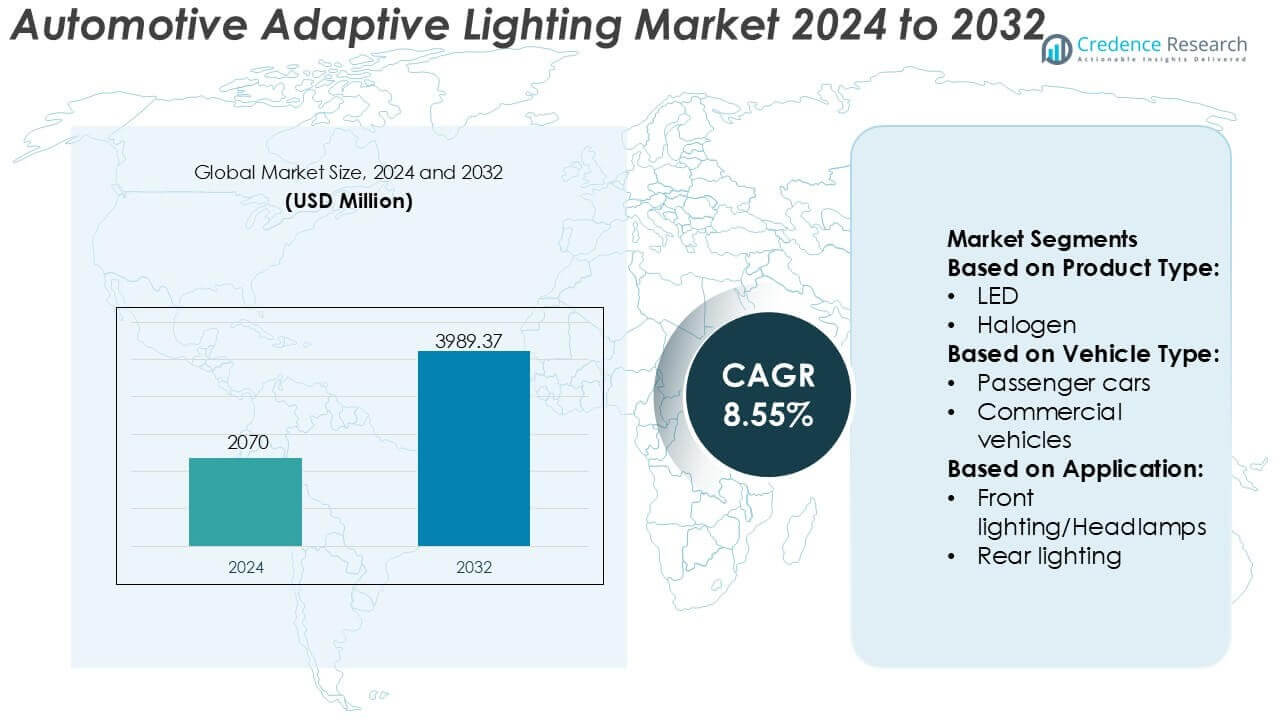
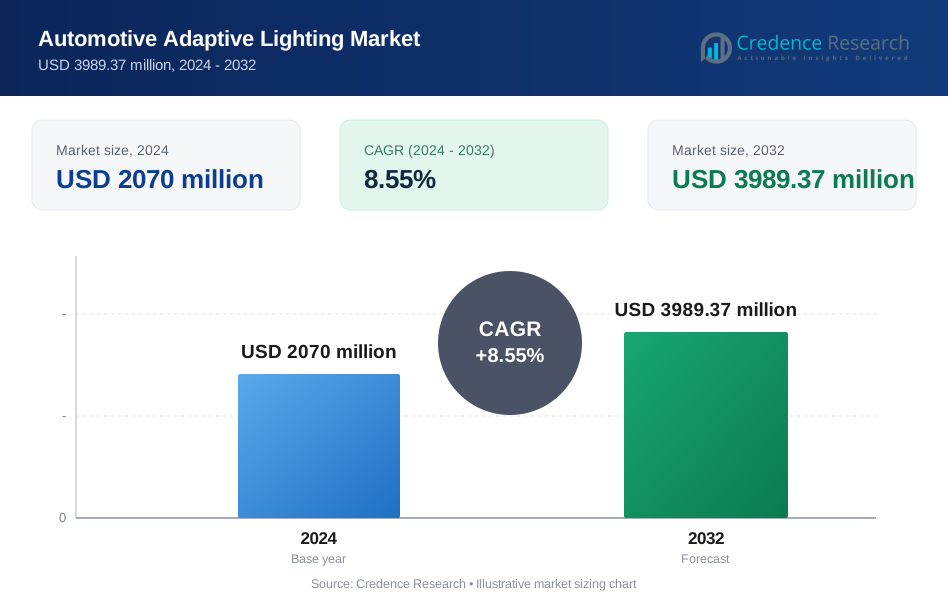
Automotive Adaptive Lighting Market size was valued USD 2070 million in 2024 and is anticipated to reach USD 3989.37 million by 2032, at a CAGR of 8.55% during the forecast period.
| REPORT ATTRIBUTE | DETAILS |
|---|---|
| Historical Period | 2020-2023 |
| Base Year | 2024 |
| Forecast Period | 2025-2032 |
| Automotive Adaptive Lighting Market Size 2024 | USD 2070 million |
| Automotive Adaptive Lighting Market, CAGR | 8.55% |
| Automotive Adaptive Lighting Market Size 2032 | USD 3989.37 million |
Automotive Adaptive Lighting Market Insights
- Market growth is driven by rising adoption of ADAS, stricter road safety regulations, and increasing demand for glare-free high-beam and intelligent headlamp systems in passenger vehicles.
- Key trends include rapid penetration of matrix LED technology, which dominates with an estimated share of over 70%, alongside growing use of software-defined lighting and sensor-based beam control.
- Competitive dynamics focus on innovation, OEM partnerships, and scalable platforms, while high system costs and integration complexity act as restraints, particularly in price-sensitive markets.
- Regionally, North America leads with an exact market share of 38%, followed by Europe and Asia-Pacific, supported by premium vehicle demand, strong regulatory frameworks, and expanding electric vehicle production.
Automotive Adaptive Lighting Market Segmentation Analysis:
By Product Type
By product type, LED lighting dominates the automotive adaptive lighting market, holding an estimated 55–58% market share, driven by superior energy efficiency, longer operational life, and advanced controllability. LEDs enable adaptive beam shaping, matrix lighting, and pixel-level light distribution, which are essential for modern adaptive driving beam systems. Automakers increasingly integrate LED modules to support intelligent lighting functions such as glare-free high beams and dynamic cornering lights. Xenon systems retain relevance in mid-range vehicles due to strong illumination performance, while halogen lighting continues to decline, limited mainly to entry-level models due to lower efficiency and reduced adaptability.
- For instance, Marelli Holdings Co., Ltd. has developed matrix LED headlamp systems integrating more than 20,000 individually addressable micro-LED pixels per vehicle, with electronic control units capable of processing lighting commands in under 10 milliseconds, enabling real-time beam adaptation based on camera and sensor inputs.
By Vehicle Type
By vehicle type, passenger cars represent the dominant segment with approximately 65–68% market share, supported by high production volumes and rapid adoption of advanced driver assistance and comfort features. Adaptive lighting systems are increasingly offered as standard or optional features in mid-range and premium passenger vehicles to enhance night-time visibility and driving safety. Commercial vehicles follow, driven by growing emphasis on fleet safety, long-haul visibility, and regulatory compliance. Two wheelers show emerging adoption, particularly in premium motorcycles, where adaptive LED headlamps improve cornering visibility and rider safety under variable road conditions.
- For instance, OSRAM GmbH has developed its EVIYOS HD smart LED platform for passenger cars, integrating over 25,600 individually controllable light pixels on a single chip, enabling highly precise glare-free high-beam control and symbol projection on the road surface.
By Application
By application, front lighting and headlamps account for the largest share at around 60–63%, as adaptive lighting technologies are primarily deployed to optimize forward visibility and reduce glare for oncoming traffic. Adaptive headlamps integrate functions such as automatic high-beam control, dynamic bending light, and speed-sensitive illumination. Rear lighting follows, benefiting from adaptive brake and signaling functions that enhance vehicle-to-vehicle communication. Interior lighting gains traction through adaptive ambient lighting systems linked to driving modes, while side lighting supports improved vehicle conspicuity and safety during lane changes and turning maneuvers.
Automotive Adaptive Lighting Market Overview
Key Growth Drivers
- Rising Adoption of Advanced Driver Assistance Systems (ADAS) The accelerating integration of ADAS across passenger and commercial vehicles is a primary driver of the automotive adaptive lighting market. Adaptive headlights enhance night-time visibility by dynamically adjusting beam patterns based on vehicle speed, steering angle, and surrounding traffic detected by cameras and sensors. As OEMs increasingly bundle adaptive lighting with ADAS features such as lane-keeping assist and collision avoidance, demand rises across mid-range and premium segments. Regulatory emphasis on road safety and reduced accident rates further strengthens adoption, especially in technologically mature markets.
- For instance, TTE's core expertise lies in ultrasonic sensors, 77 GHz radar, and camera-based vision systems for parking assistance, blind-spot detection, and collision avoidance.
- Stringent Vehicle Safety Regulations and NCAP Ratings Tightening safety regulations and evolving New Car Assessment Program (NCAP) protocols are significantly boosting demand for adaptive lighting systems. Many regions now emphasize night-driving safety, glare reduction, and pedestrian visibility, directly supporting technologies such as adaptive high-beam assist and matrix LED headlamps. Automakers increasingly deploy adaptive lighting to achieve higher safety ratings, which strongly influence consumer purchasing decisions. This regulatory push accelerates standardization of adaptive lighting beyond luxury vehicles, expanding penetration across mass-market passenger cars and light commercial vehicles.
- For instance, Valeo's most advanced system, the h-Digi® microLED, uses approximately 20,000 pixels per headlamp (40,000 total per vehicle), which is closer to the claim but still a different figure.
- Growing Consumer Preference for Premium and Smart Vehicle Features Rising consumer demand for premium comfort, aesthetics, and smart vehicle features is driving adoption of adaptive lighting systems. Modern buyers increasingly value enhanced driving experience, personalization, and advanced styling enabled by intelligent lighting solutions. Adaptive front lighting, dynamic cornering lights, and intelligent ambient lighting improve both functionality and vehicle differentiation. As disposable incomes grow and vehicle electrification advances, adaptive lighting is becoming a key feature for brand positioning, particularly among premium OEMs seeking to deliver technologically advanced and visually distinctive vehicles.
Key Trends & Opportunities
- Rapid Shift Toward LED and Matrix LED Technologies The market is witnessing a strong shift from halogen and xenon systems toward LED and matrix LED adaptive lighting. LEDs offer superior energy efficiency, longer lifespan, compact design, and precise beam control, making them ideal for adaptive applications. Matrix LED systems enable selective dimming of individual light segments to avoid glare while maintaining high-beam illumination. This transition creates opportunities for suppliers specializing in advanced optics, control electronics, and software algorithms that enable real-time beam adaptation.
- For instance, Aptiv’s primary focus remains on Smart Vehicle Architecture (SVA) and Gen 6 ADAS platforms. While they develop advanced software-defined vehicle (SDV) technologies, their lighting involvement is primarily focused on Intelligent Interior Lighting (ambient lighting that reacts to driver monitoring) rather than high-definition exterior adaptive headlamp modules.
- Integration of Software-Defined and Sensor-Fusion Lighting Systems Adaptive lighting is increasingly evolving into a software-defined feature integrated with vehicle sensor fusion platforms. Camera, radar, and LiDAR inputs are now used to optimize beam patterns in real time based on traffic, weather, and road conditions. This trend opens opportunities for software providers and Tier-1 suppliers offering AI-enabled lighting control units. Over-the-air updates further allow OEMs to enhance lighting performance post-sale, creating long-term value and differentiation through continuous feature upgrades.
- For instance, Stanley has commercialized a μLED Adaptive Driving Beam (ADB) system that manages approximately 20,000 LED pixels arranged in a matrix. This allows for precise electronic swiveling (moving light without a motor) and targeted shielding of oncoming traffic.
- Expansion of Adaptive Lighting in Electric and Autonomous Vehicles Electric and autonomous vehicles present strong growth opportunities for adaptive lighting adoption. EV platforms emphasize energy-efficient systems, favoring LED-based adaptive lighting solutions. Meanwhile, autonomous vehicles require advanced external lighting for vehicle-to-pedestrian communication and enhanced situational awareness. Adaptive lighting plays a critical role in signaling vehicle intent and improving safety in mixed traffic environments. As EV and autonomous vehicle production scales, adaptive lighting is expected to become a standard feature rather than an optional upgrade.
Key Challenges
- High System Cost and Integration Complexity Despite growing adoption, high system costs remain a key challenge for the automotive adaptive lighting market. Advanced components such as matrix LEDs, control electronics, sensors, and software significantly increase vehicle costs. Integration with existing vehicle architectures and ADAS platforms also adds engineering complexity for OEMs. These factors limit adoption in entry-level and cost-sensitive vehicle segments, particularly in emerging markets. Cost optimization, platform standardization, and economies of scale are critical to achieving broader market penetration.
- Regulatory Variability and Standardization Issues Inconsistent lighting regulations across regions pose challenges for global deployment of adaptive lighting systems. Differences in headlamp beam patterns, glare limits, and approval procedures complicate product standardization for OEMs operating worldwide. Some advanced adaptive functions face delayed approvals in certain markets, slowing commercialization. Harmonization of global lighting standards and clearer regulatory frameworks are necessary to unlock the full potential of adaptive lighting technologies and support faster adoption across international automotive markets.
Regional Analysis
North America
North America leads the automotive adaptive lighting market with an estimated 38% share, driven by high penetration of advanced driver-assistance systems (ADAS), premium vehicle demand, and early adoption of matrix LED and laser lighting technologies. Stringent vehicle safety regulations from NHTSA and strong consumer awareness accelerate OEM integration of adaptive headlamps across passenger cars and light commercial vehicles. The presence of major automotive OEMs and Tier-1 suppliers, coupled with strong R&D investment in intelligent lighting software and sensor fusion, supports sustained growth. Electrification trends and rising SUV sales further reinforce demand for adaptive lighting solutions.
Europe
Europe accounts for approximately 32% of the automotive adaptive lighting market, supported by strict road safety norms and rapid adoption of advanced lighting technologies in premium and mid-range vehicles. Regulations from UNECE encouraging glare-free high-beam systems and adaptive front lighting systems (AFS) drive large-scale deployment. Germany, France, and the UK remain key contributors due to strong automotive manufacturing bases and high luxury vehicle production. The region also benefits from technological leadership in matrix LED, OLED rear lighting, and laser headlights, alongside growing integration of adaptive lighting with vehicle sensors and autonomous driving platforms.
Asia-Pacific
Asia-Pacific holds nearly 24% of the automotive adaptive lighting market and represents the fastest-growing region due to rising vehicle production volumes and increasing adoption of premium features in mass-market vehicles. China, Japan, and South Korea dominate regional demand, supported by expanding electric vehicle manufacturing and government safety initiatives. Cost-optimized adaptive LED systems are gaining traction in passenger cars, while two-wheelers increasingly adopt adaptive front lighting for enhanced safety. Rapid urbanization, improving road infrastructure, and the presence of leading semiconductor and lighting manufacturers strengthen the region’s long-term growth outlook.
Latin America
Latin America captures around 4% of the automotive adaptive lighting market, with growth primarily driven by gradual modernization of vehicle fleets and rising consumer preference for safety-enhancing features. Brazil and Mexico lead regional demand due to their automotive manufacturing hubs and export-oriented production. While adoption remains concentrated in higher-end passenger vehicles, increasing regulatory focus on road safety is encouraging OEMs to introduce adaptive lighting in mid-segment models. Economic recovery, improving vehicle financing, and partnerships with global Tier-1 suppliers are expected to support steady but moderate market expansion.
Middle East & Africa
The Middle East & Africa region accounts for approximately 2% of the automotive adaptive lighting market, supported by demand for premium and luxury vehicles in Gulf countries. Harsh driving conditions, including low visibility due to sand and dust, increase the value proposition of adaptive lighting systems. Adoption is strongest in the UAE and Saudi Arabia, where high disposable incomes and premium vehicle sales dominate. In Africa, market growth remains limited but gradual, driven by improving automotive imports and regulatory alignment with global safety standards, creating long-term opportunities for adaptive lighting suppliers.
Automotive Adaptive Lighting Market Segmentations:
By Product Type:
- LED
- Halogen
By Vehicle Type:
- Passenger cars
- Commercial vehicles
By Application:
- Front lighting/Headlamps
- Rear lighting
By Geography
- North America
- U.S.
- Canada
- Mexico
- Europe
- Germany
- France
- U.K.
- Italy
- Spain
- Rest of Europe
- Asia Pacific
- China
- Japan
- India
- South Korea
- South-east Asia
- Rest of Asia Pacific
- Latin America
- Brazil
- Argentina
- Rest of Latin America
- Middle East & Africa
- GCC Countries
- South Africa
- Rest of the Middle East and Africa
Competitive Landscape
The automotive adaptive lighting market players such as Marelli Holdings Co., Ltd., OSRAM GmbH, Tung Thih Electronic Co., Ltd., Valeo SA, Aptiv PLC, Stanley Electric Co., Ltd., Hyundai Mobis, ZKW Group (Part of LG Electronics), HELLA GmbH & Co. KGaA, and Koito Manufacturing Co., Ltd. The automotive adaptive lighting market exhibits a competitive landscape driven by rapid technological innovation, strong OEM collaboration, and increasing regulatory emphasis on road safety. Market competition centers on the development of advanced matrix LED, laser, and pixel-based lighting systems that enable real-time beam adaptation and glare-free high-beam functionality. Companies differentiate through software-defined lighting control, integration with vehicle sensors and ADAS platforms, and scalable system architectures suitable for both premium and mid-range vehicles. Cost efficiency, energy optimization, and compact module design remain critical as electrification accelerates and OEMs seek lightweight solutions. Additionally, global manufacturing capabilities, supply chain resilience, and compliance with regional safety standards play a decisive role in maintaining competitiveness and securing long-term OEM contracts.
Key Player Analysis
- Marelli Holdings Co., Ltd.
- OSRAM GmbH
- Tung Thih Electronic Co., Ltd.
- Valeo SA
- Aptiv PLC
- Stanley Electric Co., Ltd.
- Hyundai Mobis
- ZKW Group (Part of LG Electronics)
- HELLA GmbH & Co. KGaA
- Koito Manufacturing Co., Ltd.
Recent Developments
- In April 2025, Valeo and laser display innovator Appotronics announced a partnership to develop next-gen car lighting using Appotronics' ALPD® laser tech, integrating advanced projection for smarter adaptive headlights, better road safety (ADB), and new driver experiences with entertainment and personalization features.
- In June 2024, Melexis launched the MLX81123 IC, an automotive LIN RGB LED driver that extends their family with smaller SOIC8 and DFN-8 (3x3mm) packages, enabling more flexible, miniaturized ambient lighting throughout vehicle interiors, succeeding the popular MLX81113 with cost-effective performance and supply chain benefits.
- In April 2024, Signify introduces new UltraEfficient and 3D printed innovations, supporting the transition to energy-efficient, sustainable workspaces. The new products significantly reduce energy consumption and carbon footprint while maintaining high performance.
- In March 2024, Semilux International Ltd. initiated an R&D program with academics and researchers from Taiwanese universities, including National Chung Hsing University, Turing Drive, and the Industrial Technology Research Institute, to develop an advanced solid-state LiDAR module for autonomous vehicles.
Report Coverage
The research report offers an in-depth analysis based on Product Type, Vehicle Type, Application and Geography. It details leading market players, providing an overview of their business, product offerings, investments, revenue streams, and key applications. Additionally, the report includes insights into the competitive environment, SWOT analysis, current market trends, as well as the primary drivers and constraints. Furthermore, it discusses various factors that have driven market expansion in recent years. The report also explores market dynamics, regulatory scenarios, and technological advancements that are shaping the industry. It assesses the impact of external factors and global economic changes on market growth. Lastly, it provides strategic recommendations for new entrants and established companies to navigate the complexities of the market.
Future Outlook
- Adoption of matrix LED and pixel-based adaptive lighting will expand across mid-range and mass-market vehicles.
- Integration of adaptive lighting with ADAS and autonomous driving systems will accelerate for enhanced situational awareness.
- Software-defined lighting architectures will gain importance, enabling over-the-air updates and feature customization.
- Demand for energy-efficient and lightweight lighting modules will increase with rising electric vehicle production.
- Regulatory support for glare-free high-beam and adaptive front lighting systems will strengthen global adoption.
- Rear adaptive lighting and dynamic signaling functions will see increased implementation for improved vehicle-to-vehicle communication.
- Cost-optimized adaptive LED solutions will drive higher penetration in emerging automotive markets.
- Sensor fusion using cameras, radar, and lidar will improve real-time beam control accuracy.
- OEMs will prioritize modular and scalable lighting platforms to reduce development time and platform complexity.
- Sustainability-focused designs using recyclable materials and reduced power consumption will shape future product development.
Request a Free Sample
Fill in your details and we'll send you a free sample report.
- Sample data tables & charts
- Research methodology
Need a Custom Version of This Report?
Tailor the scope, geography, or segments to your exact requirements.
- Custom geography or segment scope
- Direct access to our analyst team
Frequently Asked Questions
What is the current market size for Automotive Adaptive Lighting Market, and what is its projected size in 2032?
At what Compound Annual Growth Rate is the Automotive Adaptive Lighting Market projected to grow between 2024 and 2032?
Which Automotive Adaptive Lighting Market segment held the largest share in 2024?
What are the primary factors fueling the growth of the Automotive Adaptive Lighting Market?
Who are the leading companies in the Automotive Adaptive Lighting Market?
Which region commanded the largest share of the Automotive Adaptive Lighting Market in 2024?
Table of Content
Chapter 1. Report Introduction
- 1.1 Report Description & Purpose
- 1.1.1 Report Title & Market Definition
- 1.1.2 Unique Selling Propositions (USP) & Key Differentiators
- 1.1.3 Value Proposition for Stakeholders
- 1.2 Research Objectives
- 1.2.1 Market Sizing Objectives (Volume & Revenue) (Volume Where Applicable)
- 1.2.2 Segmentation Objectives
- 1.2.3 Competitive Intelligence Objectives
- 1.2.4 Forecast & Scenario Objectives
- 1.3 Report Scope
- 1.3.1 Automotive Adaptive Lighting Scope – Segments & Subsegments Covered
- 1.3.2 Geographic Scope – Regions & Countries Covered
- 1.3.3 Historical Period, Base Year & Forecast Period (2024; forecast to 2032)
- 1.3.4 Inclusions & Exclusions
- 1.4 Industry Classification & Applicable Codes
- 1.5 Currency, Measurement Units & Valuation Basis
- 1.6 Target Stakeholders
- 1.7 Limitations & Assumptions
Chapter 2. Executive Summary
- 2.1 Global Automotive Adaptive Lighting Market Snapshot
- 2.1.1 Market Size – Historical (2024) & Forecast (2024-2032) (2024: USD 2070 million → 2032: USD 3989.37 million)
- 2.1.2 Volume & Revenue – Global Totals (Volume Where Applicable)
- 2.1.3 Key Market Highlights – Top Five Facts
- 2.2 Automotive Adaptive Lighting Market Segmentation Snapshot
- 2.2.1 Market Split by Region – 2024 vs. 2032
- 2.3 Competitive Snapshot
- 2.3.1 Top 10 Players by Revenue Share – 2024
- 2.3.2 Top 10 Players by Volume Share – 2024 (Volume Where Applicable)
- 2.3.3 Recent Strategic Developments (18-Month Summary)
- 2.4 Key Investment Highlights & Strategic Conclusions
Chapter 3. Automotive Adaptive Lighting Market Dynamics & Industry Analysis
- 3.1 Market Overview & Context
- 3.1.1 Automotive Adaptive Lighting Market Position in the Broader Industry Value Chain
- 3.1.2 Demand Structure & Purchasing Dynamics
- 3.1.3 Market Maturity & Development Stage by Region
- 3.2 Automotive Adaptive Lighting Market Drivers
- 3.3 Automotive Adaptive Lighting Market Restraints & Challenges
- 3.4 Automotive Adaptive Lighting Market Opportunities
- 3.5 Porter's Five Forces Analysis
- 3.5.1 Threat of New Entrants
- 3.5.2 Bargaining Power of Suppliers
- 3.5.3 Bargaining Power of Buyers
- 3.5.4 Threat of Substitutes
- 3.5.5 Competitive Rivalry – Intensity Assessment
- 3.6 Automotive Adaptive Lighting Value Chain Analysis
- 3.6.1 Upstream – Key Inputs, Resources & Suppliers
- 3.6.1.1 Key Input/Resource 1
- 3.6.1.2 Key Input/Resource 2
- 3.6.1.3 Key Input/Resource 3
- 3.6.2 Midstream – Core Operations & Value Creation
- 3.6.2.1 Operating Model & Process Overview
- 3.6.2.2 Key Operating Locations & Capabilities by Company
- 3.6.3 Downstream – Market Channels & End Users
- 3.6.3.1 Direct Sales & Customer Engagement Channels
- 3.6.3.2 Indirect Sales, Intermediaries & Partner Channels
- 3.6.4 Value Chain Profitability Analysis
- 3.6.1 Upstream – Key Inputs, Resources & Suppliers
- 3.7 PESTEL Analysis
- 3.7.1 Political Factors
- 3.7.2 Economic Factors
- 3.7.3 Social Factors
- 3.7.4 Technological Factors
- 3.7.5 Environmental Factors
- 3.7.6 Legal Factors
- 3.8 Automotive Adaptive Lighting Supply Chain Analysis
- 3.8.1 Critical Input & Resource Availability Risk Assessment
- 3.8.2 Supplier & Operational Concentration Risk (Geographic Exposure)
- 3.8.3 Supply & Service Disruption Impact Analysis
- 3.9 Regulatory & Policy Landscape
Note: The regulatory and policy landscape section covers regulations based on their applicability to the market, Automotive Adaptive Lighting category, geography, and scope of the study. Only regulatory frameworks with a material impact on operations, compliance, trade, sustainability, or market access are analyzed in detail.
Chapter 4. Key Investment Pockets & Opportunity Analysis
- 4.1 Automotive Adaptive Lighting Market Attractiveness Analysis
- 4.1.1 By Region – Investment Attractiveness Matrix (Market Size × CAGR)
- 4.2 Absolute Revenue Growth Opportunity
- 4.2.1 By Region – Absolute Revenue Growth Through 2032
- 4.3 Incremental Demand Opportunity
- 4.3.1 By Region – Incremental Demand Through 2032
- 4.3.2 Segment – Incremental Demand
- 4.4 Emerging Submarket Opportunity Deep Dive (Subject to Applicability)
- 4.5 Priority Market Opportunity Scorecards
- 4.5.1 United States
- 4.5.2 Europe
- 4.5.3 Asia
- 4.5.4 Middle East & Africa
Note: Priority market opportunity scorecards reflect the geographic scope and strategic relevance of the study. Listed markets are indicative and may be adapted to the industry.
Chapter 5. Automotive Adaptive Lighting Cross-Border Trade & Market Access Analysis
- 5.1 International Trade & Cross-Border Activity Overview
- 5.1.1 Global Export Value by Country (2024)
- 5.1.2 Global Export Volume by Country (2024) (Volume Where Applicable)
- 5.1.3 Global Import Value by Country (2024)
- 5.1.4 Global Import Volume by Country (2024) (Volume Where Applicable)
- 5.1.5 Net Trade Balance by Country (2024)
- 5.2 Export Analysis – Segment
- 5.2.1 Category 1 (Applicable Classification Code)
- 5.2.2 Category 2 (Applicable Classification Code)
- 5.2.3 Category 3 (Applicable Classification Code)
- 5.2.4 Category 4 (Applicable Classification Code)
- 5.2.5 Category 5 (Applicable Classification Code)
- 5.3 Import Analysis – Segment
- 5.3.1 Category 1 (Applicable Classification Code)
- 5.3.2 Category 2 (Applicable Classification Code)
- 5.3.3 Category 3 (Applicable Classification Code)
- 5.3.4 Category 4 (Applicable Classification Code)
- 5.3.5 Category 5 (Applicable Classification Code)
- 5.4 Cross-Border Pricing & Transaction Benchmarks
- 5.4.1 Export Pricing – Segment & Country
- 5.4.2 Import Pricing – Segment & Source Country
- 5.4.3 Price Trends (2024)
- 5.5 Key Cross-Border Trade & Delivery Routes
- 5.5.1 Cross-Border Trade/Delivery Route 1
- 5.5.2 Cross-Border Trade/Delivery Route 2
- 5.5.3 Cross-Border Trade/Delivery Route 3
- 5.5.4 Cross-Border Trade/Delivery Route 4
- 5.5.5 Cross-Border Trade/Delivery Route 5
- 5.6 Trade Policy & Market Access Impact Assessment
- 5.6.1 Tariff & Non-Tariff Barriers
- 5.6.2 Regional Trade & Economic Integration Frameworks
- 5.6.3 Bilateral & Multilateral Trade Agreements
- 5.6.4 Cross-Border Operating, Licensing & Localization Requirements
Note: This chapter applies where cross-border trade or delivery is relevant to Automotive Adaptive Lighting. Goods, services, and digital offerings are assessed using applicable classifications and transaction measures. Import-export volumes, trade balances, and route analyses are included only where meaningful to the market.
Chapter 6. Competitive Landscape & Company Benchmarking
- 6.1 Automotive Adaptive Lighting Market Concentration & Structure
- 6.1.1 Herfindahl-Hirschman Index (HHI) – vs. 2024
- 6.1.2 Leading, Mid-Sized & Emerging Player Structure
- 6.1.3 Global, Regional & Local Player Dynamics
- 6.2 Automotive Adaptive Lighting Market Share Analysis – 2024
- 6.2.1 Global Revenue Share by Company
- 6.2.2 Global Volume Share by Company (Volume Where Applicable)
- 6.2.3 Regional Revenue Share
- 6.2.4 Market Share Evolution ( vs. 2024)
- 6.2.5 Company Market Share by Key Segment
- 6.2.6 Company Market Share by Customer Group
- 6.3 Operating Scale, Capacity & Infrastructure Analysis
- 6.3.1 Global Operating Scale & Supply Capacity
- 6.3.2 Resource Utilization & Operating Efficiency
- 6.3.3 Output, Service Delivery & Activity Metrics
- 6.3.4 Operating Footprint & Infrastructure Map
- 6.3.5 Planned Operational & Capacity Expansion
- 6.4 Automotive Adaptive Lighting Competitive Benchmarking Matrix
- 6.4.1 Revenue, Growth, Profitability & Operating Metric Comparison
- 6.4.2 Channel Revenue Mix
- 6.4.3 Geographic Revenue Exposure
- 6.4.4 R&D Intensity
- 6.4.5 Sustainability Maturity
- 6.5 Strategic Developments in Automotive Adaptive Lighting (Last 24 Months)
- 6.5.1 Mergers, Acquisitions & Divestments
- 6.5.2 New Products, Services & Solutions in Automotive Adaptive Lighting
- 6.5.3 Operational & Infrastructure Expansions
- 6.5.4 Strategic Alliances, Joint Ventures & Partnerships
- 6.5.5 Distribution Expansion & Market Entry
- 6.5.6 Sustainability & ESG Initiatives
- 6.6 Competitive Strategy Mapping
- 6.6.1 Leader, Challenger, Follower & Niche Classification
- 6.6.2 Pricing Strategy Comparison
- 6.6.3 Channel Strategy Matrix
Note: Strategic developments are included based on their materiality and the availability of reliable information.
Chapter 7. Global Automotive Adaptive Lighting Market – By Sales & Delivery Channel
- 7.1 Segment Overview
- 7.1.1 Volume & Revenue Split by Channel (2024 & 2032) (Volume Where Applicable)
- 7.1.2 Channel Mix Evolution (2024-2032)
Chapter 8. Regional Market Analysis – Global Overview
- 8.1 Global Regional Overview
- 8.1.1 Regional Volume Share (Volume Where Applicable)
- 8.1.2 Regional Revenue Share
- 8.1.3 Regional Volume by Region (Volume Where Applicable)
- 8.1.4 Regional Revenue by Region
- 8.1.5 Regional Forecast Through 2032
- 8.2 Cross-Regional Segment Analysis
- 8.2.1 By Sales & Delivery Channel
- 8.2.2 By Competitive Positioning & Price Tier
Chapter 9. North America Automotive Adaptive Lighting Market
- 9.1 United States
- 9.2 Canada
- 9.3 Mexico
Chapter 10. Europe Automotive Adaptive Lighting Market
- 10.1 Germany
- 10.2 France
- 10.3 Italy
- 10.4 United Kingdom
- 10.5 Spain
- 10.6 Poland
- 10.7 Russia
- 10.8 Netherlands
- 10.9 Belgium
- 10.10 Sweden
- 10.11 Denmark
- 10.12 Norway
- 10.13 Rest of Europe
Chapter 11. Asia Pacific Automotive Adaptive Lighting Market
- 11.1 China
- 11.2 India
- 11.3 Japan
- 11.4 South Korea
- 11.5 Thailand
- 11.6 Indonesia
- 11.7 Vietnam
- 11.8 Malaysia
- 11.9 Australia
- 11.10 Rest of Asia Pacific
Chapter 12. Latin America Automotive Adaptive Lighting Market
- 12.1 Brazil
- 12.2 Argentina
- 12.3 Colombia
- 12.4 Chile
- 12.5 Rest of Latin America
Chapter 13. Middle East Automotive Adaptive Lighting Market
- 13.1 Saudi Arabia
- 13.2 United Arab Emirates
- 13.3 Turkey
- 13.4 Israel
- 13.5 Iran
- 13.6 Rest of the Middle East
Chapter 14. Africa Automotive Adaptive Lighting Market
- 14.1 South Africa
- 14.2 Egypt
- 14.3 Nigeria
- 14.4 Morocco
- 14.5 Rest of Africa
Chapter 15. Automotive Adaptive Lighting Company Profiles
- 15.1 [Company 01]
- 15.1.1 Company Overview
- 15.1.2 Key Management Personnel
- 15.1.3 Products & Services Portfolio
- 15.1.4 Financial Performance
- 15.1.5 Key Market Focus & Geographic Presence
- 15.1.6 Recent Developments & Strategic Initiatives
Note: The company profile list is preliminary and may change based on research findings, market developments, data availability, and client requirements.
Chapter 16. Appendices
- Appendix A – List of Abbreviations & Acronyms
- Appendix B – Industry Classification Code Reference – Full Series
- Appendix C – Supply, Output & Operating Capacity Data Tables
- Appendix D – End-Use & Demand Base Tables
- Appendix E – Demand, Adoption & Usage Assumptions
- Appendix F – Pricing & Revenue Metric Reference Tables
- Appendix G – Company Operations & Infrastructure Database
- Appendix H – Cross-Border Trade & Activity Data Tables (Where Applicable)
- Appendix I – Regulatory Summary Tables
- Appendix J – Primary Research Participant List (Anonymized)
- Appendix K – Primary Research Questionnaire Framework
- Appendix L – Data Sources & Bibliography
- Appendix M – Market Size Divergence & Source Comparison
Chapter 17. Research Methodology
- 17.1 Research Framework & Philosophy
- 17.2 Secondary Research – Sources, Hierarchy & Data Extraction
- 17.3 Data Modeling – Bottom-Up & Top-Down Market Sizing
- 17.4 Primary Research – Stakeholder Framework, LOI & Sample Sizes
- 17.5 Forecast Methodology – Regression, Scenario & Sensitivity Analysis
- 17.6 Quality Control – Four-Layer Validation Framework
- 17.7 Limitations & Standard Assumptions
- 17.8 Disclaimer
