
Actionable Insights Delivered - Peer to Peer Electric Vehicle Charging Market Size
Positioned with a USD 0.1 billion valuation in 2022, the Peer to Peer Electric Vehicle Charging Market asserted its global eminence. Set to scale to USD 0.4 billion by 2030, the market's remarkable Compound Annual Growth Rate (CAGR) of 22.5% (2022-2030) underscores its strategic growth trajectory.
Key Highlights of the Report
The global peer to peer electric vehicle charging market is segmented by charger type, application, and region. Level 1 is widely used, while Residential is a widely utilized segment. Europe is leading the market growth.
The market for peer-to-peer electric vehicle charging is driven by two factors, the growing popularity of electric vehicles, which increases demand for accessible and convenient charging options, and the desire of EV owners to save money and generate income by renting out their infrastructure for charging other EVs. The requirement for legal frameworks and technology answers to enable secure and effective transactions between EV owners and users and address worries about responsibility and safety is one market limitation.
Nonetheless, the global peer to peer electric vehicle charging market is the creation of a decentralized, scaleable charging infrastructure that can increase access to charging stations in locations with limited traditional infrastructure. The potential to foster community engagement and collaboration by allowing EV owners to share their charging resources and create sustainable transportation networks are two opportunities for the peer-to-peer electric vehicle charging market. Furthermore, the market for peer-to-peer charging offers a chance for cutting-edge business models and platforms to develop, simplifying easy transactions and improving charging efficiency for owners and users.
What Are The Main Drivers Of The Global Peer to Peer Electric Vehicle Charging Market?
Demand for quick and accessible charging infrastructure is increasing as the number of electric vehicles on the road rises. Peer-to-peer electric car charging addresses the need for more charging options by providing a network of additional charging sites beyond conventional charging stations.
What Are The Major Challenges Faced By The Global Peer to Peer Electric Vehicle Charging Market?
Uncertainties about liability, safety, and transactional procedures result from the lack of standardized rules and legal frameworks for peer-to-peer electric vehicle charging. Clear rules and standards are required to overcome these problems and guarantee a consistent and safe user experience.
What Are The Growth Opportunities In The Global Peer to Peer Electric Vehicle Charging Market?
A decentralized and scalable charging system may be possible with peer-to-peer charging. In residential neighborhoods, private residences, flats, businesses, and other sites, it permits the usage of underutilized charging resources. Particularly in locations with no traditional charging infrastructure, this development can dramatically increase the accessibility of charging.
Executive Summary
Overview of the Global Peer to Peer Electric Vehicle Charging Market
The growing popularity of electric vehicles and the demand for simple and accessible charging infrastructure drive the expansion of the global peer-to-peer electric vehicle charging industry. Peer to peer charging extends access to charging beyond conventional stations and provides a decentralized and scalable alternative. Sharing their charging infrastructure offers EV owners the chance to reduce costs and make money. However, the market has difficulties with interoperability, legal frameworks, and assuring trust and security. However, the market has room for growth, community involvement, and developing cutting-edge business models and platforms to streamline transactions and maximize charging efficiency.
Market Definition
Electric vehicle (EV) owners can share their private charging infrastructure with other EV owners under a system known as peer-to-peer (P2P) charging. It enables owners or operators of charging stations, such as those found in residences, apartments, or workplaces, to provide charging services to those in need. By offering charging services to other EV owners, EV owners can make money off their infrastructure for charging, enhancing the accessibility and ease of charging alternatives. Peer-to-peer electric car charging attempts to broaden the network of charging stations, maximize resource use, and offer other options for charging beyond conventional public charging stations.
Market Insights
- The global demand for peer to peer electric vehicle charging was valued at USD 0.1 Billion in 2022 and is expected to reach USD 0.4 Billion in 2030, growing at a CAGR of 22.5% between 2023 and 2030.
- Level 1 is the market leader in material and holds over 65% of the market's value in 2022, while level 2 is anticipated to show the quickest CAGR over the forecast period.
- The residential segment governs the global demand for peer to peer electric vehicle charging, holding a massive share of over 45% in 2022, and is expected to grow at a rapid CAGR.
- Europe was fueling the growth of the peer to peer electric vehicle charging industry with an over one-third share in 2022. North America and Asia Pacific collectively accounted for just under 40% share in 2022. Asia Pacific held over 22% share in 2022.
- The use of electric vehicles is encouraged by Europe's rigorous emission standards and policies. Governments have established challenging goals for lowering carbon emissions, motivating manufacturers and buyers to switch to electric cars. The adoption of EVs has been made easier by these rules, which have also increased demand for electric vehicles in Europe.
- The growing demand for simple and accessible charging infrastructure brought on by the increasing uptake of electric vehicles is one factor driving the global peer-to-peer electric vehicle charging industry. Peer to Peer charging offers an additional network of charging stations to address this demand as more people switch to electric vehicles, and there is a larger need for accessible charging options. The requirement for legal frameworks and standardized protocols to facilitate secure and effective transactions between EV owners and users is one market limitation. The widespread adoption and expansion of peer-to-peer electric car charging may be hampered by uncertainty surrounding liability, safety, and transactional procedures caused by the absence of uniform rules.
The desire for cost savings and money generation among owners of electric vehicles is one of the factors driving the global peer-to-peer electric car charging market. There is a financial incentive for people to join peer-to-peer charging networks because they may reduce their charging expenses and possibly make extra money by sharing their infrastructure with other EV owners. As more owners of electric vehicles become aware of the financial advantages of sharing their charging supplies, this factor promotes market expansion.
In Germany, the peer-to-peer electric vehicle charging market is being used to increase charging accessibility and foster neighborhood cooperation. Owners of electric vehicles can use services like Share&Charge to share their private charging infrastructure with other EV owners. More charging choices are now possible, especially in residential settings. As EV owners cooperate and support one another's charging requirements, fostering a decentralized and sustainable charging network, market use in Germany encourages community participation.
The Netherlands uses the peer-to-peer electric vehicle charging market to meet the rising demand for charging infrastructure. Platforms created by businesses like Jedlix enable EV owners to share their charging stations with others. Using the market, the charging network is expanded beyond conventional stations, and resources for charging are optimized. The Peer to Peer charging model fits well with the Netherlands' emphasis on environmentally friendly transportation. EV owners can share their charging infrastructure and support the nation's ambitious plans to cut emissions and promote clean mobility.
Increasing Electric Vehicle Adoption
The market for peer-to-peer electric vehicle charging is significantly fueled by the rising popularity of electric vehicles (EVs). Demand for convenient and accessible charging infrastructure rises as more people and businesses switch to electric vehicles. To maintain the functionality and usability of their vehicles, owners of electric vehicles need charging options that are dependable and easily accessible.
Several variables, such as government subsidies, environmental concerns, and advancements in EV technology, influence the adoption of EVs. People have started choosing electric cars as a more environmentally friendly form of transportation due to worries about climate change and air pollution. Government regulations and incentives such as financial subsidies, tax advantages, and access to limited places have pushed consumers to use electric vehicles.
Desire for Cost Savings and Income Generation
The desire among owners of electric vehicles for cost savings and income generation is another factor driving the market for peer-to-peer electric vehicle charging. They can reduce their charging expenses and even make more money by lending their charging infrastructure to other EV owners.
Compared to the usual fuel expenditures for internal combustion engines, the cost of electricity for charging an electric car can be substantially less. EV owners that engage in peer-to-peer charging can profit from their infrastructure by charging other EV owners for a charge. This enables them to recoup part of their charging costs and possibly convert their EVs into income-generating assets.
Additionally, electric vehicle owners can make the most of their charging infrastructure by using the sharing economy model, improving resource efficiency and minimizing waste. Peer to Peer charging enables charging stations to be utilized actively by other people, increasing the effectiveness of the charging network.
Absence Of Uniform Laws And Regulatory Frameworks
The absence of uniform laws and regulatory frameworks is one barrier to the market for peer-to-peer electric car charging. Liability, safety, and transactional processes are questionable due to the lack of formal Peer to Peer charging rules and regulations. It becomes difficult to resolve issues relating to consumer protection, dispute resolution, and data privacy without established legislative frameworks.
The scalability of peer-to-peer charging networks might also be hampered by the absence of established protocols and interoperability standards. It is essential to implement comprehensive and harmonized regulatory frameworks to guarantee a secure and consistent user experience, foster market expansion, and foster trust among electric car owners and users.
Decentralized Charging Infrastructure
The potential for developing a decentralized charging infrastructure is one opportunity in the peer-to-peer electric vehicle charging sector. In residential neighborhoods, private residences, flats, workplaces, and other sites, peer-to-peer charging enables the use of underutilized charging facilities.
This decentralized strategy for building out the infrastructure for charging can greatly increase the accessibility of charging, especially in places with few conventional charging stations. It gives electric vehicle users freedom and convenience by making it simple to locate nearby charging stations. Decentralized charging infrastructure also eases the burden on centralized charging networks, improving overall charging efficiency and encouraging the adoption of electric vehicles on a larger scale.
Community Engagement and Collaboration
Fostering community interaction and collaboration is another possibility in the peer-to-peer electric vehicle charging sector. Thanks to peer-to-peer charging, electric vehicle owners can share their charging resources with neighbors in their communities.
As a result, EV owners have more chances to collaborate, network, and assist one another. Community participation in peer-to-peer charging networks allows communities to forge connections, exchange knowledge and expertise, and work together to advance sustainable transportation.
This community-based strategy encourages using electric vehicles and a sense of shared responsibility for lowering carbon emissions. Community participation in peer-to-peer charging can also result in the formation of regional EV associations, team projects, and collaborations, which will boost the local sustainable transportation ecosystem.
Segmentations
By Type Segment- Level 1
- Level 2
- Private Homes
- Apartments
- Destination Charging Station
- Fleet Charging Station
- Workplace Charging Station
Competitive Landscape
Key Players
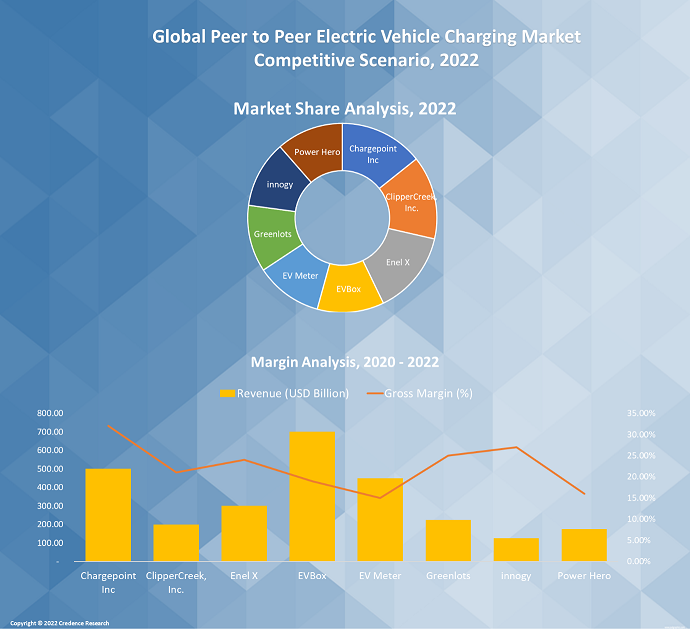
The global peer to peer electric vehicle charging market is highly competitive, with several key players. Some of the major players in the market and their market share are as follows:
- Chargepoint Inc
- ClipperCreek, Inc.
- Enel X
- EVBox
- EV Meter
- Greenlots
- has·to·be gmbh
- innogy
- Power Hero
- Webasto Group
Several stakeholders are in the peer-to-peer electric vehicle charging business, including platform providers, infrastructure providers for charging, and IT firms. These organizations compete to provide user-friendly platforms, frictionless transactions, and dependable charging infrastructure. Some concentrate on certain geographies or novel business strategies to stand out.
Summary of Key Finding
- Level 1 is the material market leader and will account for over 65% of market value in 2022. Still, level 2 is expected to grow fastest during the projection period.
- The residential market dominates the demand for peer-to-peer electric vehicle charging globally, accounting for a sizeable proportion of over 45% in 2022, and is projected to expand at a significant CAGR.
- With a market share of over one-third in 2022, Europe was the region driving the expansion of peer-to-peer electric car charging. North America and Asia Pacific made for slightly under 40% of the market in 2022. In 2022, Asia Pacific owned a share of over 22%
Future Outlook
- The market for peer-to-peer electric car charging has considerable future potential.
- There will be an exponential increase in demand for simple and accessible charging infrastructure as the use of electric vehicles spreads around the globe.
- Peer-to-peer charging extends the charging network beyond conventional stations and offers a decentralized, scalable alternative.
- The market has the opportunity to provide a seamless and secure user experience with technological improvements and the creation of established protocols.
- Peer to Peer charging is also positioned for greater growth and innovation in the future years as more people become aware of its financial advantages and positive environmental effects.
Segmentation
- By Charger type
- Level 1
- Level 2
- By Application
- Residential
- Private Homes
- Apartments
- Commercial
- By Region
- North America
- U.S
- Canada
- Mexico
- Europe
- Germany
- France
- U.K.
- Italy
- Spain
- Rest of Europe
- Asia Pacific
- China
- Japan
- India
- South Korea
- South-east Asia
- Rest of Asia Pacific
- Latin America
- Brazil
- Argentina
- Rest of Latin America
- Middle East & Africa
- GCC Countries
- South Africa
- Rest of Middle East and Africa

Request a Free Sample
Fill in your details and we'll send you a free sample report.
- Sample data tables & charts
- Research methodology
Market Dynamics
Increasing Electric Vehicle Adoption
As more consumers and businesses switch to electric vehicles, the need for accessible and convenient charging options grows, directly fueling demand for peer-to-peer charging networks that expand beyond traditional infrastructure.
Desire for Cost Savings and Income Generation
EV owners are motivated to share their charging infrastructure to reduce their own charging costs and generate additional income, making peer-to-peer charging platforms attractive and accelerating market participation.
Decentralized and Scalable Charging Infrastructure
Peer-to-peer charging enables the use of underutilized private charging stations in homes, apartments, and workplaces, increasing overall charging accessibility, especially in areas underserved by public infrastructure.
Supportive Government Policies and Emission Standards
Regions like Europe are driving market growth through strict emission regulations and incentives for EV adoption, which in turn increases the need for flexible and widespread charging solutions such as peer-to-peer networks.
Community Engagement and Collaboration
Peer-to-peer charging fosters local community involvement, allowing EV owners to support each other, share resources, and collectively build sustainable transportation networks, further promoting adoption and network expansion.
Need a Custom Version of This Report?
Tailor the scope, geography, or segments to your exact requirements.
- Custom geography or segment scope
- Direct access to our analyst team
Frequently Asked Questions
What is the current size of the global peer to peer electric vehicle charging market?
What is the expected growth rate of the peer to peer electric vehicle charging market between 2023 and 2030?
Which segment is leading the market share in terms of charger type?
Which application segment governs the demand for peer to peer electric vehicle charging worldwide?
Which segment is expected to post the highest CAGR during the forecast period?
Which region is fueling the growth of the peer to peer electric vehicle charging industry?
Who are the major players in the global peer to peer electric vehicle charging market?
What are the major market drivers of the peer to peer electric vehicle charging industry?
What are the major market restraints of the peer to peer electric vehicle charging industry?
What are the major market opportunities of the peer to peer electric vehicle charging industry?
Table of Content
Chapter 1 Market Segmentation
- 1.1 Segmentation Framework
- 1.1.1 Product and Service Classification
- 1.1.2 Application and End-Use Classification
- 1.1.3 Technology and Solution Classification
- 1.1.4 Customer and Distribution Channel Classification
- 1.1.5 Geographic Segmentation
- 1.1.6 Market Segment Definitions and Boundaries
- 1.2 By Application
- 1.2.1 Residential
- 1.2.2 Private Homes
- 1.2.3 Apartments
- 1.2.4 Commercial
- 1.2.5 Destination Charging Station
- 1.2.6 Fleet Charging Station
- 1.2.7 Workplace Charging Station
- 1.3 By Charger Type
- 1.3.1 Level 1
- 1.3.2 Level 2
Chapter 2 Introduction
- 2.1 Report Objectives and Scope
- 2.2 Product Definition and Industry Terminology
- 2.3 Market Inclusions and Exclusions
- 2.4 Research Process
- 2.4.1 Primary Research and Expert Interviews
- 2.4.2 Secondary Research and Source Review
- 2.4.3 Top-Down and Bottom-Up Estimation
- 2.4.4 Data Triangulation and Verification
- 2.5 Market Size Measurement Basis
- 2.5.1 2022: USD 0.1 Billion → Forecast year: —
- 2.6 Historical and Forecast Reference Periods
- 2.6.1 Base Year: 2022
- 2.7 Research Assumptions and Limitations
Chapter 3 Executive Summary
- 3.1 Market Snapshot and Key Findings
- 3.2 Base-Year Market Size, 2022
- 3.3 Forecast Market Size
- 3.4 Revenue and Volume Growth Outlook
- 3.5 Key Demand and Supply Indicators
- 3.6 Leading Market Segments
- 3.7 Fastest-Growing Market Opportunities
- 3.8 Regional Performance Highlights
- 3.9 Technology and Industry Transformation
- 3.10 Competitive Landscape Summary
- 3.11 Analyst View and Strategic Implications
Chapter 4 Global Peer-To-Peer Electric Vehicle Charging Market Trends and Developments
- 4.1 Historical Industry Development
- 4.2 Recent Market Trends and Developments
- 4.3 Demand and Customer Behavior Trends
- 4.4 Technology and Product Innovation
- 4.5 Artificial Intelligence, Automation and Digitalization
- 4.6 Local Manufacturing and Supply Chain Realignment
- 4.7 Industry Partnerships, Mergers and Acquisitions
- 4.8 Sustainability and Circular Economy Developments
- 4.9 Government and Private Sector Investment Trends
- 4.10 Emerging Business Models and Commercialization
- 4.11 Industry Developments and Announcements
Chapter 5 Global Peer-To-Peer Electric Vehicle Charging Market Production, Supply and Demand Analysis
- 5.1 Demand Trend and Consumption Analysis
- 5.2 Demand Forecast
- 5.3 Production and Output Trend
- 5.4 Production and Output Forecast
- 5.5 Installed Capacity and Capacity Utilization
- 5.6 Company-Wise Production Plants and Statistics
- 5.6.1 Installed Production Capacity
- 5.6.2 Actual Production
- 5.6.3 Planned Capacity and Expansion Targets
- 5.7 Supply Chain Structure and Procurement Trends
- 5.8 Supply-Demand Gap and Bottlenecks
- 5.9 Import Dependence and Sourcing Structure
- 5.10 Contract Manufacturing and Outsourcing
- 5.11 Regional Supply and Demand Concentration
Chapter 6 Global Peer-To-Peer Electric Vehicle Charging Market Pricing Analysis
- 6.1 Pricing Structure and Measurement
- 6.2 Historical Pricing Trends
- 6.3 Pricing Outlook
- 6.4 Average Selling Price and Unit Economics
- 6.5 Pricing by Product and Market Segment
- 6.6 Geographic Pricing Differences
- 6.7 Key Input, Energy, Labor and Logistics Costs
- 6.8 Contract Pricing and Purchasing Models
- 6.9 Pricing Sensitivity and Competitive Positioning
- 6.10 Price, Margin and Profitability Implications
Chapter 7 Global Peer-To-Peer Electric Vehicle Charging Market Dynamics
- 7.1 Market Growth Drivers
- 7.1.1 Demand-Side Drivers
- 7.1.2 Technology and Innovation Drivers
- 7.1.3 Infrastructure and Investment Drivers
- 7.1.4 Regulatory and Policy Drivers
- 7.2 Market Restraints
- 7.2.1 Cost and Affordability Constraints
- 7.2.2 Technology and Adoption Barriers
- 7.2.3 Supply Chain and Operational Constraints
- 7.3 Market Challenges
- 7.3.1 Competitive Pressure and Margin Erosion
- 7.3.2 Skills, Infrastructure and Implementation Gaps
- 7.4 Emerging Market Opportunities
- 7.5 Market Dynamics Impact and Time-Horizon Assessment
Chapter 8 Global Peer-To-Peer Electric Vehicle Charging Value Chain Analysis
- 8.1 Industry Value Chain Overview
- 8.2 Upstream Suppliers and Critical Inputs
- 8.3 Technology and Component Providers
- 8.4 Manufacturing or Service Delivery
- 8.5 Distribution, Channel Partners and Integrators
- 8.6 Downstream Applications and End Users
- 8.7 Value Addition and Profit Pools
- 8.8 Vertical Integration and Outsourcing
- 8.9 Supplier Concentration and Risk
- 8.10 Supply Chain Localization and Resilience
Chapter 9 Global Peer-To-Peer Electric Vehicle Charging Market Regulations and Policies
- 9.1 Relevant Laws, Standards and Compliance Frameworks
- 9.2 Product, Service, Safety and Quality Requirements
- 9.3 Government Policies, Incentives and Subsidies
- 9.4 Imports, Exports and Trade Barriers
- 9.5 Public Procurement and Local Content Requirements
- 9.6 Environmental and Sustainability Compliance
- 9.7 Upcoming Policy Changes and Market Implications
Chapter 10 Global Peer-To-Peer Electric Vehicle Charging Market Hotspots and Opportunities
- 10.1 Market Opportunity Mapping and Growth Hotspots
- 10.2 High-Growth Applications and Customer Groups
- 10.3 Underserved Markets and White-Space Opportunities
- 10.4 Emerging Technology and Product Opportunities
- 10.5 New Capacity and Investment Hotspots
- 10.6 Market Entry and Expansion Opportunities
- 10.7 Distribution and Partnership Opportunities
- 10.8 Near-Term and Long-Term Commercial Potential
- 10.9 Opportunity Attractiveness and Execution Risks
Chapter 11 Global Peer-To-Peer Electric Vehicle Charging Market Outlook
- 11.1 Market Size and Analysis
- 11.1.1 Revenue (Market Measurement: 2022: USD 0.1 Billion → Forecast year: —)
- 11.1.2 Market Volume and Quantity Sold
- 11.1.3 Historical Market Size
- 11.1.4 Base-Year Market Size, 2022
- 11.2 Market Forecast
- 11.2.1 Revenue Forecast
- 11.2.2 Volume Forecast
- 11.2.3 CAGR and Year-on-Year Growth
- 11.2.4 Incremental Revenue Opportunity
- 11.3 Forecast Assumptions and Scenario Analysis
- 11.3.1 Base-Case Forecast
- 11.3.2 Optimistic and Conservative Scenarios
- 11.3.3 Technology, Pricing and Policy Sensitivities
- 11.4 Market Attractiveness and Growth Outlook
Chapter 12 Global Peer-To-Peer Electric Vehicle Charging Market Segmentation and Outlook
- 12.1 Segmentation Summary and Market Shares, 2022
- 12.2 Largest and Fastest-Growing Segments
- 12.3 By Application - Market Size and Forecast
- 12.3.1 Segment Definition and Scope
- 12.3.2 Historical Market Size
- 12.3.3 Revenue Forecast
- 12.3.4 Volume Forecast
- 12.3.5 Base-Year Market Share, 2022
- 12.3.6 Segment CAGR and Growth Drivers
- 12.3.7 Subsegment Market Size and Forecast
- 12.3.7.1 Residential
- 12.3.7.2 Private Homes
- 12.3.7.3 Apartments
- 12.3.7.4 Commercial
- 12.3.7.5 Destination Charging Station
- 12.3.7.6 Fleet Charging Station
- 12.3.7.7 Workplace Charging Station
- 12.3.8 Subsegment Pricing and Adoption Trends
- 12.3.9 Leading Suppliers and Competition
- 12.3.10 Regional Demand and Opportunities
- 12.4 By Charger Type - Market Size and Forecast
- 12.4.1 Segment Definition and Scope
- 12.4.2 Historical Market Size
- 12.4.3 Revenue Forecast
- 12.4.4 Volume Forecast
- 12.4.5 Base-Year Market Share, 2022
- 12.4.6 Segment CAGR and Growth Drivers
- 12.4.7 Subsegment Market Size and Forecast
- 12.4.7.1 Level 1
- 12.4.7.2 Level 2
- 12.4.8 Subsegment Pricing and Adoption Trends
- 12.4.9 Leading Suppliers and Competition
- 12.4.10 Regional Demand and Opportunities
- 12.5 Segment Growth Comparison
- 12.6 Segment Attractiveness and Priority Matrix
Chapter 13 Global Peer-To-Peer Electric Vehicle Charging End-Use and Application Market Outlook
- 13.1 End-Use Industry and Customer Demand Structure
- 13.2 Leading Applications and Customer Groups
- 13.3 End-Use Market Size, Share and Forecast
- 13.4 Major End-Use Industry Deep Dives
- 13.4.1 Customer Requirements and Use Cases
- 13.4.2 Demand and Replacement Cycles
- 13.4.3 Technical and Regulatory Considerations
- 13.4.4 Purchasing and Procurement Models
- 13.4.5 Leading Vendors and Distribution Channels
- 13.4.6 Forecast and Commercial Opportunities
- 13.5 Emerging Applications and Cross-Segment Demand
- 13.6 End-Use Industry Investment Priorities
Chapter 14 Global Peer-To-Peer Electric Vehicle Charging Geographic Market Outlook
- 14.1 Regional Market Size and Share, 2022
- 14.2 Regional Market Forecast
- 14.3 Regional Pricing, Production and Demand Differences
- 14.4 North America
- 14.4.1 United States
- 14.4.2 Canada
- 14.4.3 Mexico
- 14.5 Europe
- 14.5.1 Germany
- 14.5.2 France
- 14.5.3 Italy
- 14.5.4 United Kingdom
- 14.5.5 Spain
- 14.5.6 Poland
- 14.5.7 Russia
- 14.5.8 Netherlands
- 14.5.9 Belgium
- 14.5.10 Sweden
- 14.5.11 Denmark
- 14.5.12 Norway
- 14.5.13 Rest of Europe
- 14.6 Asia Pacific
- 14.6.1 China
- 14.6.2 India
- 14.6.3 Japan
- 14.6.4 South Korea
- 14.6.5 Thailand
- 14.6.6 Indonesia
- 14.6.7 Vietnam
- 14.6.8 Malaysia
- 14.6.9 Australia
- 14.6.10 Rest of Asia Pacific
- 14.7 Latin America
- 14.7.1 Brazil
- 14.7.2 Argentina
- 14.7.3 Colombia
- 14.7.4 Chile
- 14.7.5 Rest of Latin America
- 14.8 Middle East
- 14.8.1 Saudi Arabia
- 14.8.2 United Arab Emirates
- 14.8.3 Turkey
- 14.8.4 Israel
- 14.8.5 Iran
- 14.8.6 Rest of the Middle East
- 14.9 Africa
- 14.9.1 South Africa
- 14.9.2 Egypt
- 14.9.3 Nigeria
- 14.9.4 Morocco
- 14.9.5 Rest of Africa
- 14.10 Regional Investment, Policy and Supply Chain Differences
- 14.11 Regional Competitive Landscape
- 14.12 Geographic Growth Hotspots
Chapter 15 Global Peer-To-Peer Electric Vehicle Charging Technology, Innovation and Sustainability Outlook
- 15.1 Technology Landscape and Maturity
- 15.2 Product, Process and Service Innovation
- 15.3 AI, Automation and Digital Tools in the Industry
- 15.4 Technology Adoption and Performance Benchmarking
- 15.5 Innovation Pipeline and R&D Investment
- 15.6 Patent and Intellectual Property Trends
- 15.7 Energy Efficiency and Resource Management
- 15.8 Sustainability, Recycling and Circularity
- 15.9 Technology Roadmap
- 15.10 Risks of Obsolescence and Technology Substitution
Chapter 16 Global Peer-To-Peer Electric Vehicle Charging Market Key Strategic Imperatives
- 16.1 Growth and Market Entry Priorities
- 16.2 High-Return Products and Segments
- 16.3 Pricing, Profitability and Cost Optimization
- 16.4 Technology Investment and Product Differentiation
- 16.5 Supply Chain Localization and Resilience
- 16.6 Distribution and Customer Acquisition
- 16.7 Partnership, Acquisition and Capacity Strategy
- 16.8 Regional Expansion Priorities
- 16.9 Short-, Medium- and Long-Term Actions
Chapter 17 Competition Outlook
- 17.1 Industry Competition Characteristics
- 17.2 Market Structure and Concentration
- 17.3 Market Share and Competitive Positioning, 2022
- 17.4 Company-Wise Revenue and Product Benchmarking
- 17.5 Production and Service Capacity Benchmarking
- 17.6 Technology, Pricing and Differentiation
- 17.7 Regional Footprint and Distribution Strength
- 17.8 Mergers, Acquisitions and Strategic Alliances
- 17.9 New Entrants and Competitive Threats
- 17.10 Porter's Five Forces and Industry Attractiveness
- 17.11 Competitive Outlook
Chapter 18 Company Profiles
- 18.1 Company Coverage and Selection Criteria
- 18.2 Chargepoint Inc
- 18.2.1 Business Description
- 18.2.2 Company Ownership and Geographic Presence
- 18.2.3 Product and Service Portfolio
- 18.2.4 Manufacturing and Operating Footprint
- 18.2.5 Production Capacity and Expansion Plans
- 18.2.6 Financial Performance and Investment
- 18.2.7 Market Share and Competitive Position
- 18.2.8 Technology and Innovation Capabilities
- 18.2.9 Strategic Alliances or Partnerships
- 18.2.10 Recent Developments
- 18.2.11 Growth Strategy and Outlook
- 18.3 ClipperCreek, Inc.
- 18.4 Enel X
- 18.5 EVBox
- 18.6 EV Meter
- 18.7 Greenlots
- 18.8 has·to·be gmbh
- 18.9 innogy
- 18.10 Power Hero
- 18.11 Webasto Group
- 18.12 Other Relevant Market Participants
Note: Every listed company is profiled on the structure shown under the first company. The company list is preliminary and may change based on research findings, market developments, data availability and client requirements.
Chapter 19 Disclaimer
- 19.1 Research and Forecast Disclaimer
- 19.2 Data Source and Estimation Limitations
Note: The depth of individual sections depends on data availability for this market. Volume, capacity, trade and other unit-based metrics are included where applicable.
