Market Overview
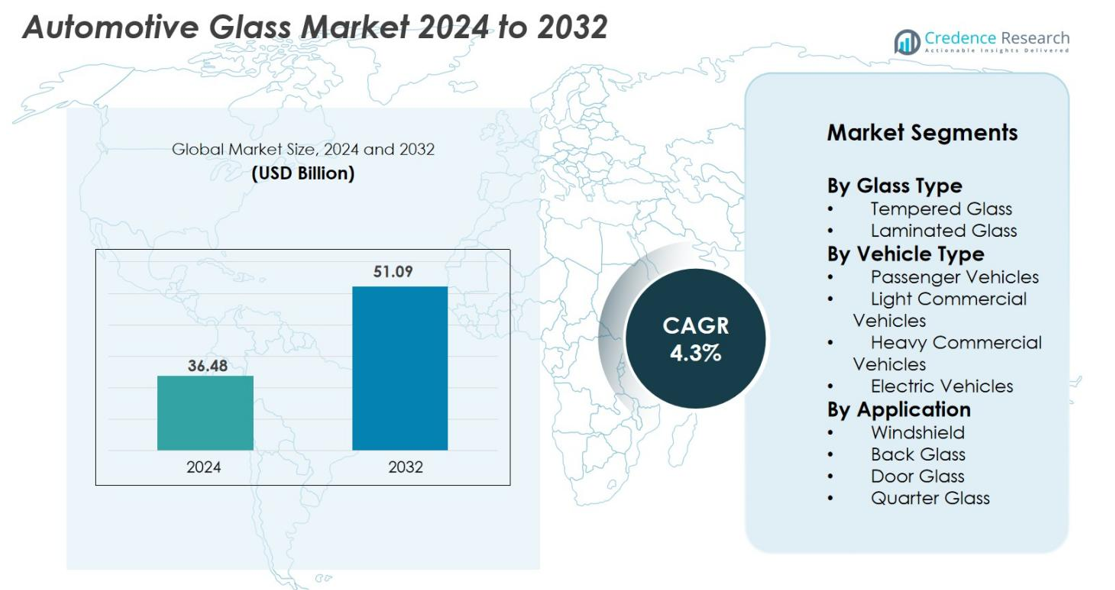
The Automotive Glass Market size was valued at USD 36.48 Billion in 2024 and is anticipated to reach USD 51.09 Billion by 2032, at a CAGR of 4.3% during the forecast period.
| REPORT ATTRIBUTE | DETAILS |
|---|---|
| Historical Period | 2020-2023 |
| Base Year | 2024 |
| Forecast Period | 2025-2032 |
| Automotive Glass Market Size 2024 | USD 36.48 Billion |
| Automotive Glass Market, CAGR | 4.3% |
| Automotive Glass Market Size 2032 | USD 51.09 Billion |
The Automotive Glass Market is driven by major players such as AGC Inc., Saint-Gobain Sekurit, Fuyao Glass Industry Group, Nippon Sheet Glass Co. Ltd., Xinyi Glass Holdings Limited, Pilkington (NSG Group), Asahi Glass Company, Guardian Industries, Vitro Automotive, and Shatterpruuf, all of which focus on advanced laminated, tempered, and smart glazing solutions. These companies strengthen their positions through OEM partnerships, technological innovation, and expanded production capacity. Asia-Pacific leads the market with over 38% share, supported by high automotive production and rapid EV adoption. North America and Europe follow with strong demand for ADAS-enabled windshields, safety-enhanced glass, and panoramic sunroof applications.
Market Insights
- The Automotive Glass Market was valued at USD 36.48 Billion in 2024 and is projected to reach USD 51.09 Billion by 2032, expanding at a CAGR of 4.3%.
- Market growth is driven by rising vehicle production, increasing adoption of laminated safety glass, and rapid integration of ADAS-compatible windshields across passenger and commercial vehicles.
- Key trends include the surge in panoramic sunroofs, smart glass technologies, solar-control coatings, and larger glazing surfaces, especially in electric vehicles.
- Leading players such as AGC Inc., Saint-Gobain Sekurit, Fuyao Glass, NSG Group, and Xinyi Glass strengthen the landscape through OEM collaborations and expansion in high-growth markets.
- Asia-Pacific holds the largest regional share at over 38%, followed by North America at 28% and Europe at 25%, while tempered glass leads by type with 58% share and passenger vehicles dominate by vehicle type with 67% share.
Market Segmentation Analysis
By Glass Type
The Automotive Glass Market by glass type is primarily driven by safety regulations, rising vehicle ownership, and the demand for enhanced impact resistance. Tempered glass dominates the segment with 58% market share in 2024, supported by its cost-effectiveness, rapid manufacturing cycles, and high shatter-resistance, making it the preferred choice for side and rear windows. Laminated glass continues to gain traction as OEMs adopt advanced windshield technologies such as HUDs and acoustic interlayers. Increasing adoption of ADAS, sensor-integrated windshields, and premium vehicle production further accelerates laminated glass usage during the forecast period.
- For instance, AGC Glass Brazil’s complex in Guaratinguetá operates float glass furnaces with a combined output of 1,450 tons of flat glass per day, supplying an integrated automotive glass plant that cuts and tempers glazing for regional OEM programs
By Vehicle Type
In the Automotive Glass Market by vehicle type, growth is fueled by expanding automotive production, rising EV penetration, and increased usage of high-performance glazing materials. Passenger vehicles lead the segment with 67% market share, supported by their large global production volume and high adoption of advanced laminated windshields and panoramic sunroofs. Light commercial vehicles continue to expand due to rising e-commerce logistics demand, while heavy commercial vehicles depend on durability-focused glass. Electric vehicles present the fastest growth, driven by aerodynamic designs and larger glass surfaces integrated for energy efficiency and structural rigidity.
- For instance, BMW equips the iX with a panoramic electrochromic glass roof measuring 1,058 mm × 1,130 mm, manufactured using a polymer-dispersed liquid crystal structure.
By Application
The Automotive Glass Market by application is shaped by rising safety standards, demand for improved cabin comfort, and the integration of smart glass technologies. Windshields dominate the application segment with 45% market share, owing to mandatory laminated glass usage, ADAS sensor placement, and increasing adoption of UV-blocking and noise-reducing interlayers. Back glass and door glass exhibit steady growth driven by vehicle production, while quarter glass benefits from premium vehicle styling. Advancements in panoramic glazing, solar-control coatings, and lightweight glass solutions further enhance demand across all application categories.
Key Growth Drivers
Rising Vehicle Production and Increasing Demand for Safety-Enhanced Glass
The Automotive Glass Market benefits significantly from the steady rise in global vehicle production, supported by urbanization, growing middle-class income, and expanding automotive manufacturing facilities across Asia-Pacific, Europe, and North America. The increasing preference for safety-enhanced glass has further strengthened market adoption, particularly with stricter safety standards mandating laminated windshields and tempered side and rear windows. OEMs are actively integrating impact-resistant, UV-protective, and noise-reducing glass to improve occupant safety and driving comfort. Additionally, the surge in passenger vehicle sales including SUVs and crossovers has boosted demand for large panoramic windshields and rear glass components. Advanced glass coatings, better heat insulation, and improved visibility features are also driving OEM investments. As consumers prioritize vehicle safety and comfort, the demand for laminated and multi-layered glazing systems continues to rise, reinforcing this driver’s importance during the forecast period.
- For instance, Hyundai's Ulsan manufacturing complex, the world's largest single automobile plant, has an annual production capacity of approximately 1.4 million vehicles (down from a past peak of 1.5 million or more). The facility produces various models, including the Palisade, which features an available large sunroof made of tempered glass to enhance cabin light ingress
Growing Integration of ADAS, HUDs, and Smart Windshield Technologies
Automotive glass is becoming a functional component rather than merely a structural accessory, driven by the rapid adoption of ADAS, Heads-Up Displays (HUDs), and sensor-integrated smart windshields. High-end windshield designs are increasingly incorporating cameras, lidar sensors, rain sensors, lane detection modules, and augmented reality projection systems to support advanced driving assistance. This technological shift demands laminated glass with high optical clarity, thermal stability, and smooth surface quality for accurate sensor performance. The rise of premium vehicles and EVs has amplified demand for intelligent glazing, including electrochromic and solar-control glass. OEMs and suppliers are collaborating on next-generation windshield technologies that deliver better visibility, improved safety, and enhanced digital integration. With the shift toward autonomous and connected vehicles accelerating, the role of smart windshields as an integral interface for sensors and projected displays continues to strengthen this growth driver.
- For instance, AGC’s lidar-compatible glazing (known as WAVEATTO™) uses a specialized infrared-transmitting layer or glass composition enabling near-infrared wavelengths (such as those around 905 nanometers) to pass through with nearly 100% light transmission, a significant improvement over standard automotive glass.
Expansion of Electric Vehicles and Increasing Use of Lightweight Panoramic Glazing
The rapid global adoption of electric vehicles has created a strong demand for lightweight, aerodynamic, and energy-efficient automotive glass. EV manufacturers increasingly rely on panoramic windshields, full-glass roofs, and larger glazing surfaces to enhance cabin openness and reduce vehicle weight, directly contributing to improved battery efficiency. Lightweight laminated glass and advanced composite glazing deliver structural rigidity while supporting the sleek, aerodynamic designs favored in modern EVs. Additionally, solar-control and heat-reflective coatings help minimize cabin heat buildup, reducing air-conditioning load and extending EV driving range. Many EV brands now use expansive glass roofs as a core design feature, further boosting market growth. As global EV sales continue accelerating, supported by government incentives and emissions regulations, glass suppliers are innovating to deliver high-strength, lightweight glazing systems optimized for electric platforms, making EV growth a major catalyst for the automotive glass industry.
Key Trends & Opportunities
Growing Adoption of Panoramic Sunroofs and Large-Format Glazing
A major trend shaping the Automotive Glass Market is the growing consumer preference for panoramic sunroofs and large-format glazing, driven by demand for enhanced aesthetics, improved cabin ambience, and premium vehicle styling. Automakers across all segments-from compact cars to luxury SUVs-are incorporating large glass roofs to differentiate their models and cater to lifestyle-focused consumers. This shift fuels demand for high-strength, UV-resistant, and heat-insulating glass capable of handling larger surface areas. The trend also opens opportunities for electrochromic smart roofs, providing adjustable light control and improved thermal comfort. As panoramic sunroofs transition from a luxury feature to mainstream adoption, glass manufacturers are innovating lightweight, multi-layered, and laminated roofing solutions. With large-glass designs supporting vehicle aerodynamics and visual appeal, panoramic glazing represents one of the most lucrative opportunities for suppliers over the forecast period.
- For instance, BMW’s iX features an electrochromic roof using polymer-dispersed liquid crystal (PDLC) technology capable of switching between transparent and opaque states in under 1 second across a viewing area of approximately 1 square meter.
Rising Innovation in Smart Glass, Electrochromic Glazing, and Solar-Control Technologies
Technological innovation presents significant growth opportunities, particularly in smart glass, electrochromic glazing, and solar-control technologies. Smart glass allows drivers to electronically adjust transparency, reduce glare, and improve cabin temperature regulation without mechanical shades. Electrochromic windshields and side windows enhance comfort and energy efficiency-especially in electric vehicles-by reducing reliance on air-conditioning systems. Solar-control coatings and infrared-reflective layers further advance passenger comfort by minimizing heat penetration, supporting sustainable mobility trends. With autonomous and connected vehicles demanding advanced visibility and digital integration, smart glazing featuring HUD compatibility and sensor-optimized surfaces is gaining momentum. These innovations align with regulatory pushes for energy efficiency and consumer demand for enhanced driving experience, making advanced glass technologies a key opportunity segment over the next decade.
- For instance, Research Frontiers’ SPD-SmartGlass technology enables variable tint control with switching speeds of approximately 1–3 seconds on automotive roof panels measuring up to 1,800 mm in length.
Key Challenges
High Manufacturing Costs and Complex Production Processes
One of the most significant challenges in the Automotive Glass Market is the high cost associated with the production of laminated, coated, and sensor-integrated glass. Advanced glazing systems require sophisticated technologies, including multi-layer lamination, precision coatings, and optical clarity enhancement, all of which increase manufacturing expenses. The integration of ADAS sensors into windshields adds further complexity, often requiring specialized calibration processes and costly replacements. High raw material costs-especially for specialty interlayers and coatings-compound the issue. Smaller suppliers struggle to match the technological and financial capabilities of larger players, creating industry-wide pressure. As OEMs push for lightweight, durable, and technology-enabled glass, production complexity continues to rise, posing a barrier to mass adoption in cost-sensitive markets.
Vulnerability to Breakage, Replacements Costs, and Infrastructure Limitations
Automotive glass remains vulnerable to breakage from impacts, extreme weather, temperature fluctuations, and road debris, leading to high replacement costs-especially for ADAS-enabled windshields that require recalibration. The complexity of smart and laminated glass increases repair times and often necessitates specialized technicians, creating service barriers in emerging markets. Additionally, large-format panoramic roofs and full-glass designs, while visually appealing, are more exposed to damage and stress. In many regions, the lack of widespread calibration infrastructure for ADAS-equipped windshields limits efficient replacements, affecting consumer adoption. These operational challenges create friction for both OEMs and vehicle owners, making durability and long-term performance key focus areas for the industry.
Regional Analysis
North America
North America holds a strong position in the Automotive Glass Market with 28% market share in 2024, driven by high vehicle ownership, strong demand for SUVs and pickup trucks, and rapid adoption of ADAS-enabled windshields. The presence of major OEMs in the U.S. and Canada supports continuous demand for laminated and tempered glazing solutions. Growth is further fueled by increasing sales of electric vehicles, which require larger, lightweight, and aerodynamic glass surfaces. Advancements in smart glass, heated windshields, and solar-control coatings also enhance market penetration. Replacement demand from aftermarket channels contributes significantly to steady regional growth.
Europe
Europe accounts for 25% market share of the Automotive Glass Market, supported by strong regulatory standards for vehicle safety and rising adoption of laminated glass across passenger and commercial vehicles. Germany, France, and the U.K. lead production, driven by their strong automotive manufacturing ecosystems and premium vehicle demand. The region is witnessing increasing integration of panoramic roofs, acoustic glass, and thermal-insulated glazing, driven by consumer preference for comfort and efficiency. Stringent environmental regulations and electrification trends further elevate the use of lightweight glass technologies. Continuous R&D investments by major European glass manufacturers strengthen the region’s competitive edge.
Asia-Pacific
Asia-Pacific dominates the Automotive Glass Market with over 38% market share in 2024, making it the largest and fastest-growing region. China, India, Japan, and South Korea drive demand due to high vehicle production volumes, expanding EV manufacturing, and rising disposable income. The region benefits from cost-effective manufacturing, large-scale OEM capacity, and growing adoption of premium features such as panoramic sunroofs and solar-control glass. Rapid urbanization and increasing car ownership support market expansion. Asia-Pacific’s strong supply chain, robust aftermarket demand, and government support for electric mobility continue to propel the adoption of laminated, tempered, and smart glazing technologies.
Latin America
Latin America captures 5% market share, driven by rising vehicle production in Brazil, Mexico, and Argentina and increasing consumer preference for affordable passenger cars. The region’s demand for tempered and laminated glass is influenced by extreme climate conditions, prompting adoption of UV-protected and solar-control glazing. Growing investments from international OEMs and aftermarket expansion further support market growth. While economic fluctuations limit premium adoption, EV introduction in select countries is expected to generate new opportunities for advanced glazing systems. Strengthening automotive manufacturing ecosystems in Mexico and Brazil continues to anchor the region’s demand for automotive glass solutions.
Middle East & Africa
The Middle East & Africa region holds close to 4% market share, supported by rising automobile imports, increasing demand for SUVs, and growing adoption of heat-resistant and solar-control automotive glass due to extreme temperatures. The UAE, Saudi Arabia, and South Africa are the key contributors. Infrastructure development, tourism-driven mobility demand, and the expansion of vehicle service networks support aftermarket consumption. Although manufacturing presence is limited, international OEMs and glass suppliers are focusing on regional partnerships. As EV adoption picks up gradually, demand for lightweight and high-insulation glazing solutions is expected to rise across premium and commercial vehicle categories.
Market Segmentations
By Glass Type
- Tempered Glass
- Laminated Glass
By Vehicle Type
- Passenger Vehicles
- Light Commercial Vehicles
- Heavy Commercial Vehicles
- Electric Vehicles
By Application
- Windshield
- Back Glass
- Door Glass
- Quarter Glass
By Geography
- North America
- U.S.
- Canada
- Mexico
- Europe
- Germany
- France
- U.K.
- Italy
- Spain
- Rest of Europe
- Asia Pacific
- China
- Japan
- India
- South Korea
- South-east Asia
- Rest of Asia Pacific
- Latin America
- Brazil
- Argentina
- Rest of Latin America
- Middle East & Africa
- GCC Countries
- South Africa
- Rest of the Middle East and Africa
Competitive Landscape
The Automotive Glass Market features a well-established competitive landscape characterized by strong global players, continuous technological innovation, and expanding OEM partnerships. Leading companies such as AGC Inc., Saint-Gobain Sekurit, Fuyao Glass Industry Group, Nippon Sheet Glass Co. Ltd., Xinyi Glass Holdings Limited, Asahi Glass Company, Pilkington (NSG Group), Guardian Industries, Vitro Automotive, and Shatterpruuf dominate the market through extensive manufacturing capabilities and diversified product portfolios. These players focus on developing advanced laminated, tempered, acoustic, and solar-control glazing solutions to meet rising safety and comfort requirements. Strategic investments in ADAS-compatible windshields, electrochromic glazing, and panoramic roof technologies strengthen their market presence. Many companies are expanding production facilities in Asia-Pacific to leverage cost advantages and rising vehicle demand. Long-term supply contracts with major automakers, strong aftermarket distribution networks, and continuous R&D in lightweight glass materials further shape the industry’s competitive dynamics, reinforcing leadership among top global manufacturers.
Key Player Analysis
- Vitro Automotive
- Xinyi Glass Holdings Limited
- Guardian Industries
- Fuyao Glass Market Group
- Saint-Gobain Sekurit
- Pilkington (NSG Group)
- Shatterpruuf
- AGC Inc.
- Nippon Sheet Glass Co. Ltd.
- Asahi Glass Company
Recent Developments
- In 2025, PGW Auto Glass acquired Dakotaland Autoglass, marking an expansion of its automotive-glass business.
- In July 2025, Gauzy launched the automotive industry’s first prefabricated smart‐glass stack for scalable manufacturing and high-volume vehicle adoption.
- In March 2024, PGW Auto Glass acquired AutoglassCRM, a provider of VIN-decoding services and point-of-sale software, to strengthen its digital installer services.
Report Coverage
The research report offers an in-depth analysis based on Glass Type, Vehicle Type, Application and Geography. It details leading market players, providing an overview of their business, product offerings, investments, revenue streams, and key applications. Additionally, the report includes insights into the competitive environment, SWOT analysis, current market trends, as well as the primary drivers and constraints. Furthermore, it discusses various factors that have driven market expansion in recent years. The report also explores market dynamics, regulatory scenarios, and technological advancements that are shaping the industry. It assesses the impact of external factors and global economic changes on market growth. Lastly, it provides strategic recommendations for new entrants and established companies to navigate the complexities of the market.
Future Outlook
- The market will increasingly shift toward laminated and advanced glazing solutions to support rising safety and comfort requirements.
- ADAS-integrated windshields and sensor-compatible glass will gain rapid adoption across all vehicle categories.
- Smart glass technologies, including electrochromic and solar-control glazing, will become mainstream in premium and electric vehicles.
- Demand for larger panoramic roofs and expansive glazing surfaces will continue to rise due to consumer preference for premium aesthetics.
- Lightweight glass materials will gain importance as automakers focus on improving fuel efficiency and EV range.
- EV growth will accelerate the use of aerodynamic, heat-insulating, and noise-reducing glass systems.
- OEM–supplier collaborations will strengthen to support advanced windshield calibration and integration needs.
- Aftermarket demand for replacement windshields, especially ADAS-enabled ones, will experience steady expansion.
- Asia-Pacific will remain the fastest-growing region, driven by vehicle production and EV manufacturing.
- Continuous R&D investments will drive innovations in durability, optical clarity, and energy-efficient glazing solutions.

Request a Free Sample
Fill in your details and we'll send you a free sample report.
- Sample data tables & charts
- Research methodology
Market Dynamics
Rising Vehicle Production and Safety-Enhanced Glass Demand
Global increases in vehicle production, especially in Asia-Pacific, are driving demand for automotive glass, with stricter safety standards mandating laminated windshields and tempered side and rear windows. OEMs are integrating impact-resistant, UV-protective, and noise-reducing glass to enhance occupant safety and comfort.
Integration of ADAS, HUDs, and Smart Windshield Technologies
The rapid adoption of ADAS, heads-up displays, and sensor-integrated windshields is transforming automotive glass into a functional component, requiring advanced laminated glass with high optical clarity and sensor compatibility. This trend is especially strong in premium and electric vehicles, fueling demand for intelligent glazing solutions.
Expansion of Electric Vehicles and Lightweight Panoramic Glazing
The shift toward electric vehicles is accelerating the use of lightweight, panoramic, and energy-efficient glass to improve battery efficiency and cabin openness. EV manufacturers are increasingly adopting large-format glazing and advanced coatings to support aerodynamic designs and reduce vehicle weight.
Growing Adoption of Panoramic Sunroofs and Large-Format Glazing
Consumer preference for panoramic sunroofs and expansive glazing is driving automakers to incorporate larger, high-strength, and UV-resistant glass surfaces, especially in SUVs and premium vehicles. This trend is creating new opportunities for innovative, multi-layered, and electrochromic glass solutions.
Technological Innovation in Smart, Electrochromic, and Solar-Control Glass
Advancements in smart glass, electrochromic glazing, and solar-control technologies are enabling features like variable tint, glare reduction, and improved thermal comfort. These innovations are increasingly demanded in both premium and electric vehicles, supporting regulatory and consumer trends toward energy efficiency and enhanced driving experience.
Need a Custom Version of This Report?
Tailor the scope, geography, or segments to your exact requirements.
- Custom geography or segment scope
- Direct access to our analyst team
Frequently Asked Questions
What is the current market size for Automotive Glass Market, and what is its projected size in 2032?
At what Compound Annual Growth Rate is the Automotive Glass Market projected to grow between 2025 and 2032?
Which vehicle type segment governs the demand for automotive glasss in the world?
Who are the major players in the global automotive glass market?
What are the major market drivers of the automotive glass industry?
What are the major market opportunities of the automotive glass industry?
Who are the leading companies in the Automotive Glass Market?
Table of Content
Chapter 1 Market Segmentation
- 1.1 Segmentation Framework
- 1.1.1 Product and Service Classification
- 1.1.2 Application and End-Use Classification
- 1.1.3 Technology and Solution Classification
- 1.1.4 Customer and Distribution Channel Classification
- 1.1.5 Geographic Segmentation
- 1.1.6 Market Segment Definitions and Boundaries
- 1.2 By Glass Type
- 1.2.1 Tempered Glass
- 1.2.2 Laminated Glass
- 1.3 By Application
- 1.3.1 Windshield
- 1.3.2 Back Glass
- 1.3.3 Door Glass
- 1.3.4 Quarter Glass
- 1.4 By Vehicle Type
- 1.4.1 Passenger Vehicles
- 1.4.2 Light Commercial Vehicles
- 1.4.3 Heavy Commercial Vehicles
- 1.4.4 Electric Vehicles
Chapter 2 Introduction
- 2.1 Report Objectives and Scope
- 2.2 Product Definition and Industry Terminology
- 2.3 Market Inclusions and Exclusions
- 2.4 Research Process
- 2.4.1 Primary Research and Expert Interviews
- 2.4.2 Secondary Research and Source Review
- 2.4.3 Top-Down and Bottom-Up Estimation
- 2.4.4 Data Triangulation and Verification
- 2.5 Market Size Measurement Basis
- 2.5.1 2024: USD 36.48 Billion → 2032: USD 51.09 Billion
- 2.6 Historical and Forecast Reference Periods
- 2.6.1 Base Year: 2024
- 2.6.2 Forecast Period: 2024-2032
- 2.7 Research Assumptions and Limitations
Chapter 3 Executive Summary
- 3.1 Market Snapshot and Key Findings
- 3.2 Base-Year Market Size, 2024
- 3.3 Forecast Market Size, 2032
- 3.4 Revenue and Volume Growth Outlook
- 3.5 Key Demand and Supply Indicators
- 3.6 Leading Market Segments
- 3.7 Fastest-Growing Market Opportunities
- 3.8 Regional Performance Highlights
- 3.9 Technology and Industry Transformation
- 3.10 Competitive Landscape Summary
- 3.11 Analyst View and Strategic Implications
Chapter 4 Global Automotive Glass Market Trends and Developments
- 4.1 Historical Industry Development
- 4.2 Recent Market Trends and Developments
- 4.3 Demand and Customer Behavior Trends
- 4.4 Technology and Product Innovation
- 4.5 Artificial Intelligence, Automation and Digitalization
- 4.6 Local Manufacturing and Supply Chain Realignment
- 4.7 Industry Partnerships, Mergers and Acquisitions
- 4.8 Sustainability and Circular Economy Developments
- 4.9 Government and Private Sector Investment Trends
- 4.10 Emerging Business Models and Commercialization
- 4.11 Industry Developments and Announcements
Chapter 5 Global Automotive Glass Market Production, Supply and Demand Analysis
- 5.1 Demand Trend and Consumption Analysis
- 5.2 Demand Forecast, 2024-2032
- 5.3 Production and Output Trend
- 5.4 Production and Output Forecast, 2024-2032
- 5.5 Installed Capacity and Capacity Utilization
- 5.6 Company-Wise Production Plants and Statistics
- 5.6.1 Installed Production Capacity
- 5.6.2 Actual Production
- 5.6.3 Planned Capacity and Expansion Targets
- 5.7 Supply Chain Structure and Procurement Trends
- 5.8 Supply-Demand Gap and Bottlenecks
- 5.9 Import Dependence and Sourcing Structure
- 5.10 Contract Manufacturing and Outsourcing
- 5.11 Regional Supply and Demand Concentration
Chapter 6 Global Automotive Glass Market Pricing Analysis
- 6.1 Pricing Structure and Measurement
- 6.2 Historical Pricing Trends
- 6.3 Pricing Outlook, 2024-2032
- 6.4 Average Selling Price and Unit Economics
- 6.5 Pricing by Product and Market Segment
- 6.6 Geographic Pricing Differences
- 6.7 Key Input, Energy, Labor and Logistics Costs
- 6.8 Contract Pricing and Purchasing Models
- 6.9 Pricing Sensitivity and Competitive Positioning
- 6.10 Price, Margin and Profitability Implications
Chapter 7 Global Automotive Glass Market Dynamics
- 7.1 Market Growth Drivers
- 7.1.1 Demand-Side Drivers
- 7.1.2 Technology and Innovation Drivers
- 7.1.3 Infrastructure and Investment Drivers
- 7.1.4 Regulatory and Policy Drivers
- 7.2 Market Restraints
- 7.2.1 Cost and Affordability Constraints
- 7.2.2 Technology and Adoption Barriers
- 7.2.3 Supply Chain and Operational Constraints
- 7.3 Market Challenges
- 7.3.1 Competitive Pressure and Margin Erosion
- 7.3.2 Skills, Infrastructure and Implementation Gaps
- 7.4 Emerging Market Opportunities
- 7.5 Market Dynamics Impact and Time-Horizon Assessment
Chapter 8 Global Automotive Glass Value Chain Analysis
- 8.1 Industry Value Chain Overview
- 8.2 Upstream Suppliers and Critical Inputs
- 8.3 Technology and Component Providers
- 8.4 Manufacturing or Service Delivery
- 8.5 Distribution, Channel Partners and Integrators
- 8.6 Downstream Applications and End Users
- 8.7 Value Addition and Profit Pools
- 8.8 Vertical Integration and Outsourcing
- 8.9 Supplier Concentration and Risk
- 8.10 Supply Chain Localization and Resilience
Chapter 9 Global Automotive Glass Market Regulations and Policies
- 9.1 Relevant Laws, Standards and Compliance Frameworks
- 9.2 Product, Service, Safety and Quality Requirements
- 9.3 Government Policies, Incentives and Subsidies
- 9.4 Imports, Exports and Trade Barriers
- 9.5 Public Procurement and Local Content Requirements
- 9.6 Environmental and Sustainability Compliance
- 9.7 Upcoming Policy Changes and Market Implications
Chapter 10 Global Automotive Glass Market Hotspots and Opportunities
- 10.1 Market Opportunity Mapping and Growth Hotspots
- 10.2 High-Growth Applications and Customer Groups
- 10.3 Underserved Markets and White-Space Opportunities
- 10.4 Emerging Technology and Product Opportunities
- 10.5 New Capacity and Investment Hotspots
- 10.6 Market Entry and Expansion Opportunities
- 10.7 Distribution and Partnership Opportunities
- 10.8 Near-Term and Long-Term Commercial Potential
- 10.9 Opportunity Attractiveness and Execution Risks
Chapter 11 Global Automotive Glass Market Outlook, 2024-2032
- 11.1 Market Size and Analysis
- 11.1.1 Revenue (Market Measurement: 2024: USD 36.48 Billion → 2032: USD 51.09 Billion)
- 11.1.2 Market Volume and Quantity Sold
- 11.1.3 Historical Market Size
- 11.1.4 Base-Year Market Size, 2024
- 11.2 Market Forecast, 2024-2032
- 11.2.1 Revenue Forecast to 2032
- 11.2.2 Volume Forecast to 2032
- 11.2.3 CAGR and Year-on-Year Growth
- 11.2.4 Incremental Revenue Opportunity
- 11.3 Forecast Assumptions and Scenario Analysis
- 11.3.1 Base-Case Forecast
- 11.3.2 Optimistic and Conservative Scenarios
- 11.3.3 Technology, Pricing and Policy Sensitivities
- 11.4 Market Attractiveness and Growth Outlook
Chapter 12 Global Automotive Glass Market Segmentation and Outlook
- 12.1 Segmentation Summary and Market Shares, 2024
- 12.2 Largest and Fastest-Growing Segments
- 12.3 By Glass Type - Market Size and Forecast, 2024-2032
- 12.3.1 Segment Definition and Scope
- 12.3.2 Historical Market Size
- 12.3.3 Revenue Forecast, 2024-2032
- 12.3.4 Volume Forecast, 2024-2032
- 12.3.5 Base-Year Market Share, 2024
- 12.3.6 Segment CAGR and Growth Drivers
- 12.3.7 Subsegment Market Size and Forecast
- 12.3.7.1 Tempered Glass
- 12.3.7.2 Laminated Glass
- 12.3.8 Subsegment Pricing and Adoption Trends
- 12.3.9 Leading Suppliers and Competition
- 12.3.10 Regional Demand and Opportunities
- 12.4 By Application - Market Size and Forecast, 2024-2032
- 12.4.1 Segment Definition and Scope
- 12.4.2 Historical Market Size
- 12.4.3 Revenue Forecast, 2024-2032
- 12.4.4 Volume Forecast, 2024-2032
- 12.4.5 Base-Year Market Share, 2024
- 12.4.6 Segment CAGR and Growth Drivers
- 12.4.7 Subsegment Market Size and Forecast
- 12.4.7.1 Windshield
- 12.4.7.2 Back Glass
- 12.4.7.3 Door Glass
- 12.4.7.4 Quarter Glass
- 12.4.8 Subsegment Pricing and Adoption Trends
- 12.4.9 Leading Suppliers and Competition
- 12.4.10 Regional Demand and Opportunities
- 12.5 By Vehicle Type - Market Size and Forecast, 2024-2032
- 12.5.1 Segment Definition and Scope
- 12.5.2 Historical Market Size
- 12.5.3 Revenue Forecast, 2024-2032
- 12.5.4 Volume Forecast, 2024-2032
- 12.5.5 Base-Year Market Share, 2024
- 12.5.6 Segment CAGR and Growth Drivers
- 12.5.7 Subsegment Market Size and Forecast
- 12.5.7.1 Passenger Vehicles
- 12.5.7.2 Light Commercial Vehicles
- 12.5.7.3 Heavy Commercial Vehicles
- 12.5.7.4 Electric Vehicles
- 12.5.8 Subsegment Pricing and Adoption Trends
- 12.5.9 Leading Suppliers and Competition
- 12.5.10 Regional Demand and Opportunities
- 12.6 Segment Growth Comparison
- 12.7 Segment Attractiveness and Priority Matrix
Chapter 13 Global Automotive Glass End-Use and Application Market Outlook
- 13.1 End-Use Industry and Customer Demand Structure
- 13.2 Leading Applications and Customer Groups
- 13.3 End-Use Market Size, Share and Forecast
- 13.4 Major End-Use Industry Deep Dives
- 13.4.1 Customer Requirements and Use Cases
- 13.4.2 Demand and Replacement Cycles
- 13.4.3 Technical and Regulatory Considerations
- 13.4.4 Purchasing and Procurement Models
- 13.4.5 Leading Vendors and Distribution Channels
- 13.4.6 Forecast and Commercial Opportunities
- 13.5 Emerging Applications and Cross-Segment Demand
- 13.6 End-Use Industry Investment Priorities
Chapter 14 Global Automotive Glass Geographic Market Outlook, 2024-2032
- 14.1 Regional Market Size and Share, 2024
- 14.2 Regional Market Forecast, 2024-2032
- 14.3 Regional Pricing, Production and Demand Differences
- 14.4 North America
- 14.4.1 United States
- 14.4.2 Canada
- 14.4.3 Mexico
- 14.5 Europe
- 14.5.1 Germany
- 14.5.2 France
- 14.5.3 Italy
- 14.5.4 United Kingdom
- 14.5.5 Spain
- 14.5.6 Poland
- 14.5.7 Russia
- 14.5.8 Netherlands
- 14.5.9 Belgium
- 14.5.10 Sweden
- 14.5.11 Denmark
- 14.5.12 Norway
- 14.5.13 Rest of Europe
- 14.6 Asia Pacific
- 14.6.1 China
- 14.6.2 India
- 14.6.3 Japan
- 14.6.4 South Korea
- 14.6.5 Thailand
- 14.6.6 Indonesia
- 14.6.7 Vietnam
- 14.6.8 Malaysia
- 14.6.9 Australia
- 14.6.10 Rest of Asia Pacific
- 14.7 Latin America
- 14.7.1 Brazil
- 14.7.2 Argentina
- 14.7.3 Colombia
- 14.7.4 Chile
- 14.7.5 Rest of Latin America
- 14.8 Middle East
- 14.8.1 Saudi Arabia
- 14.8.2 United Arab Emirates
- 14.8.3 Turkey
- 14.8.4 Israel
- 14.8.5 Iran
- 14.8.6 Rest of the Middle East
- 14.9 Africa
- 14.9.1 South Africa
- 14.9.2 Egypt
- 14.9.3 Nigeria
- 14.9.4 Morocco
- 14.9.5 Rest of Africa
- 14.10 Regional Investment, Policy and Supply Chain Differences
- 14.11 Regional Competitive Landscape
- 14.12 Geographic Growth Hotspots
Chapter 15 Global Automotive Glass Technology, Innovation and Sustainability Outlook
- 15.1 Technology Landscape and Maturity
- 15.2 Product, Process and Service Innovation
- 15.3 AI, Automation and Digital Tools in the Industry
- 15.4 Technology Adoption and Performance Benchmarking
- 15.5 Innovation Pipeline and R&D Investment
- 15.6 Patent and Intellectual Property Trends
- 15.7 Energy Efficiency and Resource Management
- 15.8 Sustainability, Recycling and Circularity
- 15.9 Technology Roadmap, 2024-2032
- 15.10 Risks of Obsolescence and Technology Substitution
Chapter 16 Global Automotive Glass Market Key Strategic Imperatives
- 16.1 Growth and Market Entry Priorities
- 16.2 High-Return Products and Segments
- 16.3 Pricing, Profitability and Cost Optimization
- 16.4 Technology Investment and Product Differentiation
- 16.5 Supply Chain Localization and Resilience
- 16.6 Distribution and Customer Acquisition
- 16.7 Partnership, Acquisition and Capacity Strategy
- 16.8 Regional Expansion Priorities
- 16.9 Short-, Medium- and Long-Term Actions
Chapter 17 Competition Outlook
- 17.1 Industry Competition Characteristics
- 17.2 Market Structure and Concentration
- 17.3 Market Share and Competitive Positioning, 2024
- 17.4 Company-Wise Revenue and Product Benchmarking
- 17.5 Production and Service Capacity Benchmarking
- 17.6 Technology, Pricing and Differentiation
- 17.7 Regional Footprint and Distribution Strength
- 17.8 Mergers, Acquisitions and Strategic Alliances
- 17.9 New Entrants and Competitive Threats
- 17.10 Porter's Five Forces and Industry Attractiveness
- 17.11 Competitive Outlook, 2024-2032
Chapter 18 Company Profiles
- 18.1 Company Coverage and Selection Criteria
- 18.2 AGC Inc.
- 18.2.1 Business Description
- 18.2.2 Company Ownership and Geographic Presence
- 18.2.3 Product and Service Portfolio
- 18.2.4 Manufacturing and Operating Footprint
- 18.2.5 Production Capacity and Expansion Plans
- 18.2.6 Financial Performance and Investment
- 18.2.7 Market Share and Competitive Position
- 18.2.8 Technology and Innovation Capabilities
- 18.2.9 Strategic Alliances or Partnerships
- 18.2.10 Recent Developments
- 18.2.11 Growth Strategy and Outlook
- 18.3 Saint-Gobain Sekurit
- 18.4 Fuyao Glass Industry Group
- 18.5 Nippon Sheet Glass Co. Ltd.
- 18.6 Xinyi Glass Holdings Limited
- 18.7 Pilkington (NSG Group)
- 18.8 Asahi Glass Company
- 18.9 Guardian Industries
- 18.10 Vitro Automotive
- 18.11 Shatterpruuf
- 18.12 Other Relevant Market Participants
Note: Every listed company is profiled on the structure shown under the first company. The company list is preliminary and may change based on research findings, market developments, data availability and client requirements.
Chapter 19 Disclaimer
- 19.1 Research and Forecast Disclaimer
- 19.2 Data Source and Estimation Limitations
Note: The depth of individual sections depends on data availability for this market. Volume, capacity, trade and other unit-based metrics are included where applicable.