
Market Overview
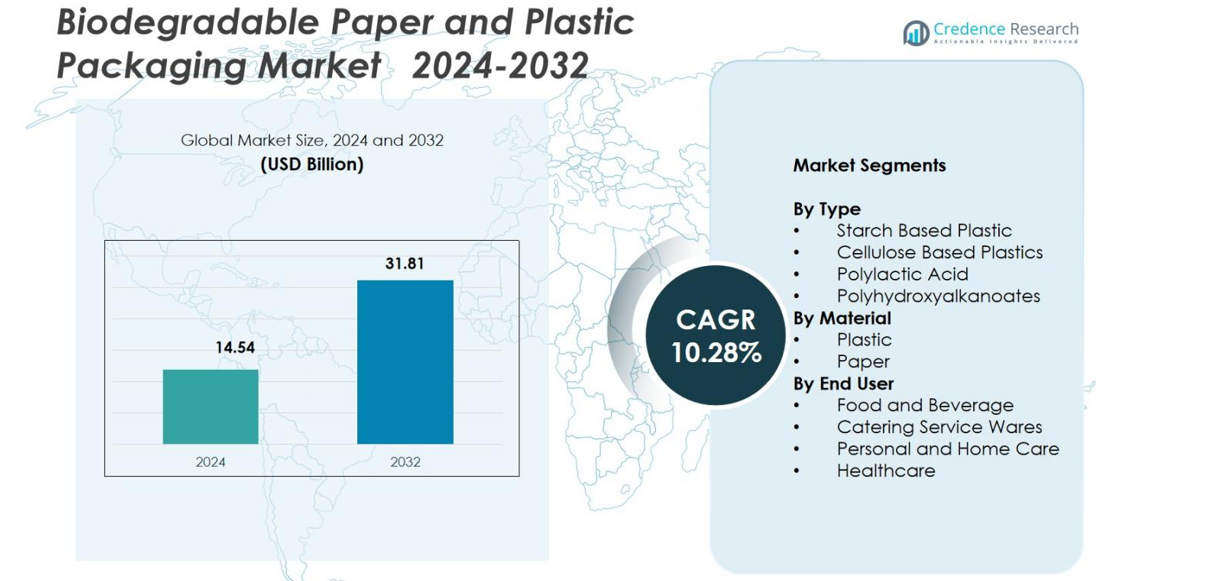
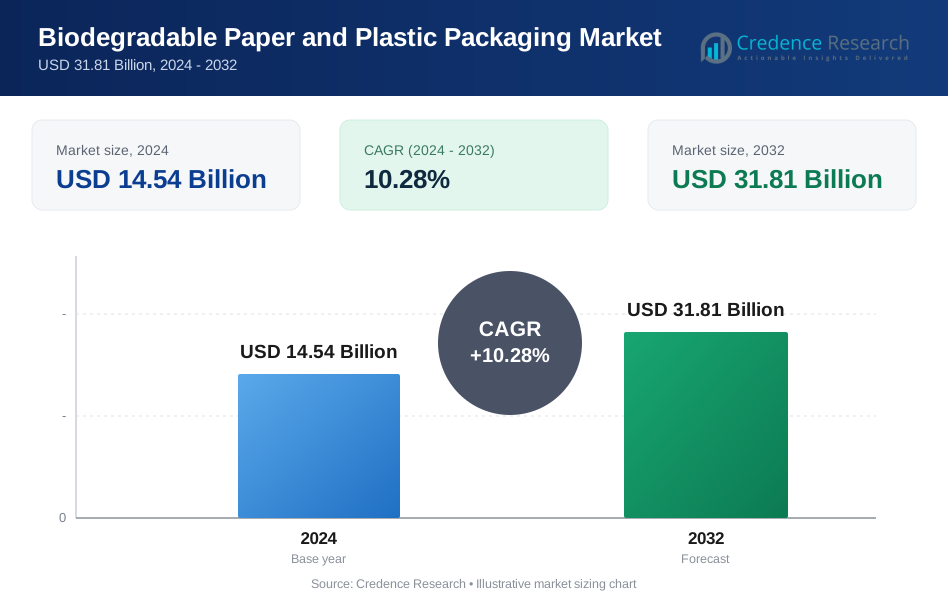
Biodegradable Paper and Plastic Packaging Market size was valued at USD 14.54 Billion in 2024 and is anticipated to reach USD 31.81 Billion by 2032, at a CAGR of 10.28% during the forecast period.
| REPORT ATTRIBUTE | DETAILS |
|---|---|
| Historical Period | 2020-2023 |
| Base Year | 2024 |
| Forecast Period | 2025-2032 |
| Biodegradable Paper and Plastic Packaging Market Size 2024 | USD 14.54 Billion |
| Biodegradable Paper and Plastic Packaging Market, CAGR | 10.28% |
| Biodegradable Paper and Plastic Packaging Market Size 2032 | USD 31.81 Billion |
Biodegradable Paper and Plastic Packaging Market features strong participation from global sustainability-focused packaging manufacturers, with Amcor plc, Mondi Group, Tetra Pak International SA, Kruger Inc., SmartSolve Industries, Ultra Green Sustainable Packaging, Eurocell S.r.l., and Hosgör Plastik emerging as prominent players driving innovation in fiber-based and compostable materials. Europe led the market in 2024 with a 35.7% share, supported by stringent environmental regulations and advanced recycling and composting infrastructure. North America followed with a 28.4% share, driven by expanding foodservice and e-commerce demand, while Asia-Pacific accounted for 27.1% due to rapid regulatory reforms and rising consumer interest in sustainable packaging.
Market Insights
- The Biodegradable Paper and Plastic Packaging Market was valued at USD 14.54 Billion in 2024 and is projected to reach USD 31.81 Billion by 2032, advancing at a CAGR of 10.28%.
- Growing regulatory pressure to phase out single-use plastics and rising adoption across food and beverage applications, which held the largest segment share at 44.9% in 2024, strongly drive market expansion.
- Increasing demand for compostable and fiber-based materials, along with innovations in PLA, PHA, and coated paper technologies, shapes key market trends as brands prioritize sustainability-focused packaging formats.
- Key players, including Amcor plc, Mondi Group, Tetra Pak, Kruger Inc., and SmartSolve Industries, enhance market competitiveness by investing in biodegradable polymers, molded fiber solutions, and recyclable paper packaging developments.
- Europe led the market with a 35.7% regional share in 2024, followed by North America at 28.4% and Asia-Pacific at 27.1%, reflecting strong regulatory support, advanced infrastructure, and rising consumer preference for sustainable packaging.
Market Segmentation Analysis
By Type
In the Biodegradable Paper and Plastic Packaging market, starch-based plastic dominated the segment with a 38.2% share in 2024, driven by its low cost, easy processability, and strong alignment with compostability regulations. Its adoption accelerates across single-use items, flexible packaging, and food-contact applications. Polylactic acid (PLA) and cellulose-based plastics are also gaining traction due to renewable sourcing and improved performance characteristics, while polyhydroxyalkanoates (PHA) expands in premium niches requiring high biodegradability, particularly in marine and medical environments.
- For instance, NatureWorks’ Ingeo PLA portfolio, produced at 150,000 metric tons per year with an additional 75,000-ton PLA plant under construction in Thailand, is widely deployed in compostable coffee capsules, flexible films, and food-service packaging, including new grades such as Ingeo Extend 4950D for coffee capsules and single-portion packets.
By Material
Paper remained the leading material category with a 56.7% market share in 2024, supported by expanding demand for recyclable, fiber-based packaging and global restrictions on single-use plastics. Its cost efficiency, strong printability, and suitability for foodservice, e-commerce, and retail applications reinforce its dominance. Biodegradable plastics continue to grow but face higher production costs and performance trade-offs, prompting innovation in coated paper, high-barrier fiber materials, and molded pulp solutions that further enhance uptake across major industries.
- For instance, Mondi introduced its FunctionalBarrier paper range, a recyclable high-barrier paper designed for dry foods, frozen items, and consumer goods.
By End User
The food and beverage sector led the end-user segment with a 44.9% share in 2024, driven by rising adoption of compostable trays, wrappers, containers, and takeaway packaging aligned with sustainability mandates. Catering service wares also show strong momentum as restaurants and cloud kitchens transition to eco-conscious disposables. Personal and home care brands increasingly adopt biodegradable pouches and fiber-based bottles, while healthcare applications expand with sterile, bio-based packaging formats that reduce medical waste, collectively strengthening demand across diverse end-use industries.
Key Growth Drivers
Rapid Regulatory Enforcement and Phase-Out of Single-Use Plastics
Governments worldwide are accelerating bans, taxes, and extended producer responsibility (EPR) mandates that restrict traditional petroleum-based plastics, significantly boosting adoption of biodegradable paper and plastic packaging. These policies push manufacturers, retailers, and foodservice operators to transition toward compostable, recyclable, and fiber-based alternatives. The EU Single-Use Plastics Directive, India’s single-use plastic ban, and U.S. state-level compostability rules drive large-scale packaging redesigns. Companies invest in certified materials, eco-labeling, and sustainable sourcing to remain compliant. As countries strengthen circular-economy frameworks and carbon-reduction targets, stringent regulatory pressure continues to anchor long-term demand for biodegradable packaging across FMCG, food delivery, e-commerce, and retail ecosystems.
- For instance, India’s nationwide ban on selects single-use plastics in July 2022, FMCG players and quick-service restaurants switched to molded fiber trays, paper cups, and compostable bags, with several states enforcing strict compliance checks on manufacturers and distributors.
Rising Consumer Demand for Sustainable and Eco-Conscious Packaging
Growing environmental awareness among consumers remains a decisive driver for biodegradable packaging adoption. Shoppers increasingly link sustainable packaging to brand responsibility, product quality, and environmental stewardship, compelling FMCG and retail companies to replace conventional plastics with biodegradable alternatives. Younger demographics especially millennials and Gen Z prefer packaging made from renewable sources such as PLA, starch blends, cellulose fibers, and recycled paper. This shift is most visible in food delivery, organic foods, cosmetics, and premium personal care segments where sustainability strongly influences purchase decisions. Brands enhance customer loyalty by promoting compostable, recyclable, and bio-based packaging. As ESG-aligned purchasing behavior expands globally, consumer-driven demand significantly strengthens market growth.
- For instance, L’Oréal introduced its paper-based cosmetic tubes developed with Albéa, replacing a significant portion of plastic with responsibly sourced fiber material directly responding to rising consumer preference for low-carbon, bio-based packaging.
Technological Advancements in Biodegradable Materials and Processing
Innovations in material science and processing technologies are drastically improving the performance, durability, and commercial viability of biodegradable packaging. Breakthroughs in coated paper barriers, multilayer compostable films, nanocellulose coatings, enhanced PLA blends, and PHA fermentation systems are enabling biodegradable materials to replace petroleum-based plastics in high-barrier applications. These advancements enhance moisture resistance, heat stability, and mechanical strength, expanding use in refrigerated items, foodservice wares, healthcare disposables, and personal care packaging. Upgraded manufacturing processes reduce costs, increase throughput, and support mass adoption. Certification systems, lifecycle assessment tools, and eco-design guidelines streamline regulatory compliance. As R&D investments accelerate, technological progress continues unlocking new market opportunities.
Key Trends & Opportunities
Acceleration of Circular Economy Integration and Composting Infrastructure
A major trend reshaping the biodegradable packaging market is the rapid expansion of circular economy frameworks that emphasize material recovery, composting, and renewable feedstock adoption. Governments and private companies are investing in municipal composting plants, organic waste collection, and closed-loop recycling systems, making biodegradable packaging more practical and scalable. Foodservice chains and retailers increasingly deploy compostable service ware, molded fiber trays, and collection programs for in-store waste. Collaborations among waste-management firms, polymer producers, and sustainability initiatives accelerate infrastructure growth. As circular systems mature, biodegradable packaging becomes more accessible, cost-efficient, and aligned with global sustainability goals, creating major long-term opportunities.
- For instance, Starbucks expanded its circular pilot programs by introducing compostable cups and establishing in-store cup-collection systems in select North American and European cities, working with local composters to ensure certified materials enter proper processing facilities.
Expansion of Premium Fiber-Based and High-Barrier Biodegradable Solutions
The market presents strong opportunities in advanced biodegradable solutions that match or exceed the barrier properties of traditional plastics. High-performance coated papers, plant-based laminates, nanocellulose films, and hybrid bio-polymers support oxygen, grease, and moisture resistance, enabling adoption in premium food items, beverages, cosmetics, and pharmaceuticals. Molded fiber packaging is replacing rigid plastics in electronics, luxury goods, and personal care due to its premium aesthetics and strong sustainability appeal. As brands seek visually distinctive, high-barrier packaging that enhances eco-conscious branding, suppliers developing specialty fibers, coated paper technologies, and compostable laminates are positioned to capitalize on these emerging opportunities.
- For instance, Stora Enso commercialized MFC (microfibrillated cellulose) barrier papers that provide enhanced grease and oxygen resistance, supporting applications in confectionery, snack packaging, and dry foods previously dominated by plastic laminates.
Key Challenges
High Production Costs and Limited Economies of Scale
Despite rising demand, biodegradable packaging materials remain significantly more expensive to produce than conventional plastics. Biopolymers like PLA and PHA require specialized fermentation or polymerization processes, while high-barrier coated papers incur additional processing costs. Limited large-scale manufacturing capacity prevents economies of scale, making biodegradable options challenging for low-margin industries and small businesses. Rising raw material prices, energy usage in processing, and certification requirements further elevate costs. These pricing constraints slow adoption in mass foodservice and in developing markets. Until manufacturing capacity expands and production costs decline, affordability will remain a major barrier to widespread deployment.
Inadequate Composting and Recycling Infrastructure in Many Regions
A critical challenge hindering the full potential of biodegradable packaging is the lack of adequate industrial composting, material segregation systems, and standardized disposal pathways. Many biodegradable and compostable materials require controlled conditions to degrade efficiently, yet several regions lack certified composting facilities or municipal organic-waste programs. Misclassification of materials such as confusion between biodegradable, recyclable, and compostable formats leads to improper disposal, contamination of recycling streams, and reduced environmental benefit. Without stronger waste-management reforms, consumer education, and infrastructure investment, biodegradable packaging cannot achieve optimal performance, limiting adoption across global markets.
Regional Analysis
North America
North America held a 28.4% share in 2024, driven by strong regulatory actions, rising consumer preference for sustainable packaging, and rapid adoption across foodservice, e-commerce, and personal care industries. The U.S. market leads due to state-level compostability mandates, brand commitments to plastic reduction, and expanding biopolymer manufacturing capacity. Growth is further supported by corporate ESG initiatives and increasing availability of certified compostable packaging. Canada’s national waste-reduction policies also accelerate adoption, while expanding municipal composting infrastructure enhances feasibility for large-scale biodegradable packaging deployment across multiple sectors.
Europe
Europe dominated the global market with a 35.7% share in 2024, supported by stringent EU regulations, advanced recycling systems, and widespread consumer acceptance of sustainable materials. The region’s leadership stems from the Single-Use Plastics Directive, circular-economy initiatives, and strong demand from food and beverage brands shifting to fiber-based and compostable formats. Countries such as Germany, France, Italy, and the Netherlands exhibit high adoption rates due to well-developed composting networks and industry collaborations. Continuous investment in bio-based polymers and coated paper technologies reinforces Europe’s position as the primary hub for biodegradable packaging innovation.
Asia-Pacific
Asia-Pacific accounted for a 27.1% share in 2024, driven by rapid urbanization, government bans on single-use plastics, and expanding food delivery and retail sectors. China, India, Japan, and South Korea are key markets adopting biodegradable packaging to address waste-management pressures and environmental concerns. India’s nationwide plastic ban and China’s aggressive phase-out policies significantly accelerate market growth. Strong manufacturing capabilities, rising consumer awareness, and increasing foreign investments in biopolymer production support regional expansion. The booming e-commerce ecosystem further increases demand for biodegradable alternatives in flexible packaging, molded fiber solutions, and foodservice disposables.
Latin America
Latin America captured a 5.8% market share in 2024, with growth driven by rising sustainability awareness, expanding foodservice industries, and government-led restrictions on single-use plastic items. Brazil, Mexico, and Chile lead adoption as retailers and FMCG companies transition toward compostable bags, molded fiber containers, and paper-based packaging. Infrastructure limitations slow large-scale deployment, yet increasing investment in recycling and composting facilities helps unlock future opportunities. Regional consumers increasingly prefer eco-friendly products, prompting manufacturers to explore cost-effective biodegradable materials suited to local markets and environmental regulations.
Middle East & Africa
The Middle East & Africa region held a 3.0% share in 2024, characterized by evolving regulatory frameworks, emerging sustainability initiatives, and growing interest in reducing plastic pollution. The UAE, Saudi Arabia, and South Africa spearhead adoption through bans on non-biodegradable bags and initiatives promoting compostable and recyclable packaging. While infrastructure gaps remain, rising environmental concerns and national waste-reduction strategies stimulate demand. The retail, hospitality, and foodservice sectors increasingly integrate biodegradable packaging, while partnerships with international material suppliers help expand availability of premium fiber-based and bio-based plastics across the region.
Market Segmentations
By Type
- Starch Based Plastic
- Cellulose Based Plastics
- Polylactic Acid
- Polyhydroxyalkanoates
By Material
- Plastic
- Paper
By End User
- Food and Beverage
- Catering Service Wares
- Personal and Home Care
- Healthcare
By Geography
- North America
- U.S.
- Canada
- Mexico
- Europe
- Germany
- France
- U.K.
- Italy
- Spain
- Rest of Europe
- Asia Pacific
- China
- Japan
- India
- South Korea
- South-east Asia
- Rest of Asia Pacific
- Latin America
- Brazil
- Argentina
- Rest of Latin America
- Middle East & Africa
- GCC Countries
- South Africa
- Rest of the Middle East and Africa
Competitive Landscape
The competitive landscape of the Biodegradable Paper and Plastic Packaging market is characterized by strong participation from global packaging manufacturers, biopolymer producers, and fiber-based material innovators focused on expanding sustainable product portfolios. Key players such as Amcor plc, Mondi Group, Tetra Pak International SA, Kruger Inc., SmartSolve Industries, Ultra Green Sustainable Packaging, Eurocell S.r.l., and Hosgör Plastik actively invest in advanced biodegradable materials, coated paper technologies, and high-barrier compostable films to meet rising regulatory and consumer demands. Companies prioritize R&D to enhance performance attributes, reduce production costs, and offer scalable, eco-friendly alternatives for foodservice, e-commerce, personal care, and retail sectors. Strategic partnerships, capacity expansions, and certifications such as industrial compostability and recyclable fiber-grade validation strengthen market positioning. Growing competition encourages innovation in starch-based plastics, PLA, PHA, molded fiber solutions, and recyclable paper formats, enabling suppliers to address diverse application requirements and differentiate through sustainability-driven value propositions.
Key Player Analysis
- SmartSolve Industries
- Mondi
- Eurocell S.r.l
- Amcor PLC
- Riverside Paper Co. Inc.
- Ultra Green Sustainable Packaging
- Özsoy Plastik
- Kruger Inc.
- Hosgör Plastik
- Tetra Pak International SA
Recent Developments
- In September 2025, Xampla (UK) raised USD 14 million to scale its plant-protein-derived biodegradable alternatives to single-use plastics including packaging linings, films and sachets.
- In August 2025, BioPak acquired Queensland-based eco-friendly packaging supplier Bygreen, expanding its sustainable packaging offerings including biodegradable paper straws and compostable packaging.
- In March 2025, Green Lab a Southeast Asia based sustainable packaging company officially entered the U.S. market with its FSC-certified 100% recycled paper bags and biodegradable food packaging.
Report Coverage
The research report offers an in-depth analysis based on Type, Material, End-User and Geography. It details leading market players, providing an overview of their business, product offerings, investments, revenue streams, and key applications. Additionally, the report includes insights into the competitive environment, SWOT analysis, current market trends, as well as the primary drivers and constraints. Furthermore, it discusses various factors that have driven market expansion in recent years. The report also explores market dynamics, regulatory scenarios, and technological advancements that are shaping the industry. It assesses the impact of external factors and global economic changes on market growth. Lastly, it provides strategic recommendations for new entrants and established companies to navigate the complexities of the market.
Future Outlook
- The market will grow steadily as global policies increasingly restrict single-use plastics and promote sustainable packaging adoption.
- Advances in PLA, PHA, and high-barrier coated paper technologies will broaden functional applications across industries.
- Food and beverage, e-commerce, and personal care sectors will intensify their shift toward biodegradable packaging solutions.
- Larger production capacities and process optimization will help reduce manufacturing costs over time.
- Expansion of composting and recycling infrastructure will improve end-of-life management and market feasibility.
- Companies will focus on eco-design, lightweight materials, and circular packaging strategies to meet ESG goals.
- Strategic collaborations among material developers, converters, and FMCG brands will accelerate innovation and adoption.
- Consumer demand for compostable, fiber-based, and renewable packaging formats will influence packaging choices.
- Asia-Pacific will record strong growth due to regulatory reforms, sustainability programs, and urban consumption patterns.
- Emerging hybrid bio-materials and premium molded fiber solutions will create new opportunities in high-value packaging segments.
Request a Free Sample
Fill in your details and we'll send you a free sample report.
- Sample data tables & charts
- Research methodology
Need a Custom Version of This Report?
Tailor the scope, geography, or segments to your exact requirements.
- Custom geography or segment scope
- Direct access to our analyst team
Frequently Asked Questions
What is the current market size for Biodegradable Paper and Plastic Packaging Market, and what is its projected size in 2032?
At what Compound Annual Growth Rate is the Biodegradable Paper and Plastic Packaging Market projected to grow between 2024 and 2032?
Which are the leading region of the biodegradable paper and plastic packaging market?
What are the key drivers for the growth of the biodegradable paper and plastic packaging market?
Which are the major segment in the biodegradable paper and plastic packaging market by application?
Who are the leading companies in the Biodegradable Paper and Plastic Packaging Market?
Table of Content
Chapter 1. Report Introduction
- 1.1 Report Description & Purpose
- 1.1.1 Report Title & Market Definition
- 1.1.2 Unique Selling Propositions (USP) & Key Differentiators
- 1.1.3 Value Proposition for Stakeholders
- 1.2 Research Objectives
- 1.2.1 Market Sizing Objectives (Volume & Revenue)
- 1.2.2 Segmentation Objectives
- 1.2.3 Competitive Intelligence Objectives
- 1.2.4 Forecast & Scenario Objectives
- 1.3 Report Scope
- 1.3.1 Biodegradable Paper and Plastic Packaging Scope – Types & Subtypes Covered
- 1.3.2 Geographic Scope – Regions & Countries Covered
- 1.3.3 Historical Period, Base Year & Forecast Period (2024; forecast to 2032)
- 1.3.4 Inclusions & Exclusions
- 1.4 HS Code & Classification Framework
- 1.5 Currency, Units & Pricing Basis
- 1.6 Target Stakeholders
- 1.7 Limitations & Assumptions
Chapter 2. Executive Summary
- 2.1 Global Biodegradable Paper and Plastic Packaging Market Snapshot
- 2.1.1 Market Size – Historical (2024) & Forecast (2024-2032) (2024: USD 14.54 Billion → 2032: USD 31.81 Billion)
- 2.1.2 Volume & Revenue – Global Totals
- 2.1.3 Key Market Highlights – Top Five Facts
- 2.2 Biodegradable Paper and Plastic Packaging Market Segmentation Snapshot
- 2.2.1 Market Split by Region – 2024 vs. 2032
- 2.3 Competitive Snapshot
- 2.3.1 Top 10 Players by Revenue Share – 2024
- 2.3.2 Top 10 Players by Volume Share – 2024
- 2.3.3 Recent Strategic Developments (18-Month Summary)
- 2.4 Key Investment Highlights & Strategic Conclusions
Chapter 3. Biodegradable Paper and Plastic Packaging Market Dynamics & Industry Analysis
- 3.1 Market Overview & Context
- 3.1.1 Biodegradable Paper and Plastic Packaging Market Position in the Broader Automotive Value Chain
- 3.1.2 OEM vs. Replacement Market Dynamics
- 3.1.3 Market Maturity & Development Stage by Region
- 3.2 Biodegradable Paper and Plastic Packaging Market Drivers
- 3.3 Biodegradable Paper and Plastic Packaging Market Restraints & Challenges
- 3.4 Biodegradable Paper and Plastic Packaging Market Opportunities
- 3.5 Porter's Five Forces Analysis
- 3.5.1 Threat of New Entrants
- 3.5.2 Bargaining Power of Suppliers
- 3.5.3 Bargaining Power of Buyers
- 3.5.4 Threat of Substitutes
- 3.5.5 Competitive Rivalry – Intensity Assessment
- 3.6 Biodegradable Paper and Plastic Packaging Value Chain Analysis
- 3.6.1 Upstream – Raw Material/Input Suppliers
- 3.6.1.1 Raw Material/Input 1
- 3.6.1.2 Raw Material/Input 2
- 3.6.1.3 Raw Material/Input 3
- 3.6.2 Midstream – Production/Manufacturing/Service Delivery
- 3.6.2.1 Production/Process Overview
- 3.6.2.2 Key Facility Locations & Capacity by Manufacturer
- 3.6.3 Downstream – Distribution & End Consumer
- 3.6.3.1 Primary Channel – B2B/OEM
- 3.6.3.2 Secondary Channels – Dealer, Retail, Online, Direct
- 3.6.4 Value Chain Profitability Analysis
- 3.6.1 Upstream – Raw Material/Input Suppliers
- 3.7 PESTEL Analysis
- 3.7.1 Political Factors
- 3.7.2 Economic Factors
- 3.7.3 Social Factors
- 3.7.4 Technological Factors
- 3.7.5 Environmental Factors
- 3.7.6 Legal Factors
- 3.8 Biodegradable Paper and Plastic Packaging Supply Chain Analysis
- 3.8.1 Raw Material/Input Supply Risk Assessment
- 3.8.2 Manufacturing Concentration Risk (Geographic Exposure)
- 3.8.3 Trade Disruption Impact Analysis
- 3.9 Regulatory & Policy Landscape
Note: The regulatory and policy landscape section covers regulations based on their applicability to the market, Biodegradable Paper and Plastic Packaging category, geography, and scope of the study. Only regulatory frameworks with a material impact on operations, compliance, trade, sustainability, or market access are analyzed in detail.
Chapter 4. Key Investment Pockets & Opportunity Analysis
- 4.1 Biodegradable Paper and Plastic Packaging Market Attractiveness Analysis
- 4.1.1 By Region – Investment Attractiveness Matrix (Volume × CAGR)
- 4.2 Absolute Revenue Growth Opportunity
- 4.2.1 By Region – Absolute USD Growth Through 2032
- 4.3 Incremental Volume Opportunity
- 4.3.1 By Region – Incremental Volume Through 2032
- 4.3.2 Segment – Incremental Volume
- 4.4 Emerging Submarket Opportunity Deep Dive (Subject to Applicability)
- 4.5 Emerging Market Opportunity Scorecards
- 4.5.1 United States
- 4.5.2 Europe
- 4.5.3 Asia
- 4.5.4 Middle East & Africa
Note: Emerging Market Opportunity Scorecards will be included based on relevance and strategic importance. Regions listed are indicative and may vary depending on data availability and market dynamics.
Chapter 5. Biodegradable Paper and Plastic Packaging Import-Export Analysis & Trade Flows
- 5.1 Global Trade Overview
- 5.1.1 Global Export Value by Country (2024)
- 5.1.2 Global Export Volume by Country (2024)
- 5.1.3 Global Import Value by Country (2024)
- 5.1.4 Global Import Volume by Country (2024)
- 5.1.5 Net Trade Balance by Country (2024)
- 5.2 Export Analysis – Segment
- 5.2.1 Type 1 (HS Code)
- 5.2.2 Type 2 (HS Code)
- 5.2.3 Type 3 (HS Code)
- 5.2.4 Type 4 (HS Code)
- 5.2.5 Type 5 (HS Code)
- 5.3 Import Analysis – Segment
- 5.3.1 Type 1 (HS Code)
- 5.3.2 Type 2 (HS Code)
- 5.3.3 Type 3 (HS Code)
- 5.3.4 Type 4 (HS Code)
- 5.3.5 Type 5 (HS Code)
- 5.4 Average Unit Trade Prices
- 5.4.1 Average Export Price – Segment & Country
- 5.4.2 Average Import Price – Segment & Source Country
- 5.4.3 Price Trends (2024)
- 5.5 Key Trade Route Analysis
- 5.5.1 Trade Route 1
- 5.5.2 Trade Route 2
- 5.5.3 Trade Route 3
- 5.5.4 Trade Route 4
- 5.5.5 Trade Route 5
- 5.6 Trade Policy Impact Assessment
- 5.6.1 US Anti-Dumping & Section 301 Tariffs
- 5.6.2 EU Customs Union Impact
- 5.6.3 Major Free Trade Agreements
- 5.6.4 USMCA Rules of Origin
Note: Trade policy analysis will be included only where relevant to the Biodegradable Paper and Plastic Packaging market.
Chapter 6. Competitive Landscape & Company Benchmarking
- 6.1 Biodegradable Paper and Plastic Packaging Market Concentration & Structure
- 6.1.1 Herfindahl-Hirschman Index (HHI) – vs. 2024
- 6.1.2 Tier 1, Tier 2 & Tier 3 Market Structure
- 6.1.3 Global, Regional & Local Player Dynamics
- 6.2 Biodegradable Paper and Plastic Packaging Market Share Analysis – 2024
- 6.2.1 Global Revenue Share by Company
- 6.2.2 Global Volume Share by Company
- 6.2.3 Regional Revenue Share
- 6.2.4 Market Share Evolution ( vs. 2024)
- 6.2.5 OEM Segment Share by Company
- 6.2.6 Replacement Segment Share by Company
- 6.3 Production/Delivery Capacity & Facility Analysis
- 6.3.1 Global Installed Capacity
- 6.3.2 Capacity Utilization Rates
- 6.3.3 Production/Output Volume
- 6.3.4 Facility Locations & Capacity Map
- 6.3.5 Planned Capacity Additions
- 6.4 Biodegradable Paper and Plastic Packaging Competitive Benchmarking Matrix
- 6.4.1 Revenue, Volume, CAGR & Profitability Comparison
- 6.4.2 Channel Revenue Mix
- 6.4.3 Geographic Revenue Exposure
- 6.4.4 R&D Intensity
- 6.4.5 Sustainability Maturity
- 6.5 Strategic Developments in Biodegradable Paper and Plastic Packaging (Last 24 Months)
- 6.5.1 Mergers, Acquisitions & Divestments
- 6.5.2 New Biodegradable Paper and Plastic Packaging Launches
- 6.5.3 Facility Expansions
- 6.5.4 Strategic Alliances, Joint Ventures & Partnerships
- 6.5.5 Distribution Expansion & Market Entry
- 6.5.6 Sustainability & ESG Initiatives
- 6.6 Competitive Strategy Mapping
- 6.6.1 Leader, Challenger, Follower & Niche Classification
- 6.6.2 Pricing Strategy Comparison
- 6.6.3 Channel Strategy Matrix
Note: Strategic developments are included based on their materiality and the availability of reliable information.
Chapter 7. Global Biodegradable Paper and Plastic Packaging Market – By Distribution Channel
- 7.1 Segment Overview
- 7.1.1 Volume & Revenue Split by Channel (2024 & 2032)
- 7.1.2 Channel Mix Evolution (2024-2032)
Chapter 8. Regional Market Analysis – Global Overview
- 8.1 Global Regional Overview
- 8.1.1 Regional Volume Share
- 8.1.2 Regional Revenue Share
- 8.1.3 Regional Volume by Region
- 8.1.4 Regional Revenue by Region
- 8.1.5 Regional Forecast Through 2032
- 8.2 Cross-Regional Segment Analysis
- 8.2.1 By Distribution Channel
- 8.2.2 By Brand/Price Tier
Chapter 9. North America Biodegradable Paper and Plastic Packaging Market
- 9.1 United States
- 9.2 Canada
- 9.3 Mexico
Chapter 10. Europe Biodegradable Paper and Plastic Packaging Market
- 10.1 Germany
- 10.2 France
- 10.3 Italy
- 10.4 United Kingdom
- 10.5 Spain
- 10.6 Poland
- 10.7 Russia
- 10.8 Netherlands
- 10.9 Belgium
- 10.10 Sweden
- 10.11 Denmark
- 10.12 Norway
- 10.13 Rest of Europe
Chapter 11. Asia Pacific Biodegradable Paper and Plastic Packaging Market
- 11.1 China
- 11.2 India
- 11.3 Japan
- 11.4 South Korea
- 11.5 Thailand
- 11.6 Indonesia
- 11.7 Vietnam
- 11.8 Malaysia
- 11.9 Australia
- 11.10 Rest of Asia Pacific
Chapter 12. Latin America Biodegradable Paper and Plastic Packaging Market
- 12.1 Brazil
- 12.2 Argentina
- 12.3 Colombia
- 12.4 Chile
- 12.5 Rest of Latin America
Chapter 13. Middle East Biodegradable Paper and Plastic Packaging Market
- 13.1 Saudi Arabia
- 13.2 United Arab Emirates
- 13.3 Turkey
- 13.4 Israel
- 13.5 Iran
- 13.6 Rest of the Middle East
Chapter 14. Africa Biodegradable Paper and Plastic Packaging Market
- 14.1 South Africa
- 14.2 Egypt
- 14.3 Nigeria
- 14.4 Morocco
- 14.5 Rest of Africa
Chapter 15. Biodegradable Paper and Plastic Packaging Company Profiles
- 15.1 [Company 01]
- 15.1.1 Company Overview
- 15.1.2 Key Management Personnel
- 15.1.3 Products & Services Portfolio
- 15.1.4 Financial Performance
- 15.1.5 Key Market Focus & Geographic Presence
- 15.1.6 Recent Developments & Strategic Initiatives
Note: The company profile list is preliminary and may change based on research findings, market developments, data availability, and client requirements.
Chapter 16. Appendices
- Appendix A – List of Abbreviations & Acronyms
- Appendix B – Industry Classification Code Reference – Full Series
- Appendix C – Production & Capacity Data Tables
- Appendix D – End-Use & Demand Base Tables
- Appendix E – Consumption & Replacement Rate Assumptions
- Appendix F – ASP Reference Tables
- Appendix G – Manufacturing & Facility Database
- Appendix H – Import-Export Data Tables
- Appendix I – Regulatory Summary Tables
- Appendix J – Primary Research Participant List (Anonymized)
- Appendix K – Primary Research Questionnaire Framework
- Appendix L – Data Sources & Bibliography
- Appendix M – Market Size Divergence & Source Comparison
Chapter 17. Research Methodology
- 17.1 Research Framework & Philosophy
- 17.2 Secondary Research – Sources, Hierarchy & Data Extraction
- 17.3 Data Modeling – Bottom-Up & Top-Down Market Sizing
- 17.4 Primary Research – Stakeholder Framework, LOI & Sample Sizes
- 17.5 Forecast Methodology – Regression, Scenario & Sensitivity Analysis
- 17.6 Quality Control – Four-Layer Validation Framework
- 17.7 Limitations & Standard Assumptions
- 17.8 Disclaimer
