Bleisure Travel Market Overview:
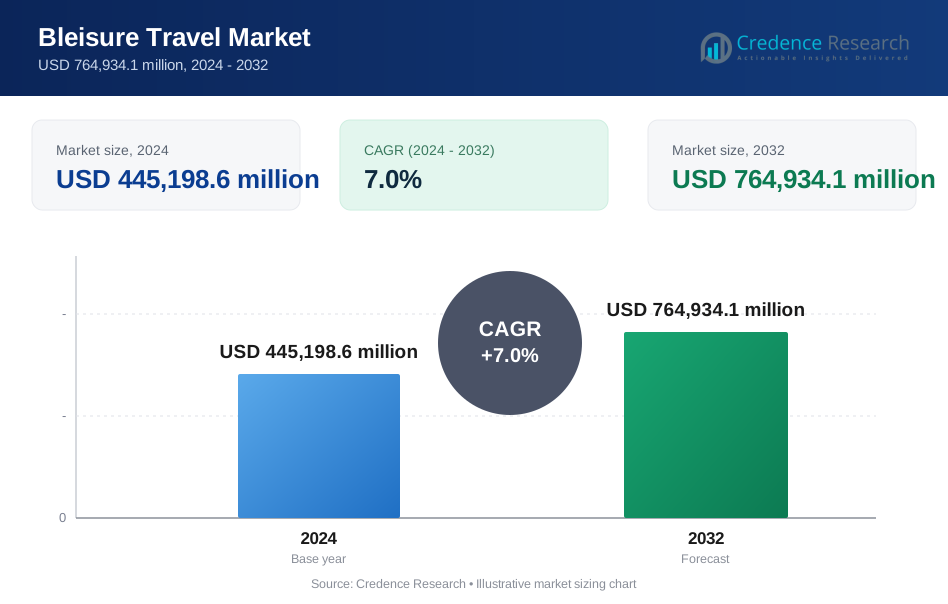
The Bleisure Travel Market size was valued at USD 445,198.6 million in 2024 and is anticipated to reach USD 764,934.1 million by 2032, at a CAGR of 7.0% during the forecast period.
| REPORT ATTRIBUTE | DETAILS |
|---|---|
| Historical Period | 2020-2023 |
| Base Year | 2024 |
| Forecast Period | 2025-2032 |
| Bleisure Travel Market Size 2024 | USD 445,198.6 million |
| Bleisure Travel Market, CAGR | 7.0% |
| Bleisure Travel Market Size 2032 | USD 764,934.1 million |
Bleisure Travel Market Insights
- Increasing corporate travel budgets and flexible workplace policies are driving demand for extended business-leisure trips globally.
- Younger professionals, especially Millennials and Gen Z, are influencing travel preferences with a strong focus on personalized, experience-based travel that blends work and leisure.
- Key players such as Expedia Group, American Express Travel, and FCM Travel Solution dominate through tech-driven platforms, loyalty programs, and bundled travel offerings.
- North America leads with a 32% market share, followed by Europe at 28% and Asia-Pacific at 26%, while lodging remains the dominant service segment with over 40% share, and group tours lead the tour type segment with more than 60% share, reflecting strong corporate demand for bundled travel.
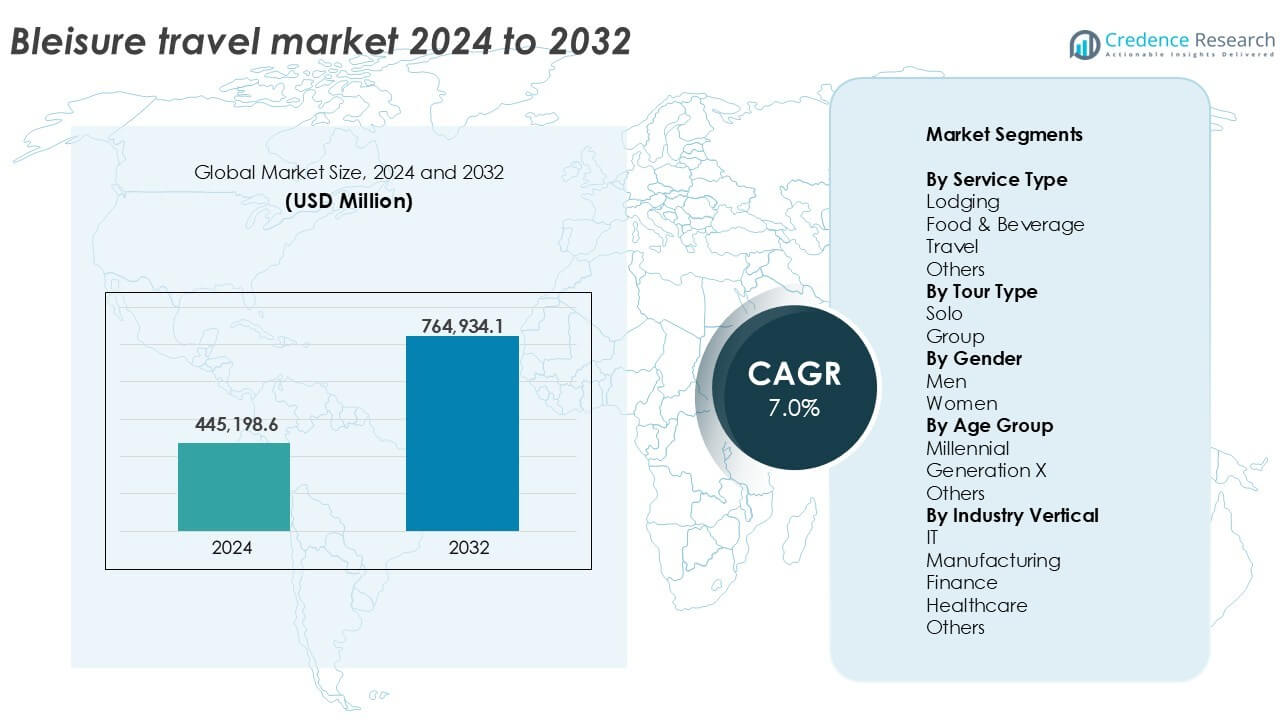
Bleisure Travel Market Segmentation Analysis:
By Service Type
Lodging holds the largest share in the bleisure travel market, accounting for over 40% in 2024. Business travelers extending their stays require comfortable accommodations that support both work and leisure needs. Hotels offering flexible check-in, high-speed internet, and proximity to tourist attractions see strong demand. The rise of boutique hotels and serviced apartments also supports this segment's growth. Food & Beverage follows closely, driven by culinary tourism and dining preferences of business travelers. Travel services, including air and local transport, support seamless movement, while “Others” includes wellness, entertainment, and retail services that enhance trip quality.
- For instance, Marriott International reported operating over 8,800 properties worldwide in 2024, many offering dedicated workspaces, high-speed Wi-Fi, and extended-stay formats like Residence Inn.
By Tour Type
Group tours dominate the tour type segment, capturing more than 60% market share in 2024. Corporates often organize group-based incentive travel, offsite meetings, and training sessions that combine leisure activities. Group packages also offer cost efficiency and managed itineraries, which appeal to companies. The solo segment is growing steadily among mid-level professionals and digital nomads who prefer customized travel experiences. Increasing acceptance of remote work and flexible travel policies enables solo business travelers to explore destinations independently during or after official commitments, supporting growth in this segment.
- For instance, BCD Travel managed corporate travel programs for clients across more than 170 countries in 2023, including group incentive and meeting travel.
By Gender
Men lead the gender segment with a market share exceeding 55% in 2024, driven by their higher participation in business travel globally. Traditional corporate roles, especially in industries like manufacturing and finance, still show male-dominated travel patterns. However, the women segment is growing rapidly with rising female workforce participation and increasing representation in executive roles. Women-focused bleisure packages, safety-oriented services, and wellness-oriented offerings encourage more participation. Destinations and providers tailoring experiences for female travelers have further helped narrow the gender gap in bleisure travel adoption.
Key Growth Drivers
Growth in Corporate Travel Spending
Global corporate travel budgets are expanding, supporting the rise of bleisure travel. Companies across sectors like IT, finance, and manufacturing are investing more in employee mobility, cross-border meetings, and international conferences. Many organizations now encourage blending business with leisure as a strategy to boost employee satisfaction and retention. This aligns with evolving workplace cultures that promote wellness and flexibility. Multinational firms, especially in North America, Europe, and Asia-Pacific, are revising travel policies to include leisure days and reimbursement for extended stays. The availability of business travel-friendly booking platforms also simplifies this integration. Hospitality providers are responding by bundling corporate rates with leisure incentives like spa access or city tours. With the return of business travel post-COVID, supported by hybrid work models, employees increasingly expect personal enrichment from work trips. This steady growth in corporate travel expenditure will remain a strong driver for bleisure travel across regions and industries.
- For instance, Deloitte reported resuming in-person global events across more than 150 countries in 2023, supporting frequent employee travel.
Expansion of Remote and Hybrid Work Models
The rise of remote and hybrid work models has significantly transformed travel behaviors, making it easier for employees to combine work and leisure. Professionals can now work from any location, allowing them to extend business trips or travel midweek and stay through weekends. This flexibility drives longer stays and higher spending per trip. Companies are also adopting “work-from-anywhere” policies that promote wellness while maintaining productivity. Destinations are responding with infrastructure improvements, such as co-working hotels, reliable internet, and business lounges in tourist hubs. Coastal and cultural cities are especially capitalizing on this shift. Moreover, the gig economy and freelance workforce have embraced the bleisure trend, further diversifying the demand base. The ability to attend meetings during the day and explore in off-hours is an appealing combination. The continued expansion of hybrid work models worldwide will play a pivotal role in supporting bleisure travel as a mainstream travel category.
- For instance, Accor launched work-friendly hotel concepts with high-speed connectivity across more than 5,600 properties globally.
Rising Millennial and Gen Z Business Travelers
Millennials and Gen Z professionals are reshaping business travel expectations, driving demand for immersive and balanced experiences. Unlike traditional travelers who focus solely on work obligations, younger employees seek destination engagement, cultural experiences, and local exploration. They prioritize lifestyle integration and personal growth through travel. Bleisure fits these expectations, as it enables relaxation without sacrificing work objectives. These generations also favor mobile-first booking, personalized packages, and sustainable travel options-all aligning with bleisure offerings. Employers are adapting benefits to cater to this demographic shift, offering incentives like extra days or partnerships with experience platforms. In response, the hospitality industry is designing tech-enabled stays, community-centered accommodations, and flexible packages. Since Millennials and Gen Z now form a major portion of the global workforce, their preferences are influencing corporate travel strategies. Their appetite for purposeful travel and enriching downtime is expected to be a long-term driver for bleisure travel growth.
Key Trends & Opportunities
Digital Nomad Visas and Long-Stay Travel Infrastructure
Several countries now offer digital nomad visas, enabling extended stays for remote workers and traveling professionals. These visas, available in destinations like Portugal, Indonesia, UAE, and Estonia, allow travelers to reside longer while working legally. This aligns perfectly with the bleisure travel concept. Supporting infrastructure, such as coworking cafés, flexible accommodations, and concierge services tailored for working travelers, is expanding rapidly. Platforms like Airbnb and Selina are leveraging this trend by targeting professionals who combine work and leisure. Airlines and travel aggregators also promote longer, flexible itineraries. Destinations with cultural appeal, good connectivity, and digital services are positioning themselves as bleisure-friendly zones. Governments see this as a source of long-term tourism income with reduced seasonality. This trend also opens new market opportunities for insurance providers, fintech platforms, and hospitality brands offering extended stay support. The rising popularity of digital nomad-friendly policies will strengthen the long-stay bleisure segment globally.
- For instance, Portugal’s D8 digital nomad visa permits stays up to 12 months for non-EU remote workers under national immigration rules. Infrastructure expands to support this shift.
Personalized, Experience-Centric Travel Packages
Bleisure travelers increasingly seek tailored experiences that blend work convenience with memorable leisure. This shift is creating opportunities for travel operators, hotels, and DMCs to develop curated packages based on traveler profiles. Personalization based on preferences, trip purpose, and length of stay adds value and builds customer loyalty. AI-powered booking platforms and CRM integration allow precise recommendations for after-hours city tours, wellness activities, or dining experiences. Loyalty programs are also evolving to reward longer stays and leisure add-ons. Companies are now collaborating with local businesses to offer unique cultural or recreational opportunities. This expands revenue channels while enhancing guest satisfaction. Travel management companies and OTAs offering flexible, bundled packages with dynamic pricing are expected to gain strong traction. As demand rises for customizable and enriching bleisure travel, suppliers with end-to-end tailored solutions will capture a competitive edge and higher margins.
Key Challenges
Policy Restrictions and Reimbursement Limitations
Many corporate travel policies still draw a firm line between business and personal expenses, limiting the scope of bleisure travel. Employees often face challenges in getting reimbursement for leisure components or extending stays using corporate travel portals. Some organizations lack clear frameworks or insurance coverage for personal add-ons, making employees hesitant to book mixed trips. In regulated industries, compliance, tax, and liability concerns further restrict policy flexibility. Without employer support, bleisure travelers may be forced to manage leisure extensions independently, affecting convenience and adoption. Additionally, certain destinations require complex visa arrangements or restrict business-leisure travel mixing under specific immigration rules. Until more companies update their policies and government frameworks align, these constraints will continue to limit seamless integration of work and leisure travel.
Balancing Work Commitments with Leisure Experience
One of the key barriers to bleisure travel adoption is the difficulty in balancing professional obligations with meaningful leisure time. Business trips often involve tight schedules, multiple meetings, or high-pressure presentations, leaving little energy or time for leisure activities. Even with extended stays, travelers may struggle to fully explore destinations due to fatigue or limited planning time. In some cases, corporate expectations may discourage personal activities during work-related travel. This affects overall satisfaction and reduces the perceived value of bleisure experiences. Further, poor infrastructure such as unstable internet, lack of quiet workspaces, or inconsistent transportation can disrupt productivity, making the leisure portion stressful instead of relaxing. For bleisure to succeed at scale, travel service providers and employers must create environments that support a true blend of productivity and relaxation without compromise.
Regional Analysis
North America
North America leads the bleisure travel market with over 32% market share in 2024, driven by high corporate travel volume and flexible work cultures. The U.S. and Canada host major business hubs that attract international events and conferences. Companies across tech, finance, and consulting encourage blended travel for employee well-being. Widespread adoption of hybrid work models supports extended business trips. Urban destinations such as New York, San Francisco, and Toronto offer strong tourism infrastructure alongside business amenities. Frequent domestic flights and loyalty-driven travel programs further enable seamless work-leisure transitions in the region.
Europe
Europe holds around 28% of the global bleisure market in 2024, supported by rich cultural diversity and strong intra-regional connectivity. Major cities like London, Paris, Berlin, and Amsterdam attract business travelers year-round due to global summits, exhibitions, and finance centers. Business travelers often extend stays to explore historical and cultural attractions. The Schengen visa simplifies cross-border movement, promoting multi-destination travel. Bleisure adoption is rising among corporate travelers from the UK, Germany, France, and the Nordics. Well-developed rail networks and hospitality offerings tailored to professional travelers further strengthen Europe’s competitive position in the market.
Asia-Pacific
Asia-Pacific accounts for nearly 26% market share in the bleisure travel market in 2024, led by countries such as China, Japan, India, South Korea, and Singapore. The region's rapid economic growth, rising business activity, and expanding tech and manufacturing sectors drive demand. Corporate travelers frequently extend work trips to nearby tourist destinations like Bali, Kyoto, or Phuket. Millennial workforce growth, regional MICE events, and flexible visa regimes boost bleisure appeal. Governments and hospitality players in Southeast Asia and East Asia increasingly target professionals with digital nomad-friendly initiatives and urban leisure hubs, enhancing growth prospects.
Latin America
Latin America captures around 7% market share, with Brazil and Mexico serving as key business travel destinations. The region sees growing interest in bleisure due to scenic landscapes, cultural diversity, and expanding corporate presence. While infrastructure challenges exist, improved air connectivity and urban tourism development support growth. Business travelers to cities like São Paulo, Mexico City, and Bogotá often add leisure components to explore nearby natural or heritage sites. Local governments are promoting business tourism packages with extended-stay incentives. The growing adoption of remote work among professionals also fuels short-term bleisure activity in the region.
Middle East & Africa (MEA)
The Middle East & Africa region holds approximately 5% of the bleisure travel market, led by the UAE, Saudi Arabia, and South Africa. Dubai and Abu Dhabi serve as major MICE destinations with premium hospitality offerings and modern infrastructure. Business travelers often extend stays to enjoy shopping, desert tours, or wellness resorts. Saudi Arabia’s Vision 2030 initiatives aim to boost tourism and business synergy, supporting market expansion. In Africa, South Africa sees growing regional travel, though limited connectivity and safety perceptions pose barriers. Overall, MEA presents strong potential with increasing investment in blended travel offerings.
Bleisure Travel Market Segmentations:
By Service Type
- Lodging
- Food & Beverage
- Travel
- Others
By Tour Type
- Solo
- Group
By Gender
- Men
- Women
By Age Group
- Millennial
- Generation X
- Others
By Industry Vertical
- IT
- Manufacturing
- Finance
- Healthcare
- Others
By Geography
- North America
- U.S.
- Canada
- Mexico
- Europe
- Germany
- France
- U.K.
- Italy
- Spain
- Rest of Europe
- Asia Pacific
- China
- Japan
- India
- South Korea
- South-east Asia
- Rest of Asia Pacific
- Latin America
- Brazil
- Argentina
- Rest of Latin America
- Middle East & Africa
- GCC Countries
- South Africa
- Rest of the Middle East and Africa
Competitive Landscape
The competitive landscape of the bleisure travel market is shaped by a mix of global travel giants and specialized service providers focused on corporate travel management. Key players such as Expedia Group, American Express Travel, and BCD Travel dominate with integrated platforms that offer bundled travel, lodging, and leisure services tailored for business travelers. Companies like Flight Centre Travel Group and FCM Travel Solution enhance their appeal through region-specific strategies, loyalty programs, and customizable corporate travel policies. CT Business Travel and JTB Business Travel focus on premium business-leisure experiences, often partnering with luxury hotels and cultural providers. Firms such as Bleisure Travel Company S.p.A and World Travel Holding Inc offer curated services targeting European and U.S. professionals seeking experiential travel extensions. These players compete on technology integration, personalization, geographic coverage, and cost efficiency. As demand rises, companies are strengthening partnerships, expanding digital tools, and targeting younger professionals to maintain competitive edge in the evolving bleisure segment.
Key Player Analysis
- Flight Centre Travel Group (Australia)
- FCM Travel Solution (India)
- Bleisure Travel Company S.p.A (Italy)
- Expedia Group (U.S)
- American Express Travel (U.S)
- JTB Business Travel (U.S)
- CT Business Travel (U.K)
- World Travel Holding Inc (U.S)
- Carlson Wagonlit Travel (U.S)
- BCD Travel (Netherlands)
Recent Developments
- In January 2025, Oakwood, a brand under Ascott Limited (Ascott), a Singapore-based hospitality company, introduced its new campaign, All You Knead is Comfort, to invite travelers and capture the growing need for blended travel.
- In November 2022, Hotel Engine, a Denver, U.S.-based hotel booking platform, introduced two new features, the Hotel Engine Flex and the Self-Serve Trip Extensions, aimed to offer a flexible booking experience and increase blended travel.
Report Coverage
The research report offers an in-depth analysis based on Service Type, Tour Type, Gender, Age Group, Industry Vertical and Geography. It details leading market players, providing an overview of their business, product offerings, investments, revenue streams, and key applications. Additionally, the report includes insights into the competitive environment, SWOT analysis, current market trends, as well as the primary drivers and constraints. Furthermore, it discusses various factors that have driven market expansion in recent years. The report also explores market dynamics, regulatory scenarios, and technological advancements that are shaping the industry. It assesses the impact of external factors and global economic changes on market growth. Lastly, it provides strategic recommendations for new entrants and established companies to navigate the complexities of the market.
Future Outlook
- Bleisure travel will see rising adoption as remote and hybrid work models continue to expand.
- Companies will update travel policies to support blended itineraries and longer business trips.
- Demand for personalized travel packages combining work and leisure experiences will increase.
- Hospitality providers will design co-working and leisure-focused facilities within single locations.
- Younger workforce segments will drive preference for experiential and culture-rich destinations.
- AI-driven travel planning tools will simplify the booking of bleisure components in one platform.
- Secondary cities and regional hubs will gain popularity for short-stay bleisure opportunities.
- Governments will introduce visa schemes and incentives targeting long-stay professionals.
- Strategic alliances between airlines, hotels, and travel agencies will enhance bundled offerings.
- Corporate travel management firms will expand loyalty programs focused on extended-stay travelers.
Request a Free Sample
Fill in your details and we'll send you a free sample report.
- Sample data tables & charts
- Research methodology
Need a Custom Version of This Report?
Tailor the scope, geography, or segments to your exact requirements.
- Custom geography or segment scope
- Direct access to our analyst team
Frequently Asked Questions
What is the current market size for the Bleisure travel market, and what is its projected size in 2032?
At what Compound Annual Growth Rate is the Bleisure travel market projected to grow between 2024 and 2032?
Which Bleisure travel market segment held the largest share in 2024?
What are the primary factors fueling the growth of the Bleisure travel market?
Who are the leading companies in the Bleisure travel market?
Which region commanded the largest share of the Bleisure travel market in 2024?
Table of Content
Chapter 1 Market Segmentation
- 1.1 Segmentation Framework
- 1.1.1 Product and Service Classification
- 1.1.2 Application and End-Use Classification
- 1.1.3 Technology and Solution Classification
- 1.1.4 Customer and Distribution Channel Classification
- 1.1.5 Geographic Segmentation
- 1.1.6 Market Segment Definitions and Boundaries
Chapter 2 Introduction
- 2.1 Report Objectives and Scope
- 2.2 Product Definition and Industry Terminology
- 2.3 Market Inclusions and Exclusions
- 2.4 Research Process
- 2.4.1 Primary Research and Expert Interviews
- 2.4.2 Secondary Research and Source Review
- 2.4.3 Top-Down and Bottom-Up Estimation
- 2.4.4 Data Triangulation and Verification
- 2.5 Market Size Measurement Basis
- 2.5.1 2024: USD 445,198.6 million → 2032: USD 764,934.1 million
- 2.6 Historical and Forecast Reference Periods
- 2.6.1 Base Year: 2024
- 2.6.2 Forecast Period: 2024-2032
- 2.7 Research Assumptions and Limitations
Chapter 3 Executive Summary
- 3.1 Market Snapshot and Key Findings
- 3.2 Base-Year Market Size, 2024
- 3.3 Forecast Market Size, 2032
- 3.4 Revenue and Volume Growth Outlook
- 3.5 Key Demand and Supply Indicators
- 3.6 Leading Market Segments
- 3.7 Fastest-Growing Market Opportunities
- 3.8 Regional Performance Highlights
- 3.9 Technology and Industry Transformation
- 3.10 Competitive Landscape Summary
- 3.11 Analyst View and Strategic Implications
Chapter 4 Global Bleisure Travel Market Trends and Developments
- 4.1 Historical Industry Development
- 4.2 Recent Market Trends and Developments
- 4.3 Demand and Customer Behavior Trends
- 4.4 Technology and Product Innovation
- 4.5 Artificial Intelligence, Automation and Digitalization
- 4.6 Local Manufacturing and Supply Chain Realignment
- 4.7 Industry Partnerships, Mergers and Acquisitions
- 4.8 Sustainability and Circular Economy Developments
- 4.9 Government and Private Sector Investment Trends
- 4.10 Emerging Business Models and Commercialization
- 4.11 Industry Developments and Announcements
Chapter 5 Global Bleisure Travel Market Production, Supply and Demand Analysis
- 5.1 Demand Trend and Consumption Analysis
- 5.2 Demand Forecast, 2024-2032
- 5.3 Production and Output Trend
- 5.4 Production and Output Forecast, 2024-2032
- 5.5 Installed Capacity and Capacity Utilization
- 5.6 Company-Wise Production Plants and Statistics
- 5.6.1 Installed Production Capacity
- 5.6.2 Actual Production
- 5.6.3 Planned Capacity and Expansion Targets
- 5.7 Supply Chain Structure and Procurement Trends
- 5.8 Supply-Demand Gap and Bottlenecks
- 5.9 Import Dependence and Sourcing Structure
- 5.10 Contract Manufacturing and Outsourcing
- 5.11 Regional Supply and Demand Concentration
Chapter 6 Global Bleisure Travel Market Pricing Analysis
- 6.1 Pricing Structure and Measurement
- 6.2 Historical Pricing Trends
- 6.3 Pricing Outlook, 2024-2032
- 6.4 Average Selling Price and Unit Economics
- 6.5 Pricing by Product and Market Segment
- 6.6 Geographic Pricing Differences
- 6.7 Key Input, Energy, Labor and Logistics Costs
- 6.8 Contract Pricing and Purchasing Models
- 6.9 Pricing Sensitivity and Competitive Positioning
- 6.10 Price, Margin and Profitability Implications
Chapter 7 Global Bleisure Travel Market Dynamics
- 7.1 Market Growth Drivers
- 7.1.1 Demand-Side Drivers
- 7.1.2 Technology and Innovation Drivers
- 7.1.3 Infrastructure and Investment Drivers
- 7.1.4 Regulatory and Policy Drivers
- 7.2 Market Restraints
- 7.2.1 Cost and Affordability Constraints
- 7.2.2 Technology and Adoption Barriers
- 7.2.3 Supply Chain and Operational Constraints
- 7.3 Market Challenges
- 7.3.1 Competitive Pressure and Margin Erosion
- 7.3.2 Skills, Infrastructure and Implementation Gaps
- 7.4 Emerging Market Opportunities
- 7.5 Market Dynamics Impact and Time-Horizon Assessment
Chapter 8 Global Bleisure Travel Value Chain Analysis
- 8.1 Industry Value Chain Overview
- 8.2 Upstream Suppliers and Critical Inputs
- 8.3 Technology and Component Providers
- 8.4 Manufacturing or Service Delivery
- 8.5 Distribution, Channel Partners and Integrators
- 8.6 Downstream Applications and End Users
- 8.7 Value Addition and Profit Pools
- 8.8 Vertical Integration and Outsourcing
- 8.9 Supplier Concentration and Risk
- 8.10 Supply Chain Localization and Resilience
Chapter 9 Global Bleisure Travel Market Regulations and Policies
- 9.1 Relevant Laws, Standards and Compliance Frameworks
- 9.2 Product, Service, Safety and Quality Requirements
- 9.3 Government Policies, Incentives and Subsidies
- 9.4 Imports, Exports and Trade Barriers
- 9.5 Public Procurement and Local Content Requirements
- 9.6 Environmental and Sustainability Compliance
- 9.7 Upcoming Policy Changes and Market Implications
Chapter 10 Global Bleisure Travel Market Hotspots and Opportunities
- 10.1 Market Opportunity Mapping and Growth Hotspots
- 10.2 High-Growth Applications and Customer Groups
- 10.3 Underserved Markets and White-Space Opportunities
- 10.4 Emerging Technology and Product Opportunities
- 10.5 New Capacity and Investment Hotspots
- 10.6 Market Entry and Expansion Opportunities
- 10.7 Distribution and Partnership Opportunities
- 10.8 Near-Term and Long-Term Commercial Potential
- 10.9 Opportunity Attractiveness and Execution Risks
Chapter 11 Global Bleisure Travel Market Outlook, 2024-2032
- 11.1 Market Size and Analysis
- 11.1.1 Revenue (Market Measurement: 2024: USD 445,198.6 million → 2032: USD 764,934.1 million)
- 11.1.2 Market Volume and Quantity Sold
- 11.1.3 Historical Market Size
- 11.1.4 Base-Year Market Size, 2024
- 11.2 Market Forecast, 2024-2032
- 11.2.1 Revenue Forecast to 2032
- 11.2.2 Volume Forecast to 2032
- 11.2.3 CAGR and Year-on-Year Growth
- 11.2.4 Incremental Revenue Opportunity
- 11.3 Forecast Assumptions and Scenario Analysis
- 11.3.1 Base-Case Forecast
- 11.3.2 Optimistic and Conservative Scenarios
- 11.3.3 Technology, Pricing and Policy Sensitivities
- 11.4 Market Attractiveness and Growth Outlook
Chapter 12 Global Bleisure Travel Market Segmentation and Outlook
- 12.1 Segmentation Summary and Market Shares, 2024
- 12.2 Largest and Fastest-Growing Segments
- 12.3 Segment Growth Comparison
- 12.4 Segment Attractiveness and Priority Matrix
Chapter 13 Global Bleisure Travel Geographic Market Outlook, 2024-2032
- 13.1 Regional Market Size and Share, 2024
- 13.2 Regional Market Forecast, 2024-2032
- 13.3 Regional Pricing, Production and Demand Differences
- 13.4 North America
- 13.4.1 United States
- 13.4.2 Canada
- 13.4.3 Mexico
- 13.5 Europe
- 13.5.1 Germany
- 13.5.2 France
- 13.5.3 Italy
- 13.5.4 United Kingdom
- 13.5.5 Spain
- 13.5.6 Poland
- 13.5.7 Russia
- 13.5.8 Netherlands
- 13.5.9 Belgium
- 13.5.10 Sweden
- 13.5.11 Denmark
- 13.5.12 Norway
- 13.5.13 Rest of Europe
- 13.6 Asia Pacific
- 13.6.1 China
- 13.6.2 India
- 13.6.3 Japan
- 13.6.4 South Korea
- 13.6.5 Thailand
- 13.6.6 Indonesia
- 13.6.7 Vietnam
- 13.6.8 Malaysia
- 13.6.9 Australia
- 13.6.10 Rest of Asia Pacific
- 13.7 Latin America
- 13.7.1 Brazil
- 13.7.2 Argentina
- 13.7.3 Colombia
- 13.7.4 Chile
- 13.7.5 Rest of Latin America
- 13.8 Middle East
- 13.8.1 Saudi Arabia
- 13.8.2 United Arab Emirates
- 13.8.3 Turkey
- 13.8.4 Israel
- 13.8.5 Iran
- 13.8.6 Rest of the Middle East
- 13.9 Africa
- 13.9.1 South Africa
- 13.9.2 Egypt
- 13.9.3 Nigeria
- 13.9.4 Morocco
- 13.9.5 Rest of Africa
- 13.10 Regional Investment, Policy and Supply Chain Differences
- 13.11 Regional Competitive Landscape
- 13.12 Geographic Growth Hotspots
Chapter 14 Global Bleisure Travel Technology, Innovation and Sustainability Outlook
- 14.1 Technology Landscape and Maturity
- 14.2 Product, Process and Service Innovation
- 14.3 AI, Automation and Digital Tools in the Industry
- 14.4 Technology Adoption and Performance Benchmarking
- 14.5 Innovation Pipeline and R&D Investment
- 14.6 Patent and Intellectual Property Trends
- 14.7 Energy Efficiency and Resource Management
- 14.8 Sustainability, Recycling and Circularity
- 14.9 Technology Roadmap, 2024-2032
- 14.10 Risks of Obsolescence and Technology Substitution
Chapter 15 Global Bleisure Travel Market Key Strategic Imperatives
- 15.1 Growth and Market Entry Priorities
- 15.2 High-Return Products and Segments
- 15.3 Pricing, Profitability and Cost Optimization
- 15.4 Technology Investment and Product Differentiation
- 15.5 Supply Chain Localization and Resilience
- 15.6 Distribution and Customer Acquisition
- 15.7 Partnership, Acquisition and Capacity Strategy
- 15.8 Regional Expansion Priorities
- 15.9 Short-, Medium- and Long-Term Actions
Chapter 16 Competition Outlook
- 16.1 Industry Competition Characteristics
- 16.2 Market Structure and Concentration
- 16.3 Market Share and Competitive Positioning, 2024
- 16.4 Company-Wise Revenue and Product Benchmarking
- 16.5 Production and Service Capacity Benchmarking
- 16.6 Technology, Pricing and Differentiation
- 16.7 Regional Footprint and Distribution Strength
- 16.8 Mergers, Acquisitions and Strategic Alliances
- 16.9 New Entrants and Competitive Threats
- 16.10 Porter's Five Forces and Industry Attractiveness
- 16.11 Competitive Outlook, 2024-2032
Chapter 17 Company Profiles
- 17.1 Company Coverage and Selection Criteria
- 17.2 Leading Market Participants – Standard Profile Structure
- 17.2.1 Business Description
- 17.2.2 Company Ownership and Geographic Presence
- 17.2.3 Product and Service Portfolio
- 17.2.4 Manufacturing and Operating Footprint
- 17.2.5 Production Capacity and Expansion Plans
- 17.2.6 Financial Performance and Investment
- 17.2.7 Market Share and Competitive Position
- 17.2.8 Technology and Innovation Capabilities
- 17.2.9 Strategic Alliances or Partnerships
- 17.2.10 Recent Developments
- 17.2.11 Growth Strategy and Outlook
- 17.3 Other Relevant Market Participants
Note: Every listed company is profiled on the structure shown under the first company. The company list is preliminary and may change based on research findings, market developments, data availability and client requirements.
Chapter 18 Disclaimer
- 18.1 Research and Forecast Disclaimer
- 18.2 Data Source and Estimation Limitations
Note: The depth of individual sections depends on data availability for this market. Volume, capacity, trade and other unit-based metrics are included where applicable.