
Market Overview
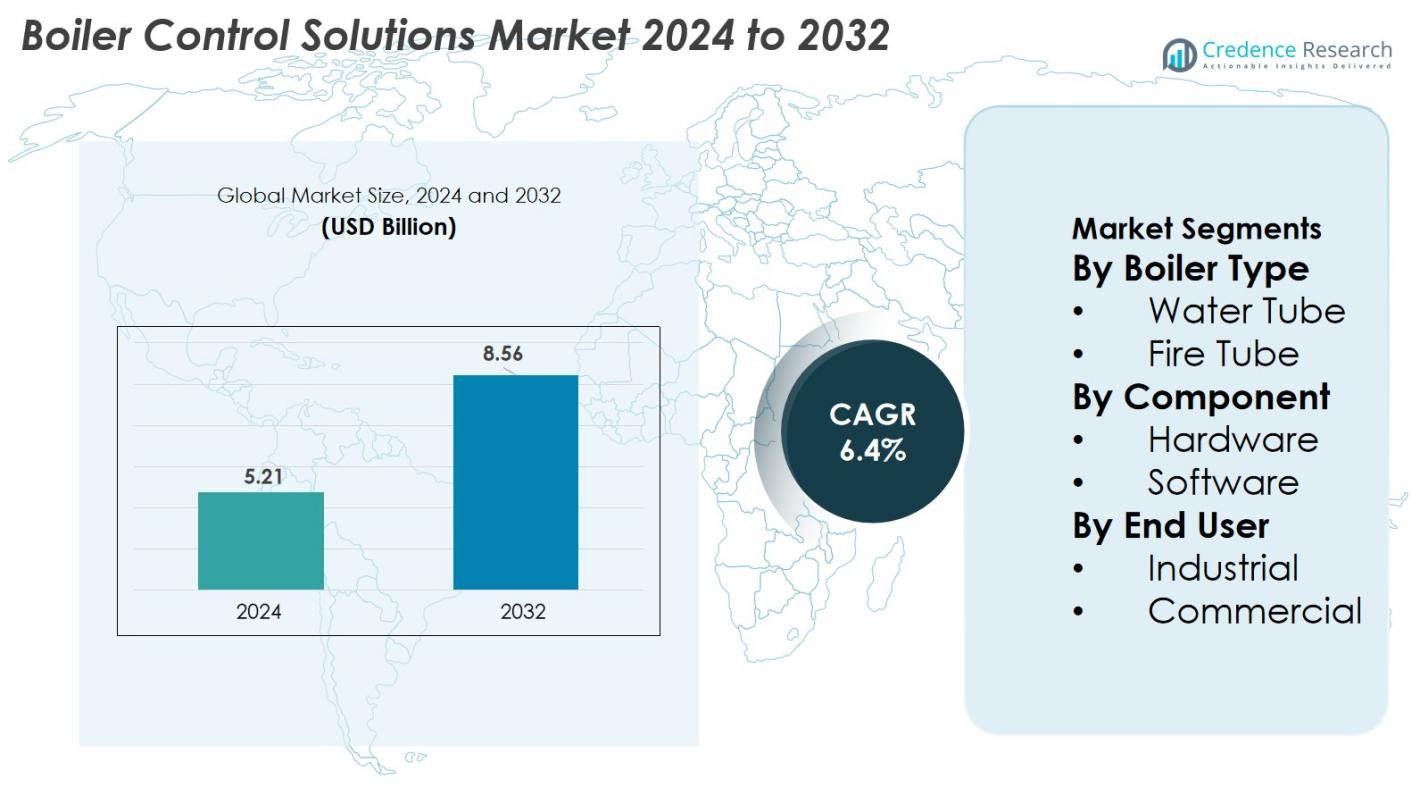
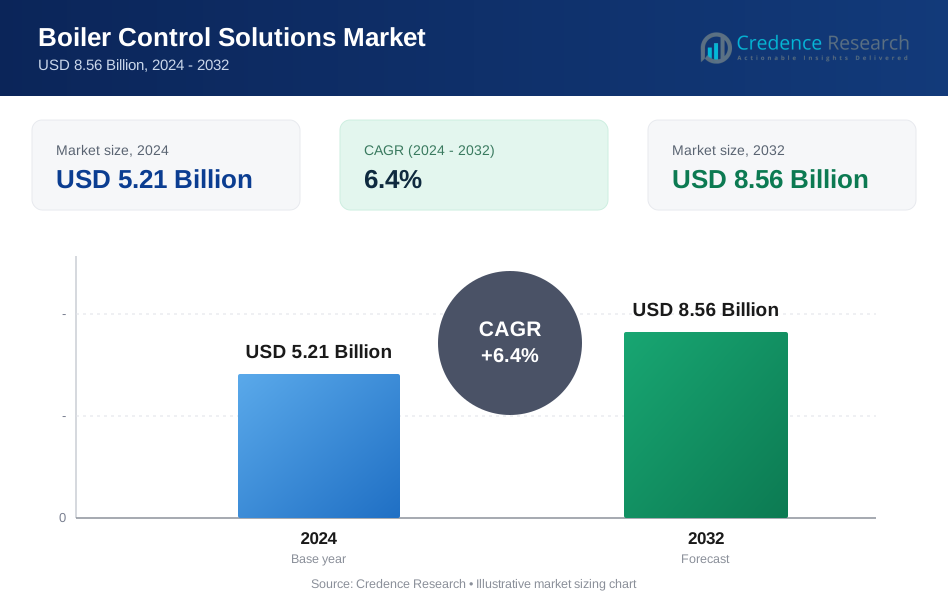
Boiler Control Solutions market size was valued at USD 5.21 Billion in 2024 and is anticipated to reach USD 8.56 Billion by 2032, at a CAGR of 6.4% during the forecast period.
| REPORT ATTRIBUTE | DETAILS |
|---|---|
| Historical Period | 2020-2023 |
| Base Year | 2024 |
| Forecast Period | 2025-2032 |
| Boiler Control Solutions Market Size 2024 | USD 5.21 Billion |
| Boiler Control Solutions Market, CAGR | 6.4% |
| Boiler Control Solutions Market Size 2032 | USD 8.56 Billion |
Boiler Control Solutions market is shaped by the presence of global automation and boiler technology leaders, including Siemens AG, ABB, Schneider Electric, Emerson Electric Co., Yokogawa Electric Corporation, Honeywell International Inc., Cleaver-Brooks Company, Inc., Burnham Commercial Boilers, Spirax Sarco Limited, and HBX Control Systems. These companies strengthen the market through advanced combustion control, smart monitoring systems, IoT-enabled sensors, and integrated automation platforms designed to improve efficiency and safety. Regionally, Asia Pacific leads the market with a 38.9% share in 2024, driven by rapid industrialization and strong demand from manufacturing and power sectors, followed by North America and Europe with robust modernization and emission-compliance initiatives.
Market Insights
- Boiler Control Solutions market reached USD 5.21 Billion in 2024 and is projected to grow at a CAGR of 6.4% through 2032, supported by increasing automation adoption.
- Market growth is driven by rising demand for energy-efficient boiler operations, stringent emission-compliance requirements, and modernization of industrial heating systems across key sectors.
- Key trends include rapid integration of IoT, AI-based monitoring, predictive maintenance, and the shift toward low-NOx, sustainable combustion technologies enhancing operational reliability.
- Leading players such as Siemens AG, ABB, Schneider Electric, Emerson, Honeywell, Yokogawa, Spirax Sarco, and Cleaver-Brooks strengthen the market through digital control platforms and smart hardware solutions.
- Asia Pacific leads with 38.9% share, followed by North America at 32.6% and Europe at 27.4%, while the water tube boiler segment dominates with 62.4% share, supported by strong industrial adoption.
Market Segmentation Analysis
By Boiler Type
The Water Tube segment dominates the Boiler Control Solutions market, accounting for 62.4% of the market share in 2024. Water tube boilers lead due to their higher efficiency, superior heat transfer rates, and suitability for high-pressure industrial operations. Industries such as power generation, oil and gas, and chemicals increasingly favor water tube systems for their reliability and ability to support automation-driven control architectures. The rising integration of advanced monitoring sensors, fuel-optimization technologies, and real-time performance analytics further accelerates adoption over fire tube configurations.
- For instance, Babcock & Wilcox (B&W) has delivered more than 5,000 water-tube package and industrial boilers worldwide a testament to their reliability and ability to meet diverse capacity, fuel and emissions-control requirements.
By Component
The Hardware segment held the largest share in 2024, commanding 68.7% of the Boiler Control Solutions market. This dominance is driven by widespread deployment of controllers, sensors, actuators, and automation modules essential for real-time boiler operation, safety, and combustion efficiency. Industries rely heavily on robust hardware infrastructure to ensure stable performance, reduce energy consumption, and meet stringent emission norms. Continuous advancements in digital control panels, smart valves, and IoT-enabled sensing devices further strengthen hardware uptake, while software continues to expand through cloud-based monitoring and predictive analytics.
- For instance, Siemens' SIPART PS2 smart positioner installed in over 10 million valve applications globally enhances combustion control stability through precise valve actuation in industrial boiler systems.
By End User
The Industrial segment led the Boiler Control Solutions market with 71.5% share in 2024, supported by extensive use across power plants, refineries, chemical processing, food and beverage, and metals manufacturing facilities. Industrial users demand advanced automation, high-efficiency combustion systems, and strict adherence to energy-efficiency regulations, driving strong adoption of modern control platforms. Increasing focus on process optimization, operational safety, and fuel-cost reduction further accelerates the shift toward integrated control solutions. Meanwhile, the commercial segment records steady growth as buildings adopt smart boiler controls for energy management and sustainability goals.
Key Growth Drivers
Rising Focus on Energy Efficiency and Fuel Optimization
The Boiler Control Solutions market is primarily driven by industries’ increasing focus on enhancing energy efficiency and reducing fuel consumption. Industrial facilities across chemicals, power generation, pharmaceuticals, and food processing rely heavily on boilers, making fuel savings a critical operational priority. Advanced control systems equipped with precise combustion management, automated modulation, and oxygen-trim technologies significantly improve thermal efficiency while minimizing wastage. Growing pressure from global energy-efficiency regulations, carbon-tax policies, and sustainability mandates further accelerates adoption. Real-time monitoring and predictive maintenance also help reduce downtimes and operational losses, enhancing overall process reliability. As energy costs continue escalating globally, industries increasingly deploy modern boiler control platforms to optimize load management and reduce lifecycle operating expenses. This cost-saving potential remains a major growth catalyst for the market.
- For instance, Yokogawa’s Oxygen Analyzer ZR402G/ZR802G widely deployed in refinery and utility boilers supports oxygen-trim control that reduces excess air levels and enhances combustion efficiency, helping facilities cut fuel use and emissions simultaneously
Expansion of Industrial Automation and Industry 4.0 Adoption
The demand for boiler control solutions continues to strengthen due to rapid expansion of industrial automation and Industry 4.0 adoption. Modern manufacturing environments require highly precise, digitally integrated boiler operations to maintain production continuity and ensure thermal stability. Smart controls enable remote monitoring, automated fault detection, and seamless integration with plant-wide SCADA or DCS systems, supporting fully connected industrial ecosystems. IoT-enabled sensors, cloud analytics, and advanced control algorithms improve accuracy and responsiveness, reducing the risk of thermal imbalance or equipment failure. As industries pursue digital transformation, automated control mechanisms become essential for meeting quality, safety, and performance benchmarks. The shift toward autonomous operations in sectors such as petrochemicals, power plants, and food processing further amplifies the need for intelligent boiler control infrastructures. The increasing convergence of automation and digitization remains a powerful driver shaping the market’s growth trajectory.
- For instance, Emerson’s DeltaV™ control system supports embedded advanced control algorithms and real-time asset health monitoring, enabling early detection of boiler inefficiencies or burner issues and reducing operational risks in continuous-process facilities.
Stringent Safety Regulations and Emission Compliance Requirements
Stringent industrial safety standards and emission-control regulations are major drivers compelling industries to adopt advanced boiler control systems. Boilers operate under high pressure and temperature conditions, making safety-critical controls essential for preventing hazardous failures, explosions, or thermal runaways. Regulatory bodies mandate real-time monitoring of combustion quality, pressure levels, steam output, and NOx emissions to ensure safe and sustainable operations. Modern control solutions incorporate automated shutdown protocols, fault alarms, and continuous emissions monitoring systems to meet these requirements. Governments worldwide continue implementing tougher industrial emission standards, particularly for coal and gas-fired boilers, pushing facilities toward digitalized control platforms capable of maintaining compliance. The increasing emphasis on workplace safety, environmental responsibility, and audit-ready reporting systems continues to fuel adoption of advanced boiler control technologies across both industrial and commercial sectors.
Key Trends & Opportunities
Growing Integration of IoT, AI, and Predictive Analytics
A major trend shaping the Boiler Control Solutions market is the rapid integration of IoT, AI, and predictive analytics to enhance operational reliability and decision-making. Modern boiler systems are increasingly equipped with interconnected sensors that capture real-time data on temperature, pressure, fuel characteristics, and component wear. AI-driven predictive analytics help identify early signs of malfunction, allowing operators to schedule maintenance before failures occur. This shift from reactive to proactive maintenance significantly reduces downtime and extends equipment life. Cloud-based dashboards also offer remote accessibility and automated reporting, enabling multi-site monitoring. As industries embrace smart manufacturing and digital twins, the opportunity for intelligent boiler controls expands, creating new revenue prospects for solution providers offering analytics-driven services.
- For instance, Honeywell’s Connected Plant platform uses AI-enabled asset analytics to detect boiler performance anomalies and has been documented to reduce unplanned downtime by up to 30% across industrial sites through early fault detection.
Increasing Demand for Low-NOx and Sustainable Boiler Technologies
The global push toward sustainability and carbon reduction is creating strong opportunities for low-NOx and eco-friendly boiler control technologies. Industries are prioritizing greener combustion systems to comply with international emission norms and corporate ESG targets. Advanced control systems enable precise fuel-air ratio management, flue gas recirculation, and real-time emissions optimization, making them essential for low-emission boiler operations. The rise of biomass, biofuel, and hybrid boiler installations also fuels demand for adaptive control platforms capable of handling fuel variability and multi-fuel combustion. As green industrial transitions accelerate, manufacturers offering emission-optimized controls, energy recovery features, and carbon-reporting functionalities are positioned to capitalize on expanding environmental compliance markets.
- For instance, Honeywell’s SLATE™ platform is widely used in low-NOx burner systems and supports precise air–fuel ratio control, helping facilities meet stringent sub-30 ppm NOx emission requirements documented across industrial heating applications.
Key Challenges
High Initial Investment and Integration Complexity
One of the major challenges for the Boiler Control Solutions market is the high initial investment associated with advanced control technologies and digital integration. Many industries operate legacy boiler systems that require significant retrofitting, wiring upgrades, or compatibility modifications before new controls can be installed. These upgrades involve substantial capital expenditure, which can be a barrier for small and medium-sized enterprises. Additionally, integrating new control systems with existing SCADA, DCS, or plant automation platforms often requires specialized technical expertise, increasing project complexity and deployment timelines. Limited skilled workforce availability further complicates the adoption process. Despite long-term savings, the upfront cost burden remains a restraint for widespread implementation.
Cybersecurity Risks in Connected Boiler Systems
The growing adoption of IoT-enabled and cloud-connected boiler controls introduces notable cybersecurity challenges. As boilers become integrated into broader industrial automation ecosystems, they become potential entry points for cyberattacks targeting operational disruption, data theft, or unauthorized system manipulation. Compromised boiler controls can cause severe safety hazards, production shutdowns, or equipment damage. Many industrial facilities still lack mature cybersecurity frameworks, making them vulnerable to threats. Ensuring secure data transmission, network segmentation, authentication protocols, and real-time threat detection becomes essential. The increasing frequency of industrial cyberattacks heightens concerns and forces solution providers to invest in robust cybersecurity architectures, which adds complexity and cost to deployment.
Regional Analysis
North America
North America holds a significant position in the Boiler Control Solutions market, capturing 32.6% of the global share in 2024. The region benefits from strong industrial automation adoption across power generation, oil and gas, chemicals, and food processing industries. Increasing emphasis on energy efficiency, emission compliance, and modernization of aging boiler infrastructure drives demand for advanced control systems. The presence of major technology innovators and supportive regulatory frameworks accelerates digital upgrades. Ongoing investments in smart manufacturing, combined with the growing need for real-time monitoring and predictive maintenance, further strengthen the region’s leadership in boiler control adoption.
Europe
Europe accounts for 27.4% of the Boiler Control Solutions market, supported by strict environmental regulations, decarbonization initiatives, and rapid industrial modernization. Countries such as Germany, the U.K., France, and Italy are actively upgrading industrial boilers to meet stringent NOx reduction and energy-efficiency standards. The region’s strong focus on sustainability fuels demand for smart combustion controls, low-emission boilers, and automation-integrated monitoring systems. Growth in the district heating sector and adoption of Industry 4.0 technologies further support market expansion. Continuous upgrades in manufacturing plants and widespread acceptance of digital boiler management systems reinforce Europe’s strong market position.
Asia Pacific
Asia Pacific dominates the Boiler Control Solutions market with 38.9% share in 2024, making it the largest regional contributor. Rapid industrialization, strong expansion of power generation capacity, and large-scale manufacturing activities in China, India, Japan, and Southeast Asia drive robust demand. Governments across the region are enforcing stricter energy-efficiency and emission norms, prompting industries to adopt automated boiler control platforms. Investments in smart factories, advanced monitoring technologies, and infrastructure development further support market acceleration. The region’s growing focus on operational reliability, cost optimization, and digitization ensures sustained growth and solidifies Asia Pacific’s leading position.
Latin America
Latin America represents 6.2% of the Boiler Control Solutions market, driven by increasing modernization of industrial boilers in Brazil, Mexico, Argentina, and Chile. Rising investments in food processing, chemicals, pulp and paper, and energy industries create opportunities for advanced combustion and automation systems. Although adoption is slower compared to developed regions, rising fuel costs and the need for efficient heat-generation processes encourage digital control implementation. Governments are also promoting industrial energy-efficiency programs, supporting gradual upgrades. The region’s expanding industrial base and improving regulatory frameworks contribute to steady demand for intelligent boiler management technologies.
Middle East & Africa
The Middle East & Africa region holds 4.9% of the global Boiler Control Solutions market, driven by strong demand from oil and gas, petrochemicals, and power-generation sectors. Countries such as Saudi Arabia, UAE, and South Africa are increasingly investing in industrial modernization and automation initiatives. Harsh operating environments and high energy consumption levels encourage adoption of advanced boiler controls that enhance reliability and reduce operational risks. Growing focus on emission compliance and energy-efficient technologies supports market growth. Although overall adoption remains at an early stage, ongoing industrial expansion and smart infrastructure projects are expected to boost future demand.
Market Segmentations
By Boiler Type
- Water Tube
- Fire Tube
By Component
- Hardware
- Software
By End User
- Industrial
- Commercial
By Geography
- North America
- U.S.
- Canada
- Mexico
- Europe
- Germany
- France
- U.K.
- Italy
- Spain
- Rest of Europe
- Asia Pacific
- China
- Japan
- India
- South Korea
- South-east Asia
- Rest of Asia Pacific
- Latin America
- Brazil
- Argentina
- Rest of Latin America
- Middle East & Africa
- GCC Countries
- South Africa
- Rest of the Middle East and Africa
Competitive Landscape
The Boiler Control Solutions market features a diverse and well-established competitive landscape, led by global automation, instrumentation, and boiler technology providers. Companies such as Siemens AG, ABB, Schneider Electric, Emerson Electric Co., Yokogawa Electric Corporation, and Honeywell International Inc. dominate the market through advanced control platforms, smart sensors, and integrated automation solutions. Cleaver-Brooks Company, Inc., Burnham Commercial Boilers, Spirax Sarco Limited, and HBX Control Systems strengthen competition with specialized boiler technology, efficient combustion controls, and tailored solutions for industrial and commercial applications. Players focus heavily on digital upgrades, cloud-based monitoring, low-NOx control systems, and predictive maintenance capabilities to meet regulatory requirements and enhance operational efficiency. Strategic partnerships, technology innovation, and expansion into emerging industrial economies remain key focus areas as companies compete to offer more intelligent, energy-efficient, and safety-driven boiler control systems.
Key Player Analysis
- HBX Control Systems
- Emerson Electric Co.
- Spirax Sarco Limited
- Schneider Electric
- Honeywell International Inc.
- Yokogawa Electric Corporation
- BURNHAM COMMERCIAL BOILERS
- Siemens AG
- Cleaver-Brooks Company, Inc.
- ABB
Recent Developments
- In 2025, Sellers Manufacturing announced new “rapid‑response boilers and medical‑waste autoclaves,” featuring a novel multi‑flame boiler technology likely to include advanced control solutions.
- In July 2024, Bradford White Corporation Acquired Heatflo, a stainless-steel indirect water-heating and hydronic storage specialist, broadening its portfolio for efficient heating and control technologies.
- In 2024, Miura Co. (Japan) acquired Cleaver‑Brooks a well-known boiler manufacturer. This could impact the boiler control solutions market via upstream consolidation.
Report Coverage
The research report offers an in-depth analysis based on Boiler Type, Component, End-User and Geography. It details leading market players, providing an overview of their business, product offerings, investments, revenue streams, and key applications. Additionally, the report includes insights into the competitive environment, SWOT analysis, current market trends, as well as the primary drivers and constraints. Furthermore, it discusses various factors that have driven market expansion in recent years. The report also explores market dynamics, regulatory scenarios, and technological advancements that are shaping the industry. It assesses the impact of external factors and global economic changes on market growth. Lastly, it provides strategic recommendations for new entrants and established companies to navigate the complexities of the market.
Future Outlook
- The market will increasingly shift toward fully automated and interconnected boiler systems supported by IoT and cloud platforms.
- AI-driven predictive maintenance will become a core feature, reducing downtime and improving operational reliability.
- Adoption of low-emission and low-NOx combustion control technologies will accelerate as global sustainability regulations tighten.
- Integration of digital twins will enhance real-time performance simulation and optimization for industrial boiler operations.
- Remote monitoring capabilities will expand, enabling multi-site management and faster issue resolution.
- The demand for retrofitting legacy boilers with advanced control hardware and software will grow significantly.
- Cybersecurity solutions for connected boiler systems will gain priority as digitalization increases system vulnerabilities.
- Industrial sectors such as power, chemicals, and food processing will remain major adopters of advanced control platforms.
- Emerging markets in Asia Pacific, Latin America, and the Middle East will drive strong installation growth.
- Collaboration between automation providers and boiler manufacturers will deepen to deliver integrated, high-efficiency control ecosystems.
Request a Free Sample
Fill in your details and we'll send you a free sample report.
- Sample data tables & charts
- Research methodology
Need a Custom Version of This Report?
Tailor the scope, geography, or segments to your exact requirements.
- Custom geography or segment scope
- Direct access to our analyst team
Frequently Asked Questions
What is the current market size for Boiler Control Solutions market, and what is its projected size in 2032?
At what Compound Annual Growth Rate is the Boiler Control Solutions market projected to grow between 2025 and 2032?
Which Boiler Control Solutions market segment held the largest share in 2024?
What are the primary factors fueling the growth of the Boiler Control Solutions market?
Who are the leading companies in the Boiler Control Solutions market?
Which region commanded the largest share of the Boiler Control Solutions market in 2024?
Table of Content
Chapter 1. Report Introduction
- 1.1 Report Description & Purpose
- 1.1.1 Report Title & Market Definition
- 1.1.2 Unique Selling Propositions (USP) & Key Differentiators
- 1.1.3 Value Proposition for Stakeholders
- 1.2 Research Objectives
- 1.2.1 Market Sizing Objectives (Volume & Revenue)
- 1.2.2 Segmentation Objectives
- 1.2.3 Competitive Intelligence Objectives
- 1.2.4 Forecast & Scenario Objectives
- 1.3 Report Scope
- 1.3.1 Boiler Control Solutions Scope – Types & Subtypes Covered
- 1.3.2 Geographic Scope – Regions & Countries Covered
- 1.3.3 Historical Period, Base Year & Forecast Period (2024; forecast to 2032)
- 1.3.4 Inclusions & Exclusions
- 1.4 HS Code & Classification Framework
- 1.5 Currency, Units & Pricing Basis
- 1.6 Target Stakeholders
- 1.7 Limitations & Assumptions
Chapter 2. Executive Summary
- 2.1 Global Boiler Control Solutions Market Snapshot
- 2.1.1 Market Size – Historical (2024) & Forecast (2024-2032) (2024: USD 5.21 Billion → 2032: USD 8.56 Billion)
- 2.1.2 Volume & Revenue – Global Totals
- 2.1.3 Key Market Highlights – Top Five Facts
- 2.2 Boiler Control Solutions Market Segmentation Snapshot
- 2.2.1 Market Split by Region – 2024 vs. 2032
- 2.3 Competitive Snapshot
- 2.3.1 Top 10 Players by Revenue Share – 2024
- 2.3.2 Top 10 Players by Volume Share – 2024
- 2.3.3 Recent Strategic Developments (18-Month Summary)
- 2.4 Key Investment Highlights & Strategic Conclusions
Chapter 3. Boiler Control Solutions Market Dynamics & Industry Analysis
- 3.1 Market Overview & Context
- 3.1.1 Boiler Control Solutions Market Position in the Broader Automotive Value Chain
- 3.1.2 OEM vs. Replacement Market Dynamics
- 3.1.3 Market Maturity & Development Stage by Region
- 3.2 Boiler Control Solutions Market Drivers
- 3.3 Boiler Control Solutions Market Restraints & Challenges
- 3.4 Boiler Control Solutions Market Opportunities
- 3.5 Porter's Five Forces Analysis
- 3.5.1 Threat of New Entrants
- 3.5.2 Bargaining Power of Suppliers
- 3.5.3 Bargaining Power of Buyers
- 3.5.4 Threat of Substitutes
- 3.5.5 Competitive Rivalry – Intensity Assessment
- 3.6 Boiler Control Solutions Value Chain Analysis
- 3.6.1 Upstream – Raw Material/Input Suppliers
- 3.6.1.1 Raw Material/Input 1
- 3.6.1.2 Raw Material/Input 2
- 3.6.1.3 Raw Material/Input 3
- 3.6.2 Midstream – Production/Manufacturing/Service Delivery
- 3.6.2.1 Production/Process Overview
- 3.6.2.2 Key Facility Locations & Capacity by Manufacturer
- 3.6.3 Downstream – Distribution & End Consumer
- 3.6.3.1 Primary Channel – B2B/OEM
- 3.6.3.2 Secondary Channels – Dealer, Retail, Online, Direct
- 3.6.4 Value Chain Profitability Analysis
- 3.6.1 Upstream – Raw Material/Input Suppliers
- 3.7 PESTEL Analysis
- 3.7.1 Political Factors
- 3.7.2 Economic Factors
- 3.7.3 Social Factors
- 3.7.4 Technological Factors
- 3.7.5 Environmental Factors
- 3.7.6 Legal Factors
- 3.8 Boiler Control Solutions Supply Chain Analysis
- 3.8.1 Raw Material/Input Supply Risk Assessment
- 3.8.2 Manufacturing Concentration Risk (Geographic Exposure)
- 3.8.3 Trade Disruption Impact Analysis
- 3.9 Regulatory & Policy Landscape
Note: The regulatory and policy landscape section covers regulations based on their applicability to the market, Boiler Control Solutions category, geography, and scope of the study. Only regulatory frameworks with a material impact on operations, compliance, trade, sustainability, or market access are analyzed in detail.
Chapter 4. Key Investment Pockets & Opportunity Analysis
- 4.1 Boiler Control Solutions Market Attractiveness Analysis
- 4.1.1 By Region – Investment Attractiveness Matrix (Volume × CAGR)
- 4.2 Absolute Revenue Growth Opportunity
- 4.2.1 By Region – Absolute USD Growth Through 2032
- 4.3 Incremental Volume Opportunity
- 4.3.1 By Region – Incremental Volume Through 2032
- 4.3.2 Segment – Incremental Volume
- 4.4 Emerging Submarket Opportunity Deep Dive (Subject to Applicability)
- 4.5 Emerging Market Opportunity Scorecards
- 4.5.1 United States
- 4.5.2 Europe
- 4.5.3 Asia
- 4.5.4 Middle East & Africa
Note: Emerging Market Opportunity Scorecards will be included based on relevance and strategic importance. Regions listed are indicative and may vary depending on data availability and market dynamics.
Chapter 5. Boiler Control Solutions Import-Export Analysis & Trade Flows
- 5.1 Global Trade Overview
- 5.1.1 Global Export Value by Country (2024)
- 5.1.2 Global Export Volume by Country (2024)
- 5.1.3 Global Import Value by Country (2024)
- 5.1.4 Global Import Volume by Country (2024)
- 5.1.5 Net Trade Balance by Country (2024)
- 5.2 Export Analysis – Segment
- 5.2.1 Type 1 (HS Code)
- 5.2.2 Type 2 (HS Code)
- 5.2.3 Type 3 (HS Code)
- 5.2.4 Type 4 (HS Code)
- 5.2.5 Type 5 (HS Code)
- 5.3 Import Analysis – Segment
- 5.3.1 Type 1 (HS Code)
- 5.3.2 Type 2 (HS Code)
- 5.3.3 Type 3 (HS Code)
- 5.3.4 Type 4 (HS Code)
- 5.3.5 Type 5 (HS Code)
- 5.4 Average Unit Trade Prices
- 5.4.1 Average Export Price – Segment & Country
- 5.4.2 Average Import Price – Segment & Source Country
- 5.4.3 Price Trends (2024)
- 5.5 Key Trade Route Analysis
- 5.5.1 Trade Route 1
- 5.5.2 Trade Route 2
- 5.5.3 Trade Route 3
- 5.5.4 Trade Route 4
- 5.5.5 Trade Route 5
- 5.6 Trade Policy Impact Assessment
- 5.6.1 US Anti-Dumping & Section 301 Tariffs
- 5.6.2 EU Customs Union Impact
- 5.6.3 Major Free Trade Agreements
- 5.6.4 USMCA Rules of Origin
Note: Trade policy analysis will be included only where relevant to the Boiler Control Solutions market.
Chapter 6. Competitive Landscape & Company Benchmarking
- 6.1 Boiler Control Solutions Market Concentration & Structure
- 6.1.1 Herfindahl-Hirschman Index (HHI) – vs. 2024
- 6.1.2 Tier 1, Tier 2 & Tier 3 Market Structure
- 6.1.3 Global, Regional & Local Player Dynamics
- 6.2 Boiler Control Solutions Market Share Analysis – 2024
- 6.2.1 Global Revenue Share by Company
- 6.2.2 Global Volume Share by Company
- 6.2.3 Regional Revenue Share
- 6.2.4 Market Share Evolution ( vs. 2024)
- 6.2.5 OEM Segment Share by Company
- 6.2.6 Replacement Segment Share by Company
- 6.3 Production/Delivery Capacity & Facility Analysis
- 6.3.1 Global Installed Capacity
- 6.3.2 Capacity Utilization Rates
- 6.3.3 Production/Output Volume
- 6.3.4 Facility Locations & Capacity Map
- 6.3.5 Planned Capacity Additions
- 6.4 Boiler Control Solutions Competitive Benchmarking Matrix
- 6.4.1 Revenue, Volume, CAGR & Profitability Comparison
- 6.4.2 Channel Revenue Mix
- 6.4.3 Geographic Revenue Exposure
- 6.4.4 R&D Intensity
- 6.4.5 Sustainability Maturity
- 6.5 Strategic Developments in Boiler Control Solutions (Last 24 Months)
- 6.5.1 Mergers, Acquisitions & Divestments
- 6.5.2 New Boiler Control Solutions Launches
- 6.5.3 Facility Expansions
- 6.5.4 Strategic Alliances, Joint Ventures & Partnerships
- 6.5.5 Distribution Expansion & Market Entry
- 6.5.6 Sustainability & ESG Initiatives
- 6.6 Competitive Strategy Mapping
- 6.6.1 Leader, Challenger, Follower & Niche Classification
- 6.6.2 Pricing Strategy Comparison
- 6.6.3 Channel Strategy Matrix
Note: Strategic developments are included based on their materiality and the availability of reliable information.
Chapter 7. Global Boiler Control Solutions Market – By Distribution Channel
- 7.1 Segment Overview
- 7.1.1 Volume & Revenue Split by Channel (2024 & 2032)
- 7.1.2 Channel Mix Evolution (2024-2032)
Chapter 8. Regional Market Analysis – Global Overview
- 8.1 Global Regional Overview
- 8.1.1 Regional Volume Share
- 8.1.2 Regional Revenue Share
- 8.1.3 Regional Volume by Region
- 8.1.4 Regional Revenue by Region
- 8.1.5 Regional Forecast Through 2032
- 8.2 Cross-Regional Segment Analysis
- 8.2.1 By Distribution Channel
- 8.2.2 By Brand/Price Tier
Chapter 9. North America Boiler Control Solutions Market
- 9.1 United States
- 9.2 Canada
- 9.3 Mexico
Chapter 10. Europe Boiler Control Solutions Market
- 10.1 Germany
- 10.2 France
- 10.3 Italy
- 10.4 United Kingdom
- 10.5 Spain
- 10.6 Poland
- 10.7 Russia
- 10.8 Netherlands
- 10.9 Belgium
- 10.10 Sweden
- 10.11 Denmark
- 10.12 Norway
- 10.13 Rest of Europe
Chapter 11. Asia Pacific Boiler Control Solutions Market
- 11.1 China
- 11.2 India
- 11.3 Japan
- 11.4 South Korea
- 11.5 Thailand
- 11.6 Indonesia
- 11.7 Vietnam
- 11.8 Malaysia
- 11.9 Australia
- 11.10 Rest of Asia Pacific
Chapter 12. Latin America Boiler Control Solutions Market
- 12.1 Brazil
- 12.2 Argentina
- 12.3 Colombia
- 12.4 Chile
- 12.5 Rest of Latin America
Chapter 13. Middle East Boiler Control Solutions Market
- 13.1 Saudi Arabia
- 13.2 United Arab Emirates
- 13.3 Turkey
- 13.4 Israel
- 13.5 Iran
- 13.6 Rest of the Middle East
Chapter 14. Africa Boiler Control Solutions Market
- 14.1 South Africa
- 14.2 Egypt
- 14.3 Nigeria
- 14.4 Morocco
- 14.5 Rest of Africa
Chapter 15. Boiler Control Solutions Company Profiles
- 15.1 [Company 01]
- 15.1.1 Company Overview
- 15.1.2 Key Management Personnel
- 15.1.3 Products & Services Portfolio
- 15.1.4 Financial Performance
- 15.1.5 Key Market Focus & Geographic Presence
- 15.1.6 Recent Developments & Strategic Initiatives
Note: The company profile list is preliminary and may change based on research findings, market developments, data availability, and client requirements.
Chapter 16. Appendices
- Appendix A – List of Abbreviations & Acronyms
- Appendix B – Industry Classification Code Reference – Full Series
- Appendix C – Production & Capacity Data Tables
- Appendix D – End-Use & Demand Base Tables
- Appendix E – Consumption & Replacement Rate Assumptions
- Appendix F – ASP Reference Tables
- Appendix G – Manufacturing & Facility Database
- Appendix H – Import-Export Data Tables
- Appendix I – Regulatory Summary Tables
- Appendix J – Primary Research Participant List (Anonymized)
- Appendix K – Primary Research Questionnaire Framework
- Appendix L – Data Sources & Bibliography
- Appendix M – Market Size Divergence & Source Comparison
Chapter 17. Research Methodology
- 17.1 Research Framework & Philosophy
- 17.2 Secondary Research – Sources, Hierarchy & Data Extraction
- 17.3 Data Modeling – Bottom-Up & Top-Down Market Sizing
- 17.4 Primary Research – Stakeholder Framework, LOI & Sample Sizes
- 17.5 Forecast Methodology – Regression, Scenario & Sensitivity Analysis
- 17.6 Quality Control – Four-Layer Validation Framework
- 17.7 Limitations & Standard Assumptions
- 17.8 Disclaimer
