
Market Overview
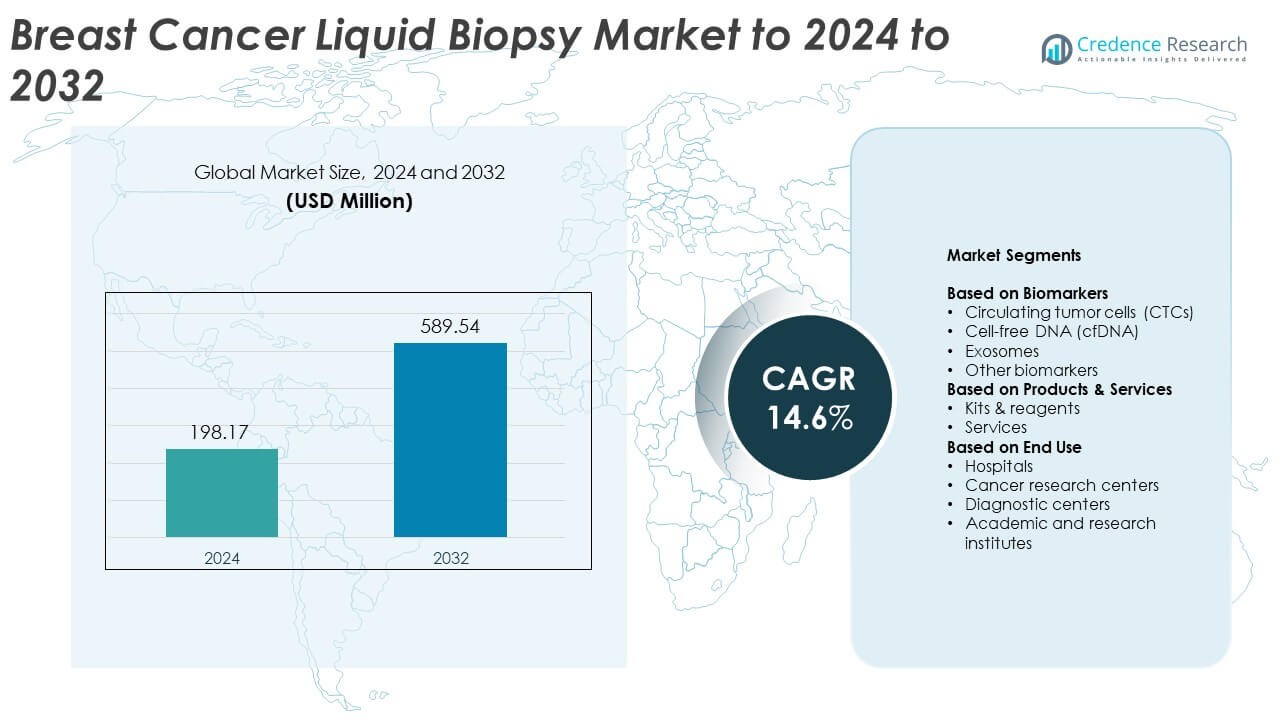
Breast Cancer Liquid Biopsy Market size was valued at USD 198.17 Million in 2024 and is anticipated to reach USD 589.54 Million by 2032, at a CAGR of 14.6% during the forecast period.
| REPORT ATTRIBUTE | DETAILS |
|---|---|
| Historical Period | 2020-2023 |
| Base Year | 2024 |
| Forecast Period | 2025-2032 |
| Breast Cancer Liquid Biopsy Market Size 2024 | USD 198.17 Million |
| Breast Cancer Liquid Biopsy Market , CAGR | 14.6% |
| Breast Cancer Liquid Biopsy Market Size 2032 | USD 589.54 Million |
The Breast Cancer Liquid Biopsy Market is shaped by key participants including QIAGEN, Genes2me, Sysmex, Menarini Silicon Biosystems, Illumina, OncoDNA, Epic Sciences, Myriad Genetics, F. Hoffmann-La Roche, and Datar Cancer Genetics. These companies advance high-sensitivity biomarker assays, sequencing technologies, and AI-enabled analysis tools that support wider clinical adoption. North America leads the market with about 41% share due to strong diagnostic infrastructure and rapid integration of precision oncology. Europe follows with nearly 29% share, supported by robust cancer screening programs, while Asia-Pacific holds about 21% share and continues to grow quickly as genomic testing capabilities expand.
Market Insights
- The Breast Cancer Liquid Biopsy Market was valued at USD 198.17 Million in 2024 and is projected to reach USD 589.54 Million by 2032 at a CAGR of 14.6%. • Strong demand for minimally invasive diagnostics drives adoption, with circulating tumor cells leading the biomarker segment at about 42% share due to high clinical utility. • AI-enabled analysis, multi-omics integration, and rising use of cfDNA for mutation tracking shape major market trends while improving detection accuracy and treatment monitoring. • The competitive landscape involves companies expanding assay sensitivity, sequencing platforms, and data-interpretation capabilities while forming partnerships with hospitals and research centers. • North America leads with around 41% share, followed by Europe at about 29%, while Asia-Pacific holds nearly 21% and grows fastest; hospitals dominate end use with about 48% share as they expand precision oncology and recurrence-monitoring practices.
Market Segmentation Analysis:
By Biomarkers
The circulating tumor cells segment leads this category with about 42% share in 2024. This dominance comes from strong clinical use in early detection, recurrence monitoring, and therapy response analysis. CTCs offer high diagnostic value because they provide intact cellular material for genetic and phenotypic assessment. The cfDNA segment grows fast due to rising demand for noninvasive genomic profiling and mutation tracking. Exosomes gain traction as researchers expand work on microRNA signatures in breast cancer. Other biomarkers hold a smaller share but support niche diagnostic applications.
- For instance, Guardant Health, Inc. reported 18 abstracts (including four oral sessions) on its ShieldTM multi-cancer detection (MCD) test at the 2025 American Association for Cancer Research Annual Meeting.
By Products and Services
Kits and reagents dominate this segment with nearly 63% share in 2024, supported by frequent test usage, high consumable demand, and recurring revenue models in diagnostic workflows. The strong uptake comes from rising adoption of liquid biopsy panels, mutation detection kits, and sample preparation reagents in hospitals and research labs. Services continue to expand as cancer centers outsource genomic testing, sequencing, and data analysis. Growth remains linked to increasing personalization of breast cancer treatment and broader integration of biomarker-driven decision tools.
- For instance, QIAGEN N.V. disclosed that its consumables and related sales made up nearly 90 % of its total sales, and the Diagnostic Solutions Product Group saw an 8 % CER sales rise in Q2 FY24.
By End Use
Hospitals hold the leading share of about 48% in 2024 due to high patient volume, growing adoption of liquid biopsy for monitoring treatment response, and rapid integration of minimally invasive diagnostics. Cancer research centers follow as they increase clinical trials and molecular research focused on early detection biomarkers. Diagnostic centers expand use of advanced sequencing platforms for routine screening. Academic and research institutes contribute steady growth by advancing biomarker discovery, assay refinement, and validation studies that support broader market adoption.
Key Growth Drivers
Growing demand for minimally invasive diagnostics
Hospitals and cancer centers continue to increase the use of liquid biopsy because the method offers a safer and more comfortable alternative to tissue biopsy. Clinicians adopt these tests to monitor treatment response, detect recurrence earlier, and reduce repeated surgical procedures. Rising awareness among patients also supports wider acceptance. The push toward precision oncology strengthens this growth because liquid biopsy enables real-time molecular insights that guide therapy changes. Together, these factors make minimally invasive diagnostics a primary growth driver.
- For instance, Guardant Health announced data for its Shield MCD test across 10 tumour types, showing “high specificity and clinically meaningful sensitivity” in April 2025.
Rising focus on precision medicine in breast cancer care
Oncologists rely more on biomarker-driven decisions to choose targeted therapies and evaluate treatment effectiveness. Liquid biopsy supports this model by allowing frequent genomic assessments without invasive procedures. This capability helps identify emerging mutations, track tumor evolution, and adjust therapies faster. Pharmaceutical companies also expand companion diagnostic partnerships to align new drugs with liquid biopsy platforms. These advances make precision medicine a major driver of sustained market expansion.
- For instance, A large-scale analysis demonstrated that presence of circulating tumour cells (CTCs) predicted worse outcomes with HRs of 1.82 for DFS, 1.89 for distant DFS in breast cancer.
Advancements in biomarker technologies and assay sensitivity
Improved detection of circulating tumor cells, cfDNA, and exosomes enhances diagnostic accuracy and supports deeper clinical adoption. Companies launch high-sensitivity assays capable of identifying low-frequency mutations that previously went undetected. Better sample preparation tools and sequencing platforms increase test reliability across diverse patient profiles. These improvements enable broader use in early detection, prognosis evaluation, and longitudinal monitoring. As a result, technological progress stands as a core market driver.
Key Trends and Opportunities
Expansion of multi-omics liquid biopsy platforms
Developers integrate genomics, transcriptomics, and proteomics into unified liquid biopsy assays to improve prediction power. Multi-omics platforms help clinicians gain a more complete view of tumor biology, enabling stronger personalization of treatment. Research centers invest in these technologies to validate new biomarker combinations. This trend creates opportunities for companies offering hybrid assay panels and advanced data-analytics solutions.
- For instance, PrognomiQ announced promising results from a deep multi-omics case-control study of 2,513 subjects and subsequently launched a large-scale prospective clinical program of 15,000 subjects.
Rising adoption of AI-enabled data interpretation
AI tools support faster and more accurate interpretation of complex biomarker patterns such as cfDNA fragmentation, CTC morphology, and exosomal signatures. Machine-learning models help reduce diagnostic errors and enhance prediction of relapse risk. Technology firms collaborate with research institutes to build algorithms trained on large patient datasets. This creates new opportunities for precision-focused liquid biopsy solutions with stronger clinical utility.
- For instance, HEALWELL AI Inc.’s subsidiary Pentavere Research Group published a study in the Journal of Liquid Biopsy showing its DARWEN™ AI system achieved a 100-fold improvement in time compared to manual review of complex NGS/liquid-biopsy reports.
Growing use in treatment-response monitoring and recurrence tracking
More oncologists use liquid biopsy to evaluate therapy effectiveness after each treatment cycle. This enables earlier detection of resistance mutations and faster therapy adjustment. The opportunity grows as clinical guidelines shift toward continual monitoring in metastatic breast cancer. Companies benefit through increased demand for longitudinal testing panels.
Key Challenges
Limited standardization across testing platforms
- Laboratories use different extraction methods, sequencing workflows, and biomarker thresholds, leading to variations in test results. This inconsistency reduces confidence among clinicians and slows broader clinical integration. Regulatory agencies work to define harmonized protocols, but adoption remains uneven. The lack of uniform standards continues to be a major market challenge.
High test costs and reimbursement barriers
Many advanced liquid biopsy assays remain expensive due to sequencing requirements and specialized reagents. Limited reimbursement coverage restricts access for many patients and reduces routine testing in smaller hospitals. Payers demand stronger clinical-utility evidence before expanding coverage. These financial constraints present a persistent challenge for market growth.
Regional Analysis
North America
North America holds about 41% share in 2024 because hospitals and cancer centers rapidly adopt liquid biopsy for early detection and treatment monitoring. Strong presence of diagnostic companies, high awareness among patients, and wide access to genomic testing support regional leadership. Research institutes also run large clinical studies that validate new biomarkers, increasing confidence among clinicians. Favorable reimbursement expansion in select states improves testing uptake. Growing integration of cfDNA and CTC-based assays in precision cancer care keeps North America the dominant regional contributor.
Europe
Europe accounts for nearly 29% share in 2024, supported by strong cancer screening programs and steady investment in molecular diagnostics across major countries. Hospitals adopt liquid biopsy for tracking metastatic breast cancer and guiding targeted therapy decisions. Regulatory agencies promote high-quality standards, which boosts clinical trust in biomarker-based tests. Research collaborations between universities and diagnostic firms also accelerate technology validation. Rising focus on reducing invasive procedures strengthens regional growth, keeping Europe a key participant in the global market.
Asia-Pacific
Asia-Pacific captures about 21% share in 2024 and represents the fastest-growing region due to rising breast cancer incidence, growing healthcare spending, and expanding genomic testing infrastructure. Countries such as China, Japan, and South Korea increase adoption of cfDNA and CTC assays for early diagnosis and monitoring. Government-backed precision oncology programs further boost uptake. Private diagnostic labs introduce advanced sequencing services that improve accessibility. The combination of rising patient awareness and rapid technology expansion positions Asia-Pacific as a major growth hub.
Latin America
Latin America holds close to 6% share in 2024, driven by gradual expansion of molecular diagnostics and increasing adoption in urban cancer centers. Larger hospitals integrate liquid biopsy for monitoring therapy response in advanced breast cancer cases. Limited access in rural areas slows wider uptake, but private labs introduce cost-effective testing panels that improve availability. Government health programs in select countries work to expand cancer screening infrastructure. Steady improvements in diagnostic capacity help the region progress at a moderate pace.
Middle East and Africa
Middle East and Africa account for around 3% share in 2024, supported by rising investments in cancer care and the gradual expansion of precision medicine facilities in Gulf countries. Adoption is higher in specialized oncology centers that use liquid biopsy for treatment monitoring and recurrence assessment. Limited laboratory infrastructure in several African nations slows broader penetration. Increasing partnerships with international diagnostic companies improve access to advanced biomarker technologies. Although the smallest contributor, the region shows steady long-term potential.
Market Segmentations:
By Biomarkers
- Circulating tumor cells (CTCs)
- Cell-free DNA (cfDNA)
- Exosomes
- Other biomarkers
By Products & Services
- Kits & reagents
- Services
By End Use
- Hospitals
- Cancer research centers
- Diagnostic centers
- Academic and research institutes
By Geography
- North America
- U.S.
- Canada
- Mexico
- Europe
- Germany
- France
- U.K.
- Italy
- Spain
- Rest of Europe
- Asia Pacific
- China
- Japan
- India
- South Korea
- South-east Asia
- Rest of Asia Pacific
- Latin America
- Brazil
- Argentina
- Rest of Latin America
- Middle East & Africa
- GCC Countries
- South Africa
- Rest of the Middle East and Africa
Competitive Landscape
The Breast Cancer Liquid Biopsy Market features active participation from QIAGEN, Genes2me, Sysmex, Menarini Silicon Biosystems, Illumina, OncoDNA, Epic Sciences, Myriad Genetics, F. Hoffmann-La Roche, and Datar Cancer Genetics in the competitive landscape. Companies focus on developing high-sensitivity assays, improving biomarker detection accuracy, and expanding multi-omics capabilities to strengthen their positions. Many firms invest in advanced sequencing platforms and automated workflows to support large-scale clinical adoption. Strategic partnerships with hospitals, research institutions, and pharmaceutical developers help expand clinical trial involvement and improve validation of emerging biomarkers. Providers also work on enhancing turnaround time, reducing testing complexity, and improving data-analysis tools to meet rising demand for real-time treatment monitoring. Strong emphasis on regulatory compliance, quality standards, and geographical expansion further shapes competition across the global market.
Key Player Analysis
- QIAGEN
- Genes2me
- Sysmex
- Menarini Silicon Biosystems
- Illumina
- OncoDNA
- Epic Sciences
- Myriad Genetics
- Hoffmann-La Roche
- Datar Cancer Genetics
Recent Developments
- In 2024, Genes2me launched liquid biopsy NGS panels, including a breast cancer panel covering 36 clinically relevant genes.
- In 2023, QIAGEN launched QIAseq targeted cfDNA ultra panels to enable easy and speedy diagnosis of cancers, including breast cancer.
- In 2023, Datar Cancer Genetics received its third Breakthrough Device Designation from the US FDA for its TriNetra-Glio blood test to help diagnose brain tumors, completing a set of three designations that include earlier-stage breast and prostate cancer liquid biopsy tests
Report Coverage
The research report offers an in-depth analysis based on Biomarkers, Products & Services, End-Use and Geography. It details leading market players, providing an overview of their business, product offerings, investments, revenue streams, and key applications. Additionally, the report includes insights into the competitive environment, SWOT analysis, current market trends, as well as the primary drivers and constraints. Furthermore, it discusses various factors that have driven market expansion in recent years. The report also explores market dynamics, regulatory scenarios, and technological advancements that are shaping the industry. It assesses the impact of external factors and global economic changes on market growth. Lastly, it provides strategic recommendations for new entrants and established companies to navigate the complexities of the market.
Future Outlook
- Liquid biopsy adoption will rise as hospitals expand precision breast cancer care.
- High-sensitivity biomarker assays will improve early detection accuracy.
- AI-driven analytics will strengthen mutation tracking and recurrence prediction.
- Multi-omics platforms will gain traction for deeper tumor biology insights.
- Companion diagnostics partnerships will increase as targeted therapies expand.
- Testing costs will gradually decline with wider sequencing availability.
- Clinical guidelines will incorporate liquid biopsy more often for treatment monitoring.
- Emerging biomarkers such as exosomal RNA will unlock new diagnostic pathways.
- Decentralized testing models will grow across developing regions.
- Regulatory approvals will accelerate market entry for next-generation liquid biopsy tools.

Request a Free Sample
Fill in your details and we'll send you a free sample report.
- Sample data tables & charts
- Research methodology
Market Dynamics
Growing demand for minimally invasive diagnostics
Liquid biopsy offers a safer, less invasive alternative to tissue biopsy, enabling clinicians to monitor treatment response and detect recurrence with greater patient comfort. This drives adoption in hospitals and cancer centers, especially as awareness of the benefits increases among patients and providers.
Rising focus on precision medicine in breast cancer care
Oncologists increasingly rely on biomarker-driven decisions for targeted therapies, and liquid biopsy enables frequent, noninvasive genomic assessments. This supports real-time therapy adjustments and aligns with the broader shift toward personalized cancer treatment.
Advancements in biomarker technologies and assay sensitivity
Technological improvements in detecting CTCs, cfDNA, and exosomes have enhanced diagnostic accuracy and enabled earlier detection of breast cancer. High-sensitivity assays and better sequencing platforms support broader clinical adoption and more reliable monitoring.
Expansion of multi-omics and AI-enabled analysis
Integration of genomics, transcriptomics, and proteomics in liquid biopsy platforms, along with AI-driven data interpretation, improves detection accuracy and enables deeper insights into tumor biology. These innovations create new opportunities for personalized diagnostics and treatment monitoring.
Increasing integration into clinical guidelines and hospital workflows
As clinical guidelines increasingly recommend liquid biopsy for treatment monitoring and recurrence tracking, hospitals are expanding their use of these tests. This institutional adoption accelerates market growth and supports the transition to precision oncology.
Need a Custom Version of This Report?
Tailor the scope, geography, or segments to your exact requirements.
- Custom geography or segment scope
- Direct access to our analyst team
Frequently Asked Questions
What is the current market size for Breast Cancer Liquid Biopsy Market, and what is its projected size in 2032?
At what Compound Annual Growth Rate is the Breast Cancer Liquid Biopsy Market projected to grow between 2025 and 2032?
Which Breast Cancer Liquid Biopsy Market segment held the largest share in 2024?
What are the primary factors fueling the growth of the Breast Cancer Liquid Biopsy Market?
Who are the leading companies in the Breast Cancer Liquid Biopsy Market?
Which region commanded the largest share of the Breast Cancer Liquid Biopsy Market in 2024?
Table of Content
Chapter 1 Market Segmentation
- 1.1 Segmentation Framework
- 1.1.1 Product and Service Classification
- 1.1.2 Application and End-Use Classification
- 1.1.3 Technology and Solution Classification
- 1.1.4 Customer and Distribution Channel Classification
- 1.1.5 Geographic Segmentation
- 1.1.6 Market Segment Definitions and Boundaries
- 1.2 By End Use
- 1.2.1 Hospitals
- 1.2.2 Cancer research centers
- 1.2.3 Diagnostic centers
- 1.2.4 Academic and research institutes
- 1.3 By Biomarkers
- 1.3.1 Circulating tumor cells (CTCs)
- 1.3.2 Cell-free DNA (cfDNA)
- 1.3.3 Exosomes
- 1.3.4 Other biomarkers
- 1.4 By Products & Services
- 1.4.1 Kits & reagents
- 1.4.2 Services
Chapter 2 Introduction
- 2.1 Report Objectives and Scope
- 2.2 Product Definition and Industry Terminology
- 2.3 Market Inclusions and Exclusions
- 2.4 Research Process
- 2.4.1 Primary Research and Expert Interviews
- 2.4.2 Secondary Research and Source Review
- 2.4.3 Top-Down and Bottom-Up Estimation
- 2.4.4 Data Triangulation and Verification
- 2.5 Market Size Measurement Basis
- 2.5.1 2024: USD 198.17 Million → 2032: USD 589.54 Million
- 2.6 Historical and Forecast Reference Periods
- 2.6.1 Base Year: 2024
- 2.6.2 Forecast Period: 2024-2032
- 2.7 Research Assumptions and Limitations
Chapter 3 Executive Summary
- 3.1 Market Snapshot and Key Findings
- 3.2 Base-Year Market Size, 2024
- 3.3 Forecast Market Size, 2032
- 3.4 Revenue and Volume Growth Outlook
- 3.5 Key Demand and Supply Indicators
- 3.6 Leading Market Segments
- 3.7 Fastest-Growing Market Opportunities
- 3.8 Regional Performance Highlights
- 3.9 Technology and Industry Transformation
- 3.10 Competitive Landscape Summary
- 3.11 Analyst View and Strategic Implications
Chapter 4 Global Breast Cancer Liquid Biopsy Market Trends and Developments
- 4.1 Historical Industry Development
- 4.2 Recent Market Trends and Developments
- 4.3 Demand and Customer Behavior Trends
- 4.4 Technology and Product Innovation
- 4.5 Artificial Intelligence, Automation and Digitalization
- 4.6 Local Manufacturing and Supply Chain Realignment
- 4.7 Industry Partnerships, Mergers and Acquisitions
- 4.8 Sustainability and Circular Economy Developments
- 4.9 Government and Private Sector Investment Trends
- 4.10 Emerging Business Models and Commercialization
- 4.11 Industry Developments and Announcements
Chapter 5 Global Breast Cancer Liquid Biopsy Market Production, Supply and Demand Analysis
- 5.1 Demand Trend and Consumption Analysis
- 5.2 Demand Forecast, 2024-2032
- 5.3 Production and Output Trend
- 5.4 Production and Output Forecast, 2024-2032
- 5.5 Installed Capacity and Capacity Utilization
- 5.6 Company-Wise Production Plants and Statistics
- 5.6.1 Installed Production Capacity
- 5.6.2 Actual Production
- 5.6.3 Planned Capacity and Expansion Targets
- 5.7 Supply Chain Structure and Procurement Trends
- 5.8 Supply-Demand Gap and Bottlenecks
- 5.9 Import Dependence and Sourcing Structure
- 5.10 Contract Manufacturing and Outsourcing
- 5.11 Regional Supply and Demand Concentration
Chapter 6 Global Breast Cancer Liquid Biopsy Market Pricing Analysis
- 6.1 Pricing Structure and Measurement
- 6.2 Historical Pricing Trends
- 6.3 Pricing Outlook, 2024-2032
- 6.4 Average Selling Price and Unit Economics
- 6.5 Pricing by Product and Market Segment
- 6.6 Geographic Pricing Differences
- 6.7 Key Input, Energy, Labor and Logistics Costs
- 6.8 Contract Pricing and Purchasing Models
- 6.9 Pricing Sensitivity and Competitive Positioning
- 6.10 Price, Margin and Profitability Implications
Chapter 7 Global Breast Cancer Liquid Biopsy Market Dynamics
- 7.1 Market Growth Drivers
- 7.1.1 Demand-Side Drivers
- 7.1.2 Technology and Innovation Drivers
- 7.1.3 Infrastructure and Investment Drivers
- 7.1.4 Regulatory and Policy Drivers
- 7.2 Market Restraints
- 7.2.1 Cost and Affordability Constraints
- 7.2.2 Technology and Adoption Barriers
- 7.2.3 Supply Chain and Operational Constraints
- 7.3 Market Challenges
- 7.3.1 Competitive Pressure and Margin Erosion
- 7.3.2 Skills, Infrastructure and Implementation Gaps
- 7.4 Emerging Market Opportunities
- 7.5 Market Dynamics Impact and Time-Horizon Assessment
Chapter 8 Global Breast Cancer Liquid Biopsy Value Chain Analysis
- 8.1 Industry Value Chain Overview
- 8.2 Upstream Suppliers and Critical Inputs
- 8.3 Technology and Component Providers
- 8.4 Manufacturing or Service Delivery
- 8.5 Distribution, Channel Partners and Integrators
- 8.6 Downstream Applications and End Users
- 8.7 Value Addition and Profit Pools
- 8.8 Vertical Integration and Outsourcing
- 8.9 Supplier Concentration and Risk
- 8.10 Supply Chain Localization and Resilience
Chapter 9 Global Breast Cancer Liquid Biopsy Market Regulations and Policies
- 9.1 Relevant Laws, Standards and Compliance Frameworks
- 9.2 Product, Service, Safety and Quality Requirements
- 9.3 Government Policies, Incentives and Subsidies
- 9.4 Imports, Exports and Trade Barriers
- 9.5 Public Procurement and Local Content Requirements
- 9.6 Environmental and Sustainability Compliance
- 9.7 Upcoming Policy Changes and Market Implications
Chapter 10 Global Breast Cancer Liquid Biopsy Market Hotspots and Opportunities
- 10.1 Market Opportunity Mapping and Growth Hotspots
- 10.2 High-Growth Applications and Customer Groups
- 10.3 Underserved Markets and White-Space Opportunities
- 10.4 Emerging Technology and Product Opportunities
- 10.5 New Capacity and Investment Hotspots
- 10.6 Market Entry and Expansion Opportunities
- 10.7 Distribution and Partnership Opportunities
- 10.8 Near-Term and Long-Term Commercial Potential
- 10.9 Opportunity Attractiveness and Execution Risks
Chapter 11 Global Breast Cancer Liquid Biopsy Market Outlook, 2024-2032
- 11.1 Market Size and Analysis
- 11.1.1 Revenue (Market Measurement: 2024: USD 198.17 Million → 2032: USD 589.54 Million)
- 11.1.2 Market Volume and Quantity Sold
- 11.1.3 Historical Market Size
- 11.1.4 Base-Year Market Size, 2024
- 11.2 Market Forecast, 2024-2032
- 11.2.1 Revenue Forecast to 2032
- 11.2.2 Volume Forecast to 2032
- 11.2.3 CAGR and Year-on-Year Growth
- 11.2.4 Incremental Revenue Opportunity
- 11.3 Forecast Assumptions and Scenario Analysis
- 11.3.1 Base-Case Forecast
- 11.3.2 Optimistic and Conservative Scenarios
- 11.3.3 Technology, Pricing and Policy Sensitivities
- 11.4 Market Attractiveness and Growth Outlook
Chapter 12 Global Breast Cancer Liquid Biopsy Market Segmentation and Outlook
- 12.1 Segmentation Summary and Market Shares, 2024
- 12.2 Largest and Fastest-Growing Segments
- 12.3 By End Use - Market Size and Forecast, 2024-2032
- 12.3.1 Segment Definition and Scope
- 12.3.2 Historical Market Size
- 12.3.3 Revenue Forecast, 2024-2032
- 12.3.4 Volume Forecast, 2024-2032
- 12.3.5 Base-Year Market Share, 2024
- 12.3.6 Segment CAGR and Growth Drivers
- 12.3.7 Subsegment Market Size and Forecast
- 12.3.7.1 Hospitals
- 12.3.7.2 Cancer research centers
- 12.3.7.3 Diagnostic centers
- 12.3.7.4 Academic and research institutes
- 12.3.8 Subsegment Pricing and Adoption Trends
- 12.3.9 Leading Suppliers and Competition
- 12.3.10 Regional Demand and Opportunities
- 12.4 By Biomarkers - Market Size and Forecast, 2024-2032
- 12.4.1 Segment Definition and Scope
- 12.4.2 Historical Market Size
- 12.4.3 Revenue Forecast, 2024-2032
- 12.4.4 Volume Forecast, 2024-2032
- 12.4.5 Base-Year Market Share, 2024
- 12.4.6 Segment CAGR and Growth Drivers
- 12.4.7 Subsegment Market Size and Forecast
- 12.4.7.1 Circulating tumor cells (CTCs)
- 12.4.7.2 Cell-free DNA (cfDNA)
- 12.4.7.3 Exosomes
- 12.4.7.4 Other biomarkers
- 12.4.8 Subsegment Pricing and Adoption Trends
- 12.4.9 Leading Suppliers and Competition
- 12.4.10 Regional Demand and Opportunities
- 12.5 By Products & Services - Market Size and Forecast, 2024-2032
- 12.5.1 Segment Definition and Scope
- 12.5.2 Historical Market Size
- 12.5.3 Revenue Forecast, 2024-2032
- 12.5.4 Volume Forecast, 2024-2032
- 12.5.5 Base-Year Market Share, 2024
- 12.5.6 Segment CAGR and Growth Drivers
- 12.5.7 Subsegment Market Size and Forecast
- 12.5.7.1 Kits & reagents
- 12.5.7.2 Services
- 12.5.8 Subsegment Pricing and Adoption Trends
- 12.5.9 Leading Suppliers and Competition
- 12.5.10 Regional Demand and Opportunities
- 12.6 Segment Growth Comparison
- 12.7 Segment Attractiveness and Priority Matrix
Chapter 13 Global Breast Cancer Liquid Biopsy End-Use and Application Market Outlook
- 13.1 End-Use Industry and Customer Demand Structure
- 13.2 Leading Applications and Customer Groups
- 13.3 End-Use Market Size, Share and Forecast
- 13.4 Major End-Use Industry Deep Dives
- 13.4.1 Customer Requirements and Use Cases
- 13.4.2 Demand and Replacement Cycles
- 13.4.3 Technical and Regulatory Considerations
- 13.4.4 Purchasing and Procurement Models
- 13.4.5 Leading Vendors and Distribution Channels
- 13.4.6 Forecast and Commercial Opportunities
- 13.5 Emerging Applications and Cross-Segment Demand
- 13.6 End-Use Industry Investment Priorities
Chapter 14 Global Breast Cancer Liquid Biopsy Geographic Market Outlook, 2024-2032
- 14.1 Regional Market Size and Share, 2024
- 14.2 Regional Market Forecast, 2024-2032
- 14.3 Regional Pricing, Production and Demand Differences
- 14.4 North America
- 14.4.1 United States
- 14.4.2 Canada
- 14.4.3 Mexico
- 14.5 Europe
- 14.5.1 Germany
- 14.5.2 France
- 14.5.3 Italy
- 14.5.4 United Kingdom
- 14.5.5 Spain
- 14.5.6 Poland
- 14.5.7 Russia
- 14.5.8 Netherlands
- 14.5.9 Belgium
- 14.5.10 Sweden
- 14.5.11 Denmark
- 14.5.12 Norway
- 14.5.13 Rest of Europe
- 14.6 Asia Pacific
- 14.6.1 China
- 14.6.2 India
- 14.6.3 Japan
- 14.6.4 South Korea
- 14.6.5 Thailand
- 14.6.6 Indonesia
- 14.6.7 Vietnam
- 14.6.8 Malaysia
- 14.6.9 Australia
- 14.6.10 Rest of Asia Pacific
- 14.7 Latin America
- 14.7.1 Brazil
- 14.7.2 Argentina
- 14.7.3 Colombia
- 14.7.4 Chile
- 14.7.5 Rest of Latin America
- 14.8 Middle East
- 14.8.1 Saudi Arabia
- 14.8.2 United Arab Emirates
- 14.8.3 Turkey
- 14.8.4 Israel
- 14.8.5 Iran
- 14.8.6 Rest of the Middle East
- 14.9 Africa
- 14.9.1 South Africa
- 14.9.2 Egypt
- 14.9.3 Nigeria
- 14.9.4 Morocco
- 14.9.5 Rest of Africa
- 14.10 Regional Investment, Policy and Supply Chain Differences
- 14.11 Regional Competitive Landscape
- 14.12 Geographic Growth Hotspots
Chapter 15 Global Breast Cancer Liquid Biopsy Technology, Innovation and Sustainability Outlook
- 15.1 Technology Landscape and Maturity
- 15.2 Product, Process and Service Innovation
- 15.3 AI, Automation and Digital Tools in the Industry
- 15.4 Technology Adoption and Performance Benchmarking
- 15.5 Innovation Pipeline and R&D Investment
- 15.6 Patent and Intellectual Property Trends
- 15.7 Energy Efficiency and Resource Management
- 15.8 Sustainability, Recycling and Circularity
- 15.9 Technology Roadmap, 2024-2032
- 15.10 Risks of Obsolescence and Technology Substitution
Chapter 16 Global Breast Cancer Liquid Biopsy Market Key Strategic Imperatives
- 16.1 Growth and Market Entry Priorities
- 16.2 High-Return Products and Segments
- 16.3 Pricing, Profitability and Cost Optimization
- 16.4 Technology Investment and Product Differentiation
- 16.5 Supply Chain Localization and Resilience
- 16.6 Distribution and Customer Acquisition
- 16.7 Partnership, Acquisition and Capacity Strategy
- 16.8 Regional Expansion Priorities
- 16.9 Short-, Medium- and Long-Term Actions
Chapter 17 Competition Outlook
- 17.1 Industry Competition Characteristics
- 17.2 Market Structure and Concentration
- 17.3 Market Share and Competitive Positioning, 2024
- 17.4 Company-Wise Revenue and Product Benchmarking
- 17.5 Production and Service Capacity Benchmarking
- 17.6 Technology, Pricing and Differentiation
- 17.7 Regional Footprint and Distribution Strength
- 17.8 Mergers, Acquisitions and Strategic Alliances
- 17.9 New Entrants and Competitive Threats
- 17.10 Porter's Five Forces and Industry Attractiveness
- 17.11 Competitive Outlook, 2024-2032
Chapter 18 Company Profiles
- 18.1 Company Coverage and Selection Criteria
- 18.2 QIAGEN
- 18.2.1 Business Description
- 18.2.2 Company Ownership and Geographic Presence
- 18.2.3 Product and Service Portfolio
- 18.2.4 Manufacturing and Operating Footprint
- 18.2.5 Production Capacity and Expansion Plans
- 18.2.6 Financial Performance and Investment
- 18.2.7 Market Share and Competitive Position
- 18.2.8 Technology and Innovation Capabilities
- 18.2.9 Strategic Alliances or Partnerships
- 18.2.10 Recent Developments
- 18.2.11 Growth Strategy and Outlook
- 18.3 Genes2me
- 18.4 Sysmex
- 18.5 Menarini Silicon Biosystems
- 18.6 Illumina
- 18.7 OncoDNA
- 18.8 Epic Sciences
- 18.9 Myriad Genetics
- 18.10 F. Hoffmann-La Roche
- 18.11 Datar Cancer Genetics
- 18.12 Other Relevant Market Participants
Note: Every listed company is profiled on the structure shown under the first company. The company list is preliminary and may change based on research findings, market developments, data availability and client requirements.
Chapter 19 Disclaimer
- 19.1 Research and Forecast Disclaimer
- 19.2 Data Source and Estimation Limitations
Note: The depth of individual sections depends on data availability for this market. Volume, capacity, trade and other unit-based metrics are included where applicable.

