
Market Overview:
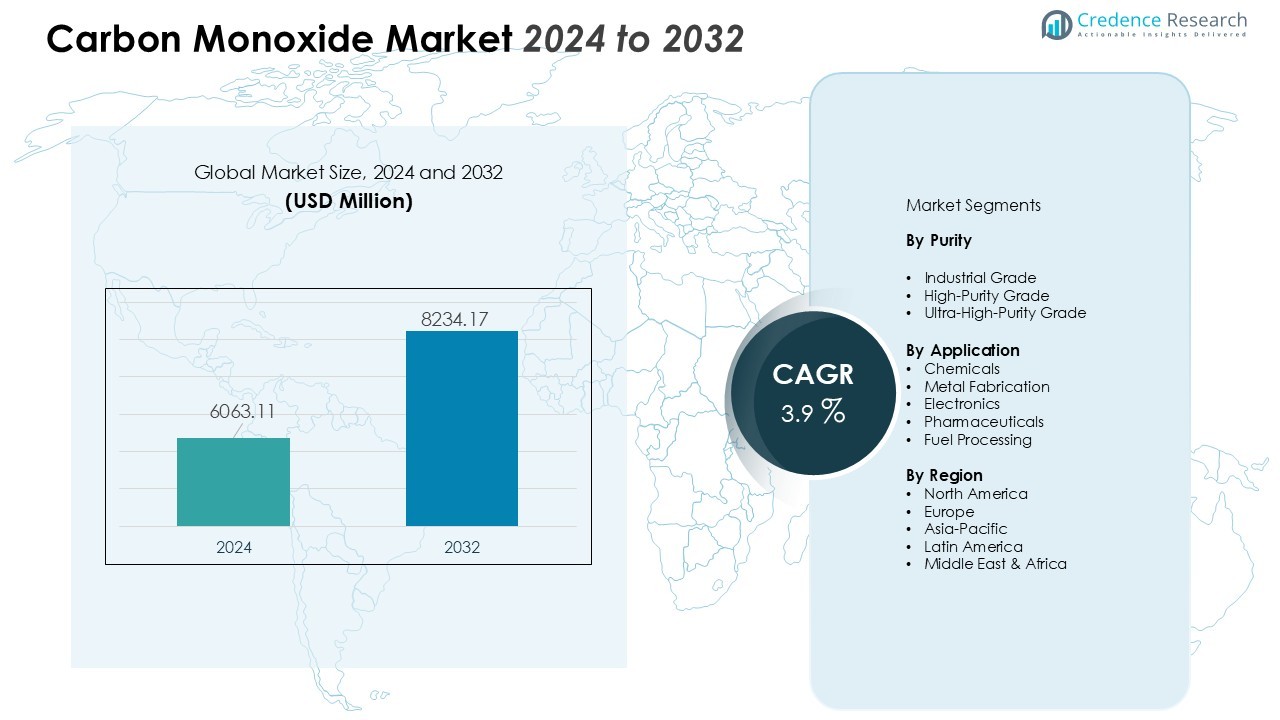
The carbon monoxide market size was valued at USD 6063.11 million in 2024 and is anticipated to reach USD 8234.17 million by 2032, at a CAGR of 3.9% during the forecast period.
| REPORT ATTRIBUTE | DETAILS |
|---|---|
| Historical Period | 2020-2023 |
| Base Year | 2024 |
| Forecast Period | 2025-2032 |
| Carbon Monoxide Market Size 2024 | USD 6063.11 Million |
| Carbon Monoxide Market, CAGR | 3.9% |
| Carbon Monoxide Market Size 2032 | USD 8234.17 Million |
Key market drivers include rising utilization of carbon monoxide in metal fabrication, hydroformylation processes, and bulk chemical synthesis. Industries such as pharmaceuticals, polymers, and electronics rely on CO-based intermediates for catalyst regeneration, reductive processing, and fine chemical production. The increasing shift toward clean-energy feedstocks, along with the growing adoption of CO in fuel-cell technologies and emerging carbon-recycling systems, also contributes to demand expansion. Expanding manufacturing footprints in developing economies and continuous innovation in gas handling, storage, and distribution systems reinforce market momentum.
Regionally, North America and Europe maintain strong demand due to mature industrial gas networks, advanced chemical manufacturing capabilities, and ongoing R&D activities. Asia-Pacific is expected to register the fastest growth, supported by rapid industrialization, rising steel production, and expanding chemical synthesis sectors across China, India, South Korea, and Southeast Asia. Emerging markets in Latin America and the Middle East further enhance growth opportunities as industrial infrastructure accelerates and investments in gas-based processing intensify.
Market Insights:
- The carbon monoxide market is valued at USD 6063.11 million in 2024 and is projected to reach USD 8234.17 million by 2032, supported by a CAGR of 3.9% during the forecast period.
- Demand strengthens due to rising use of CO in bulk chemical synthesis, including oxo-alcohols, acetic acid, and phosgene derivatives that rely on high-efficiency carbonylation and hydroformylation processes.
- Metal fabrication and metallurgy fuel market expansion as CO remains essential for ore reduction, blast furnace operations, sintering, annealing, and steel-refining activities.
- High-purity CO adoption grows rapidly in semiconductor and electronics manufacturing, where it enables controlled deposition, fine etching, and advanced material engineering.
- Clean-energy innovations and carbon-recycling technologies increasingly use CO for fuel cells, synthetic fuels, and CO₂-conversion systems, supporting circular-carbon pathways.
- Market challenges arise from stringent safety regulations, high handling risks, costly purification systems, and infrastructure limitations that restrict large-volume transport and storage.
- Regional growth is led by strong industrial gas networks in North America and Europe, while Asia-Pacific registers the fastest expansion driven by rapid industrialization, steel output, and increasing semiconductor and chemical production.
Market Drivers:
Rising Use of CO in Bulk Chemical and Intermediate Production
The carbon monoxide market benefits from strong uptake across large-scale chemical synthesis. Industries produce oxo-alcohols, acetic acid, and phosgene derivatives through CO-based pathways that support high output efficiency. It enables manufacturers to maintain consistent purity levels that strengthen downstream product performance. Demand remains stable due to its critical role in hydroformylation and reductive reactions across diverse chemical chains.
- For instance, Celanese Corporation industrially produces acetic acid via carbonylation of methanol with CO using a rhodium catalyst, producing over 3 million metric tons annually with purity levels exceeding 99.9%, meeting strict chemical manufacturing standards.
Growing Dependence on CO in Metallurgy and Metal Fabrication Processes
Rising steel and metal production strengthens demand for CO as a reducing agent in blast furnaces and metal refining systems. It supports efficient removal of oxygen from metal ores and enhances furnace productivity. The carbon monoxide market benefits from expanding applications in sintering, annealing, and surface treatment. Rapid industrial growth in developing economies pushes metal processors to secure reliable CO supplies.
- For Instance, ArcelorMittal's steel mills produce blast furnace gas as a by-product during the iron-making process, which typically has a carbon monoxide (CO) content of around 20-25%.
Increasing Need for High-Purity CO in Electronics and Semiconductor Manufacturing
High-purity grades of CO gain traction in semiconductor fabrication, where it supports controlled deposition and etching processes. It helps manufacturers achieve precise material characteristics required for advanced electronic devices. The carbon monoxide market grows due to rising demand for specialty gases in integrated circuit and display panel production. Strong focus on microelectronics innovation encourages investments in advanced gas purification systems.
Expansion of Clean Energy Technologies and Carbon Recycling Platforms
Emerging clean-energy systems adopt CO for fuel-cell applications and synthetic fuel development. It also supports carbon-capture and conversion platforms that convert CO₂ into value-added chemicals. The carbon monoxide market benefits from growing interest in low-carbon manufacturing routes and circular chemical processes. Ongoing research promotes novel pathways where CO enables sustainable industrial transformation.
Market Trends:
Growing Adoption of High-Purity and Specialty CO Grades Across Advanced Manufacturing
The carbon monoxide market observes a shift toward high-purity and specialty gas grades that support precision-driven industries. Semiconductor fabrication, fiber optics, and specialty chemical producers rely on refined CO supply to maintain strict process uniformity. It improves reaction selectivity and strengthens quality control in highly sensitive manufacturing lines. Growing demand for microelectronics and advanced materials pushes suppliers to invest in purification technologies. Rising emphasis on stable supply chains encourages long-term contracts with gas distributors. Increased deployment of automated gas delivery systems elevates operational efficiency and safety in production environments.
- For instance, Linde implemented pressure swing adsorption systems, reducing impurities to parts-per-billion for CVD applications in chip production.
Expansion of CO Utilization in Sustainable Industrial Pathways and Low-Carbon Technologies
Global industries integrate CO into emerging clean-energy and circular-chemistry platforms that target emission reduction. It contributes to synthetic fuel production, carbon-capture conversion, and next-generation catalyst development. The carbon monoxide market aligns with rising interest in carbon-recycling routes that transform CO₂ into industrial feedstocks. Strong policy support for decarbonization encourages research partnerships across energy, chemical, and engineering sectors. Commercialization of solid oxide fuel cells and gasification technologies increases CO consumption in pilot and industrial-scale units. Growing attention to energy-efficient syngas systems supports wider industrial adoption and strengthens long-term market prospects.
- For instance, Northwestern University researchers developed a process achieving 70% Faradaic efficiency in converting captured \(CO_{2}\) to \(CO\) at room temperature, which operates at an energy intensity of 35 gigajoules per ton of CO produced. This significantly lowers energy consumption compared to older methods, which required more than 59 gigajoules per ton.
Market Challenges Analysis:
Stringent Safety Regulations and Operational Risks in CO Handling
The carbon monoxide market faces significant challenges due to strict safety norms and high operational risks. CO’s toxic nature requires advanced monitoring systems, airtight storage, and controlled transport procedures. It increases compliance costs for chemical plants, metal processors, and semiconductor facilities. Frequent regulatory updates demand continuous investment in training and safety upgrades. Limited tolerance for leaks or exposure incidents forces operators to adopt specialized equipment. Heightened scrutiny from environmental and occupational safety agencies increases operational complexity.
High Production Costs and Infrastructure Constraints Across Key Industries
Producers encounter rising costs linked to purification, separation, and distribution of CO across industrial clusters. The carbon monoxide market struggles with limited pipeline networks that restrict efficient large-volume transport. It also faces infrastructure gaps in emerging economies where industrial gas supply chains remain underdeveloped. High capital requirements slow expansion plans for small and mid-sized manufacturers. Volatile raw material availability affects production stability for syngas-derived CO. Supply disruptions and logistical barriers create uncertainty for industries that depend on consistent high-purity CO delivery.
Market Opportunities:
Expansion of CO Applications in Sustainable Chemicals and Low-Carbon Technologies
The carbon monoxide market gains strong opportunities from rising interest in sustainable chemical pathways and circular-carbon systems. It supports new routes for synthetic fuels, green methanol, and advanced intermediates that align with global decarbonization goals. Emerging carbon-capture and conversion platforms create fresh demand for CO-based reactions that convert CO₂ into valuable products. Strong research activity in catalysis strengthens commercialization potential for next-generation processes. Investment flows from energy transition programs encourage industrial pilots across major economies. Adoption of clean-energy gasification units broadens market access for producers that supply high-purity CO.
Growth Potential Across High-Precision Manufacturing and Specialty Gas Applications
Rising demand for high-performance electronics, engineered materials, and fine chemicals opens new revenue avenues. The carbon monoxide market benefits from the need for ultra-high-purity gases in semiconductor fabrication, OLED production, and specialty coatings. It enhances process accuracy and enables manufacturers to meet strict quality benchmarks in advanced industries. Expansion of microelectronics clusters in Asia and North America raises CO consumption in deposition and reduction steps. Strong interest in automated gas supply systems increases opportunities for gas suppliers offering integrated delivery solutions. Broader industrial digitization supports new service models built around remote monitoring and predictive maintenance for CO infrastructure.
Market Segmentation Analysis:
By Purity
The carbon monoxide market categorizes purity levels into industrial grade, high-purity grade, and ultra-high-purity grade, each serving distinct end-use requirements. Industrial-grade CO secures strong demand from metallurgy, bulk chemicals, and syngas-based operations that prioritize volume and cost efficiency. High-purity CO gains traction in pharmaceutical intermediates and advanced chemical synthesis where controlled reactions require consistent gas quality. Ultra-high-purity CO records rapid growth due to its critical role in semiconductor manufacturing, microelectronics processing, and precision material deposition. It enables producers to meet strict purity standards and helps maintain uniformity in sensitive production environments. Rising focus on stringent quality benchmarks drives investment in refined purification and distribution systems.
- For instance, Air Liquide supplies industrial-grade oxygen to steel producers like ArcelorMittal, enabling efficient blast furnace operations and improved energy performance.
By Application
Application segments include chemicals, metal fabrication, electronics, pharmaceuticals, and fuel processing, each contributing to diverse revenue streams. The carbon monoxide market maintains strong penetration in chemical synthesis, where CO supports production of acetic acid, oxo-alcohols, and other high-volume intermediates. Metal fabrication units depend on CO for reduction processes that improve furnace efficiency and material performance. It strengthens demand in the electronics sector through its role in deposition, etching, and specialty gas applications. Pharmaceutical industries adopt CO-based intermediates to support complex synthesis pathways. Emerging fuel production and carbon-conversion technologies create new application avenues for CO in low-carbon industrial platforms.
- For instance, chemical manufacturers like Celanese and INEOS utilize CO in their chemical synthesis processes, producing millions of tons of acetic acid annually using advanced CO-based carbonylation technology
Segmentations:
By Purity
- Industrial Grade
- High-Purity Grade
- Ultra-High-Purity Grade
By Application
- Chemicals
- Metal Fabrication
- Electronics
- Pharmaceuticals
- Fuel Processing
By Region
- North America
- Europe
- Asia-Pacific
- Latin America
- Middle East & Africa
Regional Analysis:
Strong Market Presence Across North America Driven by Advanced Industrial Infrastructure
North America holds a significant share due to its mature chemical manufacturing base, robust metal processing capacity, and well-developed industrial gas networks. The carbon monoxide market benefits from strong demand in hydroformylation, acetic acid production, and semiconductor fabrication facilities across the U.S. and Canada. It supports high adoption levels in refineries and syngas plants where operational efficiency and steady gas supply remain priorities. Growth in specialty chemicals and advanced materials strengthens long-term consumption. Expanding investments in microelectronics manufacturing stimulate demand for ultra-high-purity CO. Strong regulatory frameworks and investments in safety technologies reinforce market stability.
Consistent Expansion Across Europe Supported by Technological and Environmental Advancements
Europe records steady growth driven by its strong chemical clusters, advanced metallurgical operations, and rising focus on sustainable industrial pathways. The carbon monoxide market gains support from European initiatives that promote low-carbon chemicals and circular-carbon technologies. It sees rising uptake in synthetic fuel development, carbon-conversion platforms, and precision manufacturing. Demand in Germany, France, and the UK remains stable due to established industrial gas infrastructure and high standards for purity control. Strengthening semiconductor and specialty materials production drives interest in high-purity CO. Rising emphasis on emission control and energy-efficient gasification technologies supports regional momentum.
Rapid Growth Across Asia-Pacific Driven by Industrialization and Manufacturing Expansion Asia-Pacific emerges as the fastest-growing regional segment, supported by large-scale industrialization, expanding chemical production, and strong steel output. The carbon monoxide market benefits from increasing consumption across China, India, South Korea, and Southeast Asia. It plays a vital role in electronics manufacturing, where high-purity CO supports deposition, etching, and specialty gas applications. Rising investments in semiconductor fabs, fine chemicals, and engineered materials strengthen regional opportunities. Expanding syngas projects and clean-energy initiatives improve access to CO supply. Strong government support for industrial modernization accelerates adoption across multiple sectors.
Key Player Analysis:
- Celanese Corporation
- Linde plc
- ATCO Atmospheric And Speciality Gases Private Limited
- Middlesex Gases & Technologies, Inc.
- Air Liquide
- Air Products and Chemicals, Inc.
- Axcel Gases
- Sipchem Company
- American Gas Products
- Messer
Competitive Analysis:
The carbon monoxide market features an established competitive landscape dominated by global industrial gas producers and specialized chemical manufacturers. Key participants such as Celanese Corporation, Linde plc, ATCO Atmospheric And Speciality Gases Private Limited, and Middlesex Gases & Technologies, Inc. strengthen market structure through broad distribution networks and advanced gas-handling capabilities. It benefits leading players that invest in purification technologies, high-purity gas production, and integrated supply solutions. Companies focus on long-term supply contracts to support semiconductor fabrication, metal processing, and bulk chemical operations. Strategic expansions into emerging economies help suppliers address rising demand from industrial clusters. Strong emphasis on safety compliance, product quality, and technological innovation shapes competitive differentiation across the industry.
Recent Developments:
- In July 2025, Linde announced major U.S. investments to support the commercial space sector, including two new long-term agreements for bulk industrial gases for rocket launches and construction of a new air separation unit in Brownsville, Texas, expected online in Q1 2026.
- In February 2025, Air Products announced exiting three U.S.-based projects including sustainable aviation fuel expansion in California, green liquid hydrogen in New York, and carbon monoxide project in Texas, recording a pre-tax charge of up to $3.1 billion to streamline its portfolio and focus on core industrial gas business.
Report Coverage:
The research report offers an in-depth analysis based on Purity, Application and Region. It details leading Market players, providing an overview of their business, product offerings, investments, revenue streams, and key applications. Additionally, the report includes insights into the competitive environment, SWOT analysis, current Market trends, as well as the primary drivers and constraints. Furthermore, it discusses various factors that have driven Market expansion in recent years. The report also explores Market dynamics, regulatory scenarios, and technological advancements that are shaping the industry. It assesses the impact of external factors and global economic changes on Market growth. Lastly, it provides strategic recommendations for new entrants and established companies to navigate the complexities of the Market.
Future Outlook:
- Rising demand for high-purity CO in semiconductor and microelectronics manufacturing strengthens long-term growth potential.
- Expansion of gasification projects increases CO availability for chemicals, fuels, and advanced materials.
- Growing interest in carbon-conversion technologies positions CO as a key intermediate in low-carbon industrial pathways.
- It supports wider adoption of circular-chemistry models that convert CO₂ into value-added products.
- Investments in specialty gas infrastructure improve supply reliability across high-precision manufacturing sectors.
- Strengthening environmental regulations accelerate development of cleaner CO production methods.
- R&D activity in catalyst optimization enhances efficiency of CO-based reactions across chemical processing routes.
- Emerging industrial clusters in Asia-Pacific drive strong demand across steel, chemicals, and electronics industries.
- Automation of gas handling, monitoring, and delivery systems enhances operational efficiency for end users.
- Global focus on energy transition expands opportunities for CO use in synthetic fuels and next-generation energy platforms.

Request a Free Sample
Fill in your details and we'll send you a free sample report.
- Sample data tables & charts
- Research methodology
Market Dynamics
Expansion of Bulk Chemical Synthesis
Carbon monoxide is a critical feedstock for the production of oxo-alcohols, acetic acid, and phosgene derivatives, supporting high-efficiency carbonylation and hydroformylation processes. The growth of the global chemicals sector, especially in Asia-Pacific, is driving increased demand for CO in these applications.
Rising Steel and Metal Production
CO is essential as a reducing agent in blast furnaces and metal refining, supporting efficient ore reduction and productivity in steel and metal fabrication. Rapid industrialization and infrastructure development in emerging economies are boosting CO consumption in metallurgy.
Growth in High-Purity CO for Electronics and Semiconductors
The increasing complexity of semiconductor and electronics manufacturing requires ultra-high-purity CO for controlled deposition and etching processes. The expansion of microelectronics and display panel production, particularly in Asia-Pacific and North America, is accelerating demand for specialty CO grades.
Adoption in Clean Energy and Carbon Recycling Technologies
Emerging fuel-cell technologies, synthetic fuel production, and carbon-capture conversion platforms are utilizing CO as a key intermediate. The global shift toward low-carbon and circular-chemistry models is creating new opportunities for CO in sustainable industrial pathways.
Advancements in Gas Handling and Distribution Infrastructure
Continuous innovation in purification, storage, and automated delivery systems is improving the safety, reliability, and efficiency of CO supply. These advancements are enabling broader adoption across high-precision manufacturing sectors and supporting market growth in both mature and developing regions.
Need a Custom Version of This Report?
Tailor the scope, geography, or segments to your exact requirements.
- Custom geography or segment scope
- Direct access to our analyst team
Frequently Asked Questions
What is the current market size for the carbon monoxide market, and what is its projected size in 2032?
At what Compound Annual Growth Rate is the carbon monoxide market expected to grow between 2024 and 2032?
Which segment held the largest share in the carbon monoxide market in 2024?
What are the primary factors fueling the growth of the carbon monoxide market?
Who are the leading companies in the carbon monoxide market?
Which region commanded the largest share of the carbon monoxide market in 2024?
Table of Content
Chapter 1 Market Segmentation
- 1.1 Segmentation Framework
- 1.1.1 Product and Service Classification
- 1.1.2 Application and End-Use Classification
- 1.1.3 Technology and Solution Classification
- 1.1.4 Customer and Distribution Channel Classification
- 1.1.5 Geographic Segmentation
- 1.1.6 Market Segment Definitions and Boundaries
- 1.2 By Purity
- 1.2.1 Industrial Grade
- 1.2.2 High-Purity Grade
- 1.2.3 Ultra-High-Purity Grade
- 1.3 By Application
- 1.3.1 Chemicals
- 1.3.2 Metal Fabrication
- 1.3.3 Electronics
- 1.3.4 Pharmaceuticals
- 1.3.5 Fuel Processing
Chapter 2 Introduction
- 2.1 Report Objectives and Scope
- 2.2 Product Definition and Industry Terminology
- 2.3 Market Inclusions and Exclusions
- 2.4 Research Process
- 2.4.1 Primary Research and Expert Interviews
- 2.4.2 Secondary Research and Source Review
- 2.4.3 Top-Down and Bottom-Up Estimation
- 2.4.4 Data Triangulation and Verification
- 2.5 Market Size Measurement Basis
- 2.5.1 2024: USD 6063.11 million → 2032: USD 8234.17 million
- 2.6 Historical and Forecast Reference Periods
- 2.6.1 Base Year: 2024
- 2.6.2 Forecast Period: 2024-2032
- 2.7 Research Assumptions and Limitations
Chapter 3 Executive Summary
- 3.1 Market Snapshot and Key Findings
- 3.2 Base-Year Market Size, 2024
- 3.3 Forecast Market Size, 2032
- 3.4 Revenue and Volume Growth Outlook
- 3.5 Key Demand and Supply Indicators
- 3.6 Leading Market Segments
- 3.7 Fastest-Growing Market Opportunities
- 3.8 Regional Performance Highlights
- 3.9 Technology and Industry Transformation
- 3.10 Competitive Landscape Summary
- 3.11 Analyst View and Strategic Implications
Chapter 4 Global Carbon Monoxide Market Trends and Developments
- 4.1 Historical Industry Development
- 4.2 Recent Market Trends and Developments
- 4.3 Demand and Customer Behavior Trends
- 4.4 Technology and Product Innovation
- 4.5 Artificial Intelligence, Automation and Digitalization
- 4.6 Local Manufacturing and Supply Chain Realignment
- 4.7 Industry Partnerships, Mergers and Acquisitions
- 4.8 Sustainability and Circular Economy Developments
- 4.9 Government and Private Sector Investment Trends
- 4.10 Emerging Business Models and Commercialization
- 4.11 Industry Developments and Announcements
Chapter 5 Global Carbon Monoxide Market Production, Supply and Demand Analysis
- 5.1 Demand Trend and Consumption Analysis
- 5.2 Demand Forecast, 2024-2032
- 5.3 Production and Output Trend
- 5.4 Production and Output Forecast, 2024-2032
- 5.5 Installed Capacity and Capacity Utilization
- 5.6 Company-Wise Production Plants and Statistics
- 5.6.1 Installed Production Capacity
- 5.6.2 Actual Production
- 5.6.3 Planned Capacity and Expansion Targets
- 5.7 Supply Chain Structure and Procurement Trends
- 5.8 Supply-Demand Gap and Bottlenecks
- 5.9 Import Dependence and Sourcing Structure
- 5.10 Contract Manufacturing and Outsourcing
- 5.11 Regional Supply and Demand Concentration
Chapter 6 Global Carbon Monoxide Market Pricing Analysis
- 6.1 Pricing Structure and Measurement
- 6.2 Historical Pricing Trends
- 6.3 Pricing Outlook, 2024-2032
- 6.4 Average Selling Price and Unit Economics
- 6.5 Pricing by Product and Market Segment
- 6.6 Geographic Pricing Differences
- 6.7 Key Input, Energy, Labor and Logistics Costs
- 6.8 Contract Pricing and Purchasing Models
- 6.9 Pricing Sensitivity and Competitive Positioning
- 6.10 Price, Margin and Profitability Implications
Chapter 7 Global Carbon Monoxide Market Dynamics
- 7.1 Market Growth Drivers
- 7.1.1 Demand-Side Drivers
- 7.1.2 Technology and Innovation Drivers
- 7.1.3 Infrastructure and Investment Drivers
- 7.1.4 Regulatory and Policy Drivers
- 7.2 Market Restraints
- 7.2.1 Cost and Affordability Constraints
- 7.2.2 Technology and Adoption Barriers
- 7.2.3 Supply Chain and Operational Constraints
- 7.3 Market Challenges
- 7.3.1 Competitive Pressure and Margin Erosion
- 7.3.2 Skills, Infrastructure and Implementation Gaps
- 7.4 Emerging Market Opportunities
- 7.5 Market Dynamics Impact and Time-Horizon Assessment
Chapter 8 Global Carbon Monoxide Value Chain Analysis
- 8.1 Industry Value Chain Overview
- 8.2 Upstream Suppliers and Critical Inputs
- 8.3 Technology and Component Providers
- 8.4 Manufacturing or Service Delivery
- 8.5 Distribution, Channel Partners and Integrators
- 8.6 Downstream Applications and End Users
- 8.7 Value Addition and Profit Pools
- 8.8 Vertical Integration and Outsourcing
- 8.9 Supplier Concentration and Risk
- 8.10 Supply Chain Localization and Resilience
Chapter 9 Global Carbon Monoxide Market Regulations and Policies
- 9.1 Relevant Laws, Standards and Compliance Frameworks
- 9.2 Product, Service, Safety and Quality Requirements
- 9.3 Government Policies, Incentives and Subsidies
- 9.4 Imports, Exports and Trade Barriers
- 9.5 Public Procurement and Local Content Requirements
- 9.6 Environmental and Sustainability Compliance
- 9.7 Upcoming Policy Changes and Market Implications
Chapter 10 Global Carbon Monoxide Market Hotspots and Opportunities
- 10.1 Market Opportunity Mapping and Growth Hotspots
- 10.2 High-Growth Applications and Customer Groups
- 10.3 Underserved Markets and White-Space Opportunities
- 10.4 Emerging Technology and Product Opportunities
- 10.5 New Capacity and Investment Hotspots
- 10.6 Market Entry and Expansion Opportunities
- 10.7 Distribution and Partnership Opportunities
- 10.8 Near-Term and Long-Term Commercial Potential
- 10.9 Opportunity Attractiveness and Execution Risks
Chapter 11 Global Carbon Monoxide Market Outlook, 2024-2032
- 11.1 Market Size and Analysis
- 11.1.1 Revenue (Market Measurement: 2024: USD 6063.11 million → 2032: USD 8234.17 million)
- 11.1.2 Market Volume and Quantity Sold
- 11.1.3 Historical Market Size
- 11.1.4 Base-Year Market Size, 2024
- 11.2 Market Forecast, 2024-2032
- 11.2.1 Revenue Forecast to 2032
- 11.2.2 Volume Forecast to 2032
- 11.2.3 CAGR and Year-on-Year Growth
- 11.2.4 Incremental Revenue Opportunity
- 11.3 Forecast Assumptions and Scenario Analysis
- 11.3.1 Base-Case Forecast
- 11.3.2 Optimistic and Conservative Scenarios
- 11.3.3 Technology, Pricing and Policy Sensitivities
- 11.4 Market Attractiveness and Growth Outlook
Chapter 12 Global Carbon Monoxide Market Segmentation and Outlook
- 12.1 Segmentation Summary and Market Shares, 2024
- 12.2 Largest and Fastest-Growing Segments
- 12.3 By Purity - Market Size and Forecast, 2024-2032
- 12.3.1 Segment Definition and Scope
- 12.3.2 Historical Market Size
- 12.3.3 Revenue Forecast, 2024-2032
- 12.3.4 Volume Forecast, 2024-2032
- 12.3.5 Base-Year Market Share, 2024
- 12.3.6 Segment CAGR and Growth Drivers
- 12.3.7 Subsegment Market Size and Forecast
- 12.3.7.1 Industrial Grade
- 12.3.7.2 High-Purity Grade
- 12.3.7.3 Ultra-High-Purity Grade
- 12.3.8 Subsegment Pricing and Adoption Trends
- 12.3.9 Leading Suppliers and Competition
- 12.3.10 Regional Demand and Opportunities
- 12.4 By Application - Market Size and Forecast, 2024-2032
- 12.4.1 Segment Definition and Scope
- 12.4.2 Historical Market Size
- 12.4.3 Revenue Forecast, 2024-2032
- 12.4.4 Volume Forecast, 2024-2032
- 12.4.5 Base-Year Market Share, 2024
- 12.4.6 Segment CAGR and Growth Drivers
- 12.4.7 Subsegment Market Size and Forecast
- 12.4.7.1 Chemicals
- 12.4.7.2 Metal Fabrication
- 12.4.7.3 Electronics
- 12.4.7.4 Pharmaceuticals
- 12.4.7.5 Fuel Processing
- 12.4.8 Subsegment Pricing and Adoption Trends
- 12.4.9 Leading Suppliers and Competition
- 12.4.10 Regional Demand and Opportunities
- 12.5 Segment Growth Comparison
- 12.6 Segment Attractiveness and Priority Matrix
Chapter 13 Global Carbon Monoxide End-Use and Application Market Outlook
- 13.1 End-Use Industry and Customer Demand Structure
- 13.2 Leading Applications and Customer Groups
- 13.3 End-Use Market Size, Share and Forecast
- 13.4 Major End-Use Industry Deep Dives
- 13.4.1 Customer Requirements and Use Cases
- 13.4.2 Demand and Replacement Cycles
- 13.4.3 Technical and Regulatory Considerations
- 13.4.4 Purchasing and Procurement Models
- 13.4.5 Leading Vendors and Distribution Channels
- 13.4.6 Forecast and Commercial Opportunities
- 13.5 Emerging Applications and Cross-Segment Demand
- 13.6 End-Use Industry Investment Priorities
Chapter 14 Global Carbon Monoxide Geographic Market Outlook, 2024-2032
- 14.1 Regional Market Size and Share, 2024
- 14.2 Regional Market Forecast, 2024-2032
- 14.3 Regional Pricing, Production and Demand Differences
- 14.4 North America
- 14.4.1 United States
- 14.4.2 Canada
- 14.4.3 Mexico
- 14.5 Europe
- 14.5.1 Germany
- 14.5.2 France
- 14.5.3 Italy
- 14.5.4 United Kingdom
- 14.5.5 Spain
- 14.5.6 Poland
- 14.5.7 Russia
- 14.5.8 Netherlands
- 14.5.9 Belgium
- 14.5.10 Sweden
- 14.5.11 Denmark
- 14.5.12 Norway
- 14.5.13 Rest of Europe
- 14.6 Asia Pacific
- 14.6.1 China
- 14.6.2 India
- 14.6.3 Japan
- 14.6.4 South Korea
- 14.6.5 Thailand
- 14.6.6 Indonesia
- 14.6.7 Vietnam
- 14.6.8 Malaysia
- 14.6.9 Australia
- 14.6.10 Rest of Asia Pacific
- 14.7 Latin America
- 14.7.1 Brazil
- 14.7.2 Argentina
- 14.7.3 Colombia
- 14.7.4 Chile
- 14.7.5 Rest of Latin America
- 14.8 Middle East
- 14.8.1 Saudi Arabia
- 14.8.2 United Arab Emirates
- 14.8.3 Turkey
- 14.8.4 Israel
- 14.8.5 Iran
- 14.8.6 Rest of the Middle East
- 14.9 Africa
- 14.9.1 South Africa
- 14.9.2 Egypt
- 14.9.3 Nigeria
- 14.9.4 Morocco
- 14.9.5 Rest of Africa
- 14.10 Regional Investment, Policy and Supply Chain Differences
- 14.11 Regional Competitive Landscape
- 14.12 Geographic Growth Hotspots
Chapter 15 Global Carbon Monoxide Technology, Innovation and Sustainability Outlook
- 15.1 Technology Landscape and Maturity
- 15.2 Product, Process and Service Innovation
- 15.3 AI, Automation and Digital Tools in the Industry
- 15.4 Technology Adoption and Performance Benchmarking
- 15.5 Innovation Pipeline and R&D Investment
- 15.6 Patent and Intellectual Property Trends
- 15.7 Energy Efficiency and Resource Management
- 15.8 Sustainability, Recycling and Circularity
- 15.9 Technology Roadmap, 2024-2032
- 15.10 Risks of Obsolescence and Technology Substitution
Chapter 16 Global Carbon Monoxide Market Key Strategic Imperatives
- 16.1 Growth and Market Entry Priorities
- 16.2 High-Return Products and Segments
- 16.3 Pricing, Profitability and Cost Optimization
- 16.4 Technology Investment and Product Differentiation
- 16.5 Supply Chain Localization and Resilience
- 16.6 Distribution and Customer Acquisition
- 16.7 Partnership, Acquisition and Capacity Strategy
- 16.8 Regional Expansion Priorities
- 16.9 Short-, Medium- and Long-Term Actions
Chapter 17 Competition Outlook
- 17.1 Industry Competition Characteristics
- 17.2 Market Structure and Concentration
- 17.3 Market Share and Competitive Positioning, 2024
- 17.4 Company-Wise Revenue and Product Benchmarking
- 17.5 Production and Service Capacity Benchmarking
- 17.6 Technology, Pricing and Differentiation
- 17.7 Regional Footprint and Distribution Strength
- 17.8 Mergers, Acquisitions and Strategic Alliances
- 17.9 New Entrants and Competitive Threats
- 17.10 Porter's Five Forces and Industry Attractiveness
- 17.11 Competitive Outlook, 2024-2032
Chapter 18 Company Profiles
- 18.1 Company Coverage and Selection Criteria
- 18.2 Celanese Corporation
- 18.2.1 Business Description
- 18.2.2 Company Ownership and Geographic Presence
- 18.2.3 Product and Service Portfolio
- 18.2.4 Manufacturing and Operating Footprint
- 18.2.5 Production Capacity and Expansion Plans
- 18.2.6 Financial Performance and Investment
- 18.2.7 Market Share and Competitive Position
- 18.2.8 Technology and Innovation Capabilities
- 18.2.9 Strategic Alliances or Partnerships
- 18.2.10 Recent Developments
- 18.2.11 Growth Strategy and Outlook
- 18.3 Linde plc
- 18.4 Air Liquide
- 18.5 Air Products and Chemicals, Inc.
- 18.6 Messer
- 18.7 ATCO Atmospheric And Speciality Gases Private Limited
- 18.8 Middlesex Gases & Technologies, Inc.
- 18.9 Axcel Gases
- 18.10 Sipchem Company
- 18.11 American Gas Products
- 18.12 Other Relevant Market Participants
Note: Every listed company is profiled on the structure shown under the first company. The company list is preliminary and may change based on research findings, market developments, data availability and client requirements.
Chapter 19 Disclaimer
- 19.1 Research and Forecast Disclaimer
- 19.2 Data Source and Estimation Limitations
Note: The depth of individual sections depends on data availability for this market. Volume, capacity, trade and other unit-based metrics are included where applicable.

