
Market Overview:
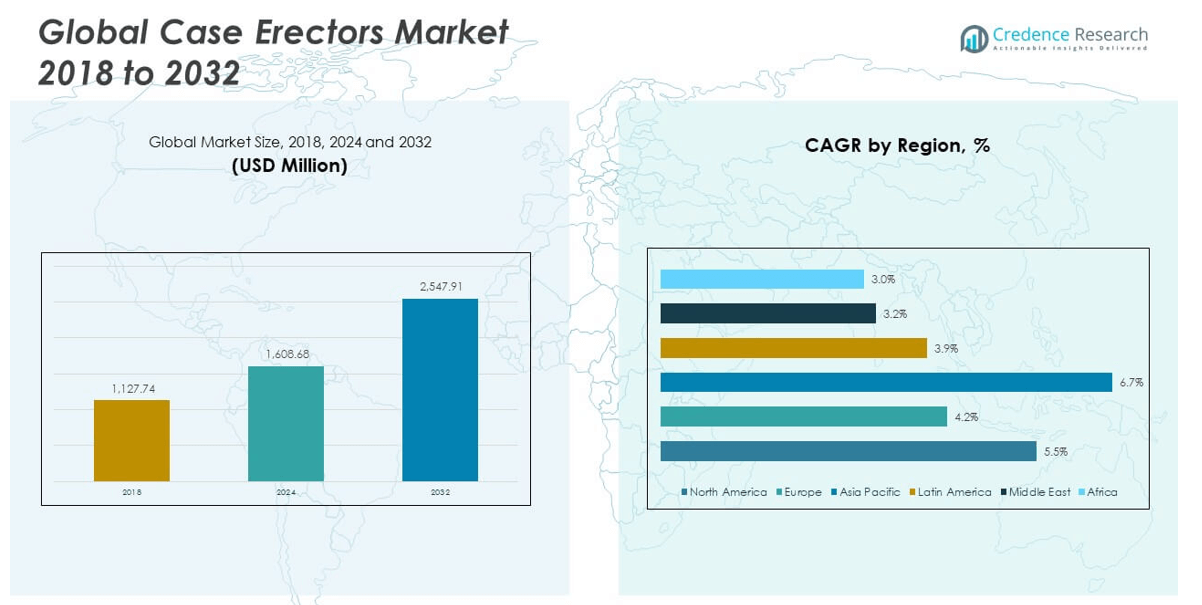
The Global Case Erectors Market size was valued at USD 1,127.74 million in 2018 to USD 1,608.68 million in 2024 and is anticipated to reach USD 2,547.91 million by 2032, at a CAGR of 5.51% during the forecast period.
| REPORT ATTRIBUTE | DETAILS |
|---|---|
| Historical Period | 2020-2023 |
| Base Year | 2024 |
| Forecast Period | 2025-2032 |
| Case Erectors Market Size 2024 | USD 1,608.68 million |
| Case Erectors Market, CAGR | 5.51% |
| Case Erectors Market Size 2032 | USD 2,547.91 million |
The market is being driven by the increasing automation in packaging operations across industries such as food and beverage, pharmaceuticals, and e-commerce. As companies seek to improve operational efficiency and reduce manual labor, case erectors offer a reliable solution for consistent, high-speed box forming. The growing need for cost-effective and flexible packaging lines, coupled with the rise in demand for corrugated packaging, is accelerating the adoption of case erectors globally. Technological advancements such as smart sensors and robotic integration further enhance their appeal.
North America leads the global market due to its mature manufacturing and packaging sectors, along with strong investments in automation technologies. Europe follows closely, supported by stringent packaging standards and growing demand from the food industry. The Asia Pacific region is emerging as a high-growth market, with rapid industrialization, rising consumption, and increasing adoption of automated systems in countries like China, India, and Southeast Asia. Latin America and the Middle East & Africa are witnessing gradual growth, fueled by expanding retail and logistics sectors.
Market Insights:
- The Global Case Erectors Market was valued at USD 1,608.68 million in 2024 and is projected to reach USD 2,547.91 million by 2032, growing at a CAGR of 5.51%.
- Automation in packaging lines and rising demand from food, beverage, and e-commerce sectors drive market expansion.
- High upfront investment and integration complexity with legacy systems remain key restraints to widespread adoption.
- North America leads the Global Case Erectors Market, backed by mature manufacturing infrastructure and automation readiness.
- Asia Pacific shows the fastest growth due to industrialization, smart manufacturing policies, and rising consumer goods demand.
- Automatic case erectors hold the dominant share, preferred for their high-speed performance in large-scale operations.
- Sustainability initiatives and demand for energy-efficient, modular systems are influencing future product development.
Market Drivers:
Rising demand for automation across packaging lines in major end-use industries
The Global Case Erectors Market benefits from the widespread shift toward automation in packaging processes, particularly in sectors such as food and beverage, pharmaceuticals, and e-commerce. Industries seek faster throughput, reduced labor dependency, and consistent packaging quality. Case erectors play a critical role in automating the first step of secondary packaging by forming boxes quickly and uniformly. Companies aim to optimize operational efficiency while ensuring minimal product damage. Labor shortages and the increasing cost of skilled labor further encourage investment in these machines. Businesses require packaging systems that can keep pace with rising production volumes. It allows manufacturers to maintain high production uptime and scalability. Automation reduces the margin of error, increasing output and minimizing waste.
Increased preference for cost-efficiency and packaging flexibility in logistics operations
Cost optimization remains a significant factor for companies across manufacturing and logistics. The Global Case Erectors Market responds to this by offering equipment that supports various box sizes and configurations. Flexibility in handling custom and standard cartons appeals to industries facing SKU proliferation. The shift toward shorter product life cycles and just-in-time manufacturing necessitates quick changeovers in packaging lines. Case erectors allow for such adaptability while maintaining speed and consistency. It provides a return on investment through savings in manual labor and reduced packaging waste. Many businesses pursue packaging systems that align with sustainable practices without compromising cost efficiency. Case erectors achieve this through precision and waste minimization.
Growing demand for corrugated packaging driven by e-commerce expansion
The expansion of the e-commerce sector continues to increase the global consumption of corrugated boxes. The Global Case Erectors Market is closely tied to this trend, as businesses seek equipment to handle large volumes of shipping-ready cartons. Corrugated packaging offers durability, ease of recycling, and lightweight transport benefits. Online retailers require high-speed packaging systems that can operate continuously during peak seasons. Case erectors reduce the bottleneck in warehouse and fulfillment center operations. It enables seamless integration with other downstream automation systems such as case sealers and palletizers. The rising demand for tamper-proof and well-structured packaging further supports this segment. Corrugated material compatibility enhances the value proposition of these machines.
- For instance, Combi Packaging's 2-EZ® HS High-Speed Case Erector can form and bottom-seal up to 30 corrugated cases per minute and features a no-tool changeover system, supporting high-volume e-commerce warehouses during order peaks.
Technological advancements enhancing machine capabilities and system integration
Recent innovations in sensors, control systems, and robotics contribute to more intelligent and reliable case erector systems. The Global Case Erectors Market witnesses an uptrend in smart machines capable of diagnostics, remote monitoring, and predictive maintenance. Manufacturers integrate IoT capabilities to allow seamless communication across the production floor. Such advancements increase uptime and reduce maintenance-related delays. Intuitive HMI interfaces and tool-less changeovers improve user experience and operational ease. It encourages adoption even among small- and mid-sized enterprises. The compatibility of case erectors with end-to-end automated lines enhances throughput across packaging operations. Smart features raise machine efficiency while reducing dependency on operator skill.
- For instance, Sidel’s Cermex EvoPack integrates advanced Industry 4.0 technologies, delivers up to 60 cases per minute, and offers format changeovers as fast as five minutes, enabling predictive maintenance and seamless line automation for global FMCG manufacturers.
Market Trends
Rising adoption of modular and compact machine designs for space optimization
Manufacturers increasingly develop compact case erectors to fit into space-constrained production environments. The Global Case Erectors Market reflects this trend through machines offering high performance in a smaller footprint. Businesses value modular systems that can expand with future requirements. The modular design supports ease of maintenance and streamlined upgrades. Compact case erectors are preferred in emerging economies where space comes at a premium. It simplifies machine installation and reduces time to deploy. Flexible layout integration is also a key buying criterion for buyers. Compact formats reduce the operational footprint without compromising speed or capacity.
- For instance, Pearson Packaging Systems’ CE25 Case Erector forms up to 25 cases per minute and operates within a compact footprint, making it suitable for facilities with limited space. Its vertical case presentation, dual-opposed vacuum opening, and intuitive HMI support efficient case forming and streamlined integration into packaging lines.
Integration of smart features and connectivity for enhanced operational insight
Industrial equipment manufacturers are embedding smart features in packaging machinery to improve real-time performance tracking. The Global Case Erectors Market includes solutions with integrated sensors, data analytics, and remote access systems. Connected case erectors provide actionable insights to reduce downtime and maintenance costs. Real-time fault detection improves production reliability. It strengthens asset performance monitoring in multi-line operations. Smart connectivity enables proactive decision-making at the plant level. The focus on predictive analytics helps facilities optimize operational schedules. Industry 4.0 strategies further reinforce the demand for smart packaging machines.
Increased use of robotics and collaborative automation in secondary packaging lines
Robotic integration in case erecting systems is reshaping packaging operations in high-volume facilities. The Global Case Erectors Market reflects a rising demand for robotic-assisted packaging, particularly in advanced economies. Robotic arms assist in box positioning, loading, and handling irregular carton sizes. Collaborative robots, or cobots, work safely alongside human operators without caging. It enhances workforce safety and enables flexible, multipurpose operations. Robotics improves precision and minimizes human fatigue in repetitive tasks. The technology aligns with lean manufacturing goals. Faster ROI and ease of redeployment make robotic systems attractive for high-mix production settings.
Focus on sustainability driving material-agnostic and energy-efficient designs
Sustainability requirements are prompting packaging equipment manufacturers to design energy-efficient machines. The Global Case Erectors Market evolves with solutions that consume less power and accommodate recyclable packaging materials. Businesses opt for systems capable of handling eco-friendly and biodegradable cartons. Reduced material waste during carton erection also supports environmental goals. It aligns with global regulations promoting greener packaging standards. Energy-efficient drives and motors reduce operating costs. Environmental certifications influence purchasing decisions in regulated markets. Equipment that supports sustainability initiatives adds long-term value to production lines.
- For instance, Sidel’s Cermex EvoPack platform uses recyclable corrugated board, supports up to 60 cases per minute within a compact footprint, and enables energy-efficient case forming with Industry 4.0 features such as real-time digital dashboards and condition-based maintenance, documented in its technical specifications.
Market Challenges Analysis
High capital investment and maintenance cost pose adoption barriers for SMEs
The upfront cost of automated case erecting machines continues to act as a deterrent for small and medium-sized enterprises. The Global Case Erectors Market faces this challenge particularly in emerging economies where capital budgets remain limited. Businesses hesitate to invest in high-end machines without guaranteed production volumes. Ongoing maintenance costs and the need for trained technicians add to operational burden. It restricts market penetration among price-sensitive buyers. Long-term cost savings are not always apparent during procurement. Return on investment depends on consistent usage and integration with other automated systems. Smaller manufacturers often continue using manual or semi-automatic equipment due to these constraints.
Complex integration with legacy systems and limited customization options
Many production facilities operate with legacy packaging infrastructure that lacks compatibility with modern case erectors. The Global Case Erectors Market contends with integration issues that delay installation and commissioning. Customization limitations in standard case erectors create a mismatch with existing production layouts. It can lead to production bottlenecks if not planned carefully. Manufacturers may face downtime while adapting workflows to accommodate new equipment. Training operators for newer systems requires additional time and resources. Limited post-installation flexibility hinders scaling or layout changes. These integration and adaptability issues slow market expansion in conservative manufacturing environments.
Market Opportunities
Expanding packaging needs of e-commerce and last-mile delivery sectors
Rapid growth in e-commerce is driving increased demand for high-throughput packaging systems. The Global Case Erectors Market stands to benefit from logistics hubs and fulfillment centers needing consistent and scalable box-forming equipment. It enables companies to handle varied order volumes efficiently. Growing direct-to-consumer models create pressure for faster order processing and error-free packaging. Case erectors can support dynamic packaging needs while reducing manual labor. This demand presents an opportunity for market players to tailor compact, high-speed systems suited for high-turnover operations.
Emerging economies embracing industrial automation in manufacturing
Industrialization in countries such as India, Brazil, and Vietnam is creating a favorable environment for automated packaging solutions. The Global Case Erectors Market finds opportunities in supporting small and mid-size enterprises modernizing their production lines. It allows vendors to offer cost-effective models that meet local requirements. Local support networks and region-specific customization can boost adoption. Governments promoting smart manufacturing and infrastructure upgrades also contribute to long-term market growth.
Market Segmentation Analysis:
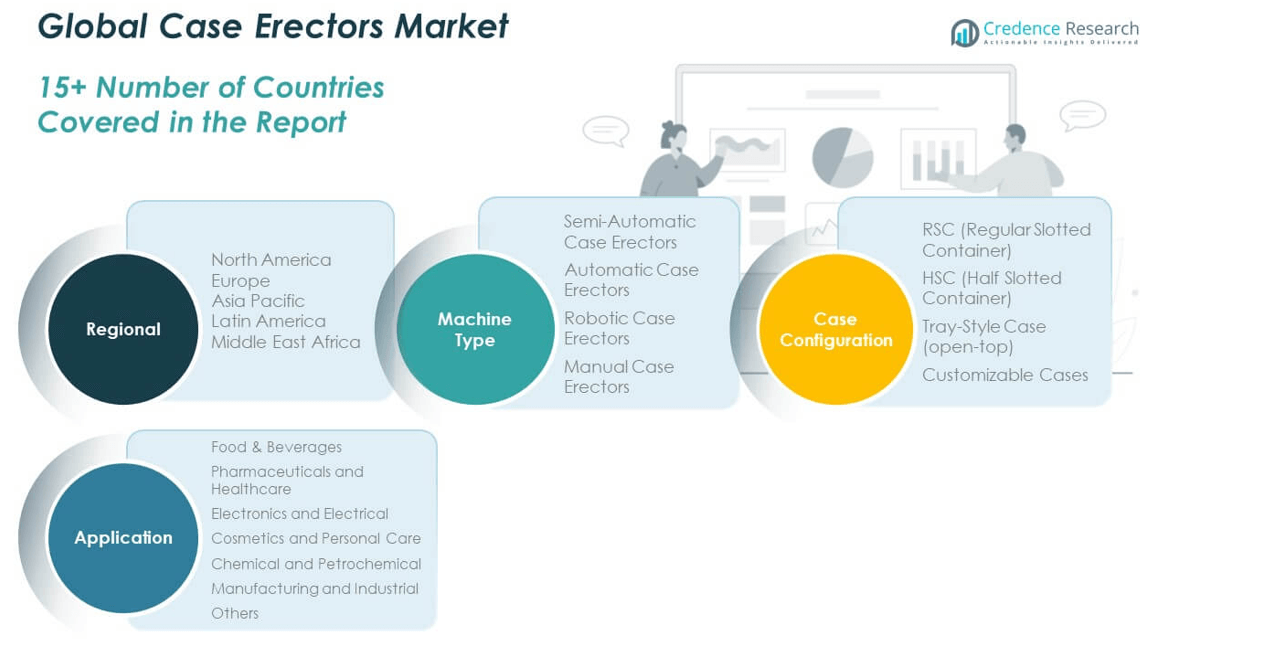
The Global Case Erectors Market is segmented by machine type, case configuration, and application, each reflecting varying degrees of technological adoption and end-user demand.
By machine type, automatic case erectors dominate due to their speed, reliability, and suitability for high-volume operations. Semi-automatic models follow, serving mid-sized enterprises seeking a balance between efficiency and cost. Robotic case erectors are gaining traction in advanced manufacturing due to their precision and integration capabilities, while manual systems maintain relevance in small-scale operations with lower throughput requirements.
- For example, Lantech’s CS-300 Case Erector is built for mid-sized companies and cited in Lantech’s product sheets as supporting speeds up to 10 cpmwith manual case loading, offering a balance of cost and automation for mid-volume users.
By case configuration, RSC (Regular Slotted Container) remains the most widely used format due to its cost-efficiency and structural simplicity. HSC (Half Slotted Containers) are popular for top-loading applications, particularly in retail and display packaging. Tray-style cases are suited for open-top handling and are commonly used in food and beverage settings. Customizable cases address the growing demand for flexible packaging solutions across niche applications.
- For instance, Combi’s TF‑40G tray former produces up to 40 open‑top trays per minute using four‑corner glue formation within a compact footprint, suited for high-throughput food and beverage packaging applications
By application, food and beverages lead due to stringent hygiene and high-volume packaging demands. Pharmaceuticals and healthcare follow, with rising automation in regulated environments. Electronics and electrical sectors favor precision and dust-free packaging, while cosmetics and personal care drive demand for aesthetically compliant, secure cases. Chemical and petrochemical industries use robust packaging solutions for safety and compliance. Manufacturing and industrial applications continue to adopt automated case erecting systems for operational efficiency. It serves varied needs across sectors by aligning product formats with end-use requirements.
Segmentation:
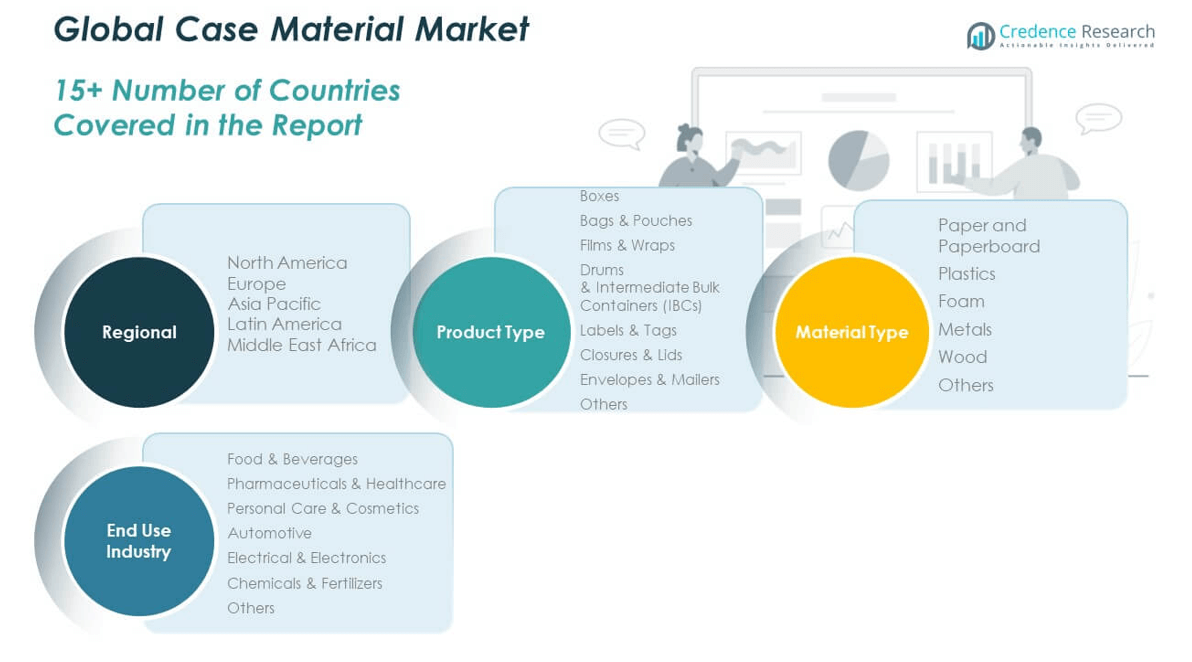
By Machine Type
- Semi-Automatic Case Erectors
- Automatic Case Erectors
- Robotic Case Erectors
- Manual Case Erectors
By Case Configuration
- RSC (Regular Slotted Container)
- HSC (Half Slotted Container)
- Tray-Style Case (Open-Top)
- Customizable Cases
By Application
- Food & Beverages
- Pharmaceuticals and Healthcare
- Electronics and Electrical
- Cosmetics and Personal Care
- Chemical and Petrochemical
- Manufacturing and Industrial
- Others
By Region
- North America
- U.S.
- Canada
- Mexico
- Europe
- Germany
- France
- U.K.
- Italy
- Spain
- Rest of Europe
- Asia Pacific
- China
- Japan
- India
- South Korea
- South-east Asia
- Rest of Asia Pacific
- Latin America
- Brazil
- Argentina
- Rest of Latin America
- Middle East & Africa
- GCC Countries
- South Africa
- Rest of the Middle East and Africa
Regional Analysis:
The North America Global Case Erectors Market size was valued at USD 492.08 million in 2018 to USD 694.64 million in 2024 and is anticipated to reach USD 1,103.26 million by 2032, at a CAGR of 5.5% during the forecast period. North America accounts for 43.2% of the total Global Case Erectors Market share in 2024. It leads due to early adoption of packaging automation and strong investments in high-speed machinery. The region’s robust food, beverage, and pharmaceutical sectors drive consistent demand. Large-scale manufacturers prioritize production efficiency, supporting the integration of case erectors in automated lines. It benefits from a mature e-commerce ecosystem, creating packaging requirements in distribution and fulfillment centers. Technological advancements and a skilled workforce further support growth. Stringent packaging standards promote adoption of reliable, high-precision equipment. Leading market players actively launch innovative systems tailored for U.S. and Canadian industries.
The Europe Global Case Erectors Market size was valued at USD 207.01 million in 2018 to USD 278.84 million in 2024 and is anticipated to reach USD 400.87 million by 2032, at a CAGR of 4.2% during the forecast period. Europe holds 17.3% of the total Global Case Erectors Market share in 2024. It is driven by strong regulatory frameworks promoting sustainable and standardized packaging. Countries like Germany, France, and Italy show high deployment in food processing and consumer goods manufacturing. It supports automation across factory floors to improve productivity. European companies seek compact, energy-efficient systems compatible with green packaging initiatives. Integration with Industry 4.0 infrastructure enhances efficiency. Local players introduce customizable and modular case erectors for mid-sized enterprises. Focus on safety, hygiene, and design compliance strengthens market dynamics in the region.
The Asia Pacific Global Case Erectors Market size was valued at USD 322.92 million in 2018 to USD 486.59 million in 2024 and is anticipated to reach USD 841.12 million by 2032, at a CAGR of 6.7% during the forecast period. Asia Pacific commands 30.2% of the Global Case Erectors Market share in 2024, emerging as a key growth region. Rapid industrialization in China, India, and Southeast Asia fuels the shift toward packaging automation. Demand from food processing, electronics, and FMCG industries continues to rise. Local manufacturers invest in modernizing operations to meet global standards. It experiences increasing adoption of cost-effective and space-saving equipment. Government-led smart manufacturing policies support technology upgrades. The growing influence of regional suppliers enhances market competition and accessibility. Urbanization and rising middle-class consumption drive packaged goods demand across developing markets.
The Latin America Global Case Erectors Market size was valued at USD 54.36 million in 2018 to USD 76.59 million in 2024 and is anticipated to reach USD 107.66 million by 2032, at a CAGR of 3.9% during the forecast period. Latin America represents 4.8% of the total Global Case Erectors Market share in 2024. Brazil and Mexico remain the dominant markets due to expanding food and beverage sectors. It sees steady adoption of semi-automatic and entry-level case erectors. Manufacturers aim to balance cost constraints with operational upgrades. Economic recovery and infrastructure development create favorable conditions for machinery investment. Market expansion is influenced by growth in packaged consumer goods. Regional players collaborate with international firms to bring advanced technologies. Industrial automation spreads across urban industrial hubs, improving packaging capabilities across mid-sized operations.
The Middle East Global Case Erectors Market size was valued at USD 30.59 million in 2018 to USD 39.76 million in 2024 and is anticipated to reach USD 52.78 million by 2032, at a CAGR of 3.2% during the forecast period. The Middle East contributes 2.5% to the total Global Case Erectors Market share in 2024. It shows stable demand from sectors like pharmaceuticals, packaged food, and logistics. The UAE and Saudi Arabia invest in industrial automation to diversify their economies. It benefits from growth in regional exports and supply chain modernization. Case erectors help improve packaging consistency in export-driven industries. Customized solutions tailored for temperature-sensitive or specialty packaging gain traction. Market development is slower in smaller Gulf economies due to budget limitations. Focus on product shelf life and branding drives machinery upgrades in premium goods packaging.
The Africa Global Case Erectors Market size was valued at USD 20.79 million in 2018 to USD 32.26 million in 2024 and is anticipated to reach USD 42.23 million by 2032, at a CAGR of 3.0% during the forecast period. Africa accounts for 2.0% of the total Global Case Erectors Market share in 2024. The market remains at an early growth stage with rising interest in automation. South Africa leads regional adoption due to relatively advanced industrial infrastructure. Nigeria, Kenya, and Egypt show gradual uptake in packaging modernization. It sees increased demand for packaging machinery in food processing and local manufacturing. Budget-friendly, semi-automatic models are in higher demand. Market expansion is supported by government initiatives to boost local production. International suppliers collaborate with regional distributors to improve access. Training and support services remain essential to accelerate adoption.
Key Player Analysis:
- Wexxar/BEL Packaging
- Lantech
- Wayne Automation Corporation
- Combi Packaging Systems LLC
- Hamrick Manufacturing & Services
- WestRock Company
- Marq Packaging Systems
- Lenze
- FilSilPek
- Arpac LLC
- Recopak Machinery PTY Ltd.
- Pearson Packaging Systems
Competitive Analysis:
The Global Case Erectors Market experiences moderate concentration, with key players driving innovation and market expansion. Leading names such as Wexxar BEL Packaging, Lantech, Combi Packaging Systems, Wayne Automation, Hamrick Manufacturing and A‑B‑C Packaging Machine Corporation consistently emerge as top competitors. It places emphasis on automation, energy efficiency, modular design, and AI-enabled functionality. Wexxar BEL introduced AI-based machine models in April 2024, while Lantech launched an energy‑efficient line in March 2024. Combi Packaging released modular case erectors mid‑2024 and Wayne Automation integrated advanced robotics earlier in 2024. It faces competition from numerous regional vendors, but tier‑1 firms hold roughly 15% of market share, with top five players commanding around 35%. Product performance, customization, global support networks, and R&D investment influence competitive positioning. Firms push continuous improvements to maintain relevance in a fast‑evolving packaging automation landscape.
Recent Developments:
- In June 2025, Lantech announced it would debut the SL 400 Semi-Automatic Stretch Wrapper and unveil several new LeanWrap technologies at PACK EXPO Las Vegas from September 29 to October 1, 2025. The company will also showcase other automation solutions such as the C300 and C1000 Case Erectors and its LINC IoT platform, underscoring its commitment to efficiency and sustainability in packaging.
- In May 2025, Wexxar/BEL Packaging’s parent company ProMach acquired DJS Systems, expanding their automation capabilities for the disposable food packaging segment. Earlier, Wexxar/BEL continued to emphasize innovation in case formers and sealers, notably with technologies like Smart Select on the BEL 5150E, which enables seamless warehouse management system integration and automatic case selection.
- In September 2024, Hamrick Manufacturing & Services showcased the 600D-S Servo Case Packer featuring a Morrison Turning Timing Screw Drive Unit at PACK EXPO International. This partnership delivered a turnkey packing solution capable of handling 150 containers per minute with increased speed and flexibility, aiming to optimize large-scale, high-velocity packaging environments
- In September 2024, Kite Packaging introduced a new range of case erectors designed to significantly accelerate packaging operations. This advanced equipment is engineered to quickly erect cardboard boxes, providing a substantial productivity increase of up to 300% for businesses needing efficient packaging solutions.
Market Concentration & Characteristics
The Global Case Erectors Market shows moderate concentration with the top few players capturing a significant share. It features a competitive landscape where tier‑1 companies control around one‑third of total market value, while numerous mid‑ and small‑scale companies fill regional and niche segments. It requires high technical capability and capital investment, favoring firms that offer automation, modular configurations, and energy‑efficient designs. It attracts clients seeking consistent, high‑speed performance and advanced diagnostics. It demands integration with production lines, which limits adoption of low‑tech entrants. Market firms compete on machine reliability, rapid changeover capabilities, and service network reach. Frequent product updates and technological enhancements shape firm competitiveness. It remains dynamic, with R&D and customer support key differentiators in securing long‑term contracts.
Report Coverage:
The research report offers an in-depth analysis based on machine type, case configuration, and application. It details leading market players, providing an overview of their business, product offerings, investments, revenue streams, and key applications. Additionally, the report includes insights into the competitive environment, SWOT analysis, current market trends, as well as the primary drivers and constraints. Furthermore, it discusses various factors that have driven market expansion in recent years. The report also explores market dynamics, regulatory scenarios, and technological advancements that are shaping the industry. It assesses the impact of external factors and global economic changes on market growth. Lastly, it provides strategic recommendations for new entrants and established companies to navigate the complexities of the market.
Future Outlook:
- Demand for automated case erecting solutions will continue to rise due to expanding packaging needs in e-commerce and logistics.
- Technological integration such as smart sensors and IoT connectivity will shape future product development.
- Sustainability initiatives will drive innovation in energy-efficient and material-compatible equipment designs.
- Customization and modular configurations will gain traction among mid-sized manufacturers seeking flexible packaging solutions.
- Asia Pacific will remain the fastest-growing region, supported by industrial growth and automation investments.
- Market players will prioritize strategic partnerships and mergers to expand geographic presence and product portfolios.
- Robotics and collaborative automation will become standard features in high-throughput case erector systems.
- User-friendly interfaces and tool-less changeovers will enhance machine accessibility and operator efficiency.
- Entry-level systems tailored for emerging markets will support broader adoption among SMEs.
- Strong after-sales support and predictive maintenance services will influence long-term buyer loyalty.

Request a Free Sample
Fill in your details and we'll send you a free sample report.
- Sample data tables & charts
- Research methodology
Market Dynamics
Automation in Packaging Lines
The shift toward automation in packaging operations across industries such as food, beverage, pharmaceuticals, and e-commerce is driving demand for case erectors, as companies seek to improve throughput, reduce labor dependency, and ensure consistent packaging quality.
Cost-Efficiency and Packaging Flexibility
Businesses are increasingly seeking cost-effective and flexible packaging solutions to handle SKU proliferation and shorter product life cycles. Case erectors support quick changeovers and multiple box configurations, reducing manual labor and packaging waste.
Growth of E-Commerce and Corrugated Packaging
The rapid expansion of e-commerce is fueling demand for corrugated boxes and high-speed packaging systems. Case erectors enable fulfillment centers and logistics hubs to efficiently process large volumes of shipping-ready cartons, supporting seamless integration with automated lines.
Technological Advancements and Smart Integration
Innovations in sensors, robotics, and IoT connectivity are enhancing the capabilities of case erectors, enabling predictive maintenance, remote monitoring, and seamless integration with end-to-end automated packaging lines, which increases machine uptime and operational efficiency.
Sustainability and Energy Efficiency
Rising sustainability initiatives are prompting manufacturers to adopt energy-efficient, modular case erectors that minimize material waste and support recyclable packaging materials, aligning with global regulations and customer preferences for greener operations.
Need a Custom Version of This Report?
Tailor the scope, geography, or segments to your exact requirements.
- Custom geography or segment scope
- Direct access to our analyst team
Frequently Asked Questions
What is the current market size for Global Case Erectors Market, and what is its projected size in 2032?
Which Global Case Erectors Market segment held the largest share in 2024?
Who are the leading companies in the Global Case Erectors Market?
Which region commanded the largest share of the Global Case Erectors Market in 2024?
Table of Content
Chapter 1 Market Segmentation
- 1.1 Segmentation Framework
- 1.1.1 Product and Service Classification
- 1.1.2 Application and End-Use Classification
- 1.1.3 Technology and Solution Classification
- 1.1.4 Customer and Distribution Channel Classification
- 1.1.5 Geographic Segmentation
- 1.1.6 Market Segment Definitions and Boundaries
- 1.2 By Application
- 1.2.1 Food & Beverages
- 1.2.2 Pharmaceuticals and Healthcare
- 1.2.3 Electronics and Electrical
- 1.2.4 Cosmetics and Personal Care
- 1.2.5 Chemical and Petrochemical
- 1.2.6 Manufacturing and Industrial
- 1.2.7 Others
- 1.3 By Machine Type
- 1.3.1 Semi-Automatic Case Erectors
- 1.3.2 Automatic Case Erectors
- 1.3.3 Robotic Case Erectors
- 1.3.4 Manual Case Erectors
- 1.4 By Case Configuration
- 1.4.1 RSC (Regular Slotted Container)
- 1.4.2 HSC (Half Slotted Container)
- 1.4.3 Tray-Style Case (Open-Top)
- 1.4.4 Customizable Cases
Chapter 2 Introduction
- 2.1 Report Objectives and Scope
- 2.2 Product Definition and Industry Terminology
- 2.3 Market Inclusions and Exclusions
- 2.4 Research Process
- 2.4.1 Primary Research and Expert Interviews
- 2.4.2 Secondary Research and Source Review
- 2.4.3 Top-Down and Bottom-Up Estimation
- 2.4.4 Data Triangulation and Verification
- 2.5 Market Size Measurement Basis
- 2.5.1 2024: USD 1,608.68 million → 2032: USD 2,547.91 million
- 2.6 Historical and Forecast Reference Periods
- 2.6.1 Base Year: 2024
- 2.6.2 Forecast Period: 2024-2032
- 2.7 Research Assumptions and Limitations
Chapter 3 Executive Summary
- 3.1 Market Snapshot and Key Findings
- 3.2 Base-Year Market Size, 2024
- 3.3 Forecast Market Size, 2032
- 3.4 Revenue and Volume Growth Outlook
- 3.5 Key Demand and Supply Indicators
- 3.6 Leading Market Segments
- 3.7 Fastest-Growing Market Opportunities
- 3.8 Regional Performance Highlights
- 3.9 Technology and Industry Transformation
- 3.10 Competitive Landscape Summary
- 3.11 Analyst View and Strategic Implications
Chapter 4 Global Case Erectors Market Trends and Developments
- 4.1 Historical Industry Development
- 4.2 Recent Market Trends and Developments
- 4.3 Demand and Customer Behavior Trends
- 4.4 Technology and Product Innovation
- 4.5 Artificial Intelligence, Automation and Digitalization
- 4.6 Local Manufacturing and Supply Chain Realignment
- 4.7 Industry Partnerships, Mergers and Acquisitions
- 4.8 Sustainability and Circular Economy Developments
- 4.9 Government and Private Sector Investment Trends
- 4.10 Emerging Business Models and Commercialization
- 4.11 Industry Developments and Announcements
Chapter 5 Global Case Erectors Market Production, Supply and Demand Analysis
- 5.1 Demand Trend and Consumption Analysis
- 5.2 Demand Forecast, 2024-2032
- 5.3 Production and Output Trend
- 5.4 Production and Output Forecast, 2024-2032
- 5.5 Installed Capacity and Capacity Utilization
- 5.6 Company-Wise Production Plants and Statistics
- 5.6.1 Installed Production Capacity
- 5.6.2 Actual Production
- 5.6.3 Planned Capacity and Expansion Targets
- 5.7 Supply Chain Structure and Procurement Trends
- 5.8 Supply-Demand Gap and Bottlenecks
- 5.9 Import Dependence and Sourcing Structure
- 5.10 Contract Manufacturing and Outsourcing
- 5.11 Regional Supply and Demand Concentration
Chapter 6 Global Case Erectors Market Pricing Analysis
- 6.1 Pricing Structure and Measurement
- 6.2 Historical Pricing Trends
- 6.3 Pricing Outlook, 2024-2032
- 6.4 Average Selling Price and Unit Economics
- 6.5 Pricing by Product and Market Segment
- 6.6 Geographic Pricing Differences
- 6.7 Key Input, Energy, Labor and Logistics Costs
- 6.8 Contract Pricing and Purchasing Models
- 6.9 Pricing Sensitivity and Competitive Positioning
- 6.10 Price, Margin and Profitability Implications
Chapter 7 Global Case Erectors Market Dynamics
- 7.1 Market Growth Drivers
- 7.1.1 Demand-Side Drivers
- 7.1.2 Technology and Innovation Drivers
- 7.1.3 Infrastructure and Investment Drivers
- 7.1.4 Regulatory and Policy Drivers
- 7.2 Market Restraints
- 7.2.1 Cost and Affordability Constraints
- 7.2.2 Technology and Adoption Barriers
- 7.2.3 Supply Chain and Operational Constraints
- 7.3 Market Challenges
- 7.3.1 Competitive Pressure and Margin Erosion
- 7.3.2 Skills, Infrastructure and Implementation Gaps
- 7.4 Emerging Market Opportunities
- 7.5 Market Dynamics Impact and Time-Horizon Assessment
Chapter 8 Global Case Erectors Value Chain Analysis
- 8.1 Industry Value Chain Overview
- 8.2 Upstream Suppliers and Critical Inputs
- 8.3 Technology and Component Providers
- 8.4 Manufacturing or Service Delivery
- 8.5 Distribution, Channel Partners and Integrators
- 8.6 Downstream Applications and End Users
- 8.7 Value Addition and Profit Pools
- 8.8 Vertical Integration and Outsourcing
- 8.9 Supplier Concentration and Risk
- 8.10 Supply Chain Localization and Resilience
Chapter 9 Global Case Erectors Market Regulations and Policies
- 9.1 Relevant Laws, Standards and Compliance Frameworks
- 9.2 Product, Service, Safety and Quality Requirements
- 9.3 Government Policies, Incentives and Subsidies
- 9.4 Imports, Exports and Trade Barriers
- 9.5 Public Procurement and Local Content Requirements
- 9.6 Environmental and Sustainability Compliance
- 9.7 Upcoming Policy Changes and Market Implications
Chapter 10 Global Case Erectors Market Hotspots and Opportunities
- 10.1 Market Opportunity Mapping and Growth Hotspots
- 10.2 High-Growth Applications and Customer Groups
- 10.3 Underserved Markets and White-Space Opportunities
- 10.4 Emerging Technology and Product Opportunities
- 10.5 New Capacity and Investment Hotspots
- 10.6 Market Entry and Expansion Opportunities
- 10.7 Distribution and Partnership Opportunities
- 10.8 Near-Term and Long-Term Commercial Potential
- 10.9 Opportunity Attractiveness and Execution Risks
Chapter 11 Global Case Erectors Market Outlook, 2024-2032
- 11.1 Market Size and Analysis
- 11.1.1 Revenue (Market Measurement: 2024: USD 1,608.68 million → 2032: USD 2,547.91 million)
- 11.1.2 Market Volume and Quantity Sold
- 11.1.3 Historical Market Size
- 11.1.4 Base-Year Market Size, 2024
- 11.2 Market Forecast, 2024-2032
- 11.2.1 Revenue Forecast to 2032
- 11.2.2 Volume Forecast to 2032
- 11.2.3 CAGR and Year-on-Year Growth
- 11.2.4 Incremental Revenue Opportunity
- 11.3 Forecast Assumptions and Scenario Analysis
- 11.3.1 Base-Case Forecast
- 11.3.2 Optimistic and Conservative Scenarios
- 11.3.3 Technology, Pricing and Policy Sensitivities
- 11.4 Market Attractiveness and Growth Outlook
Chapter 12 Global Case Erectors Market Segmentation and Outlook
- 12.1 Segmentation Summary and Market Shares, 2024
- 12.2 Largest and Fastest-Growing Segments
- 12.3 By Application - Market Size and Forecast, 2024-2032
- 12.3.1 Segment Definition and Scope
- 12.3.2 Historical Market Size
- 12.3.3 Revenue Forecast, 2024-2032
- 12.3.4 Volume Forecast, 2024-2032
- 12.3.5 Base-Year Market Share, 2024
- 12.3.6 Segment CAGR and Growth Drivers
- 12.3.7 Subsegment Market Size and Forecast
- 12.3.7.1 Food & Beverages
- 12.3.7.2 Pharmaceuticals and Healthcare
- 12.3.7.3 Electronics and Electrical
- 12.3.7.4 Cosmetics and Personal Care
- 12.3.7.5 Chemical and Petrochemical
- 12.3.7.6 Manufacturing and Industrial
- 12.3.7.7 Others
- 12.3.8 Subsegment Pricing and Adoption Trends
- 12.3.9 Leading Suppliers and Competition
- 12.3.10 Regional Demand and Opportunities
- 12.4 By Machine Type - Market Size and Forecast, 2024-2032
- 12.4.1 Segment Definition and Scope
- 12.4.2 Historical Market Size
- 12.4.3 Revenue Forecast, 2024-2032
- 12.4.4 Volume Forecast, 2024-2032
- 12.4.5 Base-Year Market Share, 2024
- 12.4.6 Segment CAGR and Growth Drivers
- 12.4.7 Subsegment Market Size and Forecast
- 12.4.7.1 Semi-Automatic Case Erectors
- 12.4.7.2 Automatic Case Erectors
- 12.4.7.3 Robotic Case Erectors
- 12.4.7.4 Manual Case Erectors
- 12.4.8 Subsegment Pricing and Adoption Trends
- 12.4.9 Leading Suppliers and Competition
- 12.4.10 Regional Demand and Opportunities
- 12.5 By Case Configuration - Market Size and Forecast, 2024-2032
- 12.5.1 Segment Definition and Scope
- 12.5.2 Historical Market Size
- 12.5.3 Revenue Forecast, 2024-2032
- 12.5.4 Volume Forecast, 2024-2032
- 12.5.5 Base-Year Market Share, 2024
- 12.5.6 Segment CAGR and Growth Drivers
- 12.5.7 Subsegment Market Size and Forecast
- 12.5.7.1 RSC (Regular Slotted Container)
- 12.5.7.2 HSC (Half Slotted Container)
- 12.5.7.3 Tray-Style Case (Open-Top)
- 12.5.7.4 Customizable Cases
- 12.5.8 Subsegment Pricing and Adoption Trends
- 12.5.9 Leading Suppliers and Competition
- 12.5.10 Regional Demand and Opportunities
- 12.6 Segment Growth Comparison
- 12.7 Segment Attractiveness and Priority Matrix
Chapter 13 Global Case Erectors End-Use and Application Market Outlook
- 13.1 End-Use Industry and Customer Demand Structure
- 13.2 Leading Applications and Customer Groups
- 13.3 End-Use Market Size, Share and Forecast
- 13.4 Major End-Use Industry Deep Dives
- 13.4.1 Customer Requirements and Use Cases
- 13.4.2 Demand and Replacement Cycles
- 13.4.3 Technical and Regulatory Considerations
- 13.4.4 Purchasing and Procurement Models
- 13.4.5 Leading Vendors and Distribution Channels
- 13.4.6 Forecast and Commercial Opportunities
- 13.5 Emerging Applications and Cross-Segment Demand
- 13.6 End-Use Industry Investment Priorities
Chapter 14 Global Case Erectors Geographic Market Outlook, 2024-2032
- 14.1 Regional Market Size and Share, 2024
- 14.2 Regional Market Forecast, 2024-2032
- 14.3 Regional Pricing, Production and Demand Differences
- 14.4 North America
- 14.4.1 United States
- 14.4.2 Canada
- 14.4.3 Mexico
- 14.5 Europe
- 14.5.1 Germany
- 14.5.2 France
- 14.5.3 Italy
- 14.5.4 United Kingdom
- 14.5.5 Spain
- 14.5.6 Poland
- 14.5.7 Russia
- 14.5.8 Netherlands
- 14.5.9 Belgium
- 14.5.10 Sweden
- 14.5.11 Denmark
- 14.5.12 Norway
- 14.5.13 Rest of Europe
- 14.6 Asia Pacific
- 14.6.1 China
- 14.6.2 India
- 14.6.3 Japan
- 14.6.4 South Korea
- 14.6.5 Thailand
- 14.6.6 Indonesia
- 14.6.7 Vietnam
- 14.6.8 Malaysia
- 14.6.9 Australia
- 14.6.10 Rest of Asia Pacific
- 14.7 Latin America
- 14.7.1 Brazil
- 14.7.2 Argentina
- 14.7.3 Colombia
- 14.7.4 Chile
- 14.7.5 Rest of Latin America
- 14.8 Middle East
- 14.8.1 Saudi Arabia
- 14.8.2 United Arab Emirates
- 14.8.3 Turkey
- 14.8.4 Israel
- 14.8.5 Iran
- 14.8.6 Rest of the Middle East
- 14.9 Africa
- 14.9.1 South Africa
- 14.9.2 Egypt
- 14.9.3 Nigeria
- 14.9.4 Morocco
- 14.9.5 Rest of Africa
- 14.10 Regional Investment, Policy and Supply Chain Differences
- 14.11 Regional Competitive Landscape
- 14.12 Geographic Growth Hotspots
Chapter 15 Global Case Erectors Technology, Innovation and Sustainability Outlook
- 15.1 Technology Landscape and Maturity
- 15.2 Product, Process and Service Innovation
- 15.3 AI, Automation and Digital Tools in the Industry
- 15.4 Technology Adoption and Performance Benchmarking
- 15.5 Innovation Pipeline and R&D Investment
- 15.6 Patent and Intellectual Property Trends
- 15.7 Energy Efficiency and Resource Management
- 15.8 Sustainability, Recycling and Circularity
- 15.9 Technology Roadmap, 2024-2032
- 15.10 Risks of Obsolescence and Technology Substitution
Chapter 16 Global Case Erectors Market Key Strategic Imperatives
- 16.1 Growth and Market Entry Priorities
- 16.2 High-Return Products and Segments
- 16.3 Pricing, Profitability and Cost Optimization
- 16.4 Technology Investment and Product Differentiation
- 16.5 Supply Chain Localization and Resilience
- 16.6 Distribution and Customer Acquisition
- 16.7 Partnership, Acquisition and Capacity Strategy
- 16.8 Regional Expansion Priorities
- 16.9 Short-, Medium- and Long-Term Actions
Chapter 17 Competition Outlook
- 17.1 Industry Competition Characteristics
- 17.2 Market Structure and Concentration
- 17.3 Market Share and Competitive Positioning, 2024
- 17.4 Company-Wise Revenue and Product Benchmarking
- 17.5 Production and Service Capacity Benchmarking
- 17.6 Technology, Pricing and Differentiation
- 17.7 Regional Footprint and Distribution Strength
- 17.8 Mergers, Acquisitions and Strategic Alliances
- 17.9 New Entrants and Competitive Threats
- 17.10 Porter's Five Forces and Industry Attractiveness
- 17.11 Competitive Outlook, 2024-2032
Chapter 18 Company Profiles
- 18.1 Company Coverage and Selection Criteria
- 18.2 Wexxar/BEL Packaging
- 18.2.1 Business Description
- 18.2.2 Company Ownership and Geographic Presence
- 18.2.3 Product and Service Portfolio
- 18.2.4 Manufacturing and Operating Footprint
- 18.2.5 Production Capacity and Expansion Plans
- 18.2.6 Financial Performance and Investment
- 18.2.7 Market Share and Competitive Position
- 18.2.8 Technology and Innovation Capabilities
- 18.2.9 Strategic Alliances or Partnerships
- 18.2.10 Recent Developments
- 18.2.11 Growth Strategy and Outlook
- 18.3 Lantech
- 18.4 Wayne Automation Corporation
- 18.5 Combi Packaging Systems LLC
- 18.6 Hamrick Manufacturing & Services
- 18.7 WestRock Company
- 18.8 Marq Packaging Systems
- 18.9 Pearson Packaging Systems
- 18.10 Arpac LLC
- 18.11 Recopak Machinery PTY Ltd.
- 18.12 Other Relevant Market Participants
Note: Every listed company is profiled on the structure shown under the first company. The company list is preliminary and may change based on research findings, market developments, data availability and client requirements.
Chapter 19 Disclaimer
- 19.1 Research and Forecast Disclaimer
- 19.2 Data Source and Estimation Limitations
Note: The depth of individual sections depends on data availability for this market. Volume, capacity, trade and other unit-based metrics are included where applicable.

