
Market Overview
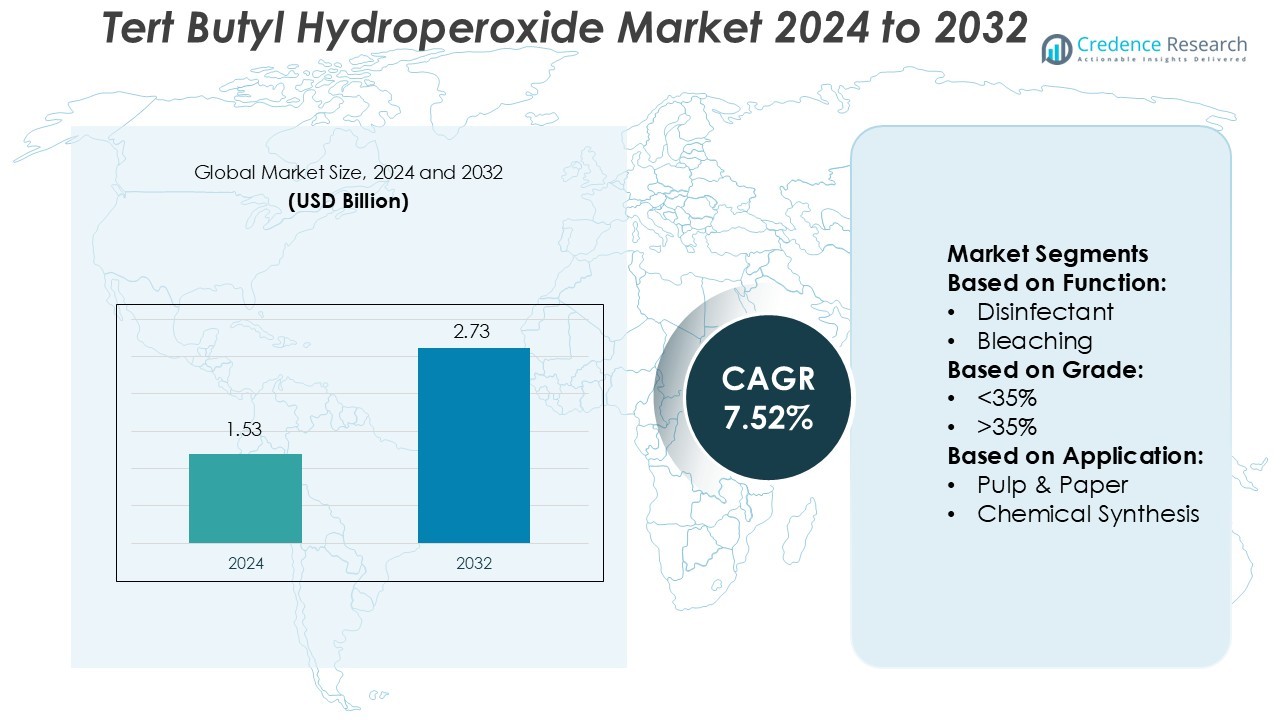
Tert Butyl Hydroperoxide Market size was valued USD 1.53 billion in 2024 and is anticipated to reach USD 2.73 billion by 2032, at a CAGR of 7.52% during the forecast period.
| REPORT ATTRIBUTE | DETAILS |
|---|---|
| Historical Period | 2020-2023 |
| Base Year | 2024 |
| Forecast Period | 2025-2032 |
| Tert Butyl Hydroperoxide Market Size 2024 | USD 1.53 Billion |
| Tert Butyl Hydroperoxide Market, CAGR | 7.52% |
| Tert Butyl Hydroperoxide Market Size 2032 | USD 2.73 Billion |
The Tert Butyl Hydroperoxide market is shaped by leading players including Thai Peroxide Ltd, Evonik Industries A.G, Hansol Chemical Co. Ltd., Arkema S.A., Merck, Kemira Oyj, Mitsubishi Gas Chemical Company Inc., Taekwang Industrial Co., Ltd., Tokyo Chemical Industries, and Solvay S.A. These companies focus on expanding capacity, improving oxidation technology, and developing safer, high-purity formulations. Strategic alliances and R&D investments are common to enhance efficiency and regulatory compliance. Asia-Pacific leads the global market with a 38% share, driven by strong industrial infrastructure, rising polymer production, and growing demand for fine chemical synthesis. Continuous technological upgrades and sustainable peroxide manufacturing strengthen the region’s dominance.
Market Insights
- The Tert Butyl Hydroperoxide Market was valued at USD 1.53 billion in 2024 and is projected to reach USD 2.73 billion by 2032, growing at a CAGR of 7.52% during the forecast period.
- Demand growth is driven by increasing use in polymerization, resin production, and fine chemical synthesis, supported by expanding applications in pharmaceuticals and wastewater treatment.
- Rising adoption of high-purity grades and automation in oxidation processes is a key trend, improving efficiency and safety standards across industries.
- Market growth faces restraints from stringent safety regulations, storage risks, and fluctuating raw material costs impacting production stability.
- Asia-Pacific dominates with a 38% share, followed by North America at 32% and Europe at 27%, while the oxidant segment leads the market with over 40% share, driven by wide industrial use and process reliability.
Market Segmentation Analysis:
By Function
The oxidant segment holds the dominant share in the Tert Butyl Hydroperoxide market, accounting for over 40% of total demand. Its wide use as an initiator and catalyst in polymerization, resin curing, and oxidation reactions drives strong adoption. The segment benefits from the compound’s high reactivity and stability, which enhance conversion efficiency in industrial chemical processes. For instance, Arkema employs tert-butyl hydroperoxide in controlled radical polymerization systems to improve polymer uniformity, supporting increased demand from specialty chemical manufacturers. Growth also stems from the rising use of oxidants in refining and coatings applications.
- For instance, Hansol Chemical expanded its semiconductor-grade hydrogen peroxide production capacity by 30 % to reach 127 000 tonnes per annum, with the expansion set to start full operations in 2019.
By Grade
The >35% concentration grade dominates the market, capturing the largest share due to its effectiveness in industrial synthesis and controlled oxidation processes. This high-concentration grade provides better initiation control and reduces reaction time, making it ideal for large-scale chemical production. For instance, Nouryon’s high-purity TBHP formulations above 35% are widely used in polymer and coatings manufacturing to ensure consistent yield and minimal residue formation. The segment’s growth is also supported by its extensive adoption in the pharmaceutical and fine chemical industries, where process precision and product quality are critical.
- For instance, Arkema announced a 2.5-fold increase in organic peroxide production capacity at its Changshu (China) site, representing the installation of its most efficient technology for such grades.
By Application
The chemical synthesis segment leads the Tert Butyl Hydroperoxide market with a share exceeding 45%, driven by its extensive use in polymerization, oxidation, and epoxidation processes. TBHP’s strong oxidizing properties and compatibility with metal catalysts make it essential in producing intermediates, coatings, and fine chemicals. For instance, Evonik utilizes TBHP in epoxidation of propylene and butene to manufacture specialty oxides with enhanced stability and purity. Rising demand for synthetic resins, specialty chemicals, and catalysts continues to strengthen the segment’s dominance, supported by increasing industrial output in Asia-Pacific and Europe.
Key Growth Drivers
Expanding Use in Polymer and Resin Production
The growing demand for polymers and resins in construction, packaging, and automotive industries is a major driver for the Tert Butyl Hydroperoxide (TBHP) market. TBHP serves as a crucial initiator and catalyst in polymerization reactions, improving yield and quality. For instance, Arkema’s use of TBHP in acrylic resin manufacturing enhances polymer chain control and surface finish consistency. The expansion of global polymer production capacity, especially in Asia-Pacific, continues to fuel TBHP consumption in synthetic material manufacturing.
- For instance, Kemira will invest in an expansion of paper and board chemical capacity at its Wellgrow site in Thailand, with the total estimated annual capacity reaching approximately 100 000 tonnes after completion.
Rising Adoption in Fine Chemical Synthesis
The market benefits from TBHP’s increasing use as an oxidizing agent in fine chemical synthesis and pharmaceutical intermediates. Its high purity and strong oxidation efficiency make it valuable for controlled reactions in laboratory and industrial settings. For instance, Evonik employs TBHP in oxidation processes to produce high-value organic compounds with superior selectivity. Growing R&D activities and demand for specialty chemicals are further accelerating adoption in this segment, supporting sustained market growth across multiple chemical industries.
- For instance, TCI lists a catalogue of 31,000 organic reagents for benchtop-to-bulk chemistry on their site.The company reports the ability to supply custom & bulk chemicals globally.
Increasing Applications in Environmental Treatment
TBHP is gaining traction in wastewater treatment and environmental remediation applications due to its strong oxidation capability and eco-friendly degradation. It enables effective decomposition of organic pollutants and industrial effluents, aligning with global environmental regulations. For instance, Nouryon’s TBHP formulations are integrated into advanced oxidation processes (AOPs) to improve pollutant breakdown efficiency in municipal systems. The rising focus on sustainable chemical solutions and stricter emission standards are encouraging industries to adopt TBHP for cleaner and safer operations.
Key Trends & Opportunities
Shift Toward High-Purity Grades
Manufacturers are increasingly developing high-purity TBHP formulations to meet stringent performance standards in pharmaceuticals and electronics. These grades enable consistent reaction control and reduce impurities in final products. For instance, PERGAN GmbH’s high-purity TBHP portfolio targets polymer and fine chemical producers seeking greater precision and safety in oxidation processes. The growing demand for controlled chemical reactions in advanced manufacturing presents significant opportunities for suppliers offering enhanced product quality and safety compliance.
- For instance, Shandong Huatai Interox joint venture with Solvay announced it will produce 48 kilotons of photovoltaic-grade hydrogen peroxide annually by 2025.
Integration of Continuous Flow Production Systems
Continuous flow systems are transforming TBHP manufacturing by improving process safety and reaction efficiency. This trend reduces peroxide decomposition risks and allows better temperature management. For instance, United Initiators integrates continuous flow oxidation units for TBHP production, enhancing process reliability and minimizing waste. As chemical manufacturers adopt automation and digital control technologies, continuous processes provide scalability, consistent output, and reduced operational costs, creating growth opportunities for TBHP producers worldwide.
- For instance, OCI's hydrogen peroxide production capacity is distributed between its Iksan plant (85,000 metric tons) and the Gwangyang plant (50,000 metric tons), which was formerly part of the P&O Chemical joint venture.
Key Challenges
Safety Concerns and Handling Risks
TBHP is highly reactive and flammable, posing significant safety challenges during storage and transportation. Strict handling protocols and explosion-proof infrastructure increase operational costs for manufacturers and users. For instance, Evonik implements multi-layer containment systems and temperature-controlled logistics to mitigate peroxide instability risks. Regulatory compliance requirements and safety audits further complicate supply chain operations, restricting smaller firms from large-scale TBHP production and distribution.
Fluctuating Raw Material Costs
Volatility in the prices of raw materials such as isobutane and hydrogen peroxide affects TBHP production economics. These fluctuations disrupt supply stability and narrow profit margins for chemical producers. For instance, Arkema and Nouryon have adjusted production cycles to mitigate feedstock cost spikes and ensure contract stability. The dependency on petrochemical-derived inputs also exposes the market to oil price variations, creating uncertainty in long-term planning and investment for TBHP manufacturers.
Regional Analysis
North America North America holds a 32% share of the Tert Butyl Hydroperoxide market, driven by strong demand from polymer, coating, and pharmaceutical industries. The U.S. leads regional consumption, supported by large-scale chemical synthesis and polymer manufacturing facilities. For instance, Arkema and Nouryon maintain robust TBHP production capacities in the U.S. to meet rising domestic and export demand. The region benefits from advanced infrastructure, strict quality standards, and innovation in fine chemical applications, ensuring steady growth. Environmental regulations promoting oxidation-based wastewater treatment also contribute to increasing TBHP utilization across industrial sectors.
Europe
Europe accounts for a 27% market share, led by Germany, France, and the Netherlands, where strong industrial bases support chemical manufacturing. European producers such as Evonik and PERGAN GmbH use TBHP extensively in resin, coatings, and fine chemical production. The region’s focus on sustainable and high-purity oxidation processes enhances adoption in pharmaceutical and specialty chemical industries. For instance, PERGAN’s advanced TBHP formulations meet REACH compliance standards, ensuring safety and quality consistency. The growing demand for environmentally safe oxidizing agents positions Europe as a key hub for TBHP innovation and regulatory advancement.
Asia-Pacific
Asia-Pacific dominates the global market with a 38% share, fueled by expanding industrialization and rising polymer output in China, India, and Japan. Strong growth in the coatings, plastics, and fine chemicals sectors drives large-scale TBHP consumption. For instance, United Initiators operates advanced TBHP production plants in China to cater to regional demand across polymer and oxidation industries. Increasing investments in chemical infrastructure and supportive government policies enhance regional competitiveness. The region’s rapid shift toward high-purity and high-performance oxidizing agents further strengthens its leadership in global TBHP production and consumption.
Latin America
Latin America captures an 8% share of the market, with Brazil and Mexico leading due to growing industrial applications in chemical synthesis and environmental treatment. Regional demand is supported by expanding polymer production and rising wastewater treatment initiatives. For instance, TBHP is increasingly used in oxidation-based effluent management across Brazil’s manufacturing sector. Collaborations with global suppliers are improving regional access to high-quality TBHP formulations. Growing industrial modernization and focus on sustainability are expected to drive further market expansion in the coming years.
Middle East & Africa
The Middle East & Africa region holds a 5% market share, primarily supported by petrochemical and refining industries in Saudi Arabia, the UAE, and South Africa. TBHP is used in oxidation and polymerization reactions across local chemical manufacturing facilities. For instance, regional players collaborate with international chemical firms to ensure steady TBHP supply for refining catalysts and specialty synthesis. The adoption of advanced wastewater treatment solutions also supports moderate growth. Increasing industrial diversification and ongoing investments in chemical processing are expected to enhance TBHP demand over the forecast period.
Market Segmentations:
By Function:
- Disinfectant
- Bleaching
By Grade:
- <35%
- >35%
By Application:
- Pulp & Paper
- Chemical Synthesis
By Geography
- North America
- U.S.
- Canada
- Mexico
- Europe
- Germany
- France
- U.K.
- Italy
- Spain
- Rest of Europe
- Asia Pacific
- China
- Japan
- India
- South Korea
- South-east Asia
- Rest of Asia Pacific
- Latin America
- Brazil
- Argentina
- Rest of Latin America
- Middle East & Africa
- GCC Countries
- South Africa
- Rest of the Middle East and Africa
Competitive Landscape
The Tert Butyl Hydroperoxide market features strong competition among key players such as Thai Peroxide Ltd, Evonik Industries A.G, Hansol Chemical Co. Ltd., Arkema S.A., Merck, Kemira Oyj, Mitsubishi Gas Chemical Company Inc., Taekwang Industrial Co., Ltd., Tokyo Chemical Industries, and Solvay S.A. The Tert Butyl Hydroperoxide (TBHP) market is defined by continuous innovation, safety enhancement, and strategic regional expansion. Leading manufacturers focus on improving process efficiency, product purity, and sustainability to strengthen market positioning. Companies invest in advanced oxidation technologies and automation to enhance reaction control and ensure consistent quality. Strategic collaborations and capacity expansions across Asia-Pacific and Europe are helping producers meet rising global demand from polymer, coatings, and specialty chemical sectors. The market also witnesses growing emphasis on safer handling, eco-friendly formulations, and compliance with international safety standards, which drive differentiation and long-term competitiveness.
Key Player Analysis
- Thai Peroxide Ltd
- Evonik Industries A.G
- Hansol Chemical Co. Ltd.
- Arkema S.A.
- Merck
- Kemira Oyj
- Mitsubishi Gas Chemical Company Inc.
- Taekwang Industrial Co., Ltd.
- Tokyo Chemical Industries
- Solvay S.A.
Recent Developments
- In July 2024, ARLANXEO announced that its Butyl plant in Singapore, EPDM plant in Geleen (The Netherlands), and EVM facility in Dormagen (Germany) had received ISCC PLUS certifications. This development is expected to help the company boost the production of sustainable synthetic rubber solutions under its ‘Eco’ label, with ARLANXEO currently producing Eco grades for X_Butyl, Keltan, Levamelt, and standard Levapren.
- In January 2024, Solvay announced the extension of its hydrogen peroxide production capacity at the Shandong Huatai Interox Chemical site in China. With this strategic investment, the company aims to significantly increase its annual production of photovoltaic-grade hydrogen peroxide by 2025 to meet China's growing renewable energy sector demand.
- In December 2023, Evonik announced the full acquisition of Thai Peroxide Company Limited, enhancing its hydrogen peroxide and peracetic acid production capabilities in Asia. This strategic move, finalized on December 15, strengthens Evonik's specialty chemicals portfolio, which is crucial for microchip and solar cell manufacturing, wastewater treatment, and food safety applications.
- In September 2023, Shinsol Advanced Chemicals, a partnership between Solvay and Shinkong Synthetic Fibers Corporation, started operations for a new production plant in Tainan, Taiwan.
Report Coverage
The research report offers an in-depth analysis based on Function, Grade, Application and Geography. It details leading market players, providing an overview of their business, product offerings, investments, revenue streams, and key applications. Additionally, the report includes insights into the competitive environment, SWOT analysis, current market trends, as well as the primary drivers and constraints. Furthermore, it discusses various factors that have driven market expansion in recent years. The report also explores market dynamics, regulatory scenarios, and technological advancements that are shaping the industry. It assesses the impact of external factors and global economic changes on market growth. Lastly, it provides strategic recommendations for new entrants and established companies to navigate the complexities of the market.
Future Outlook
- The demand for high-purity TBHP will grow due to increased use in specialty and fine chemicals.
- Polymer and resin manufacturers will continue adopting TBHP as a preferred oxidation initiator.
- Asia-Pacific will remain the leading production hub driven by expanding chemical infrastructure.
- Environmental applications such as wastewater oxidation will gain stronger market traction.
- Automation and digital monitoring in TBHP manufacturing will enhance process safety and yield.
- Producers will focus on eco-friendly and low-emission peroxide formulations to meet regulations.
- Strategic collaborations and technology licensing will expand global production capabilities.
- Pharmaceutical and laboratory-grade TBHP will see rising demand from precision chemical synthesis.
- Supply chain optimization and regional distribution centers will reduce transportation risks.
- Ongoing R&D will focus on safer storage, handling systems, and improved catalyst performance.

Request a Free Sample
Fill in your details and we'll send you a free sample report.
- Sample data tables & charts
- Research methodology
Need a Custom Version of This Report?
Tailor the scope, geography, or segments to your exact requirements.
- Custom geography or segment scope
- Direct access to our analyst team
Frequently Asked Questions
What is the current market size for the Tert Butyl Hydroperoxide Market, and what is its projected size in 2032?
At what Compound Annual Growth Rate is the Tert Butyl Hydroperoxide Market projected to grow between 2025 and 2032?
Which Tert Butyl Hydroperoxide Market segment held the largest share in 2024?
What are the primary factors fueling the growth of the Tert Butyl Hydroperoxide Market?
Who are the leading companies in the Tert Butyl Hydroperoxide Market?
Which region commanded the largest share of the Tert Butyl Hydroperoxide Market in 2024?
Table of Content
Chapter 1. Report Introduction
- 1.1 Report Description & Purpose
- 1.1.1 Report Title & Market Definition
- 1.1.2 Unique Selling Propositions (USP) & Key Differentiators
- 1.1.3 Value Proposition for Stakeholders
- 1.2 Research Objectives
- 1.2.1 Market Sizing Objectives (Volume & Revenue) (Volume Where Applicable)
- 1.2.2 Segmentation Objectives
- 1.2.3 Competitive Intelligence Objectives
- 1.2.4 Forecast & Scenario Objectives
- 1.3 Report Scope
- 1.3.1 Tert Butyl Hydroperoxide Scope – Segments & Subsegments Covered
- 1.3.2 Geographic Scope – Regions & Countries Covered
- 1.3.3 Historical Period, Base Year & Forecast Period (2024; forecast to 2032)
- 1.3.4 Inclusions & Exclusions
- 1.4 Industry Classification & Applicable Codes
- 1.5 Currency, Measurement Units & Valuation Basis
- 1.6 Target Stakeholders
- 1.7 Limitations & Assumptions
Chapter 2. Executive Summary
- 2.1 Global Tert Butyl Hydroperoxide Market Snapshot
- 2.1.1 Market Size – Historical (2024) & Forecast (2024-2032) (2024: USD 1.53 billion → 2032: USD 2.73 billion)
- 2.1.2 Volume & Revenue – Global Totals (Volume Where Applicable)
- 2.1.3 Key Market Highlights – Top Five Facts
- 2.2 Tert Butyl Hydroperoxide Market Segmentation Snapshot
- 2.2.1 Market Split by Region – 2024 vs. 2032
- 2.3 Competitive Snapshot
- 2.3.1 Top 10 Players by Revenue Share – 2024
- 2.3.2 Top 10 Players by Volume Share – 2024 (Volume Where Applicable)
- 2.3.3 Recent Strategic Developments (18-Month Summary)
- 2.4 Key Investment Highlights & Strategic Conclusions
Chapter 3. Tert Butyl Hydroperoxide Market Dynamics & Industry Analysis
- 3.1 Market Overview & Context
- 3.1.1 Tert Butyl Hydroperoxide Market Position in the Broader Industry Value Chain
- 3.1.2 Demand Structure & Purchasing Dynamics
- 3.1.3 Market Maturity & Development Stage by Region
- 3.2 Tert Butyl Hydroperoxide Market Drivers
- 3.3 Tert Butyl Hydroperoxide Market Restraints & Challenges
- 3.4 Tert Butyl Hydroperoxide Market Opportunities
- 3.5 Porter's Five Forces Analysis
- 3.5.1 Threat of New Entrants
- 3.5.2 Bargaining Power of Suppliers
- 3.5.3 Bargaining Power of Buyers
- 3.5.4 Threat of Substitutes
- 3.5.5 Competitive Rivalry – Intensity Assessment
- 3.6 Tert Butyl Hydroperoxide Value Chain Analysis
- 3.6.1 Upstream – Key Inputs, Resources & Suppliers
- 3.6.1.1 Key Input/Resource 1
- 3.6.1.2 Key Input/Resource 2
- 3.6.1.3 Key Input/Resource 3
- 3.6.2 Midstream – Core Operations & Value Creation
- 3.6.2.1 Operating Model & Process Overview
- 3.6.2.2 Key Operating Locations & Capabilities by Company
- 3.6.3 Downstream – Market Channels & End Users
- 3.6.3.1 Direct Sales & Customer Engagement Channels
- 3.6.3.2 Indirect Sales, Intermediaries & Partner Channels
- 3.6.4 Value Chain Profitability Analysis
- 3.6.1 Upstream – Key Inputs, Resources & Suppliers
- 3.7 PESTEL Analysis
- 3.7.1 Political Factors
- 3.7.2 Economic Factors
- 3.7.3 Social Factors
- 3.7.4 Technological Factors
- 3.7.5 Environmental Factors
- 3.7.6 Legal Factors
- 3.8 Tert Butyl Hydroperoxide Supply Chain Analysis
- 3.8.1 Critical Input & Resource Availability Risk Assessment
- 3.8.2 Supplier & Operational Concentration Risk (Geographic Exposure)
- 3.8.3 Supply & Service Disruption Impact Analysis
- 3.9 Regulatory & Policy Landscape
Note: The regulatory and policy landscape section covers regulations based on their applicability to the market, Tert Butyl Hydroperoxide category, geography, and scope of the study. Only regulatory frameworks with a material impact on operations, compliance, trade, sustainability, or market access are analyzed in detail.
Chapter 4. Key Investment Pockets & Opportunity Analysis
- 4.1 Tert Butyl Hydroperoxide Market Attractiveness Analysis
- 4.1.1 By Region – Investment Attractiveness Matrix (Market Size × CAGR)
- 4.2 Absolute Revenue Growth Opportunity
- 4.2.1 By Region – Absolute Revenue Growth Through 2032
- 4.3 Incremental Demand Opportunity
- 4.3.1 By Region – Incremental Demand Through 2032
- 4.3.2 Segment – Incremental Demand
- 4.4 Emerging Submarket Opportunity Deep Dive (Subject to Applicability)
- 4.5 Priority Market Opportunity Scorecards
- 4.5.1 United States
- 4.5.2 Europe
- 4.5.3 Asia
- 4.5.4 Middle East & Africa
Note: Priority market opportunity scorecards reflect the geographic scope and strategic relevance of the study. Listed markets are indicative and may be adapted to the industry.
Chapter 5. Tert Butyl Hydroperoxide Cross-Border Trade & Market Access Analysis
- 5.1 International Trade & Cross-Border Activity Overview
- 5.1.1 Global Export Value by Country (2024)
- 5.1.2 Global Export Volume by Country (2024) (Volume Where Applicable)
- 5.1.3 Global Import Value by Country (2024)
- 5.1.4 Global Import Volume by Country (2024) (Volume Where Applicable)
- 5.1.5 Net Trade Balance by Country (2024)
- 5.2 Export Analysis – Segment
- 5.2.1 Category 1 (Applicable Classification Code)
- 5.2.2 Category 2 (Applicable Classification Code)
- 5.2.3 Category 3 (Applicable Classification Code)
- 5.2.4 Category 4 (Applicable Classification Code)
- 5.2.5 Category 5 (Applicable Classification Code)
- 5.3 Import Analysis – Segment
- 5.3.1 Category 1 (Applicable Classification Code)
- 5.3.2 Category 2 (Applicable Classification Code)
- 5.3.3 Category 3 (Applicable Classification Code)
- 5.3.4 Category 4 (Applicable Classification Code)
- 5.3.5 Category 5 (Applicable Classification Code)
- 5.4 Cross-Border Pricing & Transaction Benchmarks
- 5.4.1 Export Pricing – Segment & Country
- 5.4.2 Import Pricing – Segment & Source Country
- 5.4.3 Price Trends (2024)
- 5.5 Key Cross-Border Trade & Delivery Routes
- 5.5.1 Cross-Border Trade/Delivery Route 1
- 5.5.2 Cross-Border Trade/Delivery Route 2
- 5.5.3 Cross-Border Trade/Delivery Route 3
- 5.5.4 Cross-Border Trade/Delivery Route 4
- 5.5.5 Cross-Border Trade/Delivery Route 5
- 5.6 Trade Policy & Market Access Impact Assessment
- 5.6.1 Tariff & Non-Tariff Barriers
- 5.6.2 Regional Trade & Economic Integration Frameworks
- 5.6.3 Bilateral & Multilateral Trade Agreements
- 5.6.4 Cross-Border Operating, Licensing & Localization Requirements
Note: This chapter applies where cross-border trade or delivery is relevant to Tert Butyl Hydroperoxide. Goods, services, and digital offerings are assessed using applicable classifications and transaction measures. Import-export volumes, trade balances, and route analyses are included only where meaningful to the market.
Chapter 6. Competitive Landscape & Company Benchmarking
- 6.1 Tert Butyl Hydroperoxide Market Concentration & Structure
- 6.1.1 Herfindahl-Hirschman Index (HHI) – vs. 2024
- 6.1.2 Leading, Mid-Sized & Emerging Player Structure
- 6.1.3 Global, Regional & Local Player Dynamics
- 6.2 Tert Butyl Hydroperoxide Market Share Analysis – 2024
- 6.2.1 Global Revenue Share by Company
- 6.2.2 Global Volume Share by Company (Volume Where Applicable)
- 6.2.3 Regional Revenue Share
- 6.2.4 Market Share Evolution ( vs. 2024)
- 6.2.5 Company Market Share by Key Segment
- 6.2.6 Company Market Share by Customer Group
- 6.3 Operating Scale, Capacity & Infrastructure Analysis
- 6.3.1 Global Operating Scale & Supply Capacity
- 6.3.2 Resource Utilization & Operating Efficiency
- 6.3.3 Output, Service Delivery & Activity Metrics
- 6.3.4 Operating Footprint & Infrastructure Map
- 6.3.5 Planned Operational & Capacity Expansion
- 6.4 Tert Butyl Hydroperoxide Competitive Benchmarking Matrix
- 6.4.1 Revenue, Growth, Profitability & Operating Metric Comparison
- 6.4.2 Channel Revenue Mix
- 6.4.3 Geographic Revenue Exposure
- 6.4.4 R&D Intensity
- 6.4.5 Sustainability Maturity
- 6.5 Strategic Developments in Tert Butyl Hydroperoxide (Last 24 Months)
- 6.5.1 Mergers, Acquisitions & Divestments
- 6.5.2 New Products, Services & Solutions in Tert Butyl Hydroperoxide
- 6.5.3 Operational & Infrastructure Expansions
- 6.5.4 Strategic Alliances, Joint Ventures & Partnerships
- 6.5.5 Distribution Expansion & Market Entry
- 6.5.6 Sustainability & ESG Initiatives
- 6.6 Competitive Strategy Mapping
- 6.6.1 Leader, Challenger, Follower & Niche Classification
- 6.6.2 Pricing Strategy Comparison
- 6.6.3 Channel Strategy Matrix
Note: Strategic developments are included based on their materiality and the availability of reliable information.
Chapter 7. Global Tert Butyl Hydroperoxide Market – By Sales & Delivery Channel
- 7.1 Segment Overview
- 7.1.1 Volume & Revenue Split by Channel (2024 & 2032) (Volume Where Applicable)
- 7.1.2 Channel Mix Evolution (2024-2032)
Chapter 8. Regional Market Analysis – Global Overview
- 8.1 Global Regional Overview
- 8.1.1 Regional Volume Share (Volume Where Applicable)
- 8.1.2 Regional Revenue Share
- 8.1.3 Regional Volume by Region (Volume Where Applicable)
- 8.1.4 Regional Revenue by Region
- 8.1.5 Regional Forecast Through 2032
- 8.2 Cross-Regional Segment Analysis
- 8.2.1 By Sales & Delivery Channel
- 8.2.2 By Competitive Positioning & Price Tier
Chapter 9. North America Tert Butyl Hydroperoxide Market
- 9.1 United States
- 9.2 Canada
- 9.3 Mexico
Chapter 10. Europe Tert Butyl Hydroperoxide Market
- 10.1 Germany
- 10.2 France
- 10.3 Italy
- 10.4 United Kingdom
- 10.5 Spain
- 10.6 Poland
- 10.7 Russia
- 10.8 Netherlands
- 10.9 Belgium
- 10.10 Sweden
- 10.11 Denmark
- 10.12 Norway
- 10.13 Rest of Europe
Chapter 11. Asia Pacific Tert Butyl Hydroperoxide Market
- 11.1 China
- 11.2 India
- 11.3 Japan
- 11.4 South Korea
- 11.5 Thailand
- 11.6 Indonesia
- 11.7 Vietnam
- 11.8 Malaysia
- 11.9 Australia
- 11.10 Rest of Asia Pacific
Chapter 12. Latin America Tert Butyl Hydroperoxide Market
- 12.1 Brazil
- 12.2 Argentina
- 12.3 Colombia
- 12.4 Chile
- 12.5 Rest of Latin America
Chapter 13. Middle East Tert Butyl Hydroperoxide Market
- 13.1 Saudi Arabia
- 13.2 United Arab Emirates
- 13.3 Turkey
- 13.4 Israel
- 13.5 Iran
- 13.6 Rest of the Middle East
Chapter 14. Africa Tert Butyl Hydroperoxide Market
- 14.1 South Africa
- 14.2 Egypt
- 14.3 Nigeria
- 14.4 Morocco
- 14.5 Rest of Africa
Chapter 15. Tert Butyl Hydroperoxide Company Profiles
- 15.1 [Company 01]
- 15.1.1 Company Overview
- 15.1.2 Key Management Personnel
- 15.1.3 Products & Services Portfolio
- 15.1.4 Financial Performance
- 15.1.5 Key Market Focus & Geographic Presence
- 15.1.6 Recent Developments & Strategic Initiatives
Note: The company profile list is preliminary and may change based on research findings, market developments, data availability, and client requirements.
Chapter 16. Appendices
- Appendix A – List of Abbreviations & Acronyms
- Appendix B – Industry Classification Code Reference – Full Series
- Appendix C – Supply, Output & Operating Capacity Data Tables
- Appendix D – End-Use & Demand Base Tables
- Appendix E – Demand, Adoption & Usage Assumptions
- Appendix F – Pricing & Revenue Metric Reference Tables
- Appendix G – Company Operations & Infrastructure Database
- Appendix H – Cross-Border Trade & Activity Data Tables (Where Applicable)
- Appendix I – Regulatory Summary Tables
- Appendix J – Primary Research Participant List (Anonymized)
- Appendix K – Primary Research Questionnaire Framework
- Appendix L – Data Sources & Bibliography
- Appendix M – Market Size Divergence & Source Comparison
Chapter 17. Research Methodology
- 17.1 Research Framework & Philosophy
- 17.2 Secondary Research – Sources, Hierarchy & Data Extraction
- 17.3 Data Modeling – Bottom-Up & Top-Down Market Sizing
- 17.4 Primary Research – Stakeholder Framework, LOI & Sample Sizes
- 17.5 Forecast Methodology – Regression, Scenario & Sensitivity Analysis
- 17.6 Quality Control – Four-Layer Validation Framework
- 17.7 Limitations & Standard Assumptions
- 17.8 Disclaimer
