Market Overview
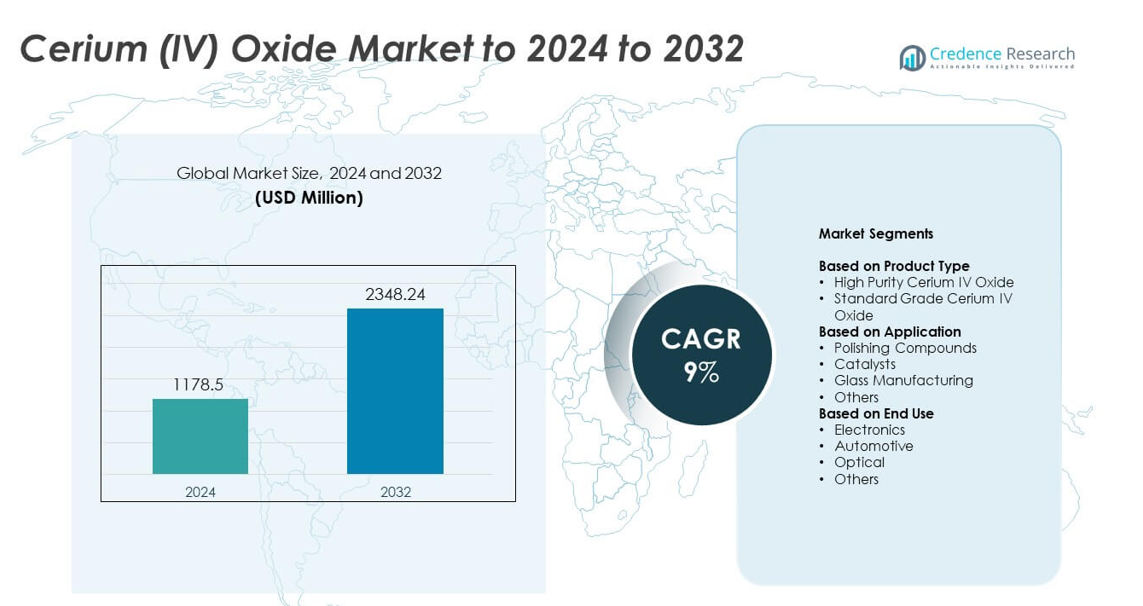
Cerium (IV) Oxide Market size was valued at USD 1,178.5 million in 2024 and is anticipated to reach USD 2,348.24 million by 2032, at a CAGR of 9% during the forecast period.
| REPORT ATTRIBUTE | DETAILS |
|---|---|
| Historical Period | 2020-2023 |
| Base Year | 2024 |
| Forecast Period | 2025-2032 |
| Cerium (IV) Oxide Market Size 2024 | USD 1,178.5 million |
| Cerium (IV) Oxide Market, CAGR | 9% |
| Cerium (IV) Oxide Market Size 2032 | USD 2,348.24 million |
The Cerium (IV) Oxide Market features key players such as Merck KGaA, Neo Performance Materials Inc., Lynas Rare Earths Ltd, Hitachi Chemical Co., Ltd, China Northern Rare Earth Group, Solvay S.A., Showa Denko Materials Co., Ltd, China Minmetals Rare Earth Co., Ltd, Treibacher Industrie AG, and Shin-Etsu Chemical Co., Ltd. These companies compete through high-purity grades, advanced polishing materials, and stronger supply-chain control. Asia Pacific led the global market in 2024 with about 32% share, driven by large semiconductor and electronics clusters. North America followed with nearly 34% share, supported by strong investment in chip fabrication and optical industries, while Europe accounted for around 27% share due to its advanced automotive and precision optics sectors.
Market Insights
- Cerium (IV) Oxide Market size reached USD 1,178.5 million in 2024 and is projected to hit USD 2,348.24 million by 2032 at a CAGR of 9%.
- Strong demand from electronics and semiconductor polishing drives market growth, with high-purity grades holding about 58% share due to wider use in wafer finishing and precision optics.
- Trends show rising adoption of nano-structured cerium oxide and increased use in clean-energy technologies, including fuel cells and emission-control systems across industrial applications.
- Market competition intensifies as leading producers focus on purity improvement, supply-chain stability, and advanced polishing formulations while managing challenges linked to rare-earth sourcing and environmental rules.
- Asia Pacific held about 32% share, North America captured nearly 34%, and Europe accounted for around 27%, with polishing compounds leading applications at roughly 46% share across global demand.
Market Segmentation Analysis:
By Product Type
High purity cerium IV oxide dominated the product segment in 2024 with a market share of about 58%. Demand stayed strong due to its higher efficiency in precision polishing, catalytic converters, and advanced optical uses. Manufacturers preferred this grade because it offered tighter particle-size control and stronger thermal stability. Standard grade cerium IV oxide held steady adoption in mass polishing, glass formulations, and cost-sensitive industrial tasks. Growth in semiconductor wafer finishing and cleaner automotive exhaust systems continued to support wider use of high purity grades across global markets.
- For instance, US Research Nanomaterials, Inc. offers cerium oxide nanopowder with an average particle size of 10 nanometers and a specific surface area between 35 and 70 square meters per gram for high-precision polishing and electronic applications.
By Application
Polishing compounds led the application segment in 2024 with nearly 46% share. This leadership came from wider use in semiconductor wafers, LCD panels, automotive glass, and precision lens finishing. Cerium IV oxide remained the preferred polishing material due to its chemical-mechanical action, which delivered smoother surfaces with fewer defects. Catalysts saw rising uptake as emission-control rules tightened in major regions. Glass manufacturing and other uses expanded in line with growth in architectural glass, specialty optics, and electronics production.
- For instance, Advanced Abrasives Corporation markets PremaLox C cerium oxide powders in standardized grain sizes of 0.5, 1, 2, and 10 micrometers specifically formulated for glass and optical polishing compounds.
By End Use
Electronics was the dominant end-use segment in 2024, holding around 41% share. Strong demand came from wafer fabrication, display glass finishing, and advanced optical components used in smartphones and high-resolution panels. Cerium IV oxide supported these applications through stable polishing performance and high material purity. The automotive sector showed steady growth as catalytic converter production increased under stricter emission targets. Optical industries also expanded consumption due to rising use of precision lenses, laser components, and coated glass in imaging and scientific devices.
Key Growth Drivers
Rising Demand from Electronics and Semiconductor Processing
Growth accelerated as cerium IV oxide became essential for wafer polishing, display glass finishing, and advanced optical components. The material provided strong chemical-mechanical performance, which improved surface quality in high-precision electronics. Expanding production of smartphones, tablets, and high-resolution displays strengthened its role in global supply chains. Rising investments in semiconductor fabs across Asia and North America also pushed consumption higher. Growing focus on defect-free surfaces in next-generation chips continued to support strong long-term demand.
- For instance, a Ferro Corporation chemical-mechanical polishing slurry disclosed in patent US6491843B1 achieves a silicon dioxide removal rate of 540.1 nanometers per minute while removing silicon nitride at 1.1 nanometers per minute, giving a selectivity of 491 in semiconductor wafer planarization.
Stricter Automotive Emission Regulations Boosting Catalyst Use
Tighter emission norms across Europe, China, and India increased reliance on cerium IV oxide for catalytic converters. Automakers adopted the material due to its oxygen-storage capacity, which enhanced combustion efficiency and reduced harmful exhaust gases. Hybrid and gasoline vehicles maintained strong output, reinforcing steady catalyst demand. As governments pushed toward cleaner mobility, suppliers scaled production of advanced catalytic materials. Rising vehicle fleets in emerging markets further strengthened the need for high-performance catalyst formulations.
- For instance, NGK Europe reports that the NGK Group is a leading global producer of automotive NOx sensor probes, with an annual production capacity of over 25 million (2017 press release) units to support exhaust aftertreatment systems that help vehicles comply with tightening emission standards
Expansion of Precision Optics and Advanced Glass Manufacturing
Demand grew as optical lenses, laser components, and specialty glass products gained wider use in imaging, scientific equipment, and smart devices. Cerium IV oxide remained a preferred polishing and clarifying agent, helping producers achieve high transparency and improved refractive accuracy. Growth in architectural glass coatings and protective glass for electronics also supported higher consumption. Investments in optical fiber and photonics production increased material usage across industrial clusters. The shift toward premium optical and glass components continued to drive global market growth.
Key Trends and Opportunities
Shift Toward High-Purity Grades for Advanced Manufacturing
Manufacturers increased adoption of high-purity cerium IV oxide as semiconductor and optical applications demanded tighter quality control. Higher purity grades delivered improved performance in CMP slurries, precision polishing, and thin-film processes. Demand grew as fabrication plants upgraded to advanced lithography and higher-resolution panels. The trend supported opportunities for suppliers focused on refining, purification, and particle-size optimization. Expanding R&D in nano-structured formulations created additional scope for performance upgrades in modern electronics.
- For instance, Rhodia Operations, now part of Solvay, describes an Actalys HSA20 cerium oxide catalyst that after calcination in air at 400 degrees Celsius for 10 hours reaches a specific surface area of 129.9 square meters per gram, supporting high-performance catalytic processes.
Growth in Clean Energy and Environmental Technologies
Rising investments in hydrogen production, fuel cells, and pollution-control systems opened new opportunities. Cerium IV oxide gained interest for its redox properties, which improved efficiency in catalytic and energy-conversion applications. The material also supported flue-gas cleaning, industrial emission reduction, and air-quality improvement technologies. Its role in emerging energy systems strengthened as governments promoted carbon-reduction goals. Broader adoption of green industrial processes continued to stimulate growth in advanced cerium-based materials.
- For instance, BASF cerium oxide is commonly used by researchers as a catalyst support (such as in Pt/CeO₂ catalyst preparations) to enhance performance in various electrochemical and hydrogen-related energy conversion studies.
Key Challenges
Supply Dependence on Limited Rare-Earth Sources
The market faced challenges due to concentration of rare-earth mining and processing in a few countries. Supply disruptions, export restrictions, and geopolitical tensions created uncertainty for downstream manufacturers. Fluctuating availability increased procurement risks for electronics, optical, and automotive users. Limited diversification in global supply chains added pressure on pricing and long-term security. Efforts to recycle cerium-based materials and expand exploration helped, but dependency remained a major concern for industry stability.
Environmental and Regulatory Constraints in Rare-Earth Mining
Strict environmental rules around rare-earth extraction slowed capacity expansion in several producing regions. Mining activities generated waste and required careful management of radioactive by-products, raising compliance costs. Tougher regulations forced producers to adopt cleaner and more expensive processing technologies. These factors increased operational burdens and limited rapid scaling of production. Heightened scrutiny from regulators and communities continued to challenge the growth of rare-earth mining, indirectly affecting the availability of cerium IV oxide.
Regional Analysis
North America
North America held about 34% share in 2024, supported by strong demand from semiconductor fabrication, advanced optics, and automotive catalytic systems. Growth stayed steady as the United States expanded investments in chip manufacturing and precision glass production. The region benefited from established research facilities and rising adoption of CMP slurries in advanced wafer processes. Automotive catalysts and industrial polishing uses also contributed to stable consumption levels. Ongoing clean-energy projects and emission-control technologies continued to encourage broader use of cerium IV oxide across Canada and the United States.
Europe
Europe accounted for nearly 27% share in 2024, driven by high standards in emission-control technologies and strong production of optical components. Rising demand from Germany, France, and the United Kingdom supported adoption in automotive catalysts, precision lenses, and industrial polishing systems. The region maintained a stable base of glass manufacturers and specialty optics producers, boosting material consumption. Investments in clean-energy research and stricter environmental norms also enhanced the use of cerium-based catalysts. A well-developed automotive sector continued to anchor steady demand across major European economies.
Asia Pacific
Asia Pacific dominated the global market with around 32% share in 2024, led by extensive electronics manufacturing, glass production, and semiconductor expansion in China, Japan, South Korea, and Taiwan. Rapid growth in display panels, smartphones, and chip fabrication drove significant consumption of high-purity cerium IV oxide. Automotive catalyst demand also increased as regional emission norms tightened. Strong investments in optical fiber, precision lenses, and advanced materials research further accelerated adoption. Expanding renewable-energy initiatives and industrial growth continued to strengthen the region’s leadership in global demand.
Latin America
Latin America held about 4% share in 2024, supported by growing adoption of emission-control technologies and rising demand in industrial polishing tasks. Brazil and Mexico contributed most of the regional consumption due to expanding automotive assembly operations and electronics imports. Interest in specialty glass and basic optical components increased at a gradual pace. Limited local rare-earth processing capacity kept the region dependent on imports from Asia and North America. Investments in industrial modernization and clean-technology adoption provided moderate opportunities for broader cerium IV oxide use.
Middle East and Africa
Middle East and Africa captured nearly 3% share in 2024, with demand driven by industrial polishing applications, basic optical uses, and gradual adoption of catalytic materials in emission-control systems. Growth remained modest due to limited local manufacturing of electronics and precision optics. Countries such as the United Arab Emirates and South Africa showed rising interest in advanced materials for infrastructure and industrial modernization. Import dependence remained high, and supply fluctuations influenced procurement cycles. Ongoing diversification efforts across several economies supported steady but moderate expansion in cerium IV oxide demand.
Market Segmentations:
By Product Type
- High Purity Cerium IV Oxide
- Standard Grade Cerium IV Oxide
By Application
- Polishing Compounds
- Catalysts
- Glass Manufacturing
- Others
By End Use
- Electronics
- Automotive
- Optical
- Others
By Geography
- North America
- U.S.
- Canada
- Mexico
- Europe
- Germany
- France
- U.K.
- Italy
- Spain
- Rest of Europe
- Asia Pacific
- China
- Japan
- India
- South Korea
- South-east Asia
- Rest of Asia Pacific
- Latin America
- Brazil
- Argentina
- Rest of Latin America
- Middle East & Africa
- GCC Countries
- South Africa
- Rest of the Middle East and Africa
Competitive Landscape
The competitive landscape of the Cerium (IV) Oxide Market includes Merck KGaA, Neo Performance Materials Inc., Lynas Rare Earths Ltd, Hitachi Chemical Co., Ltd, China Northern Rare Earth Group, Solvay S.A., Showa Denko Materials Co., Ltd, China Minmetals Rare Earth Co., Ltd, Treibacher Industrie AG, and Shin-Etsu Chemical Co., Ltd. The market reflects steady competition driven by purity enhancement, particle-size optimization, and improved polishing performance. Producers focus on expanding high-purity grades to support semiconductor fabrication, advanced optics, and catalytic uses. Supply-chain integration remains a priority as companies work to secure rare-earth feedstock and stabilize production. Rising investments in R&D help firms develop nano-structured formulations and advanced surface treatments. Many manufacturers also strengthen their environmental compliance through cleaner extraction and processing technologies. Regional expansion strategies continue as companies target electronics clusters and automotive hubs for long-term growth.
Key Player Analysis
- Merck KGaA
- Neo Performance Materials Inc.
- Lynas Rare Earths Ltd
- Hitachi Chemical Co., Ltd
- China Northern Rare Earth Group
- Solvay S.A.
- Showa Denko Materials Co., Ltd
- China Minmetals Rare Earth Co., Ltd
- Treibacher Industrie AG
- Shin-Etsu Chemical Co., Ltd
Recent Developments
- In 2025, Solvay formed partnerships in the US and Europe to diversify rare earth supply chains and improve processing efficiencies, leveraging proprietary technology to enhance rare earth oxide purity and reduce costs.
- In 2024, China Northern Rare Earth, with Fujian Jinlong Rare Earth Co., Ltd., planned investment to set up a production line for 5,000 metric tons of rare earth oxides, likely inclusive of cerium oxides.
- In 2023, Resonac (formerly Showa Denko Materials Co., Ltd.) expanded its production capacity for nano-ceria slurry used in semiconductor transistor formation processes.
Report Coverage
The research report offers an in-depth analysis based on Product Type, Application, End-Use and Geography. It details leading market players, providing an overview of their business, product offerings, investments, revenue streams, and key applications. Additionally, the report includes insights into the competitive environment, SWOT analysis, current market trends, as well as the primary drivers and constraints. Furthermore, it discusses various factors that have driven market expansion in recent years. The report also explores market dynamics, regulatory scenarios, and technological advancements that are shaping the industry. It assesses the impact of external factors and global economic changes on market growth. Lastly, it provides strategic recommendations for new entrants and established companies to navigate the complexities of the market.
Future Outlook
- Demand will rise as semiconductor fabs expand advanced polishing and CMP processes.
- Adoption in catalytic systems will grow under stricter global emission norms.
- High-purity grades will gain stronger traction in precision optics and photonics.
- Use in advanced glass coatings and specialty glass products will increase.
- Clean-energy applications will create new opportunities in fuel cells and hydrogen systems.
- Recycling of rare-earth materials will gain importance to stabilize supply.
- Nano-structured cerium oxide formulations will support next-generation electronics.
- Market dependence on concentrated rare-earth sources will drive supply-chain diversification.
- Investments in optical fiber and imaging technologies will strengthen long-term consumption.
- Environmental regulations will push producers toward cleaner extraction and processing methods.

Request a Free Sample
Fill in your details and we'll send you a free sample report.
- Sample data tables & charts
- Research methodology
Market Dynamics
Expansion of Electronics and Semiconductor Manufacturing
Cerium (IV) oxide is essential for wafer polishing and display glass finishing in the electronics and semiconductor industries. The growth of advanced chip fabrication and high-resolution display production, especially in Asia Pacific and North America, is driving significant demand for high-purity cerium oxide.
Stricter Automotive Emission Regulations
Tightening emission standards in regions such as Europe, China, and India are increasing the use of cerium (IV) oxide in automotive catalytic converters. Its oxygen-storage capacity enhances combustion efficiency and reduces harmful exhaust gases, supporting its adoption in emission-control systems.
Growth in Precision Optics and Advanced Glass Manufacturing
The rising use of precision lenses, laser components, and specialty glass in imaging, scientific equipment, and smart devices is boosting demand for cerium (IV) oxide as a polishing and clarifying agent. Its ability to deliver high transparency and improved refractive accuracy is critical for these applications.
Adoption in Clean Energy and Environmental Technologies
Investments in hydrogen production, fuel cells, and pollution-control systems are opening new opportunities for cerium (IV) oxide due to its redox properties. Its role in catalytic and energy-conversion applications is expanding as governments promote carbon-reduction and clean-energy initiatives.
Shift Toward High-Purity and Nano-Structured Grades
The need for tighter quality control in semiconductor and optical manufacturing is driving the adoption of high-purity and nano-structured cerium (IV) oxide. These advanced grades offer improved performance in CMP slurries, precision polishing, and thin-film processes, supporting next-generation electronics and photonics.
Need a Custom Version of This Report?
Tailor the scope, geography, or segments to your exact requirements.
- Custom geography or segment scope
- Direct access to our analyst team
Frequently Asked Questions
What is the current market size for Cerium (IV) Oxide Market, and what is its projected size in 2032?
At what Compound Annual Growth Rate is the Cerium (IV) Oxide Market projected to grow between 2025 and 2032?
Which is the leading region of the market for cerium (IV) oxide?
What are the key drivers for the growth of the cerium (IV) oxide market?
Which is the major segment in the cerium (IV) oxide market by application?
Who are the leading companies in the Cerium (IV) Oxide Market?
Table of Content
Chapter 1 Market Segmentation
- 1.1 Segmentation Framework
- 1.1.1 Product and Service Classification
- 1.1.2 Application and End-Use Classification
- 1.1.3 Technology and Solution Classification
- 1.1.4 Customer and Distribution Channel Classification
- 1.1.5 Geographic Segmentation
- 1.1.6 Market Segment Definitions and Boundaries
- 1.2 By End Use
- 1.2.1 Electronics
- 1.2.2 Automotive
- 1.2.3 Optical
- 1.2.4 Others
- 1.3 By Application
- 1.3.1 Polishing Compounds
- 1.3.2 Catalysts
- 1.3.3 Glass Manufacturing
- 1.3.4 Others
- 1.4 By Product Type
- 1.4.1 High Purity Cerium IV Oxide
- 1.4.2 Standard Grade Cerium IV Oxide
Chapter 2 Introduction
- 2.1 Report Objectives and Scope
- 2.2 Product Definition and Industry Terminology
- 2.3 Market Inclusions and Exclusions
- 2.4 Research Process
- 2.4.1 Primary Research and Expert Interviews
- 2.4.2 Secondary Research and Source Review
- 2.4.3 Top-Down and Bottom-Up Estimation
- 2.4.4 Data Triangulation and Verification
- 2.5 Market Size Measurement Basis
- 2.5.1 2024: USD 1,178.5 million → 2032: USD 2,348.24 million
- 2.6 Historical and Forecast Reference Periods
- 2.6.1 Base Year: 2024
- 2.6.2 Forecast Period: 2024-2032
- 2.7 Research Assumptions and Limitations
Chapter 3 Executive Summary
- 3.1 Market Snapshot and Key Findings
- 3.2 Base-Year Market Size, 2024
- 3.3 Forecast Market Size, 2032
- 3.4 Revenue and Volume Growth Outlook
- 3.5 Key Demand and Supply Indicators
- 3.6 Leading Market Segments
- 3.7 Fastest-Growing Market Opportunities
- 3.8 Regional Performance Highlights
- 3.9 Technology and Industry Transformation
- 3.10 Competitive Landscape Summary
- 3.11 Analyst View and Strategic Implications
Chapter 4 Global Cerium (IV) Oxide Market Trends and Developments
- 4.1 Historical Industry Development
- 4.2 Recent Market Trends and Developments
- 4.3 Demand and Customer Behavior Trends
- 4.4 Technology and Product Innovation
- 4.5 Artificial Intelligence, Automation and Digitalization
- 4.6 Local Manufacturing and Supply Chain Realignment
- 4.7 Industry Partnerships, Mergers and Acquisitions
- 4.8 Sustainability and Circular Economy Developments
- 4.9 Government and Private Sector Investment Trends
- 4.10 Emerging Business Models and Commercialization
- 4.11 Industry Developments and Announcements
Chapter 5 Global Cerium (IV) Oxide Market Production, Supply and Demand Analysis
- 5.1 Demand Trend and Consumption Analysis
- 5.2 Demand Forecast, 2024-2032
- 5.3 Production and Output Trend
- 5.4 Production and Output Forecast, 2024-2032
- 5.5 Installed Capacity and Capacity Utilization
- 5.6 Company-Wise Production Plants and Statistics
- 5.6.1 Installed Production Capacity
- 5.6.2 Actual Production
- 5.6.3 Planned Capacity and Expansion Targets
- 5.7 Supply Chain Structure and Procurement Trends
- 5.8 Supply-Demand Gap and Bottlenecks
- 5.9 Import Dependence and Sourcing Structure
- 5.10 Contract Manufacturing and Outsourcing
- 5.11 Regional Supply and Demand Concentration
Chapter 6 Global Cerium (IV) Oxide Market Pricing Analysis
- 6.1 Pricing Structure and Measurement
- 6.2 Historical Pricing Trends
- 6.3 Pricing Outlook, 2024-2032
- 6.4 Average Selling Price and Unit Economics
- 6.5 Pricing by Product and Market Segment
- 6.6 Geographic Pricing Differences
- 6.7 Key Input, Energy, Labor and Logistics Costs
- 6.8 Contract Pricing and Purchasing Models
- 6.9 Pricing Sensitivity and Competitive Positioning
- 6.10 Price, Margin and Profitability Implications
Chapter 7 Global Cerium (IV) Oxide Market Dynamics
- 7.1 Market Growth Drivers
- 7.1.1 Demand-Side Drivers
- 7.1.2 Technology and Innovation Drivers
- 7.1.3 Infrastructure and Investment Drivers
- 7.1.4 Regulatory and Policy Drivers
- 7.2 Market Restraints
- 7.2.1 Cost and Affordability Constraints
- 7.2.2 Technology and Adoption Barriers
- 7.2.3 Supply Chain and Operational Constraints
- 7.3 Market Challenges
- 7.3.1 Competitive Pressure and Margin Erosion
- 7.3.2 Skills, Infrastructure and Implementation Gaps
- 7.4 Emerging Market Opportunities
- 7.5 Market Dynamics Impact and Time-Horizon Assessment
Chapter 8 Global Cerium (IV) Oxide Value Chain Analysis
- 8.1 Industry Value Chain Overview
- 8.2 Upstream Suppliers and Critical Inputs
- 8.3 Technology and Component Providers
- 8.4 Manufacturing or Service Delivery
- 8.5 Distribution, Channel Partners and Integrators
- 8.6 Downstream Applications and End Users
- 8.7 Value Addition and Profit Pools
- 8.8 Vertical Integration and Outsourcing
- 8.9 Supplier Concentration and Risk
- 8.10 Supply Chain Localization and Resilience
Chapter 9 Global Cerium (IV) Oxide Market Regulations and Policies
- 9.1 Relevant Laws, Standards and Compliance Frameworks
- 9.2 Product, Service, Safety and Quality Requirements
- 9.3 Government Policies, Incentives and Subsidies
- 9.4 Imports, Exports and Trade Barriers
- 9.5 Public Procurement and Local Content Requirements
- 9.6 Environmental and Sustainability Compliance
- 9.7 Upcoming Policy Changes and Market Implications
Chapter 10 Global Cerium (IV) Oxide Market Hotspots and Opportunities
- 10.1 Market Opportunity Mapping and Growth Hotspots
- 10.2 High-Growth Applications and Customer Groups
- 10.3 Underserved Markets and White-Space Opportunities
- 10.4 Emerging Technology and Product Opportunities
- 10.5 New Capacity and Investment Hotspots
- 10.6 Market Entry and Expansion Opportunities
- 10.7 Distribution and Partnership Opportunities
- 10.8 Near-Term and Long-Term Commercial Potential
- 10.9 Opportunity Attractiveness and Execution Risks
Chapter 11 Global Cerium (IV) Oxide Market Outlook, 2024-2032
- 11.1 Market Size and Analysis
- 11.1.1 Revenue (Market Measurement: 2024: USD 1,178.5 million → 2032: USD 2,348.24 million)
- 11.1.2 Market Volume and Quantity Sold
- 11.1.3 Historical Market Size
- 11.1.4 Base-Year Market Size, 2024
- 11.2 Market Forecast, 2024-2032
- 11.2.1 Revenue Forecast to 2032
- 11.2.2 Volume Forecast to 2032
- 11.2.3 CAGR and Year-on-Year Growth
- 11.2.4 Incremental Revenue Opportunity
- 11.3 Forecast Assumptions and Scenario Analysis
- 11.3.1 Base-Case Forecast
- 11.3.2 Optimistic and Conservative Scenarios
- 11.3.3 Technology, Pricing and Policy Sensitivities
- 11.4 Market Attractiveness and Growth Outlook
Chapter 12 Global Cerium (IV) Oxide Market Segmentation and Outlook
- 12.1 Segmentation Summary and Market Shares, 2024
- 12.2 Largest and Fastest-Growing Segments
- 12.3 By End Use - Market Size and Forecast, 2024-2032
- 12.3.1 Segment Definition and Scope
- 12.3.2 Historical Market Size
- 12.3.3 Revenue Forecast, 2024-2032
- 12.3.4 Volume Forecast, 2024-2032
- 12.3.5 Base-Year Market Share, 2024
- 12.3.6 Segment CAGR and Growth Drivers
- 12.3.7 Subsegment Market Size and Forecast
- 12.3.7.1 Electronics
- 12.3.7.2 Automotive
- 12.3.7.3 Optical
- 12.3.7.4 Others
- 12.3.8 Subsegment Pricing and Adoption Trends
- 12.3.9 Leading Suppliers and Competition
- 12.3.10 Regional Demand and Opportunities
- 12.4 By Application - Market Size and Forecast, 2024-2032
- 12.4.1 Segment Definition and Scope
- 12.4.2 Historical Market Size
- 12.4.3 Revenue Forecast, 2024-2032
- 12.4.4 Volume Forecast, 2024-2032
- 12.4.5 Base-Year Market Share, 2024
- 12.4.6 Segment CAGR and Growth Drivers
- 12.4.7 Subsegment Market Size and Forecast
- 12.4.7.1 Polishing Compounds
- 12.4.7.2 Catalysts
- 12.4.7.3 Glass Manufacturing
- 12.4.7.4 Others
- 12.4.8 Subsegment Pricing and Adoption Trends
- 12.4.9 Leading Suppliers and Competition
- 12.4.10 Regional Demand and Opportunities
- 12.5 By Product Type - Market Size and Forecast, 2024-2032
- 12.5.1 Segment Definition and Scope
- 12.5.2 Historical Market Size
- 12.5.3 Revenue Forecast, 2024-2032
- 12.5.4 Volume Forecast, 2024-2032
- 12.5.5 Base-Year Market Share, 2024
- 12.5.6 Segment CAGR and Growth Drivers
- 12.5.7 Subsegment Market Size and Forecast
- 12.5.7.1 High Purity Cerium IV Oxide
- 12.5.7.2 Standard Grade Cerium IV Oxide
- 12.5.8 Subsegment Pricing and Adoption Trends
- 12.5.9 Leading Suppliers and Competition
- 12.5.10 Regional Demand and Opportunities
- 12.6 Segment Growth Comparison
- 12.7 Segment Attractiveness and Priority Matrix
Chapter 13 Global Cerium (IV) Oxide End-Use and Application Market Outlook
- 13.1 End-Use Industry and Customer Demand Structure
- 13.2 Leading Applications and Customer Groups
- 13.3 End-Use Market Size, Share and Forecast
- 13.4 Major End-Use Industry Deep Dives
- 13.4.1 Customer Requirements and Use Cases
- 13.4.2 Demand and Replacement Cycles
- 13.4.3 Technical and Regulatory Considerations
- 13.4.4 Purchasing and Procurement Models
- 13.4.5 Leading Vendors and Distribution Channels
- 13.4.6 Forecast and Commercial Opportunities
- 13.5 Emerging Applications and Cross-Segment Demand
- 13.6 End-Use Industry Investment Priorities
Chapter 14 Global Cerium (IV) Oxide Geographic Market Outlook, 2024-2032
- 14.1 Regional Market Size and Share, 2024
- 14.2 Regional Market Forecast, 2024-2032
- 14.3 Regional Pricing, Production and Demand Differences
- 14.4 North America
- 14.4.1 United States
- 14.4.2 Canada
- 14.4.3 Mexico
- 14.5 Europe
- 14.5.1 Germany
- 14.5.2 France
- 14.5.3 Italy
- 14.5.4 United Kingdom
- 14.5.5 Spain
- 14.5.6 Poland
- 14.5.7 Russia
- 14.5.8 Netherlands
- 14.5.9 Belgium
- 14.5.10 Sweden
- 14.5.11 Denmark
- 14.5.12 Norway
- 14.5.13 Rest of Europe
- 14.6 Asia Pacific
- 14.6.1 China
- 14.6.2 India
- 14.6.3 Japan
- 14.6.4 South Korea
- 14.6.5 Thailand
- 14.6.6 Indonesia
- 14.6.7 Vietnam
- 14.6.8 Malaysia
- 14.6.9 Australia
- 14.6.10 Rest of Asia Pacific
- 14.7 Latin America
- 14.7.1 Brazil
- 14.7.2 Argentina
- 14.7.3 Colombia
- 14.7.4 Chile
- 14.7.5 Rest of Latin America
- 14.8 Middle East
- 14.8.1 Saudi Arabia
- 14.8.2 United Arab Emirates
- 14.8.3 Turkey
- 14.8.4 Israel
- 14.8.5 Iran
- 14.8.6 Rest of the Middle East
- 14.9 Africa
- 14.9.1 South Africa
- 14.9.2 Egypt
- 14.9.3 Nigeria
- 14.9.4 Morocco
- 14.9.5 Rest of Africa
- 14.10 Regional Investment, Policy and Supply Chain Differences
- 14.11 Regional Competitive Landscape
- 14.12 Geographic Growth Hotspots
Chapter 15 Global Cerium (IV) Oxide Technology, Innovation and Sustainability Outlook
- 15.1 Technology Landscape and Maturity
- 15.2 Product, Process and Service Innovation
- 15.3 AI, Automation and Digital Tools in the Industry
- 15.4 Technology Adoption and Performance Benchmarking
- 15.5 Innovation Pipeline and R&D Investment
- 15.6 Patent and Intellectual Property Trends
- 15.7 Energy Efficiency and Resource Management
- 15.8 Sustainability, Recycling and Circularity
- 15.9 Technology Roadmap, 2024-2032
- 15.10 Risks of Obsolescence and Technology Substitution
Chapter 16 Global Cerium (IV) Oxide Market Key Strategic Imperatives
- 16.1 Growth and Market Entry Priorities
- 16.2 High-Return Products and Segments
- 16.3 Pricing, Profitability and Cost Optimization
- 16.4 Technology Investment and Product Differentiation
- 16.5 Supply Chain Localization and Resilience
- 16.6 Distribution and Customer Acquisition
- 16.7 Partnership, Acquisition and Capacity Strategy
- 16.8 Regional Expansion Priorities
- 16.9 Short-, Medium- and Long-Term Actions
Chapter 17 Competition Outlook
- 17.1 Industry Competition Characteristics
- 17.2 Market Structure and Concentration
- 17.3 Market Share and Competitive Positioning, 2024
- 17.4 Company-Wise Revenue and Product Benchmarking
- 17.5 Production and Service Capacity Benchmarking
- 17.6 Technology, Pricing and Differentiation
- 17.7 Regional Footprint and Distribution Strength
- 17.8 Mergers, Acquisitions and Strategic Alliances
- 17.9 New Entrants and Competitive Threats
- 17.10 Porter's Five Forces and Industry Attractiveness
- 17.11 Competitive Outlook, 2024-2032
Chapter 18 Company Profiles
- 18.1 Company Coverage and Selection Criteria
- 18.2 Merck KGaA
- 18.2.1 Business Description
- 18.2.2 Company Ownership and Geographic Presence
- 18.2.3 Product and Service Portfolio
- 18.2.4 Manufacturing and Operating Footprint
- 18.2.5 Production Capacity and Expansion Plans
- 18.2.6 Financial Performance and Investment
- 18.2.7 Market Share and Competitive Position
- 18.2.8 Technology and Innovation Capabilities
- 18.2.9 Strategic Alliances or Partnerships
- 18.2.10 Recent Developments
- 18.2.11 Growth Strategy and Outlook
- 18.3 Neo Performance Materials Inc.
- 18.4 Lynas Rare Earths Ltd
- 18.5 Hitachi Chemical Co., Ltd
- 18.6 China Northern Rare Earth Group
- 18.7 Solvay S.A.
- 18.8 Showa Denko Materials Co., Ltd
- 18.9 China Minmetals Rare Earth Co., Ltd
- 18.10 Treibacher Industrie AG
- 18.11 Shin-Etsu Chemical Co., Ltd
- 18.12 Other Relevant Market Participants
Note: Every listed company is profiled on the structure shown under the first company. The company list is preliminary and may change based on research findings, market developments, data availability and client requirements.
Chapter 19 Disclaimer
- 19.1 Research and Forecast Disclaimer
- 19.2 Data Source and Estimation Limitations
Note: The depth of individual sections depends on data availability for this market. Volume, capacity, trade and other unit-based metrics are included where applicable.