
Market Overview
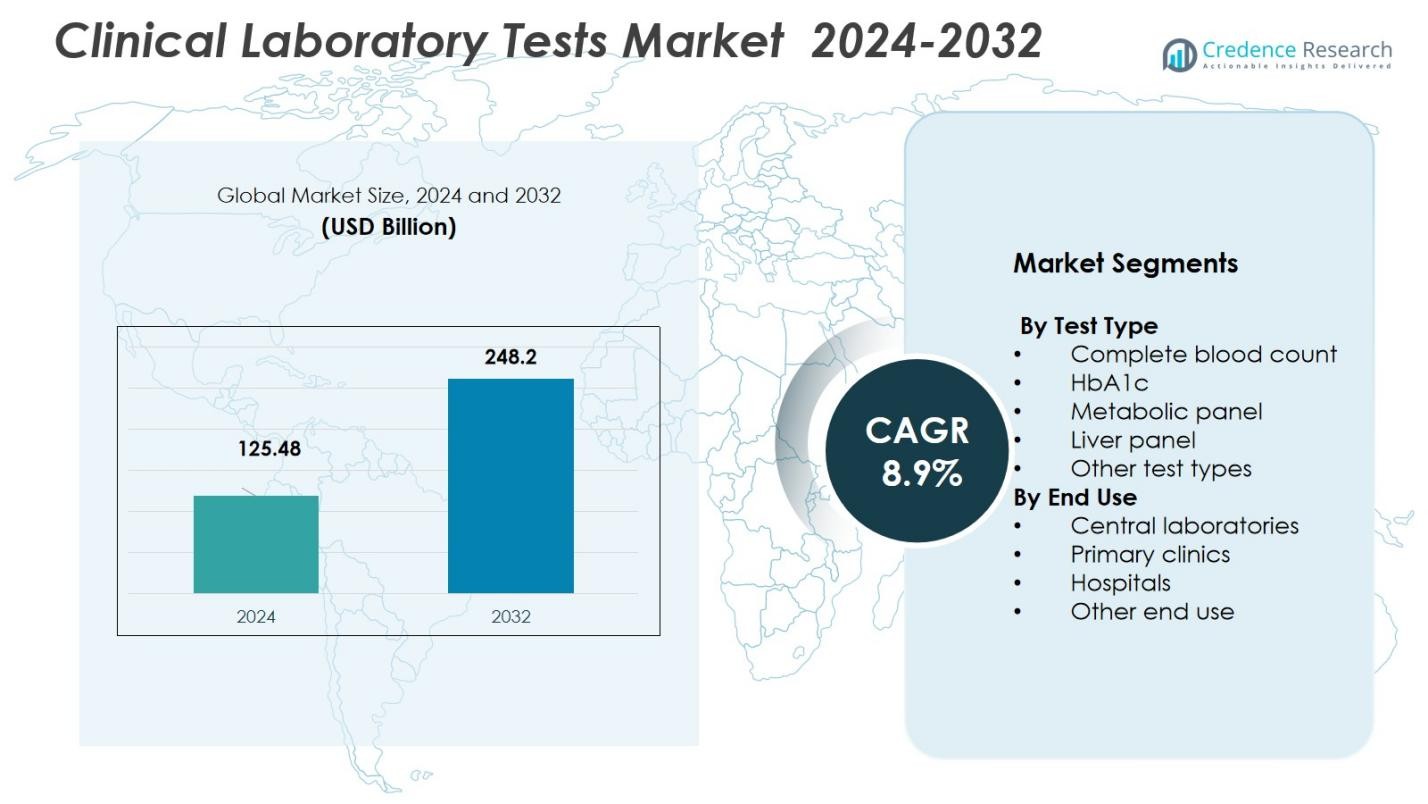
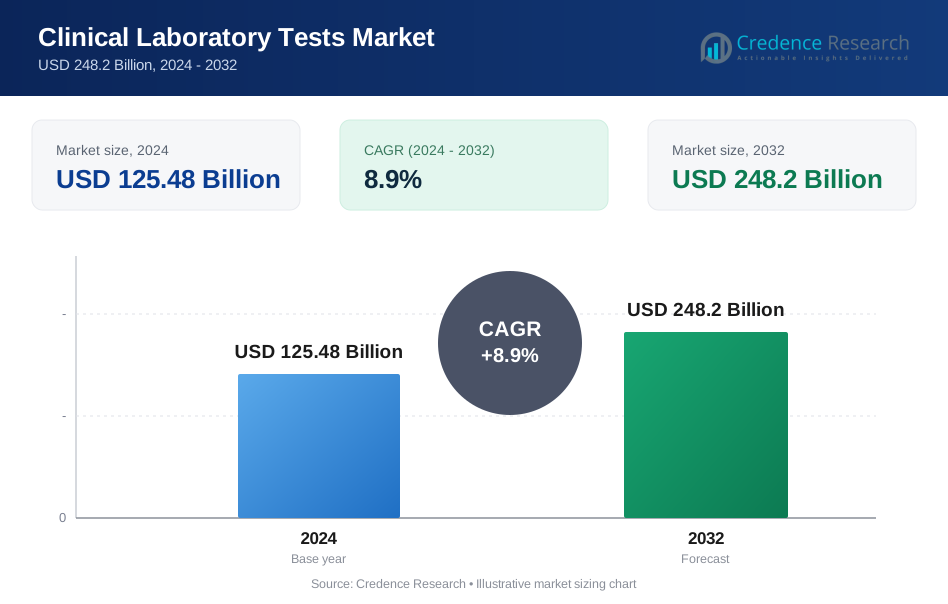
The Clinical Laboratory Tests Market size was valued at USD 125.48 Billion in 2024 and is anticipated to reach USD 248.2 Billion by 2032, at a CAGR of 8.9% during the forecast period.
| REPORT ATTRIBUTE | DETAILS |
|---|---|
| Historical Period | 2020-2023 |
| Base Year | 2024 |
| Forecast Period | 2025-2032 |
| Clinical Laboratory Tests Market Size 2024 | USD 125.48 Billion |
| Clinical Laboratory Tests Market, CAGR | 8.9% |
| Clinical Laboratory Tests Market Size 2032 | USD 248.2 Billion |
The Clinical Laboratory Tests Market features leading players such as Abbott Laboratories, F. Hoffmann‑La Roche Ltd., Danaher Corporation, bioMérieux, Bio-Rad Laboratories, Becton, Dickinson and Company (BD), Agilent Technologies, Hologic, Inc. and Illumina, Inc., which together shape global diagnostics offerings. Market growth draws most heavily from the North America region, which accounted for a 47.40% share in 2024, supported by advanced healthcare infrastructure, high testing volumes, and widespread adoption of modern diagnostic technologies. Other regions, including Asia‑Pacific and Europe, continue to contribute meaningfully as investments in healthcare infrastructure and testing capabilities expand globally.
Market Insights
- The Clinical Laboratory Tests Market size was valued at USD 125.48 Billion in 2024 and is expected to reach USD 248.2 Billion by 2032, growing at a CAGR of 8.9% during the forecast period.
- The rising prevalence of chronic diseases, such as diabetes and cardiovascular diseases, is driving the demand for routine and specialized diagnostic testing across the globe.
- Increasing adoption of automation, AI in diagnostics, and high-throughput testing platforms are key trends enhancing testing accuracy, speed, and efficiency.
- The Central Laboratories segment leads the market with a 45% share in 2024, driven by economies of scale and high-volume testing capabilities, particularly in North America, which holds 47.4% of the market share.
- Regulatory hurdles and reimbursement challenges remain as key restraints, especially in emerging markets where healthcare access is limited and policy frameworks are evolving.
 Market Segmentation Analysis:
By Test Type:
The Clinical Laboratory Tests Market is dominated by the Complete Blood Count (CBC) sub-segment, which holds the largest share due to its widespread use in diagnosing a range of conditions, including anemia, infection, and leukemia. The CBC test's versatility and cost-effectiveness drive its dominance, representing a significant portion of the market share at 32% in 2024. Other test types such as HbA1c, metabolic panels, and liver panels are also significant contributors, driven by increasing chronic disease prevalence and advancements in diagnostic technologies that improve test accuracy and speed.
- For instance, Roche Diagnostics has enhanced diagnostic precision for conditions like diabetes and kidney disease through the introduction of AI-powered digital solutions rather than solely through changes to metabolic panel assays.
By End Use:
The Central Laboratories sub-segment commands the largest share of the Clinical Laboratory Tests Market, holding 45% of the market share in 2024. Central laboratories benefit from economies of scale, high throughput capabilities, and their ability to handle a wide variety of tests, which drive demand from hospitals, clinics, and research institutions. Hospitals and primary clinics are also significant end users, with increasing healthcare infrastructure and demand for rapid diagnostic services contributing to the growth of these sub-segments. The rise of outpatient care and diagnostic outsourcing further supports the central laboratory segment's dominance.
- For instance, Labcorp operates a network of global central labs and offers “integrated central laboratory support” for large clinical‑trial and diagnostic workloads enabling standardized testing and higher throughput than smaller in‑house labs.
Key Growth Drivers
Increasing Prevalence of Chronic Diseases
The rising global burden of chronic diseases such as diabetes, cardiovascular diseases, and cancer is a significant growth driver for the Clinical Laboratory Tests Market. As these diseases become more prevalent, the demand for regular diagnostic testing, including blood tests, metabolic panels, and HbA1c tests, is accelerating. Early detection through clinical laboratory testing plays a crucial role in managing chronic conditions, enhancing patient outcomes, and reducing healthcare costs, further fueling market growth. This trend is expected to continue as healthcare systems focus on preventive care.
- For instance, Roche Diagnostics reported that its HbA1c test system improved diabetes monitoring accuracy, aiding in better patient management.
Technological Advancements in Diagnostics
Ongoing technological advancements in diagnostic tools and techniques are significantly enhancing the accuracy, speed, and cost-effectiveness of clinical laboratory tests. Innovations such as automation, artificial intelligence (AI), and high-throughput diagnostic systems are enabling faster results with greater precision. These advancements are improving the overall efficiency of clinical laboratories and driving adoption across healthcare settings. As the demand for more accurate and rapid diagnostic solutions grows, these technological improvements are expected to drive significant growth in the clinical laboratory tests market.
- For instance, Thermo Fisher Scientific's Ion Torrent Genexus System delivers next-generation sequencing results within 24 hours, dramatically speeding up genetic testing processes
Rising Demand for Point-of-Care Testing
The increasing demand for point-of-care (POC) testing is another key driver for the Clinical Laboratory Tests Market. POC testing enables quicker diagnosis and faster decision-making, reducing the need for patients to visit central laboratories. With healthcare becoming more decentralized and mobile, the convenience of testing at home or in primary care settings is becoming more popular. The ongoing adoption of POC devices in outpatient care, emergency medical services, and rural areas is expected to continue driving market growth, especially for tests such as blood glucose and cholesterol.
Key Trends & Opportunities
Shift Towards Home-Based Testing
There is a growing trend towards home-based clinical laboratory testing, driven by patient demand for convenience, reduced healthcare costs, and faster results. Consumers increasingly prefer testing services that can be performed at home, such as blood glucose monitoring, cholesterol testing, and pregnancy tests. The market is witnessing the launch of new, user-friendly diagnostic kits that enable patients to conduct tests at home and send samples to central laboratories for analysis. This trend is creating new opportunities for companies in the clinical laboratory testing market, as more players enter the home-testing segment.
- For instance, Abbott's FreeStyle Libre system allows diabetic patients to monitor glucose levels continuously at home without frequent finger pricks.
Growth of Personalized Medicine
Personalized medicine, which tailors healthcare treatments based on individual genetic and biomarker profiles, is creating a significant opportunity in the clinical laboratory tests market. With the increasing use of genetic testing, such as genomics and biomarker-based tests, physicians can offer customized treatment plans for patients. This shift towards precision medicine is driving the demand for specialized laboratory tests that cater to genetic predispositions and treatment responses. As the focus on personalized care intensifies, clinical laboratories are capitalizing on this trend by offering more targeted, individualized testing services.
- For instance, Thermo Fisher Scientific's Oncomine assays help identify specific mutations to guide targeted treatments in oncology.
Key Challenges
Regulatory and Reimbursement Challenges
One of the significant challenges faced by the Clinical Laboratory Tests Market is navigating complex regulatory and reimbursement landscapes. Governments and regulatory bodies impose stringent requirements on clinical laboratory tests, which can delay product approval and market entry. Additionally, reimbursement policies for diagnostic tests vary by region and can create barriers to widespread adoption, particularly for newer or more specialized tests. These challenges may hinder the growth of the market, especially in emerging economies where regulatory frameworks may not be as robust.
Sample Contamination and Quality Control Issues
Another challenge in the Clinical Laboratory Tests Market is ensuring sample integrity and maintaining high standards of quality control. Contamination of samples or errors in test procedures can lead to inaccurate results, potentially affecting patient diagnosis and treatment. Maintaining strict quality control measures is essential for clinical laboratories to ensure the reliability and accuracy of test results. However, managing quality control consistently across different laboratory settings remains a complex and costly task, particularly as laboratory volumes increase, posing an ongoing challenge for the market.
Regional Analysis
North America
North America leads the global Clinical Laboratory Tests Market, accounting for 47.4% of the market share in 2024. This dominance stems from advanced healthcare infrastructure, widespread adoption of diagnostic technologies, and high testing volumes driven by a large and aging population with significant chronic disease burden. Well‑established central laboratories and robust healthcare reimbursement frameworks further support the region’s strong market position. The region’s early adoption of novel diagnostics and regulatory support for preventive healthcare continue to drive sustained demand.
Asia‑Pacific
The Asia‑Pacific region is emerging as the fastest-growing region in the Clinical Laboratory Tests Market, with a projected growth rate contributing to a market share of 28.5% by 2032. Expansion of healthcare infrastructure, rising healthcare awareness, and increasing prevalence of chronic and lifestyle diseases propel growth. Governments in countries such as India, China, and Southeast Asian nations are investing in diagnostic capabilities, while private diagnostic chains are expanding reach. Enhanced access to tests, growing middle-class populations, and increasing out-of-pocket healthcare expenditure contribute to rising adoption of laboratory testing across urban and rural areas.
Europe
Europe holds a substantial portion of the global Clinical Laboratory Tests Market, with a share of 30% in 2024. This growth is supported by advanced healthcare systems, high per‑capita healthcare spending, and rising demand for early disease detection. The region benefits from strong regulatory frameworks, high adoption of automated and high-throughput diagnostic technologies, and well-established central laboratory networks. An aging population and rising prevalence of chronic conditions such as cardiovascular disease and diabetes further sustain demand for routine and specialized testing across hospitals, clinics, and independent labs.
Latin America
Latin America’s share of the Clinical Laboratory Tests Market stands at 7.2% in 2024, with steady growth driven by expanding healthcare access, rising awareness of diagnostics, and increasing disease burden. Governments across key countries are investing in public health infrastructure and diagnostic capabilities. Improved health insurance coverage and growing private healthcare providers are boosting demand for both routine and advanced laboratory tests. However, economic variability and structural disparities in rural vs. urban healthcare access influence the growth pace.
Middle East & Africa
The Middle East & Africa region holds a 6.9% share of the global Clinical Laboratory Tests Market, gradually strengthening its position through rising investments in healthcare infrastructure and growing demand for preventive diagnostics. Governments in some countries are promoting diagnostic and screening programs to address the increasing incidence of chronic diseases. Expansion of private diagnostic chains, international collaborations, and gradual adoption of advanced diagnostic technologies support market growth. Nonetheless, challenges such as uneven access to healthcare, limited lab capacity in remote areas, and workforce shortages continue to constrain full regional potential.
Market Segmentations:
By Test Type
- Complete blood count
- HbA1c
- Metabolic panel
- Liver panel
- Other test types
By End Use
- Central laboratories
- Primary clinics
- Hospitals
- Other end use
By Geography
- North America
- U.S.
- Canada
- Mexico
- Europe
- Germany
- France
- U.K.
- Italy
- Spain
- Rest of Europe
- Asia Pacific
- China
- Japan
- India
- South Korea
- South-east Asia
- Rest of Asia Pacific
- Latin America
- Brazil
- Argentina
- Rest of Latin America
- Middle East & Africa
- GCC Countries
- South Africa
- Rest of the Middle East and Africa
Competitive Landscape
The Clinical Laboratory Tests Market is highly competitive, with key players including Abbott Laboratories, F. Hoffmann-La Roche Ltd., Danaher Corporation, bioMérieux, Bio-Rad Laboratories, Becton, Dickinson and Company (BD), Agilent Technologies, Hologic, Inc., and Illumina, Inc. These companies maintain strong market positions through extensive product portfolios, advanced diagnostic technologies, and continuous investment in research and development. They differentiate themselves by offering comprehensive, integrated diagnostic solutions that include test reagents, instruments, and software. Innovation in areas such as molecular diagnostics, automation, and point-of-care testing is crucial to their competitive strategies. Additionally, geographic expansion, particularly in emerging markets, and compliance with stringent regulatory standards are key factors that drive competition. The ongoing focus on improving diagnostic accuracy, speed, and efficiency, coupled with the growing demand for personalized medicine, strengthens the position of these players in the global market.
Key Player Analysis
- Grifols
- Abbott Laboratories
- Hologic
- F. Hoffmann-La Roche
- Becton, Dickinson and Company
- Danaher
- Illumina
- Agilent Technologies
- Bio-Rad Laboratories
- bioMérieux
Recent Developments
- In September 2025, Labcorp completed the acquisition of select oncology and clinical testing assets of BioReference Health, expanding its oncology diagnostics and clinical testing services.
- In May 2025, Roche entered into a collaboration with Broad Clinical Labs to adopt its new SBX sequencing technology aiming to integrate advanced whole‑genome sequencing, especially for critically ill newborns and their parents.
- In August 2025, Quest Diagnostics acquired clinical‑testing assets from Fresenius Medical Care to enable accelerated testing services for dialysis‑clinic patients, improving turnaround times and access to diagnostics.
Report Coverage
The research report offers an in-depth analysis based on Test Type, End Use and Geography. It details leading market players, providing an overview of their business, product offerings, investments, revenue streams, and key applications. Additionally, the report includes insights into the competitive environment, SWOT analysis, current market trends, as well as the primary drivers and constraints. Furthermore, it discusses various factors that have driven market expansion in recent years. The report also explores market dynamics, regulatory scenarios, and technological advancements that are shaping the industry. It assesses the impact of external factors and global economic changes on market growth. Lastly, it provides strategic recommendations for new entrants and established companies to navigate the complexities of the market.
Future Outlook
- The market is expected to continue growing due to the increasing demand for diagnostic testing driven by the rising prevalence of chronic diseases.
- Advances in molecular diagnostics and next-generation sequencing technologies will play a significant role in expanding testing capabilities.
- Automation in laboratory processes will improve efficiency, reduce human error, and accelerate test results, fostering market growth.
- The demand for point-of-care testing is anticipated to rise, especially in outpatient care, home testing, and rural areas.
- Integration of artificial intelligence and machine learning into diagnostic tools will enhance accuracy and help streamline laboratory workflows.
- Personalized medicine will continue to drive the need for specialized tests that cater to individual genetic profiles and disease conditions.
- Expanding healthcare infrastructure in emerging markets will create new opportunities for diagnostic testing adoption.
- There will be an increasing focus on non-invasive diagnostic techniques, reducing the need for traditional invasive testing methods.
- Regulatory advancements and standardization in diagnostic testing will improve the consistency and reliability of laboratory results.
- Rising awareness of preventive healthcare and early disease detection will lead to greater adoption of routine testing among patients and healthcare providers.
Request a Free Sample
Fill in your details and we'll send you a free sample report.
- Sample data tables & charts
- Research methodology
Need a Custom Version of This Report?
Tailor the scope, geography, or segments to your exact requirements.
- Custom geography or segment scope
- Direct access to our analyst team
Frequently Asked Questions
What is the current market size for Clinical Laboratory Tests Market, and what is its projected size in 2032?
At what Compound Annual Growth Rate is the Clinical Laboratory Tests Market projected to grow between 2025 and 2032?
Which Clinical Laboratory Tests Market segment held the largest share in 2024?
What are the primary factors fueling the growth of the Clinical Laboratory Tests Market?
Who are the leading companies in the Clinical Laboratory Tests Market?
Which region commanded the largest share of the Clinical Laboratory Tests Market in 2024?
Table of Content
Chapter 1. Report Introduction
- 1.1 Report Description & Purpose
- 1.1.1 Report Title & Market Definition
- 1.1.2 Unique Selling Propositions (USP) & Key Differentiators
- 1.1.3 Value Proposition for Stakeholders
- 1.2 Research Objectives
- 1.2.1 Market Sizing Objectives (Volume & Revenue)
- 1.2.2 Segmentation Objectives
- 1.2.3 Competitive Intelligence Objectives
- 1.2.4 Forecast & Scenario Objectives
- 1.3 Report Scope
- 1.3.1 Clinical Laboratory Tests Scope – Types & Subtypes Covered
- 1.3.2 Geographic Scope – Regions & Countries Covered
- 1.3.3 Historical Period, Base Year & Forecast Period (2024; forecast to 2032)
- 1.3.4 Inclusions & Exclusions
- 1.4 HS Code & Classification Framework
- 1.5 Currency, Units & Pricing Basis
- 1.6 Target Stakeholders
- 1.7 Limitations & Assumptions
Chapter 2. Executive Summary
- 2.1 Global Clinical Laboratory Tests Market Snapshot
- 2.1.1 Market Size – Historical (2024) & Forecast (2024-2032) (2024: USD 125.48 Billion → 2032: USD 248.2 Billion)
- 2.1.2 Volume & Revenue – Global Totals
- 2.1.3 Key Market Highlights – Top Five Facts
- 2.2 Clinical Laboratory Tests Market Segmentation Snapshot
- 2.2.1 Market Split by Region – 2024 vs. 2032
- 2.3 Competitive Snapshot
- 2.3.1 Top 10 Players by Revenue Share – 2024
- 2.3.2 Top 10 Players by Volume Share – 2024
- 2.3.3 Recent Strategic Developments (18-Month Summary)
- 2.4 Key Investment Highlights & Strategic Conclusions
Chapter 3. Clinical Laboratory Tests Market Dynamics & Industry Analysis
- 3.1 Market Overview & Context
- 3.1.1 Clinical Laboratory Tests Market Position in the Broader Automotive Value Chain
- 3.1.2 OEM vs. Replacement Market Dynamics
- 3.1.3 Market Maturity & Development Stage by Region
- 3.2 Clinical Laboratory Tests Market Drivers
- 3.3 Clinical Laboratory Tests Market Restraints & Challenges
- 3.4 Clinical Laboratory Tests Market Opportunities
- 3.5 Porter's Five Forces Analysis
- 3.5.1 Threat of New Entrants
- 3.5.2 Bargaining Power of Suppliers
- 3.5.3 Bargaining Power of Buyers
- 3.5.4 Threat of Substitutes
- 3.5.5 Competitive Rivalry – Intensity Assessment
- 3.6 Clinical Laboratory Tests Value Chain Analysis
- 3.6.1 Upstream – Raw Material/Input Suppliers
- 3.6.1.1 Raw Material/Input 1
- 3.6.1.2 Raw Material/Input 2
- 3.6.1.3 Raw Material/Input 3
- 3.6.2 Midstream – Production/Manufacturing/Service Delivery
- 3.6.2.1 Production/Process Overview
- 3.6.2.2 Key Facility Locations & Capacity by Manufacturer
- 3.6.3 Downstream – Distribution & End Consumer
- 3.6.3.1 Primary Channel – B2B/OEM
- 3.6.3.2 Secondary Channels – Dealer, Retail, Online, Direct
- 3.6.4 Value Chain Profitability Analysis
- 3.6.1 Upstream – Raw Material/Input Suppliers
- 3.7 PESTEL Analysis
- 3.7.1 Political Factors
- 3.7.2 Economic Factors
- 3.7.3 Social Factors
- 3.7.4 Technological Factors
- 3.7.5 Environmental Factors
- 3.7.6 Legal Factors
- 3.8 Clinical Laboratory Tests Supply Chain Analysis
- 3.8.1 Raw Material/Input Supply Risk Assessment
- 3.8.2 Manufacturing Concentration Risk (Geographic Exposure)
- 3.8.3 Trade Disruption Impact Analysis
- 3.9 Regulatory & Policy Landscape
Note: The regulatory and policy landscape section covers regulations based on their applicability to the market, Clinical Laboratory Tests category, geography, and scope of the study. Only regulatory frameworks with a material impact on operations, compliance, trade, sustainability, or market access are analyzed in detail.
Chapter 4. Key Investment Pockets & Opportunity Analysis
- 4.1 Clinical Laboratory Tests Market Attractiveness Analysis
- 4.1.1 By Region – Investment Attractiveness Matrix (Volume × CAGR)
- 4.2 Absolute Revenue Growth Opportunity
- 4.2.1 By Region – Absolute USD Growth Through 2032
- 4.3 Incremental Volume Opportunity
- 4.3.1 By Region – Incremental Volume Through 2032
- 4.3.2 Segment – Incremental Volume
- 4.4 Emerging Submarket Opportunity Deep Dive (Subject to Applicability)
- 4.5 Emerging Market Opportunity Scorecards
- 4.5.1 United States
- 4.5.2 Europe
- 4.5.3 Asia
- 4.5.4 Middle East & Africa
Note: Emerging Market Opportunity Scorecards will be included based on relevance and strategic importance. Regions listed are indicative and may vary depending on data availability and market dynamics.
Chapter 5. Clinical Laboratory Tests Import-Export Analysis & Trade Flows
- 5.1 Global Trade Overview
- 5.1.1 Global Export Value by Country (2024)
- 5.1.2 Global Export Volume by Country (2024)
- 5.1.3 Global Import Value by Country (2024)
- 5.1.4 Global Import Volume by Country (2024)
- 5.1.5 Net Trade Balance by Country (2024)
- 5.2 Export Analysis – Segment
- 5.2.1 Type 1 (HS Code)
- 5.2.2 Type 2 (HS Code)
- 5.2.3 Type 3 (HS Code)
- 5.2.4 Type 4 (HS Code)
- 5.2.5 Type 5 (HS Code)
- 5.3 Import Analysis – Segment
- 5.3.1 Type 1 (HS Code)
- 5.3.2 Type 2 (HS Code)
- 5.3.3 Type 3 (HS Code)
- 5.3.4 Type 4 (HS Code)
- 5.3.5 Type 5 (HS Code)
- 5.4 Average Unit Trade Prices
- 5.4.1 Average Export Price – Segment & Country
- 5.4.2 Average Import Price – Segment & Source Country
- 5.4.3 Price Trends (2024)
- 5.5 Key Trade Route Analysis
- 5.5.1 Trade Route 1
- 5.5.2 Trade Route 2
- 5.5.3 Trade Route 3
- 5.5.4 Trade Route 4
- 5.5.5 Trade Route 5
- 5.6 Trade Policy Impact Assessment
- 5.6.1 US Anti-Dumping & Section 301 Tariffs
- 5.6.2 EU Customs Union Impact
- 5.6.3 Major Free Trade Agreements
- 5.6.4 USMCA Rules of Origin
Note: Trade policy analysis will be included only where relevant to the Clinical Laboratory Tests market.
Chapter 6. Competitive Landscape & Company Benchmarking
- 6.1 Clinical Laboratory Tests Market Concentration & Structure
- 6.1.1 Herfindahl-Hirschman Index (HHI) – vs. 2024
- 6.1.2 Tier 1, Tier 2 & Tier 3 Market Structure
- 6.1.3 Global, Regional & Local Player Dynamics
- 6.2 Clinical Laboratory Tests Market Share Analysis – 2024
- 6.2.1 Global Revenue Share by Company
- 6.2.2 Global Volume Share by Company
- 6.2.3 Regional Revenue Share
- 6.2.4 Market Share Evolution ( vs. 2024)
- 6.2.5 OEM Segment Share by Company
- 6.2.6 Replacement Segment Share by Company
- 6.3 Production/Delivery Capacity & Facility Analysis
- 6.3.1 Global Installed Capacity
- 6.3.2 Capacity Utilization Rates
- 6.3.3 Production/Output Volume
- 6.3.4 Facility Locations & Capacity Map
- 6.3.5 Planned Capacity Additions
- 6.4 Clinical Laboratory Tests Competitive Benchmarking Matrix
- 6.4.1 Revenue, Volume, CAGR & Profitability Comparison
- 6.4.2 Channel Revenue Mix
- 6.4.3 Geographic Revenue Exposure
- 6.4.4 R&D Intensity
- 6.4.5 Sustainability Maturity
- 6.5 Strategic Developments in Clinical Laboratory Tests (Last 24 Months)
- 6.5.1 Mergers, Acquisitions & Divestments
- 6.5.2 New Clinical Laboratory Tests Launches
- 6.5.3 Facility Expansions
- 6.5.4 Strategic Alliances, Joint Ventures & Partnerships
- 6.5.5 Distribution Expansion & Market Entry
- 6.5.6 Sustainability & ESG Initiatives
- 6.6 Competitive Strategy Mapping
- 6.6.1 Leader, Challenger, Follower & Niche Classification
- 6.6.2 Pricing Strategy Comparison
- 6.6.3 Channel Strategy Matrix
Note: Strategic developments are included based on their materiality and the availability of reliable information.
Chapter 7. Global Clinical Laboratory Tests Market – By Distribution Channel
- 7.1 Segment Overview
- 7.1.1 Volume & Revenue Split by Channel (2024 & 2032)
- 7.1.2 Channel Mix Evolution (2024-2032)
Chapter 8. Regional Market Analysis – Global Overview
- 8.1 Global Regional Overview
- 8.1.1 Regional Volume Share
- 8.1.2 Regional Revenue Share
- 8.1.3 Regional Volume by Region
- 8.1.4 Regional Revenue by Region
- 8.1.5 Regional Forecast Through 2032
- 8.2 Cross-Regional Segment Analysis
- 8.2.1 By Distribution Channel
- 8.2.2 By Brand/Price Tier
Chapter 9. North America Clinical Laboratory Tests Market
- 9.1 United States
- 9.2 Canada
- 9.3 Mexico
Chapter 10. Europe Clinical Laboratory Tests Market
- 10.1 Germany
- 10.2 France
- 10.3 Italy
- 10.4 United Kingdom
- 10.5 Spain
- 10.6 Poland
- 10.7 Russia
- 10.8 Netherlands
- 10.9 Belgium
- 10.10 Sweden
- 10.11 Denmark
- 10.12 Norway
- 10.13 Rest of Europe
Chapter 11. Asia Pacific Clinical Laboratory Tests Market
- 11.1 China
- 11.2 India
- 11.3 Japan
- 11.4 South Korea
- 11.5 Thailand
- 11.6 Indonesia
- 11.7 Vietnam
- 11.8 Malaysia
- 11.9 Australia
- 11.10 Rest of Asia Pacific
Chapter 12. Latin America Clinical Laboratory Tests Market
- 12.1 Brazil
- 12.2 Argentina
- 12.3 Colombia
- 12.4 Chile
- 12.5 Rest of Latin America
Chapter 13. Middle East Clinical Laboratory Tests Market
- 13.1 Saudi Arabia
- 13.2 United Arab Emirates
- 13.3 Turkey
- 13.4 Israel
- 13.5 Iran
- 13.6 Rest of the Middle East
Chapter 14. Africa Clinical Laboratory Tests Market
- 14.1 South Africa
- 14.2 Egypt
- 14.3 Nigeria
- 14.4 Morocco
- 14.5 Rest of Africa
Chapter 15. Clinical Laboratory Tests Company Profiles
- 15.1 [Company 01]
- 15.1.1 Company Overview
- 15.1.2 Key Management Personnel
- 15.1.3 Products & Services Portfolio
- 15.1.4 Financial Performance
- 15.1.5 Key Market Focus & Geographic Presence
- 15.1.6 Recent Developments & Strategic Initiatives
Note: The company profile list is preliminary and may change based on research findings, market developments, data availability, and client requirements.
Chapter 16. Appendices
- Appendix A – List of Abbreviations & Acronyms
- Appendix B – Industry Classification Code Reference – Full Series
- Appendix C – Production & Capacity Data Tables
- Appendix D – End-Use & Demand Base Tables
- Appendix E – Consumption & Replacement Rate Assumptions
- Appendix F – ASP Reference Tables
- Appendix G – Manufacturing & Facility Database
- Appendix H – Import-Export Data Tables
- Appendix I – Regulatory Summary Tables
- Appendix J – Primary Research Participant List (Anonymized)
- Appendix K – Primary Research Questionnaire Framework
- Appendix L – Data Sources & Bibliography
- Appendix M – Market Size Divergence & Source Comparison
Chapter 17. Research Methodology
- 17.1 Research Framework & Philosophy
- 17.2 Secondary Research – Sources, Hierarchy & Data Extraction
- 17.3 Data Modeling – Bottom-Up & Top-Down Market Sizing
- 17.4 Primary Research – Stakeholder Framework, LOI & Sample Sizes
- 17.5 Forecast Methodology – Regression, Scenario & Sensitivity Analysis
- 17.6 Quality Control – Four-Layer Validation Framework
- 17.7 Limitations & Standard Assumptions
- 17.8 Disclaimer
