
Market Overview:
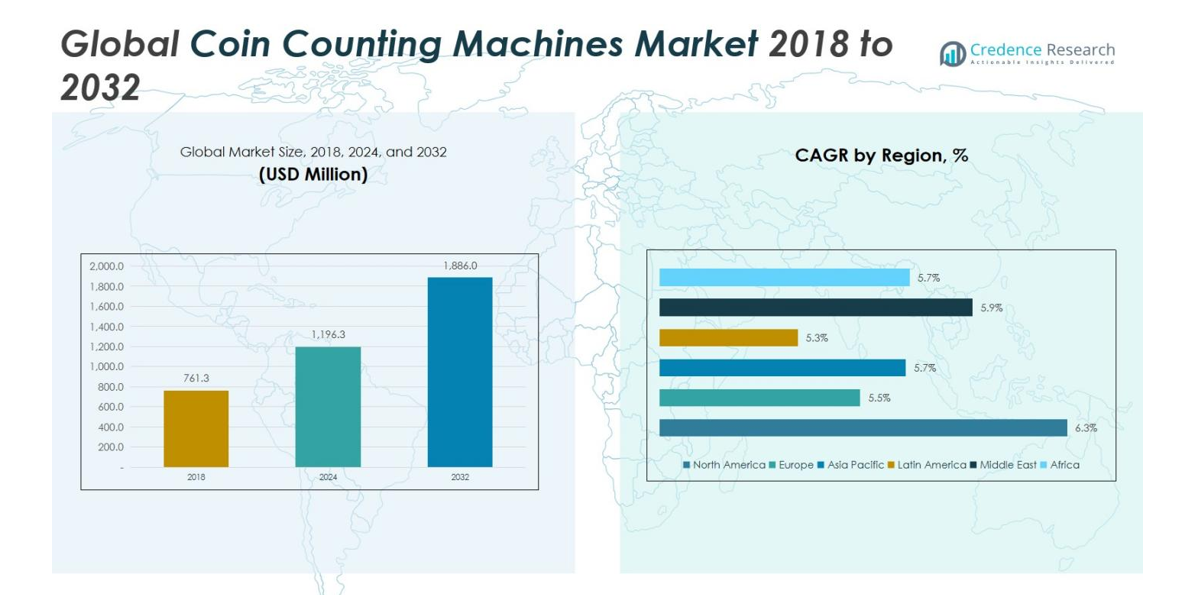
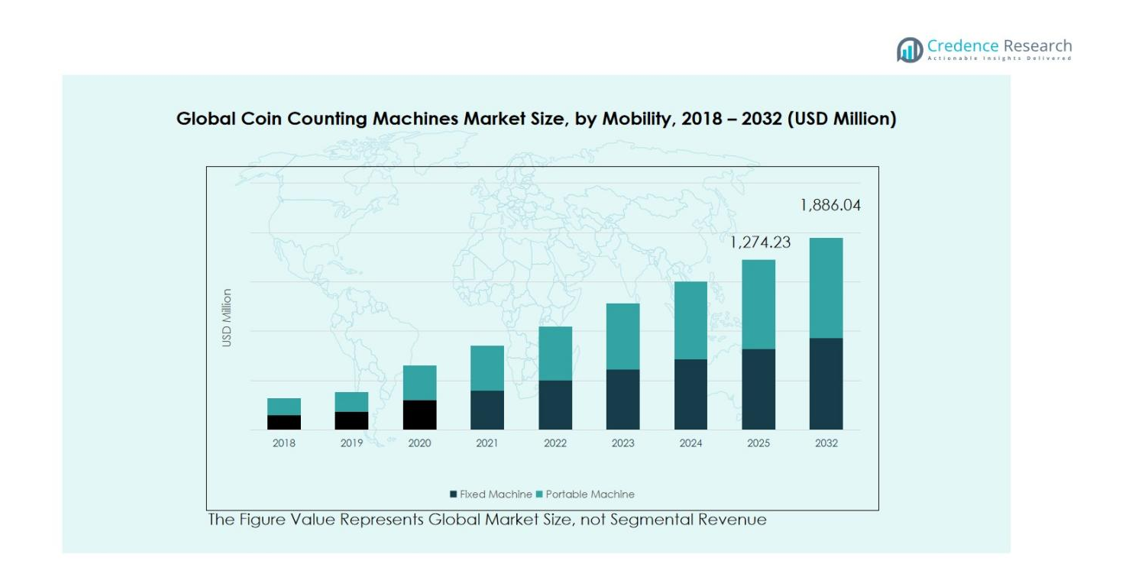
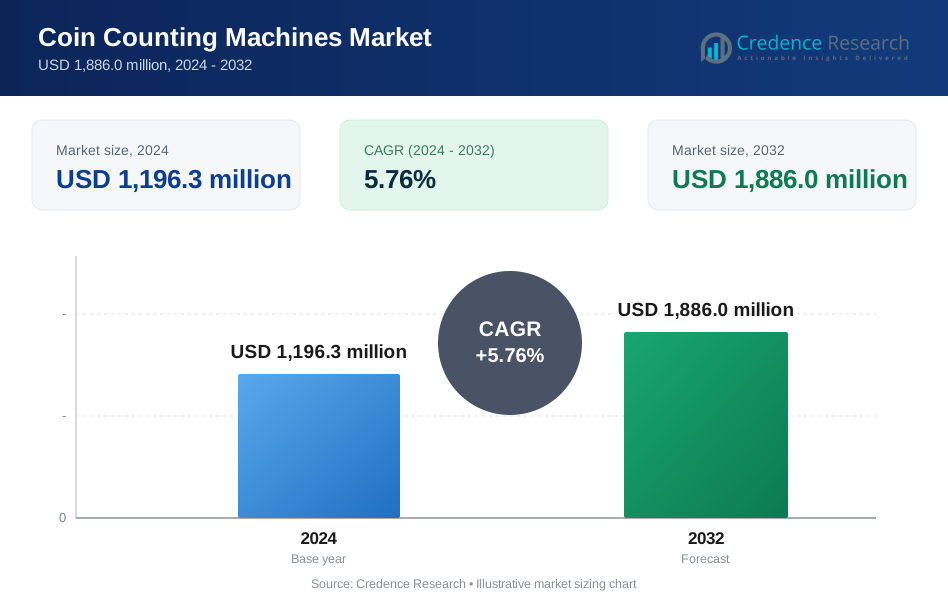
Coin Counting Machines Market size was valued at USD 761.3 million in 2018 and grew to USD 1,196.3 million in 2024. The market is anticipated to reach USD 1,886.0 million by 2032, registering a CAGR of 5.76% during the forecast period.
| REPORT ATTRIBUTE | DETAILS |
|---|---|
| Historical Period | 2020-2023 |
| Base Year | 2024 |
| Forecast Period | 2025-2032 |
| Coin Counting Machines Market Size 2024 | USD 1,196.3 million |
| Coin Counting Machines Market, CAGR | 5.76% |
| Coin Counting Machines Market Size 2032 | USD 1,886.0 million |
The Coin Counting Machines Market is highly competitive, with key players including Maxsell, Nihar International, Summi Enterprises, Bellcon, Ribao Technology, ZZAP, Magner Corporation, Safescan, LOGISCENTER, and Kaixun driving innovation and market growth. These companies focus on advanced features such as counterfeit detection, batch processing, and digital connectivity, while expanding distribution networks and strengthening after-sales support to maintain leadership. Asia Pacific emerges as the leading region in the market, accounting for a 27% share, driven by rising cash transaction volumes, expanding banking and retail sectors, and growing adoption of both fixed and portable machines. The combination of strong regional demand and strategic initiatives by top players ensures sustained growth, positioning the market for further expansion across both developed and emerging economies.
Market Insights
- The Coin Counting Machines Market was valued at USD 1,196.3 million in 2024 and is projected to reach USD 1,886.0 million by 2032, growing at a CAGR of 5.76%. Asia Pacific leads the market with a 27% share, followed by Europe at 25% and North America at 22%.
- Growth is driven by rising automation in cash handling, increasing cash transaction volumes, and expanding banking and commercial infrastructure, which create high demand for accurate and efficient coin counting solutions.
- Key trends include integration of advanced features like counterfeit detection, batch processing, and digital connectivity, along with growing adoption of portable and fixed machines in commercial and institutional settings.
- The competitive landscape is dominated by players such as Maxsell, Nihar International, Summi Enterprises, Bellcon, Ribao Technology, and Safescan, who focus on product innovation, strategic partnerships, and expanding distribution networks.
- Market restraints include high initial investment costs and the need for regular maintenance and technical support, which may slow adoption, particularly in emerging economies.
Market Segmentation Analysis:
By Type:
The coin counting machines market by type is dominated by coin counters, holding a market share of 42%. Their popularity stems from their efficiency in rapidly counting large volumes of coins with high accuracy, making them ideal for banks and commercial establishments. Coin sorters follow closely, valued for their ability to organize mixed denominations efficiently, while coin counter and sorter combos cater to institutions requiring both functionalities. Increasing adoption of automated cash handling solutions and the rising demand for operational efficiency are key drivers for growth across this segment.
- For instance, Huntsman Corporation launched a new line of epoxy-based structural adhesives in Europe that are formulated to be safer and more sustainable, being free from BPA and classified CMR substances.
By End User:
Among end users, banks and financial institutions dominate with a share of 60%, reflecting the critical need for high-speed, accurate coin processing in financial operations. Commercial businesses follow, adopting machines primarily for retail, vending, and hospitality applications to streamline cash handling and reduce labor costs. The expansion of banking infrastructure, increased focus on operational efficiency, and rising transaction volumes are significant drivers supporting the growth of this segment, emphasizing the reliance on automated coin handling solutions in institutional environments.
- For instance, Deutsche Bank deployed Giesecke+Devrient’s BPS C1 Systems across several European branches to accelerate bulk coin sorting and improve accuracy in cash handling.
Key Growth Drivers
Rising Demand for Automation in Cash Handling
The growing need for efficiency in cash management is a major driver for the coin counting machines market. Financial institutions and commercial businesses are increasingly adopting automated solutions to reduce manual errors, speed up processing, and improve operational accuracy. The expansion of banking networks and retail chains has further accelerated the adoption of coin counters and sorters. Automation not only streamlines cash handling but also reduces labor costs, making these machines a strategic investment for organizations aiming to enhance productivity and operational efficiency.
- For instance, Glory Global has implemented its QC™ self-service coin deposit machines in various financial institutions, enabling customers to deposit coins without involving tellers. This automation not only streamlines transactions but also frees up staff to focus on more complex customer needs.
Increasing Cash Transaction Volumes
Despite digital payment trends, cash transactions continue to play a significant role in many regions, particularly in retail, vending, and hospitality sectors. The rising volume of coins in circulation drives the need for accurate and fast processing solutions. Coin counting machines enable institutions to manage large volumes efficiently, reducing delays and enhancing customer service. Growing economic activity, urbanization, and the expansion of commercial outlets have reinforced demand, positioning the coin counting machines market as a critical solution for modern cash-handling operations.
- For instance, Cummins Allison’s JetSort® 2000 series has been widely adopted by U.S. banks and supermarkets to process up to 10,000 coins per minute, reducing manual counting time and improving operational efficiency.
Expansion of Banking and Financial Infrastructure
The ongoing growth of banking and financial services globally contributes significantly to the demand for coin counting machines. New bank branches, ATMs, and financial service centers require high-efficiency coin management solutions to handle increasing transaction volumes. Moreover, regulatory compliance and security concerns encourage banks to adopt automated counting and sorting systems. This expansion, combined with modernization initiatives in both developed and emerging markets, ensures a steady demand for reliable, accurate, and high-speed coin counting machines across the financial sector.
Key Trends & Opportunities
Integration of Advanced Features
Manufacturers are increasingly equipping coin counting machines with features like counterfeit detection, batch processing, and digital connectivity, enhancing their efficiency and security. These advanced functionalities present an opportunity to differentiate products and attract larger commercial clients. The integration of smart technologies enables real-time tracking and reporting, aligning with the digital transformation initiatives of financial institutions. Continuous innovation in machine capabilities creates potential for market expansion and positions coin counting machines as a vital component in modern cash management ecosystems.
- For instance, Giesecke+Devrient upgraded its BPS C2 coin processing solution with IoT-enabled monitoring, allowing banks to remotely track performance and maintenance needs.
Growing Adoption in Commercial Businesses
Beyond banks, the commercial sector-including retail chains, casinos, and vending operators-is adopting coin counting machines to improve cash-handling efficiency. This trend offers opportunities for manufacturers to target niche segments that require tailored solutions for medium-to-high volume processing. Increasing awareness of operational efficiency and cost reduction benefits drives adoption. As businesses seek to reduce manual labor and enhance accuracy, the market is poised to expand into new commercial verticals, creating long-term growth prospects beyond traditional banking applications.
- For instance, Mach™ 3 coin sorter is specified to count and sort up to 1,500 coins per minute, a capability retailers and casinos cite to dramatically shorten back-office processing time.
Key Challenges
High Initial Investment Cost
The substantial upfront cost of advanced coin counting machines remains a significant challenge, particularly for small and medium-sized businesses. While the long-term benefits include labor savings and operational efficiency, the initial expenditure may deter adoption in cost-sensitive markets. Budget constraints and limited access to financing options can slow market penetration. Manufacturers must balance feature-rich offerings with affordability to overcome this barrier and expand adoption, particularly in emerging economies where cost considerations play a decisive role in purchasing decisions.
Maintenance and Technical Support Requirements
Coin counting machines require regular maintenance, calibration, and technical support to ensure accuracy and longevity. Limited access to reliable after-sales service or trained technicians can hinder machine performance, leading to operational downtime. For small businesses and remote locations, these requirements pose challenges in adoption. Ensuring consistent technical support and easy availability of spare parts is critical for market growth. Providers that offer comprehensive maintenance packages and training can mitigate these challenges and enhance customer trust and satisfaction.
Regional Analysis
North America
North America holds a market share of 22%, reflecting steady demand for coin counting machines across banks, retail chains, and commercial businesses. The market grew from USD 164.97 million in 2018 to USD 267.09 million in 2024 and is projected to reach USD 437.56 million by 2032, at a CAGR of 6.3%. Growth is fueled by increasing automation in financial institutions, high cash transaction volumes, and the need for operational efficiency. The U.S. leads the region, supported by adoption of advanced coin handling technologies and modernization of cash management systems.
Europe
Europe commands a market share of 25%, making it a key contributor to the global market. Valued at USD 217.43 million in 2018, the market is expected to reach USD 337.16 million in 2024 and USD 522.06 million by 2032, at a CAGR of 5.5%. Strong banking infrastructure, retail modernization, and adoption of automated coin counting solutions drive growth. Germany, the UK, and France are leading markets, where financial institutions and commercial businesses prioritize speed, accuracy, and operational efficiency in cash handling.
Asia Pacific
Asia Pacific represents the largest regional market with a share of 27%. The market increased from USD 259.68 million in 2018 to USD 406.37 million in 2024 and is projected to reach USD 637.10 million by 2032, growing at a CAGR of 5.7%. Expansion is driven by rising cash transaction volumes, modernizing banking infrastructure, and growing adoption in retail and commercial sectors. Key contributors include China, India, and Japan, where both fixed and portable coin counting machines are increasingly used to streamline cash management and reduce manual labor.
Latin America
Latin America holds a market share of 6%, driven by banking expansion and commercial adoption. The market grew from USD 55.73 million in 2018 to USD 85.37 million in 2024, and is projected to reach USD 129.95 million by 2032, at a CAGR of 5.3%. Brazil and Argentina lead regional demand, focusing on automating cash handling to improve efficiency and reduce manual processes. Rising transaction volumes and adoption in retail and commercial businesses further support market growth.
Middle East
032, at a CAGR of 5.9%. Growth is driven by modernization of banking infrastructure, increased cash transactions, and adoption of advanced coin counting solutions. GCC countries, Israel, and Turkey lead demand, where banks and businesses increasingly implement fixed and portable machines for efficient cash management and operational accuracy.
Africa
Africa holds a market share of 2%, reflecting emerging demand in banking and commercial sectors. The market grew from USD 19.49 million in 2018 to USD 30.52 million in 2024 and is projected to reach USD 47.91 million by 2032, at a CAGR of 5.7%. South Africa and Egypt are leading markets, driven by increasing cash usage, expanding banking networks, and commercial adoption. Growth focuses on improving operational efficiency, minimizing errors, and supporting automated cash handling in both urban and semi-urban regions.
Market Segmentations:
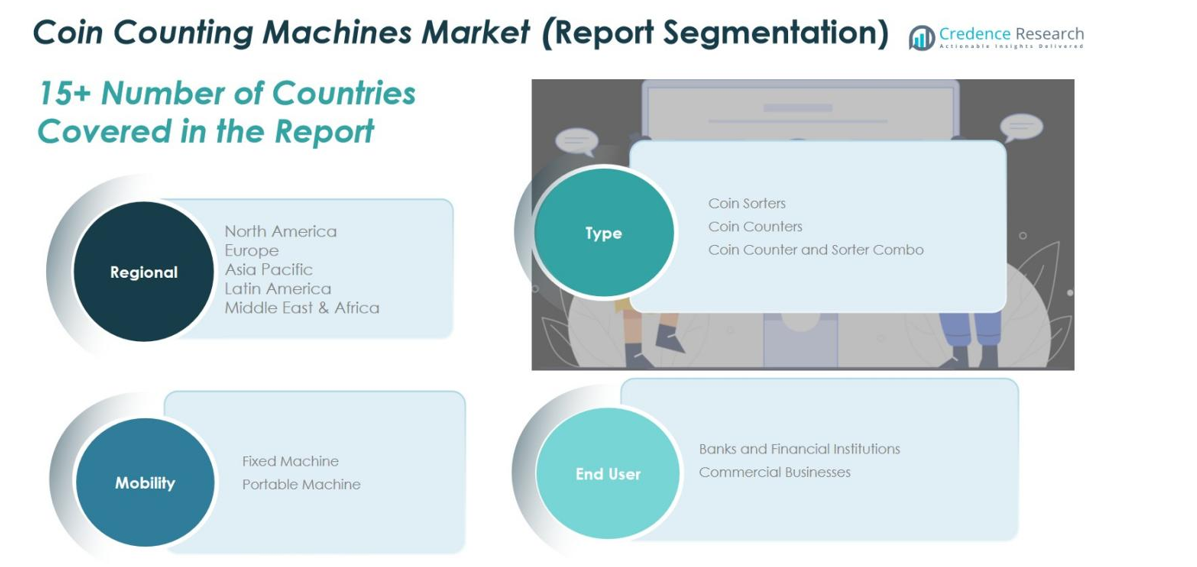
By Type:
- Coin Sorters
- Coin Counters
- Coin Counter and Sorter Combo
By Mobility:
- Fixed Machines
- Portable Machines
By End User:
- Banks and Financial Institutions
- Commercial Businesses
By Region:
- North America
- U.S.
- Canada
- Mexico
- Europe
- Germany
- France
- U.K.
- Italy
- Spain
- Rest of Europe
- Asia Pacific
- China
- Japan
- India
- South Korea
- South-east Asia
- Rest of Asia Pacific
- Latin America
- Brazil
- Argentina
- Rest of Latin America
- Middle East & Africa
- GCC Countries
- South Africa
- Rest of the Middle East and Africa
Competitive Landscape
The competitive landscape of the Coin Counting Machines Market is characterized by the presence of key players such as Maxsell, Nihar International, Summi Enterprises, Bellcon, Ribao Technology, ZZAP, Magner Corporation, Safescan, LOGISCENTER, and Kaixun. These companies focus on product innovation, technological advancements, and strategic partnerships to maintain market leadership. Market players are investing in advanced features such as counterfeit detection, batch processing, and connectivity solutions to meet evolving customer demands. Competitive strategies also include expanding distribution networks, offering customized solutions for banks and commercial businesses, and strengthening after-sales support to enhance customer loyalty. The market remains fragmented, with opportunities for smaller players to capture niche segments, particularly in emerging regions. Continuous innovation, combined with increasing adoption of automated coin handling solutions, ensures that established and new entrants can capitalize on the growing global demand for efficient cash management systems.
Key Player Analysis
- Maxsell
- Nihar International
- Summi Enterprises
- Bellcon
- Ribao Technology
- ZZAP
- Magner Corporation
- Safescan
- LOGISCENTER
- Kaixun
- Other Key Players
Recent Developments
- In October 2025, JJ Collection and CoinValue Technology launched an AI and machine learning-enabled coin sorting and counting machine, featuring advanced counterfeit detection and batch processing capabilities.
- In 2025, CTcoin partnered with EKTOS for hardware development, with EKTOS designing the electronic hardware and hardware-near software layers, while CTcoin focused on the coin-counting software.
- In 2025, Coinstar partnered with Coinme, enabling the sale of bitcoin at over 2,200 in-store kiosks across 21 states and the District of Columbia, expanding its financial service offerings
Report Coverage
The research report offers an in-depth analysis based on Type, End User, Mobility and Region. It details leading market players, providing an overview of their business, product offerings, investments, revenue streams, and key applications. Additionally, the report includes insights into the competitive environment, SWOT analysis, current market trends, as well as the primary drivers and constraints. Furthermore, it discusses various factors that have driven market expansion in recent years. The report also explores market dynamics, regulatory scenarios, and technological advancements that are shaping the industry. It assesses the impact of external factors and global economic changes on market growth. Lastly, it provides strategic recommendations for new entrants and established companies to navigate the complexities of the market.
Future Outlook
- The market is expected to witness steady growth driven by increasing automation in cash handling.
- Rising demand from banks and financial institutions will continue to propel market expansion.
- Commercial businesses will increasingly adopt coin counting machines to enhance operational efficiency.
- Advanced features like counterfeit detection and connectivity will drive product innovation.
- Fixed machines are likely to maintain dominance due to high-volume processing requirements.
- Portable machines will see moderate growth as small businesses adopt flexible solutions.
- Asia Pacific is expected to remain the largest regional market, supported by expanding banking and retail sectors.
- Emerging markets in Latin America, the Middle East, and Africa will offer new growth opportunities.
- Strategic partnerships, product launches, and technological upgrades will intensify competition.
- The focus on reducing manual errors and labor costs will sustain long-term demand globally.
Request a Free Sample
Fill in your details and we'll send you a free sample report.
- Sample data tables & charts
- Research methodology
Need a Custom Version of This Report?
Tailor the scope, geography, or segments to your exact requirements.
- Custom geography or segment scope
- Direct access to our analyst team
Frequently Asked Questions
What is the current market size for Coin Counting Machines Market, and what is its projected size in 2032?
At what Compound Annual Growth Rate is the Coin Counting Machines Market projected to grow between 2025 and 2032?
Which Coin Counting Machines Market segment held the largest share in 2024?
What are the primary factors fueling the growth of the Coin Counting Machines Market?
Who are the leading companies in the Coin Counting Machines Market?
Which region commanded the largest share of the Coin Counting Machines Market in 2024?
Table of Content
Chapter 1. Report Introduction
- 1.1 Report Description & Purpose
- 1.1.1 Report Title & Market Definition
- 1.1.2 Unique Selling Propositions (USP) & Key Differentiators
- 1.1.3 Value Proposition for Stakeholders
- 1.2 Research Objectives
- 1.2.1 Market Sizing Objectives (Volume & Revenue) (Volume Where Applicable)
- 1.2.2 Segmentation Objectives
- 1.2.3 Competitive Intelligence Objectives
- 1.2.4 Forecast & Scenario Objectives
- 1.3 Report Scope
- 1.3.1 Coin Counting Machines Scope – Segments & Subsegments Covered
- 1.3.2 Geographic Scope – Regions & Countries Covered
- 1.3.3 Historical Period, Base Year & Forecast Period (2024; forecast to 2032)
- 1.3.4 Inclusions & Exclusions
- 1.4 Industry Classification & Applicable Codes
- 1.5 Currency, Measurement Units & Valuation Basis
- 1.6 Target Stakeholders
- 1.7 Limitations & Assumptions
Chapter 2. Executive Summary
- 2.1 Global Coin Counting Machines Market Snapshot
- 2.1.1 Market Size – Historical (2024) & Forecast (2024-2032) (2024: USD 1,196.3 million → 2032: USD 1,886.0 million)
- 2.1.2 Volume & Revenue – Global Totals (Volume Where Applicable)
- 2.1.3 Key Market Highlights – Top Five Facts
- 2.2 Coin Counting Machines Market Segmentation Snapshot
- 2.2.1 Market Split by Region – 2024 vs. 2032
- 2.3 Competitive Snapshot
- 2.3.1 Top 10 Players by Revenue Share – 2024
- 2.3.2 Top 10 Players by Volume Share – 2024 (Volume Where Applicable)
- 2.3.3 Recent Strategic Developments (18-Month Summary)
- 2.4 Key Investment Highlights & Strategic Conclusions
Chapter 3. Coin Counting Machines Market Dynamics & Industry Analysis
- 3.1 Market Overview & Context
- 3.1.1 Coin Counting Machines Market Position in the Broader Industry Value Chain
- 3.1.2 Demand Structure & Purchasing Dynamics
- 3.1.3 Market Maturity & Development Stage by Region
- 3.2 Coin Counting Machines Market Drivers
- 3.3 Coin Counting Machines Market Restraints & Challenges
- 3.4 Coin Counting Machines Market Opportunities
- 3.5 Porter's Five Forces Analysis
- 3.5.1 Threat of New Entrants
- 3.5.2 Bargaining Power of Suppliers
- 3.5.3 Bargaining Power of Buyers
- 3.5.4 Threat of Substitutes
- 3.5.5 Competitive Rivalry – Intensity Assessment
- 3.6 Coin Counting Machines Value Chain Analysis
- 3.6.1 Upstream – Key Inputs, Resources & Suppliers
- 3.6.1.1 Key Input/Resource 1
- 3.6.1.2 Key Input/Resource 2
- 3.6.1.3 Key Input/Resource 3
- 3.6.2 Midstream – Core Operations & Value Creation
- 3.6.2.1 Operating Model & Process Overview
- 3.6.2.2 Key Operating Locations & Capabilities by Company
- 3.6.3 Downstream – Market Channels & End Users
- 3.6.3.1 Direct Sales & Customer Engagement Channels
- 3.6.3.2 Indirect Sales, Intermediaries & Partner Channels
- 3.6.4 Value Chain Profitability Analysis
- 3.6.1 Upstream – Key Inputs, Resources & Suppliers
- 3.7 PESTEL Analysis
- 3.7.1 Political Factors
- 3.7.2 Economic Factors
- 3.7.3 Social Factors
- 3.7.4 Technological Factors
- 3.7.5 Environmental Factors
- 3.7.6 Legal Factors
- 3.8 Coin Counting Machines Supply Chain Analysis
- 3.8.1 Critical Input & Resource Availability Risk Assessment
- 3.8.2 Supplier & Operational Concentration Risk (Geographic Exposure)
- 3.8.3 Supply & Service Disruption Impact Analysis
- 3.9 Regulatory & Policy Landscape
Note: The regulatory and policy landscape section covers regulations based on their applicability to the market, Coin Counting Machines category, geography, and scope of the study. Only regulatory frameworks with a material impact on operations, compliance, trade, sustainability, or market access are analyzed in detail.
Chapter 4. Key Investment Pockets & Opportunity Analysis
- 4.1 Coin Counting Machines Market Attractiveness Analysis
- 4.1.1 By Region – Investment Attractiveness Matrix (Market Size × CAGR)
- 4.2 Absolute Revenue Growth Opportunity
- 4.2.1 By Region – Absolute Revenue Growth Through 2032
- 4.3 Incremental Demand Opportunity
- 4.3.1 By Region – Incremental Demand Through 2032
- 4.3.2 Segment – Incremental Demand
- 4.4 Emerging Submarket Opportunity Deep Dive (Subject to Applicability)
- 4.5 Priority Market Opportunity Scorecards
- 4.5.1 United States
- 4.5.2 Europe
- 4.5.3 Asia
- 4.5.4 Middle East & Africa
Note: Priority market opportunity scorecards reflect the geographic scope and strategic relevance of the study. Listed markets are indicative and may be adapted to the industry.
Chapter 5. Coin Counting Machines Cross-Border Trade & Market Access Analysis
- 5.1 International Trade & Cross-Border Activity Overview
- 5.1.1 Global Export Value by Country (2024)
- 5.1.2 Global Export Volume by Country (2024) (Volume Where Applicable)
- 5.1.3 Global Import Value by Country (2024)
- 5.1.4 Global Import Volume by Country (2024) (Volume Where Applicable)
- 5.1.5 Net Trade Balance by Country (2024)
- 5.2 Export Analysis – Segment
- 5.2.1 Category 1 (Applicable Classification Code)
- 5.2.2 Category 2 (Applicable Classification Code)
- 5.2.3 Category 3 (Applicable Classification Code)
- 5.2.4 Category 4 (Applicable Classification Code)
- 5.2.5 Category 5 (Applicable Classification Code)
- 5.3 Import Analysis – Segment
- 5.3.1 Category 1 (Applicable Classification Code)
- 5.3.2 Category 2 (Applicable Classification Code)
- 5.3.3 Category 3 (Applicable Classification Code)
- 5.3.4 Category 4 (Applicable Classification Code)
- 5.3.5 Category 5 (Applicable Classification Code)
- 5.4 Cross-Border Pricing & Transaction Benchmarks
- 5.4.1 Export Pricing – Segment & Country
- 5.4.2 Import Pricing – Segment & Source Country
- 5.4.3 Price Trends (2024)
- 5.5 Key Cross-Border Trade & Delivery Routes
- 5.5.1 Cross-Border Trade/Delivery Route 1
- 5.5.2 Cross-Border Trade/Delivery Route 2
- 5.5.3 Cross-Border Trade/Delivery Route 3
- 5.5.4 Cross-Border Trade/Delivery Route 4
- 5.5.5 Cross-Border Trade/Delivery Route 5
- 5.6 Trade Policy & Market Access Impact Assessment
- 5.6.1 Tariff & Non-Tariff Barriers
- 5.6.2 Regional Trade & Economic Integration Frameworks
- 5.6.3 Bilateral & Multilateral Trade Agreements
- 5.6.4 Cross-Border Operating, Licensing & Localization Requirements
Note: This chapter applies where cross-border trade or delivery is relevant to Coin Counting Machines. Goods, services, and digital offerings are assessed using applicable classifications and transaction measures. Import-export volumes, trade balances, and route analyses are included only where meaningful to the market.
Chapter 6. Competitive Landscape & Company Benchmarking
- 6.1 Coin Counting Machines Market Concentration & Structure
- 6.1.1 Herfindahl-Hirschman Index (HHI) – vs. 2024
- 6.1.2 Leading, Mid-Sized & Emerging Player Structure
- 6.1.3 Global, Regional & Local Player Dynamics
- 6.2 Coin Counting Machines Market Share Analysis – 2024
- 6.2.1 Global Revenue Share by Company
- 6.2.2 Global Volume Share by Company (Volume Where Applicable)
- 6.2.3 Regional Revenue Share
- 6.2.4 Market Share Evolution ( vs. 2024)
- 6.2.5 Company Market Share by Key Segment
- 6.2.6 Company Market Share by Customer Group
- 6.3 Operating Scale, Capacity & Infrastructure Analysis
- 6.3.1 Global Operating Scale & Supply Capacity
- 6.3.2 Resource Utilization & Operating Efficiency
- 6.3.3 Output, Service Delivery & Activity Metrics
- 6.3.4 Operating Footprint & Infrastructure Map
- 6.3.5 Planned Operational & Capacity Expansion
- 6.4 Coin Counting Machines Competitive Benchmarking Matrix
- 6.4.1 Revenue, Growth, Profitability & Operating Metric Comparison
- 6.4.2 Channel Revenue Mix
- 6.4.3 Geographic Revenue Exposure
- 6.4.4 R&D Intensity
- 6.4.5 Sustainability Maturity
- 6.5 Strategic Developments in Coin Counting Machines (Last 24 Months)
- 6.5.1 Mergers, Acquisitions & Divestments
- 6.5.2 New Products, Services & Solutions in Coin Counting Machines
- 6.5.3 Operational & Infrastructure Expansions
- 6.5.4 Strategic Alliances, Joint Ventures & Partnerships
- 6.5.5 Distribution Expansion & Market Entry
- 6.5.6 Sustainability & ESG Initiatives
- 6.6 Competitive Strategy Mapping
- 6.6.1 Leader, Challenger, Follower & Niche Classification
- 6.6.2 Pricing Strategy Comparison
- 6.6.3 Channel Strategy Matrix
Note: Strategic developments are included based on their materiality and the availability of reliable information.
Chapter 7. Global Coin Counting Machines Market – By Sales & Delivery Channel
- 7.1 Segment Overview
- 7.1.1 Volume & Revenue Split by Channel (2024 & 2032) (Volume Where Applicable)
- 7.1.2 Channel Mix Evolution (2024-2032)
Chapter 8. Regional Market Analysis – Global Overview
- 8.1 Global Regional Overview
- 8.1.1 Regional Volume Share (Volume Where Applicable)
- 8.1.2 Regional Revenue Share
- 8.1.3 Regional Volume by Region (Volume Where Applicable)
- 8.1.4 Regional Revenue by Region
- 8.1.5 Regional Forecast Through 2032
- 8.2 Cross-Regional Segment Analysis
- 8.2.1 By Sales & Delivery Channel
- 8.2.2 By Competitive Positioning & Price Tier
Chapter 9. North America Coin Counting Machines Market
- 9.1 United States
- 9.2 Canada
- 9.3 Mexico
Chapter 10. Europe Coin Counting Machines Market
- 10.1 Germany
- 10.2 France
- 10.3 Italy
- 10.4 United Kingdom
- 10.5 Spain
- 10.6 Poland
- 10.7 Russia
- 10.8 Netherlands
- 10.9 Belgium
- 10.10 Sweden
- 10.11 Denmark
- 10.12 Norway
- 10.13 Rest of Europe
Chapter 11. Asia Pacific Coin Counting Machines Market
- 11.1 China
- 11.2 India
- 11.3 Japan
- 11.4 South Korea
- 11.5 Thailand
- 11.6 Indonesia
- 11.7 Vietnam
- 11.8 Malaysia
- 11.9 Australia
- 11.10 Rest of Asia Pacific
Chapter 12. Latin America Coin Counting Machines Market
- 12.1 Brazil
- 12.2 Argentina
- 12.3 Colombia
- 12.4 Chile
- 12.5 Rest of Latin America
Chapter 13. Middle East Coin Counting Machines Market
- 13.1 Saudi Arabia
- 13.2 United Arab Emirates
- 13.3 Turkey
- 13.4 Israel
- 13.5 Iran
- 13.6 Rest of the Middle East
Chapter 14. Africa Coin Counting Machines Market
- 14.1 South Africa
- 14.2 Egypt
- 14.3 Nigeria
- 14.4 Morocco
- 14.5 Rest of Africa
Chapter 15. Coin Counting Machines Company Profiles
- 15.1 [Company 01]
- 15.1.1 Company Overview
- 15.1.2 Key Management Personnel
- 15.1.3 Products & Services Portfolio
- 15.1.4 Financial Performance
- 15.1.5 Key Market Focus & Geographic Presence
- 15.1.6 Recent Developments & Strategic Initiatives
Note: The company profile list is preliminary and may change based on research findings, market developments, data availability, and client requirements.
Chapter 16. Appendices
- Appendix A – List of Abbreviations & Acronyms
- Appendix B – Industry Classification Code Reference – Full Series
- Appendix C – Supply, Output & Operating Capacity Data Tables
- Appendix D – End-Use & Demand Base Tables
- Appendix E – Demand, Adoption & Usage Assumptions
- Appendix F – Pricing & Revenue Metric Reference Tables
- Appendix G – Company Operations & Infrastructure Database
- Appendix H – Cross-Border Trade & Activity Data Tables (Where Applicable)
- Appendix I – Regulatory Summary Tables
- Appendix J – Primary Research Participant List (Anonymized)
- Appendix K – Primary Research Questionnaire Framework
- Appendix L – Data Sources & Bibliography
- Appendix M – Market Size Divergence & Source Comparison
Chapter 17. Research Methodology
- 17.1 Research Framework & Philosophy
- 17.2 Secondary Research – Sources, Hierarchy & Data Extraction
- 17.3 Data Modeling – Bottom-Up & Top-Down Market Sizing
- 17.4 Primary Research – Stakeholder Framework, LOI & Sample Sizes
- 17.5 Forecast Methodology – Regression, Scenario & Sensitivity Analysis
- 17.6 Quality Control – Four-Layer Validation Framework
- 17.7 Limitations & Standard Assumptions
- 17.8 Disclaimer
