
Market Insights
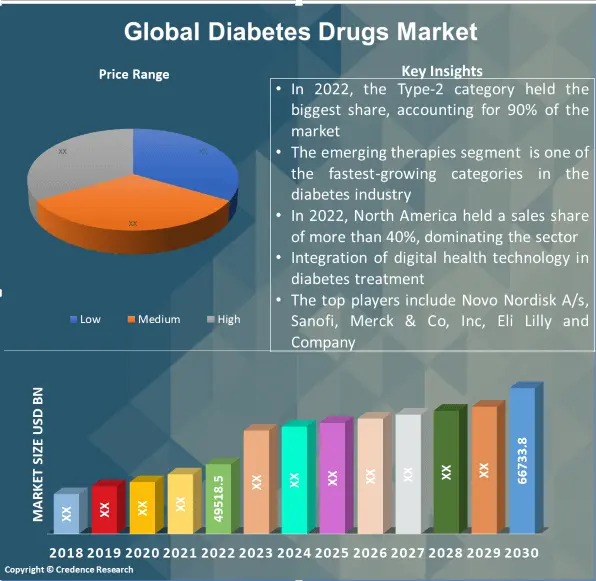
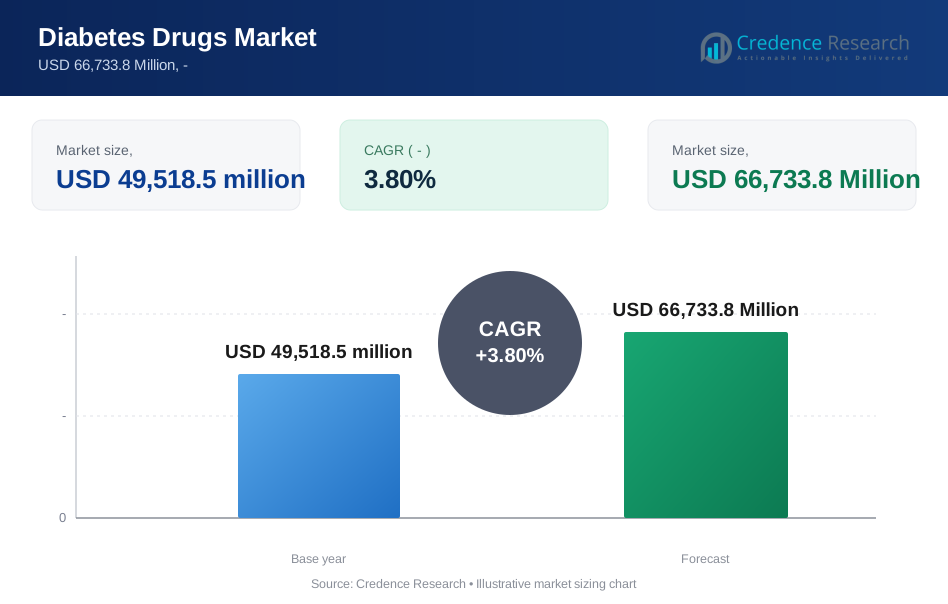
- The global demand for Diabetes Drugs was valued at USD 49518.5 million in 2022 and is expected to reach USD 66733.8 Million in 2030, growing at a CAGR of 3.80% between 2023 and 2030.
- Insulin will continue to hold the greatest sector share in 2022, with the oral anti-diabetic medicine also holding a sizable market share.
- Type 2 diabetes accounted for 90% of Diabetes Drug Market revenue in 2022, whereas Type 1 diabetes accounts for around 10% of all cases.
- In 2022, the Hospital & Clinics category led the market, with Retail pharmacies coming in second.
- The emerging therapies segment is one of the diabetes industry's fastest-growing segments, and branded drung is the market's second most important category.
- North America is predicted to dominate the industry with a sales share of more than 40% in 2022, and Asia Pacific is expected to be the fastest-growing region.
- Increase in diabetic patients will drive market expansion
- Market expansion is limited by a strict regulatory environment
Executive Summary
Market Definition
High blood glucose levels, which can affect blood vessels, the heart, kidneys, nerves, and eyes, are what are known as diabetes. Hyperglycemia, often known as high blood sugar, is another name for diabetes. The hormone insulin controls the body's blood glucose levels. Diabetes is caused by an ongoing rise in blood glucose levels. Diabetes that is uncontrolled can harm the nervous and other physiological systems.
Diabetes pharmaceuticals are medications used to treat Drug Class 1 and Drug Class 2 diabetes, and they assist the body maintain an average blood glucose level. There are various pharmacological Drug Class available to treat diabetes, and these treatments can be delivered orally, intravenously, or subcutaneously. Insulin, metformin, and sulphonylureas are examples of diabetes medications.
Market Overview
The global Diabetes Drugs Market has been steadily growing in recent years and is predicted to grow at a 3.80% CAGR between 2023 and 2030. The market is anticipated to be worth USD 66733.8 million by 2030, up from USD 49518.5 million in 2022.
With an increase in the diabetic population, technological advancements and increased acceptance rates in emerging regions are significant drivers that may help to strengthen the global market. Furthermore, rising obesity rates, increased adoption of sedentary lifestyles, and increased consumption of poor diets are likely to drive market expansion.
The tight regulatory environment and time-consuming licensing process, on the other hand, are two major challenges that may stymie market expansion. The diabetes drug market is being driven by an increase in the diabetic population, technological advancement, increased sales of innovative medicines, and a growing adoption rate in developing regions. Furthermore, the government's efforts to manage diabetes contribute to the market's growth. The market is being driven primarily by an increase in the number of diabetic people.
According to research, smoking raises the possibility of diabetes. Approximately 60% of the global population smokes, which has increased the risk of diabetes and contributed to the market's growth. However, rising healthcare costs and strong government support have also contributed to the market's expansion. The governments of several countries are assisting drug makers in meeting the increased demand for medications. As a result, the Diabetes Drugs Market will grow in the near future. However, cost difficulties, rigorous regulatory requirements, and protracted drug approval timelines may limit industry growth.
Segmentation by Drug Class
- Insulin retained the largest sector share in 2022, owing to the demand from more than 58 million individuals with Type 1 diabetes by the end of 2030.
- The Oral Antidiabetic drugs has a substantial market share. These drugs are used to regulate blood glucose levels in people with diabetes.
Segmentation by Type of Diabetes
- In 2022, the Type-2 category held the biggest share, accounting for 90% of the Diabetes Drug Market revenue. The current situation is due to the high prevalence of type 2 diabetes caused by sedentary lifestyles and obesity in all age groups.
- Type 1 diabetes accounts for around 10% of all cases, in the market
Segmentation by Distribution Channel
- The Hospital & Clinics category dominated the market in 2022 and is expected to be the fastest-growing sector during the forecast period, 2022-2030, due to the availability of qualified and competent employees and a fair reimbursement process.
- Retail pharmacies have the second greatest market share in the diabetes market. Retail pharmacies play an important role in supplying diabetes drugs, supplies, and consultations.
Segmentation by Product Type
- The emerging therapies segment is one of the fastest-growing categories in the diabetes industry. This section pertains to novel and innovative diabetic treatments and therapies that are being developed. When compared to existing treatment approaches, these developing medicines frequently provide greater efficacy, convenience, and fewer adverse effects.
- Branded drug is, indeed, the market's second most important category.
Segmentation by Region
- In 2022, North America held a sales share of more than 40%, dominating the sector.
- Asia Pacific is anticipated to experience the fastest growth during the projection period.
- The rest of the world, including Latin America, the Middle East, and Africa, supplies the remaining demand for Diabetes Drugs.
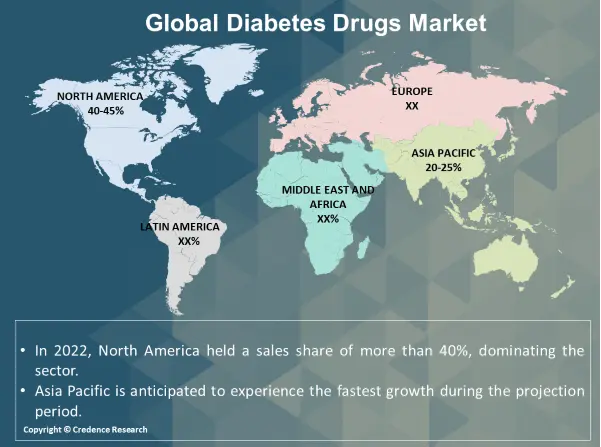
North America dominates the worldwide market due to the region's high incidence of diabetes due to sedentary lifestyle and the introduction of new medications. The United States is predicted to rise throughout the projection period, owing to factors such as the region's high prevalence of obesity and increased awareness of diabetes treatment. Because of increasing demand in the United States, North America remained the largest market for insulin medications. Diabetes affects around 37 million Americans, with 90 to 95% having Drug Class 2 diabetes. These variables are predicted to rise in the North American area throughout the forecast period.
During the projection period, the Asia-Pacific region is predicted to increase. Diabetes patients are increasing predominantly as a result of increased obesity rates induced by poor diets and sedentary lifestyles. The Asia-Pacific market is primarily driven by rising demand for diabetic medications in China and India. China now has more than 129 million diabetic sufferers, with India's diabetes population estimated to reach 82 million by 2032.
Key Highlights of the Report
The global Diabetes Drugs Market is segmented by Drug Class, Type of Diabetes, Distribution Channel, Product Type, and region. Insulin and Type-2 hold the most important sectors in 2022. Furthermore, retail pharmacies have the second largest market share in the diabetes market, and the emerging therapies area is one of the diabetes industry's fastest-growing segments, with North Amerca leading the market growth.
The rising incidence of diabetes globally, technological advancements in the treatment of diabetes, and the growing need for personalised and precision medicine are the main market drivers. The market is further constrained by factors including the high cost of managing and treating diabetes, a lack of knowledge and instruction on its prevention and control, and restricted access to healthcare facilities in some areas.
Nonetheless, North America dominated the category with a sales share of more than 40% in 2022. Because of the region's high incidence of diabetes owing to sedentary lifestyle and the release of new treatments, North America dominates the global market. Because of variables such as the region's high incidence of obesity and improved knowledge of diabetes treatment, the United States is expected to climb over the projected period. Furthermore, the Asia-Pacific area is expected to grow during the forecast period. Diabetes patients are on the rise, owing mostly to rising obesity rates caused by poor diets and sedentary lifestyles.
What Factors Are Fueling The Growth Of The Global Diabetes Drugs Market?
The primary drivers of the market include the rising prevalence of diabetes worldwide, technological developments in diabetes care, and rising desire for personalized and precision medicine.
What Are The Key Challenges Encountered By The Global Diabetes Drugs Market?
The market is confronted with constraints such as high diabetes treatment and management costs, a lack of knowledge and education about diabetes prevention and control, and limited access to healthcare facilities in certain locations.
What Opportunities For Growth Exist In The Global Diabetes Drugs Market?
The market potential is the growth of the diabetes market in developing countries, the application of AI and ML to the management of diabetes, and the creation of creative and affordable diabetes treatment options.
Market Drivers
The global Diabetes Drugs Market is driven by several factors. The following are the key drivers of the global Diabetes Drugs Market:
Excessive Sugar Diet Increases The Number Of Diabetes Individuals
Diabetes risk is increased by excessive sugar intake. The diabetes diagnostics market is also being driven by technological advancements in diabetes diagnosis, such as portable glucometers. A glucometer is a small, portable device primarily used by diabetics to check blood sugar levels. For instance, a global provider of diabetes treatment, Ascensia Diabetes treatment, received FDA approval in February 2022 for its implanted, cutting-edge Eversense E3 continuous glucose monitoring (CGM) device. The diagnosis and treatment of diabetes are aided by these recommendations and continuous glucose monitoring (CGM) equipment. Therefore, the availability of such cutting-edge glucose monitoring gadgets promotes market expansion.
Furthermore, increased R&D operations for creating innovative diabetic medicines and market product approvals contribute to the company's growing diabetes market share. For instance, the FDA authorized Semglee (insulin glargine-fun) in July 2021 as a biosimilar to the reference medicine Lantus (insulin glargine), a long-acting insulin analogue. Semglee is the first interchangeable biosimilar insulin product authorized to enhance glycemic control in Drug Class 1 and Drug Class 2 diabetes adults and children.
Diabetic Patient Rise
Diabetes is a dangerous, chronic disease with no known cure. According to the World Health Organization, there are more than 300 million diabetics in the world, and treating them costs around 12% of all healthcare spending globally. Millions have been affected, making it a worldwide epidemic. The market may have grown significantly as a result of factors like the increased incidence of diabetes and the rise in health awareness campaigns launched by various health organization. Diabetes in Drug Class-1 makes up 10% of all cases, with Drug Class-2 making up the remaining instances. Obesity in adults, which is brought on by poor diets and sedentary lifestyles, is the major cause of the increase in diabetes patients. The key driver of the Asia-Pacific market is the increased demand for diabetic drugs in China and India. Diabetes now affects about 129 million people in China, and 82 million Indians are expected to get the illness by 2027.
The insulin sector controls a sizable market share, depending on medicine. Insulin is required by around 100 million people globally, including all Drug Class 1 diabetics and 10% to 25% of Drug Class 2 diabetics. Because of the complexities of insulin manufacture, only a few companies on the market produce it. As a result, there is fierce competition among these manufacturers, who strive to meet the needs of patients by providing the highest-quality insulin.
Market Restraints
The global Diabetes Drugs Market faces some challenges that may hinder its growth. These include the following:
Strict Regulatory Environment
Two key obstacles that may impede market expansion are the stringent regulatory environment and the time-consuming approval process. In the United States, the Food and Drug Administration (FDA) needs labelling revisions for metformin-containing diabetes treatments in order to increase metformin's usage in some patients with impaired kidney function. Metformin is not indicated for some patients who have impaired renal function. The FDA examined numerous medical research on the safety of metformin usage in patients with mild to moderate renal function impairment and revised the measure of kidney function used to assess whether a patient can receive metformin in metformin medication labelling. However, cost difficulties, stringent regulatory constraints, and lengthy medication approval processes may limit industry expansion.
Opportunities
The global Diabetes Drugs Market offers significant growth opportunities. These include the following:
Technological progress in diabetic therapy
Technological improvements in diabetes devices, such as the launch of high-end insulin pumps and pens, boost demand for these items. To achieve a considerable market share, leading manufacturers rely on technological advances and the development of innovative products.
In February 2019, Abbott and Novo Nordisk signed a non-exclusive cooperation. This collaboration is intended to help accelerate the development of digital diabetes solutions. Under this collaboration, the data acquired by Novo Nordisk prefilled durable connected pens will be reflected in the digitally connected Free Style Libre system via the Free Style Libre Link mobile app and the Libre View cloud-based system. Because of this technological integration, healthcare providers can study glucose and insulin data at the same time, potentially simplifying diabetes management.
Competitive Landscape
Key Players
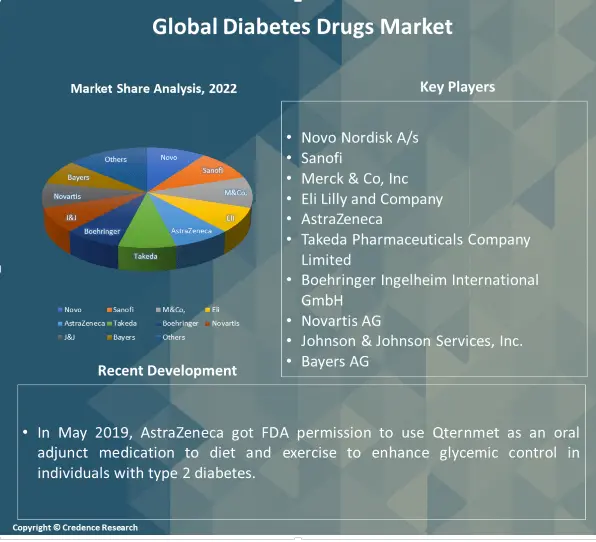
The global Diabetes Drugs Market is highly competitive, with several key players. Some of the major players in the market and their market share are as follows:
- Novo Nordisk A/s
- Sanofi
- Merck & Co, Inc
- Eli Lilly and Company
- AstraZeneca
- Takeda Pharmaceuticals Company Limited
- Boehringer Ingelheim International GmbH
- Novartis AG
- Johnson & Johnson Services, Inc.
- Bayers AG
These organizations prioritize Drug Class innovation, Disease Area expansion, and mergers and acquisitions to stay competitive.
The global Diabetes Drugs Market's key players continually seek to stay ahead by offering new Drug Class and developments.
In 2022, Novo Nordisk India has developed an oral formulation of an anti-diabetic medication that was previously only available as injections, saying that the new medication can help adults with Drug Class 2 diabetes better regulate their blood sugar levels and weight.
In 2022, Glenmark Pharmaceuticals Limited has produced a unique fixed-dose combination (FDC) of Teneligliptin, a DPP4 inhibitor, and Pioglitazone.
In April 2019, Glenmark debuted their patent-protected innovative anti-diabetic medication Remogliflozin in India. Remogliflozin is an SGT2 inhibitor that will be marketed under the brand names Remo and Remozen to treat Drug Class 2 diabetes in adults.
Summary of Key Findings
- Excessive sugar consumption raises the number of diabetics.
- Market segmented by Drug Class, Type of Diabetes, Distribution Channel, Product Type, and region.
- The emerging therapeutics category is one of the fastest-growing segments in the diabetes business
- Insulin will continue to have the highest sector share in 2022.
- North America is leading market growth; the market is highly competitive with key players including Novo Nordisk A/s, Sanofi, Merck & Co, Inc, Eli Lilly and Company, AstraZeneca, Takeda Pharmaceuticals Company Limited, Boehringer Ingelheim International GmbH
Future Outlook
- Diabetes prevalence is rising globally
- Technological advances in diabetes management are increasing demand for personalized and precision medicine
- Continuous glucose monitoring systems are becoming more popular
- Diabetes treatment options are expanding.
- Raising diabetes management awareness and education
- Integration of digital health technology in diabetes treatment
- Emerging markets with potential for development
- Research and development collaborations and partnerships
Segmentation
- By Drug Class:
- Insulin
- Oral Antidiabetic Drugs
- Injectable Antidiabetic Drugs
- Other Antidiabetic Drugs
- By Drug Class of Diabetes:
- Drug Class 1 Diabetes
- Drug Class 2 Diabetes
- Gestational Diabetes
- By Distribution Channel:
- Retail Pharmacies
- Hospitals and Clinics
- Online Pharmacies
- By Product Drug Class:
- Branded Drugs
- Generic Drugs
- Emerging Therapies
- By Region
- North America
- US
- Canada
- Mexico
- Europe
- Germany
- France
- UK.
- Italy
- Spain
- Rest of Europe
- Asia Pacific
- China
- Japan
- India
- South Korea
- South-east Asia
- Rest of Asia Pacific
- Latin America
- Brazil
- Argentina
- Rest of Latin America
- Middle East & Africa
- GCC Countries
- South Africa
- Rest of Middle East and Africa
- North America
Adjacent Markets
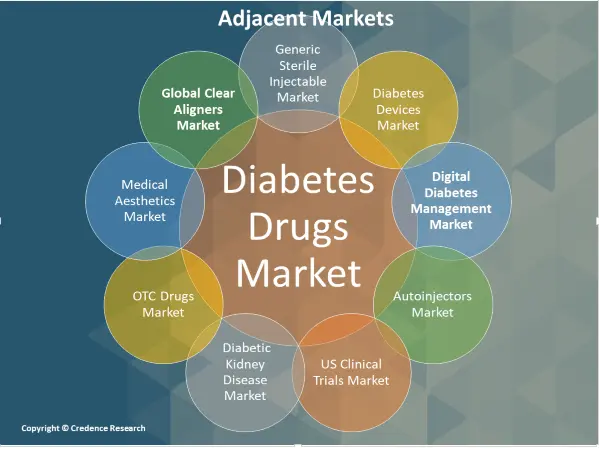
In the Diabetes Drugs Market, there are several adjacent markets which has high revenue growth opportunities. The key adjacent markets for Diabetes Drugs Market-
Request a Free Sample
Fill in your details and we'll send you a free sample report.
- Sample data tables & charts
- Research methodology
Need a Custom Version of This Report?
Tailor the scope, geography, or segments to your exact requirements.
- Custom geography or segment scope
- Direct access to our analyst team
Frequently Asked Questions
What is the current size of the worldwide Diabetes Drugs Market?
What is the predicted growth rate of the Diabetes Drugs Market between 2023 and 2030?
Which segment has the most market share in terms of types of diabetes?
Which distribution channel segment governs the market demand for Diabetes Drugs?
Which product type segment is the fastest growing segment over the forecast period?
Which region is driving the Diabetes Drugs industry forward?
Who are the major players in the global Diabetes Drugs Market?
What are the major market drivers of the Diabetes Drugs industry?
What are the major market restraints of the Diabetes Drugs industry?
What are the major market opportunities of the Diabetes Drugs industry?
Table of Content
Chapter 1. Report Introduction
- 1.1 Report Description & Purpose
- 1.1.1 Report Title & Market Definition
- 1.1.2 Unique Selling Propositions (USP) & Key Differentiators
- 1.1.3 Value Proposition for Stakeholders
- 1.2 Research Objectives
- 1.2.1 Market Sizing Objectives (Volume & Revenue)
- 1.2.2 Segmentation Objectives
- 1.2.3 Competitive Intelligence Objectives
- 1.2.4 Forecast & Scenario Objectives
- 1.3 Report Scope
- 1.3.1 Diabetes Drugs Scope – Types & Subtypes Covered
- 1.3.2 Geographic Scope – Regions & Countries Covered
- 1.3.3 Historical Period, Base Year & Forecast Period (the historical period; forecast to the forecast period)
- 1.3.4 Inclusions & Exclusions
- 1.4 HS Code & Classification Framework
- 1.5 Currency, Units & Pricing Basis
- 1.6 Target Stakeholders
- 1.7 Limitations & Assumptions
Chapter 2. Executive Summary
- 2.1 Global Diabetes Drugs Market Snapshot
- 2.1.1 Market Size – Historical (the historical period) & Forecast (the forecast period) (base year: USD 49,518.5 million → forecast year: USD 66,733.8 Million)
- 2.1.2 Volume & Revenue – Global Totals
- 2.1.3 Key Market Highlights – Top Five Facts
- 2.2 Diabetes Drugs Market Segmentation Snapshot
- 2.2.1 Market Split by Region – vs.
- 2.3 Competitive Snapshot
- 2.3.1 Top 10 Players by Revenue Share –
- 2.3.2 Top 10 Players by Volume Share –
- 2.3.3 Recent Strategic Developments (18-Month Summary)
- 2.4 Key Investment Highlights & Strategic Conclusions
Chapter 3. Diabetes Drugs Market Dynamics & Industry Analysis
- 3.1 Market Overview & Context
- 3.1.1 Diabetes Drugs Market Position in the Broader Automotive Value Chain
- 3.1.2 OEM vs. Replacement Market Dynamics
- 3.1.3 Market Maturity & Development Stage by Region
- 3.2 Diabetes Drugs Market Drivers
- 3.3 Diabetes Drugs Market Restraints & Challenges
- 3.4 Diabetes Drugs Market Opportunities
- 3.5 Porter's Five Forces Analysis
- 3.5.1 Threat of New Entrants
- 3.5.2 Bargaining Power of Suppliers
- 3.5.3 Bargaining Power of Buyers
- 3.5.4 Threat of Substitutes
- 3.5.5 Competitive Rivalry – Intensity Assessment
- 3.6 Diabetes Drugs Value Chain Analysis
- 3.6.1 Upstream – Raw Material/Input Suppliers
- 3.6.1.1 Raw Material/Input 1
- 3.6.1.2 Raw Material/Input 2
- 3.6.1.3 Raw Material/Input 3
- 3.6.2 Midstream – Production/Manufacturing/Service Delivery
- 3.6.2.1 Production/Process Overview
- 3.6.2.2 Key Facility Locations & Capacity by Manufacturer
- 3.6.3 Downstream – Distribution & End Consumer
- 3.6.3.1 Primary Channel – B2B/OEM
- 3.6.3.2 Secondary Channels – Dealer, Retail, Online, Direct
- 3.6.4 Value Chain Profitability Analysis
- 3.6.1 Upstream – Raw Material/Input Suppliers
- 3.7 PESTEL Analysis
- 3.7.1 Political Factors
- 3.7.2 Economic Factors
- 3.7.3 Social Factors
- 3.7.4 Technological Factors
- 3.7.5 Environmental Factors
- 3.7.6 Legal Factors
- 3.8 Diabetes Drugs Supply Chain Analysis
- 3.8.1 Raw Material/Input Supply Risk Assessment
- 3.8.2 Manufacturing Concentration Risk (Geographic Exposure)
- 3.8.3 Trade Disruption Impact Analysis
- 3.9 Regulatory & Policy Landscape
Note: The regulatory and policy landscape section covers regulations based on their applicability to the market, Diabetes Drugs category, geography, and scope of the study. Only regulatory frameworks with a material impact on operations, compliance, trade, sustainability, or market access are analyzed in detail.
Chapter 4. Key Investment Pockets & Opportunity Analysis
- 4.1 Diabetes Drugs Market Attractiveness Analysis
- 4.1.1 By Region – Investment Attractiveness Matrix (Volume × CAGR)
- 4.2 Absolute Revenue Growth Opportunity
- 4.2.1 By Region – Absolute USD Growth Through the forecast period
- 4.3 Incremental Volume Opportunity
- 4.3.1 By Region – Incremental Volume Through the forecast period
- 4.3.2 Segment – Incremental Volume
- 4.4 Emerging Submarket Opportunity Deep Dive (Subject to Applicability)
- 4.5 Emerging Market Opportunity Scorecards
- 4.5.1 United States
- 4.5.2 Europe
- 4.5.3 Asia
- 4.5.4 Middle East & Africa
Note: Emerging Market Opportunity Scorecards will be included based on relevance and strategic importance. Regions listed are indicative and may vary depending on data availability and market dynamics.
Chapter 5. Diabetes Drugs Import-Export Analysis & Trade Flows
- 5.1 Global Trade Overview
- 5.1.1 Global Export Value by Country (the historical period)
- 5.1.2 Global Export Volume by Country (the historical period)
- 5.1.3 Global Import Value by Country (the historical period)
- 5.1.4 Global Import Volume by Country (the historical period)
- 5.1.5 Net Trade Balance by Country (the historical period)
- 5.2 Export Analysis – Segment
- 5.2.1 Type 1 (HS Code)
- 5.2.2 Type 2 (HS Code)
- 5.2.3 Type 3 (HS Code)
- 5.2.4 Type 4 (HS Code)
- 5.2.5 Type 5 (HS Code)
- 5.3 Import Analysis – Segment
- 5.3.1 Type 1 (HS Code)
- 5.3.2 Type 2 (HS Code)
- 5.3.3 Type 3 (HS Code)
- 5.3.4 Type 4 (HS Code)
- 5.3.5 Type 5 (HS Code)
- 5.4 Average Unit Trade Prices
- 5.4.1 Average Export Price – Segment & Country
- 5.4.2 Average Import Price – Segment & Source Country
- 5.4.3 Price Trends (the historical period)
- 5.5 Key Trade Route Analysis
- 5.5.1 Trade Route 1
- 5.5.2 Trade Route 2
- 5.5.3 Trade Route 3
- 5.5.4 Trade Route 4
- 5.5.5 Trade Route 5
- 5.6 Trade Policy Impact Assessment
- 5.6.1 US Anti-Dumping & Section 301 Tariffs
- 5.6.2 EU Customs Union Impact
- 5.6.3 Major Free Trade Agreements
- 5.6.4 USMCA Rules of Origin
Note: Trade policy analysis will be included only where relevant to the Diabetes Drugs market.
Chapter 6. Competitive Landscape & Company Benchmarking
- 6.1 Diabetes Drugs Market Concentration & Structure
- 6.1.1 Herfindahl-Hirschman Index (HHI) – vs.
- 6.1.2 Tier 1, Tier 2 & Tier 3 Market Structure
- 6.1.3 Global, Regional & Local Player Dynamics
- 6.2 Diabetes Drugs Market Share Analysis –
- 6.2.1 Global Revenue Share by Company
- 6.2.2 Global Volume Share by Company
- 6.2.3 Regional Revenue Share
- 6.2.4 Market Share Evolution ( vs. )
- 6.2.5 OEM Segment Share by Company
- 6.2.6 Replacement Segment Share by Company
- 6.3 Production/Delivery Capacity & Facility Analysis
- 6.3.1 Global Installed Capacity
- 6.3.2 Capacity Utilization Rates
- 6.3.3 Production/Output Volume
- 6.3.4 Facility Locations & Capacity Map
- 6.3.5 Planned Capacity Additions
- 6.4 Diabetes Drugs Competitive Benchmarking Matrix
- 6.4.1 Revenue, Volume, CAGR & Profitability Comparison
- 6.4.2 Channel Revenue Mix
- 6.4.3 Geographic Revenue Exposure
- 6.4.4 R&D Intensity
- 6.4.5 Sustainability Maturity
- 6.5 Strategic Developments in Diabetes Drugs (Last 24 Months)
- 6.5.1 Mergers, Acquisitions & Divestments
- 6.5.2 New Diabetes Drugs Launches
- 6.5.3 Facility Expansions
- 6.5.4 Strategic Alliances, Joint Ventures & Partnerships
- 6.5.5 Distribution Expansion & Market Entry
- 6.5.6 Sustainability & ESG Initiatives
- 6.6 Competitive Strategy Mapping
- 6.6.1 Leader, Challenger, Follower & Niche Classification
- 6.6.2 Pricing Strategy Comparison
- 6.6.3 Channel Strategy Matrix
Note: Strategic developments are included based on their materiality and the availability of reliable information.
Chapter 7. Global Diabetes Drugs Market – By Distribution Channel
- 7.1 Segment Overview
- 7.1.1 Volume & Revenue Split by Channel ( & )
- 7.1.2 Channel Mix Evolution (the forecast period)
Chapter 8. Regional Market Analysis – Global Overview
- 8.1 Global Regional Overview
- 8.1.1 Regional Volume Share
- 8.1.2 Regional Revenue Share
- 8.1.3 Regional Volume by Region
- 8.1.4 Regional Revenue by Region
- 8.1.5 Regional Forecast Through the forecast period
- 8.2 Cross-Regional Segment Analysis
- 8.2.1 By Distribution Channel
- 8.2.2 By Brand/Price Tier
Chapter 9. North America Diabetes Drugs Market
- 9.1 United States
- 9.2 Canada
- 9.3 Mexico
Chapter 10. Europe Diabetes Drugs Market
- 10.1 Germany
- 10.2 France
- 10.3 Italy
- 10.4 United Kingdom
- 10.5 Spain
- 10.6 Poland
- 10.7 Russia
- 10.8 Netherlands
- 10.9 Belgium
- 10.10 Sweden
- 10.11 Denmark
- 10.12 Norway
- 10.13 Rest of Europe
Chapter 11. Asia Pacific Diabetes Drugs Market
- 11.1 China
- 11.2 India
- 11.3 Japan
- 11.4 South Korea
- 11.5 Thailand
- 11.6 Indonesia
- 11.7 Vietnam
- 11.8 Malaysia
- 11.9 Australia
- 11.10 Rest of Asia Pacific
Chapter 12. Latin America Diabetes Drugs Market
- 12.1 Brazil
- 12.2 Argentina
- 12.3 Colombia
- 12.4 Chile
- 12.5 Rest of Latin America
Chapter 13. Middle East Diabetes Drugs Market
- 13.1 Saudi Arabia
- 13.2 United Arab Emirates
- 13.3 Turkey
- 13.4 Israel
- 13.5 Iran
- 13.6 Rest of the Middle East
Chapter 14. Africa Diabetes Drugs Market
- 14.1 South Africa
- 14.2 Egypt
- 14.3 Nigeria
- 14.4 Morocco
- 14.5 Rest of Africa
Chapter 15. Diabetes Drugs Company Profiles
- 15.1 [Company 01]
- 15.1.1 Company Overview
- 15.1.2 Key Management Personnel
- 15.1.3 Products & Services Portfolio
- 15.1.4 Financial Performance
- 15.1.5 Key Market Focus & Geographic Presence
- 15.1.6 Recent Developments & Strategic Initiatives
Note: The company profile list is preliminary and may change based on research findings, market developments, data availability, and client requirements.
Chapter 16. Appendices
- Appendix A – List of Abbreviations & Acronyms
- Appendix B – Industry Classification Code Reference – Full Series
- Appendix C – Production & Capacity Data Tables
- Appendix D – End-Use & Demand Base Tables
- Appendix E – Consumption & Replacement Rate Assumptions
- Appendix F – ASP Reference Tables
- Appendix G – Manufacturing & Facility Database
- Appendix H – Import-Export Data Tables
- Appendix I – Regulatory Summary Tables
- Appendix J – Primary Research Participant List (Anonymized)
- Appendix K – Primary Research Questionnaire Framework
- Appendix L – Data Sources & Bibliography
- Appendix M – Market Size Divergence & Source Comparison
Chapter 17. Research Methodology
- 17.1 Research Framework & Philosophy
- 17.2 Secondary Research – Sources, Hierarchy & Data Extraction
- 17.3 Data Modeling – Bottom-Up & Top-Down Market Sizing
- 17.4 Primary Research – Stakeholder Framework, LOI & Sample Sizes
- 17.5 Forecast Methodology – Regression, Scenario & Sensitivity Analysis
- 17.6 Quality Control – Four-Layer Validation Framework
- 17.7 Limitations & Standard Assumptions
- 17.8 Disclaimer
