Dog Vaccines Market Overview:
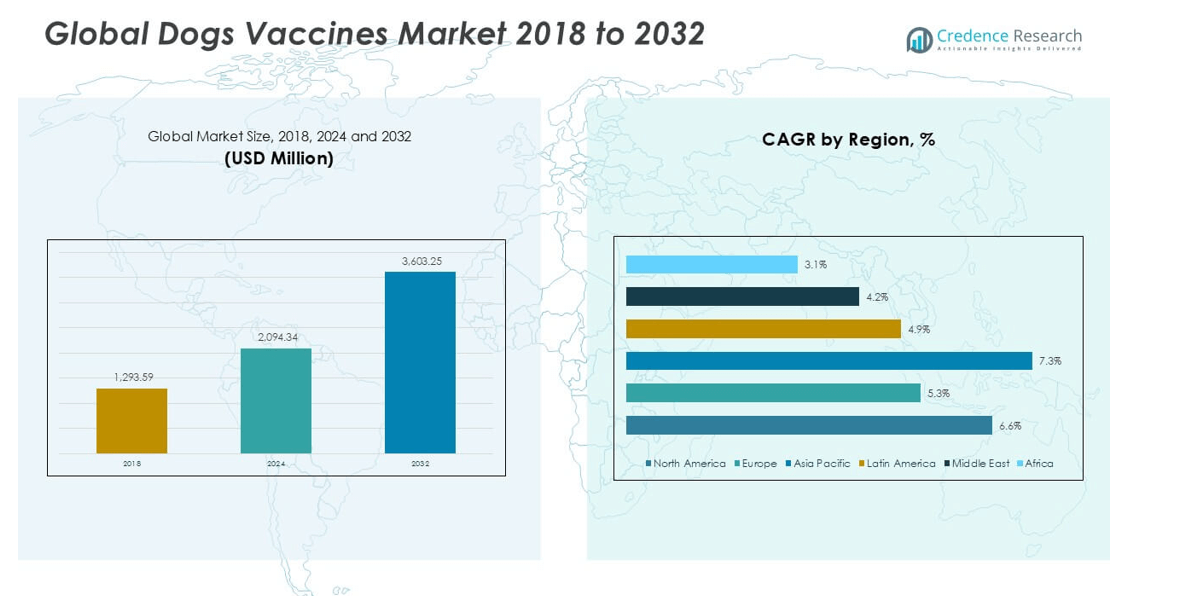
The Global Dogs Vaccines Market size was valued at USD 1,293.59 million in 2018, increased to USD 2,094.34 million in 2024, and is anticipated to reach USD 3,603.25 million by 2032, at a CAGR of 6.53% during the forecast period.
| REPORT ATTRIBUTE | DETAILS |
|---|---|
| Historical Period | 2020-2023 |
| Base Year | 2024 |
| Forecast Period | 2025-2032 |
| Dog Vaccines Market Size 2024 | USD 2,094.34 million |
| Dog Vaccines Market, CAGR | 6.53% |
| Dog Vaccines Market Size 2032 | USD 3,603.25 million |
The global dogs vaccines market is shaped by leading companies including Zoetis Inc., Merck & Co., Inc. (Merck Animal Health), Boehringer Ingelheim GmbH, Elanco Animal Health, Ceva Santé Animale, and Virbac S.A. These players maintain strong positions through extensive portfolios covering core and non-core canine diseases, alongside global distribution networks and strategic R&D investments. Regionally, Asia Pacific emerged as the largest market in 2024 with 34% share, supported by rapid pet adoption and government-backed vaccination programs. North America followed with 27% share, driven by high healthcare spending and regulatory mandates, while Europe accounted for 19%, reflecting strong veterinary infrastructure and vaccination compliance across member states.
Dog Vaccines Market Insights
- The global dogs vaccines market was valued at USD 2,094.34 million in 2024 and is projected to reach USD 3,603.25 million by 2032, expanding at a CAGR of 6.53%.
- Rising pet ownership, increasing humanization of dogs, and strict regulatory mandates for rabies vaccination are major drivers fueling consistent vaccine demand worldwide.
- Market trends highlight the adoption of advanced formulations such as recombinant and combination vaccines, along with growing interest in oral and intranasal delivery methods for ease of administration.
- The competitive landscape is dominated by global players including Zoetis, Merck Animal Health, Boehringer Ingelheim, Elanco, Ceva Santé Animale, and Virbac, which expand their reach through innovation, partnerships, and strong distribution networks.
- Regionally, Asia Pacific led with 34% share in 2024, followed by North America at 27% and Europe at 19%, while live attenuated vaccines and canine parvovirus vaccines held the largest shares within product and disease segments.
Dogs Vaccines Market Segmentation Analysis:
By Vaccine Type
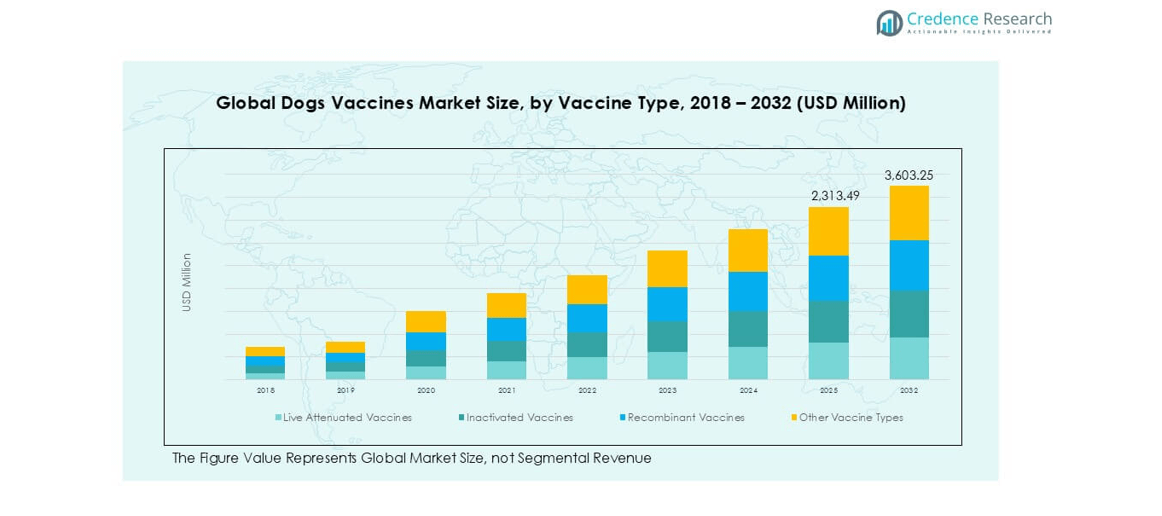
The dogs vaccines market by vaccine type is dominated by live attenuated vaccines, accounting for the largest share in 2024 due to their strong efficacy and ability to induce long-lasting immunity. These vaccines are widely used against core diseases such as distemper and parvovirus, which require reliable protection. Inactivated vaccines follow, offering safer options for immunocompromised dogs, while recombinant vaccines are gaining attention for their advanced safety profiles. Other vaccine types, though smaller in share, address niche diseases. Rising pet ownership and awareness of preventive healthcare drive growth across all categories.
- For instance, Zoetis distributed more than 12 million doses of Vanguard® live attenuated canine vaccines globally in 2023, covering core diseases including distemper and parvovirus.
By Disease Type
In terms of disease type, canine parvovirus vaccines held the dominant market share in 2024, supported by the high prevalence and severe mortality risk of the disease among unvaccinated puppies. Canine distemper vaccines follow closely, driven by global vaccination campaigns. Canine infectious respiratory disease complex (CIRDC) vaccines are gaining traction due to urbanization and rising kennel populations. Rabies vaccines remain a critical category due to mandatory regulations in many countries. Vaccines for leptospirosis and other diseases contribute to growth as veterinarians expand multi-disease protection programs for dogs.
- For instance, Boehringer Ingelheim plays a significant role in global animal health, and in 2023, the company distributed 43.2 million rabies vaccine doses through its "STOP Rabies" initiative. This initiative supported immunization programs in countries where rabies is endemic.
By Route of Administration
The market by route of administration is led by injectable vaccines, which captured the largest share in 2024, reflecting their established safety, dosage accuracy, and wide acceptance by veterinarians. Oral vaccines are expanding at a faster pace, driven by ease of administration and stress reduction in pets. These are particularly appealing for mass vaccination campaigns and for dogs that resist injections. Other routes, such as intranasal delivery, hold a smaller but growing niche, especially for respiratory diseases. The preference for injectable formats persists due to proven clinical outcomes and veterinarian reliance on standardized methods.
Dog Vaccines Market Overview
Rising Pet Ownership and Humanization of Dogs
The global dogs vaccines market is driven strongly by increasing pet ownership, particularly in urban areas where companion animals are considered part of the family. The growing humanization of dogs has led to rising healthcare spending, with owners prioritizing preventive treatments such as vaccinations to ensure longer, healthier lives. According to pet industry reports, annual veterinary care expenditure has increased significantly, creating consistent demand for both core and non-core vaccines. Additionally, pet adoption initiatives and awareness campaigns by animal welfare organizations highlight the risks of infectious diseases, pushing vaccination rates higher. The rapid expansion of dog adoption across emerging economies further strengthens this trend.
- For instance, in May 2023, Elanco secured a conditional license from the U.S. Department of Agriculture for a Canine Parvovirus Monoclonal Antibody to treat the disease in the U.S.
Regulatory Mandates and Disease Control Programs
Government regulations and international initiatives mandating vaccination for rabies and other canine diseases remain a key driver. Many countries enforce compulsory rabies vaccination, especially in regions where stray populations are high and zoonotic transmission poses risks to humans. These mandates not only create steady vaccine demand but also encourage manufacturers to expand their supply networks. International agencies, including the World Health Organization (WHO), support mass rabies elimination programs by targeting canine populations, directly boosting vaccine consumption. Furthermore, regional disease control campaigns against parvovirus, distemper, and leptospirosis promote higher coverage and improve vaccination infrastructure. The synergy between regulatory compliance and global health objectives ensures continuous growth for the market.
- For instance, Merck Animal Health supplied over 10 million doses of Nobivac® rabies vaccines in 2023 to support government-led canine rabies elimination programs across Asia and Africa.
Advancements in Veterinary Vaccine Technologies
Ongoing advancements in biotechnology are shaping the dogs vaccines market by introducing safer, more effective, and targeted solutions. Recombinant vaccines and DNA-based vaccines offer improved efficacy with fewer side effects, attracting veterinarians and pet owners seeking modern alternatives. These innovations reduce risks associated with live attenuated strains and increase adoption rates for advanced formulations. Additionally, combination vaccines that protect against multiple diseases in a single dose are gaining popularity for their convenience and reduced clinical visits. Veterinary research institutes and pharmaceutical companies are investing heavily in R&D, resulting in a pipeline of next-generation products. This technological progress enhances disease management and aligns with rising demand for preventive healthcare.
Key Trends & Opportunities
Growth of Preventive Healthcare and Wellness Services
Preventive healthcare is becoming a central theme in the pet care industry, offering significant opportunities for the dogs vaccines market. Pet owners increasingly prefer proactive measures such as vaccination, parasite prevention, and wellness checkups to avoid costly treatments for advanced diseases. Veterinary clinics are bundling vaccination services with wellness packages, ensuring regular uptake. The trend is reinforced by insurance companies expanding coverage for preventive services, lowering out-of-pocket costs for owners. This focus on wellness strengthens market penetration for vaccines and encourages repeat visits, positioning preventive care as a consistent revenue stream for veterinary providers and pharmaceutical companies alike.
- For instance, in the U.S., Banfield Pet Hospital provides preventive care to more than 3 million pets annually, primarily through its bundled Optimum Wellness Plans covering routine services like core canine vaccinations such as parvovirus, distemper, and rabies.
Expansion in Emerging Economies
Emerging markets in Asia Pacific, Latin America, and parts of Africa present significant opportunities due to growing awareness of canine health and rising disposable incomes. Pet adoption rates are climbing rapidly in urban centers, while governments are increasing investments in veterinary infrastructure. For example, regional initiatives to control rabies and zoonotic diseases are creating demand for large-scale vaccination programs. Local players and multinational companies are expanding their reach by setting up regional distribution networks and offering cost-effective vaccines tailored to local disease burdens. This trend positions emerging economies as high-growth regions with untapped market potential.
Rising Demand for Oral and Intranasal Vaccines
The preference for less invasive vaccine delivery methods is increasing, providing growth opportunities for oral and intranasal formulations. These options reduce stress for pets, improve compliance among owners, and simplify mass immunization efforts in shelters or large canine populations. Oral rabies vaccines, in particular, are gaining traction in wildlife and stray dog management programs, complementing traditional injectable solutions. Veterinary innovation in alternative routes of administration not only improves efficiency but also enhances accessibility for areas with limited veterinary resources. This trend will continue to expand as companies invest in developing user-friendly formulations for both developed and developing markets.
Key Challenges
High Cost of Advanced Vaccines and Veterinary Care
Despite the market’s growth, the high cost of advanced vaccines and veterinary services poses a barrier, particularly in low-income regions. Recombinant and multi-disease vaccines, while effective, are often priced higher than traditional formulations, limiting access for cost-sensitive pet owners. In many emerging economies, veterinary care infrastructure is underdeveloped, and out-of-pocket expenses discourage routine vaccination. This price barrier can restrict adoption and slow vaccination coverage, especially where awareness campaigns alone cannot offset financial constraints. Manufacturers face pressure to balance innovation with affordability to expand reach across diverse income groups.
Vaccine Hesitancy and Limited Awareness in Developing Regions
Vaccine hesitancy among dog owners, fueled by misinformation about side effects and low awareness of disease risks, remains a major challenge. In rural and developing areas, many pet owners are unaware of vaccination schedules or fail to prioritize preventive care. Additionally, cultural perceptions and lack of veterinary accessibility contribute to low immunization rates. This hesitancy undermines disease control programs, leaving canine populations vulnerable to outbreaks. Addressing this challenge requires targeted education campaigns, community-based veterinary outreach, and stronger collaboration between governments, NGOs, and vaccine manufacturers to build trust and increase compliance rates.
Regional Analysis
North America
North America held a 27% share of the global dogs vaccines market in 2024, with revenue at USD 571.36 million, rising from USD 358.77 million in 2018. The region is projected to reach USD 987.33 million by 2032, expanding at a CAGR of 6.6%. Growth is driven by advanced veterinary infrastructure, high pet ownership, and strong awareness of preventive healthcare. The U.S. dominates regional demand due to mandatory rabies vaccination laws and rising expenditure on companion animal health. Continuous innovation by veterinary pharmaceutical companies further strengthens market penetration, keeping North America a leading region globally.
Europe
Europe accounted for a 19% market share in 2024, with a market size of USD 381.42 million, up from USD 248.82 million in 2018. The region is expected to reach USD 598.56 million by 2032, registering a CAGR of 5.3%. Market growth is supported by strict regulatory frameworks, widespread awareness of zoonotic risks, and comprehensive veterinary healthcare services. Countries such as Germany, France, and the U.K. contribute significantly, owing to higher pet adoption rates. The EU’s animal welfare regulations and vaccination mandates enhance compliance, ensuring strong vaccine uptake across both core and non-core disease segments.
Asia Pacific
Asia Pacific dominated the market with a 34% share in 2024, valued at USD 957.88 million, up from USD 570.77 million in 2018. The market is forecasted to reach USD 1,747.59 million by 2032, growing at the highest CAGR of 7.3% among regions. Rising disposable incomes, growing urban pet adoption, and increasing focus on preventive care are driving rapid expansion. China, India, and Japan are key contributors due to large canine populations and government-backed rabies control programs. Expanding veterinary networks and entry of global vaccine manufacturers further accelerate growth, making Asia Pacific the most dynamic regional market.
Latin America
Latin America captured a 4% share of the market in 2024, with revenue reaching USD 99.79 million, rising from USD 62.40 million in 2018. By 2032, the market is projected to grow to USD 152.37 million, at a CAGR of 4.9%. Brazil and Mexico dominate the region due to their sizeable pet populations and growing veterinary services industry. Increasing awareness of canine diseases and vaccination campaigns by local governments are improving adoption rates. However, economic disparities and limited veterinary infrastructure in rural areas moderate overall market growth, keeping Latin America smaller compared to developed regions.
Middle East
The Middle East represented a 3% share in 2024, generating USD 52.00 million, up from USD 35.23 million in 2018. The market is projected to reach USD 75.05 million by 2032, advancing at a CAGR of 4.2%. Rising pet adoption in urban centers such as the UAE and Saudi Arabia supports demand, while regulatory initiatives for rabies control enhance market penetration. Despite a smaller base, the region shows steady adoption as disposable incomes rise and pet care services expand. However, lower awareness in rural communities continues to challenge widespread vaccination uptake across the Middle East.
Africa
Africa accounted for a 2% market share in 2024, with revenue at USD 31.90 million, increasing from USD 17.61 million in 2018. The market is forecasted to reach USD 42.35 million by 2032, at a CAGR of 3.1%, the slowest among regions. Growth is mainly supported by international initiatives focused on rabies eradication, given the continent’s high incidence of zoonotic transmission. South Africa leads the region, benefiting from better veterinary infrastructure compared to other countries. However, limited access to veterinary care, low awareness, and economic barriers restrict large-scale vaccine adoption, keeping Africa a relatively small market contributor.
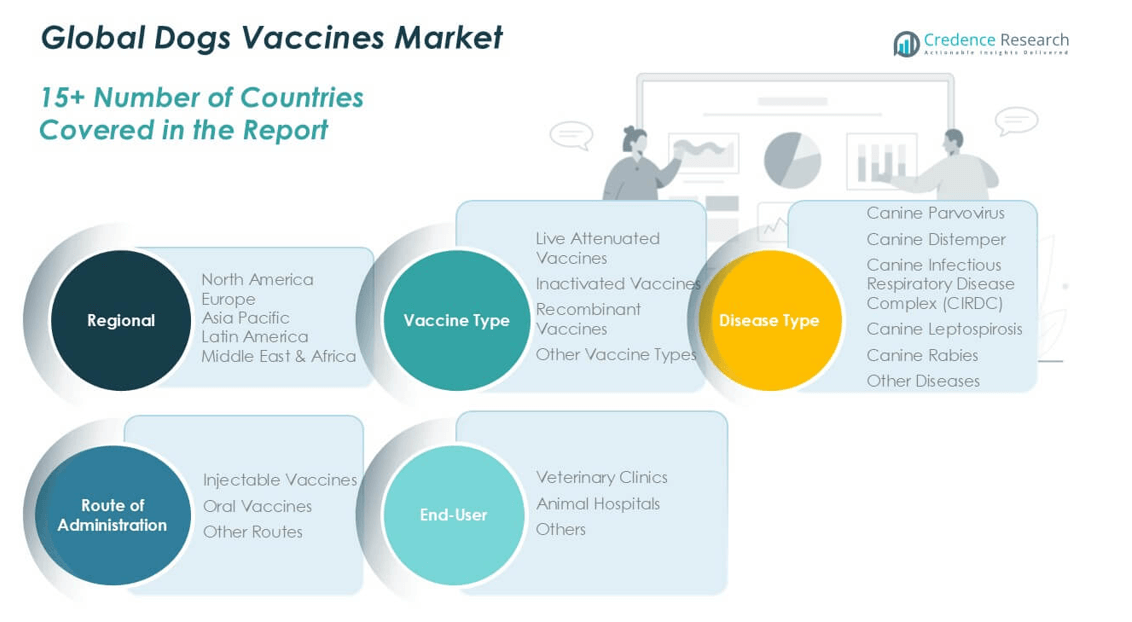
Dog Vaccines Market Segmentations:
By Vaccine Type
- Live Attenuated Vaccines
- Inactivated Vaccines
- Recombinant Vaccines
- Other Vaccine Types
By Disease Type
- Canine Parvovirus
- Canine Distemper
- Canine Infectious Respiratory Disease Complex (CIRDC)
- Canine Leptospirosis
- Canine Rabies
- Other Diseases
By Route of Administration
- Injectable Vaccines
- Oral Vaccines
- Other Routes
By Application
- Veterinary Clinics
- Animal Hospitals
- Others
By Geography
- North America
- U.S.
- Canada
- Mexico
- Europe
- UK
- France
- Germany
- Italy
- Spain
- Russia
- Belgium
- Netherlands
- Austria
- Sweden
- Poland
- Denmark
- Switzerland
- Rest of Europe
- Asia Pacific
- China
- Japan
- South Korea
- India
- Australia
- Thailand
- Indonesia
- Vietnam
- Malaysia
- Philippines
- Taiwan
- Rest of Asia Pacific
- Latin America
- Brazil
- Argentina
- Peru
- Chile
- Colombia
- Rest of Latin America
- Middle East
- UAE
- KSA
- Israel
- Turkey
- Iran
- Rest of Middle East
- Africa
- Egypt
- Nigeria
- Algeria
- Morocco
- Rest of Africa
Competitive Landscape
The global dogs vaccines market is highly competitive, led by established players such as Zoetis Inc., Merck & Co., Inc. (Merck Animal Health), Boehringer Ingelheim GmbH, Elanco Animal Health, Ceva Santé Animale, Virbac S.A., Hipra Human Health, S.A., Vetoquinol S.A., Phibro Animal Health Corporation, and Indian Immunologicals Limited. These companies dominate through extensive product portfolios, global distribution networks, and consistent investment in R&D to introduce advanced vaccines, including recombinant and combination formulations. Strategic initiatives such as mergers, partnerships, and regional expansions strengthen their market presence, particularly in high-growth regions like Asia Pacific. Companies also focus on expanding manufacturing capacities to meet rising demand from veterinary clinics and hospitals. Furthermore, recent developments in oral and intranasal vaccines demonstrate growing innovation aimed at improving compliance and ease of administration. Competitive intensity remains high, with firms balancing innovation, affordability, and regulatory compliance to capture larger market shares while addressing disease control needs worldwide.
Key Player Analysis
- Zoetis Inc.
- Merck & Co., Inc. (Merck Animal Health)
- Boehringer Ingelheim GmbH
- Elanco Animal Health
- Ceva Santé Animale
- Virbac S.A.
- Hipra Human Health, S.A.
- Vetoquinol S.A.
- Phibro Animal Health Corporation
- Indian Immunologicals Limited
Recent Developments
- In March 2024, Zendal group introduced CSIC-developed vaccine against canine leishmaniasis, a recombinant vaccine to combat canine leishmaniasis, a parasite that causes skin ulcers to severe inflammation of the liver and spleen.
- In June 2024, Merck & Co., Inc., introduced the NOBIVAC NXT Rabies portfolio in Canada, which includes NOBIVAC NXT Canine-3 Rabies and NOBIVAC NXT Feline-3 Rabies, as part of the company's continued commitment to rabies prevention.
- In January 2022, Boehringer Ingelheim collaborated with MabGenesis, a biopharmaceutical company, to discover novel monoclonal antibodies in canines.
- In November 2021, Ceva created a new cryogenic storage facility in Monor by investing in its European vaccine production capacity to meet the rapidly growing demand for vaccines.
Report Coverage
The research report offers an in-depth analysis based on Vaccine Type, Disease Type, Route of Administration, Application and Geography. It details leading market players, providing an overview of their business, product offerings, investments, revenue streams, and key applications. Additionally, the report includes insights into the competitive environment, SWOT analysis, current market trends, as well as the primary drivers and constraints. Furthermore, it discusses various factors that have driven market expansion in recent years. The report also explores market dynamics, regulatory scenarios, and technological advancements that are shaping the industry. It assesses the impact of external factors and global economic changes on market growth. Lastly, it provides strategic recommendations for new entrants and established companies to navigate the complexities of the market.
Future Outlook
- The market will expand steadily with rising global pet adoption and ownership rates.
- Preventive healthcare will remain a top priority, increasing routine vaccination uptake in dogs.
- Recombinant and DNA-based vaccines will gain higher adoption due to safety and efficacy.
- Oral and intranasal vaccines will grow as alternatives to injectable formats.
- Veterinary clinics and hospitals will strengthen their role as primary distribution channels.
- Regulatory mandates for rabies vaccination will sustain consistent global demand.
- Asia Pacific will continue to lead growth, supported by urbanization and awareness programs.
- North America and Europe will maintain strong shares due to advanced veterinary infrastructure.
- Manufacturers will focus on combination vaccines that offer protection against multiple diseases.
- Strategic collaborations and R&D investments will drive innovation and expand market competitiveness.

Request a Free Sample
Fill in your details and we'll send you a free sample report.
- Sample data tables & charts
- Research methodology
Market Dynamics
Rising Pet Ownership and Humanization of Dogs
Increasing rates of pet adoption, especially in urban areas, and the growing trend of treating dogs as family members are driving higher spending on preventive healthcare, including vaccinations.
Regulatory Mandates and Disease Control Programs
Government regulations requiring rabies and other core vaccinations, along with international disease eradication initiatives, ensure steady demand and widespread vaccine coverage.
Advancements in Veterinary Vaccine Technologies
Innovations such as recombinant and DNA-based vaccines, as well as combination formulations, are improving safety and efficacy, encouraging adoption among veterinarians and pet owners.
Expansion in Emerging Economies
Rapid urbanization, rising disposable incomes, and government-backed vaccination campaigns in Asia Pacific, Latin America, and Africa are significantly expanding the market’s reach and growth potential.
Growth of Preventive Healthcare and Wellness Services
Veterinary clinics and hospitals are increasingly bundling vaccinations with wellness packages, supported by insurance coverage for preventive care, which boosts routine vaccine uptake and market penetration.
Need a Custom Version of This Report?
Tailor the scope, geography, or segments to your exact requirements.
- Custom geography or segment scope
- Direct access to our analyst team
Frequently Asked Questions
What is the current market size for Global Dogs Vaccines market, and what is its projected size in 2032?
At what Compound Annual Growth Rate is the Global Dogs Vaccines market projected to grow between 2025 and 2032?
Which Global Dogs Vaccines market segment held the largest share in 2024?
What are the primary factors fueling the growth of the Global Dogs Vaccines market?
Who are the leading companies in the Global Dogs Vaccines market?
Table of Content
Chapter 1 Market Segmentation
- 1.1 Segmentation Framework
- 1.1.1 Product and Service Classification
- 1.1.2 Application and End-Use Classification
- 1.1.3 Technology and Solution Classification
- 1.1.4 Customer and Distribution Channel Classification
- 1.1.5 Geographic Segmentation
- 1.1.6 Market Segment Definitions and Boundaries
- 1.2 By Application
- 1.2.1 Veterinary Clinics
- 1.2.2 Animal Hospitals
- 1.2.3 Others
- 1.3 By Disease Type
- 1.3.1 Canine Parvovirus
- 1.3.2 Canine Distemper
- 1.3.3 Canine Infectious Respiratory Disease Complex (CIRDC)
- 1.3.4 Canine Leptospirosis
- 1.3.5 Canine Rabies
- 1.3.6 Other Diseases
- 1.4 By Vaccine Type
- 1.4.1 Live Attenuated Vaccines
- 1.4.2 Inactivated Vaccines
- 1.4.3 Recombinant Vaccines
- 1.4.4 Other Vaccine Types
- 1.5 By Route of Administration
- 1.5.1 Injectable Vaccines
- 1.5.2 Oral Vaccines
- 1.5.3 Other Routes
Chapter 2 Introduction
- 2.1 Report Objectives and Scope
- 2.2 Product Definition and Industry Terminology
- 2.3 Market Inclusions and Exclusions
- 2.4 Research Process
- 2.4.1 Primary Research and Expert Interviews
- 2.4.2 Secondary Research and Source Review
- 2.4.3 Top-Down and Bottom-Up Estimation
- 2.4.4 Data Triangulation and Verification
- 2.5 Market Size Measurement Basis
- 2.5.1 2024: USD 2,094.34 million → 2032: USD 3,603.25 million
- 2.6 Historical and Forecast Reference Periods
- 2.6.1 Base Year: 2024
- 2.6.2 Forecast Period: 2024-2032
- 2.7 Research Assumptions and Limitations
Chapter 3 Executive Summary
- 3.1 Market Snapshot and Key Findings
- 3.2 Base-Year Market Size, 2024
- 3.3 Forecast Market Size, 2032
- 3.4 Revenue and Volume Growth Outlook
- 3.5 Key Demand and Supply Indicators
- 3.6 Leading Market Segments
- 3.7 Fastest-Growing Market Opportunities
- 3.8 Regional Performance Highlights
- 3.9 Technology and Industry Transformation
- 3.10 Competitive Landscape Summary
- 3.11 Analyst View and Strategic Implications
Chapter 4 Global Dog Vaccines Market Trends and Developments
- 4.1 Historical Industry Development
- 4.2 Recent Market Trends and Developments
- 4.3 Demand and Customer Behavior Trends
- 4.4 Technology and Product Innovation
- 4.5 Artificial Intelligence, Automation and Digitalization
- 4.6 Local Manufacturing and Supply Chain Realignment
- 4.7 Industry Partnerships, Mergers and Acquisitions
- 4.8 Sustainability and Circular Economy Developments
- 4.9 Government and Private Sector Investment Trends
- 4.10 Emerging Business Models and Commercialization
- 4.11 Industry Developments and Announcements
Chapter 5 Global Dog Vaccines Market Production, Supply and Demand Analysis
- 5.1 Demand Trend and Consumption Analysis
- 5.2 Demand Forecast, 2024-2032
- 5.3 Production and Output Trend
- 5.4 Production and Output Forecast, 2024-2032
- 5.5 Installed Capacity and Capacity Utilization
- 5.6 Company-Wise Production Plants and Statistics
- 5.6.1 Installed Production Capacity
- 5.6.2 Actual Production
- 5.6.3 Planned Capacity and Expansion Targets
- 5.7 Supply Chain Structure and Procurement Trends
- 5.8 Supply-Demand Gap and Bottlenecks
- 5.9 Import Dependence and Sourcing Structure
- 5.10 Contract Manufacturing and Outsourcing
- 5.11 Regional Supply and Demand Concentration
Chapter 6 Global Dog Vaccines Market Pricing Analysis
- 6.1 Pricing Structure and Measurement
- 6.2 Historical Pricing Trends
- 6.3 Pricing Outlook, 2024-2032
- 6.4 Average Selling Price and Unit Economics
- 6.5 Pricing by Product and Market Segment
- 6.6 Geographic Pricing Differences
- 6.7 Key Input, Energy, Labor and Logistics Costs
- 6.8 Contract Pricing and Purchasing Models
- 6.9 Pricing Sensitivity and Competitive Positioning
- 6.10 Price, Margin and Profitability Implications
Chapter 7 Global Dog Vaccines Market Dynamics
- 7.1 Market Growth Drivers
- 7.1.1 Demand-Side Drivers
- 7.1.2 Technology and Innovation Drivers
- 7.1.3 Infrastructure and Investment Drivers
- 7.1.4 Regulatory and Policy Drivers
- 7.2 Market Restraints
- 7.2.1 Cost and Affordability Constraints
- 7.2.2 Technology and Adoption Barriers
- 7.2.3 Supply Chain and Operational Constraints
- 7.3 Market Challenges
- 7.3.1 Competitive Pressure and Margin Erosion
- 7.3.2 Skills, Infrastructure and Implementation Gaps
- 7.4 Emerging Market Opportunities
- 7.5 Market Dynamics Impact and Time-Horizon Assessment
Chapter 8 Global Dog Vaccines Value Chain Analysis
- 8.1 Industry Value Chain Overview
- 8.2 Upstream Suppliers and Critical Inputs
- 8.3 Technology and Component Providers
- 8.4 Manufacturing or Service Delivery
- 8.5 Distribution, Channel Partners and Integrators
- 8.6 Downstream Applications and End Users
- 8.7 Value Addition and Profit Pools
- 8.8 Vertical Integration and Outsourcing
- 8.9 Supplier Concentration and Risk
- 8.10 Supply Chain Localization and Resilience
Chapter 9 Global Dog Vaccines Market Regulations and Policies
- 9.1 Relevant Laws, Standards and Compliance Frameworks
- 9.2 Product, Service, Safety and Quality Requirements
- 9.3 Government Policies, Incentives and Subsidies
- 9.4 Imports, Exports and Trade Barriers
- 9.5 Public Procurement and Local Content Requirements
- 9.6 Environmental and Sustainability Compliance
- 9.7 Upcoming Policy Changes and Market Implications
Chapter 10 Global Dog Vaccines Market Hotspots and Opportunities
- 10.1 Market Opportunity Mapping and Growth Hotspots
- 10.2 High-Growth Applications and Customer Groups
- 10.3 Underserved Markets and White-Space Opportunities
- 10.4 Emerging Technology and Product Opportunities
- 10.5 New Capacity and Investment Hotspots
- 10.6 Market Entry and Expansion Opportunities
- 10.7 Distribution and Partnership Opportunities
- 10.8 Near-Term and Long-Term Commercial Potential
- 10.9 Opportunity Attractiveness and Execution Risks
Chapter 11 Global Dog Vaccines Market Outlook, 2024-2032
- 11.1 Market Size and Analysis
- 11.1.1 Revenue (Market Measurement: 2024: USD 2,094.34 million → 2032: USD 3,603.25 million)
- 11.1.2 Market Volume and Quantity Sold
- 11.1.3 Historical Market Size
- 11.1.4 Base-Year Market Size, 2024
- 11.2 Market Forecast, 2024-2032
- 11.2.1 Revenue Forecast to 2032
- 11.2.2 Volume Forecast to 2032
- 11.2.3 CAGR and Year-on-Year Growth
- 11.2.4 Incremental Revenue Opportunity
- 11.3 Forecast Assumptions and Scenario Analysis
- 11.3.1 Base-Case Forecast
- 11.3.2 Optimistic and Conservative Scenarios
- 11.3.3 Technology, Pricing and Policy Sensitivities
- 11.4 Market Attractiveness and Growth Outlook
Chapter 12 Global Dog Vaccines Market Segmentation and Outlook
- 12.1 Segmentation Summary and Market Shares, 2024
- 12.2 Largest and Fastest-Growing Segments
- 12.3 By Application - Market Size and Forecast, 2024-2032
- 12.3.1 Segment Definition and Scope
- 12.3.2 Historical Market Size
- 12.3.3 Revenue Forecast, 2024-2032
- 12.3.4 Volume Forecast, 2024-2032
- 12.3.5 Base-Year Market Share, 2024
- 12.3.6 Segment CAGR and Growth Drivers
- 12.3.7 Subsegment Market Size and Forecast
- 12.3.7.1 Veterinary Clinics
- 12.3.7.2 Animal Hospitals
- 12.3.7.3 Others
- 12.3.8 Subsegment Pricing and Adoption Trends
- 12.3.9 Leading Suppliers and Competition
- 12.3.10 Regional Demand and Opportunities
- 12.4 By Disease Type - Market Size and Forecast, 2024-2032
- 12.4.1 Segment Definition and Scope
- 12.4.2 Historical Market Size
- 12.4.3 Revenue Forecast, 2024-2032
- 12.4.4 Volume Forecast, 2024-2032
- 12.4.5 Base-Year Market Share, 2024
- 12.4.6 Segment CAGR and Growth Drivers
- 12.4.7 Subsegment Market Size and Forecast
- 12.4.7.1 Canine Parvovirus
- 12.4.7.2 Canine Distemper
- 12.4.7.3 Canine Infectious Respiratory Disease Complex (CIRDC)
- 12.4.7.4 Canine Leptospirosis
- 12.4.7.5 Canine Rabies
- 12.4.7.6 Other Diseases
- 12.4.8 Subsegment Pricing and Adoption Trends
- 12.4.9 Leading Suppliers and Competition
- 12.4.10 Regional Demand and Opportunities
- 12.5 By Vaccine Type - Market Size and Forecast, 2024-2032
- 12.5.1 Segment Definition and Scope
- 12.5.2 Historical Market Size
- 12.5.3 Revenue Forecast, 2024-2032
- 12.5.4 Volume Forecast, 2024-2032
- 12.5.5 Base-Year Market Share, 2024
- 12.5.6 Segment CAGR and Growth Drivers
- 12.5.7 Subsegment Market Size and Forecast
- 12.5.7.1 Live Attenuated Vaccines
- 12.5.7.2 Inactivated Vaccines
- 12.5.7.3 Recombinant Vaccines
- 12.5.7.4 Other Vaccine Types
- 12.5.8 Subsegment Pricing and Adoption Trends
- 12.5.9 Leading Suppliers and Competition
- 12.5.10 Regional Demand and Opportunities
- 12.6 By Route of Administration - Market Size and Forecast, 2024-2032
- 12.6.1 Segment Definition and Scope
- 12.6.2 Historical Market Size
- 12.6.3 Revenue Forecast, 2024-2032
- 12.6.4 Volume Forecast, 2024-2032
- 12.6.5 Base-Year Market Share, 2024
- 12.6.6 Segment CAGR and Growth Drivers
- 12.6.7 Subsegment Market Size and Forecast
- 12.6.7.1 Injectable Vaccines
- 12.6.7.2 Oral Vaccines
- 12.6.7.3 Other Routes
- 12.6.8 Subsegment Pricing and Adoption Trends
- 12.6.9 Leading Suppliers and Competition
- 12.6.10 Regional Demand and Opportunities
- 12.7 Segment Growth Comparison
- 12.8 Segment Attractiveness and Priority Matrix
Chapter 13 Global Dog Vaccines End-Use and Application Market Outlook
- 13.1 End-Use Industry and Customer Demand Structure
- 13.2 Leading Applications and Customer Groups
- 13.3 End-Use Market Size, Share and Forecast
- 13.4 Major End-Use Industry Deep Dives
- 13.4.1 Customer Requirements and Use Cases
- 13.4.2 Demand and Replacement Cycles
- 13.4.3 Technical and Regulatory Considerations
- 13.4.4 Purchasing and Procurement Models
- 13.4.5 Leading Vendors and Distribution Channels
- 13.4.6 Forecast and Commercial Opportunities
- 13.5 Emerging Applications and Cross-Segment Demand
- 13.6 End-Use Industry Investment Priorities
Chapter 14 Global Dog Vaccines Geographic Market Outlook, 2024-2032
- 14.1 Regional Market Size and Share, 2024
- 14.2 Regional Market Forecast, 2024-2032
- 14.3 Regional Pricing, Production and Demand Differences
- 14.4 North America
- 14.4.1 United States
- 14.4.2 Canada
- 14.4.3 Mexico
- 14.5 Europe
- 14.5.1 Germany
- 14.5.2 France
- 14.5.3 Italy
- 14.5.4 United Kingdom
- 14.5.5 Spain
- 14.5.6 Poland
- 14.5.7 Russia
- 14.5.8 Netherlands
- 14.5.9 Belgium
- 14.5.10 Sweden
- 14.5.11 Denmark
- 14.5.12 Norway
- 14.5.13 Rest of Europe
- 14.6 Asia Pacific
- 14.6.1 China
- 14.6.2 India
- 14.6.3 Japan
- 14.6.4 South Korea
- 14.6.5 Thailand
- 14.6.6 Indonesia
- 14.6.7 Vietnam
- 14.6.8 Malaysia
- 14.6.9 Australia
- 14.6.10 Rest of Asia Pacific
- 14.7 Latin America
- 14.7.1 Brazil
- 14.7.2 Argentina
- 14.7.3 Colombia
- 14.7.4 Chile
- 14.7.5 Rest of Latin America
- 14.8 Middle East
- 14.8.1 Saudi Arabia
- 14.8.2 United Arab Emirates
- 14.8.3 Turkey
- 14.8.4 Israel
- 14.8.5 Iran
- 14.8.6 Rest of the Middle East
- 14.9 Africa
- 14.9.1 South Africa
- 14.9.2 Egypt
- 14.9.3 Nigeria
- 14.9.4 Morocco
- 14.9.5 Rest of Africa
- 14.10 Regional Investment, Policy and Supply Chain Differences
- 14.11 Regional Competitive Landscape
- 14.12 Geographic Growth Hotspots
Chapter 15 Global Dog Vaccines Technology, Innovation and Sustainability Outlook
- 15.1 Technology Landscape and Maturity
- 15.2 Product, Process and Service Innovation
- 15.3 AI, Automation and Digital Tools in the Industry
- 15.4 Technology Adoption and Performance Benchmarking
- 15.5 Innovation Pipeline and R&D Investment
- 15.6 Patent and Intellectual Property Trends
- 15.7 Energy Efficiency and Resource Management
- 15.8 Sustainability, Recycling and Circularity
- 15.9 Technology Roadmap, 2024-2032
- 15.10 Risks of Obsolescence and Technology Substitution
Chapter 16 Global Dog Vaccines Market Key Strategic Imperatives
- 16.1 Growth and Market Entry Priorities
- 16.2 High-Return Products and Segments
- 16.3 Pricing, Profitability and Cost Optimization
- 16.4 Technology Investment and Product Differentiation
- 16.5 Supply Chain Localization and Resilience
- 16.6 Distribution and Customer Acquisition
- 16.7 Partnership, Acquisition and Capacity Strategy
- 16.8 Regional Expansion Priorities
- 16.9 Short-, Medium- and Long-Term Actions
Chapter 17 Competition Outlook
- 17.1 Industry Competition Characteristics
- 17.2 Market Structure and Concentration
- 17.3 Market Share and Competitive Positioning, 2024
- 17.4 Company-Wise Revenue and Product Benchmarking
- 17.5 Production and Service Capacity Benchmarking
- 17.6 Technology, Pricing and Differentiation
- 17.7 Regional Footprint and Distribution Strength
- 17.8 Mergers, Acquisitions and Strategic Alliances
- 17.9 New Entrants and Competitive Threats
- 17.10 Porter's Five Forces and Industry Attractiveness
- 17.11 Competitive Outlook, 2024-2032
Chapter 18 Company Profiles
- 18.1 Company Coverage and Selection Criteria
- 18.2 Zoetis Inc.
- 18.2.1 Business Description
- 18.2.2 Company Ownership and Geographic Presence
- 18.2.3 Product and Service Portfolio
- 18.2.4 Manufacturing and Operating Footprint
- 18.2.5 Production Capacity and Expansion Plans
- 18.2.6 Financial Performance and Investment
- 18.2.7 Market Share and Competitive Position
- 18.2.8 Technology and Innovation Capabilities
- 18.2.9 Strategic Alliances or Partnerships
- 18.2.10 Recent Developments
- 18.2.11 Growth Strategy and Outlook
- 18.3 Merck & Co., Inc. (Merck Animal Health)
- 18.4 Boehringer Ingelheim GmbH
- 18.5 Elanco Animal Health
- 18.6 Ceva Santé Animale
- 18.7 Virbac S.A.
- 18.8 Hipra Human Health, S.A.
- 18.9 Vetoquinol S.A.
- 18.10 Phibro Animal Health Corporation
- 18.11 Indian Immunologicals Limited
- 18.12 Other Relevant Market Participants
Note: Every listed company is profiled on the structure shown under the first company. The company list is preliminary and may change based on research findings, market developments, data availability and client requirements.
Chapter 19 Disclaimer
- 19.1 Research and Forecast Disclaimer
- 19.2 Data Source and Estimation Limitations
Note: The depth of individual sections depends on data availability for this market. Volume, capacity, trade and other unit-based metrics are included where applicable.