
Market Overview
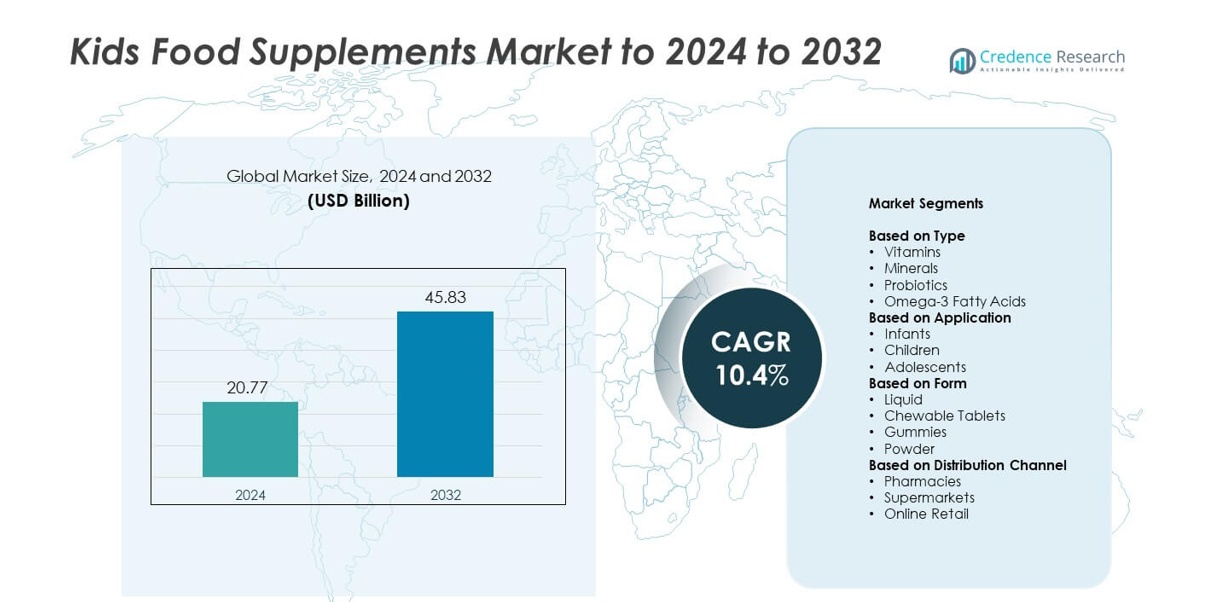
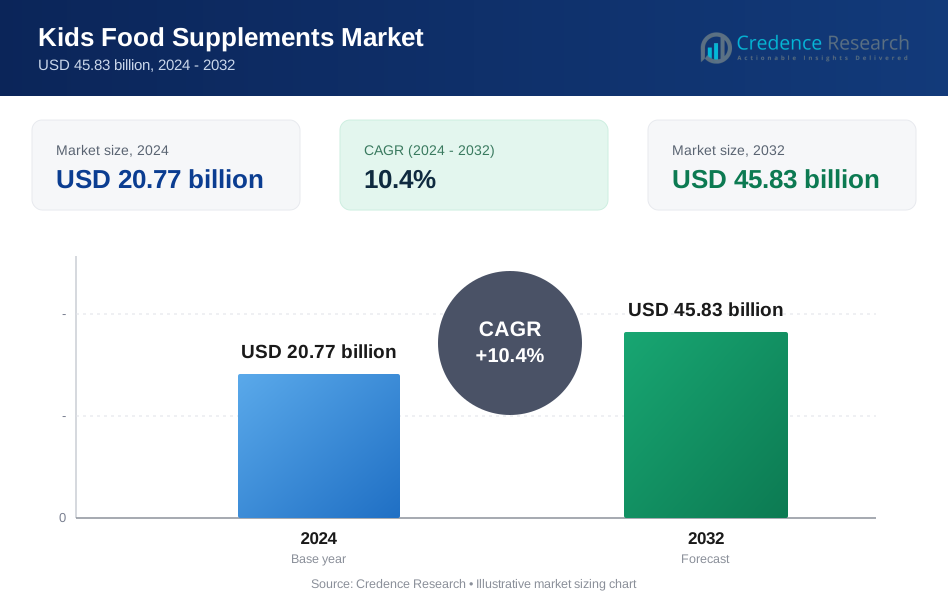
Kids Food Supplements Market size was valued at USD 20.77 billion in 2024 and is anticipated to reach USD 45.83 billion by 2032, at a CAGR of 10.4% during the forecast period.
| REPORT ATTRIBUTE | DETAILS |
|---|---|
| Historical Period | 2020-2023 |
| Base Year | 2024 |
| Forecast Period | 2025-2032 |
| Kids Food Supplements Market Size 2024 | USD 20.77 billion |
| Kids Food Supplements Market, CAGR | 10.4% |
| Kids Food Supplements Market Size 2032 | USD 45.83 billion |
The Kids Food Supplements Market is shaped by leading companies such as Abbott, Danone, Perrigo Company plc, Nestlé, Herbalife, Goodwolf Feeding Co., Nutribud Foods, Mead Johnson & Company, LLC, My Lunchbuddy, Else Nutrition, and Yamo AG. These players compete through clean-label formulas, functional blends, and child-friendly formats like gummies and liquids. Innovation in immunity, cognition, and gut-health products helps strengthen their market positions. Regionally, North America leads the global market with about 34% share due to high awareness, strong retail presence, and premium product adoption. Asia Pacific follows with nearly 29% share, supported by rising incomes and fast-growing online channels.
Market Insights
- Kids Food Supplements Market was valued at USD 20.77 billion in 2024 and is projected to reach USD 45.83 billion by 2032, growing at a CAGR of 10.4%.
- Rising focus on child immunity and nutrient-gap awareness drives strong demand for vitamins, probiotics, and omega-3 supplements across all major demographics.
- Gummies remain the leading form with about 46% share, supported by high acceptance among children and ongoing product innovation in clean-label and low-sugar options.
- Competition intensifies as global and regional brands expand portfolios with plant-based, allergen-free, and science-backed formulations tailored to specific age groups.
- North America leads the market with nearly 34% share, followed by Asia Pacific at around 29% and Europe at about 27%, driven by strong retail networks, digital adoption, and rising focus on preventive nutrition.
Market Segmentation Analysis:
By Type
Vitamins held the dominant share of about 42% in 2024. Parents choose vitamin supplements to support growth, immunity, and overall wellness in young consumers. Rising awareness about micronutrient deficiencies increases demand for vitamin drops, syrups, and gummies. Minerals, probiotics, and omega-3 products grow at a steady pace as families focus on digestive health and cognitive development. Strong marketing by major brands and wider retail availability further support the vitamin category.
- For instance, the Flintstones Sugar Free Multivitamin Gummies provide 11 essential nutrients (including vitamins A, C, E, B6, B12, niacin, and zinc) in each daily serving. The serving size varies by age: one gummy daily for children aged 2-3 years, and two gummies daily for children aged 4 years and older.
By Application
Children led the segment in 2024 with nearly 51% share. This group shows strong use of supplements due to higher nutrient requirements during early development. Parents prefer balanced products that support immunity, focus, and physical activity. Infants and adolescents record steady expansion as healthcare providers recommend targeted blends. Growth across all age groups continues due to better awareness, product innovation, and improved distribution through pharmacies, online platforms, and supermarkets.
- For instance, the Centrum Kids multivitamin and mineral gummies in the Indian market are designed for children aged 5–15 years and formulated with 12 vital nutrients (including vitamins A, C, D2, E, B1, B3, B5, B6, B12, biotin, folic acid, iodine, and zinc), along with a probiotic (Bacillus coagulans) to support growth, development, and healthy digestion.
By Form
Gummies dominated the form segment in 2024 with about 46% share. Kids prefer gummies due to easy use, appealing flavors, and better compliance. Brands invest in sugar-controlled and natural-ingredient gummy formulas, which attracts more parents. Liquid, chewable tablets, and powder formats expand with specialized blends for digestion, bone strength, and brain health. Broader retail placement and active product innovation help sustain interest across all delivery formats.
Key Growth Drivers
Rising Focus on Child Immunity
Families invest more in products that support strong immunity due to frequent infections and seasonal illnesses among young consumers. Brands introduce vitamin-rich and probiotic blends that appeal to parents seeking daily support for their children. Wider availability in pharmacies and online stores also expands access. Growing awareness campaigns by healthcare groups further strengthen demand for immunity-focused supplements across all age groups.
- For instance, The Nature's Nutrition Kids Immune Support gummies can indeed provide 60 mg of vitamin C and 5 mg of zinc per serving. However, the serving size to achieve this for children aged 4 and up is typically three gummies daily
Growing Awareness of Nutrient Deficiencies
Many children face gaps in essential nutrients due to changing food habits and reduced intake of balanced meals. Healthcare professionals highlight the need for vitamins, minerals, and omega-3 fatty acids during early development, which drives category growth. Schools and pediatric clinics promote awareness about healthy nutrition, encouraging parents to consider supplements. Rising sales of fortified gummies and liquids also reflect a shift toward convenient options.
- For instance, ChildLife Essentials Multi Vitamin & Mineral recommends 1 teaspoon daily for infants 6–12 months and 2–3 teaspoons daily for children 4–12 years to help cover nutrient gaps.
Product Innovation and Attractive Formats
Manufacturers develop gummies, flavored liquids, and chewable tablets that engage younger consumers and improve compliance. Clean-label formulas with natural colors and low sugar win trust among parents. Companies also expand specialized blends for bone strength, cognition, and digestion. These innovations help brands differentiate products and attract new buyers in a competitive market.
Key Trends and Opportunities
Premium and Clean-Label Formulations
Parents prefer products made with natural ingredients, minimal additives, and transparent labeling. This shift boosts demand for organic, plant-based, and allergen-free supplements. Brands use this trend to move into premium positioning with functional blends that support growth and long-term wellness. Clean-label innovation also opens opportunities in retail and online channels where buyers compare quality standards.
- For instance, the current SmartyPants Kids Formula (Cherry Berry Punch flavor) provides 16 essential nutrients in each daily serving (two gummies for ages 4 and up), including omega-3 EPA and DHA, vitamins D3, C, B12, B6, A, K, and zinc.
Expansion of Personalized Nutrition for Kids
Digital health tools and simple at-home assessments increase interest in personalized supplement plans. Parents seek age-specific and need-specific formulas designed around immunity, cognition, and gut health. Brands respond with customizable dosage packs and subscription models that improve long-term engagement. This trend creates a strong pathway for premium pricing and higher brand loyalty.
- For instance, prior to its closure in June 2024, the personalized vitamin service Care/of built each supplement plan using a short online quiz that assessed lifestyle, diet, and health goals, which generally took customers about 5 minutes to complete.
Growth of Online and DTC Channels
Online platforms offer a wide range of products, clear ingredient details, and convenient delivery. Parents trust digital reviews and expert guidance, which supports rapid adoption of emerging brands. Direct-to-consumer models help companies maintain stronger customer relationships and offer subscription-based packages. This shift broadens market reach and supports higher product visibility.
Key Challenges
Stringent Regulatory and Safety Requirements
Kids supplements must meet strict safety, labeling, and formulation rules. Companies face delays and higher testing costs to ensure compliance with regional standards. Any quality concerns can quickly reduce consumer trust, making risk management essential. These strict rules slow product launches and raise barriers for smaller brands.
High Risk of Misuse and Overconsumption
Parents may unintentionally exceed safe dosage levels, especially with flavored gummies and liquids. This concern forces companies to provide clear instructions and safety warnings. Healthcare professionals emphasize proper guidance to avoid nutrient imbalance. Misuse cases also prompt tighter oversight, which increases operating challenges for manufacturers.
Regional Analysis
North America
North America held about 34% of the Kids Food Supplements Market in 2024. The region benefits from strong awareness of child nutrition, high purchasing power, and wide access to premium products across retail and online channels. Parents show strong preference for vitamins, probiotics, and clean-label gummies, which supports steady category expansion. Major brands also invest in targeted formulations for immunity and cognition, further driving uptake. Supportive recommendations from pediatric groups and strong digital marketing help maintain high consumer engagement and reinforce the region’s leadership.
Europe
Europe accounted for nearly 27% of the market share in 2024. Demand grows due to rising focus on preventive health and strong regulatory oversight that enhances product trust. Families adopt supplements to support balanced nutrition, especially in countries where pediatricians encourage monitored use. The region sees increasing interest in organic and allergen-free formulations, strengthening premium product sales. Broad distribution through pharmacies and supermarket chains ensures steady growth across diverse consumer groups and supports wider adoption in both western and eastern markets.
Asia Pacific
Asia Pacific captured around 29% of the market share in 2024, showing one of the fastest growth rates. Rising disposable incomes and growing attention to children’s immunity and cognitive development drive strong demand. Urban families adopt gummies, liquids, and probiotic blends due to busy lifestyles and evolving dietary patterns. Expanding e-commerce access strengthens product visibility and improves affordability across developing markets. Local and global brands introduce affordable formats tailored to regional tastes, which helps expand penetration across emerging economies.
Latin America
Latin America represented roughly 6% of the market share in 2024. Awareness about nutrient deficiencies grows as healthcare groups highlight the benefits of vitamins and minerals for child development. Retail pharmacies and online platforms expand their supplement offerings, helping families access a wider range of products. Economic constraints slow premium adoption, yet steady demand for basic vitamins and immunity blends drives moderate growth. Brands also focus on flavored gummies and liquids to build appeal among younger consumers across key countries.
Middle East and Africa
Middle East and Africa held around 4% of the market share in 2024. Urban populations adopt supplements at a faster pace due to rising focus on child health and growing access to international brands. Demand centers on vitamins and immune-support blends, particularly in countries with higher disposable incomes. Limited awareness in rural areas slows broader uptake, yet improving distribution networks support gradual expansion. Governments and healthcare providers promote nutritional education, helping increase acceptance of safe and regulated supplement products.
Market Segmentations:
By Type
- Vitamins
- Minerals
- Probiotics
- Omega-3 Fatty Acids
By Application
- Infants
- Children
- Adolescents
By Form
- Liquid
- Chewable Tablets
- Gummies
- Powder
By Distribution Channel
- Pharmacies
- Supermarkets
- Online Retail
By Geography
- North America
- U.S.
- Canada
- Mexico
- Europe
- Germany
- France
- U.K.
- Italy
- Spain
- Rest of Europe
- Asia Pacific
- China
- Japan
- India
- South Korea
- South-east Asia
- Rest of Asia Pacific
- Latin America
- Brazil
- Argentina
- Rest of Latin America
- Middle East & Africa
- GCC Countries
- South Africa
- Rest of the Middle East and Africa
Competitive Landscape
The Kids Food Supplements Market features key players such as Abbott, Danone, Perrigo Company plc, Nestlé, Herbalife, Goodwolf Feeding Co., Nutribud Foods, Mead Johnson & Company, LLC, My Lunchbuddy, Else Nutrition, and Yamo AG. Competition strengthens as brands expand portfolios with clean-label, allergen-free, and plant-based formulations designed for immunity, growth, and cognitive support. Companies focus on appealing delivery formats, including gummies and flavored liquids, to improve compliance among young consumers. Many brands invest in clinical backing, transparent labeling, and fortified blends to increase credibility with parents and healthcare providers. Digital marketing, subscription models, and omni-channel distribution further shape competitive positioning. Global and regional players seek stronger market reach by entering emerging economies through affordable SKUs and localized flavors, while premium brands target urban families seeking high-quality nutritional solutions.
Key Player Analysis
- Abbott
- Danone
- Perrigo Company plc
- Nestlé
- Herbalife
- Goodwolf Feeding Co.
- Nutribud Foods
- Mead Johnson & Company, LLC
- My Lunchbuddy
- Else Nutrition
- Yamo AG
Recent Developments
- In 2025, Mead Johnson & Company, a global leader in pediatric nutrition, celebrated its 120th anniversary and reinforced its long-standing commitment to science-backed innovation, highlighting its historical pioneering work in introducing DHA-enriched products to the U.S. market in 2002.
- In 2025, Nestlé Unveiled a new CEREGROW variant without refined sugar.
- In March 2025, Herbalife announced it had entered into agreements to acquire Pro2col Health and Pruvit Ventures, along with a 51% controlling interest in Link BioSciences, as part of a strategic move to expand its supplement portfolio and enhance its personalized wellness platform
Report Coverage
The research report offers an in-depth analysis based on Type, Application, Form, Distribution Channel and Geography. It details leading market players, providing an overview of their business, product offerings, investments, revenue streams, and key applications. Additionally, the report includes insights into the competitive environment, SWOT analysis, current market trends, as well as the primary drivers and constraints. Furthermore, it discusses various factors that have driven market expansion in recent years. The report also explores market dynamics, regulatory scenarios, and technological advancements that are shaping the industry. It assesses the impact of external factors and global economic changes on market growth. Lastly, it provides strategic recommendations for new entrants and established companies to navigate the complexities of the market.
Future Outlook
- Demand for clean-label and natural formulations will grow across all age groups.
- Gummies and flavored liquids will remain the most preferred formats for kids.
- Personalized nutrition for children will expand through digital health tools.
- Online and direct-to-consumer channels will gain stronger influence on buying habits.
- Probiotic and gut-health focused supplements will see higher adoption among parents.
- Brands will invest more in science-backed formulations to build trust and credibility.
- Pediatric recommendations will shape product innovation and targeted nutrient blends.
- Emerging markets will record fast growth due to rising awareness and wider access.
- Premium products with organic and allergen-free claims will capture expanding demand.
- Stronger regulations will improve product quality and safety across global markets
Request a Free Sample
Fill in your details and we'll send you a free sample report.
- Sample data tables & charts
- Research methodology
Need a Custom Version of This Report?
Tailor the scope, geography, or segments to your exact requirements.
- Custom geography or segment scope
- Direct access to our analyst team
Frequently Asked Questions
What is the current market size for Kids Food Supplements Market, and what is its projected size in 2032?
At what Compound Annual Growth Rate is the Kids Food Supplements Market projected to grow between 2025 and 2032?
What types of products are most popular in the children's food supplements market?
What challenges does the children's food supplements market face?
Who are the leading companies in the Kids Food Supplements Market?
Table of Content
Chapter 1. Report Introduction
- 1.1 Report Description & Purpose
- 1.1.1 Report Title & Market Definition
- 1.1.2 Unique Selling Propositions (USP) & Key Differentiators
- 1.1.3 Value Proposition for Stakeholders
- 1.2 Research Objectives
- 1.2.1 Market Sizing Objectives (Volume & Revenue)
- 1.2.2 Segmentation Objectives
- 1.2.3 Competitive Intelligence Objectives
- 1.2.4 Forecast & Scenario Objectives
- 1.3 Report Scope
- 1.3.1 Kids Food Supplements Scope – Types & Subtypes Covered
- 1.3.2 Geographic Scope – Regions & Countries Covered
- 1.3.3 Historical Period, Base Year & Forecast Period (2024; forecast to 2032)
- 1.3.4 Inclusions & Exclusions
- 1.4 HS Code & Classification Framework
- 1.5 Currency, Units & Pricing Basis
- 1.6 Target Stakeholders
- 1.7 Limitations & Assumptions
Chapter 2. Executive Summary
- 2.1 Global Kids Food Supplements Market Snapshot
- 2.1.1 Market Size – Historical (2024) & Forecast (2024-2032) (2024: USD 20.77 billion → 2032: USD 45.83 billion)
- 2.1.2 Volume & Revenue – Global Totals
- 2.1.3 Key Market Highlights – Top Five Facts
- 2.2 Kids Food Supplements Market Segmentation Snapshot
- 2.2.1 Market Split by Region – 2024 vs. 2032
- 2.3 Competitive Snapshot
- 2.3.1 Top 10 Players by Revenue Share – 2024
- 2.3.2 Top 10 Players by Volume Share – 2024
- 2.3.3 Recent Strategic Developments (18-Month Summary)
- 2.4 Key Investment Highlights & Strategic Conclusions
Chapter 3. Kids Food Supplements Market Dynamics & Industry Analysis
- 3.1 Market Overview & Context
- 3.1.1 Kids Food Supplements Market Position in the Broader Automotive Value Chain
- 3.1.2 OEM vs. Replacement Market Dynamics
- 3.1.3 Market Maturity & Development Stage by Region
- 3.2 Kids Food Supplements Market Drivers
- 3.3 Kids Food Supplements Market Restraints & Challenges
- 3.4 Kids Food Supplements Market Opportunities
- 3.5 Porter's Five Forces Analysis
- 3.5.1 Threat of New Entrants
- 3.5.2 Bargaining Power of Suppliers
- 3.5.3 Bargaining Power of Buyers
- 3.5.4 Threat of Substitutes
- 3.5.5 Competitive Rivalry – Intensity Assessment
- 3.6 Kids Food Supplements Value Chain Analysis
- 3.6.1 Upstream – Raw Material/Input Suppliers
- 3.6.1.1 Raw Material/Input 1
- 3.6.1.2 Raw Material/Input 2
- 3.6.1.3 Raw Material/Input 3
- 3.6.2 Midstream – Production/Manufacturing/Service Delivery
- 3.6.2.1 Production/Process Overview
- 3.6.2.2 Key Facility Locations & Capacity by Manufacturer
- 3.6.3 Downstream – Distribution & End Consumer
- 3.6.3.1 Primary Channel – B2B/OEM
- 3.6.3.2 Secondary Channels – Dealer, Retail, Online, Direct
- 3.6.4 Value Chain Profitability Analysis
- 3.6.1 Upstream – Raw Material/Input Suppliers
- 3.7 PESTEL Analysis
- 3.7.1 Political Factors
- 3.7.2 Economic Factors
- 3.7.3 Social Factors
- 3.7.4 Technological Factors
- 3.7.5 Environmental Factors
- 3.7.6 Legal Factors
- 3.8 Kids Food Supplements Supply Chain Analysis
- 3.8.1 Raw Material/Input Supply Risk Assessment
- 3.8.2 Manufacturing Concentration Risk (Geographic Exposure)
- 3.8.3 Trade Disruption Impact Analysis
- 3.9 Regulatory & Policy Landscape
Note: The regulatory and policy landscape section covers regulations based on their applicability to the market, Kids Food Supplements category, geography, and scope of the study. Only regulatory frameworks with a material impact on operations, compliance, trade, sustainability, or market access are analyzed in detail.
Chapter 4. Key Investment Pockets & Opportunity Analysis
- 4.1 Kids Food Supplements Market Attractiveness Analysis
- 4.1.1 By Region – Investment Attractiveness Matrix (Volume × CAGR)
- 4.2 Absolute Revenue Growth Opportunity
- 4.2.1 By Region – Absolute USD Growth Through 2032
- 4.3 Incremental Volume Opportunity
- 4.3.1 By Region – Incremental Volume Through 2032
- 4.3.2 Segment – Incremental Volume
- 4.4 Emerging Submarket Opportunity Deep Dive (Subject to Applicability)
- 4.5 Emerging Market Opportunity Scorecards
- 4.5.1 United States
- 4.5.2 Europe
- 4.5.3 Asia
- 4.5.4 Middle East & Africa
Note: Emerging Market Opportunity Scorecards will be included based on relevance and strategic importance. Regions listed are indicative and may vary depending on data availability and market dynamics.
Chapter 5. Kids Food Supplements Import-Export Analysis & Trade Flows
- 5.1 Global Trade Overview
- 5.1.1 Global Export Value by Country (2024)
- 5.1.2 Global Export Volume by Country (2024)
- 5.1.3 Global Import Value by Country (2024)
- 5.1.4 Global Import Volume by Country (2024)
- 5.1.5 Net Trade Balance by Country (2024)
- 5.2 Export Analysis – Segment
- 5.2.1 Type 1 (HS Code)
- 5.2.2 Type 2 (HS Code)
- 5.2.3 Type 3 (HS Code)
- 5.2.4 Type 4 (HS Code)
- 5.2.5 Type 5 (HS Code)
- 5.3 Import Analysis – Segment
- 5.3.1 Type 1 (HS Code)
- 5.3.2 Type 2 (HS Code)
- 5.3.3 Type 3 (HS Code)
- 5.3.4 Type 4 (HS Code)
- 5.3.5 Type 5 (HS Code)
- 5.4 Average Unit Trade Prices
- 5.4.1 Average Export Price – Segment & Country
- 5.4.2 Average Import Price – Segment & Source Country
- 5.4.3 Price Trends (2024)
- 5.5 Key Trade Route Analysis
- 5.5.1 Trade Route 1
- 5.5.2 Trade Route 2
- 5.5.3 Trade Route 3
- 5.5.4 Trade Route 4
- 5.5.5 Trade Route 5
- 5.6 Trade Policy Impact Assessment
- 5.6.1 US Anti-Dumping & Section 301 Tariffs
- 5.6.2 EU Customs Union Impact
- 5.6.3 Major Free Trade Agreements
- 5.6.4 USMCA Rules of Origin
Note: Trade policy analysis will be included only where relevant to the Kids Food Supplements market.
Chapter 6. Competitive Landscape & Company Benchmarking
- 6.1 Kids Food Supplements Market Concentration & Structure
- 6.1.1 Herfindahl-Hirschman Index (HHI) – vs. 2024
- 6.1.2 Tier 1, Tier 2 & Tier 3 Market Structure
- 6.1.3 Global, Regional & Local Player Dynamics
- 6.2 Kids Food Supplements Market Share Analysis – 2024
- 6.2.1 Global Revenue Share by Company
- 6.2.2 Global Volume Share by Company
- 6.2.3 Regional Revenue Share
- 6.2.4 Market Share Evolution ( vs. 2024)
- 6.2.5 OEM Segment Share by Company
- 6.2.6 Replacement Segment Share by Company
- 6.3 Production/Delivery Capacity & Facility Analysis
- 6.3.1 Global Installed Capacity
- 6.3.2 Capacity Utilization Rates
- 6.3.3 Production/Output Volume
- 6.3.4 Facility Locations & Capacity Map
- 6.3.5 Planned Capacity Additions
- 6.4 Kids Food Supplements Competitive Benchmarking Matrix
- 6.4.1 Revenue, Volume, CAGR & Profitability Comparison
- 6.4.2 Channel Revenue Mix
- 6.4.3 Geographic Revenue Exposure
- 6.4.4 R&D Intensity
- 6.4.5 Sustainability Maturity
- 6.5 Strategic Developments in Kids Food Supplements (Last 24 Months)
- 6.5.1 Mergers, Acquisitions & Divestments
- 6.5.2 New Kids Food Supplements Launches
- 6.5.3 Facility Expansions
- 6.5.4 Strategic Alliances, Joint Ventures & Partnerships
- 6.5.5 Distribution Expansion & Market Entry
- 6.5.6 Sustainability & ESG Initiatives
- 6.6 Competitive Strategy Mapping
- 6.6.1 Leader, Challenger, Follower & Niche Classification
- 6.6.2 Pricing Strategy Comparison
- 6.6.3 Channel Strategy Matrix
Note: Strategic developments are included based on their materiality and the availability of reliable information.
Chapter 7. Global Kids Food Supplements Market – By Distribution Channel
- 7.1 Segment Overview
- 7.1.1 Volume & Revenue Split by Channel (2024 & 2032)
- 7.1.2 Channel Mix Evolution (2024-2032)
Chapter 8. Regional Market Analysis – Global Overview
- 8.1 Global Regional Overview
- 8.1.1 Regional Volume Share
- 8.1.2 Regional Revenue Share
- 8.1.3 Regional Volume by Region
- 8.1.4 Regional Revenue by Region
- 8.1.5 Regional Forecast Through 2032
- 8.2 Cross-Regional Segment Analysis
- 8.2.1 By Distribution Channel
- 8.2.2 By Brand/Price Tier
Chapter 9. North America Kids Food Supplements Market
- 9.1 United States
- 9.2 Canada
- 9.3 Mexico
Chapter 10. Europe Kids Food Supplements Market
- 10.1 Germany
- 10.2 France
- 10.3 Italy
- 10.4 United Kingdom
- 10.5 Spain
- 10.6 Poland
- 10.7 Russia
- 10.8 Netherlands
- 10.9 Belgium
- 10.10 Sweden
- 10.11 Denmark
- 10.12 Norway
- 10.13 Rest of Europe
Chapter 11. Asia Pacific Kids Food Supplements Market
- 11.1 China
- 11.2 India
- 11.3 Japan
- 11.4 South Korea
- 11.5 Thailand
- 11.6 Indonesia
- 11.7 Vietnam
- 11.8 Malaysia
- 11.9 Australia
- 11.10 Rest of Asia Pacific
Chapter 12. Latin America Kids Food Supplements Market
- 12.1 Brazil
- 12.2 Argentina
- 12.3 Colombia
- 12.4 Chile
- 12.5 Rest of Latin America
Chapter 13. Middle East Kids Food Supplements Market
- 13.1 Saudi Arabia
- 13.2 United Arab Emirates
- 13.3 Turkey
- 13.4 Israel
- 13.5 Iran
- 13.6 Rest of the Middle East
Chapter 14. Africa Kids Food Supplements Market
- 14.1 South Africa
- 14.2 Egypt
- 14.3 Nigeria
- 14.4 Morocco
- 14.5 Rest of Africa
Chapter 15. Kids Food Supplements Company Profiles
- 15.1 [Company 01]
- 15.1.1 Company Overview
- 15.1.2 Key Management Personnel
- 15.1.3 Products & Services Portfolio
- 15.1.4 Financial Performance
- 15.1.5 Key Market Focus & Geographic Presence
- 15.1.6 Recent Developments & Strategic Initiatives
Note: The company profile list is preliminary and may change based on research findings, market developments, data availability, and client requirements.
Chapter 16. Appendices
- Appendix A – List of Abbreviations & Acronyms
- Appendix B – Industry Classification Code Reference – Full Series
- Appendix C – Production & Capacity Data Tables
- Appendix D – End-Use & Demand Base Tables
- Appendix E – Consumption & Replacement Rate Assumptions
- Appendix F – ASP Reference Tables
- Appendix G – Manufacturing & Facility Database
- Appendix H – Import-Export Data Tables
- Appendix I – Regulatory Summary Tables
- Appendix J – Primary Research Participant List (Anonymized)
- Appendix K – Primary Research Questionnaire Framework
- Appendix L – Data Sources & Bibliography
- Appendix M – Market Size Divergence & Source Comparison
Chapter 17. Research Methodology
- 17.1 Research Framework & Philosophy
- 17.2 Secondary Research – Sources, Hierarchy & Data Extraction
- 17.3 Data Modeling – Bottom-Up & Top-Down Market Sizing
- 17.4 Primary Research – Stakeholder Framework, LOI & Sample Sizes
- 17.5 Forecast Methodology – Regression, Scenario & Sensitivity Analysis
- 17.6 Quality Control – Four-Layer Validation Framework
- 17.7 Limitations & Standard Assumptions
- 17.8 Disclaimer
